Kia Rio / Rio Hatchback (2022 year). Manual in english - page 23
Maintenance
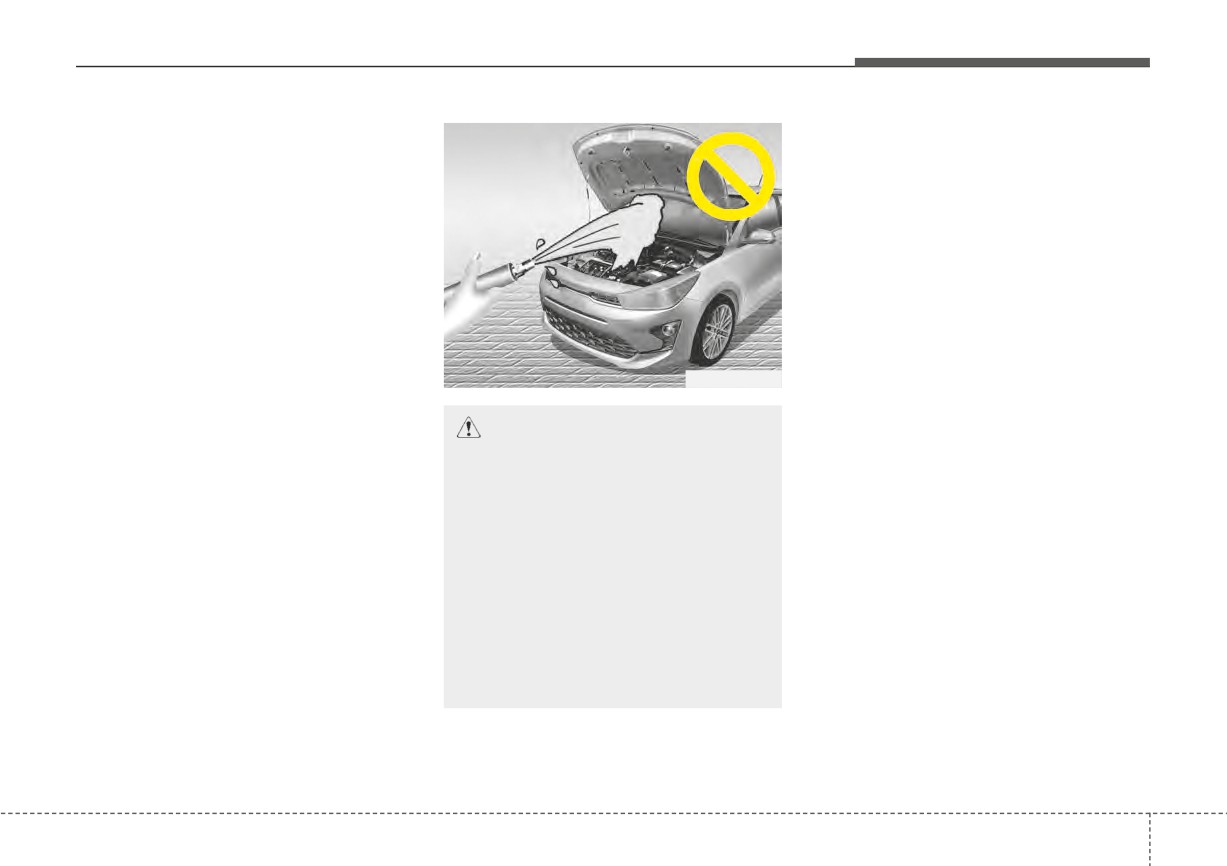
High-pressure washing
Waxing
•
When using high-pressure wash-
Wax the vehicle when water will no
ers, make sure to maintain suffi-
longer bead on the paint.
cient distance from the vehicle.
Always wash and dry the vehicle
Insufficient clearance or excessive
before waxing. Use a good quality
pressure can lead to component
liquid or paste wax, and follow the
damage or water penetration.
manufacturer’s instructions. Wax all
•
Do not spray the camera, sensors
metal trim to protect it and to main-
tain its luster.
or its surrounding area directly with
a high pressure washer. Shock
Removing oil, tar, and similar materi-
applied from high pressure water
als with a spot remover will usually
OSC071145N
may cause the device to not oper-
strip the wax from the finish. Be sure
ate normally.
to re-wax these areas even if the rest
CAUTION - Wet engine
of the vehicle does not yet need wax-
•
Do not bring the nozzle tip close to
ing.
boots (rubber or plastic covers) or
•
Washing the engine compart-
connectors as they may be dam-
ment with water, including
Do not apply wax on an embossed
aged if they come into contact with
high pressure water, may
unpainted unit, as it may tarnish the
high pressure water.
cause the failure of electrical
unit.
circuits located in the engine
compartment.
•
Never allow water or other liq-
uids to come in contact with
electrical/electronic compo-
nents inside the vehicle as
this may damage them.
7
103
Maintenance
Finish damage repair
Bright-metal maintenance
CAUTION -
Drying vehicle
Deep scratches or stone chips in the
• To remove road tar and insects,
•
Wiping dust or dirt off the
painted surface must be repaired
use a tar remover, not a scraper or
body with a dry cloth will
promptly. Exposed metal will quickly
other sharp object.
scratch the finish.
rust and may develop into a major
• To protect the surfaces of bright-
•
Do not use steel wool, abra-
repair expense.
metal parts from corrosion, apply a
sive cleaners, acid detergents
If your vehicle is damaged and
coating of wax or chrome preser-
or strong detergents contain-
requires any metal repair or replace-
vative and rub to a high luster.
ing high alkaline or caustic
ment, be sure the body shop applies
• During winter weather or in coastal
agents on chrome-plated or
anti-corrosion materials to the parts
areas, cover the bright metal parts
anodized aluminum parts.
repaired or replaced.
with a heavier coating of wax or
This may result in damage to
preservative. If necessary, coat the
the protective coating and
parts with non-corrosive petroleum
cause discoloration or paint
jelly or other protective compound.
deterioration.
7
104
Maintenance
Underbody maintenance
•
Do a thorough washing of the
Aluminum wheel maintenance
undercarriage at the end of the
Road salt and other corrosive chemi-
The aluminum wheels are coated
winter.
cals are used in cold weather states to
with a clear protective finish.
melt snow and prevent ice accumula-
•
Use professional service techni-
•
Do not use any abrasive cleaner,
tion. If these chemicals are not regu-
cians or governmental inspection
polishing compound, solvent, or
larly removed, they will corrode the
stations to annually inspect for cor-
wire brushes on aluminum wheels.
vehicle underbody and over time dam-
rosion.
They may scratch the finish.
age fuel lines, the fuel tank retention
•
Immediately seek an inspection of
•
Clean the wheel when it has
system, the vehicle suspension, the
your vehicle if you become visually
cooled.
exhaust system, and even the body
aware of corrosion flaking or scal-
frame. The National Highway Traffic
•
Use only a mild soap or neutral
ing or if you become aware of a
Safety Administration has warned all
detergent, and rinse thoroughly
change in vehicle performance,
vehicle owners of all brands of the
with water. Also, be sure to clean
such as soft or spongey brakes,
need to take the following steps:
the wheels after driving on salted
fluids leaking, impairment of direc-
roads. This helps prevent corro-
• Wash the undercarriage of your
tional control, suspension noises
sion.
vehicle regularly during the winter
or rattling metal straps.
and whenever your vehicle has
•
Avoid washing the wheels with
been exposed to such salts or
highspeed vehicle wash brushes.
chemicals.
•
Do not use any alkaline or acid
detergents as they may damage or
corrode aluminum wheels coated
with a clear protective finish.
7
105
Maintenance
Corrosion protection
High-corrosion areas
High temperatures can also acceler-
ate corrosion of parts that are not
Protecting your vehicle from corrosion
If you live in an area where your vehi-
cle is regularly exposed to corrosive
properly ventilated so the moisture
By using the most advanced design
can be dispersed. For all these rea-
materials, corrosion protection is
and construction practices to combat
particularly important. Some of the
sons, it is particularly important to
corrosion, we produce vehicles of
keep your vehicle clean and free of
common causes of accelerated cor-
the highest quality. However, this is
rosion are road salts, dust control
mud or accumulations of other mate-
only part of the job. To achieve the
rials. This applies not only to the vis-
chemicals, ocean air and industrial
long-term corrosion resistance your
pollution.
ible surfaces but particularly to the
vehicle can deliver, the owner's
underside of the vehicle.
cooperation and assistance is also
required.
Moisture breeds corrosion
To help prevent corrosion
Moisture creates the conditions in
You can help prevent corrosion from
Common causes of corrosion
which corrosion is most likely to
occur. For example, corrosion is
beginning by observing the following:
The most common causes of corro-
accelerated by high humidity, partic-
sion on your vehicle are:
ularly when temperatures are just
• Road salt, dirt and moisture that is
above freezing. In such conditions,
allowed to accumulate underneath
the corrosive material is kept in con-
the vehicle.
tact with the vehicle’s surface by
• Removal of paint or protective
moisture that evaporates slowly.
coatings by stones, gravel, abra-
Mud is particularly corrosive
sion or minor scrapes and dents
because it dries slowly and holds
which leave unprotected metal
moisture in contact with the vehicle.
exposed to corrosion.
Although the mud appears to be dry,
it can still retain moisture and pro-
mote corrosion.
7
106
Maintenance
Keep your vehicle clean
• When cleaning lower door panels,
Keep paint and trim in good con-
rocker panels and frame members,
dition
The best way to prevent corrosion is
be sure that drain holes are kept
to keep your vehicle clean and free
Scratches or chips in the finish
open so that moisture can escape
of corrosive materials. Attention to
should be covered with "touch-up"
and not be trapped inside to accel-
the underside of the vehicle is partic-
paint as soon as possible to reduce
erate corrosion.
ularly important.
the possibility of corrosion. If bare
metal is showing through, the atten-
tion of a qualified body and paint
Keep your garage dry
• If you live in a high-corrosion area
shop is recommended.
— where road salts are used, near
Don't park your vehicle in a damp,
the ocean, areas with industrial
poorly ventilated garage. This cre-
pollution, acid rain, etc.—, you
ates a favorable environment for cor-
Bird droppings: Bird droppings are
should take extra care to prevent
rosion. This is particularly true if you
highly corrosive and may damage
corrosion. In winter, hose off the
wash your vehicle in the garage or
painted surfaces in just a few hours.
underside of your vehicle at least
drive it into the garage when it is still
Always remove bird droppings as
once a month and be sure to clean
wet or covered with snow, ice or
soon as possible.
the underside thoroughly when
mud. Even a heated garage can con-
winter is over.
tribute to corrosion unless it is well
Don't neglect the interior
ventilated so moisture is dispersed.
• When cleaning underneath the
Moisture can collect under the floor
vehicle, give particular attention to
mats and carpeting and cause corro-
the components under the fenders
sion. Check under the mats periodi-
and other areas that are hidden
cally to be sure the carpeting is dry.
from view. Do a thorough job; just
Use particular care if you carry fertil-
dampening the accumulated mud
izers, cleaning materials or chemi-
rather than washing it away will
cals in the vehicle.
accelerate corrosion rather than
prevent it. Water under high pres-
These should be carried only in prop-
sure and steam are particularly
er containers and any spills or leaks
effective in removing accumulated
should be cleaned up, flushed with
mud and corrosive materials.
clean water and thoroughly dried.
7
107
Maintenance
Interior care
Cleaning the upholstery and inte-
Cleaning the lap/shoulder belt
rior trim
webbing
Interior general precautions
Vinyl
Clean the belt webbing with any mild
Prevent chemicals such as perfume,
Remove dust and loose dirt from
soap solution recommended for
cosmetic oil, sun cream, hand clean-
cleaning upholstery or carpet. Follow
er, and air freshener from contacting
vinyl with a whisk broom or vacuum
cleaner. Clean vinyl surfaces with a
the instructions provided with the
the interior parts because they may
soap. Do not bleach or re-dye the
cause damage or discoloration. If
vinyl cleaner.
webbing because this may weaken it.
they do contact the interior parts,
wipe them off immediately. If neces-
Fabric
sary, use a vinyl cleaner, see product
Cleaning the interior window
Remove dust and loose dirt from fabric
instructions for correct usage.
glass
with a whisk broom or vacuum cleaner.
Clean with a mild soap solution recom-
If the interior glass surfaces of the
CAUTION - Electrical
mended for upholstery or carpets.
vehicle become fogged (that is, cov-
components
Remove fresh spots immediately with
ered with an oily, greasy or waxy
a fabric spot cleaner. If fresh spots do
film), they should be cleaned with a
Never allow water or other liq-
not receive immediate attention, the
glass cleaner. Follow the directions
uids to come in contact with
fabric can be stained and its color can
on the glass cleaner container.
electrical/electronic
compo-
be affected. Also, its fire-resistant prop-
nents inside the vehicle as this
erties can be reduced if the material is
CAUTION - Rear window
may damage them.
not properly maintained.
Do not scrape or scratch the
Using anything but recommended
inside of the rear window. This
cleaners and procedures may affect
may result in damage of the rear
the fabric’s appearance and fire-
window defroster grid.
resistant properties.
7
108
Maintenance
Taking care of leather seats
Cleaning the leather seats
CAUTION - Leather
(if equipped)
(if equipped)
•
Vacuum the seat periodically to
•
Remove all contaminations instant-
When cleaning leather products
(steering wheel, seats etc.), use
remove dust and sand on the seat.
ly. Refer to instructions below for
It will prevent abrasion or damage of
removal of each contaminant.
neutral detergents or low alco-
hol content solutions. If you use
the leather and maintain its quality.
•
Cosmetic products(sunscreen,
high alcohol content solutions
•
Wipe the natural leather seat cover
foundation, etc.)
or acid/alkaline detergents, the
often with dry or soft cloth.
- Apply cleansing cream on a cloth
color of the leather may fade or
•
Sufficient use of a leather protec-
and wipe the contaminated point.
the surface may get stripped off.
tive may prevent abrasion of the
Wipe off the cream with a wet cloth
cover and helps maintain the color.
and remove water with a dry cloth.
Be sure to read the instructions
•
Beverages(coffee, soft drink, etc.)
and consult a specialist when
- Apply a small amount of neutral
using leather coating or protective
detergent and wipe until contami-
agents.
nations do not smear.
•
Leather with bright colors(beige,
•
Oil
cream beige) is easily contaminat-
- Remove oil instantly with
ed and clear in appearance. Clean
absorbable cloth and wipe with
the seats frequently.
stain remover for natural leather
•
Avoid wiping with wet cloth. It may
only.
cause the surface to crack.
•
Chewing gum
- Harden the gum with ice and
remove gradually.
7
109
Maintenance
Fabric seat cover using precau-
tions (If equipped)
Please clean the fabric seats regu-
larly with a vacuum cleaner in con-
sideration of fabric material charac-
teristics. If they are heavily soiled
with beverage stains, etc., use a suit-
able interior cleaner. To prevent dam-
age to seat covers, wipe off the seat
covers down to the seams with a
large wiping motion and moderate
pressure using a soft sponge or
microfiber cloth.
Velcro closures on clothing or sharp
objects may cause snagging or
scratches on the surface of the seats.
Make sure not to rub such objects
against the surface.
7
110
Maintenance
EMISSION CONTROL SYSTEM
The emission control system of your
Caution for the Inspection and
1. Crankcase emission control
vehicle is covered by a written limited
Maintenance Test (With Electronic
system
warranty. Please see the warranty
Stability Control (ESC) system)
The positive crankcase ventilation
information contained in the
•
To prevent the vehicle from mis-
system is employed to prevent air
Warranty & Consumer Information
firing during dynamometer test-
pollution caused by blow-by gases
manual in your vehicle.
ing, turn the Electronic Stability
being emitted from the crankcase.
Your vehicle is equipped with an
Control
(ESC) system off by
This system supplies fresh filtered air
emission control system to meet all
pressing the ESC switch.
to the crankcase through the air
applicable emission regulations.
•
After dynamometer testing is
intake hose. Inside the crankcase,
There are three emission control
completed, turn the ESC system
the fresh air mixes with blow-by
systems, as follows.
back on by pressing
the
ESC
gases, which then pass through the
switch again.
PCV valve into the induction system.
(1) Crankcase emission control sys-
tem
2. Evaporative emission con-
(2) Evaporative emission control sys-
trol (including ORVR:
tem
Onboard Refueling Vapor
Recovery)
(3) Exhaust emission control system
system
The Evaporative Emission Control
In order to assure the proper function
System is designed to prevent fuel
of the emission control systems, it is
vapors from escaping into the atmos-
recommended that you have your
phere.
vehicle inspected and maintained by
an authorized Kia dealer in accor-
(The ORVR system is designed to
dance with the maintenance sched-
allow the vapors from the fuel tank to
ule in this manual.
be loaded into a canister while refu-
eling at the gas station, preventing
the escape of fuel vapors into the
atmosphere.)
7
111
Maintenance
Canister
3. Exhaust emission control
Engine exhaust gas precautions
Fuel vapors generated inside the fuel
system
(carbon monoxide)
tank are absorbed and stored in the
The Exhaust Emission Control
• Carbon monoxide can be present
onboard canister. When the engine is
with other exhaust fumes.
System is a highly effective system
running, the fuel vapors absorbed in
which controls exhaust emissions
Therefore, if you smell exhaust
the canister are drawn into the surge
fumes of any kind inside your vehi-
while maintaining good vehicle per-
tank through the purge control sole-
formance.
cle, have it inspected and repaired
noid valve.
immediately. If you ever suspect
exhaust fumes are coming into
your vehicle, drive it only with all
Purge Control Solenoid Valve
the windows fully open. Have your
(PCSV)
vehicle checked and repaired
The purge control solenoid valve is
immediately.
controlled by the Engine Control
Module
(ECM); when the engine
coolant temperature is low during
WARNING - Exhaust
idling, the PCSV closes so that evap-
Engine exhaust gases contain
orated fuel is not taken into the
carbon monoxide (CO). Though
engine. After the engine warms up
colorless and odorless, it is
during ordinary driving, the PCSV
dangerous and could be lethal if
opens to introduce evaporated fuel to
inhaled. Follow the instructions
the engine.
on this page to avoid CO poi-
soning.
7
112
Maintenance
•
Do not operate the engine in con-
Operating precautions for catalyt-
fined or closed areas
(such as
ic converters (if equipped)
WARNING - Fire
garages) any more than what is
•
Do not park, idle or drive the
necessary to move the vehicle in or
vehicle over or near flamma-
WARNING - Catalytic
out of the area.
ble objects, such as grass,
converter
•
When the vehicle is stopped in an
vegetation, paper, leaves, etc.
open area for more than a short
Keep away from the catalytic
A hot exhaust system can
converter and exhaust system
time with the engine running,
ignite flammable items under
adjust the ventilation system
(as
while the vehicle is running or
your vehicle.
immediately thereafter. The
needed) to draw outside air into the
•
Also, do not remove the heat
exhaust and catalytic systems
vehicle.
shield around the exhaust
are very hot and may burn you.
•
Never sit in a parked or stopped
system, do not seal the bot-
vehicle for any extended time with
tom of the vehicle and do not
the engine running.
coat the vehicle for corrosion
control. It may present a fire
•
When the engine stalls or fails to
risk under certain conditions.
start, excessive attempts to restart
the engine may cause damage to
the emission control system.
7
113
Maintenance
CALIFORNIA
Your vehicle is equipped with a cat-
Failure to observe these precautions
PERCHLORATE NOTICE
alytic converter emission control
could result in damage to the catalyt-
Perchlorate Material-special handling
device.
ic converter and to your vehicle.
may apply, See https://dtsc.ca.gov/per-
Additionally, such actions could void
Therefore, the following precautions
chlorate.
your warranties.
must be observed:
•
Use only UNLEADED FUEL for
Notice to California Vehicle Dismantlers:
gasoline engines.
Perchlorate containing materials,
•
Do not operate the vehicle when
such as air bag inflators, seatbelt
there are signs of engine malfunc-
pretensioners and keyless remote
tion, such as misfire or a noticeable
entry batteries, must be disposed of
loss of performance.
according to Title 22 California Code
•
Do not misuse or abuse the
of Regulations
Chapter
67384.10
engine. Examples of misuse are
(a).
coasting with the ignition off and
descending steep grades in gear
with the ignition off.
•
Do not operate the engine at high
idle speed for extended periods (5
minutes or more).
•
Do not modify or tamper with any
part of the engine or emission con-
trol system. All inspections and
adjustments must be made by an
authorized Kia dealer.
•
Avoid driving with an extremely low
fuel level. Running out of fuel could
cause the engine to misfire, dam-
aging the catalytic converter.
7
114
Specifications, Consumer information and Reporting safety defects
Engine
8-2
Dimensions
8-2
Bulb wattage
8-3
Tires and wheels
8-5
Weight/Volume
8-6
Air conditioning system
8-6
Recommended lubricants and capacities
8-7
• Recommended SAE viscosity number
8-8
Vehicle Identification Number (VIN)
8-9
Vehicle certification label
8-9
Tire specification and pressure label
8-10
Engine number
8-10
Refrigerant label
8-10
Consumer assistance (U.S. only)
8-11
Electrical Equipment (U.S. only)
8-14
Reporting Safety Defects (U.S. only)
8-15
Online factory authorized manuals (U.S. only) . .
8-15
8
Specifications, Consumer information, Reporting safety defects
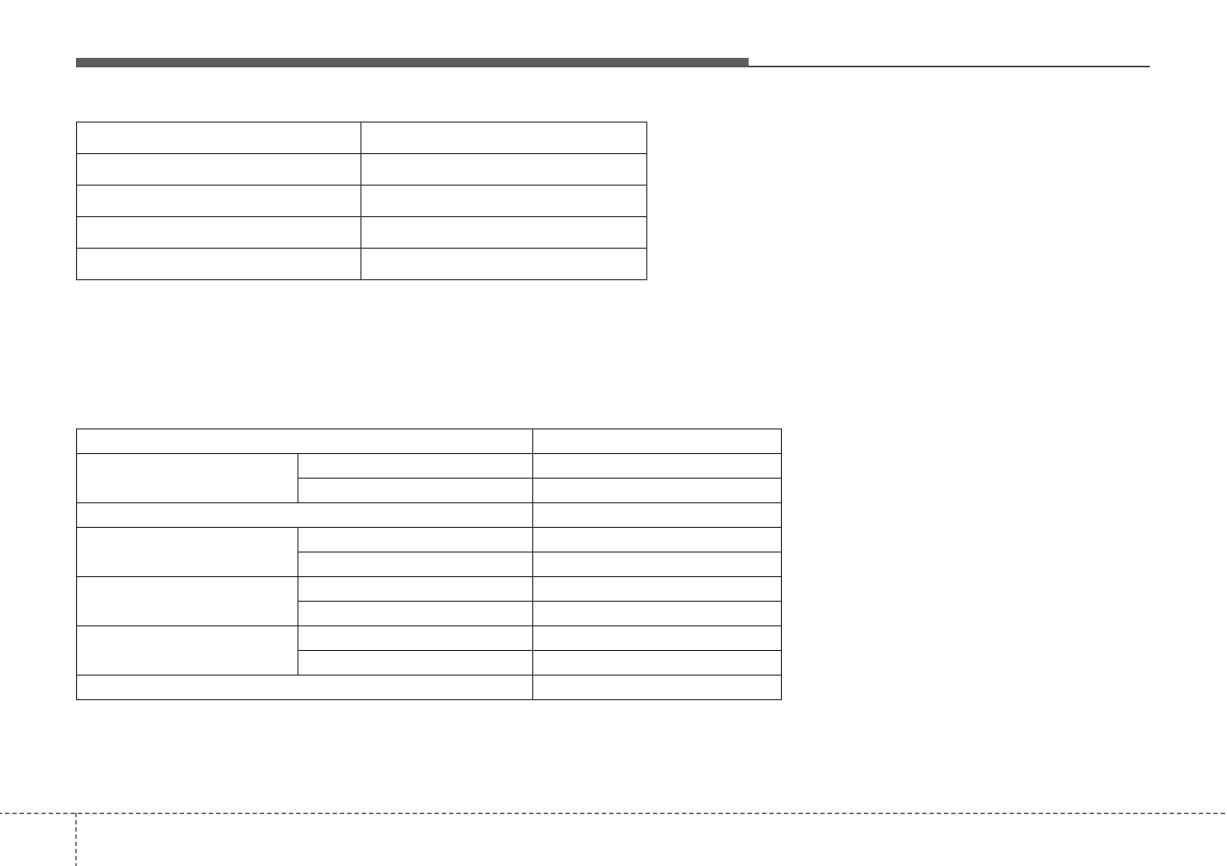
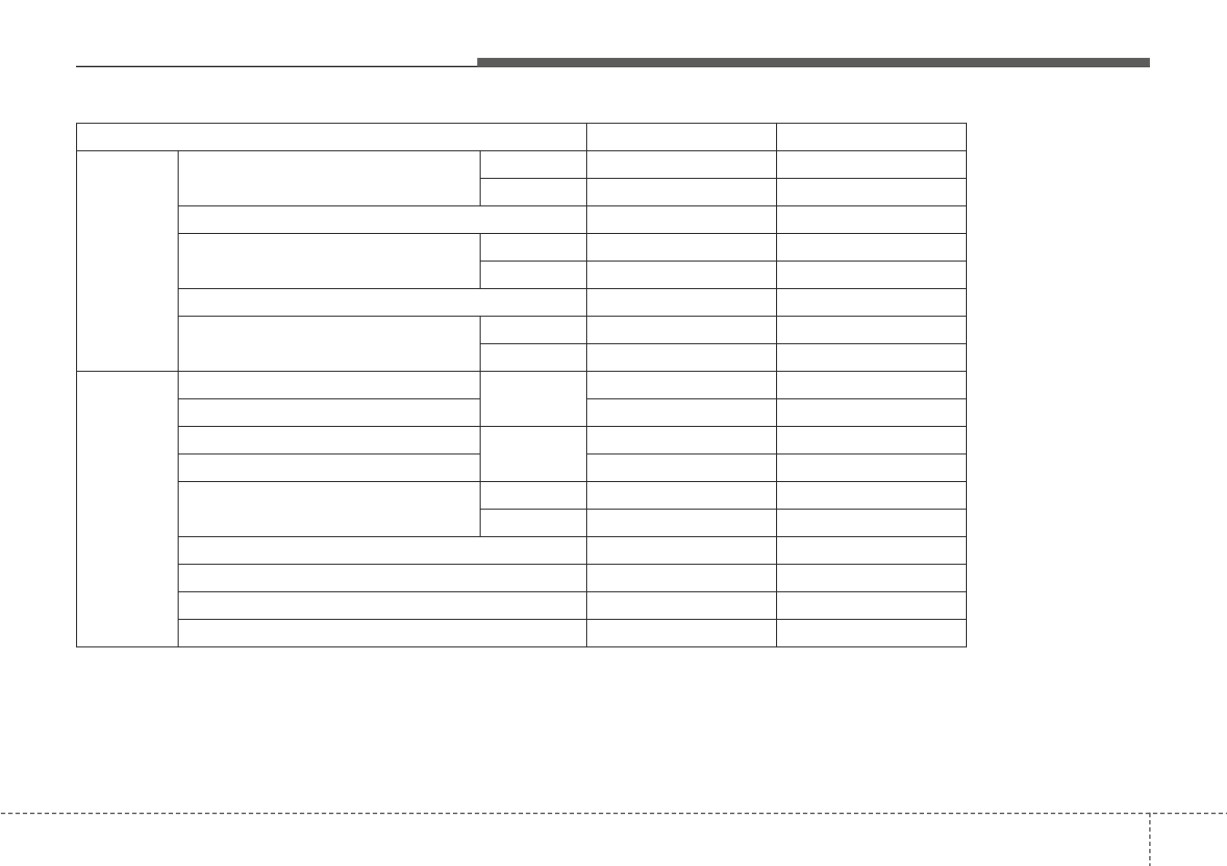
ENGINE
Item
Smartstream G1.6
Displacement [cu.in(cc)]
97.09 (1,591)
Bore x Stroke [in(mm)]
2.97 X 3.50 (75.6 X 89.0)
Firing order
1 → 3 → 4 → 2
No. of cylinders
4, In-line
DIMENSIONS
Item
in (mm)
4 Door
172.6 (4,385)
Overall length
5 Door
160 (4,065)
Overall width
67.9 (1,725)
4 Door
57.1 (1,450)
Overall height
5 Door
57.1 (1,450)
185/65R15
60.0 (1,524)
Front tread
205/45R17
59.5 (1,512)
185/65R15
60.2 (1,529)
Rear tread
205/45R17
59.7 (1,517)
Wheelbase
101.6 (2,580)
8
2
Specifications, Consumer information, Reporting safety defects
BULB WATTAGE
Light Bulb
Wattage(W)
Bulb type
Bulb type
55/60W
HB2
Head lamp (Low/High)
LED type
LED
LED
Front turn signal lamps
21W
PY21W
Bulb type
8W
PY28/8W
Front
Front position lamps
LED type
0.5W x 12
LED
Front fog lamp
51W
HB4
Bulb type
5W
W5W
Side Marker Lamp
LED type
0.5W x 2
LED
Rear Stop/Tail lamps (outside)
21W/5W
P21/5W
Bulb type
Rear tail lamps (Inside)
5W
W5W
Rear Stop/Tail lamps (outside)
1W
LED
LED type
Rear tail lamps (Inside)
0.2W
LED
Bulb type
5W
W5W
Rear
Side Marker Lamp
LED type
0.2W x 3
LED
Rear turn signal lamps
21W
PY21W
Back-up lamps
16W
W16W
High mounted stop lamp*
5W x 4
W5W
License plate lamps
5W x 2
W5W
* If equipped
(Continued)
8
3
Specifications, Consumer information, Reporting safety defects
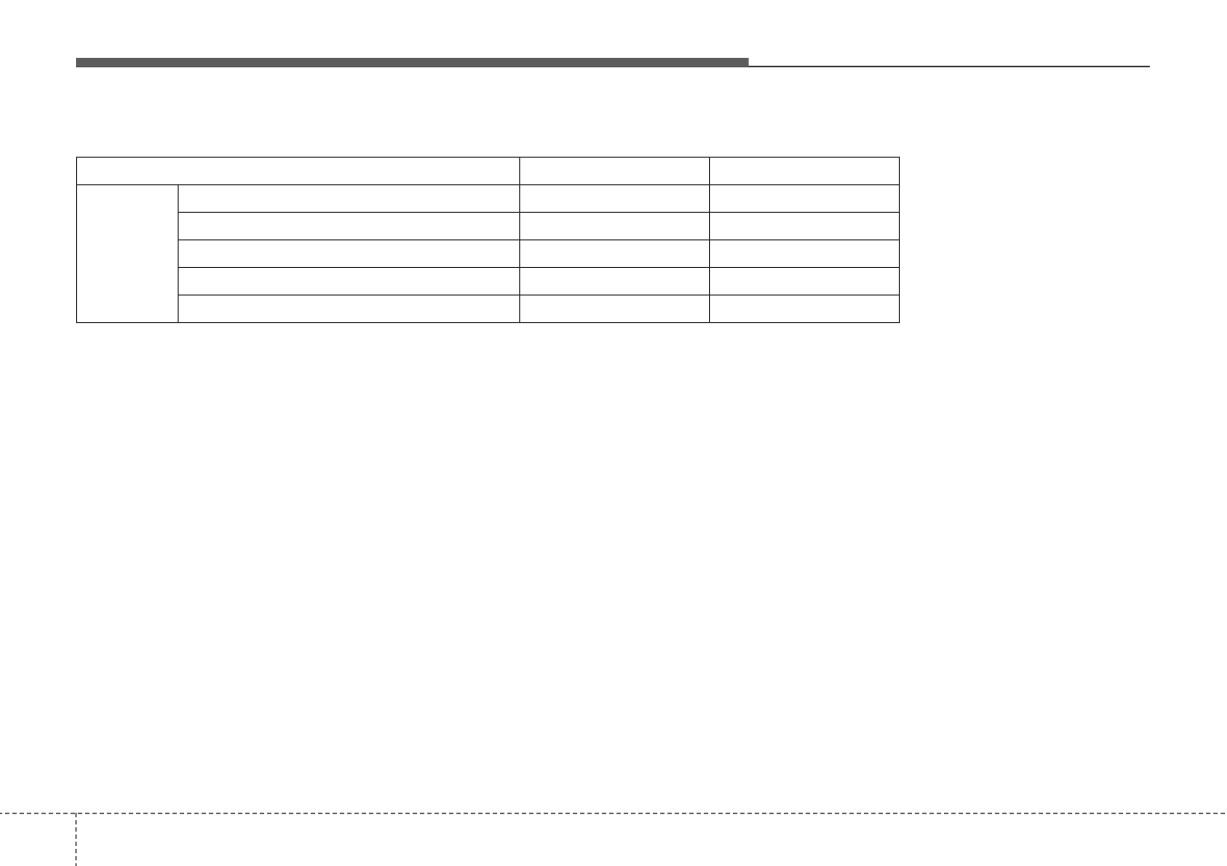
(Continued)
Light Bulb
Wattage
Bulb type
Map lamps*
10W x 2
W10W
Room lamps
8W
FESTOON
Interior
Vanity mirror lamps*
8W
FESTOON
Glove box lamp*
8W
FESTOON
Liftgate room lamp
8W
FESTOON
* If equipped
8
4
Specifications, Consumer information, Reporting safety defects
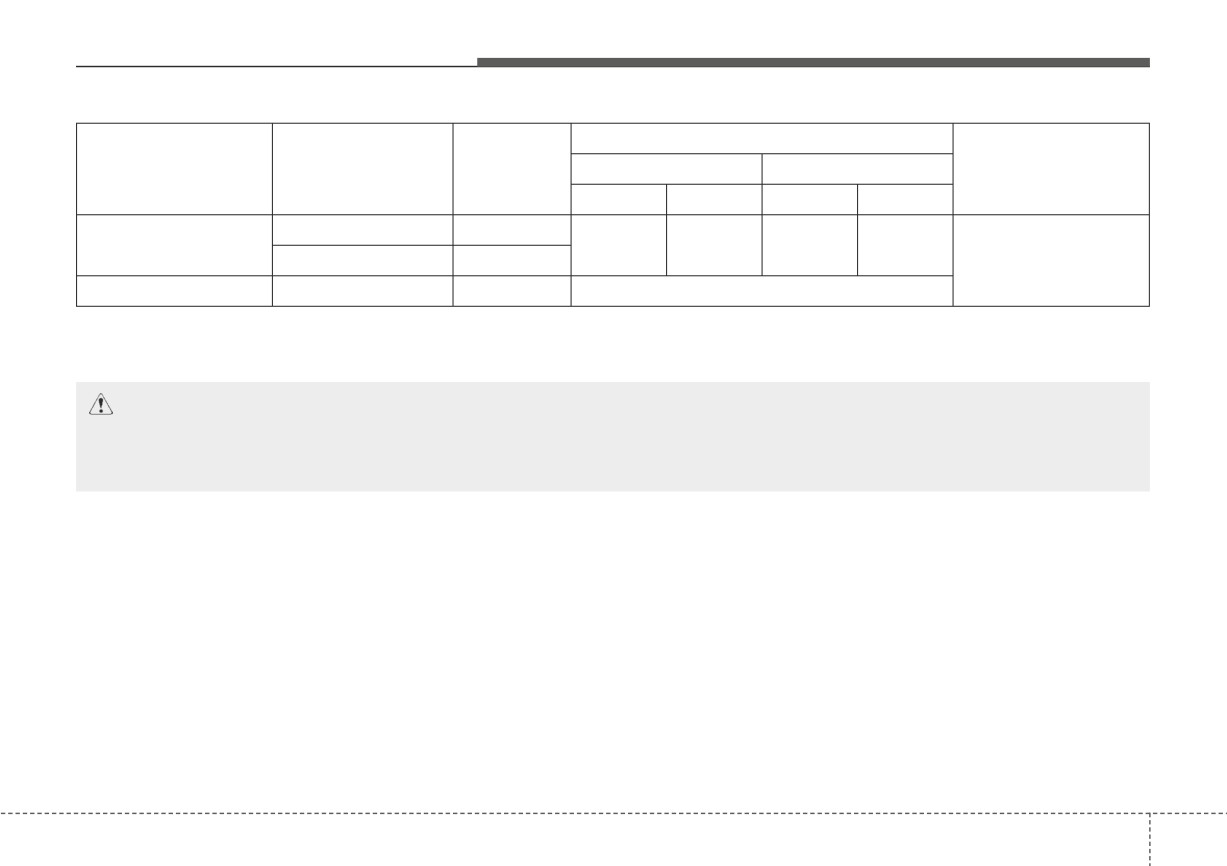
TIRES AND WHEELS
Inflation pressure kPa (psi)
Wheel lug nut torque
Item
Tire size
Wheel size
Normal load *1
Maximum load
kgf•m (lbf•ft, N•m)
Front
Rear
Front
Rear
185/65R15
5.5J X 15
Full size tire
230 (33)
230 (33)
230 (33)
230 (33)
11~13
205/45R17
6.5J X 17
(79~94, 107~127)
Compact spare tire *2
T125/80D15
3.5J x 15
420 (60)
*1 : Normal load : Up to 3 persons
*2 : If your vehicle is not equipped with a compact spare tire, it will be equipped with a Tire Mobility Kit
CAUTION
When replacing tires, use the same size originally supplied with the vehicle.
Using tires of a different size may damage the related parts or cause them to operate improperly.
✽ NOTICE
• We recommend replacing tires with the same make and model originally supplied with the vehicle; not doing so
may affect driving performance.
• When driving in high altitude grades such as mountainous areas, injection of additional air into tires may be
required due to lower atmospheric pressure. Therefore, add 1.5 psi for every 1,000m above sea level at the recom-
mended tire pressure when frequently driving in high mountainous areas.
8
5

Specifications, Consumer information, Reporting safety defects
WEIGHT/VOLUME
Smartstream G1.6
Item
4 Door
5 Door
Gross vehicle weight
3,616 (1,640)
3,616 (1,640)
lbs. (kg)
Luggage volume
17.4 *1 / 32.8 *2
13.7 (387)
cu ft (l)
(493 *1 / 928 *2)
*1 : Behind rear seat to upper edge of the seat back.
*2 : Behind front seat to roof.
AIR CONDITIONING SYSTEM
Item
Weight of volume
Classification
480 ± 25g
Refrigerant
R-1234yf
16.9 ± 0.88 oz
110 ± 10g
Compressor lubricant
FD46XG (IDEMITSU)
3.9 ± 0.35 oz
We recommend that you contact an authorized Kia dealer for more details.
8
6
Specifications, Consumer information, Reporting safety defects
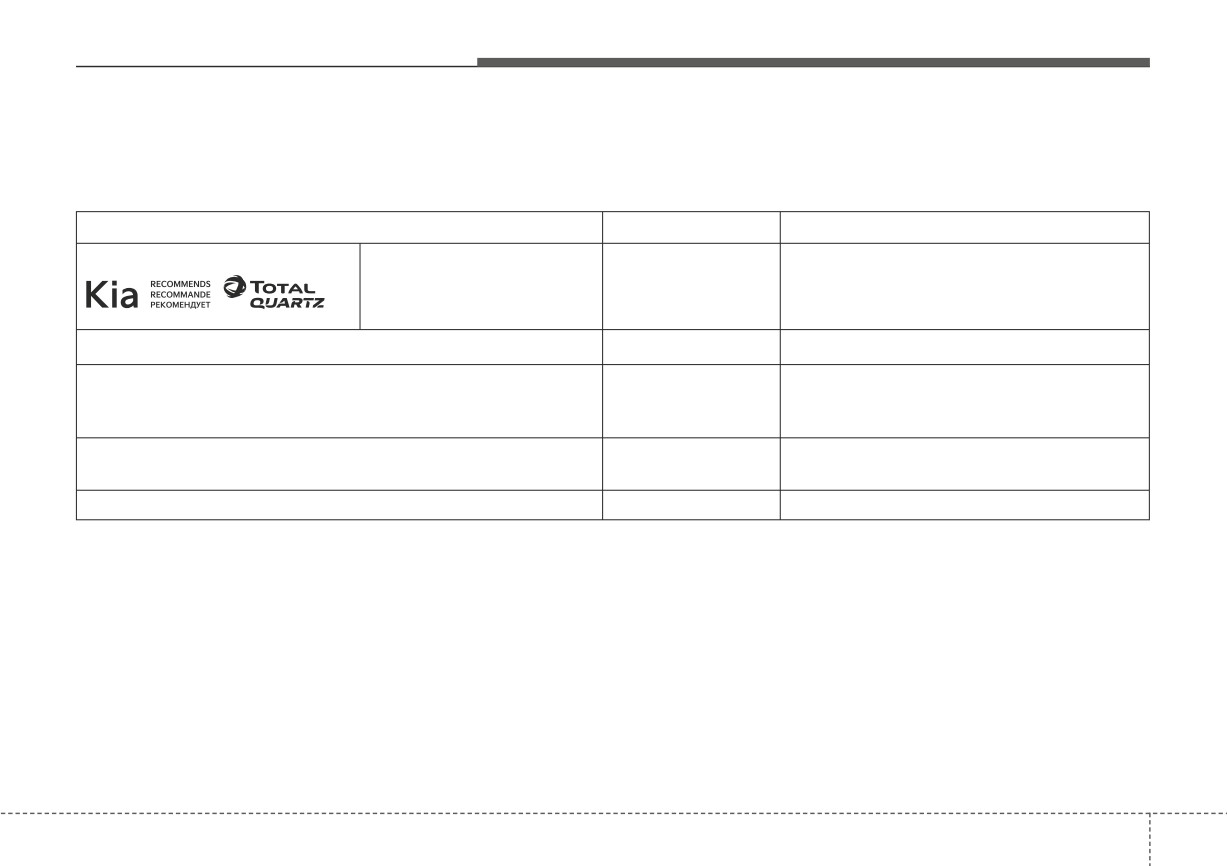
RECOMMENDED LUBRICANTS AND CAPACITIES
To help achieve proper engine and powertrain performance and durability, use only lubricants of the proper quality.
The correct lubricants also help promote engine efficiency that results in improved fuel economy.
These lubricants and fluids are recommended for use in your vehicle.
Lubricant
Volume
Classification
Engine oil *1 *2 (drain and refill)
Full synthetic API SN PLUS/SP or ILSAC
Smartstream G1.6
4.0 US qt. (3.8 l)
GF-6
Intelligent variable transmission
6.87 US qt. (6.5 l)
SP-CVT1*3
Mixture of antifreeze and water
Coolant
5.81 US qt. (5.5 l)
(Ethylene-glycol with phosphate
based coolant for cooling device)
0.7~0.8 US qt.
Brake fluid
FMVSS116 DOT-4
(0.7~0.8 l)
Fuel
11.9 US gal (45 l)
Unleaded gasoline
*1 :Refer to the recommended SAE viscosity numbers on the next page.
Semisynthetic) is used, then the engine oil and engine oil filter must be replaced as indicated severe maintenance condition.
*3 :Use only specified genuine Intelligent Variable Transmission(IVT) fluid.The use of non-specified fluid (even marked as compat-
ible with genuine) could result in shift quality deterioration and vibrations, eventually, the transmission failure.(Refer to
“Explanation of Scheduled Maintenance Items” in chapter 7.)
8
7
Specifications, Consumer information, Reporting safety defects
Recommended SAE viscosity
Temperature Range for SAE Viscosity Numbers
number
°C
-30
-20
-10
0
10
20
30
40
50
Temperature
Engine oil viscosity (thickness) has
(°F)
-10
0
20
40
60
80
100
120
an effect on fuel economy and cold
weather operation (engine start and
Smartstream
Engine
0W-20
engine oil flowability). Lower viscosi-
Oil
G1.6
ty engine oils can provide better fuel
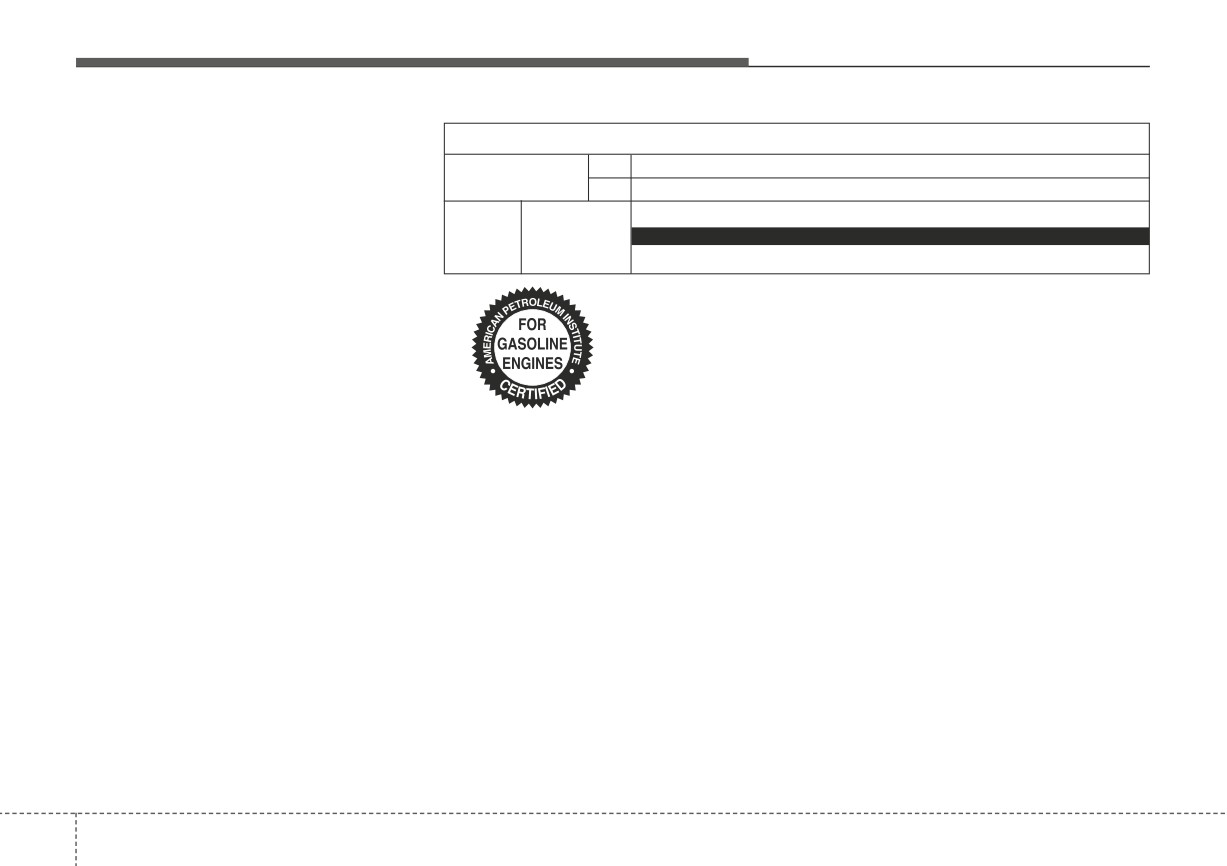
An engine oil displaying this API Certification Mark conforms
economy and cold weather perform-
ance, however, higher viscosity
to the international Lubricant Specification Advisory
Committee (ILSAC). It is recommended to only use engine oils
engine oils are required for satisfac-
tory lubrication in hot weather. Using
that uphold this API Certification Mark.
oils of any viscosity other than those
recommended could result in engine
damage. When choosing an oil, con-
sider the range of temperature your
vehicle will be operated in before the
next oil change. Proceed to select
the recommended oil viscosity from
the chart.
8
8
Specifications, Consumer information, Reporting safety defects
VEHICLE IDENTIFICATION NUMBER (VIN)
VEHICLE CERTIFICATION-
Frame Number
VIN Label
LABEL
OUB081001
OBH088005N
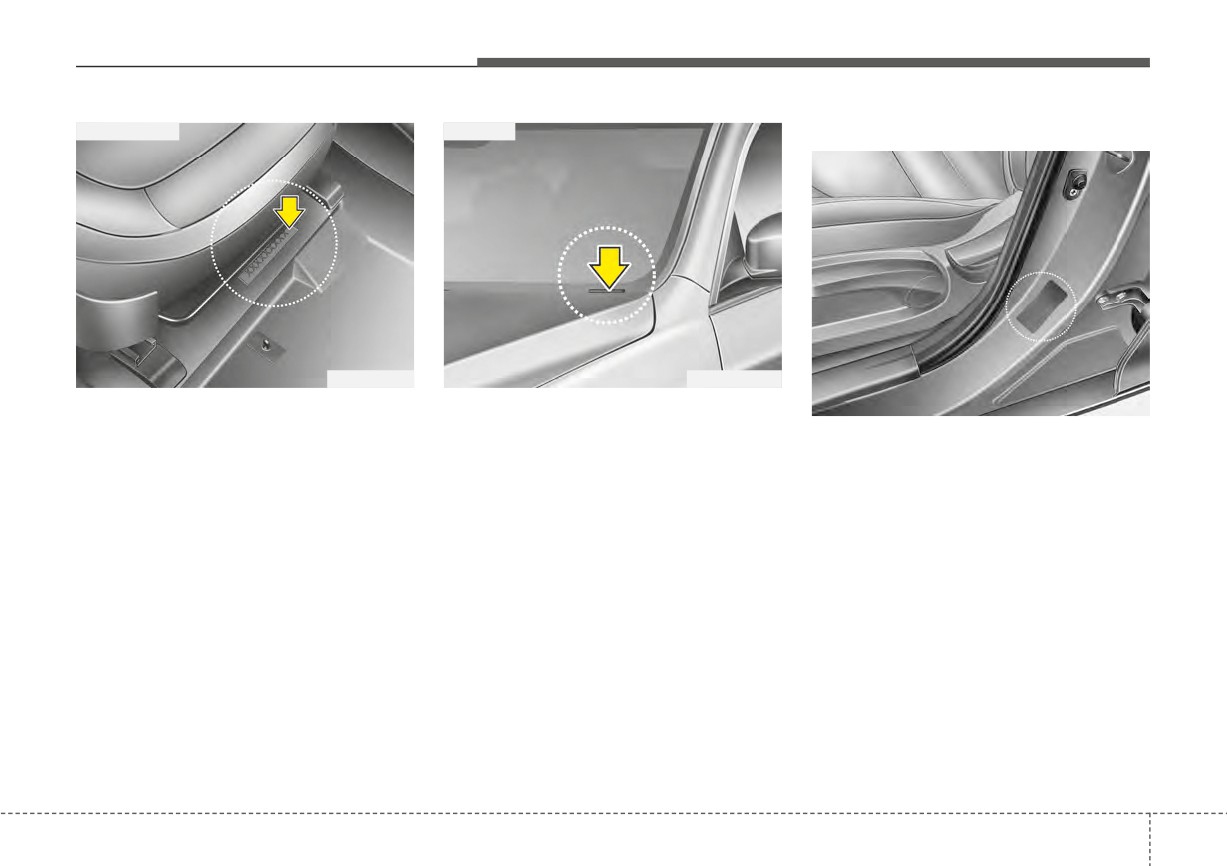
The vehicle identification number
VIN label
OUB081003
(VIN) is the number used in register-
The VIN is also on a plate attached
The vehicle certification label
ing your vehicle and in all legal mat-
to the top of the dashboard. The
attatched on the driver’s side center
ters pertaining to its ownership, etc.
number on the plate can easily be
pillar gives the vehicle identification
The number is punched under driver
seen through the windshield from
number (VIN).
or front passenger seat.
outside.
8
9
Specifications, Consumer information, Reporting safety defects
TIRE SPECIFICATION AND
ENGINE NUMBER
REFRIGERANT LABEL
PRESSURE LABEL
■ Smartstream G1.6
OSC088004N
OYB086002
OUB071018
The engine number is stamped on
The refrigerant label is located on
The tires supplied on your new vehi-
the engine block as shown in the
the underside of the hood.
cle are chosen to provide the best
drawing.
The label contains the following infor-
performance for normal driving.
mation :
The tire label located on the driver's
• Type of refrigerant
side center pillar gives the tire pres-
• Amount of refrigerant
sures recommended for your vehicle.
❈ For more details, refer to
“Air
Conditioning refrigerant label” in
chapter 4.
8
10