Amtrak. Service Standards Manual for Train Service and On-Board Service Employees (Version 6, 2011) - page 17
Order #
Description
Size
Adhesive
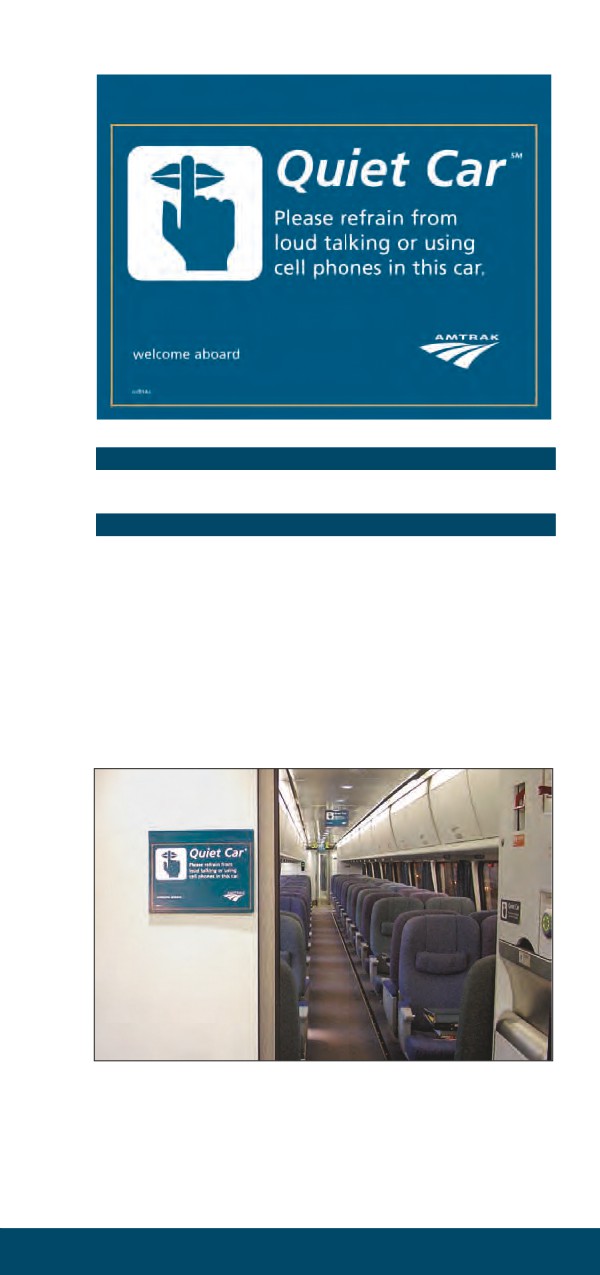
028142
Quiet Car
8.5 x 11
Yes
Two Sided
Suggested Location
Acela Equipment - Attach two signs on the ceiling near the entrance on each end
of the car. Attach one sign on the vestibule wall beside the end door at each end
of the car. Always use the self adhesive strip when attaching signs to the car,
never use tape or other adhesives. Refer to Figure 10-3 - Quiet Car -Signage
Positioning on Acela equipment.
Amfleet Equipment - Attach two signs on the ceiling (one half way between the
first two EMERGENCY EXIT signs on each end of the car). Attach one sign on the
vestibule wall beside the end door at each end of the car. Do not cover the end
door window. Always use the self adhesive strip when attaching signs to the car,
never use tape or other adhesives. Refer to Figure 10-4 - Quiet Car - Signage
Positioning on Amfleet Equipment.
Figure 10-3 - Quiet Car - Signage Positioning on Acela Equipment
Service Standards Manual No. 6
10-31
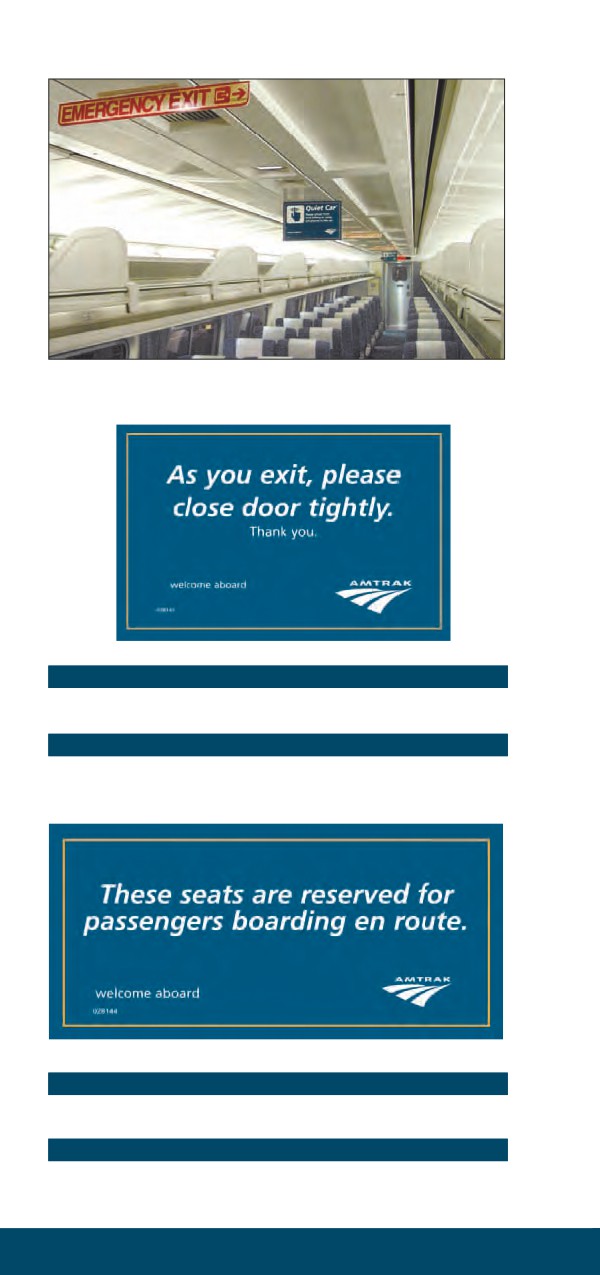
Figure 10-4 - Quiet Car - Signage Positioning on Amfleet Equipment
Order #
Description
Size
Adhesive
028135
As you exit, please
8.5 x 5.5
Yes
close door tightly
Suggested Location
Directly above the handle on the inside of restroom doors.
Order #
Description
Size
Adhesive
028144
These seats are reserved for
Tent Card
No
passengers boarding en route.
Suggested Location
Amtrak Cascades Café tables, when needed.
10-32
On-Board Announcements & Signage
Order #
Description
Size
Adhesive
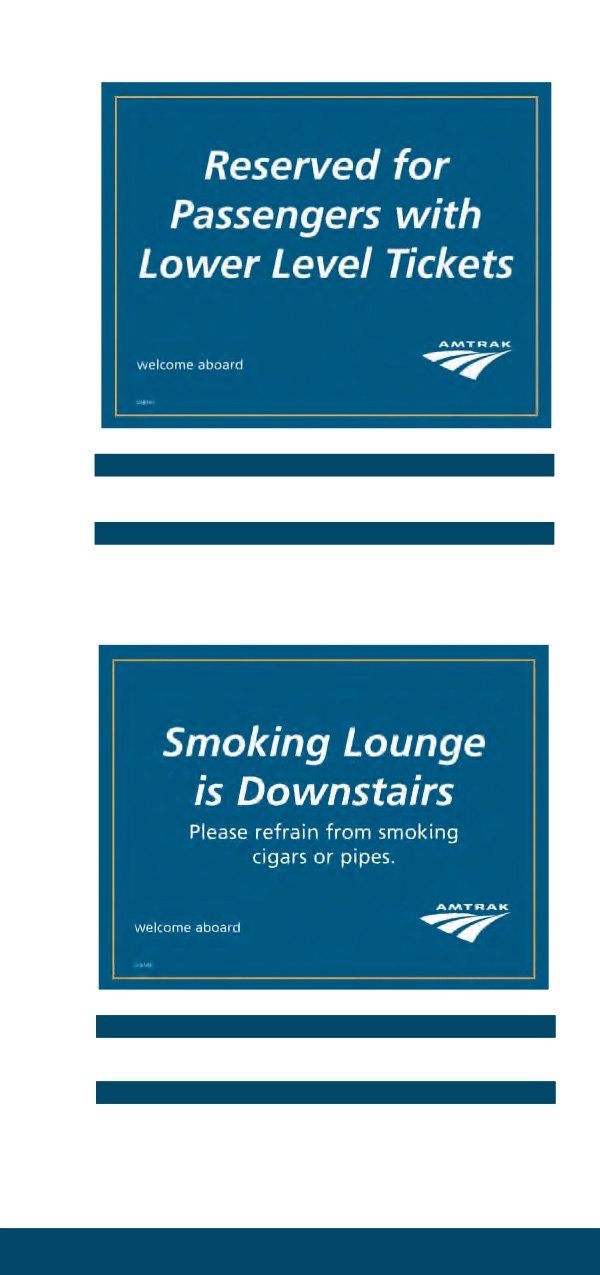
028145
Reserved for Passengers with
8.5 x 11
Yes
Lower Level Tickets
Two Sided
Suggested Location
Centered on inside of body end door window, leading into the lower level
seating area.
Order #
Description
Size
Adhesive
028146
Smoking Lounge is Downstairs
8.5 x 11
Yes
Two Sided
Suggested Location (Auto Train Only)
Wall at top of stairs.
Service Standards Manual No. 6
10-33
Order #
Description
Size
Adhesive
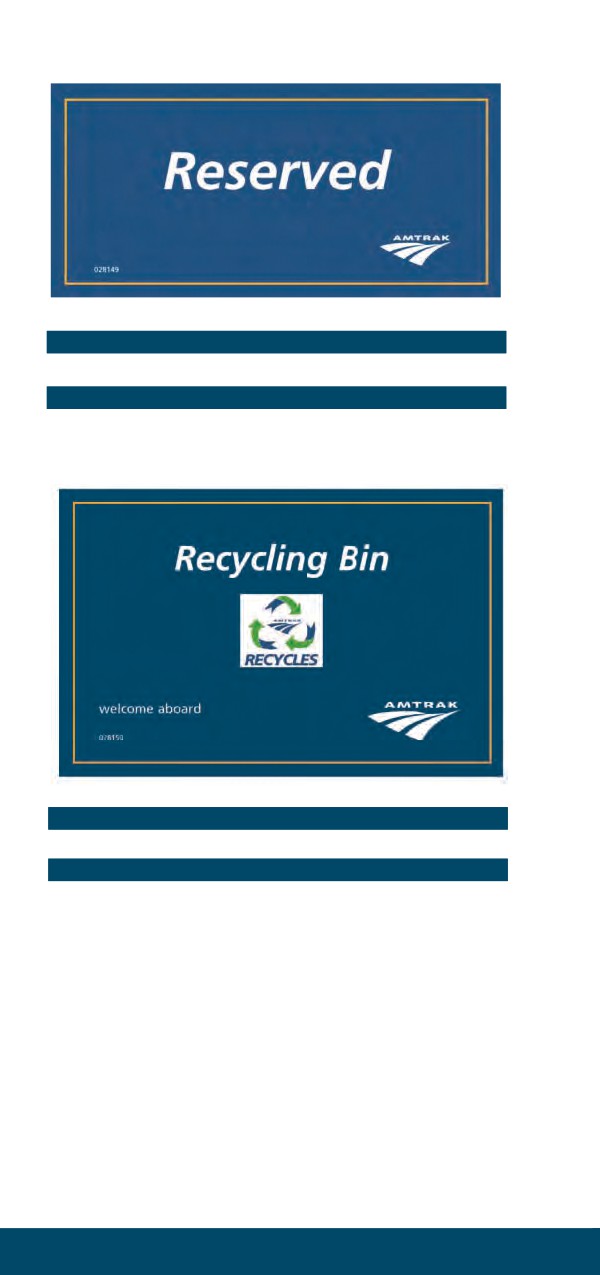
028149
Reserved
Tent Card
No
Suggested Location
Dining Car table for crew.
Order #
Description
Size
Adhesive
028150
Recycling Bin
8.5 x 5.5
Yes
Suggested Location
To be placed above the recycle bin (where applicable) in the Café/Lounge Car.
10-34
On-Board Announcements & Signage
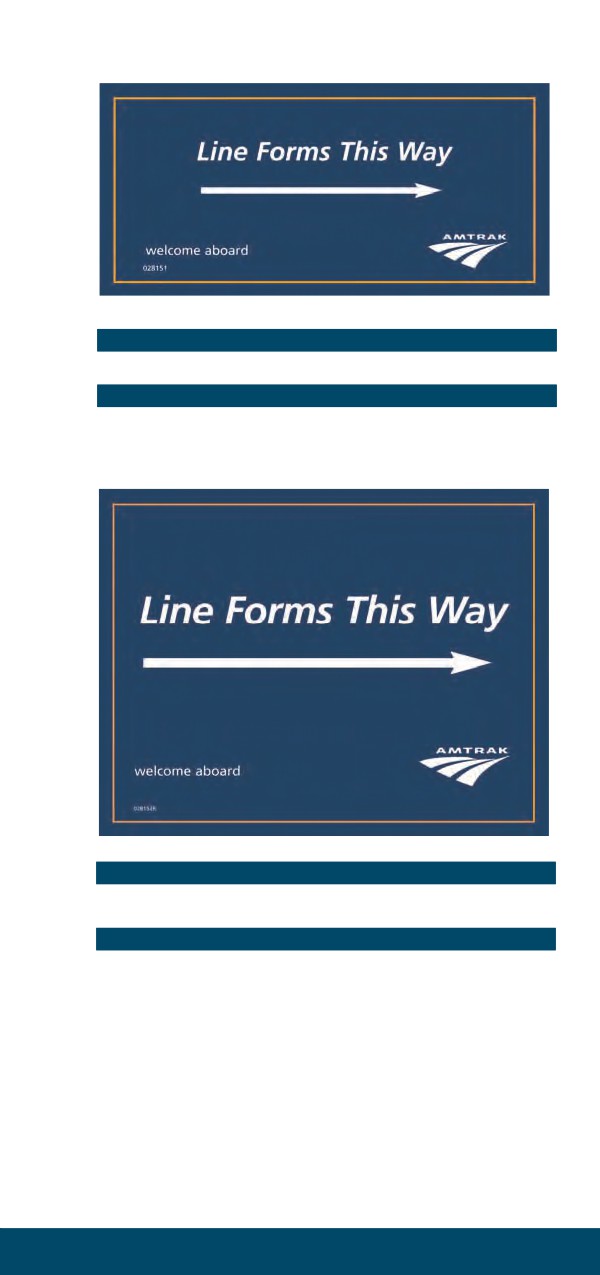
Order #
Description
Size
Adhesive
028151
Line Forms This Way
Tent Card
No
Suggested Location
Café/Lounge counter.
Order #
Description
Size
Adhesive
028152R
Line Forms This Way
8.5 x 11
Yes
One Sided
Suggested Location
Café/Lounge wall.
Service Standards Manual No. 6
10-35
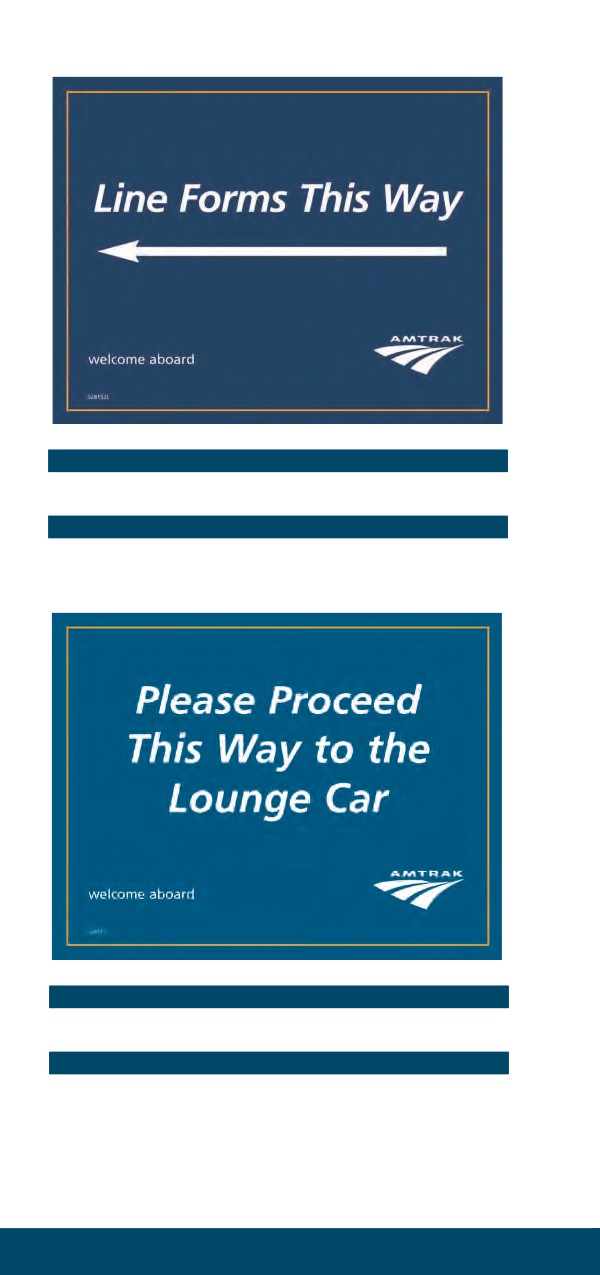
Order #
Description
Size
Adhesive
028152L
Line Forms This Way
8.5 x 11
Yes
One Sided
Suggested Location
Café/Lounge wall.
Order #
Description
Size
Adhesive
028157
Please Proceed This Way to
8.5 x 11
Yes
the Lounge Car
Two Sided
Suggested Location
Centered on inside of body end door window of cars. However, do not post in
the same location as the “Please Proceed This Way to the Dining Car” sign.
Recommended placement of signs should be on every other car.
10-36
On-Board Announcements & Signage
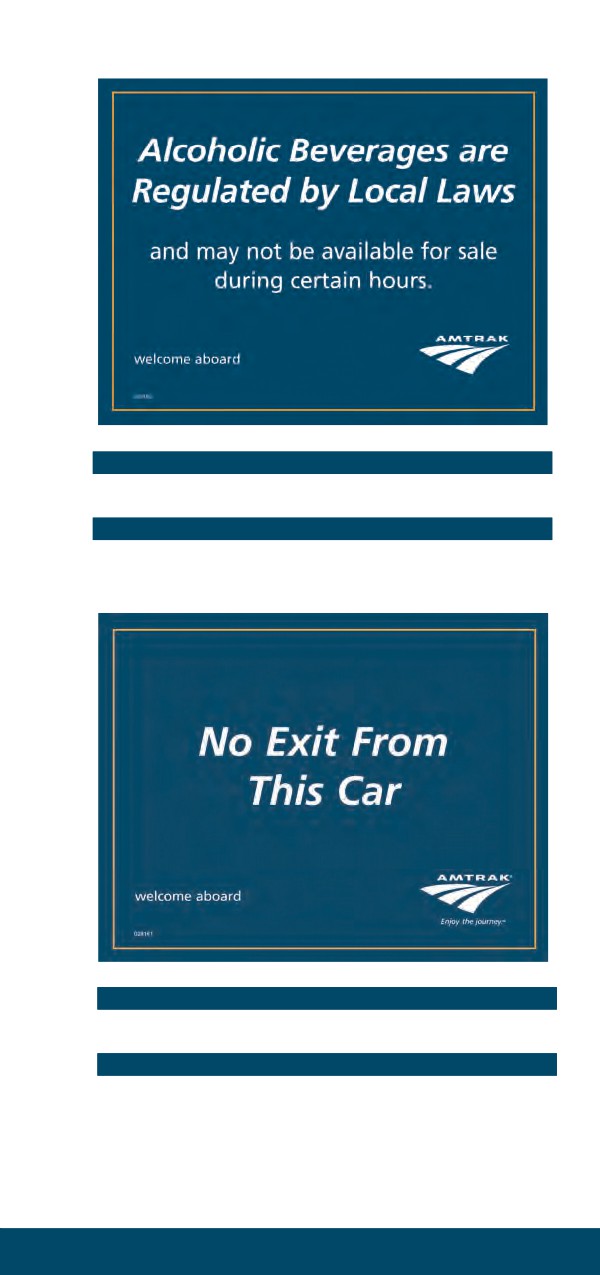
Order #
Description
Size
Adhesive
0281560
Alcoholic Beverages are
8.5 x 11
Yes
Regulated by Local Laws
One Sided
Suggested Location
Display in public view in Food Service Cars.
Order #
Description
Size
Adhesive
028161
No Exit From This Car
8.5 x 11
Yes
One Sided
Suggested Location
Place on the wall, eye level, at the top of the stairway leading to lower level
lounge on Superliner Sightseer Lounge Cars (long distance trains) and
Superliner Lounge/Coach Cars on inter-city trains.
Service Standards Manual No. 6
10-37
Introduction
Have you ever been asked to assist a passenger who has a
disability and felt uncomfortable about doing so, or were
unsure about the best way to help? This chapter provides
details about the law and contains guidelines on what to
say, what to do and how to help a disabled person. With
the information contained in this chapter, employees will
be able to maintain and improve the quality of services to
people with disabilities so that every passenger receives the
same consistent, non-discriminatory, excellent service.
Amtrak’s Commitment and Policies
The National Railroad Passenger Corporation (Amtrak) is
committed to ensuring that all passengers, including those
with disabilities, are provided with quality customer service
and everything necessary to make their trip safe and
enjoyable. Our goal is to make all Amtrak employees
sensitive to the needs of individuals with disabilities and
ensure that employees respect the judgment of each
individual as to what accommodation is best for them.
A. The ADA and What It Means for Amtrak
The Americans with Disabilities Act is a Civil Rights
Law that was enacted in 1990. It prohibits the exclusion
of any qualified individual with a disability from
receiving the benefits of public transportation services.
It makes it illegal for a public transportation provider
to discriminate against passengers because of their
disabilities, and prohibits discrimination against an
individual who is with a person with a disability.
One of Congress’ specific objectives in passing the ADA
was to ensure that people with disabilities had improved
access to all public transportation-including Amtrak.
1.
Under the ADA Law, a Person with a Disability is
Defined as:
a) A person with a physical or mental impairment
that substantially limits one or more major life
activities such as hearing, seeing, speaking,
breathing, performing manual tasks, walking,
caring for oneself, learning or working; or
b) A person with a record of such a physical or
mental impairment. Examples of individuals with
a record of an impairment are those who have
Service Standards Manual No. 6
11-1
histories of mental illness, alcoholism, heart disease,
or cancer; or
c) A person who is regarded as having such
impairment. An example is a person with an
obvious birthmark.
Provision of Services
Amtrak may not refuse to provide service because
the individual’s disability results in an appearance
or involuntary behavior that may offend, annoy,
or inconvenience employees or other passengers.
However, Amtrak may refuse to provide service
to an individual with a disability who engages in
violent, seriously disruptive, or illegal conduct or
poses a safety threat to others.
2.
Customer Service Commitment
Amtrak will not, either directly or through contractual,
licensing, or other arrangements, discriminate against
any otherwise qualified individual with a disability in
accordance with 49 U.S.C. 12162 or 49 C.F.R. Part 37.
In accordance with this regulation,
Amtrak will not:
a) Refuse transportation to an otherwise qualified
individual with a disability on the basis of that
disability;
b) Refuse transportation to an otherwise qualified
individual with a disability simply because the
person’s disability results in appearance or
involuntary behavior that may offend, annoy, or
inconvenience crew members or other passengers;
c) Require an individual with disabilities to accept
special services that have not been requested by
the passenger; or
d) Exclude a qualified individual with a disability from,
or deny that person the benefit of, any service
that is available to the general public, even if
there are separate or different services available
for individuals with disabilities.
B.
Services Offered and Provided to
Passenger with Disabilities
Although Amtrak is required by law to provide
transportation and assistance to people with disabilities,
11-2
Assisting Passengers with Disabilities
we want to apply the same service principles and
requirements to all of our passengers.
Amtrak employees will:
• explain our services and related requirements to
all passengers.
• arrange for service requests to be fulfilled.
• communicate all required information to all
departments involved.
The following guidelines describe Amtrak services
offered to passengers with disabilities and are based
on a combination of the requirement of the ADA
law, and Amtrak’s own customer service policies, and
therefore may address issues that are beyond the
scope of the law.
1.
Advance Notice
a) Amtrak suggests, but does not require, that
individuals with disabilities who require special
assistance, such as pre-boarding with a wheelchair
lift, request this assistance at least 24 hours in
advance and check-in at least one hour before
departure. We also suggest that people with
disabilities notify the ticket agent in advance of
any special accommodations needed in the station
or on-board the train.
b) Amtrak must respond to all reasonable requests
without advance notice or check-in.
c) The Amtrak Reservation Sales Call Center will
notify the stations involved of assistance requests
received through advance notification.
2.
Personal Assistance
Amtrak’s goal is to make it easier for people with
disabilities to travel independently.
a) Amtrak will provide assistance in boarding and
detraining, stowing on-board luggage, providing
information to passengers who are deaf or hard
of hearing or who have visual disabilities, and
providing services in accessible locations.
b) Employee assistance does not extend to providing
personal services such as assistance within a
restroom, sleeping compartment or with eating
a meal.
Service Standards Manual No. 6
11-3
c) Amtrak will provide alternate formats for
communicating with passengers: such as, reading
menus to those with visual impairments and
writing on-board announcements for deaf or
hard-of-hearing passengers.
d) Amtrak will ensure that any oral announcements
made on-board the train are communicated to
customers who are deaf or hard of hearing, and
requested assistance (such as notification of
upcoming stops) must be honored.
e) Amtrak will use the green “Special Assistance
Seat Check” (NRPC 3242) for any passenger
traveling in Coach who has indicated to a
crewmember that he/she needs special assistance
while on-board the train.
3.
Attendants
a) Amtrak does not require that an Attendant
accompany a qualified individual with a disability.
b) Amtrak’s train crews are not required or permitted
to provide personal care assistance for any
passenger, which includes activities such as feeding,
bathing, dressing, medicating or toileting. Therefore,
if the passenger anticipates that he/she may require
this type of assistance during the journey, the
passenger must travel with an Attendant and is
responsible for purchasing the Attendant’s ticket.
c) If a crew member has reason to believe that a
passenger may need personal care assistance during
the trip, the crew member may ask the passenger
whether or not he/she will need this type of
assistance, and should advise the passenger that
Amtrak’s crew members cannot provide such
assistance. However, if the passenger provides a
credible verbal assurance that he/she will not need
this type of assistance (either because he/she
generally does not require such assistance, or
because he/she will not need the assistance on this
trip, for example, due to the trip’s short length),
Amtrak may not refuse to provide service to the
passenger based solely on its belief that the
passenger is likely to need such assistance.
d) If, during a trip, it becomes apparent that an
unaccompanied passenger does require personal
care assistance (for example, if the passenger cannot
take care of his/her elimination needs in a hygienic
or discreet manner), it may be necessary to make
arrangements for the passenger to detrain at the
next stop.
11-4
Assisting Passengers with Disabilities
4.
Examples of Disability Situations with Suggested
Actions
a)
Passenger is traveling without Attendant.
•
Situation - A relative who is assisting the
passenger to the train but is not traveling with
that passenger, asks that a crew member make
sure that their mother is given her medication
at the appropriate times and notifies their
mother of her stop.
•
Service Requirements
• The crew member is not responsible for
ensuring that the medications are taken at
the appropriate time.
• The crew member is responsible for making
certain that the passenger is notified of
his/her stations stop.
•
Suggested Actions
• Station - If the situation occurs at a station
whether before or after the ticket has been
sold, the employee is to contact a supervisor
to determine if the passenger should be
permitted to board the train.
• On Board - If this occurs as the passenger is
boarding the train; the employee must inform
the relative that Amtrak is not permitted
to assist with any medications distribution.
If the relative insists upon continuing
boarding of the passenger, the employee
must get the Conductor who is to determine
if the passenger can be permitted to board
based upon the guidelines.
b) Passenger needs assistance from a Wheelchair to
a toilet.
• Situation - It becomes apparent that a passenger
who is on-board is not able to transfer from
their wheelchair to the toilet without assistance.
• Service Requirements
• Employees are to assist the passenger to the
restroom.
• Employees are not required to assist the
passenger once they are inside the restroom.
• Suggested Action
In this situation, the passenger is already
on-board the train when it becomes apparent
that they cannot make the transfer without
assistance. Options are limited to the following:
• Depending upon the trip length, the passenger
could be moved from Coach to an accessible
bedroom where there will be more privacy
Service Standards Manual No. 6
11-5
and grab handles which may make the
transfer easier for the passenger.
• In some cases it may be possible to solicit
assistance from other employees or passengers
to help in the transfer. It is strongly recom-
mended that if the employee provides this
assistance they have other employees in the
area to help provide support.
• If the passenger is unable to control their
bodily functions, it may be necessary to arrange
to have the passenger removed from the train.
(Refer to Chapter 7 “Policies & Procedures”,
Section 4” Conditions of Carriage”)
c)
Feeding Passenger
•
Situation - A passenger requests that their food
be cut into bite-sized pieces and fed to them.
•
Service Requirements
• The passenger is to be offered meal service at
their seat or in Sleeping Car accommodations.
• If the passenger is blind, the menu is to be
read to them.
• If the passenger is both deaf and blind, print
on their palm.
• The passenger’s food should be prepared, as
they desire.
• If the passenger is blind, orient them to
the location of the food on the plate using
references to a clock.
• The employee is not required to cut the
passenger food and does not have physically
feed them.
•
Suggested Action
• If the passenger has limited use or difficulty
using their arms and hands, recommend
items from the menu that are easier to
handle and eat.
• If the passenger is blind, provide menu
information and how the food will be served.
C.
Transporting Passengers with
Mobility Aids
A passenger, who uses a wheelchair, including
battery-powered wheelchairs, may choose to travel
in the chair, or transfer to a fixed seat and stow the
wheelchair. The passenger may also choose to check
the motorized chair and use a standard common
wheelchair while on-board the train.
11-6
Assisting Passengers with Disabilities
1.
Accessible Cars
Amtrak’s accessible cars have designated locations
to accommodate people who use wheelchairs
(including scooters). There is a space for an individual
to park their “common” wheelchair. (See Part 2 in
this section “Transporting Passengers with Mobility
Aids” for details)
a)
Superliner 34000-Series Coaches - For standards
governing the assignment of lower level seating
in Superliner 34000-Series Coaches, refer to
Chapter 8 “Accounting”, Section 1 “Train Service
Accounting Procedures”.
b) Amtrak Cascades Service - Wheelchair accessibility
to the train is only available to the permanently
attached cars located in the center of the train
consisting of the following:
• Accessible Coach, Bistro, Lounge/Diner and
Accessible Business Class Cars that contain
two hydraulic wheelchair lifts and sufficient
isle width to accommodate wheelchairs.
• The Dining Car features a special retracting
table and chair that allow wheelchair passengers
to dine with a companion.
c)
Amtrak California Service
Known as “California Cars,” these bi-level cars
are similar in concept to the Superliner equipment
and are utilized for Capitol Corridor, San Joaquin
and some California Coastal service. Wheelchair
accessibility is available in two areas on the lower
level consisting of the following:
•
“W-Space” designation on a ticket is for a seat
space that faces a common table with a flip-up
seat. (The user can leave the seat flipped up and
park the wheelchair in this area, or fold the seat
down and transfer to it. Passengers in non-folding
motorized chairs should have a ticket designation
as “W-Space.”)
•
“X-Seats” designation on a ticket is for a seat
space in an area consisting of two seats on the
same side as the “W-Space” that face a table.
(“X-Seats” are actual fixed seats designed for
transfer by wheelchair users. The folder chair
can be stored nearby. If the passenger wants to
stay in the wheelchair en route, they should be
in the “W-Space” and not an “X-Seat.”)
Service Standards Manual No. 6
11-7
2.
Mobility Aids
Amtrak’s accessible equipment provides access to a
variety of mobility aids. Certain accessible equipment
is not permitted on-board the train.
a)
Common Wheelchair
• A “common” wheelchair is defined as not
exceeding 30 inches in width or 48 inches in
length and not weighing more than 600 pounds
when occupied. Battery-powered wheelchairs
are considered common wheelchairs if they
meet this definition of weight and size.
• Gas powered units are not permitted on board
the train.
b) Scooters - Scooters meeting the common
wheelchair standards of length, width and weight
are welcome on-board the train.
c)
Segways Personal Transporters
• Personal Transporters do not qualify as mobility
assistance devices.
• Segways are not permitted in the reserved
wheelchair areas.
• Amtrak permits Segway devices in Accessible
Bedrooms.
• Segways must be “walked” onto the train,
using a lift or ramp if necessary.
• Segways do not fit within any storage area
available in any type of Amtrak passenger railcar.
• Passengers may check Segways as checked
baggage when the unit is boxed (passenger to
supply box). All weight and size requirement
apply.
d) Cane, Walkers and Other Small Mobility Aids -
There are a variety of mobility aids used by
passengers. Without exception, these types of
small mobility aids are to be permitted on-board
the train and stored carefully.
3.
Transfer to Seat
Whenever a passenger chooses to transfer to a fixed
seat, their wheelchair or mobility aid (wheelchair,
walker, cane, etc) should travel in the same car as
the passenger and be stored as close to their seat as
is possible.
4.
Checked Baggage (Wheelchairs, Scooters and
Segway Personal Transporters)
Passengers, who wish to check their mobility aids
may do so at no extra cost, provided they meet the
requirements of our checked baggage service. (Refer
to Chapter 4 “Baggage Handling”)
11-8
Assisting Passengers with Disabilities
5.
Boarding, Seating and Detraining
When a railcar cannot be accessed directly from the
platform, lifts or ramps will be used to board passengers
in wheelchairs. Upon request, passengers using other
mobility aides will be permitted to use lifts or ramps
to board and detrain.
a)
Service Requirements
On-Train and Station employees must work
together to ensure they have sufficient time when
boarding or detraining the passenger.
• Pre-Board the passenger (with the passenger’s
approval and concurrence) whenever possible.
• Coordinate the detraining process to provide
sufficient time for the passenger to prepare
and organize their personal possessions, etc.
• Assist with ramps and lifts, as necessary.
• Assist with baggage as needed.
b) Boarding and Detraining
•
Wheelchair Lifts
Many Amtrak stations (both staffed and
unstaffed) have wheelchair lifts.
• Wheelchair lifts are regularly maintained by
a vendor; however, if an employee determines
the lift is not operating correctly, the lift
must be reported to a Station Manager,
Trainmaster, Road Foreman, etc. at the end
of the trip.
• Wheelchair lifts may be used to board
passengers in wheelchairs, passengers using
walkers that are unable to sit easily, passengers
in a leg casts or passengers who are in similar
situations. In each case, the passenger must be
instructed to hold on to the guardrails while
the lift unit is in operation.
• Except in emergencies, employees should
never carry individuals with disabilities as a
means of assisting an individual to board
and detrain.
•
Superliner Ramps
All Superliner passenger cars have ramps,
which are to be used to board and detrain
passengers in wheelchairs. Whenever the ramp
is used, the employees must offer to assist
moving the passenger up or down the ramp.
c)
Seating
• The accessible seats in Coaches are reserved
for passengers who are disabled.
• If a passenger boards the train en-route and
another passenger, who is not disabled, is
occupying the only available accessible seat,
Service Standards Manual No. 6
11-9
the seated passenger must be asked to move
and be re-accommodated.
• Superliner 34000-Series Coaches have Lower
Level seats, which can be reserved on a first
come first serve basis by any passenger.
• The train manifest lists those passengers by
name that has made reservations for the
lower level seating; including passengers
who have reserved the accessible seat.
• Passengers who have reserved the accessible
seat and wheelchair area will have one ticket
for transportation and another for the
wheelchair.
• Passengers who need assistance (whether
disabled or not) are to have the green (Keep
in Sight) “Special Assistance Seat Check”
(NRPC 3242) placed with the destination seat
check above their seat.
• The Special Assistance bedroom in the Sleeping
Cars is held in inventory for a passenger who is
disabled.
D. En Route Passenger Assistance
If a question exists as to the special needs requirements
of an individual passenger, as indicated on the train
manifest or in the reservation system, employees
may call the CNOC 24-Hour Operations Customer
Service Desk at (800) 424-0217 (select the appropriate
extension to speak with a representative covering
the territory of the system where the passenger’s trip
originated) or Amtrak’s Regional and Corporate
Medical Directors for review and resolution.
1.
General
All Employees will:
• Assist passengers in moving about the train (e.g.,
transferring to and from wheelchairs or moving
to and from restrooms).
• Employees are not expected to help passengers
use the restroom.
• Acquaint passengers to the trains’ layout, length,
type of feature cars and location.
• Explain available services and restroom location.
• Offer to assist the passenger from an accessible
seat or bedroom to the Food Service Car.
• Offer and then provide at-seat or in-room snack
or meal service.
• Frequently check on the passenger to ensure they
are comfortable and enjoying the trip.
• Ensure that any information communicated to
passengers, reaches those who are disabled. This
11-10
Assisting Passengers with Disabilities
includes any passenger who is deaf, hard of hearing,
or who has cognitive disabilities.
• Use of the green (Keep in Sight) “Special Assistance
Seat Check” (NRPC 3242) to reminding employees
that these passengers need to be individually kept
informed.
2.
Meals
When requested 72 hours in advance, Amtrak will
provide special meals (low salt/sugar/fat) for a
passenger. There is no additional charge for this service.
3.
Ice
Ice for passenger insulated medicine containers
will be provided without advance notice. Passenger
medications are never to be stored in any Amtrak
refrigerators or freezers.
4.
Oxygen
• Passengers may bring oxygen with them on-board
as long as the oxygen system meets federal safety
requirements.
• The oxygen system cannot rely solely on train-
generated power.
• Passengers using oxygen must bring a battery
back-up system.
• Amtrak is not responsible for replenishing the
passenger’s supply of oxygen.
• Amtrak does not return empty oxygen tanks to
the supplier.
• In emergency situations (unexpected delays,
derailments, etc.) contact the CNOC 24-Hour
Operations Customer Service Desk for assistance
at ATS 734-2299 or (302) 683-2299
5.
Passengers with Medical Conditions
As with all disabilities, an individual with a medical
condition who is medically stable and whose condition
does not pose a threat to the health and safety of the
crew and other passengers shall be permitted travel
on Amtrak trains.
• An attendant provided by the passenger may be
required for the journey.
• The Conductor has the authority to prohibit
a passenger from boarding under certain
circumstances. (Refer to Chapter 7 “Policies &
Procedures”, Section 4 “Conditions of Carriage”)
6.
Medical Certification
If the medical stability of a passenger appears
questionable to the Ticket Agent, Conductor or other
Service Standards Manual No. 6
11-11
crewmembers, a medical certificate may be required
for travel and/or another individual who is responsible
for the passenger’s medical stability must accompany
the passenger. The Conductor has the authority to
prohibit a passenger from boarding under certain
circumstances. (Refer to Chapter 7 “Policies &
Procedures”, Section 4 “Conditions of Carriage”)
7.
Medication
• Medication cannot be stored in Food Service Cars.
• Ice can be provided to passengers to keep items
cool. (Refer to section D3 “Ice” in this chapter)
• Employees cannot administer medication or
perform other medical assistance for passengers
except as outlined in Chapter 2, “Injury, Illness
and Reporting.”
E.
Service Animals
1.
Service Animal vs. Emotional Support Animal
a) Service Animal - Defined by the ADA is an animal
that is individually trained to assist an individual
with a disability. A service animal is trained to do
a task for the individual with the disability.
Specifically- “any guide dog or other animal
individually trained to do work or perform tasks
for the benefit of an individual with a disability”.
(28 C.F.R. 36-104 (2004)) The key is that the animal
was individually trained to perform a specific task.
b) Emotional Support Animal (comfort animals) -
If an animal is accompanying a disabled person
simply to provide emotional support, security or
comfort; then this animal is NOT considered to
be a service animal. This animal has not been
individually trained to perform a task. Therefore,
an “emotional support” animal is NOT a service
animal. Amtrak is not required to allow this animal to
accompany a disabled individual on-board the train.
2.
Certification or Documentation
Service Animals may or may not have certification
or documentation.
a) Passengers traveling with service animals are not
required to have special ID cards or certification
showing that the animal is a service animal.
b) There is no standardized certification or registration
indicating that an animal is a service animal.
c) Some passengers with disabilities traveling with
11-12
Assisting Passengers with Disabilities
service animals may have documentation showing
that an animal is a service animal.
d) Employees should never pet or touch a service
animal unless asked to do so by the owner.
3.
Determining If An Animal Is A Service Animal - “Is
This Your Pet”
a)
Physical Indicators - Look for physical indicators
on the animal. Some service animals wear harnesses,
vests, capes or backpacks. Markings on these
items or on the animal’s tags may identify it as a
service animal. The absence of such equipment
however, does not necessarily mean the animal is
not a service animal.
b) Observation - Observe the animal’s behavior.
Service animals are trained to behave properly in
public settings. For example, a properly trained guide
dog will not run around the station, bark or growl
at other passengers, or bite or jump on people.
• Some service animals provide assistance or
perform specific services.
• Service animals are not pets; they are working
animals that are specifically trained to provide
assistance for individuals who have disabilities.
• Some service animals can help a person by
pulling a wheelchair, fetching dropped items,
handling money, carrying bags, opening doors
or assisting a person with a visual impairment.
• Some service animals serve as seizure-
response/alert animals for people with seizure
disorders or alert individuals with impaired
hearing to intruders or sounds.
c)
Is This Your Pet
Credible verbal assurances is needed from the
passenger that the animal is a service animal. The
way to do this:
• Ask the passenger, “Is this your pet?”
If the passenger responds that the animal is a
service animal and not a pet, but uncertainty
remains about the animal, you may ask
appropriate follow up questions.
• Ask the passenger, “What tasks or functions
does your animal perform for you?” or “What
has it been trained to do for you?”
The passenger must respond that the animal
acts as a guide, notifies of a seizures, etc.
Service Standards Manual No. 6
11-13
Employees may not ask the passenger what
his/her disability is or the cause of the disability.
• Although there may be a few people who try
to “beat the system” by bringing pets on-board
the train, most passengers with disabilities
claiming to have service animals really do have
service animals.
• Since access for persons with disabilities traveling
with service animals is a civil right covered
under the ADA, employees should err on the
side of caution by permitting access to passenger
areas. If the animal looks like a service animal
and the customer says it is a service animal-
welcome the animal aboard.
d) Not a Service Animal
• If an animal is determined not to be a service
animal or if the service animal poses a direct
threat to others, the animal can be denied
access to Amtrak premises.
• On the rare occasion that an animal has to be
excluded from Amtrak premises, you should
handle the situation in a polite and professional
manner.
• When an animal is excluded from Amtrak
premises while en route, the employee making
this decision must complete a “Passenger Incident
Report” (NRPC 3200) detailing the incident.
4.
General Information
a) Service Animal in Training
• Service animals that are in training are allowed
on-board Amtrak trains.
• Service animals in training are accepted on-board
Amtrak trains and station the same as if they
were actually helping a person with a disability.
• The animal must actually be in training with a
recognized organization.
• The animal must be kept under control at all
times.
b) Access to Equipment, Stations and Other
Public Areas
• People with disabilities must be permitted
to bring their service animals onto Amtrak
premises in whatever areas customers and
passengers are generally allowed.
11-14
Assisting Passengers with Disabilities
• Passengers traveling with service animals may
not be isolated from other passengers.
• Trained service animals are allowed in all
passenger areas in our stations, trains and
Amtrak Thruway motor coaches.
c)
Dining and Café/Lounge Car Access
• Service animals are allowed in all passenger
areas of our stations and trains (including
Dining and Café/Lounge Cars).
• FDA and Public Health rules are not a valid
justification for excluding service animals in
passenger areas of Food Service Cars.
• Passengers accompanied by service animals
who desire to eat in the Dining Car must not
be treated less favorably than other passengers
who desire to eat in the Dining Car. (For
example, passengers accompanied by service
animals may not be required to wait an inordinate
amount of time for a table if other non-disabled
passengers are not required to wait an inordinate
amount of time for a table.)
d) Denying Access
• Allergies, inconvenience and fear of animals by
other passengers are not valid reasons for
denying access to passenger areas or refusing
service to people with service animals.
• If a passenger states that he/she has allergies
or an aversion to animals, that person should
be shown to a location as far away from the
service animal as practical.
• The only time that access may be denied is if
the service animal has misbehaved in a manner,
which endangered either another passenger or
employee.
• If the reason for the problem with the animal
was created by another passenger (i.e., teasing
the animal, etc.) the animal would not be
denied access.
e)
Type of Service Animals
There are many different types of service animals.
• Dogs, although the most common service animal,
are not the only animals used as service animals.
• Cats, monkeys, pot bellied pigs, miniature
guide horses and birds are also used as service
animals.
Service Standards Manual No. 6
11-15
f)
Passenger Responsibility for Service Animal
• Service animals must be under the supervision
and care of their owner.
• Service animals should be under the full control
of their owners at all times. (The animal should
be on a leash or in a carrier. An exception to
this may occur when boarding or detraining.)
• The care and supervision of the service animal
is solely the responsibility of the owner.
g)
Service Animal Relief
• The passenger traveling with a Service Animal
must be kept informed of stations stops, which
provide sufficient time to walk the animal
(applicable primarily to dogs and small horses).
The passenger must be given assistance in
detraining, and guidance as to the general area
(i.e., grass, gravel, etc.).
• If the train is operating late, provisions still
must be made for the service animals to walk
and relieve themselves. In some cases this may
mean a small delay to the train, which is to be
noted on the Conductor’s “Delay Report”.
• Employees are not required or encouraged to
provide care (including walking the animal) or
food for service animals.
h) Accommodating Service Animal
• Service animals are generally trained to sit
under their owner’s seat or at their feet.
• Service animals should not be allowed to sit in
the aisle or on seats.
• Amtrak is not required nor do we want to ask
another passenger to move or give up a space
to accommodate a service animal.
• Amtrak is not required nor do we want to deny
transportation to another passenger in order to
provide an accommodation to a passenger with
a service animal.
• Amtrak is not required to provide more than
one seat to a passenger traveling with a service
animal.
• In some cases, the service animal is too large to
fit comfortably at the passenger’s feet. In such
cases, the passenger may purchase another seat
for the service animal.
11-16
Assisting Passengers with Disabilities
F.
Offering the Most Appropriate
Assistance
Simply being able to identify a person’s disability
does not tell you anything about that individual’s
abilities. For instance, some deaf people are verbal,
many people who are “legally blind” have some
degree of vision and some quadriplegics can walk!
So never, make assumptions. Remember to ask how
you can assist the passenger and offer that requested
assistance. Communicate clearly through each step
of the assistance process.
1.
Ask First
The first step in assisting anyone with a disability is
to ask and listen to the response before proceeding.
Asking first shows respect and consideration for the
passenger’s needs and abilities. If the passenger is
not prepared for the assistance “you think” they
need, the employee can easily injure themselves or
the passengers. Follow the directions of the passenger,
and assist them to the degree and in the method the
passenger indicates will be most helpful.
2.
Avoid Embarrassing Situations
It is very important that consideration be given to
the passenger who is disabled.
a)
Passenger’s Disability
• Do ask the passenger “How may I assist you?”
while maintaining direct eye contact.
• Do Not ask for details about a passengers
disability.
b) Deaf or Hard of Hearing
• Do keep your voice at a regular conversation
level when conversing with a deaf or hard of
hearing passenger. If necessary, write out your
communications so that they can read them.
• Do Not shout to a deaf or hard of hearing
passengers.
c)
Station Stops
• Do include in the station stop announcement
that there will be a slightly extended stop if it
is anticipated that it may take slightly longer at
a station stop to board or detrain a passenger
with a disability. That is all.
• Do Not announce that the train will be delayed
due to assisting passengers with disabilities.
Service Standards Manual No. 6
11-17
d) Assistance
• Do ask the passenger “Will you need any
assistance during the trip?” if unsure or unclear
about assistance the passenger may need.
• Do Not assume about the type of assistance a
passenger will need.
e)
Attendants
• Do speak to the passenger with the disability.
• Do Not speak to the attendant and ignore the
passenger with the disability.
f)
Wheelchair
• Do crouch down so that you have direct eye
contact with a passenger in a wheelchair.
• Do Not stand over the person in the wheelchair,
so that the person has to look up at you as
you speak.
• Do Not push a wheelchair, unless requested by
the passenger.
g)
Communication
• Do keep all conversations private when
conversing with a passenger with a disability,
as with any other passenger.
• Do ask a more specific question to avoid
embarrassing references (Ask a person with a
vision disability “Would you like me to describe
our menu selections?” instead of asking, “Can
you read the menu?”)
G. Assisting Passengers with Vision
Disabilities
1.
Approaching and Greeting
Employees are to signal their approach verbally and
identify themselves.
2.
Leading
a) Ask the passenger if they want arm assistance. If
so, determine which side (right or left) they want
you to be positioned. If the person has a guide
animal, go to the side opposite the animal.
• Offer your arm.
• Do not take the passenger’s arm and push
them along, and never grab the arm with which
the person is holding a cane or guide animal’s
harness.
• Never grab a guide animal’s harness or in any
way interact with the guide animal.
11-18
Assisting Passengers with Disabilities
b) Inform the person about obstacles such as stairs
or revolving doors.
c) To help the person sit down, place the person’s
hand on the back of the seat/chair and state
which direction it is facing.
3.
Attending and Assisting
a) Do not move luggage without asking first. If
permission is granted to move luggage, then tell
the passenger where their luggage will be.
b) To hand something to a passenger who has a
vision disability, place the item (e.g., ticket, bag,
etc.) directly in the person’s hand, or touch it to
their hand.
c) Do not touch the person’s cane or guide animal.
d) Information regarding obstacles, stairs, etc., must
be given through tactile (“touch”) messages, such
as a slight lifting of the arm when nearing stairs.
4.
Meal Service
a) Assist the passenger in offering to read the menu
to the passenger.
b) Tell the passenger the prices on the menu or the
amount of sale verbally.
c) When the passenger makes a purchase, say aloud
the amount of money the passenger gave before
putting the money away.
d) Count the change out loud, as you would for any
other passenger. Identify the denomination of the
bills when you give the passenger the change, and
allow them time to fold each bill.
5.
Parting
a) Offer to acquaint the person about the trip,
equipment or the station.
b) Ask if further assistance is needed.
c) Signal that you are leaving so the person does not
continue talking, thinking you are still there.
d) If assisting the passenger to the train, ensure they
are in their seat or accommodation and that the
employee who is working that car knows the
passenger is on-board. If assisting the passenger
to outside transportation, ensure the passenger is
fully aware of their location, and if possible
remain with the passenger until they are safety
on their way.
Service Standards Manual No. 6
11-19
6.
Boarding and Detraining
a) Always offer assistance and advise the person to
“watch their step.”
b) When a passenger declines assistance, tell them
where the railings (grab irons) are. Also, tell them
that there is a gap between the platform and
train, and give the approximate size of the gap.
c) When a passenger requests assistance, ask how
best to assist them.
d) Offer to assist with luggage, inform the person
early of their stop and put the person in touch
with the surroundings.
H.
Assisting Passengers Who are Deaf or
Hard of Hearing
Chances are you will not notice a person who is
deaf or hard of hearing unless the person has been
witnessed using sign language or wearing a hearing
aid. Remember, not all people who are deaf can read
lips, and those who do generally understand only
about 25% of a conversation.
Communicating Verbally
• Get the person’s attention before starting a
conversation.
• Follow the passenger’s cues to find out if they prefer
sign language, gesturing, writing or speaking.
• Eliminate noisy distractions.
• Move to a quiet place if possible.
• Position yourself to be seen, face the person, and
do not let any object obstruct the person’s view
of you.
• Do not eat, smoke, chew gum or hold your hands
in front of your mouth.
• Position yourself facing the light source to avoid
shadows on your face.
• Use gestures and facial expressions to help get
the message across.
• Use a clear and normal tone.
• Be prepared to write it down.
• Check for understanding.
• Be patient!
Be sure that on-board and station announcements
are communicated to passengers who are deaf or
hard of hearing. If needed, write the messages down.
11-20
Assisting Passengers with Disabilities
I.
Assisting Passengers who are Deaf/Blind
1.
Approaching
Touch him or her gently on the shoulder. The person
will then take your hand and begin signing to ask if you
are deaf. If you don’t respond, the person will assume
you do not know sign language. The person will then
offer you a pad and pen or magic marker and indicate
you should write, or the person will demonstrate how
you can print on the palm of the hand.
2.
Printing on Palm
Printing on palm is a method of “writing” with the
fingertips on the palm of a person’s hand. Use the
fleshy part of the fingertip, not the fingernail, and
follow these guidelines:
• Always use upper-case letters (block capitals).
• Use the same reference point for each letter,
holding the person’s hand the same way each time.
• Write as large as possible.
• Use the entire palm area for each letter.
• When finished with a word, wipe it off.
3.
Other Assistance
• Help the deaf/blind person to negotiate the station
and train.
• Touch the person gently and offer your arm.
• If the person has a guide animal, go to the side
opposite the animal and offer your arm.
• Remember that the customer cannot hear you and
information regarding obstacles, stairs, etc., must be
given through tactile (“touch”) messages, such as a
slight lifting of your arm when nearing stairs.
• Never leave a deaf-blind person standing in an
open space (Place his or her hand on a wall, post,
railing or whatever is available.)
• Do not leave the person alone too long unless
they refuse assistance.
J.
Assisting Passengers with Mobility
Impairments
Mobility limitations are probably the most frequent
types of disabilities you will encounter. These kinds
of disabilities affect a person’s ability to move, walk,
stand, or use their hands for activities such as eating
Service Standards Manual No. 6
11-21
or drinking. Remember that people with limited
mobility have a wide range of abilities, even among
those with the same type of disability.
If assistance is requested, keep the following in mind.
• Accessible spaces must be kept free of luggage,
trash cans and food service containers.
• At-Seat meal and snack service is to be provided
to the passenger. The passenger must be provided
a tray or other hard surface for at-seat meals and
snacks.
• If the passenger requests to be transferred to the
Lounge Car en route, make the transfer at the
appropriate station stops. If single level equipment,
the station must have level boarding or a lift. If
Superliner equipment, the ramp must be used.
1.
Self-Certification of Mobility Impairment
To self-certify a passenger for the discount afforded
disabled customers, the passenger on-board must
sign a two-part form “Self-Certification of Mobility
Impairment” (NRPC 3055) at the time tickets are
collected. (Refer to Figure 11-1) Conductors and
Assistant Conductor(s) on trains with Sleeping Cars
must have these forms available. The Conductor
keeps one signed copy for inclusion in the “Train
Earnings Reports Envelope” (NRPC 158) along with
the ticket. The passenger keeps the other copy of the
form. One form is required for an accessible bedroom.
If the passenger is traveling over several segments,
one form will be required on each train.
11-22
Assisting Passengers with Disabilities
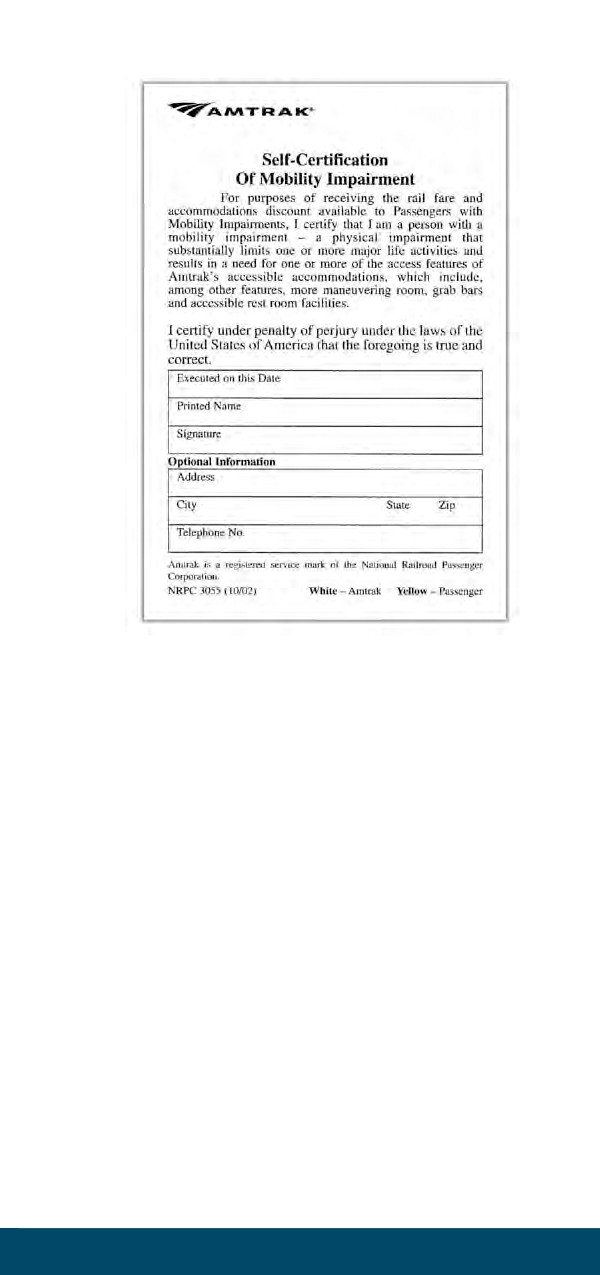
Figure 11-1 - “Self-Certification of Mobility Impairment” (NRPC 3055)
2.
Transferring to/from a Wheelchair
Some passengers may request assistance in transferring
to their seats in the car.
a) Plan the move. Ask the passenger how you can
assist and decide together the most comfortable
and safest way to make the move. Always transfer
the way the passenger requests; they know what
works best. Find out how much the passenger can
help, and decide if you can do it by yourself or if
you need to get help.
b) When making the move, keep your feet apart
and your back straight. Bend your knees and use
your legs. To support your back, stay close to the
passenger or chair, and tighten your stomach and
buttock muscles before and during the move.
Start slowly and stay smooth.
3.
Mobility Pointers
• Do not touch the wheelchair without permission.
• Do not tower over or approach unannounced from
behind, to assist, a person using a wheelchair.
Service Standards Manual No. 6
11-23
• Never grab a person using a cane or crutches.
• Always ask before helping.
4.
Maneuvering Wheelchairs
Be sure to watch for the passenger’s fingers, elbows,
knees and feet while moving the wheelchair.
5.
Transferring the Passenger with ONE Employee
The technique described in the table, “Transferring the
Passenger with ONE Employee”, may be appropriate if
the passenger can partially support their own weight
and assist with their arms. If the passenger cannot
assist to this degree, use the technique described in
Section J “Assisting Passengers with Mobility
Impairments”, Part 6 “Transferring the Passenger
with TWO Employees” of this chapter.
6.
Transferring the Passenger with TWO Employees
Use this technique when the passenger cannot or
prefers not to assist, or when there is room enough
only for the wheelchair to be placed in the aisle,
right next to the seat. Employees should remember
to move together, not apart. Take it easy, and do not
jerk. Use the technique described in the table titled
“Transferring the Passenger with TWO Employees”.
11-24
Assisting Passengers with Disabilities

Transferring the Passenger with ONE Employee
Step 1
• Approach the passenger and ask how you
Plan the Move
can best assist.
• Clarify what you will do and what the
passenger will do.
Step 2
• Position the wheelchair and lock the
Prepare the
wheelchair brakes.
Wheelchair and
• Remove the armrests on the wheelchair
the Seat
and seat, if needed.
• Swing foot rest on the “seat” side, out
of the way.
Step 3
• Have the passenger scoot forward and
Position Yourself
place their hands on the armrest or on
for the Move
your shoulders.
• Place your feet apart, flex your knees,
and lock your knees outside and against
the passenger’s knees.
• Bend your knees, put your arms under
the passenger’s arms, and firmly grasp
their back just below the shoulder blades.
Step 4
• Rock back and forth as you both count
Make the Move
aloud: 1...2...3...
• On the count of 3, pull back as the person
pushes off from the chair.
• Turn and lower the passenger into the
seat.
NOTE: Make sure you pivot your feet. Do not
twist your body from the waist-this can cause
injury. Take a couple of small steps toward the
seat if needed, then bend your knees and lean
back as you lower the passenger to the seat;
this will help you maintain the curves in your
back.
Step 5
• Ask the passenger if they are comfortable.
Follow-Up
• Help them scoot back or shift in the seat,
if needed.
7. Boarding and Detraining
a) Single Level Equipment
• Passengers who use wheelchairs should board
and detrain from high-level equipment to
low-level platforms using the mobile wheelchair
lift, which is raised and lowered by turning a
hand crank.
• People with other mobility impairments may
also use the lift; this includes passengers on
walker, crutches, etc.
Service Standards Manual No. 6
11-25

Transferring the Passenger with TWO Employees
Step 1
• Approach the passenger and ask how you
Plan the Move
can best assist.
• Clarify what you will do and what the
passenger will do.
Step 2
• Position the wheelchair and lock the
Prepare the
wheelchair brakes.
Wheelchair and
• Remove the armrests on the wheelchair
the Seat
and seat, if needed.
• Swing foot rest on the “seat” side out of
the way.
Step 3
• The taller, stronger employee should
Position All
stand behind the wheelchair. The smaller
Involved with
employee should be in front.
the Move
• Back Employee: Put arms under
passenger’s arms and grasp their wrists.
Front Employee: Squat with knees apart
and grasp passenger’s legs under their
knees.
Step 4
• Back Employee: Tighten your seat and
Make the Move
stomac h muscles as you call the move by
counting 1...2...3.
Front Employee: Tighten your seat and
stomach muscles.
• Use your legs to lift up. Lean forward
and straighten your legs as you lift up.
• Take one step over.
• Bend your knees and lower the passenger
into the seat.
Step 5
• Release your grasp.
Follow-Up
• Make sure the passenger is comfortable
before you leave.
b) Superliner Equipment
• Passengers traveling in Superliner equipment
will board using the ramp, which is located in
each car.
• The employee will position the ramp and ask if
the passenger requests assistance. If assistance
is given, push the wheelchair up the ramp or help
control the wheelchair as it goes down the ramp.
c) Emergency En Route
• When there is an emergency en route, it may
be necessary to transfer passengers to another
train or bus without the use of a wheelchair lift.
• If rescue teams are not present, Amtrak
employees may use the “Two-Handed Seat
Carry” or the “Fore-and-Aft Carry” to transfer
passengers. (Refer to Section 7”Boarding and
11-26
Assisting Passengers with Disabilities
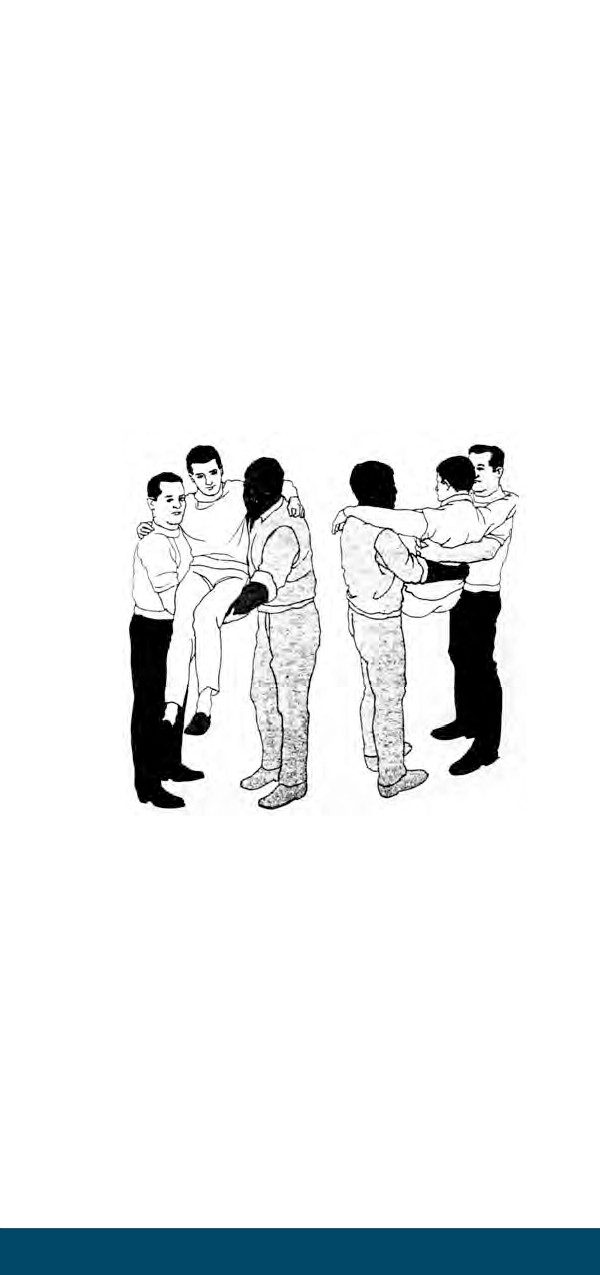
Detraining”, Part 8 “Two-Handed Seat Carry”
or Part 9 “Fore-and-Aft Carry” in this Chapter)
• Remember to get the passenger’s input before
attempting the move and use the principles of
safe lifting.
8. Two-Handed Seat Carry
The two-handed seat carry is a two-person rescue
technique. If the passenger has no serious injuries
and is able to cooperate with the rescuers, they may
be placed on a two-handed seat, as shown, with the
passenger’s arms about the necks of the rescuers and
the passenger’s back supported by the employees’
free hands.
9. Fore-and-Aft Carry
The fore-and-aft carry is another two-person rescue
technique. It may be used in moving an unconscious
person, but it is not applicable when there are serious
torso injuries or other fractures.
Service Standards Manual No. 6
11-27

K.
Assisting Passengers with Speech
Disabilities
A speech disability is any difficulty when a person
communicates verbally. This difficulty does not signify
low intelligence. A person with a severe speech
disability may travel with an interpreter, use written
notes to communicate, speak with an artificial “voice
box,” or use a “sound board,” which is controlled by
a keypad to emit a computerized voice.
When communicating with a person who has speech
disabilities:
• Give the person your full attention and do not
interrupt or finish the passenger’s sentences.
• If you do not understand what the passenger is
saying, ask them to repeat or to write it down.
• Do not say you understand if you do not understand.
• Be patient!
L.
Assisting Passengers Who are HIV
Positive or Who Have AIDS
Generally, you will not know that a passenger has
HIV/AIDS and no particular assistance is needed.
However, in the advanced stages of AIDS, other
debilitating conditions may exist, such as limited
mobility, respiratory problems and general weakness.
Casual contact (e.g., shaking hands; hugging; sharing
restrooms, equipment, food utensils, etc.) will not
transmit HIV/AIDS.
11-28
Assisting Passengers with Disabilities
The guidelines for other passengers apply to this
passenger.
• Keep conversations private.
• Ask only general questions such as “Will you
need any assistance during the trip?”
• Offer to provide at seat or in accommodation
meal service.
• Provide services the passenger requests within the
guidelines set forth in the chapter.
M. Assisting Passengers of Short Stature
People of short stature (dwarfism) are usually no taller
than 4” 10’ in height. Be aware of reach limitations, and
help these passengers with activities such as placing
suitcases in luggage racks, boarding and detraining, and
serving the passenger at the ticket window and Lounge
Car counter.
Remember that the adult passenger of short stature
is an adult and should be treated as such, with
respect and dignity.
N. Assisting Passengers with Hidden
Disabilities
Many types of disabilities are not immediately obvious,
such as psychiatric disabilities, mental retardation,
brain injury, Alzheimer’s or epilepsy. A passenger
with a hidden disability may travel with a Service
Animal (not necessarily a dog). The Service Animal
is an accommodation and must be allowed to travel
with the passenger. Honor requests for pre-boarding.
1.
Psychiatric Disabilities
Like any other group of people, people with psychiatric
disabilities may at times have difficulty coping with
the stresses of travel (delays, crowds and unfamiliar
locations).
• Treat the person as an individual, with respect
and dignity.
• Do not assume the person is in danger or is
dangerous to others.
• Reasonable requests may include written or repeated
instructions, detailed directions, priority boarding,
priority detraining and seating preferences.
Service Standards Manual No. 6
11-29
• Respond to requests in a calm, professional manner
(This will help the passenger cope with further
difficulties).
2.
Tourette Syndrome
People with Tourette Syndrome may make sounds or
gestures, such as tics, they cannot control. Very few
involuntarily say ethnic slurs or obscene words.
• If a passenger with Tourette Syndrome makes
sounds during a conversation, wait for them to
finish, then calmly continue.
• The more the person tries to contain these urges,
the more the urges build up.
• Allow the person to release the buildup in a private
place, if possible.
3.
Epilepsy
Epilepsy is a disorder of the central nervous system
that involves seizures, which are normally controlled
by medication. If a person has a convulsive seizure,
try the following:
• Remain calm, help ease the person onto the floor
on their back, and place soft material under the
head.
• Loosen clothing around the neck and gently turn
the person’s head to the side after the seizure.
• Allow the seizure to take its course, and do not
attempt to restrain the person’s movements.
• Do not expect the person to be able to communicate
during the seizure.
• Do not insert anything into the person’s mouth.
• Stay with the person until they are fully reoriented.
• Call for medical assistance if the seizure lasts more
than five minutes, if seizures occur repeatedly, or
if other injuries have occurred.
4.
Cognitive Disabilities
Some people have cognitive disabilities, affecting
their ability to know, think, remember and learn.
Some of these are developmental disabilities, mental
retardation, learning disabilities or brain injuries.
Like other disabilities, the degree of cognitive disability
differs from person to person.
• Be alert to the way the passenger communicates
and responds.
11-30
Assisting Passengers with Disabilities
• Use simpler words, add gestures, write something
down, draw a picture or repeat yourself.
• Make sure the passenger understands. (Do not ask,
“Do you understand?”) Instead, ask the passenger
what they are going to do, using “who,” “what,”
and “where” questions.
• Again, be patient!
O. Assisting Passengers of Large or
Obese Size
Although most passengers of large size are not disabled
within the meaning of the ADA, unless their size
is due to an underlying disability, treat large size
passengers just like any other passengers and make
reasonable efforts to provide assistance with boarding,
detraining and seating, if requested.
1.
Assistance/Wheelchair Lift
A passenger of large stature may not be able to walk
long distances and may require the use of a wheelchair.
Amtrak has wheelchairs available for passengers’
use at many stations. The passenger may be immobile
and request assistance getting on or off the train.
•
In some cases, a common wheelchair is not sufficient
for a large size or obese person. Many stations
have oversized wheelchairs with some locations
having “people movers” which can accommodate
the larger person.
•
The weight limit for Wheelchair Lifts is 600lbs,
which is for both the wheelchair and passenger.
•
Motorized wheelchairs generally weigh about
250lbs. Therefore, the passenger can weigh no
more than 350lbs to safely use the wheelchair lift.
•
If the employee has some concern that the
combined weight may exceed the 600lbs limit,
the following can be said to the passenger. “The
wheelchair lift can only accommodate a combined
weight of 600lbs for the wheelchair and passenger.
Any weight greater than 600lbs is unsafe for
both the passenger and employees.” Then ask
the passenger if their combined weight with the
wheelchair greater than 600lbs.
•
This conversation must be kept private.
Service Standards Manual No. 6
11-31
•
If you believe that an individual with their
wheelchair weighs more than 600lbs (the maximum
capacity for Amtrak’s wheelchair lift), or is so
large they will not fit on the wheelchair lift, there
may be a risk of harming the individual or the
employees operating the lift. In this situation,
Amtrak may not be able to board the passenger.
Speak with the supervisor to determine if it is
appropriate to provide service to the passenger.
•
If the passenger indicates that the combined
weight exceeds 600lbs, and the only way to board
the passenger is with the lift, the passenger can
be denying boarding.
•
If the passenger indicates that, the combined
weight is less than 600lbs and there is significant
doubt on the part of the employee, contact a
Supervisor or the Conductor.
•
If there is good reason to believe that the passenger
exceeds 600lbs and the lift is the only way to board
the passenger then boarding may be denied.
•
If assisting a large size passenger to board the train
would pose a danger to the safety of the individual
or of the employees assisting them, speak to a
supervisor and determine whether Amtrak can
safely provide service to the individual.
2.
Seating
A large size passenger may require more than one
seat. If a passenger requires more than one seat, they
will need to purchase an additional seat (or seats) at
the applicable fare.
P.
Discounts
When a passenger whose disability is not obvious
requests the special discount fare for passengers with
disabilities, it is appropriate for Amtrak employees to
request documentation of disability. Examples of types
of acceptable documentation are an identification card
that many transit systems provide, a membership card
for a disability organization or a letter from a doctor.
If a passenger does not request a discount, you may
not ask about their disability.
11-32
Assisting Passengers with Disabilities
Q. Complaint Procedures
Crew members should make every attempt to resolve
passenger problems on-board. If the passenger wishes
to report a complaint or concern elsewhere, the
following resources are available:
Call toll-free (800) 872-7245 (USA RAIL) and ask
to speak to a Customer Relations Representative or
log onto www.amtrak.com and click 'Contact Us'.
Service Standards Manual No. 6
11-33