Amtrak. Service Standards Manual for Train Service and On-Board Service Employees (Version 6, 2011) - page 12
e)
Discounted Children Fares
• A child with a disability, ages 2-15, is eligible
for half fare, which is one half the discount fare
for an adult with a disability.
• Up to two children may travel at “half-fare”
with each member of the same party paying an
adult fare.
• For manual calculation, apply a 15% discount
to the applicable adult fare.
• The child’s fare is approximately half the adult
with disabilities fare - this is a 58% discount.
f)
Fares Where Discounts do NOT Apply
•
Auto Train (Exception: Refer to the section
titled “Mobility Impaired and Companion” in
this chapter).
•
Through fares on trains operated jointly by
Amtrak and VIA Rail Canada.
•
Fares already discounted by passenger type,
such as Military Furlough or Travel Agent’s
Familiarization fares.
•
Multi-ride fares.
•
Fares issued by Fares Order, unless specifically
authorized.
•
Government special fares (e.g., ‘FOGM’).
•
USA Rail Pass.
•
Non-Amtrak fares or interline fares.
•
Privately-owned railroad car and special train
charges.
•
Pass rider reduced rates, except Amtrak Red,
White and Blue pass rider fares.
•
Accommodation charges. (Exception: Refer to
the section titled “Mobility Impaired and
Companion” in this chapter.)
•
Other carriers’ service.
g)
Endorsements
• Manually issued tickets will be endorsed
“Disability Discount” and “Evidence of
Disability Required on Train.”
• Arrow generated tickets will carry the proper
endorsements.
h) Good for Travel in Most Accommodations
• Disability discount fare tickets are good for
travel in all accommodations offered by
Amtrak except the accessible accommodations
saved for passengers with mobility impairments.
• Advance reservations may be made at any time.
Service Standards Manual No. 6
8-57
• Appropriate full accommodation charges must
be collected.
i) Stopovers
Stopovers are permitted only where the fare plan
permits.
j) Companions
• All disabled passengers, not just those with
mobility impairments, will be able to bring one
traveling companion at 15% off the best available
rail fare. This will encourage companion travel,
which ensures that the disabled passenger
receives continuous care.
• This companion discount cannot be combined
with other discounts such as AAA, Student
Advantage, Senior Citizen, etc.
• The companion must receive whichever discount
is most advantageous.
4.
Military Furlough
a)
Eligibility
•
Military furlough discount tickets will be sold
to personnel, and dependents of such personnel,
on active duty and traveling at their own
expense of the:
• U. S. Army.
• Navy.
• Air Force.
• Marine Corps.
• Coast Guard.
• Commissioned officers in the U. S. Public
Health Service, the National Oceanic and
Atmospheric Administration or the U.S.
Merchant Marine.
•
Military furlough discount tickets may also be
sold to former active duty U. S. armed forces
personnel within the seven-day period following
the date of their discharge from the service.
•
Reserve personnel qualify only when ordered
to active duty.
•
ROTC (Reserve Officer Training Candidates)
personnel do not qualify for military furlough
fares.
b) Must Present ID Card
To establish eligibility for this discount, a passenger
must possess the following type of documentation
8-58
Train Service Accounting Procedures
in their name and present it to the Conductor or
Assistant Conductor, upon request:
• Active duty United States Uniformed Services
identification card.
• Active duty orders for reserve personnel, along
with a valid identification card.
• Military dependents must present Department
of Defense ID (DD Form 1173).
c)
Fares
• Military furlough fare discount for military
personnel, spouse or dependents age 16-21, is
approximately 10% off the lowest available fare
booked by the passenger.
• This includes regular and discounted one-way
fares, round-trip excursion fares, etc.
• Military dependents, age 2-15, will be charged
one-half this amount when accompanied by
parent or by an adult age 18 or over.
• Use the Discount Tables for On-Board Sales to
determine the 10% discount.
d) Restricted Trains
Military furlough discounts are not good on the
following services:
• Acela Express.
• Auto Train.
• Segments of through Amtrak/VIA Rail
Canada routes operated by VIA Rail.
e)
Endorsement
• Manually issued tickets will be endorsed
“MILITARY.”
• Arrow-generated tickets will carry the proper
endorsement.
f)
On-Board Sale of Sleeping, First Class Seat or
Business Class Accommodations
• Conductors may sell Sleeping Car, Business
Class and First Class seat accommodations to
holders of military furlough tickets.
• The military discount is valid in most accom-
modations offered by Amtrak when paying the
full accommodation charge, provided the travel
meets all other restrictions.
g)
Stopovers
Stopovers are only permitted if the fare plan used
allows them.
Service Standards Manual No. 6
8-59
5.
Mobility Impaired and Companion
These policies apply on all Amtrak trains, including
Acela Express and Auto Train. VIA Rail Canada
policies continue to apply on the Canadian portion
of the Maple Leaf.
a)
Rail Fare Discount
Adult passengers with mobility impairments are
entitled to a 15% rail fare discount, and children
aged 2-15 with mobility impairments are entitled
to one-half of that rate. This is the same discount
allowed for all passengers with disabilities. (Refer
to “Amtrak Passenger Types” in the front of your
Discount Tables for On-Board Sales booklet.)
b) Adult Companion
• A 15% rail fare discount is available for one
adult companion of an adult or child mobility-
impaired passenger.
• Refer to “Amtrak Passenger Types” in your
Discount Tables for On-Board Sales book,
code ‘WC’ for companion of mobility-impaired
passenger.
• This discount is available to any adult
companion of a mobility-impaired passenger,
regardless of class of service being used by
that passenger.
• The companion may travel in the same space
as the mobility-impaired passenger; that is,
both may occupy an Accessible Bedroom or
both may sit in ‘XY’ (or other level of ‘X’)
Accessible Coach seats.
c)
Self-Certification
• In order to receive the special Accessible
Bedroom discounts, described above, a mobility-
impaired passenger traveling in an Accessible
Bedroom may be required to self-certify that
they require one or more of the access features
of that accommodation by completing the
two-part form “Self-Certification of Mobility
Impairment” (NRPC 3055). (Refer to
Figure 8-44)
• The Conductor and Assistant Conductor(s) on
trains equipped with Sleeping Cars must have
a supply of “Self-Certification of Mobility
Impairment” (NRPC 3055) forms with them
while on-duty.
8-60
Train Service Accounting Procedures
•
The “Self-Certification of Mobility Impairment”
(NRPC 3055) is not required for passengers
with mobility impairments in ‘W’ or ‘X’ accessible
Coach accommodations or passengers without
mobility impairments who pay non-discounted
prices for Accessible Bedrooms (Superliners)
or Bedrooms (Viewliners).
•
Passengers who have received this discount at
a ticket office must give the white copy of the
“Self-Certification of Mobility Impairment”
(NRPC 3055), and their ticket, to the
Conductor or Assistant Conductor when
requested or when the tickets are lifted.
•
For passengers who board without the
“Self-Certification of Mobility Impairment”
(NRPC 3055) a member of the train crew must
provide one to be completed by the passenger,
and sell the fare and accommodation at the
appropriate discount.
•
The yellow copy of the “Self-Certification of
Mobility Impairment” (NRPC 3055) is given to
the passenger.
•
Assistant Conductors must give the white copy
of the “Self-Certification of Mobility Impairment”
(NRPC 3055) to the Conductor to put in the
“Train Earnings Reports Envelope” (NRPC 158)
with sorted non-Arrow tickets.
•
The passenger is not required to indicate the
nature of the mobility impairment, only that
they require access to the features of that
accommodation due to having mobility
impairment.
Service Standards Manual No. 6
8-61
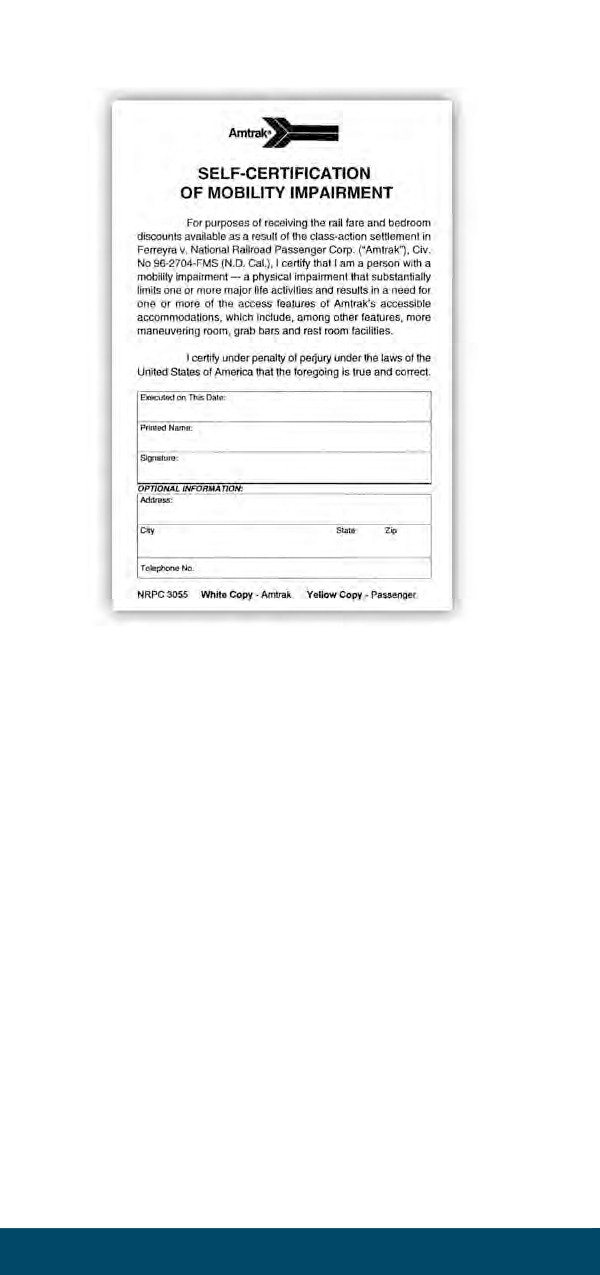
Figure 8-44 - “Self-Certification of Mobility Impairment” (NRPC 3055)
6.
Senior Citizen
a)
Eligibility
• Persons who are 62 years of age or older are
eligible for the Senior Citizen discount.
• Senior Citizen must present proof of age to the
Conductor or Assistant Conductor at time of
ticket collection.
• Proof of age may be in the form of a driver’s
license, passport, birth certificate, resident alien
card or any other official document issued by
local, state or federal government that bears
the passenger’s birth date.
• A Medicare Card issued by the Social Security
Administration, may also be used as “proof of
age.” This is the only form acceptable which
does not bear the passenger’s birth date.
b) Fares
• The Senior Citizen Discount is approximately
15% off published one-way fares.
• All rules applying to the fare against which the
discount is taken must be observed.
8-62
Train Service Accounting Procedures
• To determine the Senior Discount, apply the
fare to be discounted to the 15% discount
table in the Discount Tables for On-Board
Sales book.
c)
Validity Period
Senior citizen discount tickets are subject to the
same blackouts, fees, restrictions and validity
limits as the fare plan used.
d) On-Board Ticket Purchase
• Senior Citizen discount on-board tickets may
only be issued against fares that are valid for
on-board sale.
• Enter “SENIOR CITIZEN” and the fare plan
the discount is applied to (e.g., Senior citizen
YOFC or Senior Citizen YOTC), in the
endorsement box on the COTS.
e)
Endorsements
• Manually issued tickets will be endorsed “SR.
CITIZEN.”
• Arrow-generated tickets will carry the proper
endorsement.
f)
Auto Train
Senior Citizen discounts are not good for travel
on Auto Train.
g)
Acela Express
• Senior Citizen discounts are only good for
travel on Acela Express on Saturday, Sunday
and certain weekday holidays.
• If a passenger presents a senior discount ticket
on-board Acela Express during a blacked-out
period, issue a full fare COTS (the Acela fare
without the senior discount) and advise the
passenger to apply for possible adjustment or
refund at a ticket office or through Customer
Service.
h) Types of Accommodations
• The Senior Citizen discount is valid for most
accommodations offered by Amtrak when
paying the full accommodation charge, provided
the travel meets all other restrictions.
• The Senior Citizen discount is not valid for
travel in accessible space for the mobility
impaired except within the limited parameters
allowed for accessible Sleeping Cars (reservations
made within 14 days of travel when all other
Bedroom accommodations are sold out).
Service Standards Manual No. 6
8-63
• Advance reservations for all but accessible
Sleeping Cars may be made at any time.
7.
Unaccompanied Minor (8-14 years of age)
Unaccompanied travel is not permitted under any
circumstances for children under eight years of age. The
information contained in this section (“Unaccompanied
Minor”) pertains to the Conductor. The entire
Unaccompanied Minor policy can be found in
Chapter 7 “Policies and Procedures.”
a)
An unaccompanied minor is a child passenger 8
through 14 years old who is not accompanied by
a passenger who is at least 15 years old.
b) Departure must not be earlier than 6AM and
scheduled arrival time may not be later than
9PM.
c)
No transfers are permitted.
d) Both origin and destination stations must be
staffed by an Amtrak employee at the time of
boarding and detraining.
e)
An “Unaccompanied Minor Wristband” (NRPC
3150) that contains the Amtrak toll free number
and the reservation number of the minor is to
be fastened around their wrist in addition to the
completed “Unaccompanied Minor Notification
and Release” (NRPC 770). (Refer to Figures 8-45
and 8-46)
f)
Only the adult meeting the child at the destination
station can remove the “Unaccompanied Minor
Wristband” (NRPC 3150)
g)
If more than one minor is traveling, each minor
must have their own “Unaccompanied Minor
Wristband” (NRPC 3150) and “Unaccompanied
Minor Notification and Release” (NRPC 770). A
new form (including an interview) is required for
return trips.
h) The station agent must accompany the minor to
the train.
i)
The adult bringing the minor to the origin station
is expected to accompany the minor to trainside
and remain until the train has departed.
j)
The adult meeting the minor is allowed on the
platform. This is an authorized exception to the
current visitor restriction on platforms.
8-64
Train Service Accounting Procedures
k) The adult meeting the minor must show
identification to the station employee before
being allowed to depart with the minor.
l) The Conductor must:
• note the minor’s location on the train.
• make sure that the minor is located in sufficient
time to prepare for detraining.
• make sure that the minor departs at the correct
destination.
• periodically check on the minor or, if necessary,
have a Train Attendant periodically check on
the minor.
m) If a minor is on-board between the ages of 8-14,
but does not have a “Unaccompanied Minor
Notification and Release” (NRPC 770) form
(unusual conditions), the following procedures
apply:
•
Notify the next staffed station en route
regarding the minor’s destination.
•
If the destination is an unstaffed station,
and the adult is not there to meet the minor,
continue to the next staffed station.
•
Upon arrival at the destination (ticketed or
otherwise), release the minor to a responsible
party or Station Services Agent.
•
File a report with the Station Supervisor or
Agent that includes:
• the name of the minor.
• the fact that the minor under the acceptable
age was traveling unaccompanied without a
release form.
• the minor’s destination.
• to whom the minor was released upon
arriving at the destination (Station Services,
a relative/friend of the minor, etc.).
• verification of the identity of minor’s
relative or friend by examination of a valid
photo I.D., noting same on the report.
Figure 8-45 - “Unaccompanied Minor Wristband” (NRPC 3150)
Service Standards Manual No. 6
8-65
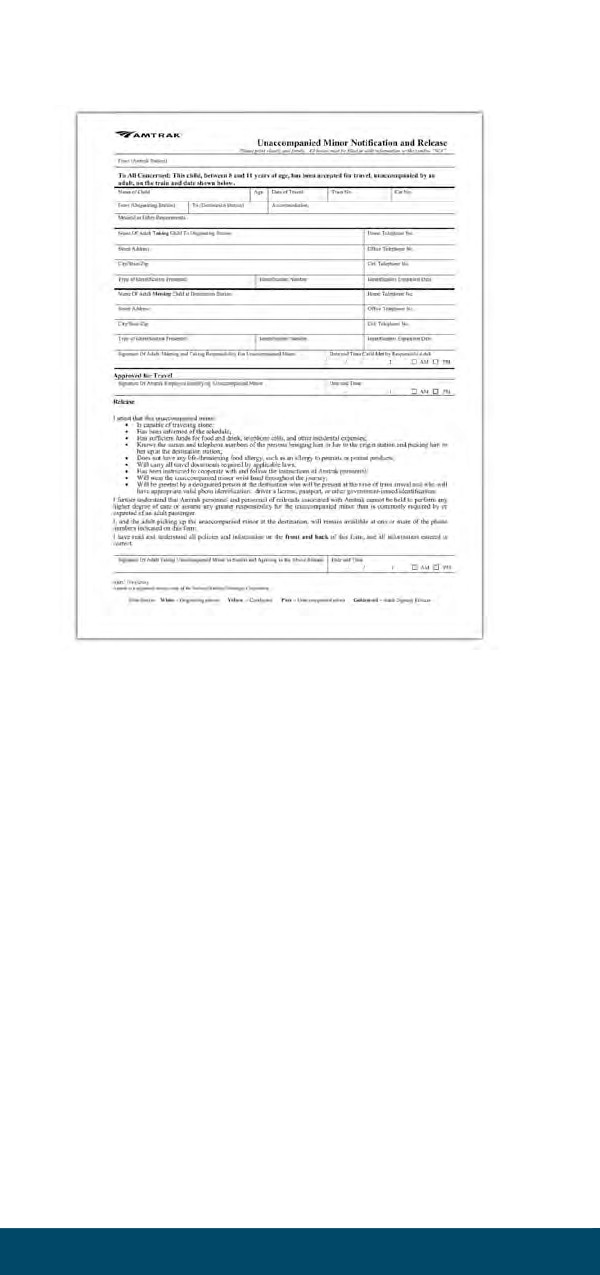
Figure 8-46 - “Unaccompanied Minor Notification and Release” (NRPC 770)
J. Service Classes
A minimum of one rail passage ticket per accommo-
dation is required for all types of accommodations.
In addition to the basic rail fares, there are various
one-way charges for the actual occupied accommo-
dations (Sleeping Car accommodations, First Class
and Business Class seating). Accommodation charges
are shown along with the rail fares in Amtrak tariffs
and must be added to regular rail fares, that are valid
for travel in these accommodations. In First Class
and Business Class seating, each passenger two
and over must pay one applicable accommodation
charge. If one or two children under two years of age
exclusively occupy one First Class or Business Class
seat, one accommodation charge must be paid. No
reduction is granted to children on Sleeping Car
charges, First Class or Business Class seat charges.
8-66
Train Service Accounting Procedures
1.
Acela Express
a)
High speed premium service between Boston,
New York and Washington.
b) Fares are higher than Northeast Regional trains
and are not through-priced with other services.
c)
Two classes of service:
• Business Class.
• First Class.
d) Wheelchair accessible seating and restrooms.
e)
First Class accommodation charge is in addition
to the rail fare.
f)
The use of the flash-pass procedure is prohibited
on Acela Express.
g)
All individuals must have a ticket to ride Acela
Express except for persons who are performing
services and/or inspections directly related with
Amtrak operations in the following capacity:
• Amtrak police officer in uniform or plain
clothes.
• Amtrak employee deadheading (compensated
time) in conjunction with a job assignment.
• Amtrak employee using a “Head End/Train
Authorization Permit”.
• Amtrak employee using a “Train Inspection
Permit”.
• Amtrak employee using a “Temporary Train
Authorization Permit” (NRPC 2889).
• Individual working for a Municipal, State or
Federal Regulatory Agency.
• New Jersey State Police, New Jersey Transit
Police and New York City Police department
officers while on duty and in uniform may
ride but only in the body of the train, unless
otherwise authorized or approved.
h) All employees must refrain from congregating or
sitting in the Café Car, which is intended for the
use of revenue passengers only.
i)
The Conductor has the authority to instruct
individuals, who are in violation of this policy, to
leave the train at the next scheduled station stop.
The Conductor is also required to complete a
“Pass Abuse Incident Report” (NRPC 1502) and
include the yellow copy in the “Train Earnings
Reports Envelope” (NRPC 158).
Service Standards Manual No. 6
8-67
2.
Auto Train
a) Superliner Sleeping Car and Coach service
between Lorton, VA and Sanford, FL.
b) Tickets are exchanged for Boarding Passes at
each terminal; no on-board ticket lift.
c) Passengers are not booked without a vehicle.
3.
Business Class
a) Reserved coach seat on some short and
medium distance trains.
b) Seats offer more leg-room and are separate
from the Coach section of the train.
c) Business Class on Acela Express would be
considered Coach on other trains.
d) On-board amenities vary by route.
e) Business Class amenities (newspaper, beverage)
are not available on the VIA Rail Canada portion
(Toronto to the U.S./Canadian border) of the
Maple Leaf.
f) Business Class accommodation charge is in
addition to the rail fare.
4.
Coach
a)
Each Coach seat reservation entitles passengers
to occupy only one seat per person.
b) An additional seat may be reserved for a Service
Assistance Animal accompanying a blind, deaf or
mobility-impaired person at no charge.
c)
A passenger who requires two seats due to a
disability, including obesity caused by a disability,
a leg in a cast, a hip operation, may book two
seats and pay only one fare.
d) A passenger who requires two seats due to size
alone, not caused by a disability, may book two
seats but must pay the lowest applicable fare for
both seats.
e)
A passenger cannot book two seats simply
because they do not want anyone sitting next to
them. If the train is full, it is very hard to explain
to standing passengers why that empty seat cannot
be used.
f)
A passenger cannot book a Coach seat and a
Sleeping Car accommodation, just so they can
move back and forth between the two spaces.
8-68
Train Service Accounting Procedures

5.
International (VIA Rail Canada)
a) VIA Rail Canada is Canada’s national passenger
rail service.
b) Passengers and train crew members crossing the
border must have one secure Western Hemisphere
Travel Initiative-compliant document.
c) Admission into either country is solely at the
discretion of border authorities, and possession of
required documentation in no way guarantees entry.
d) Passengers can connect to other VIA Rail Canada
services at Montreal, Toronto or Vancouver.
6.
Sleeping Car
a) When several passengers share a Sleeping Car
accommodation, they pay only one accommodation
charge.
EXAMPLE:
Two adults in a Roomette pay two rail fares and
one accommodation charge.
b) Passengers in Sleeping Cars (regardless of age)
must pay the charge for the accommodations used.
c) A passenger cannot book a Sleeping Car
accommodation and a Coach seat, just so they
can move back and forth between the two spaces.
7.
Sleeping Car - Berth Service
For berth service in Sleeping Car rooms, the allowable
number of passengers permitted in the rooms will be
as follows:
a) Chart 1 - For rooms containing 2 Regular Berths.
(Superliner Roomette, Viewliner Roomette,
Superliner Accessible Bedroom and Business
Travel Roomette)
CHART 1
PARTY SIZE
ALLOWABLE
(total number of
PARTY COMPOSITION
passengers in room)
(makeup of the party)
1
1 Child
1 Adult
2
2 Children
1 Adult + 1 Child
2 Adults
3
3 Children
1 Adult + 2 Children
4
4 Children
Service Standards Manual No. 6
8-69

b) Chart 2 - For rooms containing 1 Large Berth
and 1 Regular Berth (Superliner Bedroom,
Viewliner Bedroom and Viewliner Accessible
Bedroom)
CHART 2
PARTY SIZE
ALLOWABLE
(total number of
PARTY COMPOSITION
passengers in room)
(makeup of the party)
1
1 Child
1 Adult
2
2 Children
1 Adult + 1 Child
2 Adults
3
3 Children
1 Adult + 2 Children
2 Adults + 1 Child
3 Adults
4
4 Children
1 Adult + 3 Children
2 Adults + 2 Children
c)
Chart 3 - For room containing 1 Large Berth, 1
Regular Berth and 2 Small Berths (Family
Bedroom)
CHART 3
PARTY SIZE
ALLOWABLE
(total number of
PARTY COMPOSITION
passengers in room)
(makeup of the party)
1
1 Child
1 Adult
2
2 Children
1 Adult + 1 Child
2 Adults
3
3 Children
1 Adult + 2 Children
2 Adults + 1 Child
3 Adults
4
4 Children
1 Adult + 3 Children
2 Adults + 2 Children
3 Adults + 1 Child
5
5 Children
1 Adult + 4 Children
2 Adults + 3 Children
3 Adults + 2 Children
6
6 Children
1 Adult + 5 Children
2 Adults + 4 Children
8-70
Train Service Accounting Procedures

8. Sleeping Car - Non-Berth Service
a) For non-berth service (use seats only - no beds)
in Sleeping Car accommodations, the maximum
allowable number of passengers permitted to
occupy the room is shown in the following chart.
P=Permitted NP=not Permitted
SLEEPING CAR MAXIMUM OCCUPANCY FOR NON-BERTH POLICY -
PASSENGERS WILL USE SEATS ONLY - NO BEDS
PARTY SIZE
PARTY
ROOMETTES & BEDROOMS &
SUPERLINER
(Total number
COMPOSITION
SUPERLINER
VIEWLINER
FAMILY
of passengers
(F = adult;
ACCESSIBLE
ACCESSIBLE ROOM
ROOM
in room)
H = child)
(2 seats)
(4 seats)
(5 seats)
3
3-H
P
P
P
1-F & 3-H
P
P
P
2-F & 1-H
NP
P
P
3-F
NP
P
P
4
4-H
P
P
P
1-F & 3-H
NP
P
P
2-F & 2-H
NP
P
P
3-F & 1-H
NP
P
P
4-F
NP
P
P
5
5-H
NP
NP
P
1-F & 4-H
NP
NP
P
2-F & 3-H
NP
NP
P
3-F & 2-H
NP
NP
P
4-F & 1-H
NP
NP
P
5-F
NP
NP
P
6
6-H
NP
NP
P
1-F & 5-H
NP
NP
P
2-F & 4-H
NP
NP
P
3-F & 3-H
NP
NP
NP
4-F & 2-H
NP
NP
NP
5-F & 1-H
NP
NP
NP
6-F
NP
NP
NP
7
Any
NP
NP
NP
or more
composition
•
Although this situation usually occurs during
daytime travel, this policy is based on the use
of the accommodation - not the time of day or
night.
•
For example, under normal conditions three
passengers can be booked in a Bedroom
because the room sleeps one in the regular
berth and two in the large berth. If, however,
four passengers want to travel in the room and
use it for seating only, three can sit on the sofa
and one in the chair. Therefore, the maximum
number of passengers increases from three
(regular use) to four (non-berth service).
b) On-board upgrades.
• The Conductor or Assistant Conductor will
Service Standards Manual No. 6
8-71
show passengers the room and explain that
seats only - no berths - will be used.
• A rail fare must be collected from each passenger
in addition to one accommodation charge. The
“not more than two child fares per adult fare”
rule applies.
• Each person in the room, up to the maximum
permitted, will receive complimentary meals in
the Dining Car.
9.
Thruway Bus
Amtrak sells Thruway tickets for travel to certain
points not served by Amtrak trains under the name
“Amtrak Thruway Service.” Discounted fares, including
USA Rail Pass and other touring passes may be used.
Such services may be operated by bus, ferry or other
railroads. In some cases, Amtrak charters these services
for the exclusive use of Amtrak passengers. Through
fares to such points are shown in Conductor’s
Memorandum Tariffs. The station listing in the front
of the Conductor’s Memorandum Tariffs indicates
points served. In other cases, through fares have
been established between Amtrak points and points
on regularly scheduled services of other carriers. Such
fares are not shown in the Conductor’s Memorandum
Tariffs and cannot be sold on-board trains.
K.
Conductor’s Memorandum Tariff
Fares and charges shown in Conductor’s Memorandum
Tariff are reproduced from Arrow for the use and
convenience of train crews in collecting fares from
passengers. These fares and charges are subject to all
of the rules and regulations published in Arrow and in
the Conductor’s Memorandum Tariff.
1.
City Arrangment
a) Cities are arranged in the order they occur geo-
graphically, from North to South or East to West.
b) Fares are shown only once for each pair of cities,
but apply in either direction.
2.
Fares
a) Rail passage fares shown in the Conductor’s
Memorandum Tariff apply for direct-route travel
between the points shown along with discounted
fares and accommodation charges.
b) Each passenger of fare-paying age must pay a rail
passage fare.
c) Accommodation charges must also be paid to
occupy Sleeping Cars, First Class and Business
8-72
Train Service Accounting Procedures
Class seats. Acela Express Business Class seats do
not require an accommodation charge since these
seats are comparable to Coach class on regular
trains.
d) Some fares that are published in Arrow may not
appear in the Conductor’s Memorandum Tariffs.
Most of these fares cannot be sold on-board and
include Multi-ride (monthly and varying multiple
trip tickets).
e) Fares are applicable daily, except as otherwise
noted in the fare code rules.
3.
Non-Negotiable On-Board Fare (OBF)
a) The non-negotiable OBF is higher than the
regular fare.
b) Passengers are advised, through various means of
communication, that tickets are less expensive
when purchased in advance versus purchasing
on-board the train at a premium price.
c) The “basic fare” is the basic Amtrak price for the
train in question, not including any on-board
increase.
d) The OBF is the basic fare plus 50% of the fare,
up to a maximum of an additional $9.00.
4.
Tariff Examples
The Conductor’s Memorandum Tariff book lists the
OBF in italics below the basic fare for the city pair.
It appears where at least one of the locations is
designated as a “Staffed Stations.”
EXAMPLE 1:
A passenger traveling BOS - NLC boards without a
ticket. The basic fare is YOFC - $60.00 for Northeast
Regional service or KOAE - $108.00 on Acela Express.
The passenger is charged the OBF of $69.00 for
Northeast Regional service or $117.00 for Acela
Express (basic fare plus $9), which is printed in the
tariff as follows:
BTWN BOSTON, MA (SOUTH STATION BOS)
and NEW LONDON, CT (NLC)
New London, CT (NLC)
YOFC 0
$60.00
$69.00
KOFE 0
$108.00
$117.00
Service Standards Manual No. 6
8-73
EXAMPLE 2:
A passenger traveling SAL-CLT boards without a
ticket. The highest basic fare is YOFC - $14.00. The
passenger is charged the highest OBF of $21.00 (basic
fare plus 50%) that is printed in the tariff as follows:
BTWN SALISBURY, NC (SAL) and
CHARLOTTE, NC (CLT)
CHARLOTTE, NC (CLT)
YOFC 0
$14.00
$21.00
L.
Ticket Lift
1.
Introduction
Tickets are to be taken and punched immediately,
unless the ticket is a flash type. One alternative word
for "taken" is "lifted." “Punching” a ticket is also
referred to as "canceling." Relief train crews are
also responsible for making sure all passengers that
previously boarded have valid and properly canceled
receipts or seat checks. A ticket or fare must be
collected if the passenger can not prove their fare was
taken; however, utmost discretion must be used. A
Ticket Purchase Record is a separate payment
receipt for the entire amount of the transaction that
is retained by the passenger and must not be lifted.
2.
Announcements
(Refer to Chapter 10 “On-Board Announcements &
Signage”)
3.
Conductor’s Punch
a) Each Conductor’s ticket punch has a unique design.
b) A lost or stolen ticket punch must be reported to
the Transportation Supervisor and to the Amtrak
Police. A police report does not exempt an
employee from any possible restitution and/or
disciplinary action.
c) If a loaner punch is issued it must be turned in at
the end of the trip, not exceeding 48 hours after
the end of the work assignment.
• If two days of relief commences within 24 hours
of the work assignment, the limit will be 72 hours.
• Loaner punches must be turned in at the location
where they were issued.
• If the lost or stolen punch has been found, that
punch must not be used until the loaner punch
is retuned.
8-74
Train Service Accounting Procedures
• Employees are prohibited from using more
than one punch on an assignment.
d) If a Conductor or Assistant Conductor finds a
punch that is not theirs, the punch must be turned
in to the Transportation Supervisor.
4.
Location of Punch on Ticket
a)
Unless otherwise indicated on the ticket, the
target of the ticket punch must be top center.
b) The receipt portion of a passenger’s ticket must
also be punched.
c)
There is no specific target for the receipt punch.
d) On Arrow tickets, the letters C and B are printed
along the top edge. Punch the “C” for
Cancellation.
e)
On book tickets, there is a number in the
upper-center endorsement area that corresponds
with the ticket coupon number.
• Punch the number through all of the coupons
as well as the last page.
• On multi-coupon book tickets, the last page is
the passenger’s receipt, and will show a punch
for each coupon lifted.
f)
On Monthly (Flash) tickets, there are various
locations to punch depending on the week of the
month:
• During the first week of the month, punch the
ticket in the top left corner.
• During the second week, punch in the top right
side to the left of the perforated line.
• During the third week, punch in the bottom
left corner.
• During the fourth week, punch in the bottom
right side to the left of the perforated line.
g)
On Multi-Ride tickets, there is a string of numbers
on the bottom line of the endorsement box.
• Punch the next number in sequence.
• If the ticket is endorsed “non-transferable,”
only one person can use the ticket.
• If the ticket is endorsed “transferable,” different
people can use the ticket on different trips, or
several passengers can travel together on one
trip. In this case, one number must be punched
for each person, including children, traveling.
5.
Seat Checks
a) Seat checks must be used to ensure that all tickets
have been collected and to indicate each passenger’s
destination.
Service Standards Manual No. 6
8-75
b) Unused seat checks must never be kept where
the passengers have access to them.
c) The use of seat checks can vary by route or crew
base, and must be discussed during the job briefing.
Some variations include:
• Seat checks are identified by date or pre-deter-
mined code and destination so other train crew
members know that the seat check was issued
by a train crew member on that specific train.
• To reduce attempts to ride dishonestly on a
seat check from a different train, the
Conductor and Assistant Conductor(s) must
know each other’s punch design.
• A relieving train crew may replace the previous
train crew’s seat checks with their own, making
it easier to ensure passengers detrain at the
correct destination.
• Different colors may be used for different
stations.
• Seat checks can be torn, folded, or punched in
a controlled manner.
d) Trains operating through New York to Boston or
Washington, DC.
• Conductors and Assistant Conductors departing
the train at New York will leave the original seat
checks in place.
• Relieving Conductors and Assistant Conductors
boarding at New York will perform a ticket
sweep.
• Relieving Conductors and Assistant Conductors
boarding at Washington, DC will perform a ticket
sweep.
• Conductors and Assistant Conductors working
trains 19, 51, 79, 89, 91 and 97 will issue and place
a white seat check, noting the destination with
a black marker, above the seat of passenger’s
traveling past Washington, DC.
• Lime green “Special Assistance Seat Check”
(NRPC 3242) will only be used for special
assistance as required.
e)
Trains operating south of Washington, DC.
• Conductors and Assistant Conductors will use
one (1) single color check for all destinations for
their respective crew segment and single white
seat check for destinations beyond their crew
change point.
• Lime green “Special Assistance Seat Check”
(NRPC 3242) will only be used for special
assistance as required.
8-76
Train Service Accounting Procedures
• Relieving Conductors and Assistant Conductors
will perform a ticket sweep and will replace all
white seat checks with their respective color
within their work segment.
• Conductors and Assistant Conductors working
trains 19, 20, 79, 80, 89, 90, 91, 92, 97, 98, 1, 2, 50,
51, 171, 58, 59, 176, 145, 147, 156, 94, 95, 66, 67,
194, 99 and 83 will implement the seat check
plan for the respective crew segment. One seat
check will be issued to each individual ticketed
passenger and a notation will be made on seat
check for any unticketed infant.
• Conductors and Assistant Conductor will place
the seat check, noting the destination station
code with a black marker, above the respective
passenger’s seat. Only one (1) seat check per
passenger.
f)
During a ticket lift, a passenger is permitted to
pass a Conductor or Assistant Conductor without
a seat check.
• The Conductor of Assistant Conductor must
verify that the passenger’s ticket has been lifted
by examining the receipt.
• If a passenger presents a ticket and wants to
pass, collect the ticket and issue a seat check.
g)
If a seat check appears to have been altered or is
questionable,
• ask to examine the passenger’s ticket receipt.
• the seat check must be compared to information
on the ticket receipt.
• ask the passenger to pay if it is determined
that the seat check is a fraud.
• refer to the rules describing passenger removal
if they refuse to pay.
• have another train crew member as a witness
while dealing with the situation.
h) Seat checks can be used to mark a passenger’s
seat location for completing a transaction later.
• If a time-consuming transaction will prevent a
fare collection, prepare a special seat check for
that passenger.
• This seat check can be a different color, torn
in half or unique identifying character ($ to
indicate cash fare).
• If there is a question about a passenger’s form
of payment or ticket authenticity, their seat
location must be marked so the Conductor or
Service Standards Manual No. 6
8-77
Assistant Conductors can confer with another
employee.
i)
Special Assistance Seat Check (NRPC 3242)
(Refer to Figure 8-47)
•
Passengers must either be identified on the
manifest that they need special assistance, or
indicate to a train crew member that they need
special assistance before a “Special Assistance
Seat Check” (NRPC 3242) can be issued.
•
The “Special Assistance Seat Check” (NRPC
3242) is to be placed with the destination seat
check above the passenger’s seat.
•
Situations that warrant the use of a “Special
Assistance Seat Check” (NRPC 3242) include,
but are not limited to:
• Unaccompanied minors.
• Passenger indicates they have difficultly
hearing announcements.
• Sight impaired passenger requests assistance
navigating.
• Passenger using service animals requests
assistance.
• Passenger indicates they need meal service
at their seat.
• Passengers request assistance:
• With a wheelchair or mobility device.
• Boarding/Detraining.
• With baggage.
• To/from restroom.
• Reading a menu.
• All Train Service employees and Train
Attendants (working in Coaches) are
required to carry an ample supply of the
“Special Assistance Seat Check” (NRPC
3242) while on duty. These seat checks are
available at every crew base.
j)
Used seat checks, or any portion of a seat check,
must be placed in trash receptacles.
8-78
Train Service Accounting Procedures

Figure 8-47 - “Special Assistance Seat Check” (NRPC 3242)
6.
ID Verification
The identification verification process applies only
to passengers eighteen (18) years of age or older. If
during the course of executing the “Random On-
Board Ticket Verification Procedure” the passenger’s
age comes into question. Ask the passenger their age.
a)
If the passenger responds they are 18 or older
and do not have valid identification, or the
identification does not match against the name on
the face of the ticket, and there is no reasonable
explanation for the discrepancy, the Amtrak
police must be notified by the quickest available
means away from the passenger. Failure to possess
the proper photo identification is not, by itself,
sufficient reason to have the passenger removed
from the train.
b) If the passenger responds they are 17 or younger
and do not have valid identification, the
Conductor must accept the age of the passenger.
• The Conductor, at their discretion, may contact
the Amtrak police for assistance, away from
the passenger, if:
• The passenger has physical features that
make them appear to be older than 17.
• They suspect that the passenger is older
than they claim.
Service Standards Manual No. 6
8-79
• The passenger has no way to prove their age.
• In this situation, failure to verify a passenger’s
age or possess the proper photo identification
is not, by itself, sufficient reason to have the
passenger removed from the train.
c) Amish and Mennonite persons are not required
to have photo identification. Any person stating
that they are Amish or Mennonite, and wears the
distinctive dress of these communities, may present
non-photo identification containing a physical
description of the individual.
d) Parolees from correctional facilities are provided
with current, dated release papers, but may have
no photo identification. These papers may be
accepted for verification, if the name matches the
one on the ticket.
7.
Correcting an Incorrect Punch
a) When a punch is made in error on any type of
ticket other than a COTS, correct the error by
drawing a tight circle around the punch cut on
the face of the ticket.
b) Near the circle write: the train number, date and
sign it.
c) A COTS may not be corrected in this manner.
d) The COTS must be voided and a new COTS
issued.
8.
Punch Indicating Baggage Checked and Reverse
Direction
Sometimes a ticket will have punch targets for special
purposes that do not cancel a ticket.
a) Baggage Service
• On Arrow tickets, the baggage punch (B is for
Baggage checked) shows that the passenger’s
luggage has been taken to the train’s Baggage
Car and will be taken to the baggage claim
area at the passenger’s destination station.
• The baggage punch is the passenger’s proof
that Amtrak has the passenger’s baggage.
b) Reverse Direction
The reverse direction punch indicates that the
passenger traveled in the reverse direction from
that which the ticket reads.
• If there is no target indicating that the ticket
has been used in the reverse direction, and it is
8-80
Train Service Accounting Procedures
appropriate, punch the direct center of the
ticket.
• If the ticket punch will not reach the center,
punch as close to the center as possible under
the top center punch.
• The top center punch always must be punched.
• The ticket must only be punched indicating
that it was used in the reverse direction if the
passenger only travels part of the journey and
will continue later.
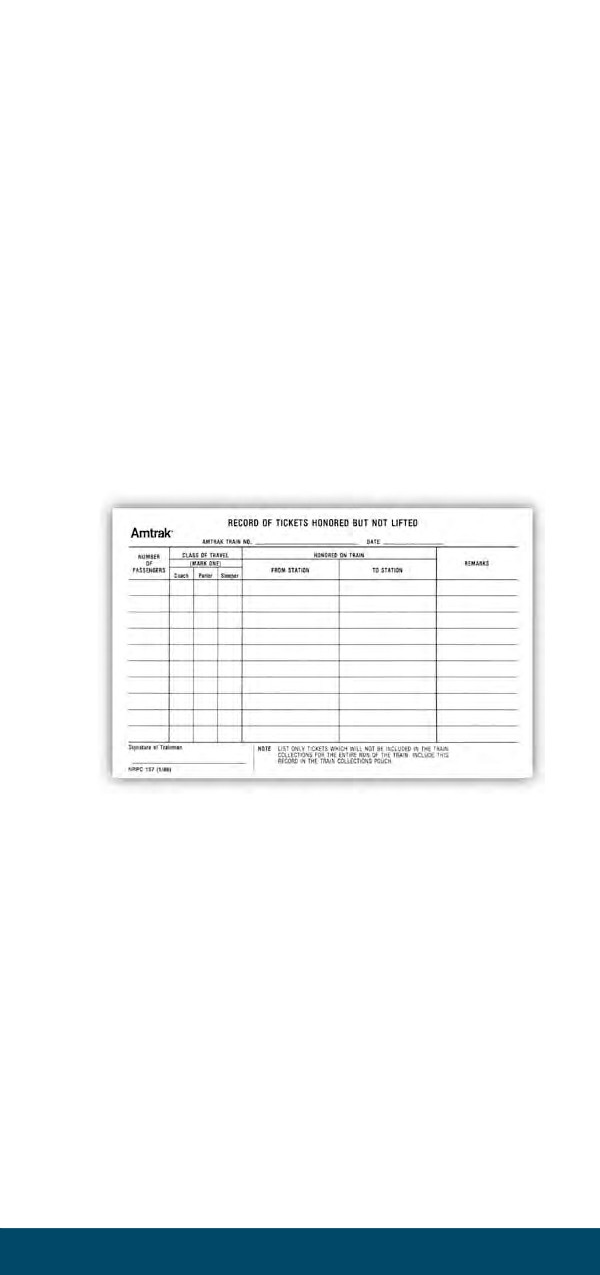
9. Tickets Honored But Not Lifted (157)
Tickets honored but not lifted must always be
recorded on a “Record of Tickets Honored But Not
Lifted” (NRPC 157) (Refer to Figure 8-48) or
“Uncollected Fare Report” (NRPC 3008). (Refer to
Figure 8-69)
Figure 8-48 - “Record of Tickets Honored But Not Lifted” (NRPC 157)
a) The “Record of Tickets Honored But Not Lifted”
(NRPC 157) report must be used whenever there
is no ticket or document for the “Train Earnings
Reports Envelope” (NRPC 158). Total ridership
counts come from the “Train Earnings Reports
Envelope”(NRPC 158) which determines train
crew size and train consists.
b) Multi-trips tickets, stopovers, and any other tickets
that are honored but not lifted must be accurately
documented on “Record of Tickets Honored
But Not Lifted” (NRPC 157). When in doubt,
complete a “Record of Tickets Honored But Not
Lifted” (NRPC 157).
Service Standards Manual No. 6
8-81
c) The “Record of Tickets Honored But Not
Lifted” (NRPC 157) is the only officially accepted
document for billing Commuter Agencies with
whom Amtrak has contracts to honor commuter
tickets. This is an absolute must if Amtrak is to
be paid.
d) Do not complete a “Record of Tickets Honored
But Not Lifted” (NRPC 157) for authorized
deadheading train crew members or employees
with proper documentation that allows them to
ride without a ticket. Some non-employees are
allowed to ride without a ticket, as long as they
have the proper documentation, such as commuter
agency employees on Amtrak-operated commuter
trains.
e) A copy of the “Record of Tickets Honored But
not Lifted” (NRPC 157) must be placed in the
“Train Earnings Reports Envelope” (NRPC 158).
M. Ticket Disposition En Route
1.
Sorting Tickets
a)
Conductors are responsible to ensure that the
“Train Earnings Reports Envelope” (NRPC 158)
is maintained correctly.
b) Conductors must instruct Assistant Conductor(s)
to present their lifted tickets and transportation
documents to them as soon as possible. This helps the
Conductor to have the tickets sorted at crew change/
end of the train run. This also helps determine
who was on the train in the event of an accident.
c)
There are instructions on the flap of the “Train
Earnings Reports Envelope” (NRPC 158) for
sorting tickets.
d) Never throw tickets into the “Train Earnings
Reports Envelope” (NRPC 158) that are not
secured with rubber bands or paper clips (never
use staples).
e)
Arrow and ARC tickets MUST all be face up and
in the same direction. These tickets are machine-read.
f)
There is no need to separate the different
accommodations of the same types of tickets.
g)
Remove any staples that are in tickets.
h) All like-tickets and documents including passage
coupons from COTS, book-type tickets, carry
orders, “On-Board Passenger Record” (NRPC
3085), reports, etc. — must be bundled together.
8-82
Train Service Accounting Procedures
The exception is the Arrow commuter tickets,
which must be bundled separately.
i) Each relieving Conductor and Assistant
Conductor must add to the bundles, not make
new ones.
2.
Live vs. Dead Tickets
a) “Coach Tickets Envelope (Long Haul)” (NRPC
218) and “First Class Tickets Envelope (Long
Haul)” (NRPC 219) are used for passengers still
on the train. Tickets in this category are referred
to as “live.” These must be used for passengers who
will detrain beyond the run of the Conductor or
Assistant Conductor who made the collection.
b) After a passengers detrains, the ticket is considered
“dead.” These tickets must be added to the
appropriate bundle in the “Train Earnings
Reports Envelope” (NRPC 158).
3.
Long-Distance Trains Ticket Envelopes
a)
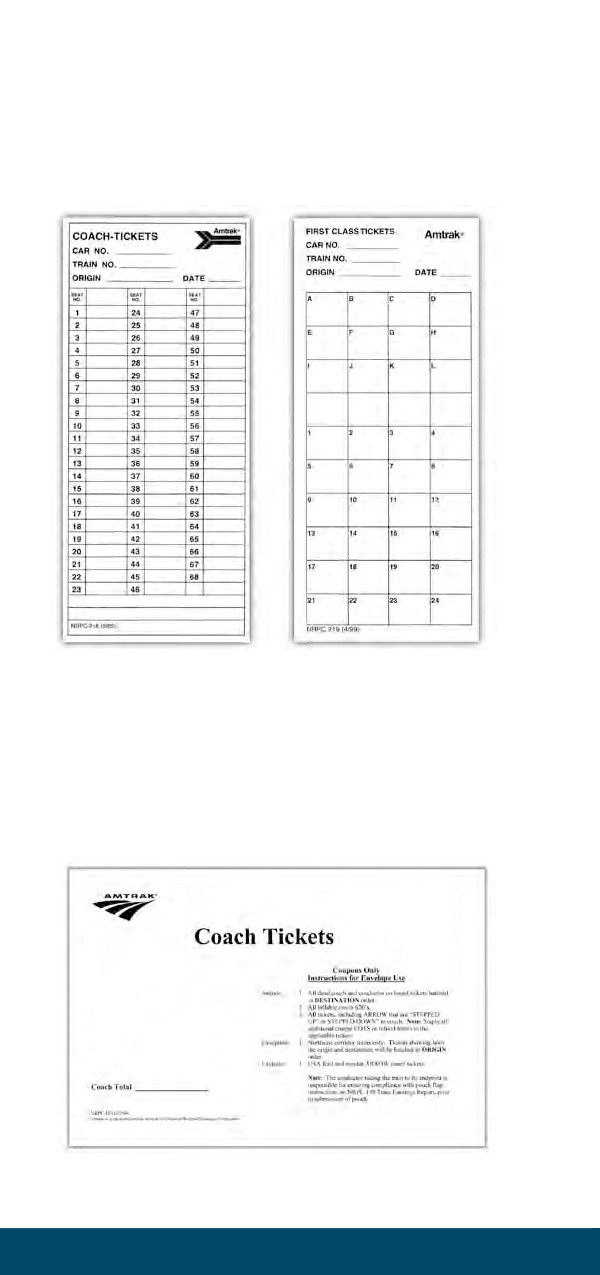
The “Coach Tickets Envelope (Long Haul)”
(NRPC 218) is used for recording the passengers
traveling in Coach Cars. Printed on the outside
of the envelope are numbered spaces indicating
seat locations where the passenger’s three-letter
city code destination can be entered. (Refer to
Figure 8-49)
b) The “First Class Tickets Envelope (Long Haul)”
(NRPC 219) is used for recording the passengers
located in the Sleeping Cars. Printed on the outside
of the envelope are numbered spaces indicating
Sleeping Car accommodations where the number
of passengers in each accommodation and three-
letter city code destination can be entered. (Refer
to Figure 8-49)
c)
To prevent a misunderstanding en route, the
live tickets can be endorsed on the face of the
ticket. A useful method is to indicate the space
like a fraction: the seat or accommodation as the
numerator and the car number as the denominator
(e.g., 3/3601).
d) Once a passenger detrains, their ticket must be
taken out of either the “Coach Tickets Envelope
(Long Haul)” (NRPC 218) or “First Class Tickets
Envelope (Long Haul)” (NRPC 219), bundled
Service Standards Manual No. 6
8-83
with rubber bands and paper clips and placed in the
“Train Earnings Reports Envelope” (NRPC 158).
e) At the train’s final destination, all tickets must
be in the “Train Earnings Reports Envelope”
(NRPC 158).
Figure 8-49 - “Coach Tickets Envelope (Long Haul)“ (NRPC 218) and
“First Class Tickets Envelope (Long Haul)“ (NRPC 219)
4. Short-Distance Trains Ticket Envelopes
For short-distance trains “Coach Tickets Envelope
(Short Haul)” (NRPC 183) and “First Class Tickets
Envelope (Short Haul)” (NRPC 181) are provided.
“Live” tickets must be placed in the appropriate
envelope. (Refer to Figures 8-50 and 8-51)
Figure 8-50 - “Coach Tickets Envelope (Short Haul)” (NRPC 183)
8-84
Train Service Accounting Procedures
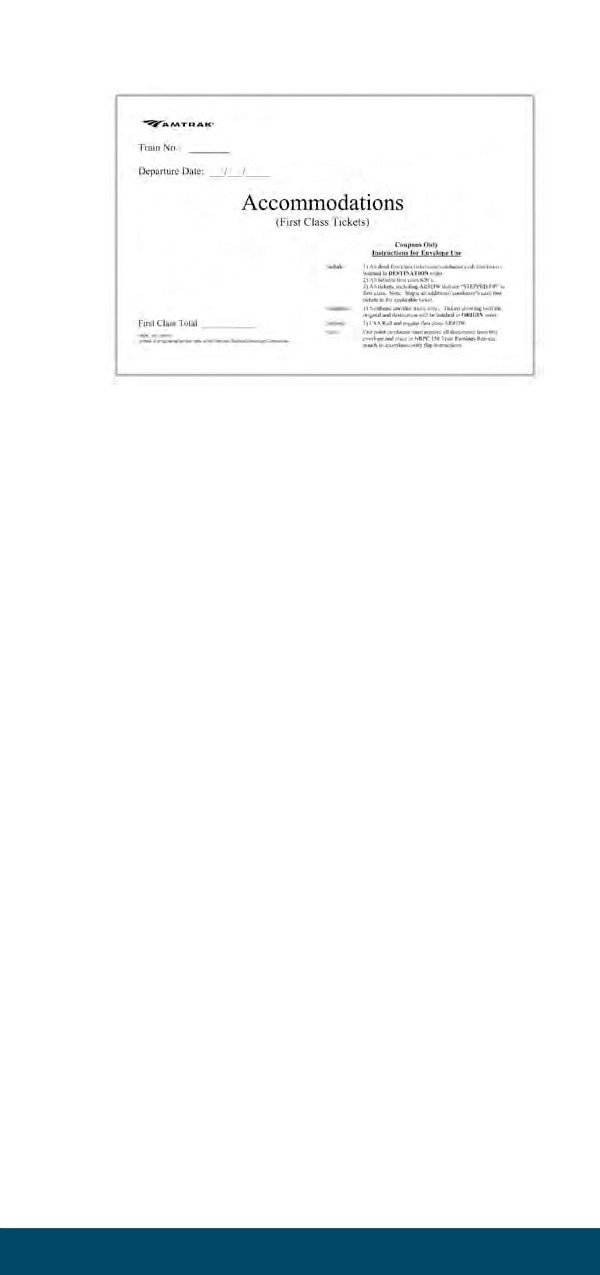
Figure 8-51 - “First Class Tickets Envelope (Short Haul)” (NRPC 181)
N. Conductor On-Board Ticket Stock (COTS)
1.
Introduction
COTS must be issued in the presence of the passenger,
and all copies of the ticket must be punched as a
single transaction. The Conductor or Assistant
Conductor must inform the passenger that they
are required to provide valid photo identification.
COTS may be used with un-ticketed passengers in
the following categories: cash, credit card payment,
payment due, passenger removal, prior erroneous
lift, carry-bys and deadheading railroad employees.
COTS must be used in consecutive order.
a) COTS, also referred to as cash fare receipts or as
ticket stock, are chargeable items.
• Always keep the tickets/COTS documents in
a secure place (on your person or in a locked
place) so that they cannot be picked up or seen
by a casual observer.
• Amtrak retains the right to make appropriate
collection against Conductors and Assistant
Conductors who have not shown proper care
of company cash, checks, credit cards and COTS.
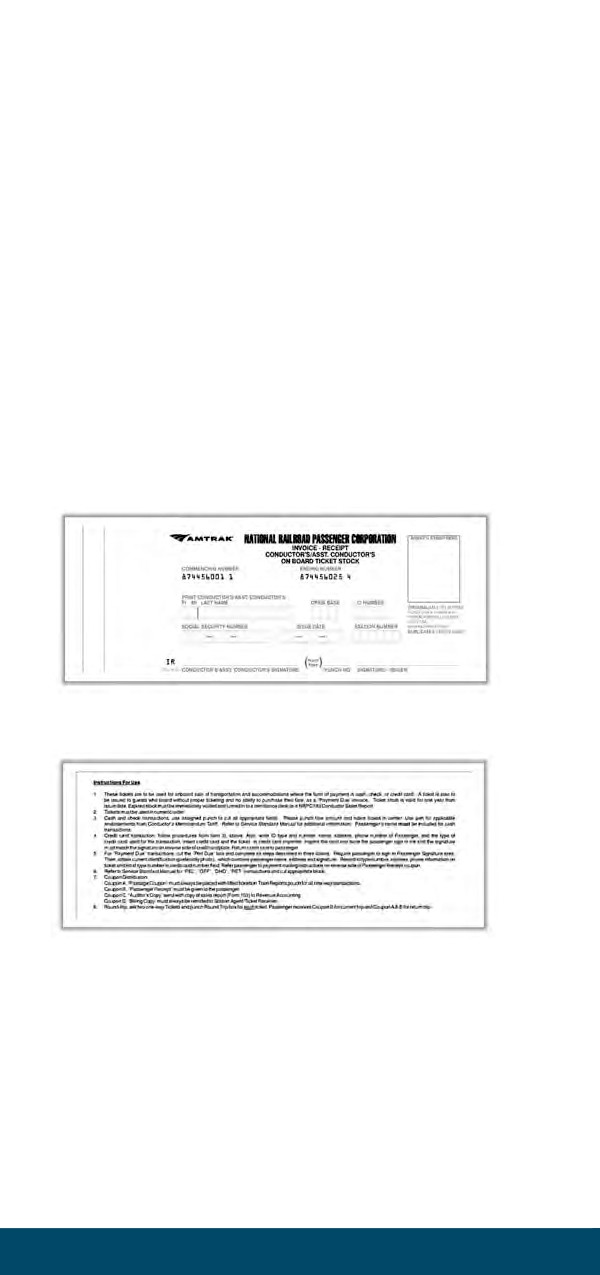
b) Drawing and using pads of COTS
• When COTS pads are issued, the Conductor
or Assistant Conductor must complete the
required information on the invoice receipts
(two copies) attached to the top of each pad.
• Conductors and Assistant Conductors are
responsible for verifying that the COTS pads
have 25 consecutively numbered tickets.
Service Standards Manual No. 6
8-85
• Legibly print:
• your name
• crew base three-letter code
• employee SAP number
• date
• station’s six-digit number
• ticket punch number
• Conductors and Assistant Conductors must
sign and punch the receipts for the COTS.
• COTS pads must be used sequentially.
• COTS pads must be used in the order in which
they were drawn.
• Employees must not transfer COTS between
train crew members; if one train crew member
runs out of COTS another employee must
complete the fare(s).
c)
Required quantities of COTS
Each Conductor and Assistant Conductor must
carry two pads unless they are working:
• Grand Rapids service and the Heartland Flyer
must carry three pads.
• Maryland Rail Commuter Service must carry
four pads.
• Connecticut D.O.T. must carry four pads.
• San Joaquin service must carry four pads.
• Capitol Corridor service must carry four pads.
• Zone 2,Washington extra board must carry
four pads.
d) Lost, Stolen or Found COTS
• Lost or stolen COTS must be reported to your
Supervisor and to the Amtrak police.
• Police reports must include the lost or stolen
COTS ticket numbers.
• Describe the incident and include the police
location, date, incident number and stock
numbers on the “Conductor/Asst. Conductor
Sales Report” (NRPC 193).
• The “Conductor/Asst. Conductor Sales Report”
(NRPC 193) which lists the stock missing,
and a copy of the police report, must then be
presented to the Conductor’s or Assistant
Conductor’s supervisor for their signature, date
and handwritten notation of “OK to Issue
Additional Stock.”
• The completed and signed “Conductor/Asst.
Conductor Sales Report” (NRPC 193), along
8-86
Train Service Accounting Procedures
with a copy of the police report, must then
be presented by the Conductor or Assistant
Conductor to a station agent or ticket receiver
for issuance of replacement COTS pads.
• A police report does not exempt an employee
from any possible restitution and/or disciplinary
action.
• If COTS becomes missing, and then found, the
Conductor or Assistant Conductor must void
the COTS and remit on a “Conductor/Asst.
Conductor Sales Report” (NRPC 193).
• The Amtrak police must be notified that the
COTS was found (with the original incident
report information).
2.
Working With Multiple Sets of COTS
Transportation supervisors may want a Conductor
or Assistant Conductor to have more than the set
number of COTS. If so, that supervisor must make
written arrangements with the issuing office.
a)
The Conductor or Assistant Conductor must
make a note, in the comments area, on the first
(NRPC 193) that they are working with additional
COTS, when turning in the additional COTS.
b) The notation must include the name of the
supervisor and the number of additional COTS
received and returned.
c)
The Conductor or Assistant Conductor must
understand exactly when the extra COTS must
be turned in.
d) To reduce the number of chargeable COTS, the
Conductor or Assistant Conductor must void all
unused of COTS and record the voided numbers
in the comments area of a separate
“Conductor/Asst. Conductor Sales Report”
(NRPC 193) until they have the authorized
amount of COTS.
e)
If chargeable stock is ruined, each piece must be
voided and remitted with the “Conductor/Asst.
Conductor Sales Report” (NRPC 193).
f)
COTS is not valid for sale after one year has
elapsed from its issuance date.
g)
All COTS must be voided and returned on its
one-year anniversary (or the first opportunity
thereafter), using a separate “Conductor/Asst.
Conductor Sales Report” (NRPC 193).
Service Standards Manual No. 6
8-87
h) Missing COTS and/or punches can become a
serious matter and punitive measures can include
being charged a reasonable amount for each
missing ticket, being charged for lost punches
and, in some cases, dismissal.
3. COTS Layout
a) COTS have been printed so that the punch targets
are aligned.
• Spot carbon has been provided so that
information imprinted on Coupon A will
appear on Coupons B, C and D with only
the last four digits of the credit card.
• The pads of COTS come with a cardboard
cover (See Figure 8-52 and 8-53) long enough
to place between COTS to shield the spot
carbon of the COTS below.
Figure 8-52 - Front Cover of “Conductor’s/Asst. Conductor’s
On Board Ticket Stock” (COTS)
Figure 8-53 - Back Cover of “Conductor’s/Asst. Conductor’s
On Board Ticket Stock” (COTS)
b) All applicable blocks must be punched completely
within the blocks.
c) Written information must be contained within
the spot carbon area.
d) The Endorsement Box must contain the following
information:
8-88
Train Service Accounting Procedures
• The fare class for the type of accommodation
occupied (e.g., Coach, Room/Car Number for
Sleeping Car, Business Class seat, etc.).
• The fare basis (e.g., senior citizen, military,
student, promotional, etc.).
• The alphanumeric fare code as listed in the
Conductor’s Memorandum Tariff (e.g., YOFC,
DOF1, EB, DS, etc.).
• Ticket number of other ticket if COTS is
issued in conjunction with another ticket
(e.g., on-board upgrade, extended travel, etc.).
•
“Pd by Ck” if passenger paid with a personal
check.
• Passenger reservation number, or “No Res #”
if passenger did not have a reservation.
e)
The fare code does not need to be indicated for an
adult traveling alone at the regular one-way fare.
f)
The fare class and fare basis do not need to be
indicated if travel is in Coach and is not discounted.
g)
The three-letter city code or the entire city name
must be entered for the passenger’s origin and
destination in the “From” and “To” boxes under
the Endorsement Box.
h) The total fare must be handwritten in the space
under the “From” and “To” boxes.
i)
Punch the 1, 2, 3 or 4 in the top row for the
number of full-fare passengers and the bottom
row for the number of half-fare passengers. If
there are more than four in any category, use the
spot carbon area to write in the information.
j)
Punch the “Unstaffed/Closed Station” or
“Station Override” box if either is applicable.
k) Punch the “In Conn With” box when additional
collection is necessary. This tells Revenue Accounting
that this was only a monetary transaction - not an
additional passenger for recording ridership.
• Passengers who want to travel beyond their
ticketed destination or board before their
ticketed origin. If a journey is extended, indicate
the “From” and “To” for the extension.
• Passengers who want to upgrade to better
accommodations.
• Passengers who want to use restricted/blacked-
out tickets on the restricted / blacked-out time
or date.
• Use for non-transportation charges.
Service Standards Manual No. 6
8-89
l) Even though two separate COTS are required for
selling a round-trip on-board, the “Round Trip”
box must be punched on both COTS.
m) Punch the “Train Check” box if the COTS is
valid on a train other than the one on which it
was issued. This could happen if a passenger
wants to purchase transportation to a destination
that will require a change of trains and, therefore,
a ticket for the second train.
n) Punch the month and date in the calendar area.
o) If the appropriate station city-codes are listed
on the COTS, punch the “From” origin station
in the blue shaded column, and punch the “To”
destination station in the white column.
p) Punch the total amount of the fare using the blue
amount boxes in the upper right corner of the COTS.
q) If payment is by credit card, imprint the card
information in the area at the bottom left side of
the COTS and circle the type of card used.
r)
Always print the passenger’s name on the
COTS, as well as other information if required
(e.g., payment due, etc.).
s)
For credit card and payment due, have the
passenger sign the COTS on the line provided.
t)
If the punches on the COTS do not clearly
represent the intent, use the spot carbon area to
explain the details.
u) The ticket number is printed vertically in the
center of the COTS. Do not include the single
digit that stands alone - that is a control number
and is not part of the ticket number.
O. Selling Ticket Using Conductor
On-Board Ticket Stock (COTS)
1.
Preparing/Punching COTS
a) A COTS for the exact amount of the fare
must immediately be completed in the presence
of the passenger(s), and the passenger receipt
portion of the COTS given to the passenger at
the end of the transaction.
8-90
Train Service Accounting Procedures
b) Prepare a COTS, completing all spaces.
c)
Conductors and Assistant Conductors must
charge the exact fare listed in the Conductor
Memorandum Tariff.
• Failure to charge the exact fare can result
in the Conductor or Assistant Conductor
being issued a debit for the difference and/or
disciplinary action.
• Sale of fares beyond the run of the train is not
required.
• However, if a Conductor or Assistant
Conductor has the proper Conductor’s
Memorandum Tariff for that train beyond their
train run, they may sell the fare and issue a
ticket unless that fare is blocked by the tariff
or if the next train requires reservations.
d) If an error is made punching the COTS, void it
and start again.
e)
To void COTS, simply write “VOID” on all
coupons and then cancel the COTS by single
punching the ticket.
f)
All voided coupons MUST be remitted with the
“Conductor/Asst. Conductor Sales Report”
(NRPC 193) with the voided ticket number(s)
entered in the comments section.
g)
If the train is sold out, a passenger without a
reservation must be advised that if carrying them
causes any standing conditions they will have to
stand, since they did not have a reservation for
the train.
h) In the event space is sold on-board trains,
the Conductor or Assistant Conductor must call
(800) 205-0711 (the phone number is also on the
manifest) and provide passenger name, origin and
destination, train number, room and car number,
and any other pertinent information requested.
2.
One-Way
a) A regular one-way ticket is issued at the published
fare between most points where Amtrak provides
direct service (no change of trains).
Service Standards Manual No. 6
8-91
b) Regular one-way fares may also be shown
between certain other points where the fare is
designated as a connection/transfer fare.
c) Tickets are good for travel at any time for one
year, including the date of sale.
3.
To Canada on the Maple Leaf
a)
When a single ticket is sold by an Amtrak station
or travel agency routed over Amtrak and VIA
Rail Canada on the Maple Leaf, the ticket must
be lifted and a COTS issued.
b) The exchange ticket origin must read from the
station where the VIA Rail Canada Conductor or
Assistant Conductor take over.
c)
The destination must be the same as the one
shown on the lifted ticket.
d) Punch the date and other applicable blocks, but
do not punch or write any revenue amount. This
is a zero value COTS.
e)
Write any appropriate information needed by
the VIA Rail Canada Conductor or Assistant
Conductor in the spot carbon area.
f)
The following is an example of a passenger
traveling from Albany, NY to a destination in
Canada on the Maple Leaf:
• A customer boards the Maple Leaf without a
ticket and requests a destination on VIA Rail
Canada territory.
• The customer must be sold the through fare,
however, two COTS must be completed.
• The first COTS ticket must list the actual origin
station as Albany, NY with a destination of
U.S./Canadian Border, (CBN).
• The full through fare must be punched and
written on the first COTS.
• Additionally, the “In Conn With” box must be
punched, and in the endorsement spot carbon
area, the next COTS ticket number must be
referenced.
• The second COTS ticket must show an origin
station of U.S./Canadian Border, (CBN) and
the actual destination city on VIA Rail Canada.
• There must be no amount recorded (zero
value) on this second COTS.
8-92
Train Service Accounting Procedures
• The “In Conn With” box must be punched, and
the ticket number of the first COTS must be
referenced in the spot carbon endorsement area.
g) Coupon distribution:
• Coupon A (Passage Coupon from VIA Rail
Canada portion COTS) Always give to the
passenger for lift by VIA Rail Canada.
• Coupon A (Passage Coupon from Amtrak
portion COTS) Always placed in the “Train
Earnings Reports Envelope” (NRPC 158).
• Coupon B (Passenger Receipt from both
COTS) Always given to passenger.
• Coupon C (Auditor’s Coupon from both
COTS) Always remitted to Station Ticket
Agent/Ticket Receiver.
• Coupon D (Billing Coupon from both COTS)
Always remitted to Station Ticket
Agent/Ticket Receiver.
4.
Round-Trip
a)
Roundtrips must only be sold by issuing two (2)
separate one-way tickets, using two (2) separate
COTS tickets.
b) Each coupon must be sold with city pairs
punched or written in the proper direction.
c)
If a credit card payment is made for each ticket,
then all required credit card information must be
recorded individually on each ticket.
d) Printing or recording of personal information
contained on the photo ID is prohibited.
e)
Punch the Round Trip block of both tickets, even
though they are single fares.
f)
The passenger must be given two (2) Coupon B's,
Passenger Receipts, one from each COTS ticket.
g)
The passenger must also receive Coupon A,
Passage Coupon, from the returning one-way ticket.
h) Coupon A of the originating one-way ticket (the
train on which the sale is occurring) must not be
given to the passenger, and must be placed in the
“Train Earnings Reports Envelope” (NRPC 158).
i)
When the passenger boards the train for their
return one-way trip, the passenger will present
Coupon A to the Conductor or Assistant
Conductor who will place it in that train’s “Train
Earnings Reports Envelope” (NRPC 158).
Service Standards Manual No. 6
8-93
j) For all types of roundtrip tickets, write the return
fare restrictions/blackouts in the spot carbon
space (such as no good at certain times or dates).
Before preparing the COTS, you must explain the
return-trip restrictions/blackouts to the passenger.
k) When reservations are necessary for the return
trip, the Conductor or Assistant Conductor must
explain this before preparing the COTS.
• Passengers must be told that the reservations
are not guaranteed; they are first come, first
served.
• Inform passengers on how and where to make
reservation.
5.
Farther Destinations
a)
A passenger wanting to travel to a destination
beyond that shown on their ticket is to be granted
the benefit of the through fare on a route.
b) Subtract the original fare paid from the fare of
the original starting point to the new destination,
and charge the passenger the difference.
c)
Use the same fare code as used on the original
ticket (e.g., DOFI, YOFC, etc.) to calculate the
new fare to the further destination.
d) If the fare to a farther destination is the same as
a fare paid to an intermediate point, no additional
collection is necessary; however, the Conductor
or Assistant Conductor must fill out a COTS “IN
CONN WITH” the original ticket. (This rule also
applies where a passenger boards at an origin
beyond that from which their ticket reads.)
EXAMPLE:
Passenger traveling on a one-way rail ticket from
Washington to New Haven decides at New York to
extend the journey through to Springfield.
Calculate the additional collection as follows:
• One-way coach Washington-Springfield: $77.00
• One-way coach Washington-New Haven: -66.00
• Additional Collection: $11.00
e)
A passenger may extend their journey to a farther
destination on the same train or in through cars
operated on the same or connecting trains provided
accommodations are available and a passage ticket
is bought or held for passage to the new destination.
8-94
Train Service Accounting Procedures
6.
Sleeping Car Accommodations
a)
When a passenger has a reservation and boards
without a ticket.
• The Conductor or Assistant Conductor must
issue a COTS.
• The Conductor or Assistant Conductor must
verify the passenger’s reservation on the
“Unticketed Passenger Display” portion of the
manifest.
• The manifest will indicate the fare level that
the passenger was quoted for the Sleeping Car
room, (e.g., VS, EB, DA, etc.).
• When issuing a ticket for reserved Sleeping
Car accommodations on-board, the lowest rail
fare is always used. This is indicated by the
fare code beginning with a “D” in the
Conductor Memorandum Tariff.
• If the passenger boarded at a station with an
open ticket office, the on-board fare (OBF)
must be charged.
• Using the Conductor Memorandum Tariff, add
the “D” rail fare to the accommodation charge
indicated by the fare level on the manifest to
obtain the total amount due.
b) When a passenger does not have a reservation
and boards without a ticket.
• This is a two-step process.
• First, the Conductor or Assistant Conductor
must issue a full-fare (highest) rail fare COTS
as if the passenger was going to travel in Coach.
• If the passenger boarded at a station with an
open ticket office, the on-board fare (OBF)
must be charged.
• The second step is to upgrade the passenger to
the Sleeping Car accommodation using a
COTS. (Refer to Section P.3. “Upgrade from
Coach to Sleeping Car” for this procedure.)
7.
Accessible Bedroom
a) Onboard Sales of Accessible Bedrooms
• Passengers with mobility impairments are
entitled to travel in an Accessible Bedroom
at the price that would otherwise be charged
for a Roomette for the same trip.
Service Standards Manual No. 6
8-95
• Passengers are also entitled to a 15% reduction
from the Roomette price. To calculate the
discount, refer to the 15% Discount column in
the Discount Tables for On-Board Sales book.
• Mobility impaired disabled passengers will
continue to have priority in booking accessible
bedrooms. The accommodation charge is 15%
off the Roomette rate.
b) On-Board Sales of Accessible Bedrooms for
Mobility-Impaired Passengers with Advance
Reservations
For mobility-impaired passengers with advance
reservations who are paying on-board, note
the accommodation symbol indicated on the
manifest.
• Superliner
HS issue ticket at the ES price, less 15%
HA issue ticket at the EA price, less 15%
HB issue ticket at the EB price, less 15%
HC issue ticket at the EC price, less 15%
HD issue ticket at the ED price, less 15%
• Viewliner
MS issue ticket at the VS price, less 15%
MA issue ticket at the VA price, less 15%
MB issue ticket at the VB price, less 15%
MC issue ticket at the VC price, less 15%
MD issue ticket at the VD price, less 15%
c)
On-Board Sales of Accessible Bedrooms for
Non-Mobility-Impaired Passengers with Advance
Reservations
For non-mobility-impaired passengers with
advance reservations who are paying on-board
for an accessible Sleeping Car space, there is no
change from current practice.
• Superliner
HS, HA, HB, HC and HD: issue ticket at the
appropriate published price in your Tariff.
• Viewliner
MS issue ticket at the DS price
MA issue ticket at the DA price
MB issue ticket at the DB price
MC issue ticket at the DC price
MD issue ticket at the DD price
8-96
Train Service Accounting Procedures