High Level Assembler for z/OS & z/VM & z/VSE. Language Reference (Version 1 Release 6) - page 1
High Level Assembler for z/OS & z/VM & z/VSE
Language Reference
Version 1 Release 6
SC26-4940-08
Contents
Figures
vii
Instruction statement format
19
Assembler language structure
22
Overview of assembler language structure . .
23
Tables
ix
Machine instructions
24
Assembler instructions
25
About this document
xi
Conditional assembly instructions
26
Who should use this manual
xi
Macro instructions
27
Programming interface information
xi
Mnemonic tags
27
Organization of this manual
xi
Terms, literals, and expressions
28
High Level Assembler documentation
xii
Terms
28
Publications
. xii
Literals
42
Collection kits
. xiii
Expressions
45
Related publications
xiv
Syntax notation
xiv
Chapter 3. Program structures and
addressing
51
How to send your comments to IBM xvii
Object program structures
51
If you have a technical problem
xvii
Source program structures
52
Source module
52
Summary of changes
xix
Sections, elements, and parts
53
Sections
54
Chapter 1. Introduction
1
Reference control sections
56
Language compatibility
2
Classes (z/OS and CMS)
59
Assembler language
2
Parts (z/OS and CMS)
61
Machine instructions
2
Location counter setting
62
Assembler instructions
3
Addressing
64
Macro instructions
3
Addressing within source modules: establishing
Assembler program
3
addressability
64
Basic functions
3
Base register instructions
66
Associated data
4
Qualified addressing
66
Controlling the assembly
4
Dependent addressing
66
Processing sequence
5
Relative addressing
67
Relationship of assembler to operating system .
5
Literal pools
67
Coding made easier
7
Establishing residence and addressing mode .
68
Symbolic representation of program elements
7
Symbolic linkages
68
Variety in data representation
7
External symbol dictionary entries
71
Controlling address assignment
7
Summary of source and object program
Relocatability
7
structures
72
Sectioning a program
7
Linkage between source modules
7
Chapter 4. Machine instruction
Program listings
8
statements
75
Multiple source modules
8
General instructions
75
Double-byte character set notation
8
Decimal instructions
75
Floating-point instructions
76
Chapter 2. Coding and structure
11
Control instructions
76
Character set
11
Input/output operations
76
Standard character set
11
Branching with extended mnemonic codes
77
Double-byte character set
12
Alternative mnemonics for some branch relative
Using EBCDIC characters and double-byte
instructions
80
characters
13
Statement formats
81
Translation table
15
Symbolic operation codes
82
Assembler language coding conventions
15
Operand entries
83
Field boundaries
15
Registers
83
Continuation lines
16
Addresses as machine instruction operands. .
85
Blank lines
19
Lengths
87
Comment statement format
19
Immediate data
88
iii
Examples of coded machine instructions
88
Redefining conditional assembly instructions
204
RI format
88
ORG instruction
205
RR format
90
POP instruction
208
RS format
91
PRINT instruction
209
RSI format
92
Process statement
212
RX format
93
PUNCH instruction
213
SI format
94
PUSH instruction
214
SS format
95
REPRO instruction
215
RMODE instruction
215
Chapter 5. Assembler instruction
RSECT instruction
216
SPACE instruction
217
statements
99
START instruction
218
64 bit addressing mode
102
TITLE instruction
219
*PROCESS statement
102
Deck ID in object records
220
ACONTROL instruction
104
Printing the heading
220
ADATA instruction
110
Printing the TITLE statement
220
AINSERT instruction
111
Sample program using the TITLE instruction
220
ALIAS instruction
112
Page ejects
221
AMODE instruction
113
Valid characters
221
CATTR instruction (z/OS and CMS). .
115
USING instruction
222
CCW and CCW0 instructions
118
Base address
222
CCW1 instruction
120
How to use the USING instruction
223
CEJECT instruction
121
Base registers for absolute addresses
224
CNOP instruction
122
Ordinary USING instruction
224
COM instruction
124
Labeled USING instruction
227
COPY instruction
125
Dependent USING instruction
230
CSECT instruction
126
WXTRN instruction
232
CXD instruction
128
XATTR instruction (z/OS and CMS)
233
DC instruction
129
Association of code and data areas (z/OS and
Rules for DC operands
132
CMS)
236
General information about constants
132
Padding and truncation of values
134
Chapter 6. Introduction to macro
Subfield 1: Duplication Factor . .
136
Subfield 2: Type
137
language
239
Subfield 3: Type Extension
138
Using macros
239
Subfield 4: Program type
139
Macro definition
239
Subfield 5: Modifier
139
Model statements
240
Subfield 6: Nominal Value
144
Processing statements
241
DROP instruction
176
Comment statements
241
Labeled USING
177
Macro instruction
241
Dependent USING
178
Source and library macro definitions
242
DS instruction
179
Macro library
242
Bytes skipped for alignment . .
180
System macro instructions
243
How to use the DS instruction. .
180
Conditional assembly language
243
DSECT instruction
182
DXD instruction
185
Chapter 7. How to specify macro
EJECT instruction
186
definitions
245
END instruction
186
Where to define a macro in a source module . .
245
ENTRY instruction
187
Format of a macro definition
246
EQU instruction
188
Macro definition header and trailer
246
Using conditional assembly values
191
MACRO statement
246
EXITCTL instruction
192
MEND statement
246
EXTRN instruction
193
Macro instruction prototype
247
ICTL instruction
194
Alternative formats for the prototype statement
248
ISEQ instruction
195
Body of a macro definition
249
LOCTR instruction
196
Model statements
249
LTORG instruction
198
Variable symbols as points of substitution . .
250
Literal pool
199
Listing of generated fields
250
Addressing considerations
199
Rules for concatenation
251
Duplicate literals
200
Rules for model statement fields
252
MNOTE instruction
200
Symbolic parameters
255
OPSYN instruction
202
iv HLASM V1R6 Language Reference
Positional parameters
256
&SYSPUNCH_MEMBER System Variable
Keyword parameters
256
Symbol
288
Combining positional and keyword parameters
256
&SYSPUNCH_VOLUME System Variable
Subscripted symbolic parameters
256
Symbol
289
Processing statements
257
&SYSSEQF System Variable Symbol
290
Conditional assembly instructions
257
&SYSSTEP System Variable Symbol
290
Inner macro instructions
257
&SYSSTMT System Variable Symbol
290
Other conditional assembly instructions . .
258
&SYSSTYP System Variable Symbol
291
AEJECT instruction
258
&SYSTEM_ID System Variable Symbol
291
AINSERT instruction
258
&SYSTERM_DSN System Variable Symbol . . 292
AREAD instruction
259
&SYSTERM_MEMBER System Variable Symbol
293
ASPACE instruction
261
&SYSTERM_VOLUME System Variable Symbol
293
COPY instruction
261
&SYSTIME System Variable Symbol
294
MEXIT instruction
261
&SYSVER System Variable Symbol
294
Comment statements
262
Ordinary comment statements
262
Chapter 8. How to write macro
Internal macro comment statements
262
instructions
297
System variable symbols
263
Macro instruction format
297
Scope and variability of system variable
Alternative formats for a macro instruction
298
symbols
263
Name entry
299
|
&SYS_HLASM_PTF System Variable Symbol
264
Operation entry
299
|
&SYS_HLASM_RPM System Variable Symbol
264
Operand entry
300
&SYSADATA_DSN System Variable Symbol .
265
Sublists in operands
304
&SYSADATA_MEMBER System Variable
Multilevel sublists
306
Symbol
265
Passing sublists to inner macro instructions
307
&SYSADATA_VOLUME System Variable
Values in operands
307
Symbol
266
Omitted operands
307
&SYSASM System Variable Symbol
266
Unquoted operands
308
&SYSCLOCK System Variable Symbol
267
Special characters
308
&SYSDATC System Variable Symbol
267
Nesting macro instruction definitions
310
&SYSDATE System Variable Symbol
268
Inner and outer macro instructions
312
&SYSECT System Variable Symbol
268
Levels of macro call nesting
312
&SYSIN_DSN System Variable Symbol
270
Recursion
313
&SYSIN_MEMBER System Variable Symbol .
271
General rules and restrictions
313
&SYSIN_VOLUME System Variable Symbol .
271
Passing values through nesting levels . .
314
&SYSJOB System Variable Symbol
272
System variable symbols in nested macros.
315
&SYSLIB_DSN System Variable Symbol . .
272
&SYSLIB_MEMBER System Variable Symbol
273
Chapter 9. How to write conditional
&SYSLIB_VOLUME System Variable Symbol
274
&SYSLIN_DSN System Variable Symbol . .
274
assembly instructions
319
&SYSLIN_MEMBER System Variable Symbol
275
Elements and functions
319
&SYSLIN_VOLUME System Variable Symbol
276
SET symbols
320
&SYSLIST System Variable Symbol
276
Subscripted SET symbols
320
&SYSLOC System Variable Symbol
278
Scope of SET symbols
320
&SYSMAC System Variable Symbol
279
Scope of symbolic parameters
320
&SYSM_HSEV System Variable Symbol . .
279
SET symbol specifications
321
&SYSM_SEV System Variable Symbol
279
Subscripted SET symbol specification . .
323
&SYSNDX System Variable Symbol
280
Created SET symbols
324
&SYSNEST System Variable Symbol
282
Data attributes
325
|
&SYSOPT_CURR_OPTABLE System Variable
Attributes of symbols and expressions . .
327
|
Symbol
283
Type attribute (T')
329
&SYSOPT_DBCS System Variable Symbol . .
283
Length attribute (L')
332
&SYSOPT_OPTABLE System Variable Symbol
284
Scale attribute (S')
334
&SYSOPT_RENT System Variable Symbol . .
284
Integer attribute (I')
335
&SYSOPT_XOBJECT System Variable Symbol
284
Count attribute (K')
336
&SYSPARM System Variable Symbol
284
Number attribute (N')
336
&SYSPRINT_DSN System Variable Symbol .
285
Defined attribute (D')
337
&SYSPRINT_MEMBER System Variable Symbol
286
Operation code attribute (O')
338
&SYSPRINT_VOLUME System Variable Symbol
287
Sequence symbols
339
&SYSPUNCH_DSN System Variable Symbol
287
Lookahead
340
Generating END statements
341
Contents v
Lookahead restrictions
342
Chapter 10. MHELP instruction
403
Sequence symbols
342
MHELP options
403
Open code
342
MHELP operand mapping
404
Conditional assembly instructions
343
Combining options
405
Declaring SET symbols
345
GBLA, GBLB, and GBLC instructions
345
Appendix A. Assembler instructions
407
LCLA, LCLB, and LCLC instructions
347
Assigning values to SET symbols
348
Appendix B. Summary of constants
413
Introducing Built-In Functions
349
SETA instruction
355
SETB instruction
369
Appendix C. Macro and conditional
SETC instruction
375
assembly language summary
417
Extended SET statements
394
SETAF instruction
394
Notices
427
SETCF instruction
395
Trademarks
428
Branching
396
AIF instruction
396
Bibliography
429
AGO instruction
399
ACTR instruction
400
ANOP instruction
401
Index
431
vi HLASM V1R6 Language Reference
Figures
1.
Assembling and link-editing your assembler
28.
Building a translate table
208
language program
1
29.
Sample program using TITLE instruction
221
2.
Standard assembler coding format
15
30.
Program object with PSECTs, example 1
236
3.
Overview of assembler language structure
23
31.
Parts of a macro definition
240
4.
Machine instructions
24
32.
Format of a macro definition
246
5.
Ordinary assembler instruction statements
25
33.
Exposing the value of a local scope variable
6.
Conditional assembly instructions
26
to open code
264
7.
Macro instructions
27
34.
Example of the behavior of the
8.
Transition from assembler language statement
&SYSM_HSEV and &SYSM_SEV variables . .
280
to object code
32
35.
Positional operands
301
9.
Assignment of length attribute values to
36.
Relationship between keyword operands and
symbols in name fields (Part 1 of 2)
40
keyword parameters and their assigned
10.
Assignment of length attribute values to
values
303
symbols in name fields (Part 2 of 2)
41
37.
Combining positional and keyword
11.
Differences between literals, constants, and
parameters
304
self-defining terms
43
38.
Sublists in operands
305
12.
Examples of valid expressions
46
39.
Editing inner macro definitions
311
13.
Definitions of absolute and relocatable
40.
Expanding nested macro definitions
312
expressions
47
41.
Values in nested macro calls
313
14.
Load module and Program Object structures
52
42.
Passing values through nesting levels
315
15.
Use of multiple location counters
63
43.
Undefined and unknown type attributes
331
16.
Extended mnemonic codes (part 1 of 5)
78
44.
Unknown type attribute for invalid symbol
331
17.
Extended mnemonic codes (part 2 of 5)
79
45.
Evaluation of length attribute references
333
18.
Extended mnemonic codes (part 3 of 5)
79
46.
Number attribute reference
337
19.
Extended mnemonic codes (part 4 of 5)
80
47.
Defining arithmetic (SETA) expressions
357
20.
Extended mnemonic codes (part 5 of 5)
80
48.
Defining logical expressions
371
21.
Format of addresses in object code
87
49.
Defining character (SETC) expressions
377
22.
CNOP alignment
123
50.
Subscripted SETC symbols
378
23.
How the location counter works
128
51.
Sample assembly using substring notation
380
24.
Rounding mode values
165
52.
Sample assembly using substring notation
25.
Hexadecimal floating-point external formats
168
with messages suppressed
381
26.
DC instruction syntax for floating point
53.
MHELP control on &SYSNDX
406
constants
172
27.
Sample code using the DSECT instruction
(Assembly-2)
184
vii
viii HLASM V1R6 Language Reference
Tables
1.
IBM High Level Assembler for z/OS & z/VM
39.
Contents of &SYSIN_DSN on CMS
270
& z/VSE documents
xiii
40.
Contents of &SYSIN_DSN on z/VSE
270
2.
Standard character set
11
41.
Contents of &SYSLIN_DSN on CMS
274
3.
Double-byte character set (DBCS)
12
42.
Contents of &SYSLIN_DSN on z/VSE
275
4.
Examples using character set
12
43.
Contents of &SYSPRINT_DSN on CMS
285
5.
Examples using character set
14
44.
Contents of &SYSPRINT_DSN on z/VSE
286
6.
Summary of terms
28
45.
Contents of &SYSPUNCH_DSN on CMS
288
7.
Defining external symbols
72
46.
Contents of &SYSPUNCH_DSN on z/VSE
288
8.
Object program structure comparison . .
72
47.
Contents of &SYSTERM_DSN on CMS
292
9.
Alternative mnemonics for some branch
48.
Relationship between subscripted parameters
relative instructions
80
and sublist entries
306
10.
Assembler instructions
99
49.
Multilevel sublists
307
11.
AMODE/RMODE combinations
115
50.
Features of SET symbols and other types of
12.
AMODE/RMODE defaults
115
variable symbols
321
13.
Channel command word, format 0
119
51.
Data attributes
325
14.
Channel command word, format 1
120
52.
Attributes and related symbols
327
15.
Valid CNOP values
122
53.
Using attribute values
328
16.
Types of data constants
130
54.
Relationship of integer to length and scale
17.
Length attribute value of symbol naming
attributes
335
constants
133
55.
Restrictions on coding expressions in open
18.
Alignment of constants
133
code
343
19.
Type codes for constants
137
56.
Assembler instructions
344
20.
Type extension codes for constants . .
138
57.
Summary of Built-In Functions and Operators
350
21.
Specifying constant values
144
58.
Variable symbols allowed as terms in
22.
Binary constants
145
arithmetic expressions
357
23.
Character constants
147
59.
Use of arithmetic expressions
359
24.
Graphic constants
150
60.
Substring notation in conditional assembly
25.
Hexadecimal constants
151
instructions
378
26.
Fixed-point constants
152
61.
Use of character expressions
381
27.
Decimal constants
155
62.
&SYSNDX Control Bits
404
28.
A and Y address constants
157
63.
Assembler instructions
407
29.
R address constants
159
64.
Assembler statements
410
30.
S address constants
161
65.
Summary of constants (part 1 of 2)
413
31.
V address constants
162
66.
Summary of constants (part 2 of 2)
414
32.
Q offset constants
163
67.
Macro language elements (part 1)
417
33.
J length constants
164
68.
Macro language elements (part 2)
418
34.
Hexadecimal floating-point constants
165
69.
Conditional assembly expressions
419
35.
LOCTR behavior with NOGOFF option
197
70.
Built-in functions
420
36.
LOCTR behavior with GOFF option . .
197
71.
Attributes
420
37.
Rules for concatenation
251
72.
Variable symbols
421
38.
Contents of &SYSADATA_DSN on CMS
265
73.
System variable symbols
422
ix
x HLASM V1R6 Language Reference
About this document
This manual describes the syntax of assembler language statements, and provides
information about writing source programs that are to be assembled by IBM® High
Level Assembler for z/OS® & z/VM® & z/VSE®, Licensed Program 5696-234, from
here on referred to as “High Level Assembler”, or “the assembler”. It is meant to
be used with the HLASM Programmer's Guide.
Detailed definitions of machine instructions are not included in this manual. See
“Bibliography” on page 429 for a list of manuals that provide this information.
Throughout this book, we use these indicators to identify platform-specific
information:
v Prefix the text with platform-specific text (for example, “Under CMS...”)
v Add parenthetical qualifications (for example, “(CMS)”)
v A definition list, for example:
z/OS Informs you of information specific to z/OS.
z/VM Informs you of information specific to z/VM.
z/VSE Informs you of information specific to z/VSE.
z/Linux
Informs you of information specific to Linux for z Systems™.
CMS is used in this manual to refer to Conversational Monitor System on z/VM.
Who should use this manual
HLASM Language Reference is for application programmers coding in the High
Level Assembler language. It is not intended to be used for tutorial purposes, but
is for reference only. If you are interested in learning more about assemblers, most
libraries have tutorial books on the subject. It assumes that you are familiar with
the functional details of the Enterprise Systems Architecture, and the role of
machine-language instructions in program execution.
Programming interface information
This manual is intended to help the customer create application programs. This
manual documents General-Use Programming Interface and Associated Guidance
Information provided by IBM High Level Assembler for z/OS & z/VM & z/VSE.
General-use programming interfaces allow the customer to write programs that
obtain the services of IBM High Level Assembler for z/OS & z/VM & z/VSE.
Organization of this manual
This manual is organized as follows:
Assembler language structure and concepts
Chapter 1, “Introduction,” on page 1 describes the assembler language and
how the assembler processes assembler language source statements. It also
xi
describes the relationship between the assembler and the operating system, and
suggests ways to make the task of coding easier.
Chapter 2, “Coding and structure,” on page 11 describes the coding rules for
and the structure of the assembler language. It also describes the language
elements in a program.
Chapter 3, “Program structures and addressing,” on page 51 describes the
concepts of addressability and symbolic addressing. It also describes control
sections and the linkage between control sections.
Machine and assembler instruction statements
Chapter 4, “Machine instruction statements,” on page 75 describes the
machine instruction types and their formats.
Chapter 5, “Assembler instruction statements,” on page 99 describes the
assembler instructions in alphabetical order.
Macro language
Chapter 6, “Introduction to macro language,” on page 239 describes the macro
facility concepts including macro definitions, macro instruction statements,
source and library macro definitions, and conditional assembly language.
Chapter 7, “How to specify macro definitions,” on page 245 describes the
components of a macro definition.
Chapter 8, “How to write macro instructions,” on page 297 describes how to
call macro definitions using macro instructions.
Chapter 9, “How to write conditional assembly instructions,” on page 319
describes the conditional assembly language including SET symbols, sequence
symbols, data attributes, branching, and the conditional assembly instructions.
Chapter 10, “MHELP instruction,” on page 403 describes the MHELP
instruction that you can use to control a set of macro trace and dump facilities.
Appendixes
Appendix A, “Assembler instructions,” on page 407 summarizes the assembler
instructions and assembler statements, and the related name and operand
entries.
Appendix B, “Summary of constants,” on page 413 summarizes the types of
constants and related information.
Appendix C, “Macro and conditional assembly language summary,” on page
417 summarizes the macro language described in Part 3. This summary also
includes a summary table of the system variable symbols.
High Level Assembler documentation
This section describes the High Level Assembler publications. Each publication
applies to High Level Assembler on the z/OS, z/VM, z/VSE, and Linux for z
Systems operating systems.
Publications
Here are the High Level Assembler publications. The table shows tasks, and which
document can help you with that particular task. Then there is a list showing each
document and a summary of its contents.
xii HLASM V1R6 Language Reference

Table 1. IBM High Level Assembler for z/OS & z/VM & z/VSE documents
Task
Document
Order Number
Installation and HLASM V1R6 Installation and Customization Guide
SC26-3494
customization
HLASM V1R6 Programmer's Guide
SC26-4941
HLASM V1R6 Toolkit Feature Installation Guide
GC26-8711
Application
HLASM V1R6 Programmer's Guide
SC26-4941
Programming
HLASM V1R6 Language Reference
SC26-4940
HLASM V1R6 Toolkit Feature User's Guide
GC26-8710
HLASM V1R6 Toolkit Feature Interactive Debug
GC26-8709
Facility User's Guide
Diagnosis
HLASM V1R6 Installation and Customization Guide
SC26-3494
HLASM Installation and Customization Guide
Contains the information you need to install and customize, and diagnose
failures in, the High Level Assembler product.
The diagnosis section of the book helps users determine if a correction for
a similar failure has been documented previously. For problems not
documented previously, the book helps users to prepare an APAR. This
section is for users who suspect that High Level Assembler is not working
correctly because of some defect.
HLASM Language Reference
Presents the rules for writing assembler language source programs to be
assembled using High Level Assembler.
HLASM Programmer's Guide
Describes how to assemble, debug, and run High Level Assembler
programs.
HLASM Toolkit Feature Installation and Customization Guide
Contains the information you need to install and customize, and diagnose
failures in, the High Level Assembler Toolkit Feature.
HLASM Toolkit Feature User's Guide
Describes how to use the High Level Assembler Toolkit Feature.
HLASM Toolkit Feature Debug Reference Summary
Contains a reference summary of the High Level Assembler Interactive
Debug Facility.
HLASM Toolkit Feature Interactive Debug Facility User's Guide
Describes how to use the High Level Assembler Interactive Debug Facility.
Collection kits
The High Level Assembler publications are available in these collection kits:
v z/OS V1Rx and Software Products DVD Collection, SK3T-4271 (Book and PDF)
v z/OS V1Rx Information Center DVD, SK5T-7089
v z/VM Collection on DVD, SK5T-7054
v z/VM VxRy Information Center DVD, SK5T-7098
v z/VSE Collection, SK3T-8348
For more information about High Level Assembler, see the High Level Assembler
Web site, at
About this document xiii
Related publications
See “Bibliography” on page 429 for a list of publications that supply information
you might need while you are using High Level Assembler.
Syntax notation
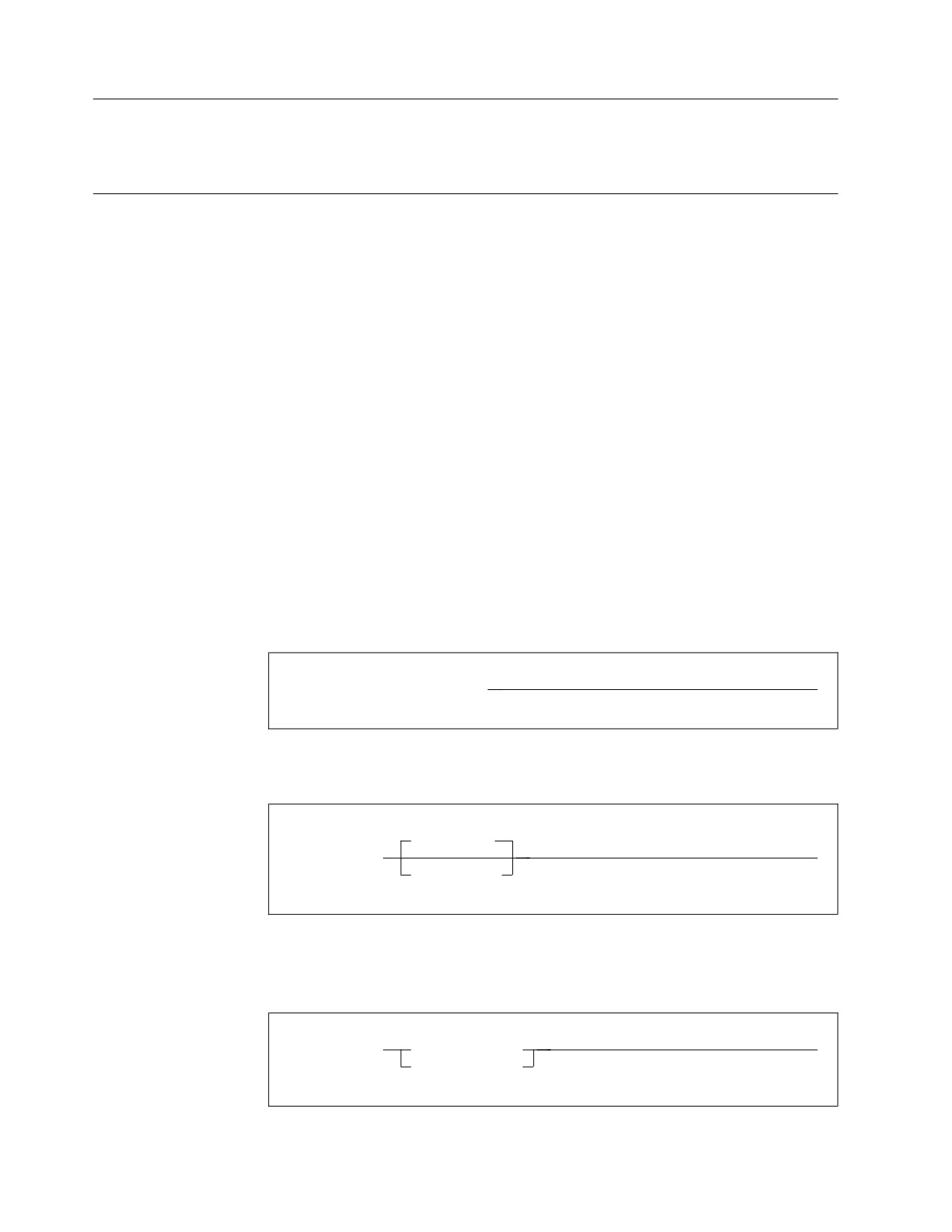
Throughout this book, syntax descriptions use this structure:
v Read the syntax diagrams from left to right, from top to bottom, following the
path of the line.
The ►►── symbol indicates the beginning of a statement.
The ───► symbol indicates that the statement syntax is continued on the next
line.
The ►─── symbol indicates that a statement is continued from the previous line.
The ──►◄ indicates the end of a statement.
Diagrams of syntactical units other than complete statements start with the ►───
symbol and end with the ───► symbol.
v Keywords appear in uppercase letters (for example, ASPACE) or uppercase and
lowercase (for example, PATHFile). They must be spelled exactly as shown.
Lowercase letters are optional (for example, you could enter the PATHFile
keyword as PATHF, PATHFI, PATHFIL, or PATHFILE).
Variables appear in all lowercase letters in a special typeface (for example,
integer). They represent user-supplied names or values.
v If punctuation marks, parentheses, or such symbols are shown, they must be
entered as part of the syntax.
v Required items appear on the horizontal line (the main path).
►► INSTRUCTION required item
►◄
v Optional items appear below the main path. If the item is optional and is the
default, the item appears above the main path.
default item
►► INSTRUCTION
►◄
optional item
v When you can choose from two or more items, they appear vertically in a stack.
If you must choose one of the items, one item of the stack appears on the main
path.
►► INSTRUCTION
required choice1
►◄
required choice2
xiv HLASM V1R6 Language Reference

If choosing one of the items is optional, the whole stack appears below the main
path.
►► INSTRUCTION
►◄
optional choice1
optional choice2
v An arrow returning to the left above the main line indicates an item that can be
repeated. When the repeat arrow contains a separator character, such as a
comma, you must separate items with the separator character.
,
▼
►► INSTRUCTION
repeatable item
►◄
A repeat arrow above a stack indicates that you can make more than one choice
from the stacked items, or repeat a single choice.
Format
The following example shows how the syntax is used.
▌A▐
▌B▐
▌C▐
,
▼
►►
INSTRUCTION
fragment
►◄
optional item
fragment:
operand choice1
(1)
operand choice2
operand choice3
Notes:
1
operand choice2 and operand choice3 must not be specified together
▌A▐
The item is optional, and can be coded or not.
▌B▐
The INSTRUCTION key word must be specified and coded as shown.
▌C▐
The item referred to by “fragment” is a required operand. Allowable
choices for this operand are given in the fragment of the syntax diagram
About this document xv
shown below “fragment” at the bottom of the diagram. The operand can
also be repeated. That is, more than one choice can be specified, with each
choice separated by a comma.
xvi HLASM V1R6 Language Reference

How to send your comments to IBM
Your feedback is important in helping to provide the most accurate and
high-quality information. If you have any comments about this book, use IBM
Knowledge Center to comment.
When you send us comments, you grant to IBM a nonexclusive right to use or
distribute the information in any way it believes appropriate without incurring any
obligation to you.
If you have a technical problem
Do not use the feedback methods listed above. Instead, do one of the following:
v Contact your IBM service representative
v Call IBM technical support
v Visit the IBM support web page
xvii
xviii HLASM V1R6 Language Reference
Summary of changes
Date of Publication
July 2017
Form of Publication
Eighth Edition, SC26-4940-HLASM Language Reference
Here is a list of the changes to HLASM that are explained in this information:
Changed Assembler instructions
v New QY-type and SY-type address constants provide resolution into long
displacement.
v Support for three decimal floating-point data types, increasing instruction
addressability and reducing the need for additional instructions.
Unified Opcode table
v OPTABLE option
- The OPTABLE option is permitted on the *PROCESS statement.
v Mnemonic tagging
- Suffix tags for instruction mnemonics let you use identically named macro
instructions and machine instructions in the same source program.
Miscellany
v References to System z® have been changed to IBM Z.
v HLASM listings have been refreshed.
v New section added to Chapter 2. “Coding and structure” entitled ““Using
EBCDIC characters and double-byte characters” on page 13”.
v Updates made resulting from readers' comments.
xix
xx HLASM V1R6 Language Reference
///////////////////////////////////////