MULTISERVICE HELICOPTER SLING LOAD: SINGLE-POINT RIGGING PROCEDURES (April 2002)
HEADQUARTERS
DEPARTMENT OF THE ARMY
UNITED STATES MARINE CORPS
DEPARTMENT OF THE NAVY
DEPARTMENT OF THE AIR FORCE
Change 2
UNITED STATES COAST GUARD
Washington, DC, 1 April 2002
MULTISERVICE HELICOPTER SLING LOAD:
SINGLE-POINT RIGGING PROCEDURES
1.
This change adds several items that are certified for sling load in the single-point configuration.
2. The United States Marine Corps has changed the Short Title of this manual to MCRP 4-11.3E, Vol II. This
Short Title will be included in the next revision of this manual.
3. Change FM 10-450-4, 30 May 1998, as follows:
Remove old pages
Insert new pages
iii through xi
iii through xi
1-1 through 1-5
1-1 through 1-5
2-1 and 2-2
2-1 and 2-2
2-9 through 2-12
2-9 through 2-12
2-15 and 2-16
2-15 and 2-16
2-23 and 2-24
2-23 and 2-24
2-41 through 2-44
2-41 through 2-44
2-61 and 2-62
2-61 and 2-62
2-65 through 2-83
3-1 and 3-2
3-1 and 3-2
3-35 and 3-36
3-35 and 3-36
3-53 through 3-60
4-13 and 4-14
4-13 and 4-14
6-17 and 6-18
6-17 through 6-18.3
11-17 and 11-18
11-17 and 11-18
Glossary-1 and Glossary-2
Glossary-1 and Glossary-2
4. New or changed material is identified by a vertical bar in the margin opposite the changed material.
5. File this transmittal sheet in the front of the publication.
DISTRIBUTION RESTRICTION: Approved for public release; distribution is unlimited.
C2, FM 10-450-4/MCRP 4-23E, VOL II/NWP 3-04.12/AFJMAN 11-223, VOL II/
COMDTINST M13482.3A
TABLE OF CONTENTS
Paragraph Page
PREFACE
i
CHAPTER 1
FUNDAMENTAL PRINCIPLES
Introduction
1-1
1-1
Classification Definitions of Sling Loads
1-2
1-1
Certification of Equipment for Helicopter Sling Load
1-3
1-1
Requests for Sling Load Certification
1-4
1-2
Unique Items of Equipment or Operational Requirements
1-5
1-2
Equipment Rigging Procedures
1- 6
1- 2
General Rigging Instructions
1- 7
1- 3
CHAPTER 2
CERTIFIED SINGLE-POINT RIGGING PROCEDURES FOR
WHEELED VEHICLES
Introduction
2-1
2-1
M996/M997/M997A2 Truck, Ambulance, (HMMWV)
2-2
2-1
M996/M1036/M1045/M1045A2/M1046 TOW Missile Carrier
(HMMWV), M1025/M1025A2/M1026/M1043/M1043A2/M1044
Armament Carrier (HMMWV)
2-3
2-4
M998/M1037 Modified (GVW 9,400 lbs)/M1038/M1097/M1097A2
Truck, Cargo,1 1/4-ton (HMMWV)
2-4
2-7
M1037/M1042/M1097/M1097A1/M1097A2 Shelter Carrier (HMMWV)
Without Shelter
2-5
2-10
M1037/M1042 Shelter Carrier (HMMWV) With S-250 or S-250E
Shelter
2-6
2-12
M1097 Shelter Carrier, Heavy HMMWV, With S-250 or S-250E
Shelter
2-7
2-15
M1037 Shelter Carrier (Heavy HMMWV) with Downsized Direct
Support Section (DDSS) Shelter
2-8
2-18
M1037 Shelter Carrier (HMMWV) With S-318 Shelter
2-9
2-20
M1097/M1097A2 Shelter Carrier (HMMWV) With Lightweight
Multipurpose Shelter (LMS)
2-10
2-22
M1037/M1042 Shelter Carrier (HMMWV) With Lightweight
Multipurpose Shelter (LMS)
2-11
2-26
M1037/M1097 Shelter Carrier (HMMWV) With G15840 Smoke
Generator Set, M157/M157A1E1
2-12
2-28
M998 (HMMWV) With Two MRC-127 Stacks
2-13
2-30
M998/M1038 (HMMWV) With Lightweight Tactical Fire Control
Systems (LTACFIRE)/Tactical Terminal Control System (TTCS)
2-14
2-32
M1037 (HMMWV) With AN/TPQ-36 Firefinder Generator Pallet
2-15
2-34
M1097 (H-HMMWV) With Antenna AS-3036/TSC on OA-9134/TSC
Pallet Group
2-16
2-36
iii
C2, FM 10-450-4/MCRP 4-23E, VOL II/NWP 3-04.12/AFJMAN 11-223, VOL II/
COMDTINST M13482.3A
Paragraph
Page
M1097 (H-HMMWV) With High Mobility Digital Group Multiplexer
(DGM) Auxiliary Equipment Transportation Container (AETC) in
2 and 3 Mast Configurations
2-17
2-38
M1097 (H-HMMWV) With Fiberglass Cargo Bed Cover (CBC)
2-18
2-41
Light Armored Vehicle (LAV) (USMC)
2-19
2-44
M1097 (H-HMMWV) With AN/TPQ-42, Meteorological Hydrogen
Generator (MHG)
2-20
2-46
M1097/M1113 Shelter Carrier (HMMWV) With Gitchner Model
1497A Shelter
2-21
2-48
M1097 (HMMWV) With Contact Maintenance Truck, Heavy
(CMTH)
2-22
2-51
M1097 (HMMWV) With Enhanced Fiber Optic Guided Missile
(EFOGM) Launcher
2-23
2-53
M1097 (HMMWV) With Sentinel AN/MPQ-64 Tactical Quiet
Generator (TQG)
2-24
2-55
M1097A2 (HMMWV) With Secure Mobile Anti-Jam Tactical
Terminal (SMART-T) Pallet
2-25
2-57
M1097A1 (HMMWV) With Remote Landing Site Tower (RLST)
2-26
2-59
M1113 (HMMWV) With M56 Smoke Generating System
2-27
2-61
M1097A2 (HMMWV) Soft Top Truck With Advanced Field
Artillery Tactical Data Systems (AFATADS)
2-28
2-63
M1113 Truck, Utility, Expanded Capacity (HMMWV), With Lightweight
Multipurpose Shelter (LMS)
2-29
2-65
M1097A2 Shelter Carrier (HMMWV) With Special Operations Media
System (SOMS-B) in S-788G Shelter (LMS)
2-30
2-68
M1037 (HMMWV) With Compressed Air-Foam System, Mobile
(CAFSM)
2-31
2-71
Prophet AN/MLQ-40 (V) on M1097 HMMWV
2-32
2-73
Helmit Hardtop (Amtech Corp) Cargo Bed Cover on M1097A2
HMMWV
2-33
2-75
Interim Fast Attack Vehicle (IFAV) Truck, Long Wheel Base
2-34
2-77
John Deere M-Gator (Model # VGM6X01001)
2-35
2-79
Two John Deere M-Gators, Model # VGM6X01001, Side by Side
(Shotgun Method)
2-36
2-81
CHAPTER 3
CERTIFIED SINGLE-POINT RIGGING PROCEDURES FOR TRAILERS
Introduction
3-1
3-1
M416 1/4-Ton Trailer
3-2
3-1
M101A2/A3 3/4-Ton Trailer
3-3
3-3
M1048/M1073 Trailer
3-4
3-5
M1048 Trailer with Tracked Suspension System (TSS)
3-5
3-7
M149A2 Water Trailer (USMC)
3-6
3-9
M989 Heavy-Expanded Mobility Ammunition Trailer (HEMAT)
3-7
3-11
M989A1 Heavy-Expanded Mobility Ammunition Trailer (HEMAT II) .. 3-8
3-13
Mk14, Trailer, Container Hauler
3-9
3-15
Mk15, Trailer, Wrecker/Recovery
3-10
3-17
Mk16, Trailer, Fifth-Wheel Adapter
3-11
3-19
Mk17, Trailer, Drop-Side, Cargo
3-12
3-21
iv
C2, FM 10-450-4/MCRP 4-23E, VOL II/NWP 3-04.12/AFJMAN 11-223, VOL II/
COMDTINST M13482.3A
Paragraph
Page
M116A2 Trailer with Antenna Groups, AS-3954/TRC
(2 each) (USMC)
3-13
3-23
M116A2 Trailer with AN/TPQ-36 Firefinder Antenna Transceiver
Group (ATG)
3-14
3-25
M116A2 Trailer with M894 18,000-BTU Air Conditioner and
MEP-003A Generator
3-15
3-27
MKT-90 Field Kitchen Trailer
3-16
3-29
Hydraulic System Test and Repair Unit (HSTRU)
3-17
3-31
M116A2 Trailer, Single Channel Objective Tactical Terminal (SCOTT)
3-18
3-33
High Mobility Trailers (HMT), M1101/M1102
3-19
3-35
M116A3 Trailer with OE334 Antenna Coupler Group
3-20
3-37
Desert Operation Trailer (DOT) with Desert Operation Motorcycle
(DOM)
3-21
3-39
HMT Trailer With Sentinel AN/MPQ-64 Antenna Transmitter
Group (ATG)
3-22
3-41
HMT Trailer With Remote Landing Site Tower (RLST)
3-23
3-43
M105A3 Trailer
3-24
3-45
M332 Ammunition Trailer, 1 1/2-Ton
3-25
3-47
AS-4492/TSC, Lightweight, High Gain, X-band, Antenna
(LHGXA) Trailer
3-26
3-49
XM1112 400 Gallon Water Trailer
3-27
3-51
M1082 Light Medium Tactical Vehicle (LMTV) and M1095 Medium
Tactical Vehicle (MTV) Trailers
3-28
3-53
Small Portable Expeditionary Aeromedical Rapid Response (SPEARR)
Trailer
3-29
3-55
Minimum Operating Strip Lighting System (MOSLS)
3-30
3-57
Assault Command Post With High Mobility Wheel Set
3-31
3-59
CHAPTER 4
CERTIFIED SINGLE-POINT RIGGING PROCEDURES FOR
TRAILERS WITH MOUNTED GENERATORS
Introduction
4-1
4-1
M353 Trailer Chassis With Mounted Generators
4-2
4-1
M200A1 Trailer-Mounted Power Units, Generators, and Power Plants 4-3
4-3
M103A3 Trailer-Mounted Power Units, Generators, and Power Plants 4-4
4-7
M103A3/A4 Trailer-Mounted Power Units, Generators, and Power
Plants
4-5
4-9
M116A2 Trailer-Mounted Power Units, Generators, and Power Plants 4-6
4-11
M116A3 Trailer-Mounted Power Units, Generators, and Power Plants 4-7
4-13
High Mobility Trailer (HMT) with AN/TJQ-35A Power Plant
4-8
4-15
High Mobility Trailer (HMT) with Tactical Quiet Generator
Power Units
4-9
4-17
High Mobility Trailers (HMT) with Generator for Joint Surveillance
Target Attack Radar (JSTAR) System
4-10
4-19
CHAPTER 5
CERTIFIED SINGLE-POINT RIGGING PROCEDURES FOR
TRUCK AND TOWED COMBINATIONS
Introduction
5-1
5-1
v
C2, FM 10-450-4/MCRP 4-23E, VOL II/NWP 3-04.12/AFJMAN 11-223, VOL II/
COMDTINST M13482.3A
Paragraph
Page
M973/M973E1/M1065/M1066 Small Unit Support Vehicle (SUSV)
5-2
5-1
M1067 Flatbed Small Unit Support Vehicle (SUSV)
5-3
5-5
CHAPTER 6
CERTIFIED SINGLE-POINT RIGGING PROCEDURES FOR
HOWITZERS AND WEAPONS SYSTEMS
Introduction
6-1
6-1
M101A1 105-MM Howitzer with or without A-22 Cargo Bags
6-2
6-1
M102 105-MM Howitzer
6-3
6-4
M102 105-MM Howitzer with One A-22 Cargo Bag
6-4
6-6
M102 105-MM Howitzer with Two or Three A-22 Cargo Bags
6-5
6-8
Two M102 105-MM Howitzers
6-6
6-10
Two M102 105-MM Howitzers with One, Two, or Three
A-22 Cargo Bags
6-7
6-12
M119 105-MM Howitzer, Folded/Towed Position
6-8
6-14
M119 105-MM Howitzer, Forward/Firing Position
6-9
6-16
M114A2 155-MM Howitzer, Towed
6-10
6-19
M119 105-MM Howitzer, Forward Firing Position, Platform Down
with Additional Boxes of Ammunition
6-9.1
6-18.1
M198 155-MM Howitzer, Towed/Stowed
6-11
6-21
Two M101A1 155-MM Howitzers
6-12
6-23
M167 20-MM AA Gun (Vulcan) with or without One A-22 Cargo Bag
6-13
6-26
BMS-120 Battalion Mortar System
6-14
6-28
CHAPTER 7
CERTIFIED SINGLE-POINT RIGGING PROCEDURES FOR
GUIDED MISSILE SYSTEMS
Introduction
7-1
7-1
M54A1/M54A2 Chaparral Launch Station
7-2
7-1
M85 Towed Chaparral Missile System
7-3
7-3
Continuous Wave Acquisition Radar (CWAR)
7-4
7-5
M192E1/M192-1 Zero Length Launcher
7-5
7-7
M501E3 Loader-Transporter, Guided Missile
7-6
7-9
M1E2 Loading and Storage Missile Pallet
7-7
7-11
Pedestal-Mounted Stinger (Avenger)
7-8
7-13
CHAPTER 8
CERTIFIED SINGLE-POINT RIGGING PROCEDURES FOR
ENGINEER EQUIPMENT
Introduction
8-1
8-1
T-3 Tractor, Crawler
8-2
8-1
D5B Tractor, Dozer
8-3
8-3
Tractor, Full-Tracked, MC 1150E
8-4
8-5
Tractor, Wheeled, Industrial, Case Model 580
8-5
8-7
Small Emplacement Excavator (SEE)
8-6
8-9
High Mobility Materiel Handler (HMMH)
8-7
8-11
Ditching Machine
8-8
8-13
950BS Scoop Loader
8-9
8-15
vi
C2, FM 10-450-4/MCRP 4-23E, VOL II/NWP 3-04.12/AFJMAN 11-223, VOL II/
COMDTINST M13482.3A
Paragraph
Page
130GS Grader
8-10
8-19
613BS Scraper, Elevating
8-11
8-21
613WDS Water Distributor
8-12
8-24
Roller, Towed, Vibrating
8-13
8-27
Mk155 Launcher, Mine Clearing
8-14
8-29
M68A2 Line Charge, Demolition with or without Mk22 Rocket Motor
8-15
8-31
Mk155 Launcher with or without M68A2 Demolition Line Charge
and Mk22 Rocket Motor on M353 Trailer
8-16
8-33
Mk155 Launcher with or without M68A2 Demolition Line Charge
and Mk22 Rocket Motor on M200A1 or Mobile-Trac System
(MTS) Trailer
8-17
8-35
LRT-110, 7 1/2-Ton Crane
8-18
8-37
LRT-110, 7 1/2-Ton Crane (Boom)
8-19
8-39
LRT-110, 7 1/2-Ton Crane (Power Unit)
8-20
8-41
Truck, Forklift, MC-4000
8-21
8-43
Truck, Forklift, RT4000
8-22
8-45
MHE-270/MHE-271 Truck, Forklift, RT4000
8-23
8-47
Truck, Forklift, MC-6000
8-24
8-49
Extendable Boom Forklift (EBFL)
8-25
8-51
Welding Shop on M200A1 Trailer
8-26
8-53
250 CFM Air Compressor
8-27
8-55
Pneumatic Tool and Compressor Outfit/Hydraulic Pioneer Tool
Outfit (PTO) on M353 Trailer
8-28
8-57
Fuel Dispensing System, Tactical Airfield (TAFDS)
8-29
8-59
Bath Unit Mounted on the M103 Trailer
8-30
8-61
Boat, Bridge Erection
8-31
8-63
Bridge, Medium Girder, Dry Gap (MGB)
8-32
8-65
Ribbon Bridge Ramp Bay
8-33
8-67
Ribbon Bridge Interior Bay
8-34
8-69
Water Purification Unit-Reverse Osmosis (ROWPU)
8-35
8-71
MS114 WFD Concrete Mixer
8-36
8-73
Towed Rollers
8-37
8-75
Tractor (Dozer), Full-Tracked, Type III, JD450G
8-38
8-77
Vibrating Roller, Caterpillar, RO-33
8-39
8-79
Countermine Miniflail
8-40
8-81
CHAPTER 9
CERTIFIED SINGLE-POINT RIGGING PROCEDURES FOR
LIQUID CONTAINERS
Introduction
9-1
9-1
Lightweight Collapsible Fabric Tank
9-2
9-1
One to Four 500-Gallon Fuel Drums
9-3
9-3
Six 500-Gallon Fuel Drums, Empty
9-4
9-6
Storage Module, Fuel/Water, Six Compartment Container (SIXCON),
Individual
9-5
9-8
Two Storage Modules, Fuel/Water, Six Compartment Container
(SIXCON), (Stacked)
9-6
9-10
vii
C2, FM 10-450-4/MCRP 4-23E, VOL II/NWP 3-04.12/AFJMAN 11-223, VOL II/
COMDTINST M13482.3A
Paragraph
Page
CHAPTER 10
CERTIFIED SINGLE-POINT RIGGING PROCEDURES FOR
SHELTERS
Introduction
10-1
10-1
AN/ASM-146 or AN/MSM-108 Electronic Shops
10-2
10-1
Communications or Electronic Systems Housed in S-250 Shelters
10-3
10-3
Communications or Electronic Systems Housed in Lightweight
Multipurpose Shelter (LMS)
10-4
10-5
Communications or Electronic Systems Housed in S-280 Shelters
10-5
10-7
8- x 8- x 10-Foot Shelter Systems
10-6
10-10
Downsized Digital Group Multiplexer (DDGM) Shelter Assemblages 10-7
10-12
AN/TYC-5A Data Communications Terminal
10-8
10-14
AN/TRN-44 Tactical Air Navigation Shelter
10-9
10-16
Hardened Army Tactical Shelter (HATS)
10-10
10-18
Cradle Mounted AN/TPQ-32A Radar Set, Component of the
AN/MPQ-49A Forward Area Alerting Radar (FAAR) System
10-11
10-20
NATO Air Base Satcom (NABS) Shelter Pallet, AN/TSC-93B (V) 2 .. 10-12
10-22
Refrigerator, Rigid Box without Refrigerator Unit
10-13
10-24
CHAPTER 11
CERTIFIED SINGLE-POINT RIGGING PROCEDURES FOR
CONTAINERS
Introduction
11-1
11-1
Pershing II in Container
11-2
11-1
Shipping/Storage Containers
11-3
11-3
Army Missile Systems Enclosure Assembly Launch Pods (EALP),
One Container
11-4
11-5
Army Missile Systems Enclosure Assembly Launch Pods (EALP),
Two Containers
11-5
11-7
M1A1 Full-Up Power Pack (FUPP) Container
11-6
11-9
Field Medical Oxygen Generation/Distribution System (FMOGDS) ... 11-7
11-11
Field Medical Oxygen Generation/Distribution System
(FMOGDS) (Combined)
11-8
11-13
Distributed Explosive Technology (DET) System, Array Container
11-9
11-15
Distributed Explosive Technology (DET) System, Landing Craft,
Air Cushioned (LCAC), Landing Interface Kit (LIK) Container, Single ... 11-10
11-17
Distributed Explosive Technology (DET) System, Landing Craft, Air
Cushioned (LCAC), Interface Kit (LIK) Container, Doubled, Stacked .11-11
11-19
CHAPTER 12
CERTIFIED SINGLE-POINT RIGGING PROCEDURES FOR
RADAR AND SATELLITE EQUIPMENT
Introduction
12-1
12-1
AN/TPQ-37 Artillery-Loading Radar Set (Firefinder)
12-2
12-1
AN/TMQ-31 Radio Direction Finder
12-3
12-4
AN/TPQ-36 Firefinder Antenna Radar Set
12-4
12-6
AN/TPQ-36 Firefinder II
12-5
12-8
OE-361/G Quick Reaction Satellite Antenna
12-6
12-11
viii
C2, FM 10-450-4/MCRP 4-23E, VOL II/NWP 3-04.12/AFJMAN 11-223, VOL II/
COMDTINST M13482.3A
Paragraph
Page
AS-3471/TPN-22 Antenna Pallet (USMC)
12-7
12-13
Antenna Pallet Transit Frame
12-8
12-15
Digital Group Multiplexer (DGM), Digital Antenna Mast Program
(DAMP), 2 and 3 Antenna Pallet Configurations
12-9
12-17
Digital Group Multiplexer (DGM), Auxiliary Equipment
Transportation Container (AETC), 2 and 3 Mast Configurations
12-10
12-19
Lightweight Generator Frame Assembly (AN/TSC-93B
Reconfiguration) Satellite Communications Terminal
12-11
12-21
Secure Mobile Anti-Jam Tactical Terminal (SMART-T) Pallet
12-12
12-23
CHAPTER 13
CERTIFIED SINGLE-POINT RIGGING PROCEDURES FOR
GENERATOR SETS
Introduction
13-1
13-1
Aviation Ground Power Unit (AGPU)
13-2
13-1
Aviation Direct Current Generator Set (ADCGS)
13-3
13-4
Skid Mounted Generators
13-4
13-6
MEP112A Generator Pallet
13-5
13-8
NATO Air Base Satcom (NABS) Power Pallet AN/TSC-85 (V) 2
13-6
13-10
Skid Mounted Tactical Quiet Generator Sets
13-7
13-12
CHAPTER 14
CERTIFIED SINGLE-POINT RIGGING PROCEDURES FOR
MISCELLANEOUS EQUIPMENT
Introduction
14-1
14-1
Forward Area Refueling Equipment (FARE)
14-2
14-1
Fire Extinguisher, Dry Chemical
14-3
14-3
Rigid Raiding Craft
14-4
14-5
2.75-inch Rocket Fastpack Pallet
14-5
14-7
Special Divers Air Support System (SDASS)
14-6
14-9
Two Mobile Oversnow Transport (MOST) Snowmobiles with or
without Two Sleds
14-7
14-11
CHAPTER 15
SUITABLE SINGLE-POINT RIGGING PROCEDURES FOR
WHEELED VEHICLES
Introduction
15-1
15-1
M342A2 2 1/2-Ton Dump Truck with Winch
15-2
15-1
M35A1/2 2 1/2-Ton Cargo Truck with Winch
15-3
15-3
M54A2 5-Ton Cargo Truck with Winch
15-4
15-5
M52A2 or M818 5-Ton Tractor with Winch
15-5
15-7
Crane, Self-Propelled, for Army Aircraft Maintenance and
Positioning (SCAMP)
15-6
15-9
CHAPTER 16
SUITABLE SINGLE-POINT RIGGING PROCEDURES FOR
TRAILERS
Introduction
16-1
16-1
ix
C2, FM 10-450-4/MCRP 4-23E, VOL II/NWP 3-04.12/AFJMAN 11-223, VOL II/
COMDTINST M13482.3A
Paragraph
Page
M105 1 1/2-Ton Trailer
16-2
16-1
M270A1 Semitrailer, Wrecker
16-3
16-3
M172A1 Semitrailer, Lowbed
16-4
16-5
Trailer, Flatbed, Tilt Deck, 15-Ton, 8-Wheel
16-5
16-7
Trailer-Mounted Welding Shop
16-6
16-9
LEB 300 Welding Machine on 2 1/2-Ton Trailer Chassis
16-7
16-11
Trailer-Mounted Compressor, Reciprocating
16-8
16-13
Trailer-Mounted AN/MTC-10
16-9
16-15
Trailer-Mounted Tool Outfit
16-10
16-17
Trailer-Mounted, Lube, Service Unit
16-11
16-19
Trailer, Bolster, M796
16-12
16-21
M149 Series Water Trailers
16-13
16-23
CHAPTER 17
SUITABLE SINGLE-POINT RIGGING PROCEDURES FOR
HOWITZERS
Introduction
17-1
17-1
M114A1 155-MM Howitzer with or without Accompanying Load
17-2
17-1
CHAPTER 18
SUITABLE SINGLE-POINT RIGGING PROCEDURES FOR
ENGINEER EQUIPMENT
Introduction
18-1
18-1
MRS-100 Wheeled Industrial Tractor
18-2
18-1
M5 8-Foot Aggregate Spreader
18-3
18-3
Roller, Towed, Vibrating, 1-Drum, 5-Ton, VRS55TM
18-4
18-5
Roller, Road, Towed, Wheeled, 13-Tire, 9-Ton
18-5
18-7
Tar Kettles
18-6
18-9
16SM Concrete Mixer
18-7
18-11
Road Sweeper, Towed
18-8
18-13
Sheepsfoot Roller, Two-Drum, MD-96
18-9
18-15
Model 1150 Full Tracked Tractor
18-10
18-17
M4K 4000-Pound Forklift
18-11
18-20
Floodlight Set, Trailer-Mounted
18-12
18-22
CHAPTER 19
SUITABLE SINGLE-POINT RIGGING PROCEDURES FOR
LIQUID CONTAINERS
Introduction
19-1
19-1
Tank, Fabric, Collapsible, 10,000-Gallon
19-2
19-1
60,000-Gallon Fuel System Supply Point
19-3
19-3
One to Six 250-Gallon Water Drums
19-4
19-5
CHAPTER 20
SUITABLE SINGLE-POINT RIGGING PROCEDURES FOR
SHELTERS
Introduction
20-1
20-1
Tool Set Aviation Maintenance, SE 1, Airmobile
20-2
20-1
x
C2, FM 10-450-4/MCRP 4-23E, VOL II/NWP 3-04.12/AFJMAN 11-223, VOL II/
COMDTINST M13482.3A
Paragraph
Page
Shop, Portable, Aircraft Maintenance (SPAM)
20-3
20-3
CHAPTER 21
SUITABLE SINGLE-POINT RIGGING PROCEDURES FOR
CONTAINERS
Introduction
21-1
21-1
One CONEX Container
21-2
21-1
Two CONEX Containers
21-3
21-3
CHAPTER 22
SUITABLE SINGLE-POINT RIGGING PROCEDURES FOR
RADAR EQUIPMENT
Introduction
22-1
22-1
AN/MPQ-4A Radar Set
22-2
22-1
CHAPTER 23
SUITABLE SINGLE-POINT RIGGING PROCEDURES FOR
GENERATOR SETS
Introduction
23-1
23-1
Trailer Mounted Generators
23-2
23-1
7.5KW Generator Set
23-3
23-3
CHAPTER 24
SUITABLE SINGLE-POINT RIGGING PROCEDURES FOR
MISCELLANEOUS EQUIPMENT
Introduction
24-1
24-1
Company Level Field Feeding Kit
24-2
24-1
350-GPM Pump Assembly
24-3
24-4
Light Tactical Floating Raft Bridge
24-4
24-6
Medium-Span Bridge
24-5
24-11
M4T6 Bridge
24-6
24-13
APPENDIX A.
NATIONAL STOCK NUMBERS FOR SLINGS, NETS, AND
SPARE PARTS
A-1
APPENDIX B.
SLING CONVERSION CHART
B-1
GLOSSARY
Glossary-1
REFERENCES
References-1
xi
C2, FM 10-450-4/MCRP 4-23E, VOL II/NWP 3-04.12/AFJMAN 11-223, VOL II/
COMDTINST M13482.3A
CHAPTER 1
FUNDAMENTAL PRINCIPLES
1-1. INTRODUCTION
CAUTION
This chapter contains general information about certifica-
Loads weighing less than 6,000 pounds may
tion for helicopter sling load and explains the role of the
not fly in a stable condition and may incur jet-
Military Traffic Management Command Transportation
tisoning problems when flown under a CH-53E
Engineering Agency (MTMCTEA) and the Department
helicopter. CH-53E units may have restrictions
of Defense (DOD) sling load certification authority. This
on flying light loads. Direct coordination with
authority rests with the US Army Soldier Systems Center
CH-53E units is encouraged.
(SSC). This chapter also explains the information con-
tained in the equipment rigging procedures and gives some
general rigging instructions.
b. Suitable Sling Loads. Suitable sling loads are those
items of equipment and their associated rigging proce-
1-2. CLASSIFICATION DEFINITIONS OF SLING
dures that have not been certified but have demonstrated
LOADS
acceptable static lift and flight characteristics during a
flight test. In most cases these loads were not pull tested
a. Certified Sling Loads. Certified sling loads are those
in accordance with MIL STD 913, but are known loads
items of equipment and their associated rigging proce-
which have been flown without incident for years and
dures which have completed the evaluation and testing
which SSC considers to be proven safe. These rigging
required by SSC for sling load certification. These rig-
procedures are in Chapters 15 through 24.
ging procedures are in Chapters 2 through 14. Only certi-
fied sling loads are authorized for the Marine Corps. The
c. Unique Sling Loads. Unique loads are equipment
US Army SSC has indicated that any single point sling
carried on a one time or low-frequency basis, such as
load certified under a specific aircraft is also certified for
telephone poles, artillery targets, or barrier material. The
any aircraft with suitable lift capability. The following
lack of sling load certification in itself does not preclude a
restrictions apply for sling load certification to remain in
unit commander from carrying a load that is not certified.
effect:
Each service is responsible for determining its policy on
carrying loads that have not been certified for sling load.
(1) The load must be within the lifting capability of
the desired helicopter model and not exceed the rated ca-
d. Prohibited Sling Loads. Prohibited sling loads are
pacity of the sling set being used.
items of equipment that are prohibited from sling loading
as determined by each service. These loads have been
(2) The load shall be rigged in accordance with the
denied sling load certification and are a safety hazard if
certified rigging procedure.
carried. They have either structural deficiencies or have
exhibited unstable flight characteristics during flight test-
(3) The recommended stable airspeed specified for
ing. Each service will identify these loads and transmit
the load in the applicability section of the rigging proce-
this information by separate list. Contact your service point
dure is a recommendation and not a restriction, unless so
of contact identified in the Preface if you have any ques-
stated.
tions regarding the classification of a particular load.
(4) This certification is limited to single-point loads
1-3. CERTIFICATION OF EQUIPMENT FOR
only.
HELICOPTER SLING LOAD
NOTE: When carrying loads at weights close to the air-
a. Objective. The objective of helicopter sling load
craft hook limitations, close coordination with the avia-
certification is to assure the user that the equipment being
tion unit is required.
transported can withstand the stresses of a sling load
1-1
C2, FM 10-450-4/MCRP 4-23E, VOL II/NWP 3-04.12/AFJMAN 11-223, VOL II/
COMDTINST M13482.3A
flight environment. Certification for sling load assures
Command, ATTN: QM Combat Developments, Suite 250,
the user that the item has met minimum standards for struc-
3901 A Avenue, Fort Lee, VA 23801-1809.
tural integrity and that the associated rigging procedures
have been developed specifically for that item.
(2) US Marine Corps - Commanding General, Marine
Corps System Command (PSE) Quantico, VA 22134-5021.
b. Responsibilities. Within the US Army, the
MTMCTEA is responsible for transportability approval
(3) US Navy - Naval Air Systems Command (NAVAIR).
of developmental equipment. Within the DOD, SSC is the
lead activity responsible for providing sling load certifica-
(4) US Air Force - US Air Force Systems Command.
tion and rigging procedures for military equipment. When
b. Previously Certified Dual-Point Loads. Loads can-
an item is certified for sling load, it means that SSC, in
not be certified for dual-point lift based on previously
cooperation with various test activities, has:
certified dual-point rigging procedures because of the dif-
(1) Conducted an engineering analysis of the load
ferences in dual hook helicopters, such as the distance
and lifting provisions for structural adequacy during sling
between the two cargo hooks. Rigging procedures for
loading.
dual-point loads must be developed and/or approved by
SSC before the test flight.
(2) Verified that the lift provisions meet the strength
requirements of the applicable military standard by means
1-5. UNIQUE ITEMS OF EQUIPMENT OR
of proof load testing.
OPERATIONAL REQUIREMENTS
(3) Developed and/or validated sling load rigging
Helicopter sling loading of unique items, due to opera-
procedures through static lift testing.
tional requirements, will be at the discretion of the
commander. Equipment not listed in this manual should
(4) Evaluated flight reports and determined that the
be static lifted (when possible) by a crane to determine
particular load meets acceptable flight characteristics with
proper rigging and stability characteristics. Personnel
the type helicopter flown during the flight test.
thoroughly familiar with sling load rigging procedures
should assist in the static lift testing. Flight evaluating
(5) Issued a statement of sling load certification for
may be conducted after a satisfactory static rigging con-
the particular load, including load configuration(s),
figuration has been determined.
weight(s), types of helicopter(s), and recommended
airspeed(s) as attained during the flight evaluation(s). Cer-
NOTE: Low density equipment with low weight and large
tification is valid only for the conditions specified in the
surface area (flat surfaces), such as shelters, empty trail-
rigging procedures.
ers, pallet loads, boat shaped items, and empty fuel or
water drums, are likely to become extremely unstable
1-4. REQUESTS FOR SLING LOAD CERTIFI-
when flown during sling load operations, even at low air-
CATION
speeds, and should be flown with extreme caution.
a. Fielded Equipment. Each service headquarters must
1-6. EQUIPMENT RIGGING PROCEDURES
designate, request, and prioritize the fielded equipment to
be evaluated by SSC for sling load certification. Individual
This section explains the information that is contained in
units can request sling load certification for fielded equip-
the rigging procedures for each load. Chapters 2 through
ment through the appropriate service agency which will
14 contain the rigging procedures for certified single-point
add the item to the prioritized list. The SSC will evaluate
loads and chapters 15 through 24 contain the rigging pro-
the equipment on a priority basis. The following agencies
cedures for suitable single-point loads.
are responsible for their branch of service:
a. Applicability Paragraph. The applicability paragraph
(1) US Army - Commander, Combined Arms Support
states whether a load is certified or suitable for sling
1-2
C2, FM 10-450-4/MCRP 4-23E, VOL II/NWP 3-04.12/AFJMAN 11-223, VOL II/
COMDTINST M13482.3A
load. It also contains the helicopter types and recom-
d. Rigging. The rigging steps give information as to the
mended airspeeds for each helicopter type.
position of the apex fitting on the load, routing orientation
For certified loads, this airspeed is the maximum airspeed
of the sling legs, location of the lift provisions, chain link
attained by the helicopter during the evaluation flight
number for each sling leg, and steps required to prevent
before the load became unstable or before the aircraft power
the sling legs from becoming entangled on the load. Do
requirements were exceeded. For suitable loads, the maxi-
not change the chain link number in the rigging proce-
mum recommended airspeed is based on previous experi-
dures under any circumstances as it may change sling leg
ence with this helicopter/load combination. For either
loading and cause lift provision failure.
certified or suitable loads, the airspeed listed is a recom-
(1) The purpose of the illustration accompanying the
mendation and not a restriction, unless so stated. The
rigging procedures is to depict what a properly rigged
aircrew should closely monitor the load during the flight,
load looks like with the slack removed from the sling legs.
especially if the helicopter exceeds the recommended air-
The arrow identifies the direction of flight.
speed.
(2) Appendix A contains NSN component listings for
b. Load Description. The load description paragraph
slings, sling sets, cargo nets, and other miscellaneous
identifies the load, model, national stock number (NSN) or
equipment and materials.
other identification, and the weight of the load for certifi-
cation.
e. Hookup. Certain sling loads, such as HMMWVs with
shelters, present substanial risk of damage to the load or
(1) The actual weight of the equipment may vary some-
injury to the hookup personnel. This risk is increased
what from the actual rigged weight during the flight evalu-
during dual point hookup or night operations.
ation due to equipment modifications, fuel, equipment
added to the load, or different models of the same item.
(1) To reduce the risk of damage to the load or injury
The load weight on the equipment data plate or in the
to the hookup personnel an extended sling system or reach
operators manual takes precedence over the load weight
pendant as defined in FM 10-450-3 may be used.
in this manual. Weigh the load if there is any doubt about
its actual weight. If the load weight exceeds the weight
(2) Using a reach pendant increases the distance be-
listed in the load description paragraph, the load becomes
tween the load and the helicopter. Reach pendants should
a unique load. Contact your service point of contact if
not be used on loads that have a tendancy to spin during
you have any questions about the load description or
flight. A static discharge person is not required when
weight.
using a reach pendant.
(2) Equipment such as cargo trailers and cargo trucks
contain descriptions of the allowable additional cargo
(3) If the tactical environment permits the use of an
weight. Do not exceed the fully loaded weight. Some
extended sling set may reduce the risk. Polyester round
trailers become extremely unstable at low weights; there-
slings are recommended for use as vertical pendants.
fore, a minimum weight is identified. If your trailer is be-
low that weight, add more cargo or dummy weight as close
1-7. GENERAL RIGGING INSTRUCTIONS
to the center of the trailer as possible until you reach the
minimum weight.
CAUTION
Inspect lifting provisions and supporting struc-
c. Preparation. The preparation steps are intended to
ture for damage or degradation prior to sling
reduce the possibility of damage to the equipment caused
loading. Do not transport loads with damaged
by sling leg entanglement during the hookup and lift-off
or degraded lift provisions.
operation or by wind resistance encountered during the
flight. Since these preparation steps are not directive in
nature, the commander assumes responsibility for any
a. Preparing the Load. Prepare the load to be trans-
damage to the equipment caused by deviation from the
ported by following the preparation and rigging instruc-
preparation steps.
tions for each item. Typical preparation instructions will
1-3
C2, FM 10-450-4/MCRP 4-23E, VOL II/NWP 3-04.12/AFJMAN 11-223, VOL II/
COMDTINST M13482.3A
provide information to secure loose items, remove or se-
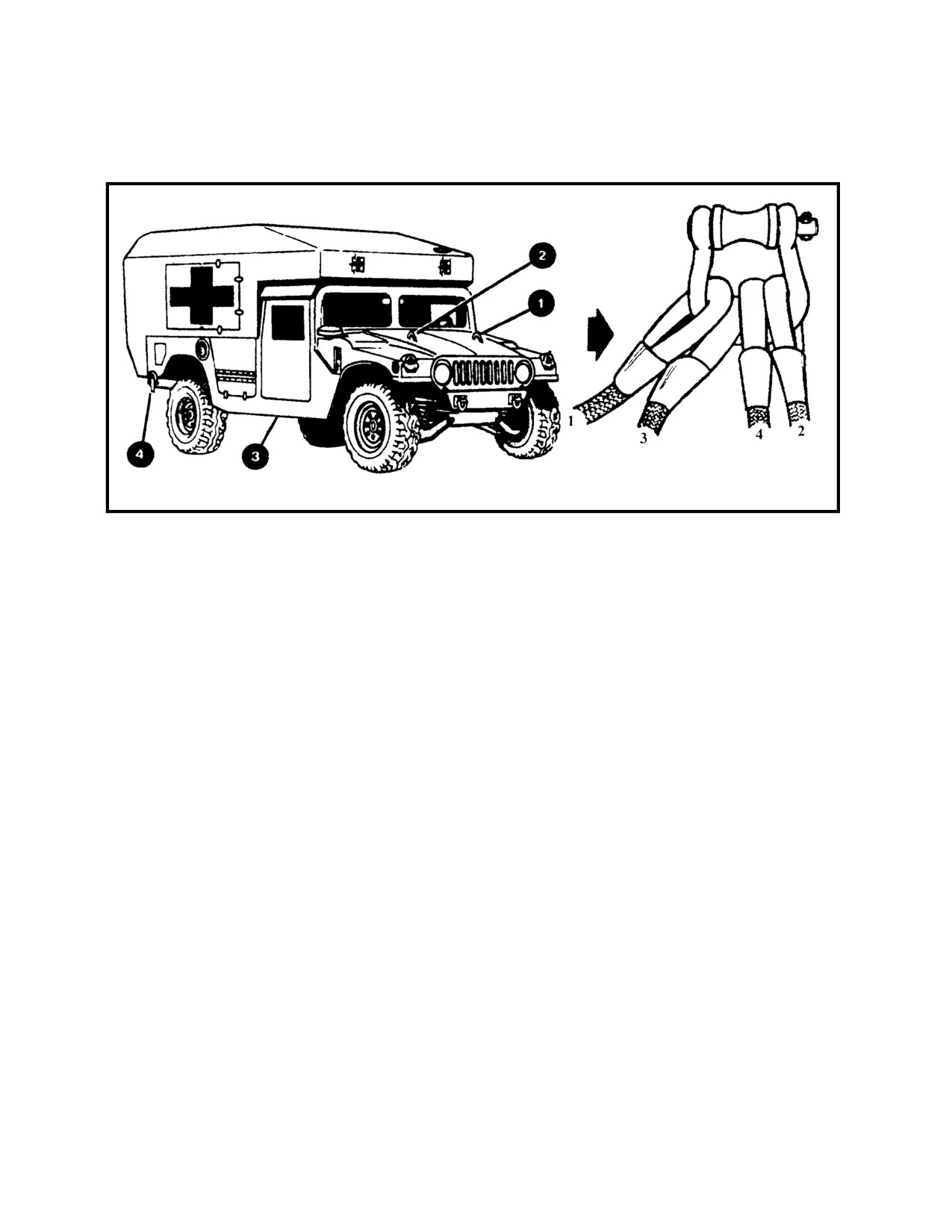
(d) Sling leg 4 to the right rear lifting provision.
cure canvas covers, and remove obstructions, such as
antennas. Place protective padding on windshields and
(2) If a six-leg sling set is required, the innermost sling
other components that could be damaged by the metal
legs, 5 and 6, are connected to the left and right middle lift
parts of the sling set during hookup or release. The load
provisions.
should be secure enough to withstand winds in excess of
120 knots caused by the forward airspeed of the aircraft.
NOTE: Odd numbered sling legs go to the same side of
If possible, position the load in the takeoff direction so
the load.
the pilot does not have to pick the load up and then turn
the aircraft into the takeoff direction.
(3) Following the equipment rigging procedures, loop
the free end of the chain end through the lift provision
b. Preparing the Equipment. Inspect and assemble the
and insert the specified chain link in the grabhook/grab
slings and miscellaneous equipment required to prepare
link. Tie or tape the excess chain end to prevent the unre-
and rig the load. Following the instructions in Chapter 6
strained chain from damaging the load. If necessary, wrap
of FM 10-450-3/MCRP 4-23E, VOL I/NWP 3-04.11/
padding around the chain or rope assembly to prevent
AFJMAN 11-223, VOL I/COMDTINST M13482.2A, add
damage to the load or sling set. If the procedures pre-
or remove sling legs, chains, or apex fittings as required.
scribe a spreader bar, install and pad it according to the
Never exceed the capacity of the sling legs or apex fitting/
rigging instructions.
web ring. If you have a sling set with a higher capacity
than the sling set prescribed, use the chain link conver-
(4) Breakaway safety ties are used to temporarily re-
sion chart in Appendix B to determine the corresponding
strain the sling legs to keep them from becoming
chain link for your sling set.
entangled on the load as the helicopter lifts the load.
These safety ties are made of Type I, 1/4-inch cotton web-
c. Positioning and Attaching the Sling Set. Position
bing or duct tape.
the sling set near the load. The sling legs for a typical load
d. Viewing the Load. Left, right, front, and rear direc-
with four lifting points are routed as shown in Figure 1-1.
tions are designated from the drivers perspective for ve-
hicles and towed equipment. Howitzer gun tubes are con-
(1) Rigging a typical load with four lifting points
sidered the front of the load. The front or rear is identified
is begun by connecting -
on other items of equipment. The sling leg numbering
system prevents sling legs from crossing each other and
(a) Sling leg 1 to the left front lifting provision.
causing damage to the sling legs or causing the load to
twist in flight. To improve flight stability, some loads are
(b) Sling leg 2 to the right front lifting provision.
transported backwards. Do not confuse the front of the
load as it is carried with the end designated as the front for
(c) Sling leg 3 to the left rear lifting provision.
rigging purposes. The arrow shown in the illustration
identifies the direction of flight.
1-4
C2, FM 10-450-4/MCRP 4-23E, VOL II/NWP 3-04.12/AFJMAN 11-223, VOL II/
COMDTINST M13482.3A
Figure 1-1. Sling Leg Lifting Point Designation
1-5
C2, FM 10-450-4/MCRP 4-23E, VOL II/NWP 3-04.12/AFJMAN 11-223, VOL II/
COMDTINST M13482.2
CHAPTER 2
CERTIFIED SINGLE-POINT RIGGING PROCEDURES FOR WHEELED VEHICLES
2-1. INTRODUCTION
This chapter contains rigging procedures for single-point
wheeled vehicle loads that have been certified for sling
NOTES:
load. Each rigging procedure is found in a paragraph that
1. Reach Pendants may be used on all single
includes a description of the load, materials required for
point loads. A static discharge person is not required
rigging, and steps to complete the procedure. An applica-
when using a Reach Pendant.
bility paragraph is also a part of each paragraph and iden-
tifies the certified loads. The certified single-point rigging
2. Canvas tops and doors should be removed and
procedures for wheeled vehicles are in this section. Para-
stowed inside the vehicle if time allows. These items may
graphs 2-2 through 2-36 give detailed instructions for rig-
be damaged if the airspeed exceeds 100 knots.
ging loads.
2-2. M996/M997/M997A2 Truck, Ambulance, (HMMWV)
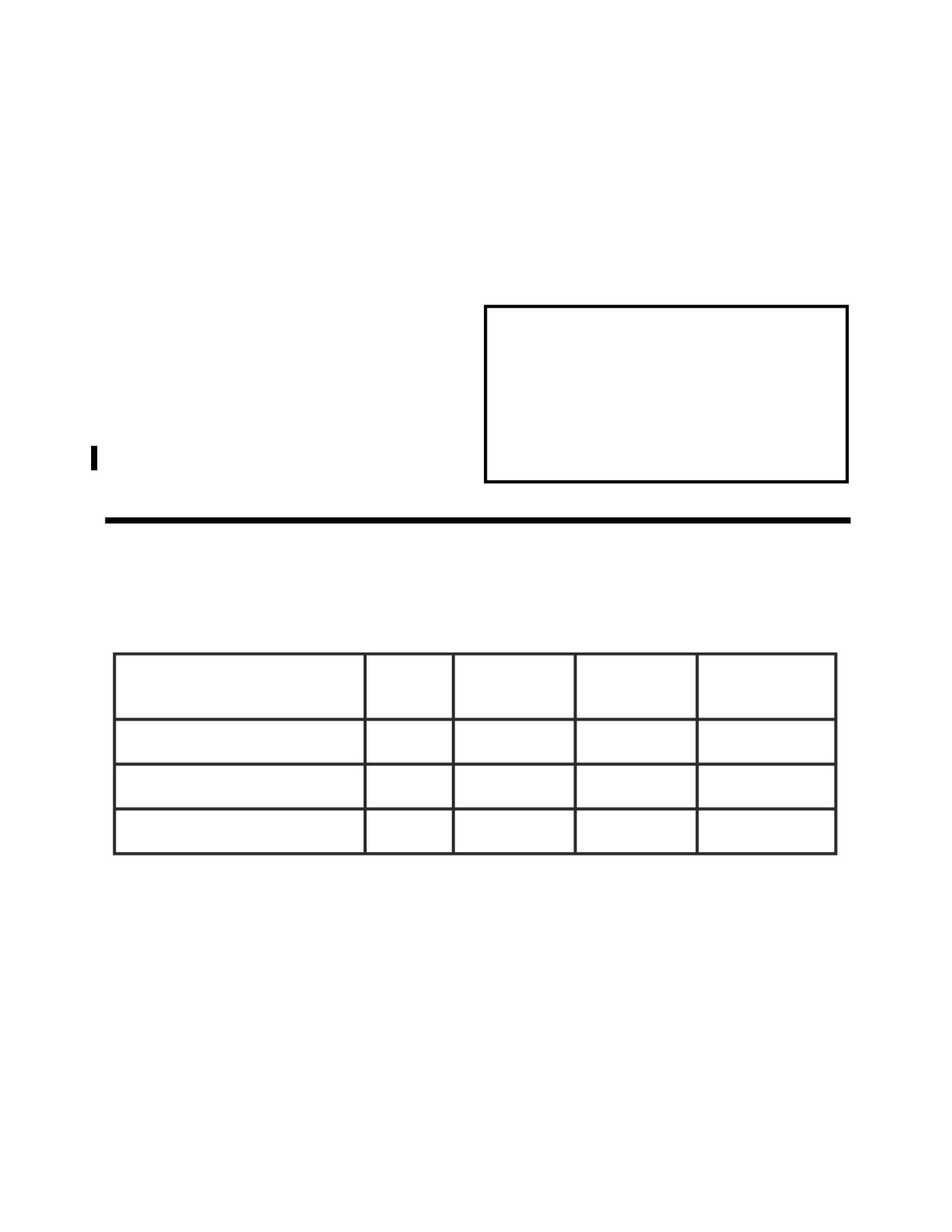
a. Applicability. The following items in Table 2-1 are certified for all helicopters with suitable lift capacity by the US
Army Soldier Systems Center:
Table 2-1. Truck, Ambulance, (HMMWV)
MAX
RECOMMENDED
LINK COUNT
NOMENCLATURE
WEIGH T
SLING SET
AIRSPEE D
FRONT/REA R
(POUNDS )
(KNOTS )
UH-60 /
60
Truck, Ambulance, M996, HMMW V
7,400
10K
8
/
CH-47 /
11
0
UH-60 /
80
Truck, Ambulance, M997, HMMW V
7,400
10K
8
/
CH-47 /
75
Truck, Ambulance, M997A2, HMMW V
10,300
25K
6
/
CH-47 / 75
b. Materials. The following materials are required to rig
(4) Cord, nylon, Type III, 550-pound breaking strength.
this load:
(5) Webbing, cotton, 1/4-inch, 80-pound breaking
(1) Sling set (10,000-pound capacity).
strength.
OR
(6) Spreader bar assembly (component of vehicle).
c. Personnel. Two persons can prepare and rig this
(2) Sling set (25,000-pound capacity).
load in 15 minutes.
(3) Tape, adhesive, pressure-sensitive, 2-inch wide
roll.
2-1
C2, FM 10-450-4/MCRP 4-23E, VOL II/NWP 3-04.12/AFJMAN 11-223, VOL II/
COMDTINST M13482.2
d. Procedures. The following procedures apply to
(i) Remove the keeper from the spreader bar and
this load:
extend the bar so the holes line up. Reinstall pin and
engage keeper. Use the sighting hole in the tube to assist
(1) Preparation. Prepare the load using the following
in aligning holes for the pin. See top view insert in Figure
steps:
2-1.
(a) Fold the mirrors forward in front of the wind-
(j) Position the spreader bar across the rear end of
shield and tie together with Type III nylon cord. Tape the
the vehicle roof. Attach the spreader bar check cables to
windshield in an X formation from corner to corner.
the eyebolts located on the aft exterior sidewall of the rear
compartment. See rear view insert in Figure 2-1.
(b) Remove the spreader bar from under the right-
hand seat inside the ambulance.
(k) Install lift provisions on the outer ends of the
rear bumper by removing the tie-down provisions located
(c) Secure all equipment inside the rear compart-
inboard of the bumper ends and installing them on the
ment with tape, nylon cord, and/or lashings. Close and
outer ends of the rear bumper, if necessary.
secure the door.
(2) Rigging. Rig the load according to the steps in
(d) Secure all other equipment inside the vehicle
Figure 2-1.
with tape, nylon cord, and/or lashings. Close and secure
the doors.
NOTE: Hookup of this load presents substantial risk
of damage to the load or injury to the hookup personnel.
(e) Make sure the fuel tank is not over 3/4 full. In-
Use of a reach pendant is recommended for this load.
spect fuel tank cap, oil filler cap, and battery caps for
proper installation.
(3) Hookup. The hookup team stands on the roof of
the vehicle. The static wand person discharges the static
(f) Engage the vehicle parking brake. Place the trans-
electricity with the static wand. The hookup person places
mission in neutral.
the apex fitting onto the aircraft cargo hook. The hookup
team then carefully dismounts the vehicle and remains
(g) Make sure that the front wheels are pointed
close to the load as the helicopter removes slack
straight ahead. Tie down the steering wheel using the
from the sling legs. When successful hookup is assured,
securing device attached under the dashboard.
the hookup team quickly exits the area underneath the
helicopter to the designated rendezvous point.
(h) Secure the Red Cross insignia covers in the closed
position.
(4) Derigging. Derigging is the reverse of the prepa-
ration and rigging procedures in steps d (1) and d (2).
2-2
C2, FM 10-450-4/MCRP 4-23E, VOL II/NWP 3-04.12/AFJMAN 11-223, VOL II/
COMDTINST M13482.2
RIGGING STEPS
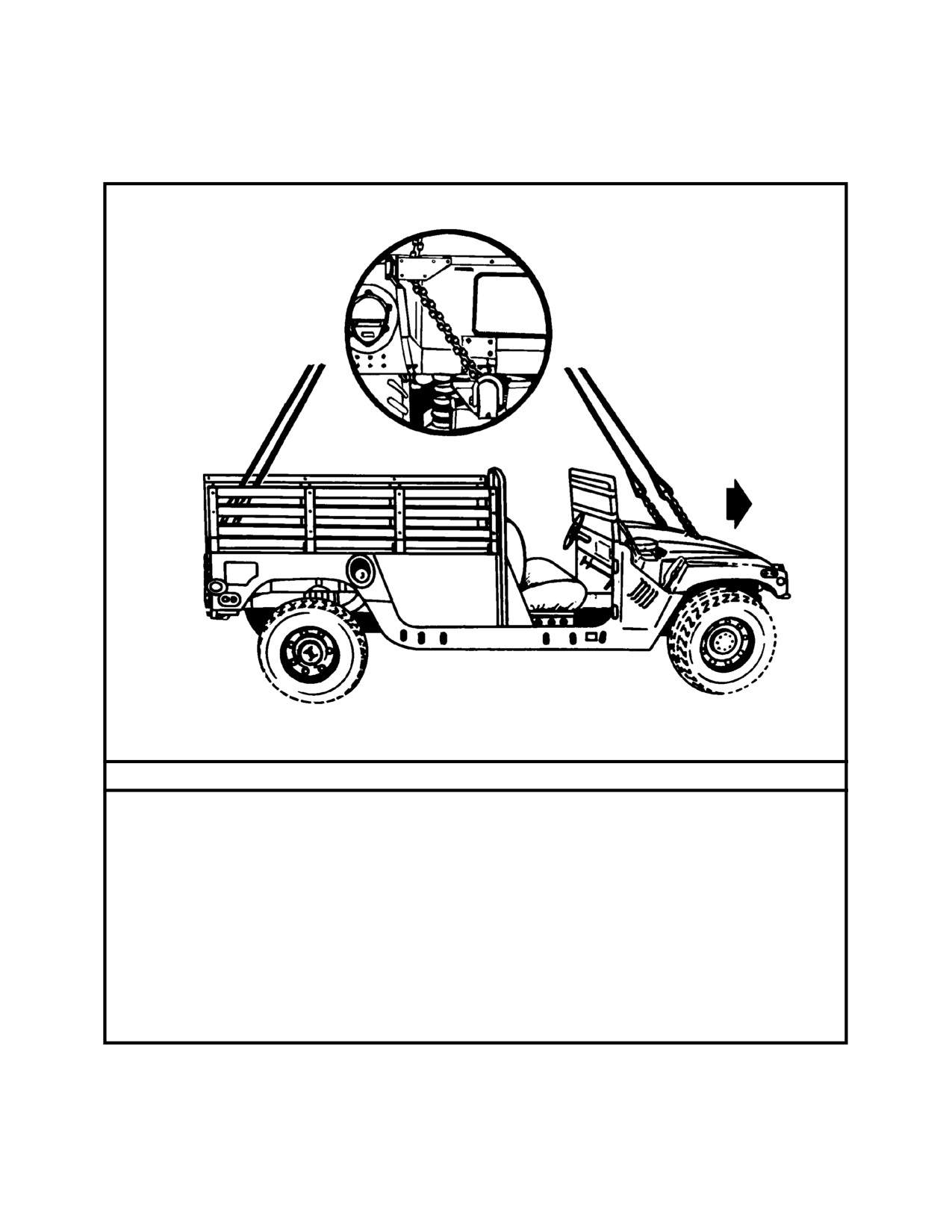
1. Position apex fitting in the bed of the vehicle. Route
3. Route the chain end of sling leg 3 through the eyelet
outer sling legs 1and 2 to the front of thevehicle and inner
opening in the upper left corner of the tailgate. Loop the
sling legs 3 and 4 to the rear. Sling legs 1 and 3 must be on
chain end through the left lift provision on the bumper
the left side of the load.
and thread back through the eyelet opening in the tail-
gate. Place the correct link from Table 2-3 in the grab
2. Loop the chain end of sling leg 1 through the left
hook. Repeat with sling leg 4 through the right rear lift
front lift provision that protrudes through the hood from
provision. See insert above.
inboard to outboard. Place the correct link from Table 2-3
in the grab hook. Repeat with sling leg 2 through the right
4. Cluster and tie or tape (breakaway technique) all sling
front lift provision. Secure excess chain with tape or Type
legs together on top of the trailer to prevent entanglement
III nylon cord.
during hookup and lift-off.
Figure 2-3. 1 1/4-Ton Cargo Truck (HMMWV)
2-9
C2, FM 10-450-4/MCRP 4-23E, VOL II/NWP 3-04.12/AFJMAN 11-223, VOL II/
COMDTINST M13482.2
2-5. M1037/M1042/M1097/M1097A1/M1097A2 Shelter Carrier (HMMWV) Without
Shelter
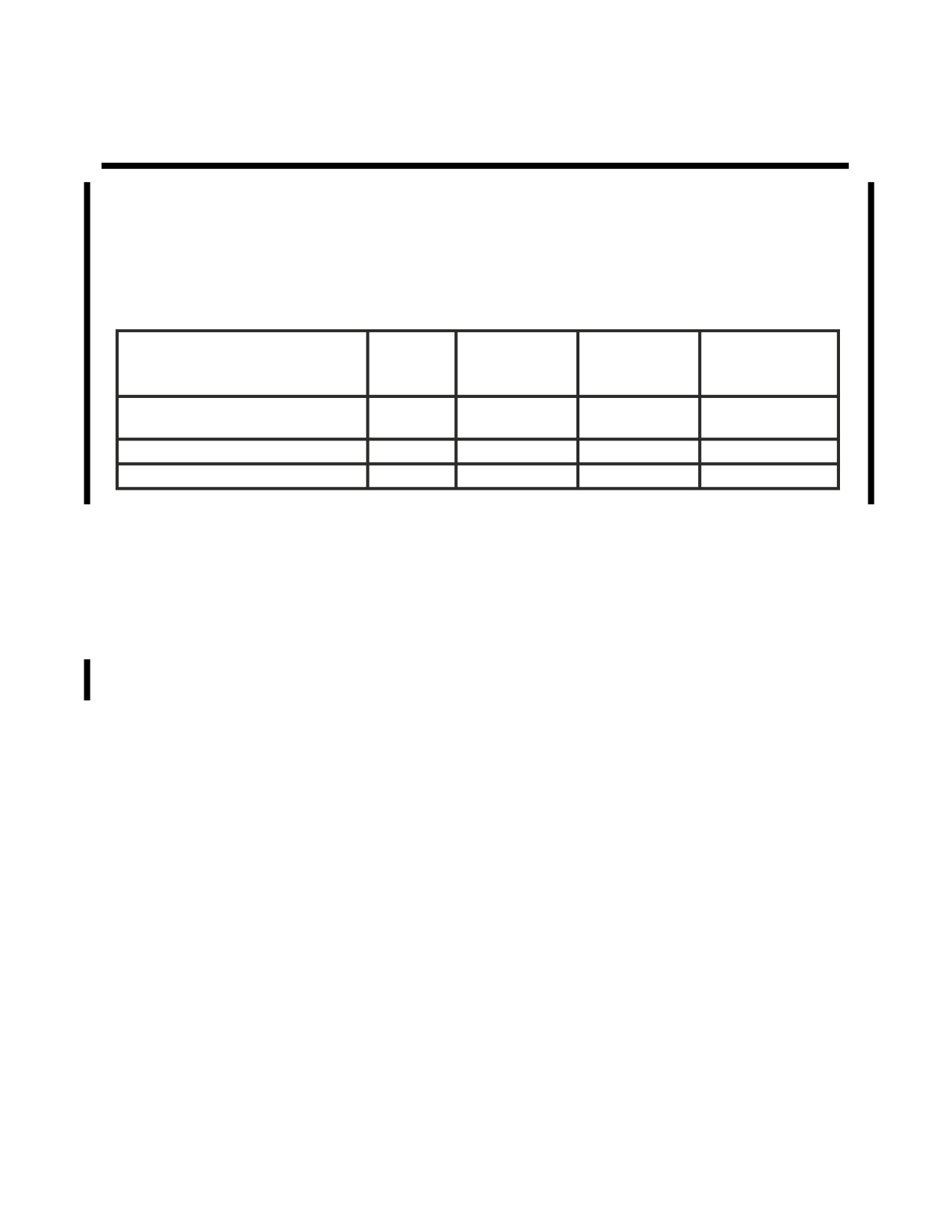
a. Applicability. The following items in Table 2-4 are certified for all helicopters with suitable lift capacity by the US
Army Soldier Systems Center:
Table 2-4. M1037/M1042/M1097/M1097A1/M1097A2 Shelter Carrier (HMMWV) Without Shelter
M AX
RECOMMENDED
LINK COUNT
NOMENCLATURE
WEIGH T
SLING SET
AIRSPEE D
FRONT/REA R
(POUNDS )
(KNOTS )
15K
Shelter Carriers, M1037/M1042
5,220
6
/
100
10K
Shelter Carriers, M1097/M1097A
1
10,000
10K
6
/
100
Shelter Carriers, M1097A
2
10,300
25K
5
/
100
b. Materials. The following materials are required to
added protection and tie together with Type III nylon cord.
rig this load:
Tape the windshield in an X formation from corner to cor-
ner.
(1) Multileg sling set (15,000-pound capacity or 40,000-
pound capacity for CH-53 only).
(b) Secure all equipment and cargo inside the vehicle
with tape, nylon cord, or lashings. Secure the doors shut
OR
if installed.
(2) Sling set (10,000-pound capacity or 25,000-pound
(c) Ensure the fuel tank is not over 3/4 full. Inspect
capacity for CH-60 and CH-47).
the fuel tank cap, oil filler cap, and battery caps for proper
installation.
(3) Tape, adhesive, pressure-sensitive, 2-inch wide
roll.
(d) Engage the vehicle parking brake and place the
transmission in neutral.
(4) Cord, nylon, Type III, 550-pound breaking strength.
(e) Ensure the front wheels are in pointed straight
(5) Webbing, cotton, 1/4-inch, 80-pound breaking
ahead. Tie down the steering wheel using the securing
strength.
device attached under the dashboard.
(6) Felt sheet, cattle hair, Type VI, 1/2-inch or suitable
(f) Install the lift provisions on the outer ends of the
substitute.
rear bumper by removing the tiedown provisions located
inboard of the bumper end and installing them on the
c. Personnel. Two persons can prepare and rig this
outer ends of the rear bumper.
load in 15 minutes.
(2) Rigging. Rig the load according to the steps in
d. Procedures. The following procedures apply to
Figure 2-4.
this load:
(3) Hookup. The hookup team stands in the bed of
the vehicle. The static wand person discharges the static
(1) Preparation. Prepare the load using the following
electricity with the static wand. The hookup person places
steps:
the apex fitting onto the aircraft cargo hook. The hookup
team then carefully dismounts the vehicle and remains
(a) Fold mirrors forward in front of the windshield for
2-10
C2, FM 10-450-4/MCRP 4-23E, VOL II/NWP 3-04.12/AFJMAN 11-223, VOL II/
COMDTINST M13482.2
close to the load as the helicopter removes slack from the
(4) Derigging. Derigging is the reverse of the prepa-
sling legs. When successful hookup is assured, the
ration and rigging procedures in steps d (1) and d (2).
hookup team quickly exits the area underneath the heli-
copter to the designated rendezvous point.
RIGGING STEPS
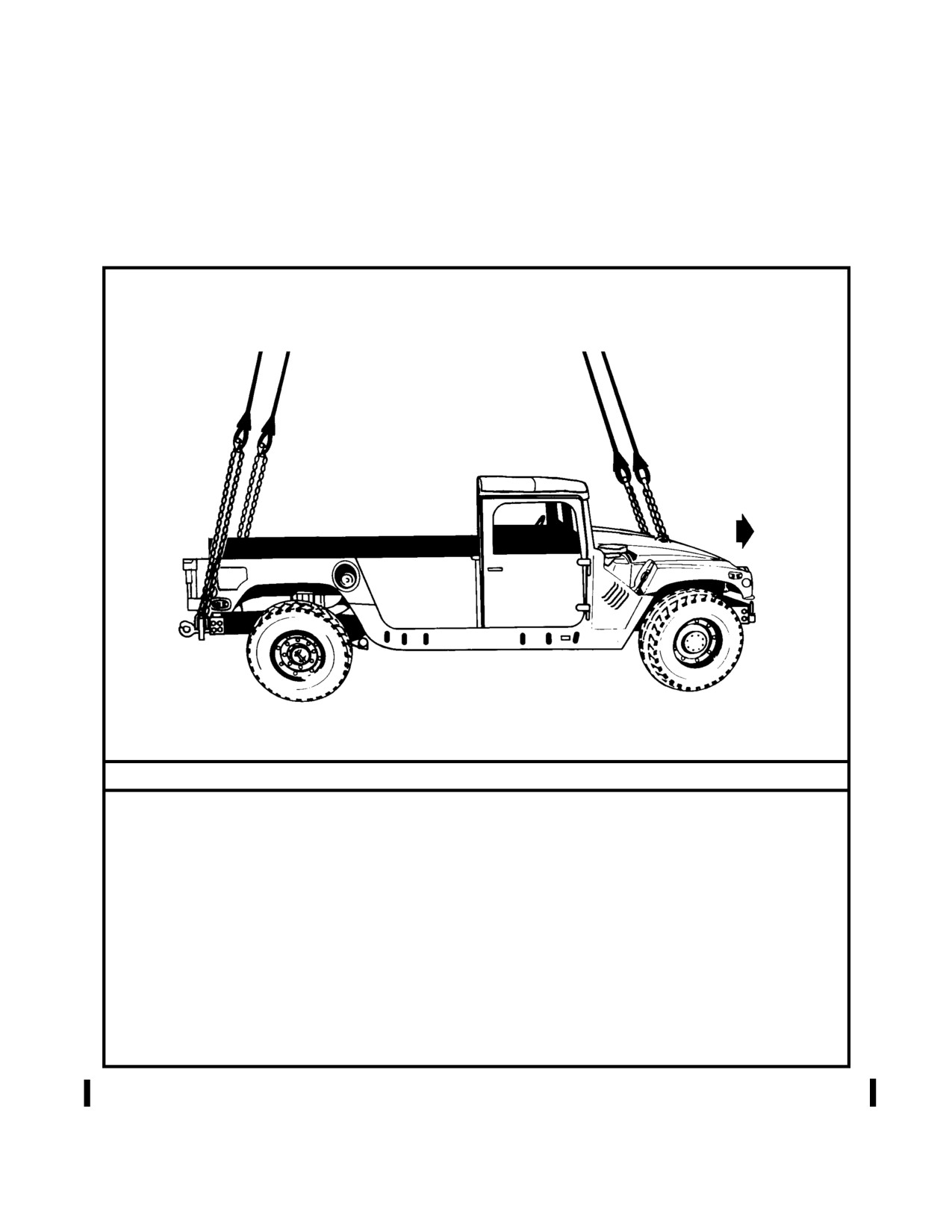
1. Position apex fitting in the bed of the vehicle. Route
provision located on the left end of the bumper from in-
outer sling legs 1and 2 to the front of thevehicle and inner
board to outboard. Place the correct link from Table 2-4 in
sling legs 3 and 4 to the rear. Sling legs 1 and 3 must be on
the grab hook. Repeat with sling leg 4 through the right
the left side of the load.
rear lift provision. Secure excess chain with tape or Type
III nylon cord.
2. Loop the chain end of sling leg 1 through the left
front lift provision that protrudes through the hood from
4. Wrap rear chains with padding where they contact
inboard to outboard. Place the correct link from Table 2-4
the shelter carrier.
in the grab hook. Repeat with sling leg 2 through the right
front lift provision. Secure excess chain with tape or Type
5. Cluster and tie or tape (breakaway technique) all sling
III nylon cord.
legs together on top of the trailer to prevent entanglement
during hookup and lift-off.
3. Route the chain end of sling leg 3 through the lift
Figure 2-4. M1037/M1042/M1097/M1097A1/M1097A2 Shelter Carrier (HMMWV) Without Shelter
2-11

C2, FM 10-450-4/MCRP 4-23E, VOL II/NWP 3-04.12/AFJMAN 11-223, VOL II/
COMDTINST M13482.2
2-6. M1037/M1042 Shelter Carrier (HMMWV) With S-250 or S-250E Shelter
a. Applicability. The following items in Table 2-5 are certified for all helicopters with suitable lift capacity by the US
Army Natick Research, Development, and Engineering Center:
Table 2-5. Shelter Carrier (HMMWV) With S-250 or S-250E Shelter
M AX
RECOMMENDED
SHELTER VARIANT
LINK COUNT
WEIGH T
SLING SET
AIRSPEE D
NOMENCLA TUR E
FRONT/REA R
(POUNDS )
(KNOTS )
NC Opera
i
8,800
10K
8
/
110
NC Sw
t
8,513
10K
8
/
100
NC LOS (V3)
8,611
10K
8
/
100
NC Management
8,800
10K
8
/
100
NC Support Ve
i
8,400
10K
8
/
100
LEN Operations
8,800
10K
8
/
100
LEN Switch
8,800
10K
8
/
100
LEN LOS (V4)
8,800
10K
8
/
100
LEN Management
8,800
10K
8
/
100
LEN Cable Vehicle
8,180
10K
8
/
100
SCC Command
8,800
10K
8
/
100
SCC Plan
i
8,300
10K
8
/
100
SCC Tech
i
8,507
10K
8
/
100
LOS (V1)
8,800
10K
8
/
100
LOS (V2)
8,500
10K
8
/
100
Radio Access Unit
8,800
10K
8
/
100
SEN (V1)
8,800
10K
8
/
100
SEN (V2)
8,800
10K
8
/
100
Maintenance
#1
8,084
10K
8
/
100
Maintenance
#2
8,350
10K
8
/
100
2-12

C2, FM 10-450-4/MCRP 4-23E, VOL II/NWP 3-04.12/AFJMAN 11-223, VOL II/
COMDTINST M13482.2
(h) Install the lift provisions on the outer ends of the
(3) Hookup. The hookup team stands on top of the
rear bumper by removing the tiedown provisions located
shelter. The static wand person discharges the static elec-
inboard of the bumper end and installing them on the
tricity with the static wand. The hookup person places
outer ends of the rear bumper.
the apex fitting onto the aircraft cargo hook. The hookup
team then carefully dismounts the vehicle and remains
(2) Rigging. Rig the load according to the steps in
close to the load as the helicopter removes slack from the
Figure 2-5.
sling legs. When successful hookup is assured, the
hookup team quickly exits the area underneath the heli-
NOTE: Hookup of this load presents substantial risk
copter to the designated rendezvous point.
of damage to the load or injury to the hookup personnel.
Use of a reach pendant is recommended for this load.
(4) Derigging. Derigging is the reverse of the prepa-
ration and rigging procedures in steps d (1) and d (2).
2-7. M1097 Shelter Carrier, Heavy HMMWV, With S-250 or S-250E Shelter
a. Applicability. The following items in Table 2-6 are certified for all helicopters with suitable lift capacity by the US
Army Soldier Systems Center:
Table 2-6. Shelter Carrier, (Heavy HMMWV), With S-250/S-250E Shelter
MAX
SLING
LINK COUNT
RECOMMENDED
NOMENCLATURE
WEIGH T
SET
FRONT / REA R
AIRSPEED (KNOTS )
(POUNDS )
S-250/S-250E
10,001
25K
6
/
120
AN/TRC-170 Communication
9,240
15K
4
/
130
Shelter
TRQ-32, Intelligence and Electronic
9,700
10K
6
/
120
Warfare (IEW) System
PlatoonOperationsCe
t
Intelligence and Electronic Warfare
9,700
10K
6
/
120
(IEW) System
Mobile Subscriber Equipment
Contingency Communica
i
9,993
10K
6
/
120
Package/Light Forces Contingency
Communications Package
i
Mobile Subscriber Equipment
Contingency Communica
i
8,913
10K
6
/
120
Package/Light Forces Contingency
Communications Package
i
LOS (V1)
9,038
10K
6
/
120
LOS (V2)
9,038
10K
6
/
120
LOS (V3)
9,038
10K
6
/
120
LOS (V4)
9,038
10K
6
/
120
NODAL Support Ve
i
8,250
10K
6
/
120
2-15
C2, FM 10-450-4/MCRP 4-23E, VOL II/NWP 3-04.12/AFJMAN 11-223, VOL II/
COMDTINST M13482.2
shield in an X formation from corner to corner.
NOTE: All certified shelters in paragraph 2-6 (M1037/
M1042 Shelter Carrier, HMMWV, With S-250/S-250E
(c) Secure the shelter to the truck using wire rope
Shelter) are certified for sling loading on the M1097
or tie-down assemblies. Secure all equipment inside the
Shelter Carrier with an increased maximum weight of
shelter with tape, nylon cord, or lashings; close and se-
300 pounds.
cure the door.
b. Materials. The following materials are required to
(d) Secure all equipment and cargo inside the vehicle
rig this load:
with tape, nylon cord, or lashings. Secure the doors shut
if installed.
(1) Sling set (10,000-pound capacity or 25,000-
pound capacity).
(e) Ensure the fuel tank is not over 3/4 full.
OR
Inspect fuel tank cap, oil filler cap, and battery caps for
(2) Multileg sling set (15,000-pound capacity for the
proper installation.
CH-53E only).
(f) Engage the vehicle parking brake and put the
(a) Additional chain lengths from the sling set
transmission in neutral.
being used (4 each).
(g) Ensure the front wheels are pointed straight
(b) Additional coupling links from the sling set
ahead. Tie down the steering wheel, using the securing
being used (4 each).
device attached under the dashboard.
(3) Tape, adhesive, pressure-sensitive, 2-inch wide
(h) Install the lift provisions on the outer ends of the
roll.
rear bumper by removing the tiedown provisions located
(4) Cord, nylon, Type III, 550-pound breaking strength.
inboard of the bumper end and installing them on the
outer ends of the rear bumper.
(5) Webbing, cotton, 1/4-inch, 80-pound breaking
strength.
(i) When using the multileg sling set, attach an addi-
tional chain length to the end of the chain on each sling
(6) Felt sheet, cattle hair, Type IV, 1/2-inch or suitable
leg with the coupling link.
padding.
(2) Rigging. Rig the load according to the steps in
(7) Padding, Cellulose.
Figure 2-6.
c. Personnel. Two persons can prepare and rig this
NOTE: Hookup of this load presents substantial risk
load in 15 to 25 minutes.
of damage to the load or injury to the hookup personnel.
Use of a reach pendant is recommended for this load.
d. Procedures. The following procedures apply to
this load:
(3) Hookup. The hookup team stands on top of the
shelter. The static wand person discharges the static elec-
(1) Preparation. Prepare the load using the following
tricity with the static wand. The hookup person places
steps:
the apex fitting onto the aircraft cargo hook. The hookup
team then carefully dismounts the vehicle and remains
(a) Connect one additional chain length
close to the load as the helicopter removes slack from the
to each chain of the sling set with the
sling legs. When successful hookup is assured, the
coupling link.
hookup team quickly exits the area underneath the heli-
copter to the designated rendezvous point.
(b) Fold mirrors forward in front of the windshield
and tie together with Type III nylon cord. Tape the wind-
(4) Derigging. Derigging is the reverse of the prepara-
tion and rigging procedures in steps d (1) and d (2).
2-16

C2, FM 10-450-4/MCRP 4-23E, VOL II/NWP 3-04.12/AFJMAN 11-223, VOL II/
COMDTINST M13482.2
Table 2-9. Lightweight Multipurpose Shelter (LMS) (continued)
M AX
RECOMMENDED
LINK COUNT
NOMENCLATURE
WEIGH T
SLING SET
AIRSPEE D
FRONT/REA R
(POUNDS )
(KNOTS )
Spare Equipment and Maintenance
9,220
10K
4
/
120
Shelter AN/TSQ-190 (V) 1
Tactical Remote Sensor System (TRSS )
Sensor Mobile Mon
t
7,685
10K
4
/
120
(SMMS)
Meteorological Measuring Set
7,770
15K
4
/
120
AN/TMQ-41
AirDefenseCommunicationsPlat
f
r
10,000
10K
4
/
120
AN/MSQ-124
Forward Area Air Defense Command
9,800
10K
4
/
100
Control System AN/TSQ-182
Forward Area Air Defense Command
7,561
10K
4
/
100
Control System AN/TSQ-183
Forward Area Air Defense Command
7,297
10K
4
/
100
Control System AN/TSQ-184
Mobile Radio Broadcasting Subsystem
9,746
10K
4
/
120
(MRBS)
Mobile Radio (MR) Cargo Vehicle
9,907
10K
4
/
120
Mobile Television Broadcasting
9,295
10K
4
/
120
Subsystem (MTBS)
Mobile Television (MT) Cargo Vehicle
9,637
10K
4
/
120
Common Ground Station, Joint
25K
3
/
SurveilanceTargetA
t
10,300
120
15K
4
/
(JSTAR) System
Advanced Field Artillery Tactical Data
Systems (AFATADS), System #1,
RW
S
8,882
10K
5
/
100
with a CHS-2 AN/GYG-3(V)1
Marine Expeditionary Force Intelligence
9,194
15K
4
/
100
Analysis System
S1
Marine Expeditionary Force Intelligence
9,126
15K
4
/
100
Analysis System
S2
Tactical Control and Analysis Center
9,300
15K
4
/
100
(1) Sling set (10,000-pound capacity or 25,000-pound
b. Materials. The following materials are required to
capacity).
rig this load:
2-23
C2, FM 10-450-4/MCRP 4-23E, VOL II/NWP 3-04.12/AFJMAN 11-223, VOL II/
COMDTINST M13482.2
(a) Chain length, part number 38850-00053-101, for
(d) Secure all equipment inside the shelter with tape,
a 10,000-pound capacity sling set or chain length, part
nylon cord, or lashings; close and secure shelter vents
number 38850-00053-102, for a 25,000-pound capacity
and door with nylon cord or tape.
sling set (4 each).
(e) Secure environmental control unit cover with
(b) Coupling link, part number 577-0615, for a
tape.
10,000-pound sling set or coupling link, part number
664241, for a 25,000-pound sling set (4 each).
(f) Disconnect the power cord from the rear panel
OR
and secure it to the rear platform with Type III nylon cord.
(2) Multileg sling set (15,000-pound capacity for the
Lower the power panel door and secure the door.
CH-53E only).
(g) Secure all equipment and cargo inside the
(a) Additional chain lengths from 15,000-pound
vehicle with tape, nylon cord, or lashings. Secure the
capacity sling sets (8 each).
doors shut if installed.
(b) Additional coupling links from 15,000-pound
(h) Ensure the fuel tank is not over 3/4 full. Inspect
capacity sling sets (8 each).
fuel tank cap, oil filler cap, and battery caps for proper
installation.
(3) Tape, adhesive, pressure-sensitive, 2-inch wide
roll.
(i) Engage the vehicle parking brake and put the
transmission in neutral.
(4) Cord, nylon, Type III, 550-pound breaking strength.
(j) Ensure the front wheels are pointed straight ahead.
(5) Webbing, cotton, 1/4-inch, 80-pound breaking
Tie down the steering wheel, using the securing device
strength.
attached under the dashboard.
(6) Felt sheet, cattle hair, Type IV, 1/2-inch or suitable
(k) Tape the windshield in an X formation from cor-
padding.
ner to corner.
c. Personnel. Two persons can prepare and rig this
(l) Install the lift provisions on the outer ends of the
load in 15 minutes.
rear bumper by removing the tiedown provisions located
inboard of the bumper end and installing them on the
d. Procedures. The following procedures apply to
outer ends of the rear bumper.
this load:
(m) Remove the upper antenna mounting bracket if
(1) Preparation. Prepare the load using the following
installed.
steps:
(2) Rigging. Rig the load according to the steps in
(a) Extend the sling leg chains by connecting one
Figure 2-9.
additional chain length to each chain on a 10,000-, 25,000-
or 40,000-pound capacity sling set with coupling links.
NOTE: Hookup of this load presents substantial risk of
Connect two additional chain lengths to each chain on
damage to the load or injury to the hookup personnel.
the 15,000-pound multileg sling set chain with coupling
Use of a reach pendant is recommended for this load.
links.
(3) Hookup. The hookup team stands on top of the
(b) Fold mirrors forward in front of the windshield for
shelter. The static wand person discharges the static elec-
added protection and tie together with Type III nylon cord.
tricity with the static wand. The hookup person places
the apex fitting onto the aircraft cargo hook. The hookup
(c) Secure the shelter to the truck using wire rope
team then carefully dismounts the vehicle and remains
or tie-down assemblies.
close to the load as the helicopter removes slack from the
2-24
C2, FM 10-450-4/MCRP 4-23E, VOL II/NWP 3-04.12/AFJMAN 11-223, VOL II/
COMDTINST M13482.3A
2-18. M1097 (H-HMMWV) With Fiberglass Cargo Bed Cover (CBC)
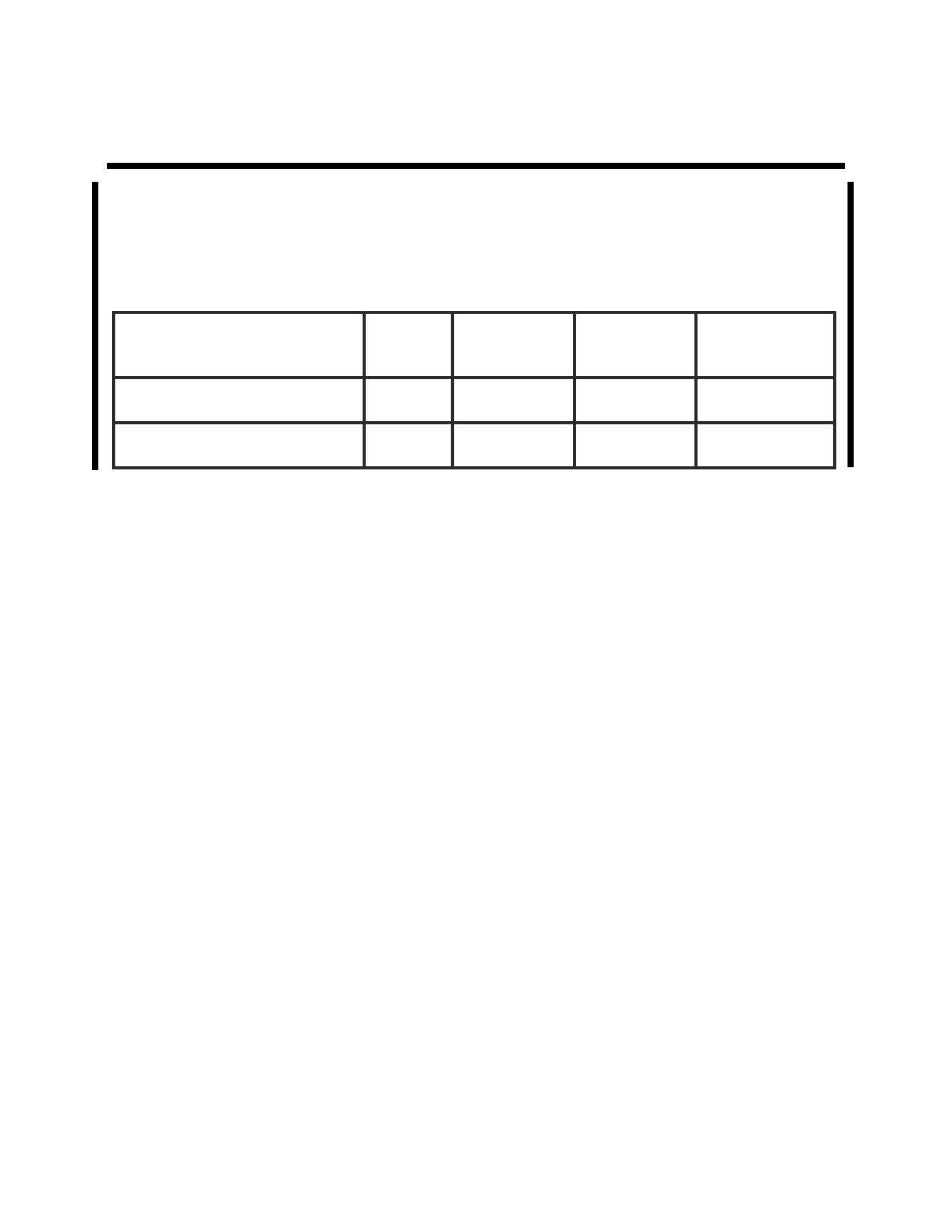
a. Applicability. The following items in Table 2-17 are certified for all helicopters with suitable lift capacity by the US
Army Soldier Systems Center:
Table 2-17. M1097 (H-HMMWV) Fiberglass Cargo Bed Cover (CBC)
M AX
RECOMMENDED
LINK COUNT
NOMENCLATURE
WEIGH T
SLING SET
AIRSPEE D
FRONT/REA R
(POUNDS )
(KNOTS )
Cargo Bed Cover, HMMWV , Type I,
10K
5
/
10,000
90
Camoflage, NSN: 5411-01-647-32463
15K
6
/
Cargo Bed Cover, HMMWV , Type I,
10K
5
/
10,000
90
Sand, NSN: 5411-01-479-1928
15K
6
/
b. Materials. The following materials are required to
(6) Felt sheet, cattle hair, Type IV, 1/2-inch or suitable
rig this load:
padding.
(1) Sling set (10,000-pound capacity).
c. Personnel. Two persons can prepare and rig this
load in 15 minutes.
(a) Chain length, part number 38850-00053-101,
from a 10,000-pound capacity sling set (4 each).
d. Procedures. The following procedures apply to
this load:
(b) Coupling link, part number 577-0615, from a
10,000-pound sling set (4 each).
(1) Preparation. Prepare the load using the following
steps:
OR
(a) Extend the sling leg chains by connecting one
(2) Multileg sling set (15,000-pound capacity for the
additional chain length to each chain on a 10,000-pound
CH-53E only).
capacity sling set with coupling links. Connect two addi-
tional chain lengths to each chain on the 15,000-pound
(a) Additional chain lengths from the sling set
multileg sling set chain with coupling links.
being used (8 each).
(b) Fold mirrors forward in front of the windshield for
(b) Additional coupling links from the sling set
added protection and tie together with Type III nylon cord.
being used (8 each).
(c) Secure the cargo bed cover to the truck using
(3) Tape, adhesive, pressure-sensitive, 2-inch wide
wire rope or tie-down assemblies.
roll.
(d) Secure all equipment inside the cargo bed cover
(4) Cord, nylon, Type III, 550-pound breaking strength.
with tape, nylon cord, or lashings; close and secure shel-
ter vents and door with nylon cord or tape.
(5) Webbing, cotton, 1/4-inch, 80-pound breaking
strength.
2-41
C2, FM 10-450-4/MCRP 4-23E, VOL II/NWP 3-04.12/AFJMAN 11-223, VOL II/
COMDTINST M13482.3A
(e) Secure all equipment and cargo inside the
rear bumper by removing the tiedown provisions located
vehicle with tape, nylon cord, or lashings. Secure the
inboard of the bumper end and installing them on the
doors shut if installed.
outer ends of the rear bumper.
(f) Ensure the fuel tank is not over 3/4 full. Inspect
(2) Rigging. Rig the load according to the steps in
fuel tank cap, oil filler cap, and battery caps for proper
Figure 2-16.
installation.
(3) Hookup. The hookup team stands on top of the
(g) Engage the vehicle parking brake and put the
cargo bed cover. The static wand person discharges the
transmission in neutral.
static electricity with the static wand. The hookup person
places the apex fitting onto the aircraft cargo hook. The
(h) Ensure the front wheels are pointed straight
hookup team then carefully dismounts the vehicle and
ahead. Tie down the steering wheel, using the securing
remains close to the load as the helicopter removes slack
device attached under the dashboard.
from the sling legs. When successful hookup is assured,
the hookup team quickly exits the area underneath the
(i) Tape the windshield in an X formation from cor-
helicopter to the designated rendezvous point.
ner to corner.
(4) Derigging. Derigging is the reverse of the prepara-
(j) Install the lift provisions on the outer ends of the
tion and rigging procedures in steps d (1) and d (2).
2-42
C2, FM 10-450-4/MCRP 4-23E, VOL II/NWP 3-04.12/AFJMAN 11-223, VOL II/
COMDTINST M13482.3A
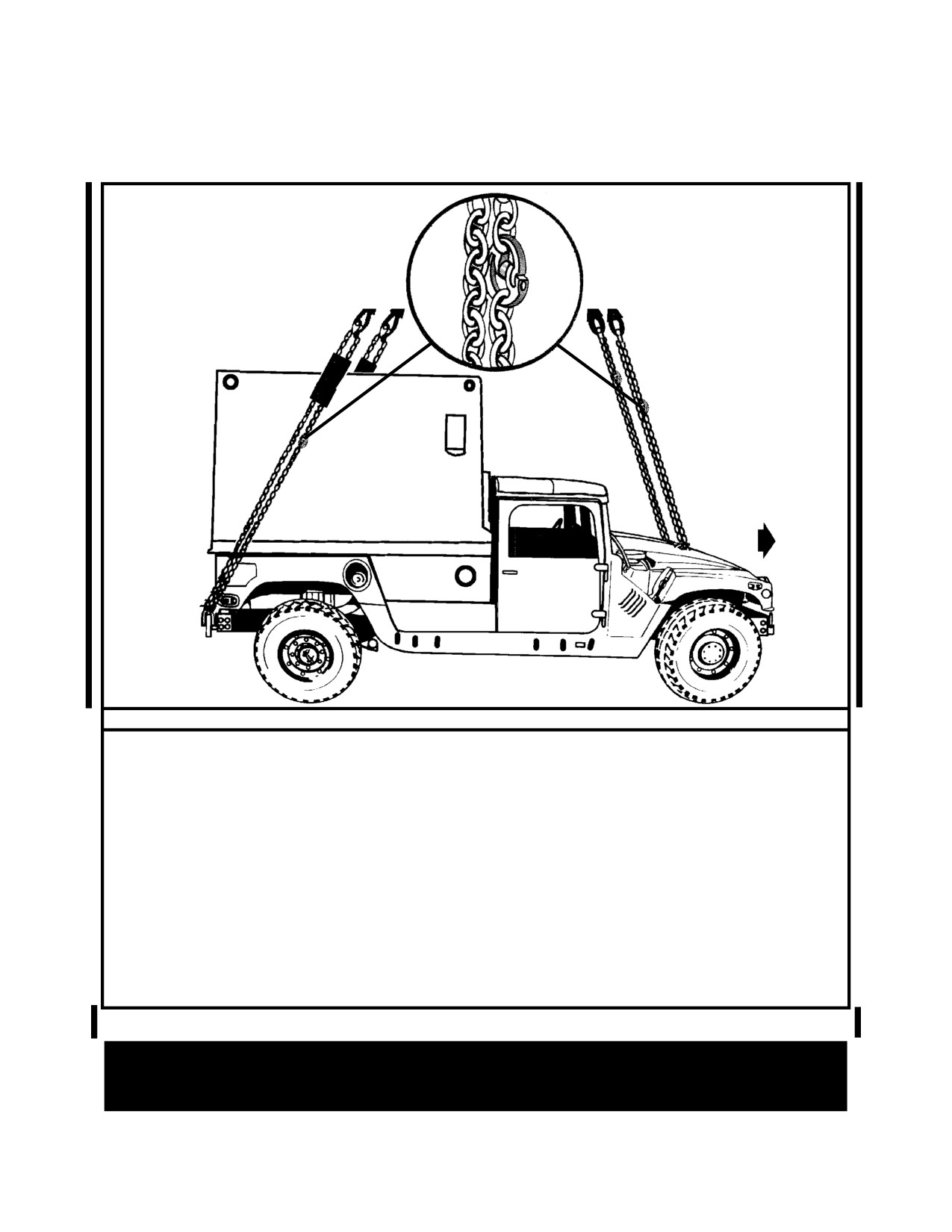
RIGGING STEPS
1. Position apex fitting on top of the cargo bed cover.
inboard to outboard. Place the correct link from Table 2-17
Route outer sling legs 1and 2 to the front of the vehicle
in the grab hook. Repeat with sling leg 4 and the right rear
and inner sling legs 3 and 4 to the rear. Sling legs 1 and 3
lift provision. Secure excess chain with tape or Type III
must be on the left side of the load.
nylon cord.
2. Loop the chain end of sling leg 1 through the left
4. Wrap the rear slings with padding where they contact
front lift provision that protrudes through the hood from
the cover sides.
inboard to outboard. Place the correct link from Table 2-17
in the grab hook. Repeat with sling leg 2 and the right
5. Raise the apex fitting above the shelter carrier keep-
front lift provision. Secure excess chain with tape or Type
ing the slings to the side of the shelter.
III nylon cord.
6. Cluster and tie or tape (breakaway technique) all sling
3. Route the chain end of sling leg 3 through the lift
legs together on top of the shelter to prevent entangle-
provision located on the left end of the rear bumper from
ment during hookup and lift-off.
Figure 2-16. M1097 (H-HMMWV) With Fiberglass Cargo Bed Cover
CAUTION
Do not use the lift shackles located near the center of the rear bumper for sling load lift provi-
sions.
2-43

C2, FM 10-450-4/MCRP 4-23E, VOL II/NWP 3-04.12/AFJMAN 11-223, VOL II/
COMDTINST M13482.3A
2-19. Light Armored Vehicle (LAV) (USMC)
a. Applicability. The following items in Table 2-18 are certified for all helicopters with suitable lift capacity by the US
Army Soldier Systems Center:
Table 2-18. Light Armored Vehicle (LAV)
M AX
RECOMMENDED
LINK COUNT
NOMENCLATURE
WEIGH T
SLING SET
AIRSPEE D
FRONT/REA R
(POUNDS )
(KNOTS )
Command and Control TAMCN E0946
27,060
40K
3/20
95
25-MM, TAMCN E0947
28,200
40K
2
/
85
Logistics TAMCN E0948
28,200
40K
3/10
90
Mortar TAMCN E0949
27,400
40K
2
/
95
Recovery Unit TAMCN E0950
28,400
40K
3/10
90
Tow Anti-Tank TAMCN E0942
27,650
40K
1
/
90
b. Materials. The following materials are required to
(b) Remove all antennae.
rig this load:
(c) Ensure the parking brake is set.
(1) Sling set (40,000-pound capacity).
(d) Pad and tape all vision blocks, mirrors, and lights.
(2) Tape, adhesive, pressure-sensitive, 2-inch wide
roll.
(e) Secure all hatches and panels.
(f) Ensure the boom is pinned down and tape the
(3) Cord, nylon, Type III, 550-pound breaking strength.
hydraulic cables. (Recovery Unit)
(4) Webbing, cotton, 1/4-inch, 80-pound breaking
(2) Rigging. Rig the load according to the steps in
strength.
Figure 2-17.
(5) Felt sheet, cattle hair, Type IV, 1/2-inch or suitable
(3) Hookup. The hookup team stands on top of the
padding.
vehicle. The static wand person discharges the static
electricity with the static wand. The hookup person places
c. Personnel. Two persons can prepare and rig this
the apex fitting onto the aircraft cargo hook. The hookup
load in 15 minutes.
team then carefully dismounts the vehicle and remains
close to the load as the helicopter removes slack from the
d. Procedures. The following procedures apply to
sling legs. When successful hookup is assured, the
this load:
hookup team quickly exits the area underneath the heli-
copter to the designated rendezvous point.
(1) Preparation. Prepare the load using the
following steps:
(4) Derigging. Derigging is the reverse of the prepa-
ration and rigging procedures in steps d (1) and d (2).
(a) Secure all loose items inside the LAV.
2-44
C2, FM 10-450-4/MCRP 4-23E, VOL II/NWP 3-04.12/AFJMAN 11-223, VOL II/
COMDTINST M13482.2
2-27. M1113 (HMMWV) With M56 Smoke Generating System
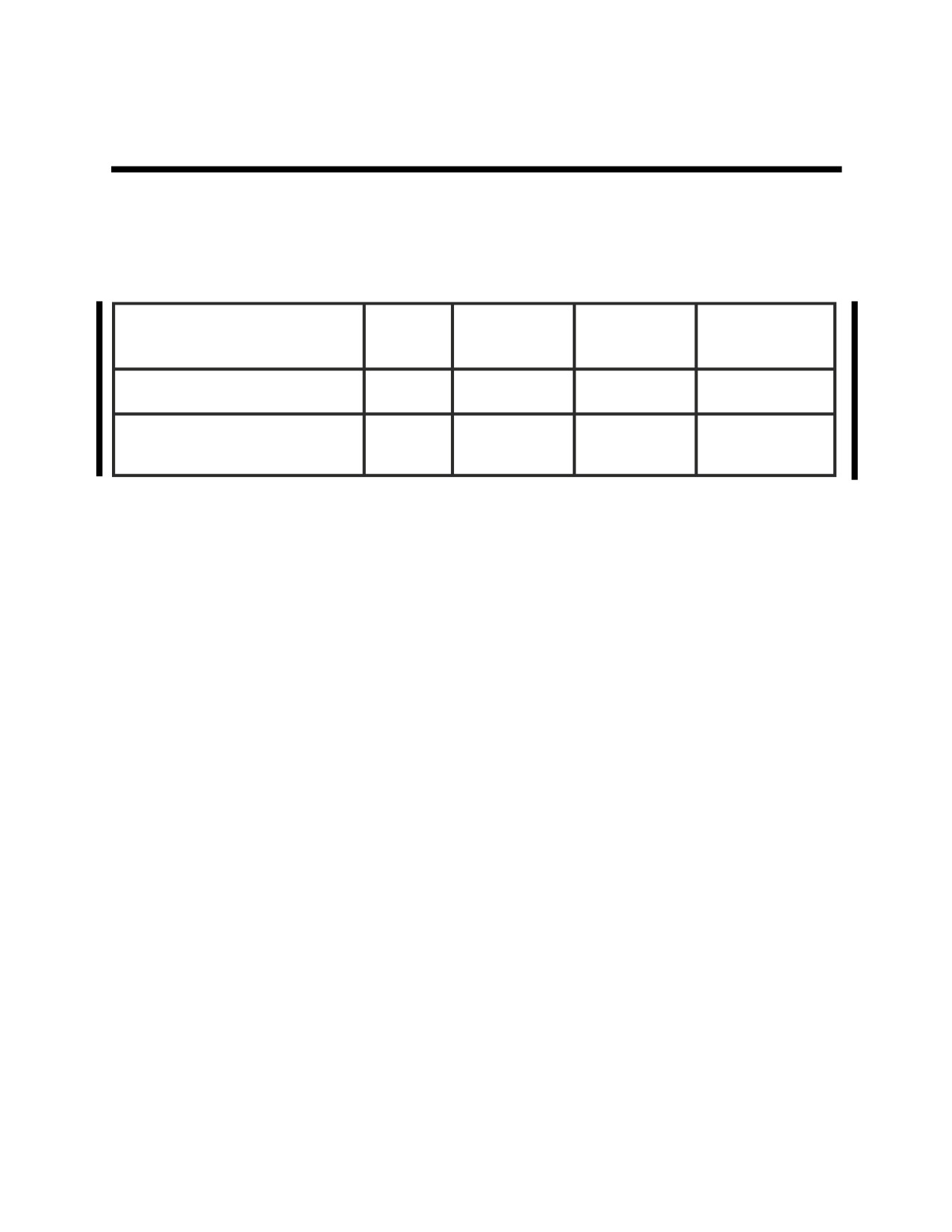
a. Applicability. The following item in Table 2-26 is certified for all helicopters with suitable lift capacity by the US
Army Soldier Systems Center:
Table 2-26. M1113 (HMMWV) With M56 Smoke Generating System
M AX
RECOMMENDED
LINK COUNT
NOMENCLATURE
WEIGH T
SLING SET
AIRSPEE D
FRONT/REA R
(POUNDS )
(KNOTS )
M1113 (HMMWV) With M56 Smoke
9,400
10K
5
/
120
Generating System with Graphite
i
M1113 (HMMWV) With M56 Smoke
50-Front
Generating System without Graphite
i
9,400
10K
14-Right Rear
120
Tank
3-Left Rear
b. Materials. The following materials are required to rig
secure the doors in the cab of the vehicle.
this load:
(c) Ensure the fuel tank is not over 3/4 full. Inspect
(1) Sling set (10,000-pound capacity).
fuel tank cap, oil filler cap, and battery caps for proper
installation.
(2) Tape, adhesive, pressure-sensitive, 2-inch wide
roll.
(d) Engage the vehicle parking brake and put the
transmission in neutral.
(3) Cord, nylon, Type III, 550-pound breaking strength.
(e) Ensure the front wheels are pointed straight ahead.
(4) Webbing, cotton, 1/4-inch, 80-pound breaking
Tie down the steering wheel, using the securing device
strength.
attached under the dashboard.
(5) Felt sheet, cattle hair, Type IV, 1/2-inch or suitable
(f) Ensure the turbine fuel and both fog oil tanks are
padding.
not over 3/4 full.
(6) Spreader bar assembly(component of the M996/
(g) Set the three-way valve to the OFF position.
M997 HMMWV Ambulance).
(h) Ensure the IR hopper latches are securely closed
c. Personnel. Two persons can prepare and rig this
and the auxiliary hoses are attached to the mounting
load in 10 minutes.
bracket at the forward end of the inboard fog oil tank.
d. Procedures. The following procedures apply to
(i) Secure all latches and doors with tape or Type III
this load:
nylon cord.
(1) Preparation. Prepare the load using the following
(j) Extend the spreader bar until the holes line up.
steps:
Install the pin and engage the keeper.
(a) Fold mirrors forward in front of the windshield for
(k) Position the spreader bar across the rear of the
added protection and tie together with Type III nylon cord.
vehicle, resting on the power module and the weapons
case. Attach the two spreader bar check cables to the
(b) Secure all equipment and cargo inside the
larger hole openings, footman's loop, on the vehicle fend-
vehicle with tape, nylon cord, or lashings. Remove and
ers.
2-61
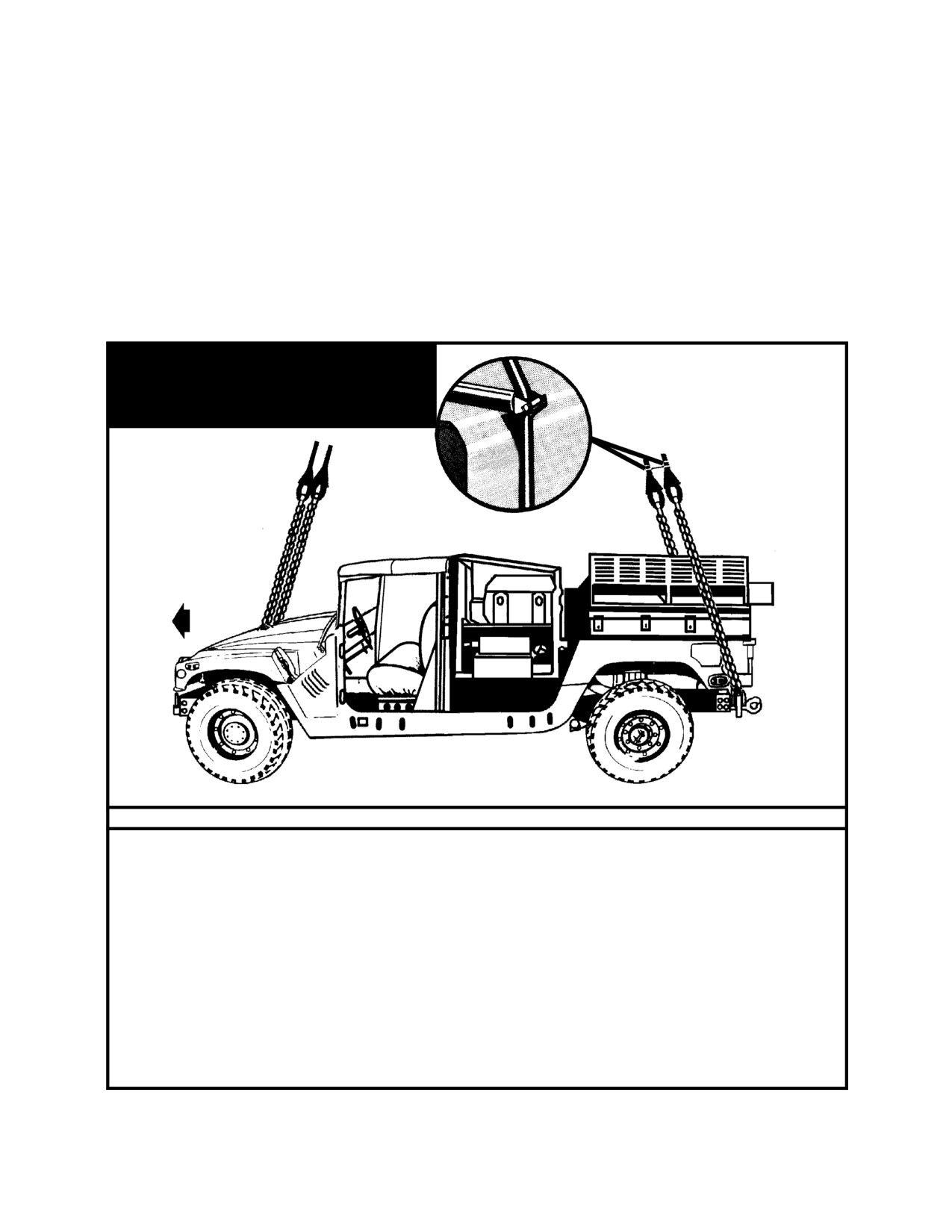
C2, FM 10-450-4/MCRP 4-23E, VOL II/NWP 3-04.12/AFJMAN 11-223, VOL II/
COMDTINST M13482.2
(2) Rigging. Rig the load according to the steps in
carefully dismounts the vehicle and remains close to the
Figure 2-25.
load as the helicopter removes slack from the sling legs.
When successful hookup is assured, the hookup
(3) Hookup. The hookup team stands on the IR hop-
teamquickly exits the area underneath the helicopter to
per loading platform on the left side of the vehicle. The
the designated rendezvous point.
static wand person discharges the static electricity with
the static wand. The hookup person places the apex fit-
(4) Derigging. Derigging is the reverse of the prepara-
ting onto the aircraft cargo hook. The hookup team then
tion and rigging procedures in steps d (1) and d (2).
CAUTION
TOTAL WEIGHT OF LOAD IS RESTRICTED TO
9,400 POUNDS DUE TO THE STRUCTURAL
STRENGTH OF THE SPREADER BAR.
RIGGING STEPS
1. Position the apex fitting on top of the IR hopper or on
3. Place the nylon rope of sling legs 3 and 4 in the
the forward end of the fog oil tanks. Route outer sling
guides on the ends of the spreader bar. Route the chain
legs 1and 2 to the front of the vehicle and inner sling legs
end of sling leg 3 through the lift provision located on the
3 and 4 to the rear. Sling legs 1 and 3 must be on the left
left end of the rear bumper from inboard to outboard. Place
side of the load.
the correct link from Table 2-26 in the grab hook. Repeat
with sling leg 4 and the right rear lift provision.
2. Loop the chain end of sling leg 1 through the left
front lift provision that protrudes through the hood from
4. Pad the sling legs in the area where they make contact
inboard to outboard. Place the correct link from Table 2-26
with the structure.
in the grab hook. Repeat with sling leg 2 and the right
front lift provision. Secure excess chain with tape or Type
5. Cluster and tie or tape (breakaway technique) all sling
III nylon cord.
legs together on top of the shelter to prevent entangle-
ment during hookup and lift-off.
Figure 2-25. M1113 (HMMWV) With M56 Smoke Generating System
2-62
C2, FM 10-450-4/MCRP 4-23E, VOL II/NWP 3-04.12/AFJMAN 11-223, VOL II/
COMDTINST M13482.3A
2-29. M1113 Truck, Utility, Expanded Capacity (HMMWV) With Lightweight Multipurpose
Shelter (LMS)
a. Applicability. The following items in Table 2-28 are certified for all helicopters with suitable lift capacity by the US
Army Soldier Systems Center:
Table 2-28. M1113 HMMWV with Lightweight Multipurpose Shelter (LMS)
MAX
RECOMMENDED
SLING
LINK COUNT
NOMENCLATURE
WEIGH T
AIRSPEE D
SET
FRONT / REA R
(POUNDS )
(KNOTS )
AN/TTC-56 Single Shelter
11,500
25K
3
/
120
Switch (SSS )
Digital Topographic Support
11,500
25K
3
/
100
System-Light (DTSS-L )
b. Materials. The following materials are required
(a) Extend the sling leg chains by connecting one
to rig this load:
additional chain length to each chain on a 25,000-pound
capacity sling set with coupling links.
(1) Sling set (25,000-pound capacity).
(b) Fold mirrors forward in front of the windshield for
(a) Chain length, part number 38850-00053-102,
added protection and tie together with Type III nylon cord.
from a 25,000-pound capacity sling set (4 each).
(c) Secure all equipment inside the shelter with tape,
(b) Coupling link, part number 664241, from a
nylon cord, or lashings; close and secure shelter vents
25,000-pound sling set (4 each).
and door with nylon cord or tape.
(2) Tape, adhesive, pressure-sensitive, 2-inch wide
(d) Secure environmental control unit cover with
roll.
duct tape.
(3) Cord, nylon, Type III, 550-pound breaking strength.
(e) Disconnect the power cord from the rear panel
and secure it to the rear platform with Type III nylon cord.
(4) Webbing, cotton, 1/4-inch, 80-pound breaking
Lower the power panel door and secure the door.
strength.
(f) Secure all equipment and cargo inside the
(5) Felt sheet, cattle hair, Type IV, 1/2-inch or suitable
vehicle with tape, nylon cord, or lashings. Secure the
padding.
doors shut if installed.
c. Personnel. Two persons can prepare and rig this
(g) Ensure the fuel tank is not over 3/4 full. Inspect
load in 15 minutes.
fuel tank cap, oil filler cap, and battery caps for proper
installation.
d. Procedures. The following procedures apply to
this load:
(h) Engage the vehicle parking brake and put the
transmission in neutral.
(1) Preparation. Prepare the load using the following
steps:
2-65
C2, FM 10-450-4/MCRP 4-23E, VOL II/NWP 3-04.12/AFJMAN 11-223, VOL II/
COMDTINST M13482.3A
(i) Ensure the front wheels are pointed straight ahead.
Figure 2-27.
Tie down the steering wheel, using the securing device
attached under the dashboard.
(3) Hookup. The hookup team stands on top of the
shelter. The static wand person discharges the static elec-
(j) Tape the windshield in an X formation from cor-
tricity with the static wand. The hookup person places
ner to corner.
the apex fitting onto the cargo hook. The hookup team
then carefully dismounts the vehicle and remains close to
(k) Install the lift provisions on the outer ends of the
the load as the helicopter removes slack from the sling
rear bumper.
legs. When successful hookup is assured, the hookup
team quickly exits the area underneath the helicopter to
(l) Remove the upper antenna mounting bracket if
the designated rendezvous point.
installed.
(4) Derigging. Derigging is the reverse of the prepara-
(2) Rigging. Rig the load according to the steps in
tion and rigging procedures in steps d (1) and d (2).
2-66
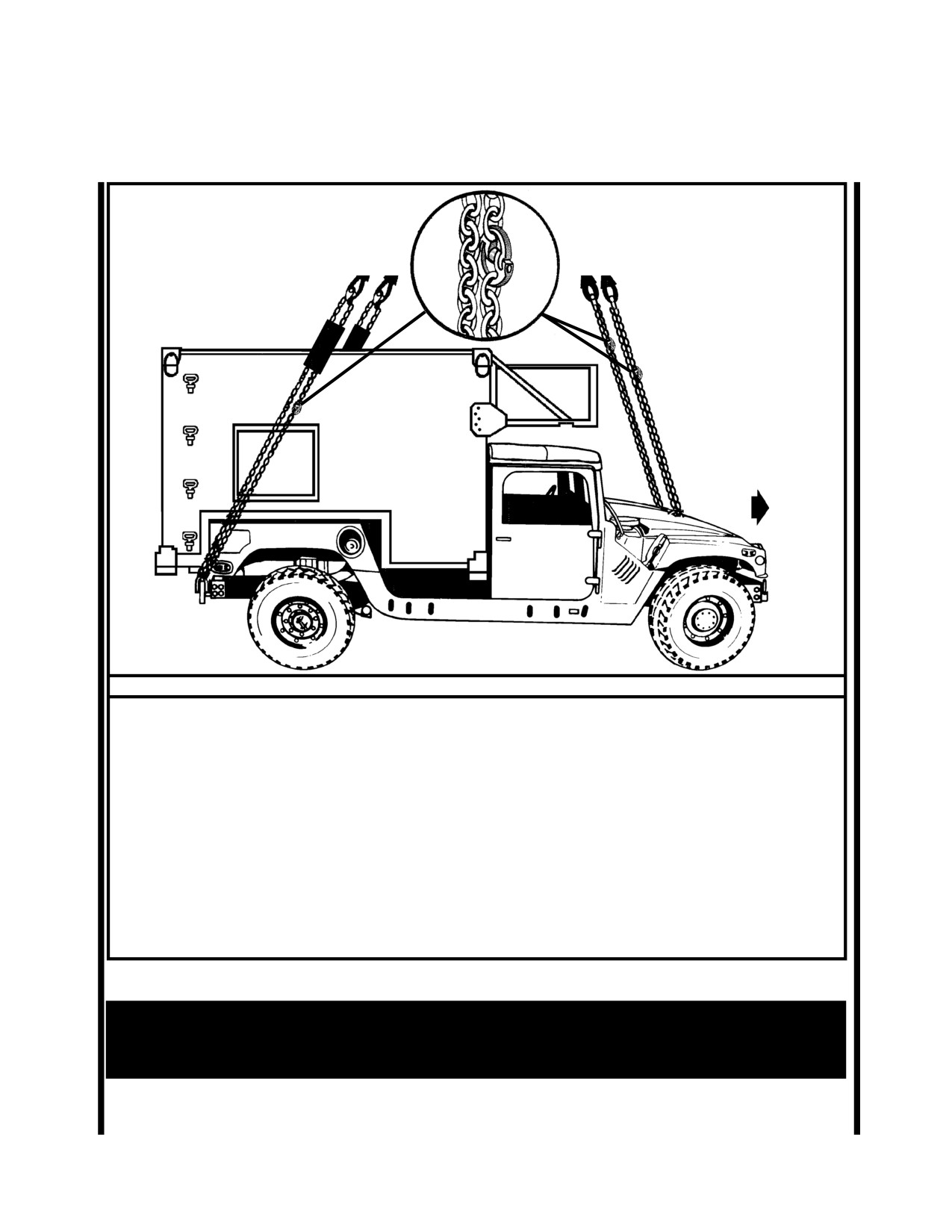
C2, FM 10-450-4/MCRP 4-23E, VOL II/NWP 3-04.12/AFJMAN 11-223, VOL II/
COMDTINST M13482.3A
RIGGING STEPS
3. Loop the chain end of sling leg 3 through the left rear
1. Position the apex fitting on top of the shelter. Route
lift provision located on the left end of the rear bumper.
outer sling legs 1 and 2 to the front of the vehicle and
Place the correct link from Table 2-28 in the grab hook.
inner sling legs 3 and 4 to the rear. Sling legs 1 and 3 must
Repeat with sling leg 4 through the right rear lift provision
be on the left side of the load.
Secure all excess chain with tape or Type III nylon cord.
2. Loop the chain end of sling leg 1 through the left
4. Wrap the rear slings with padding where they contact
front lift provision that protrudes through the hood from
the shelter sides.
inboard to outboard. Place the correct link from Table 2-28
in the grab hook. Repeat with sling leg 2 through the right
5. Cluster and tie or tape (breakaway technique) the
front lift provision. Secure all excess chain with tape or
sling legs in each sling set together to prevent entangle-
Type III nylon cord.
ment during hookup and lift-off.
Figure 2-27. LMS Shelter Mounted on the M1113
CAUTION
Do not use the lift shackles located near the center of the rear bumper for sling load lift
provisions.
2-67
C2, FM 10-450-4/MCRP 4-23E, VOL II/NWP 3-04.12/AFJMAN 11-223, VOL II/
COMDTINST M13482.3A
2-30. M1097A2 Shelter Carrier (HMMWV) With Special Operations Media System
(SOMS-B) in S-788G Shelter (LMS)
a. Applicability. The following item in Table 2-29 is certified for all helicopters with suitable lift capacity by the US
Army Soldier Systems Center:
Table 2-29. M1097A2 Shelter Carrier (HMMWV) With Special Operations Media System (SOMS-B) in S-788G
Shelter (LMS)
MAX
RECOMMENDED
SLING
LINK COUNT
NOMENCLATURE
WEIGH T
AIRSPEE D
SET
FRONT / REA R
(POUNDS )
(KNOTS )
Special Operations Media
9,080
10K
4
/
120
System
b. Materials. The following materials are required
(a) Extend the sling leg chains by connecting one
to rig this load:
additional chain length to each chain on a 10,000-pound
capacity sling set with coupling links.
(1) Sling set (10,000-pound capacity).
(b) Fold mirrors forward in front of the windshield for
(a) Chain length, part number 38850-00053-101,
added protection and tie together with Type III nylon cord.
from a 10,000-pound capacity sling set (4 each).
(c) Secure all equipment inside the shelter with tape,
(b) Coupling link, part number 577-0615, from a
nylon cord, or lashings; close and secure shelter vents
10,000-pound sling set (4 each).
and door with nylon cord or tape.
(2) Tape, adhesive, pressure-sensitive, 2-inch wide
(d) Disconnect the power cord from the rear panel
roll.
and secure it to the rear platform with Type III nylon cord.
Lower the power panel door and secure the door.
(3) Cord, nylon, Type III, 550-pound breaking strength.
(e) Secure all equipment and cargo inside the
(4) Webbing, cotton, 1/4-inch, 80-pound breaking
vehicle with tape, nylon cord, or lashings. Secure the
strength.
doors shut if installed.
(5) Felt sheet, cattle hair, Type IV, 1/2-inch or suitable
(f) Ensure the fuel tank is not over 3/4 full. Inspect
padding.
fuel tank cap, oil filler cap, and battery caps for proper
installation.
(6) Padding, Cellulose.
(g) Engage the vehicle parking brake and put the
c. Personnel. Two persons can prepare and rig this
transmission in neutral.
load in 15 minutes.
(h) Ensure the front wheels are pointed straight
d. Procedures. The following procedures apply to
ahead. Tie down the steering wheel, using the securing
this load:
device attached under the dashboard.
(1) Preparation. Prepare the load using the following
(i) Tape the windshield in an X formation from cor-
steps:
ner to corner.
2-68
C2, FM 10-450-4/MCRP 4-23E, VOL II/NWP 3-04.12/AFJMAN 11-223, VOL II/
COMDTINST M13482.3A
(j) Install the lift provisions on the outer ends of the
the apex fitting onto the cargo hook. The hookup team
rear bumper.
then carefully dismounts the vehicle and remains close to
the load as the helicopter removes slack from the sling
(k) Remove the upper antenna bracket if installed.
legs. When successful hookup is assured, the hookup
team quickly exits the area underneath the helicopter to
(2) Rigging. Rig the load according to the steps in
the designated rendezvous point.
Figure 2-28.
NOTE: Hookup of this load presents substantial risk of
NOTE: Ensure the chains on sling leg 1 are routed be-
damage to the load or injury to the hookup personnel.
tween the shelter and the 30 meter mast.
Use of a reach pendant is recommended for this load.
(3) Hookup. The hookup team stands on top of the
(4) Derigging. Derigging is the reverse of the prepara-
shelter. The static wand person discharges the static elec-
tion and rigging procedures in steps d (1) and d (2).
tricity with the static wand. The hookup person places
2-69
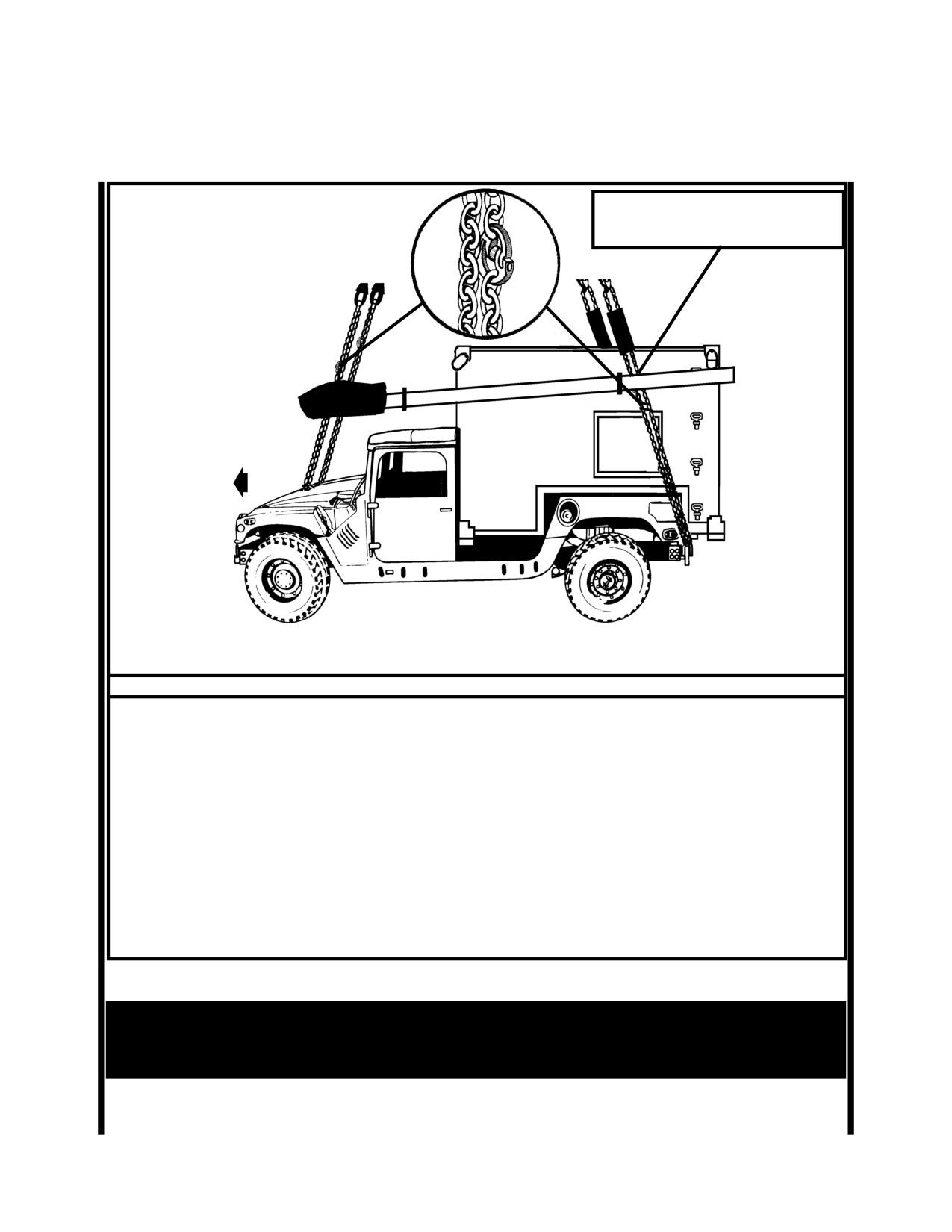
C2, FM 10-450-4/MCRP 4-23E, VOL II/NWP 3-04.12/AFJMAN 11-223, VOL II/
COMDTINST M13482.3A
NOTE: Ensure the chains on sling
leg 1 are routed between the shelter
and the 30 meter mast.
RIGGING STEPS
3. Loop the chain end of sling leg 3 through the left rear
1. Position the apex fitting on top of the shelter. Route
lift provision located on the left end of the rear bumper.
outer sling legs 1 and 2 to the front of the vehicle and
Place the correct link from Table 2-29 in the grab hook.
inner sling legs 3 and 4 to the rear. Sling legs 1 and 3 must
Repeat with sling leg 4 through the right rear lift provision
be on the left side of the load.
Secure all excess chain with tape or Type III nylon cord.
2. Loop the chain end of sling leg 1 through the left
4. Wrap the rear slings with padding where they contact
front lift provision that protrudes through the hood from
the shelter sides.
inboard to outboard. Place the correct link from Table 2-29
in the grab hook. Repeat with sling leg 2 through the right
5. Cluster and tie or tape (breakaway technique) the
front lift provision. Secure all excess chain with tape or
sling legs in each sling set together to prevent entangle-
Type III nylon cord.
ment during hookup and lift-off.
Figure 2-28. SOMS-B in LMS Shelter Mounted on the M1097A2
CAUTION
Do not use the lift shackles located near the center of the rear bumper for sling load lift
provisions.
2-70
C2, FM 10-450-4/MCRP 4-23E, VOL II/NWP 3-04.12/AFJMAN 11-223, VOL II/
COMDTINST M13482.3A
2-31. M1037 (HMMWV) With Compressed Air-Foam System, Mobile (CAFSM)
a. Applicability. The following item in Table 2-30 is certified for all helicopters with suitable lift capacity by the US
Army Soldier Systems Center:
Table 2-30. M1037 (HMMWV) With Compressed Air-Foam System, Mobile (CAFSM)
M AX
RECOMMENDED
SLING
LINK COUNT
NOMENCLATURE
WEIGH T
AIRSPEE D
SET
FRONT / REA R
(POUNDS )
(KNOTS )
Compressed Air-Foam System
,
6,400
15K
4
/
120
Mobie
(EMPTY )
Note: The water tank in the CAFSM MUST BE
(c) Secure all equipment and cargo inside the ve-
EMPTY for sling loading.
hicle with tape, nylon cord, or lashings.
b. Materials. The following materials are required
(d) Ensure the fuel tank is not over 3/4 full. Inspect
to rig this load:
fuel tank cap, oil filler cap, and battery caps for proper
installation.
(1) Sling set (15,000-pound capacity) .
(e) Engage the vehicle parking brake and put the
(2) Tape, adhesive, pressure-sensitive, 2-inch wide
transmission in neutral.
roll.
(f) Ensure the front wheels are pointed straight ahead.
(3) Cord, nylon, Type III, 550-pound breaking strength.
Tie down the steering wheel, using the securing device
attached under the dashboard.
(4) Webbing, cotton, 1/4-inch, 80-pound breaking
strength.
(g) Tape the windshield in an X formation from cor-
ner to corner.
c. Personnel. Two persons can prepare and rig this
load in 15 minutes.
(2) Rigging. Rig the load according to the steps in
Figure 2-29.
d. Procedures. The following procedures apply to
this load:
(3) Hookup. The hookup team stands in the bed of the
vehicle. The static wand person discharges the static
(1) Preparation. Prepare the load using the follow-
electricity with the static wand. The hookup person places
ing steps:
the apex fitting on the cargo hook. The hookup team then
carefully dismounts the vehicle and remains close to the
(a) Fold mirrors forward in front of the windshield for
load as the helicopter removes slack from the sling legs.
added protection and tie together with Type III nylon
When successful hookup is assured, the hookup team
cord. Remove the canvas cab top and the doors. Secure
quickly exits the area underneath the helicopter to the
to the seats with Type III nylon cord.
designated rendezvous point.
(b) Ensure the CAFSM is secured to the truck. Se-
(4) Derigging. Derigging is the reverse of the prepara-
cure all lids, doors, and vents on the CAFSM with tape or
tion and rigging procedures in steps d (1) and d (2).
Type III nylon cord. Safety tie all chains and hoses with
tape or Type III nylon cord.
2-71
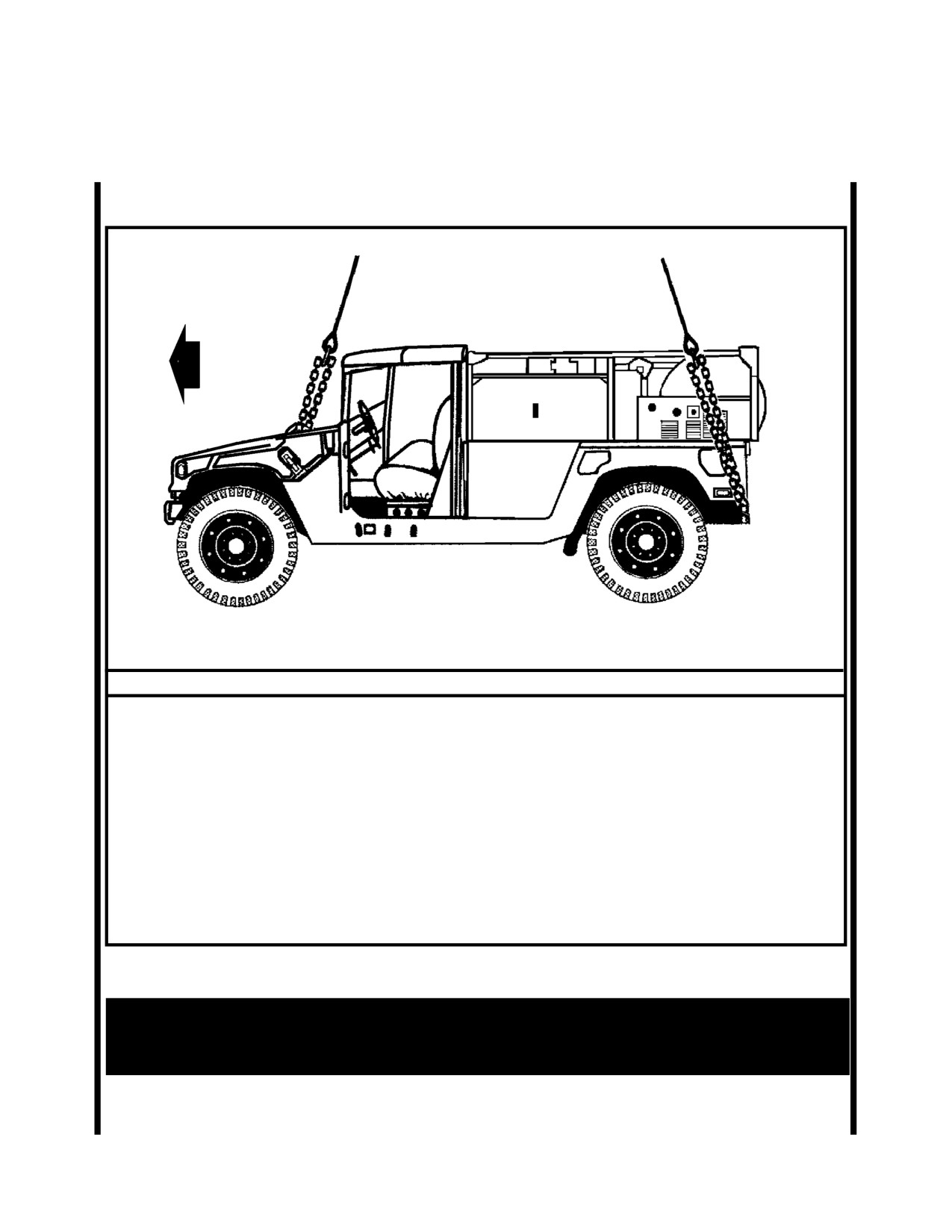
C2, FM 10-450-4/MCRP 4-23E, VOL II/NWP 3-04.12/AFJMAN 11-223, VOL II/
COMDTINST M13482.3A
RIGGING STEPS
1. Position the apex fitting on top of the vehicle. Route
3. Loop the chain end of sling leg 3 through the left rear
outer sling legs 1 and 2 to the front of the vehicle and
lift provision located on the outside end of the rear bumper.
inner sling legs 3 and 4 to the rear. Sling legs 1 and 3 must
Place the correct link from Table 2-30 in the grab hook.
be on the left side of the load.
Repeat with sling leg 4 through the right rear lift provi-
sion.
2. Loop the chain end of sling leg 1 through the left
front lift provision that protrudes through the hood from
4. Secure all excess chain with tape or Type III nylon
inboard to outboard. Place the correct link from Table 2-30
cord.
in the grab hook. Repeat with sling leg 2 through the right
front lift provision.
5. Cluster and tie or tape (breakaway technique) the
sling legs in each sling set together to prevent entangle-
ment during hookup and lift-off.
Figure 2-29. M1037 (HMMWV) With Compressed Air-Foam System, Mobile (CAFSM)
CAUTION
Do not use the lift shackles located near the center of the rear bumper for sling load lift provi-
sions.
2-72
C2, FM 10-450-4/MCRP 4-23E, VOL II/NWP 3-04.12/AFJMAN 11-223, VOL II/
COMDTINST M13482.3A
2-32. Prophet AN/MLQ-40 (V) on M1097 HMMWV
a. Applicability. The following item in Table 2-31 is certified for all helicopters with suitable lift capacity by the US
Army Soldier Systems Center:
Table 2-31. Prophet AN/MLQ-40 (V) on M1097 HMMWV
MAX
RECOMMENDED
SLING
LINK COUNT
NOMENCLATURE
WEIGH T
AIRSPEE D
SET
FRONT / REA R
(POUNDS )
(KNOTS )
Prophet AN/MLQ-40 (V
)
10,000
10K
5
/
90
b. Materials. The following materials are required
(c) Secure all equipment and cargo inside the vehicle
to rig this load:
with tape, nylon cord, or lashings. Roll up all the win-
dows and secure the doors closed (if installed)
(1) Sling set (10,000-pound capacity).
(d) Ensure the fuel tank is not over 3/4 full. Inspect
(a) Chain length, part number 38850-00053-101,
fuel tank cap, oil filler cap, and battery caps for proper
from a 10,000-pound capacity sling set (4 each).
installation.
(b) Coupling link, part number 577-0615, from a
(e) Engage the vehicle parking brake and put the
10,000-pound sling set (4 each).
transmission in neutral.
(2) Tape, adhesive, pressure-sensitive, 2-inch wide
(f) Ensure the front wheels are pointed straight ahead.
roll.
Tie down the steering wheel, using the securing device
attached under the dashboard.
(3) Cord, nylon, Type III, 550-pound breaking strength.
(g) Tape the windshield in an X formation from cor-
(4) Webbing, cotton, 1/4-inch, 80-pound breaking
ner to corner.
strength.
(h) Extend the sling leg chains by connecting one
c. Personnel. Two persons can prepare and rig this
additional chain length to each chain on a 10,000-pound
load in 15 minutes.
capacity sling set with coupling links.
d. Procedures. The following procedures apply to
(2) Rigging. Rig the load according to the steps in
this load:
Figure 2-30.
(1) Preparation. Prepare the load using the follow-
(3) Hookup. The hookup team stands on top of the
ing steps:
vehicle. The static wand person discharges the static
electricity with the static wand. The hookup person places
(a) Fold mirrors forward inward and tie together with
the apex fitting on the cargo hook. The hookup team then
Type III nylon cord.
carefully dismounts the vehicle and remains close to the
load as the helicopter removes slack from the sling legs.
(b) Ensure the Prophet cargo bed cover is secured
When successful hookup is assured, the hookup team
to the truck. Secure all equipment and cargo inside the
quickly exits the area underneath the helicopter to the
unit with tape, nylon cord, or lashings. Close and secure
designated rendezvous point.
the door.
2-73
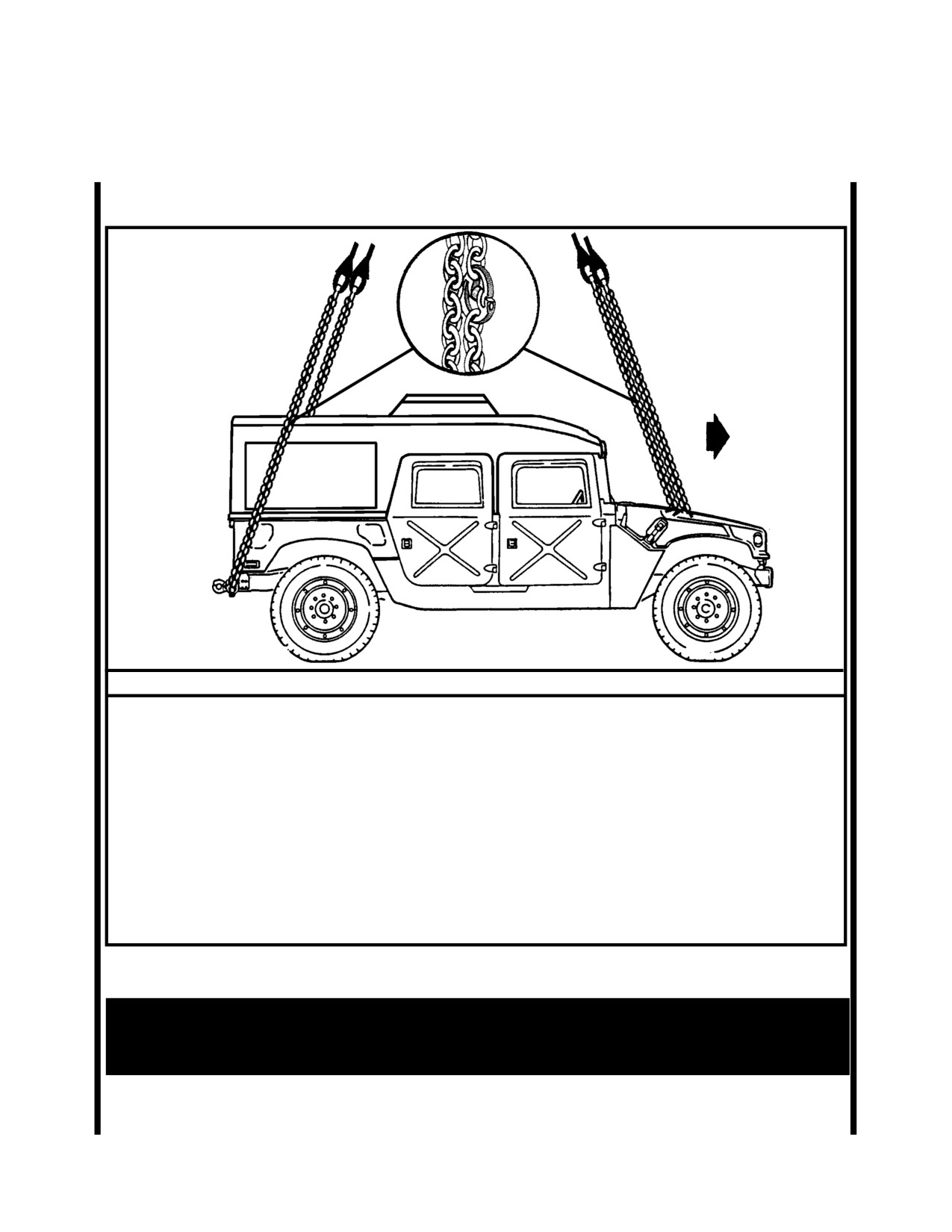
C2, FM 10-450-4/MCRP 4-23E, VOL II/NWP 3-04.12/AFJMAN 11-223, VOL II/
COMDTINST M13482.3A
(4) Derigging. Derigging is the reverse of the prepara-
tion and rigging procedures in steps d (1) and d (2).
RIGGING STEPS
1. Position the apex fitting on top of the vehicle roof.
3. Loop the chain end of sling leg 3 through the left rear
Route outer sling legs 1 and 2 to the front of the vehicle
lift provision located on the outside end of the rear bumper.
and inner sling legs 3 and 4 to the rear. Sling legs 1 and 3
Place the correct link from Table 2-31 in the grab hook.
must be on the left side of the load.
Repeat with sling leg 4 through the right rear lift provi-
sion.
2. Loop the chain end of sling leg 1 through the left
front lift provision that protrudes through the hood from
4. Secure all excess chain with tape or Type III nylon
inboard to outboard. Place the correct link from Table 2-31
cord.
in the grab hook. Repeat with sling leg 2 through the right
front lift provision.
5. Cluster and tie or tape (breakaway technique) the
sling legs in each sling set together to prevent entangle-
ment during hookup and lift-off.
Figure 2-30. Prophet AN/MLQ-40 (V) on M1097 HMMWV
CAUTION
Do not use the lift shackles located near the center of the rear bumper for sling load lift provi-
sions.
2-74
C2, FM 10-450-4/MCRP 4-23E, VOL II/NWP 3-04.12/AFJMAN 11-223, VOL II/
COMDTINST M13482.3A
2-33. Helmet Hardtop (Amtech Corp) Cargo Bed Cover on M1097A2 HMMWV
a. Applicability. The following item in Table 2-32 is certified for all helicopters with suitable lift capacity by the US
Army Soldier Systems Center:
Table 2-32. Helmit Hardtop (Amtech Corp) Cargo Bed Cover on M1097A2 HMMWV
M AX
RECOMMENDED
SLING
LINK COUNT
NOMENCLATURE
WEIGH T
AIRSPEE D
SET
FRONT / REA R
(POUNDS )
(KNOTS )
Measurements and Signature
10,300
25K
4
/
90
Intelligence (MASINT
)
b. Materials. The following materials are required
(c) Secure all equipment and cargo inside the vehicle
to rig this load:
with tape, nylon cord, or lashings. Roll up all the win-
dows and secure the doors closed (if installed)
(1) Sling set (25,000-pound capacity).
(d) Ensure the fuel tank is not over 3/4 full. Inspect
(a) Chain length, part number 38850-00053-102,
fuel tank cap, oil filler cap, and battery caps for proper
from a 25,000-pound capacity sling set (4 each).
installation.
(b) Coupling link, part number 664241, from a
(e) Engage the vehicle parking brake and put the
25,000-pound sling set (4 each).
transmission in neutral.
(2) Tape, adhesive, pressure-sensitive, 2-inch wide
(f) Ensure the front wheels are pointed straight ahead.
roll.
Tie down the steering wheel, using the securing device
attached under the dashboard.
(3) Cord, nylon, Type III, 550-pound breaking strength.
(g) Tape the windshield in an X formation from cor-
(4) Webbing, cotton, 1/4-inch, 80-pound breaking
ner to corner.
strength.
(h) Extend the sling leg chains by connecting one
c. Personnel. Two persons can prepare and rig this
additional chain length to each chain on a 10,000-pound
load in 15 minutes.
capacity sling set with coupling links.
d. Procedures. The following procedures apply to
(2) Rigging. Rig the load according to the steps in
this load:
Figure 2-31.
(1) Preparation. Prepare the load using the follow-
(3) Hookup. The hookup team stands on top of the
ing steps:
vehicle. The static wand person discharges the static
electricity with the static wand. The hookup person places
(a) Fold mirrors forward inward and tie together with
the apex fitting on the cargo hook. The hookup team then
Type III nylon cord.
carefully dismounts the vehicle and remains close to the
load as the helicopter removes slack from the sling legs.
(b) Ensure the cargo bed cover is secured to the
When successful hookup is assured, the hookup team
truck. Secure all equipment and cargo inside the unit with
quickly exits the area underneath the helicopter to the
tape, nylon cord, or lashings. Close and secure the door.
designated rendezvous point.
2-75
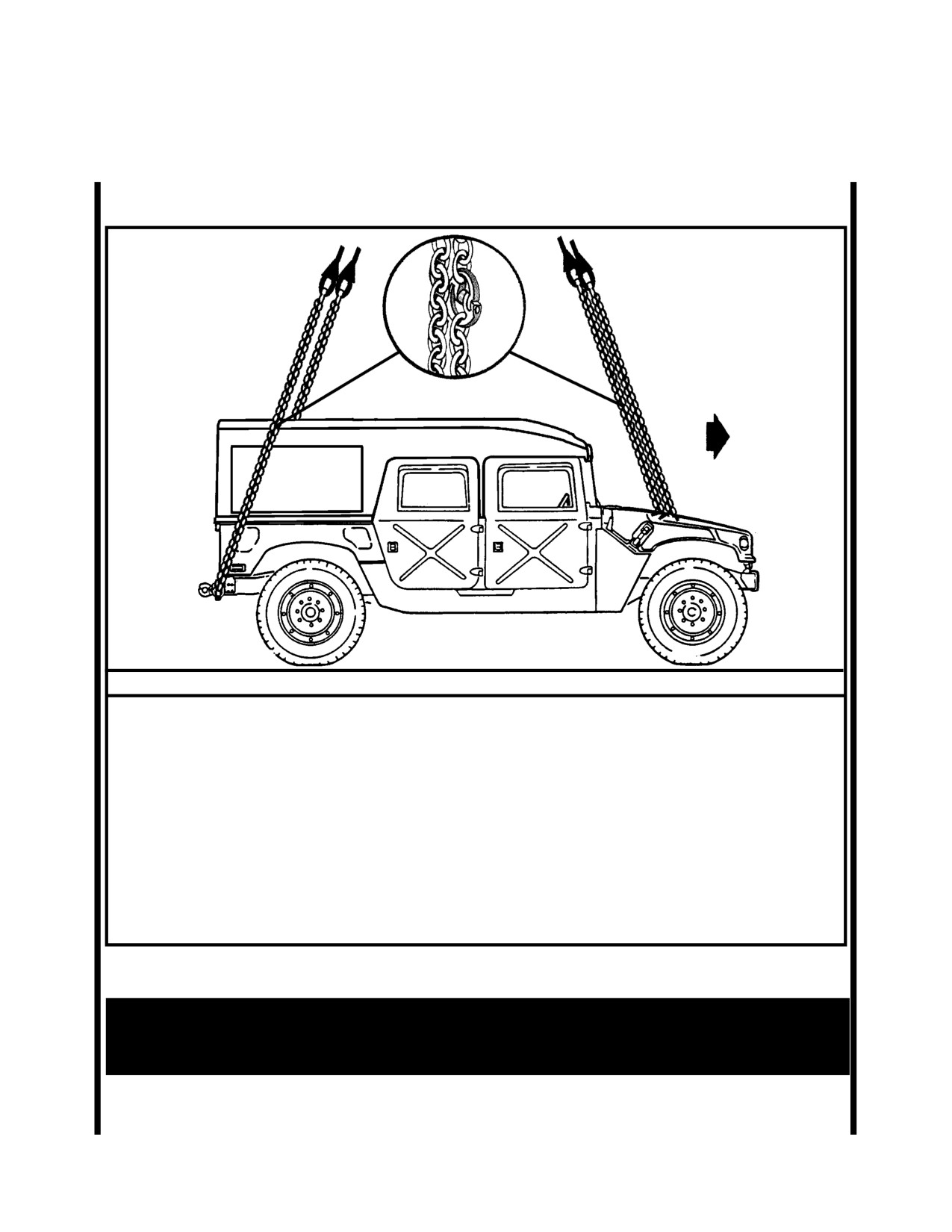
C2, FM 10-450-4/MCRP 4-23E, VOL II/NWP 3-04.12/AFJMAN 11-223, VOL II/
COMDTINST M13482.3A
(4) Derigging. Derigging is the reverse of the prepara-
tion and rigging procedures in steps d (1) and d (2).
RIGGING STEPS
1. Position the apex fitting on top of the vehicle roof.
3. Loop the chain end of sling leg 3 through the left rear
Route outer sling legs 1 and 2 to the front of the vehicle
lift provision located on the outside end of the rear bumper.
and inner sling legs 3 and 4 to the rear. Sling legs 1 and 3
Place the correct link from Table 2-32 in the grab hook.
must be on the left side of the load.
Repeat with sling leg 4 through the right rear lift provi-
sion.
2. Loop the chain end of sling leg 1 through the left
front lift provision that protrudes through the hood from
4. Secure all excess chain with tape or Type III nylon
inboard to outboard. Place the correct link from Table 2-32
cord.
in the grab hook. Repeat with sling leg 2 through the right
front lift provision.
5. Cluster and tie or tape (breakaway technique) the
sling legs in each sling set together to prevent entangle-
ment during hookup and lift-off.
Figure 2-31. Helmit Hardtop (Amtech Corp) Cargo Bed Cover on M1097A2 HMMWV
CAUTION
Do not use the lift shackles located near the center of the rear bumper for sling load lift provi-
sions.
2-76
C2, FM 10-450-4/MCRP 4-23E, VOL II/NWP 3-04.12/AFJMAN 11-223, VOL II/
COMDTINST M13482.3A
2-34. Interim Fast Attack Vehicle (IFAV) Truck, Long Wheel Base
a. Applicability. The following item in Table 2-33 is certified for all helicopters with suitable lift capacity by the US
Army Soldier Systems Center:
Table 2-33. Interim Fast Attack Vehicle (IFAV) Truck, Long Wheel Base
M AX
RECOMMENDED
SLING
LINK COUNT
NOMENCLATURE
WEIGH T
AIRSPEE D
SET
FRONT / REA R
(POUNDS )
(KNOTS )
Interim Fast Attack Vehicle
5,720
15K
3/15
120
Truck, Long Wheel Base
b. Materials. The following materials are required
(b) Secure all equipment and cargo inside the vehicle
to rig this load:
with tape, nylon cord, or tiedown straps.
(1) Sling set (15,000-pound capacity).
(c) Ensure the fuel tank is not over 3/4 full. Inspect
fuel tank cap, oil filler cap, and battery caps for proper
(2) Tape, adhesive, pressure-sensitive, 2-inch wide
installation.
roll.
(d) Engage the vehicle parking brake and put the
(3) Cord, nylon, Type III, 550-pound breaking strength.
transmission in neutral.
(4) Webbing, cotton, 1/4-inch, 80-pound breaking
(e) Ensure the front wheels are pointed straight ahead.
strength.
Tie down the steering wheel using Type III nylon cord.
(5) Padding, cellulose.
(f) Tape the windshield in an X formation from cor-
ner to corner.
(6) Strap, cargo, tiedown (as required).
(2) Rigging. Rig the load according to the steps in
c. Personnel. Two persons can prepare and rig this
Figure 2-32.
load in 10 minutes.
(3) Hookup. The hookup teams stand in the bed of the
d. Procedures. The following procedures apply to
vehicle. The static wand person discharges the static
this load:
electricity with the static wand. The hookup person places
the web ring on the cargo hook. The hookup team then
(1) Preparation. Prepare the load using the follow-
carefully dismounts the vehicle and remains close to the
ing steps:
load as the helicopter removes slack from the sling legs.
When successful hookup is assured, the hookup team
(a) Fold mirrors forward in front of the windshield for
quickly exits the area underneath the helicopter to the
added protection and tie together with Type III nylon
designated rendezvous point.
cord. Remove all canvas covers.
(4) Derigging. Derigging is the reverse of the prepara-
tion and rigging procedures in steps d (1) and d (2).
2-77
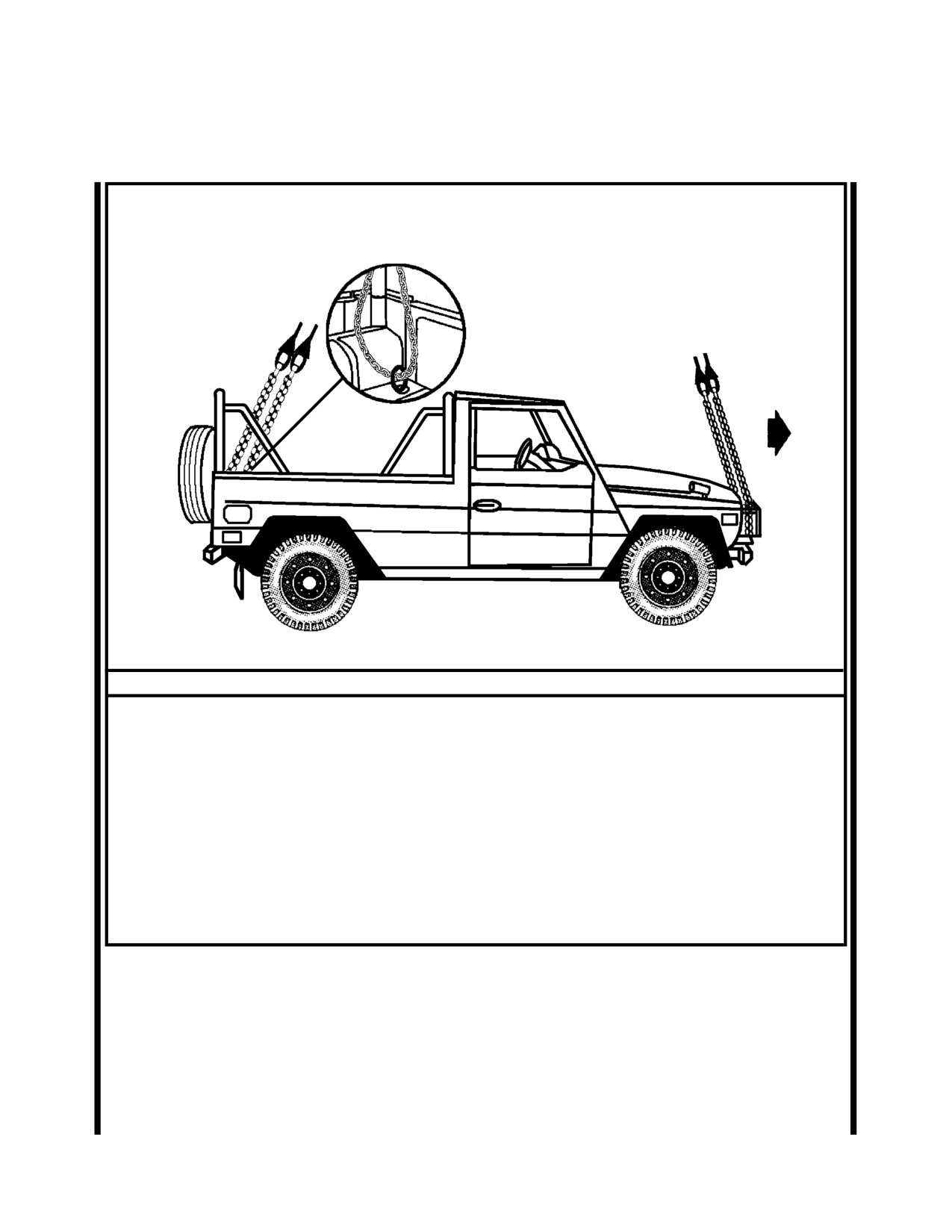
C2, FM 10-450-4/MCRP 4-23E, VOL II/NWP 3-04.12/AFJMAN 11-223, VOL II/
COMDTINST M13482.3A
RIGGING STEPS
1. Position the apex fitting on top of the vehicle. Route
3. Loop the chain end of sling leg 3 through the left rear
outer sling legs 1 and 2 to the front of the vehicle and
lift provision located in the left rear corner of the cargo
inner sling legs 3 and 4 to the rear. Sling legs 1 and 3 must
bed. Place the correct link from Table 2-33 in the grab
be on the left side of the load.
hook. Repeat with sling leg 4 through the right rear lift
provision.
2. Loop the chain end of sling leg 1 through the left
front lift provision located on the left front corner of the
4. Secure all excess chain with tape or Type III nylon
bumper . Place the correct link from Table 2-33 in the grab
cord.
hook. Repeat with sling leg 2 through the right front lift
provision.
5. Cluster and tie or tape (breakaway technique) the
sling legs in each sling set together to prevent entangle-
ment during hookup and lift-off.
Figure 2-32. Interim Fast Attack Vehicle (IFAV) Truck, Long Wheel Base
2-78
C2, FM 10-450-4/MCRP 4-23E, VOL II/NWP 3-04.12/AFJMAN 11-223, VOL II/
COMDTINST M13482.3A
2-35. John Deere M-Gator (Model #VGM6X01001)
a. Applicability. The following items in Table 2-34 are certified for all helicopters with suitable lift capacity by the US
Army Soldier Systems Center:
Table 2-34. John Deere M-Gator (Model #VGM6X01001)
MAX
RECOMMENDED
SLING
LINK COUNT
NOMENCLATURE
WEIGH T
AIRSPEE D
SET
FRONT / REA R
(POUNDS )
(KNOTS )
John Deere M-Gator (Empt
y)
1,400
10K
3/30
90
(Model # VGM6X01001)
John Deere M-Gator (with
l
2,450
10K
3/40
90
(Model # VGM6X01001)
b. Materials. The following materials are required
(c) Ensure the fuel tank is not over 3/4 full. Inspect
to rig this load:
fuel tank cap, oil filler cap, and battery caps for proper
installation.
(1) Sling set (10,000-pound capacity).
(d) Engage the vehicle parking brake and put the
(2) Tape, adhesive, pressure-sensitive, 2-inch wide
transmission in neutral.
roll.
(e) Ensure the front wheels are pointed straight ahead.
(3) Cord, nylon, Type III, 550-pound breaking strength.
Tie down the steering wheel, using the securing device
attached under the dashboard or type III nylon cord.
(4) Webbing, cotton, 1/4-inch, 80-pound breaking
strength.
(2) Rigging. Rig the load according to the steps in
Figure 2-33.
c. Personnel. Two persons can prepare and rig this
load in 10 minutes.
(3) Hookup. The hookup team stands on the vehicle.
The static wand person discharges the static electricity
d. Procedures. The following procedures apply to
with the static wand. The hookup person places the apex
this load:
fitting on the cargo hook. The hookup team then carefully
dismounts the vehicle and remains close to the load as the
(1) Preparation. Prepare the load using the follow-
helicopter removes slack from the sling legs. When suc-
ing steps:
cessful hookup is assured, the hookup team quickly exits
the area underneath the helicopter to the designated ren-
(a) Secure the gas cap, tailgate, fire extinguisher, and
dezvous point.
all equipment and cargo inside the vehicle with tape, ny-
lon cord, or lashings.
(4) Derigging. Derigging is the reverse of the prepara-
tion and rigging procedures in steps d (1) and d (2).
(b) Place tape on all the lights.
2-79
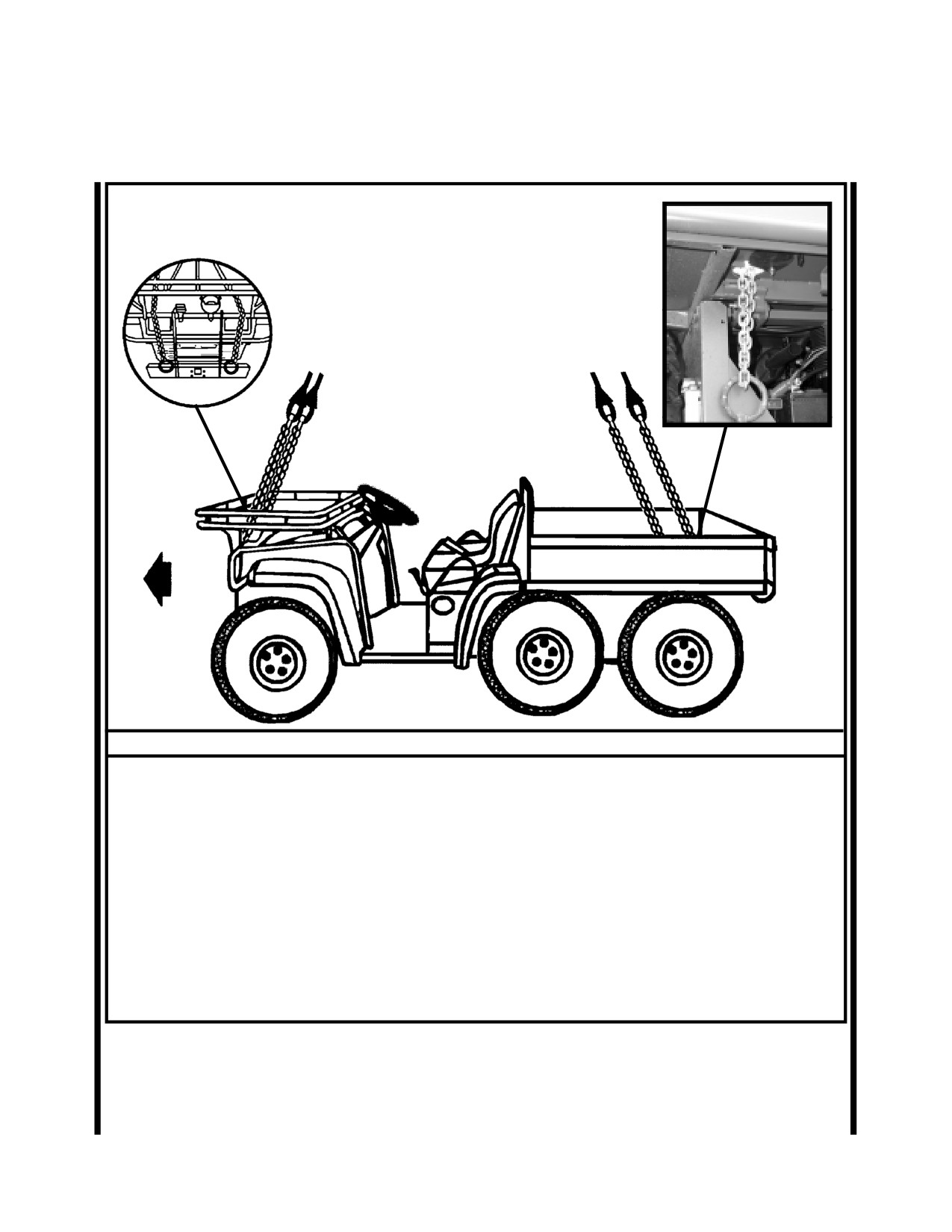
C2, FM 10-450-4/MCRP 4-23E, VOL II/NWP 3-04.12/AFJMAN 11-223, VOL II/
COMDTINST M13482.3A
RIGGING STEPS
1. Position the apex fitting on top of the vehicle. Route
3. Slide the black circular hole covers, located in the
outer sling legs 1 and 2 to the front of the vehicle and
vehicle bed, to the side. Route the chain end of sling leg
inner sling legs 3 and 4 to the rear. Sling legs 1 and 3 must
3 through the left exposed hole and the left rear lift provi-
be on the left side of the load.
sion. Place the correct link from Table 2-34 in the grab
hook. Repeat with sling leg 4 through the right exposed
2. Route the chain end of sling leg 1 through the litter
hole and right rear lift provision.
carrier and over the brush bar to the left front lift provi-
sion. Loop the chain through the lift provision and follow
4. Secure all excess chain with tape or Type III nylon
the chain routing back to the grab link. Place the correct
cord.
link from Table 2-34 in the grab hook. Repeat with sling
leg 2 through the right front lift provision.
5. Cluster and tie or tape (breakaway technique) the
sling legs in each sling set together to prevent entangle-
ment during hookup and lift-off.
Figure 2-33. John Deere M-Gator (Model #VGM6X01001)
2-80
C2, FM 10-450-4/MCRP 4-23E, VOL II/NWP 3-04.12/AFJMAN 11-223, VOL II/
COMDTINST M13482.3A
2-36. Two John Deere M-Gators, Model # VGM6X4D01001, Side by Side (Shotgun
Method)
a. Applicability. The following item in Table 2-35 is certified for all helicopters with suitable lift capacity by the US
Army Soldier Systems Center:
Table 2-35. Two John Deere M-Gators, Model # VGM6X4D01001, Side by Side (Shotgun Method)
MAX
RECOMMENDED
LINK COUNT
NOMENCLATURE
WEIGH T
SLING SET
AIRSPEE D
FRONT/REA R
(POUNDS )
(KNOTS )
John Deere M-Gator, Model#
Listed
i
1,450 each
10K
75
VGM6X4D01001
t
b. Materials. The following materials are required to
(c) Ensure the fuel tank is not over 3/4 full. Inspect
rig this load:
fuel tank cap, oil filler cap, and battery caps for proper
installation.
(1) Sling set (10,000-pound capacity (2 each)).
(d) Engage the vehicle parking brake and put the
(2) Additional apex fitting from a 10,000-pound
transmission in neutral.
capacity sling set (NSN: 4030-01-027-2902).
(e) Ensure the front wheels are pointed straight ahead.
(3) Tape, adhesive, pressure-sensitive, 2-inch wide
Tie down the steering wheel using the securing device
roll.
under the dash or Type III nylon cord.
(4) Cord, nylon, Type III, 550-pound breaking strength.
(f) Tape all lights and gauges.
(5) Webbing, cotton, 1/4-inch, 80-pound breaking
(g) Reposition the blackout lights and the infrared
strength.
LED lights so they do not interfere with the routing of the
sling legs.
(6) Strap, tiedown, cargo, CGU-1/B (2 each).
(h) Open the black sling guide covers in the bed of
c. Personnel. Two persons can prepare and rig this
both vehicles.
load in 15 minutes.
(2) Rigging. Rig the load according to the steps in
d. Procedures. The following procedures apply to
Figure 2-34.
this load:
(3) Hookup. The hookup team stands in the bed of the
(1) Preparation. Prepare the load using the following
vehicle. The static wand person discharges the static
steps:
electricity with the static wand. The hookup person places
the apex fitting on the cargo hook. The hookup team then
(a) Position the vehicles as close together as pos-
carefully dismounts the vehicle and remains close to the
sible. Ensure the vehicles are facing in the same direction
load as the helicopter removes slack from the sling legs.
and the wheels of the M-Gators are lined up.
When successful hookup is assured, the hookup team
quickly exits the area underneath the helicopter to the
(b) Secure all equipment and cargo inside the vehicle
designated rendezvous point.
with tape, nylon cord, or lashings.
(4) Derigging. Derigging is the reverse of the prepara-
tion and rigging procedures in steps d (1) and d (2).
2-81
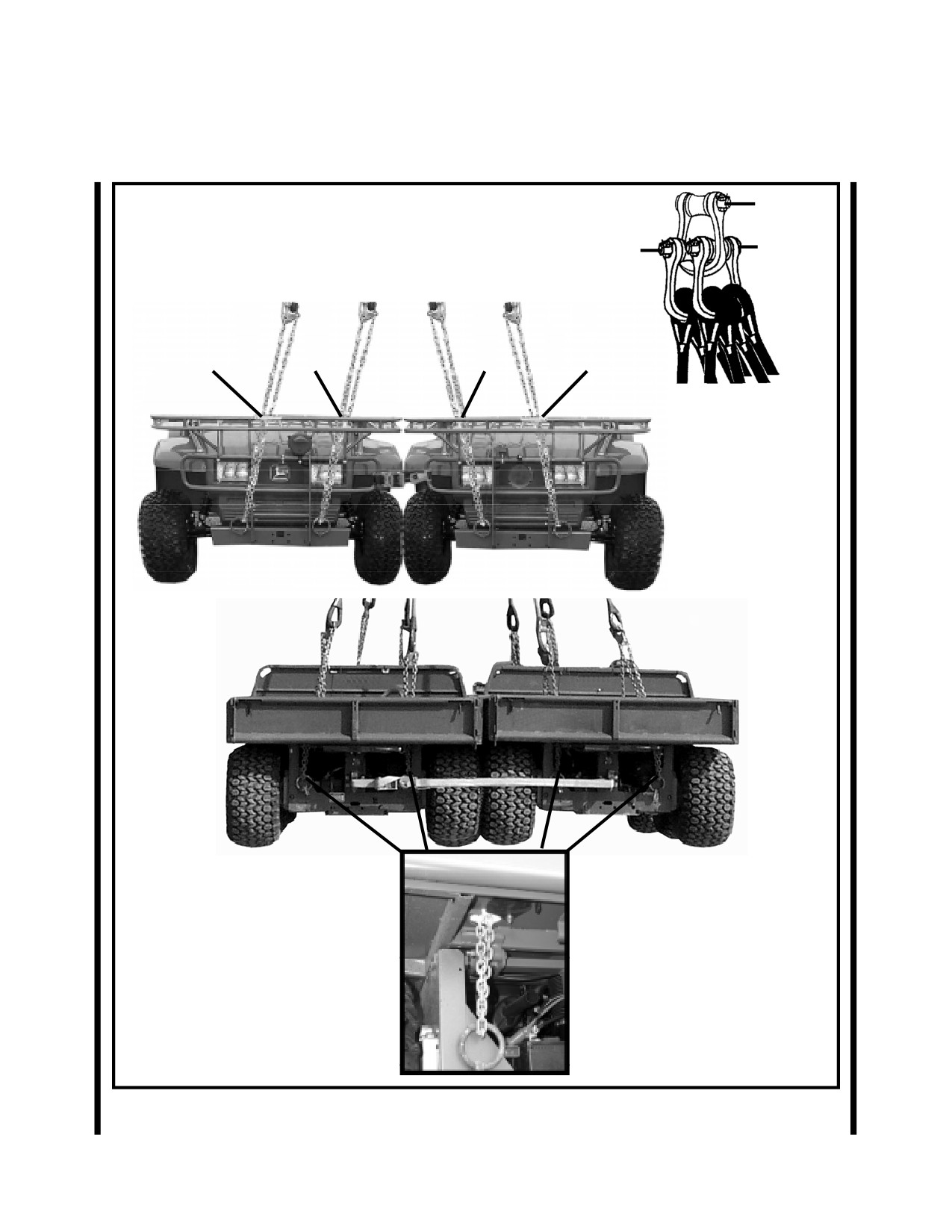
C2, FM 10-450-4/MCRP 4-23E, VOL II/NWP 3-04.12/AFJMAN 11-223, VOL II/
COMDTINST M13482.3A
APEX 3
APEX 1
APEX 2
4th
6th
6th
4th
OPENING OPENING
OPENING
OPENING
FRONT
REAR
Figure 2-34. Two John Deere M-Gators, Model # VGM6X4D01001, Side by Side (Shotgun Method)
2-82

C2, FM 10-450-4/MCRP 4-23E, VOL II/NWP 3-04.12/AFJMAN 11-223, VOL II/
COMDTINST M13482.3A
RIGGING STEPS
1. Position sling set 1 on top of the right vehicle with the
through the outside front lift provision and back to the
bolt parallel to the length of the vehicle. Route sling legs 1
grabhook along the same path. Place link 3 in the
and 2 to the front of the vehicle and sling legs 3 and 4 to
grabhook.
the rear. Sling legs 1 and 4 must be on the outside.
8. Route the chain end of sling leg 2 through the 6th
2. Route the chain end of sling leg 1 through the 4th
opening in the front litter carrier, over the brush guard to
opening in the front litter carrier, over the brush guard to
the inside front lift provision. Loop the chain end through
the outside front lift provision. Loop the chain end
the inside front lift provision and back to the grabhook
through the outside front lift provision and back to the
along the same path. Place link 20 in the grabhook.
grabhook along the same path. Place link 3 in the
grabhook.
9. Route the chain end of sling leg 4 through the outside
sling guide to the outside rear lift provision. Loop the
3. Route the chain end of sling leg 2 through the 6th
chain end through the outside rear lift provision and back
opening in the front litter carrier, over the brush guard to
to the grabhook along the same path. Place link 30 in the
the inside front lift provision. Loop the chain end through
grabhook.
the inside front lift provision and back to the grabhook
along the same path. Place link 20 in the grabhook.
10. Route the chain end of sling leg 3 through the inside
sling guide to the inside rear lift provision. Loop the chain
4. Route the chain end of sling leg 4 through the outside
end through the inside rear lift provision and back to the
sling guide to the outside rear lift provision. Loop the
grabhook along the same path. Place link 45 in the
chain end through the outside rear lift provision and back
grabhook.
to the grabhook along the same path. Place link 30 in the
grabhook.
11. Route the additional apex fitting through apex fit-
tings 1 and 2.
5. Route the chain end of sling leg 3 through the inside
sling guide to the inside rear lift provision. Loop the chain
12. Secure all excess chain with tape or Type III nylon
end through the inside rear lift provision and back to the
cord.
grabhook along the same path. Place link 45 in the
grabhook.
13. Cluster and tie or tape (breakaway technique) the
sling legs in each sling set on top of the vehicle to prevent
6. Position sling set 2 on top of the left vehicle with the
entanglement during hookup and lift-off.
bolt parallel to the length of the vehicle. Route sling legs 1
and 2 to the front of the vehicle and sling legs 3 and 4 to
14. Route a CGU-1/B cargo tiedown strap through the
the rear. Sling legs 1 and 4 must be on the outside.
trailer hitch of both vehicles and connect the hooks to-
gether. Tighten the straps.
7. Route the chain end of sling leg 1 through the 4th
opening in the front litter carrier, over the brush guard to
15. Route a CGU-1/B cargo tiedown strap through the
the outside front lift provision. Loop the chain end
inside front bar of the brush guard on both vehicles and
connect the hooks together. Tighten the straps.
Figure 2-34. Two John Deere M-Gators, Model # VGM6X4D01001, Side by Side (Shotgun Method) (continued)
2-83
C2, FM 10-450-4/MCRP 4-23E, VOL II/NWP 3-04.12/AFJMAN 11-223, VOL II/
COMDTINST M13482.2
CHAPTER 3
CERTIFIED SINGLE-POINT RIGGING PROCEDURES FOR TRAILERS
3-1. INTRODUCTION
This chapter contains rigging procedures for single-point
dures for trailers are in this section. Paragraphs 3-2 through
trailer loads that have been certified for sling load. Each
3-31 give detailed instructions for rigging loads.
rigging procedure is found in a paragraph that includes a
description of the load, materials required for rigging, and
NOTE: Reach Pendants may be used on all single point
steps to complete the procedure. An applicability para-
loads. A static discharge person is not required when
graph is also a part of each paragraph and identifies the
using a Reach Pendant.
certified loads. The certified single-point rigging proce-
3-2. M416 1/4 Ton Trailer
a. Applicability. The following item in Table 3-1 is certified for all helicopters with suitable lift capacity by the US Army
Soldier Systems Center:
Table 3-1. M416 1/4-Ton Trailer
MAX
RECOMMENDED
LINK COUNT
NOMENCLATURE
WEIGH T
SLING SET
AIRSPEE D
FRONT/REA R
(POUNDS )
(KNOTS )
M416 1/4-Ton Tra
l
1,080
10K
/
90
WARNING
c. Personnel. Two persons can prepare and rig this
load in 15 minutes.
THE M416 1/4-TON TRAILER MUST HAVE A GROSS
d. Procedures. The following procedures apply to
WEIGHT OF 800 POUNDS OR MORE. ADD ADDI-
this load:
TIONAL WEIGHT OR CARGO TO ANY TRAILER
WHICH WEIGHS LESS THAN 800 POUNDS.
(1) Preparation. Prepare the load using the following
steps:
b. Materials. The following materials are required to
rig this load:
(a) Lower and lock the trailer support leg in the down
position.
(1) Sling set (10,000-pound capacity).
(b) Tape or tie the light cable firmly to the top of the
(2) Tape, adhesive, pressure-sensitive, 2-inch wide
drawbar.
roll.
(c) Load and lash the cargo in the bed of the trailer.
(3) Cord, nylon, Type III, 550-pound breaking strength.
(d) Ensure the parking brake is set.
(4) Webbing, cotton, 1/4-inch, 80-pound breaking
strength.
(2) Rigging. Rig the load according to the steps in
Figure 3-1.
(5) Tie down, CGU-1B or Dacron lashing and load
binder.
(3) Hookup. The hookup team stands in the bed of
3-1
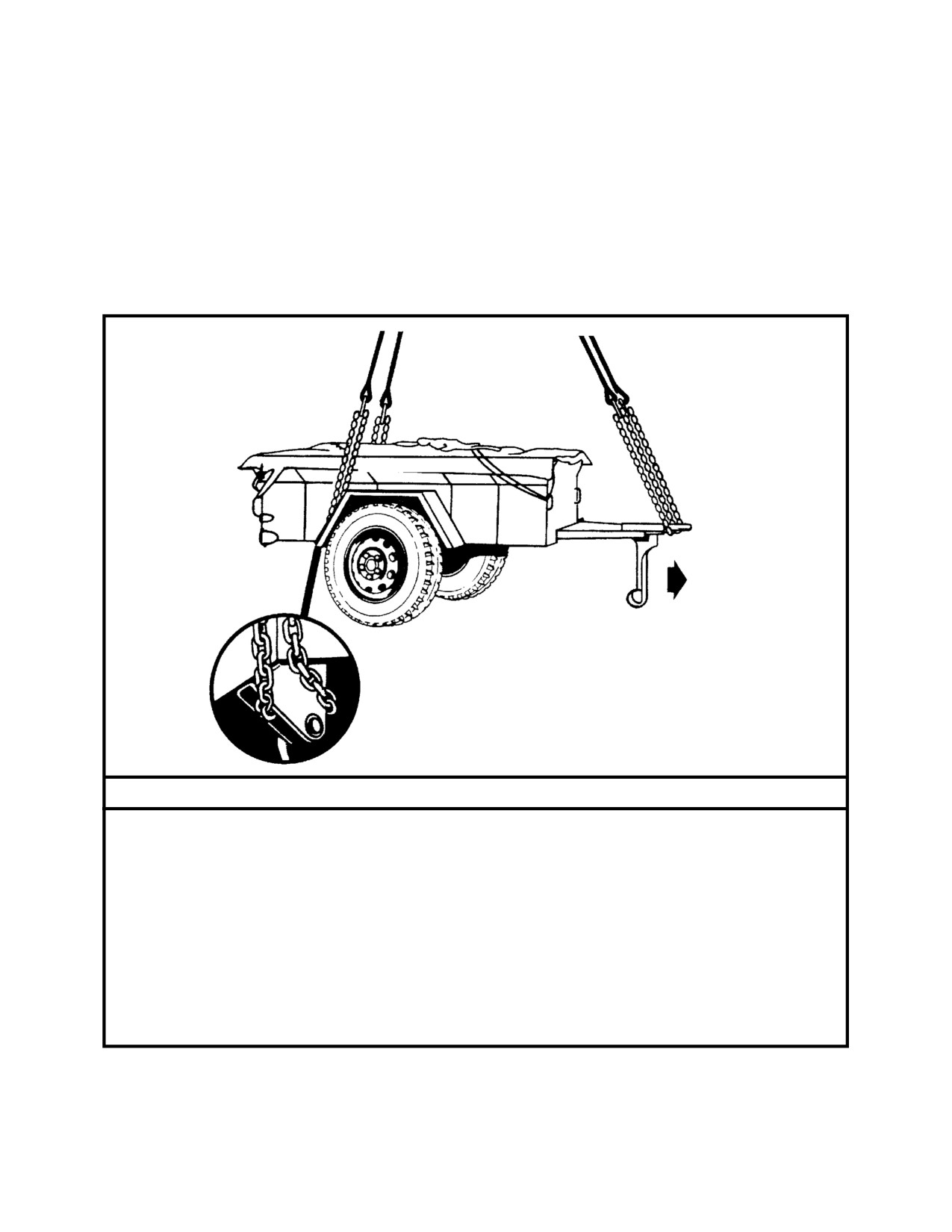
C2, FM 10-450-4/MCRP 4-23E, VOL II/NWP 3-04.12/AFJMAN 11-223, VOL II/
COMDTINST M13482.2
the trailer. The static wand person discharges the static
hookup team quickly exits the area underneath the heli-
electricity with the static wand. The hookup person places
copter to the designated rendezvous point.
the apex fitting onto the aircraft cargo hook. The hookup
team then carefully dismounts the vehicle and remains
(4) Derigging. Derigging is the reverse of the prepa-
close to the load as the helicopter removes slack from the
ration and rigging procedures in steps d (1) and d (2).
sling legs. When successful hookup is assured, the
RIGGING STEPS
1. Position apex fitting in the trailer bed. Route outer
from Table 3-1 in the grab hook. Repeat with sling leg 4
sling legs 1and 2 to the front of the trailer and inner sling
around the right rear spring shackle mounting bracket.
legs 3 and 4 to the rear. Sling legs 1 and 3 must be on the
left side of the load.
4. Tape or tie (breakaway technique) the chains of legs
3 and 4 to the next-to-last tarpaulin hold-down hook on
2. Loop the chain end of sling leg 1 through the lunette.
each side.
Place the correct link from Table 3-1 in the grab hook.
Repeat with sling leg 2 through the lunette.
5. Cluster and tie or tape (breakaway technique) all sling
legs together on top of the trailer to prevent entanglement
3. Route the chain end of sling leg 3 around the left rear
during hookup and lift-off.
spring shackle mounting bracket. Place the correct link
Figure 3-1. M416 1/4 Ton Trailer
3-2

C2, FM 10-450-4/MCRP 4-23E, VOL II/NWP 3-04.12/AFJMAN 11-223, VOL II/
COMDTINST M13482.2
3-19. High Mobility Trailers (HMT), M1101/M1102
a. Applicability. The following items in Table 3-18 are certified for all helicopters with suitable lift capacity by the US
Army Soldier Systems Center:
Table 3-18. High Mobility Trailers
MAX
RECOMMENDED
LINK COUNT
NOMENCLATURE
WEIGH T
SLING SET
AIRSPEE D
FRONT/REA R
(POUNDS )
(KNOTS )
High Mobility Trailer (Light), M1101
3,400
10K
2
/
120
High Mobility Trailer (Light), M1102
4,200
10K
2
/
120
Tactical Messaging System (TMS)
4,200
10K
2
/
120
Cargo Carrier, M1102
b. Materials. The following materials are required to
close to the ground as possible.
rig this load:
(c) Remove the canvas cover and racks from the
(1) Sling set (10,000-pound capacity).
trailer. Place these items in the bed of the trailer. Place the
accompanying load on top of the canvas cover and se-
(2) Tape, adhesive, pressure-sensitive, 2-inch wide
cure with the tie-down lashings.
roll.
(d) Secure the light cable to the top of the drawbar
(3) Cord, nylon, Type III, 550-pound breaking strength.
with Type III nylon cord.
(4) Webbing, cotton, 1/4-inch, 80-pound breaking
(e) Engage the parking brake.
strength.
(2) Rigging. Rig the load according to the steps in
(5) Felt sheet, cattle hair, Type IV, 1/2-inch or suitable
Figure 3-18.
substitute.
(3) Hookup. The hookup team stands on the drawbar
(6) Tie-down, cargo, CGU-1/B or suitable tie-down
or in the bed of the trailer (if possible). The static wand
lashings.
person discharges the static electricity with the static
wand. The hookup person places the apex fitting onto the
c. Personnel. Two persons can prepare and rig this
aircraft cargo hook. The hookup team then carefully dis-
load in 10 minutes.
mounts the trailer and remains close to the load as the
helicopter removes slack from the sling legs. When suc-
d. Procedures. The following procedures apply to this
cessful hookup is assured, the hookup team quickly exits
load:
the area underneath the helicopter to the designated ren-
dezvous point.
(1) Preparation. Prepare the load using the following
steps:
CAUTION
The hookup team should dismount the trailer towards
(a) Remove the two rear stabilizer legs from their
the lunette to keep the trailer from tipping towards the
storage location on the front of the trailer. Place the lower
rear.
support section in the fully retracted position. Install the
stabilizer legs on the rear of the trailer.
(4) Derigging. Derigging is the reverse of the prepa-
ration and rigging procedures in steps d (1) and d (2).
(b) Install the front jack and lower the lunette as
3-35
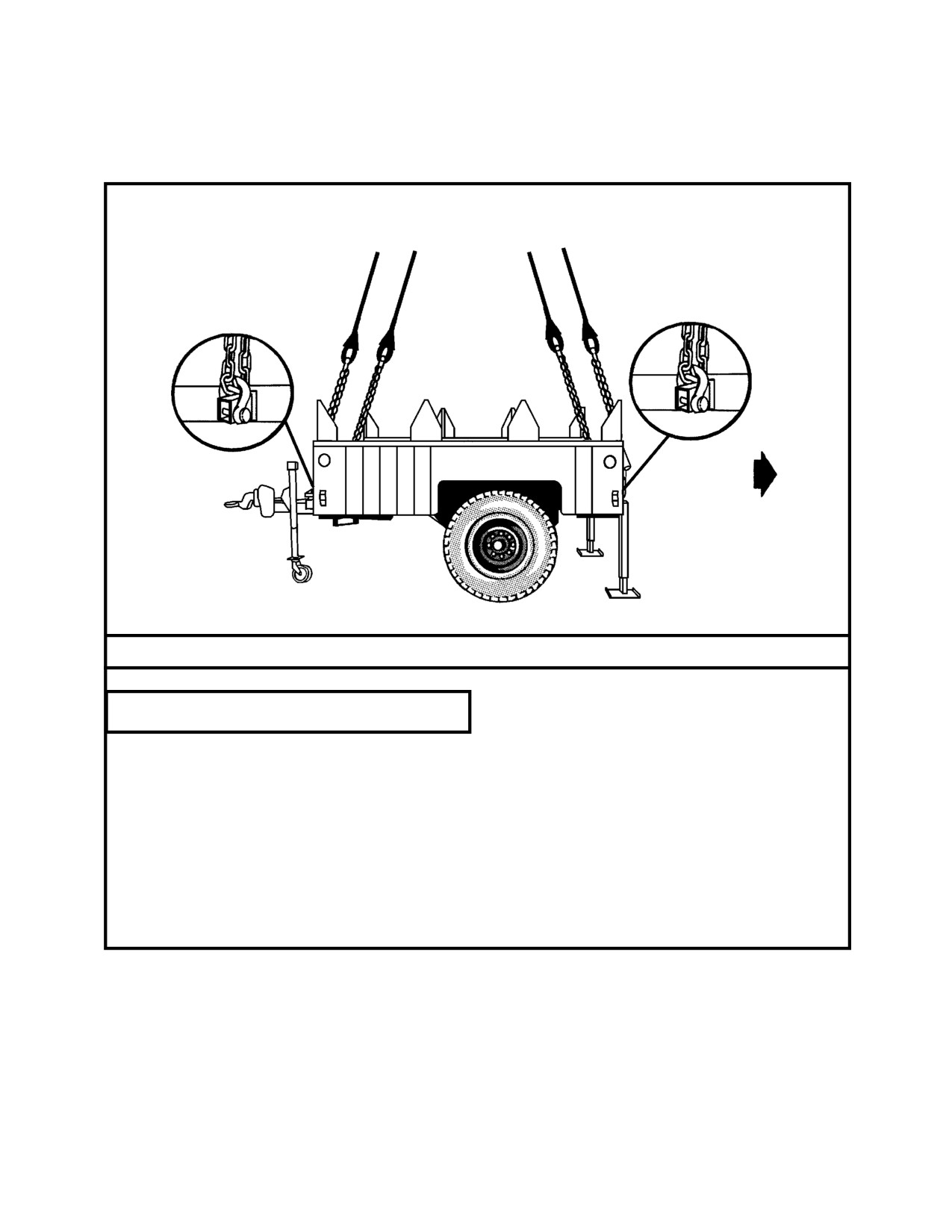
C2, FM 10-450-4/MCRP 4-23E, VOL II/NWP 3-04.12/AFJMAN 11-223, VOL II/
COMDTINST M13482.2
RIGGING STEPS
3. Route the chain end of sling leg 3 through the left
NOTE: This trailer will fly with the front end (trailer
rear lift provision located on the rear of the trailer. Place
lunette) aft.
the correct link from Table 3-18 in the grab hook. Repeat
with sling leg 4 through the right rear lift provision.
1. Position apex fitting on top of the trailer . Route outer
sling legs 1and 2 to the front of the trailer (lunette end)
4. Pad the chain at and below where the chain contacts
and inner sling legs 3 and 4 to the rear. Sling legs 1 and 3
the trailer walls.
must be on the left side of the load.
5. Cluster and tie or tape (breakaway technique) all sling
2. Loop the chain end of sling leg 1 through the left
legs together on top of the roof to prevent entanglement
front lift provision located on the front of the trailer. Place
during hookup and lift-off.
the correct link from Table 3-18 in the grab hook. Repeat
with sling leg 2 through the right side front lift provision.
Secure the excess chain with Type III nylon cord.
Figure 3-18. High Mobility Trailers
3-36
C2, FM 10-450-4/MCRP 4-23E, VOL II/NWP 3-04.12/AFJMAN 11-223, VOL II/
COMDTINST M13482.3A
3-28. M1082 Light Medium Tactical Vehicle (LMTV) and M1095 Medium Tactical Vehicle
(MTV) Trailers
a. Applicability. The following items in Table 3-27 are certified for all helicopters with suitable lift capacity by the US
Army Soldier Systems Center:
Table 3-27. M1082 Light Medium Tactical Vehicle (LMTV) and M1095 Medium Tactical Vehicle (MTV) Trailers
MAX
RECOMMENDED
LINK COUNT
NOMENCLATURE
WEIGH T
SLING SET
AIRSPEE D
FRONT / REA R
(POUNDS )
(KNOTS )
M1082 LMTV Tra
l
11,510
25K
1
/
70
M1095 MTV Tra
l
15,780
25K
1
/
70
b. Materials. The following materials are required to
(c) Engage the parking brake.
rig this load:
(d) Extend the lift provision bars to the widest posi-
(1) Sling set (25,000-pound capacity).
tion and lock into place with the locking pins. Secure the
locking pins in place with tape.
(2) Tape, adhesive, pressure-sensitive, 2-inch wide
roll.
Note: Ensure the lift eyes on the lift provision bars are
perpendicular to the ground.
(3) Cord, nylon, Type III, 550-pound breaking strength.
(e) Remove the side and end panels and stow in the
(4) Webbing, cotton, 1/4-inch, 80-pound breaking
storage boxes under the bed of the trailer. Secure the
strength.
storage latches with tape.
c. Personnel. Two persons can prepare and rig this
(2) Rigging. Rig the load according to the steps in
load in 10 minutes.
Figure 3-27.
d. Procedures. The following procedures apply to
(3) Hookup. The hookup teams stand in the bed of the
this load:
trailer. The static wand person discharges the static elec-
tricity with the static wand. The hookup person places
(1) Preparation. Prepare the load using the following
the apex fitting on the cargo hook. The hookup team then
steps:
carefully dismounts the trailer and remains close to the
load as the helicopter removes slack from the sling legs.
(a) Position the trailer's jack stand in the down posi-
When successful hookup is assured, the hookup team
tion so the trailer sets level.
quickly exits the area underneath the helicopter to the
designated rendezvous point.
(b) Secure all loose chains, hoses, and cables to the
trailer drawbar with tape or Type III nylon cord.
(4) Derigging. Derigging is the reverse of the prepa-
ration and rigging procedures in steps d (1) and d (2).
3-53
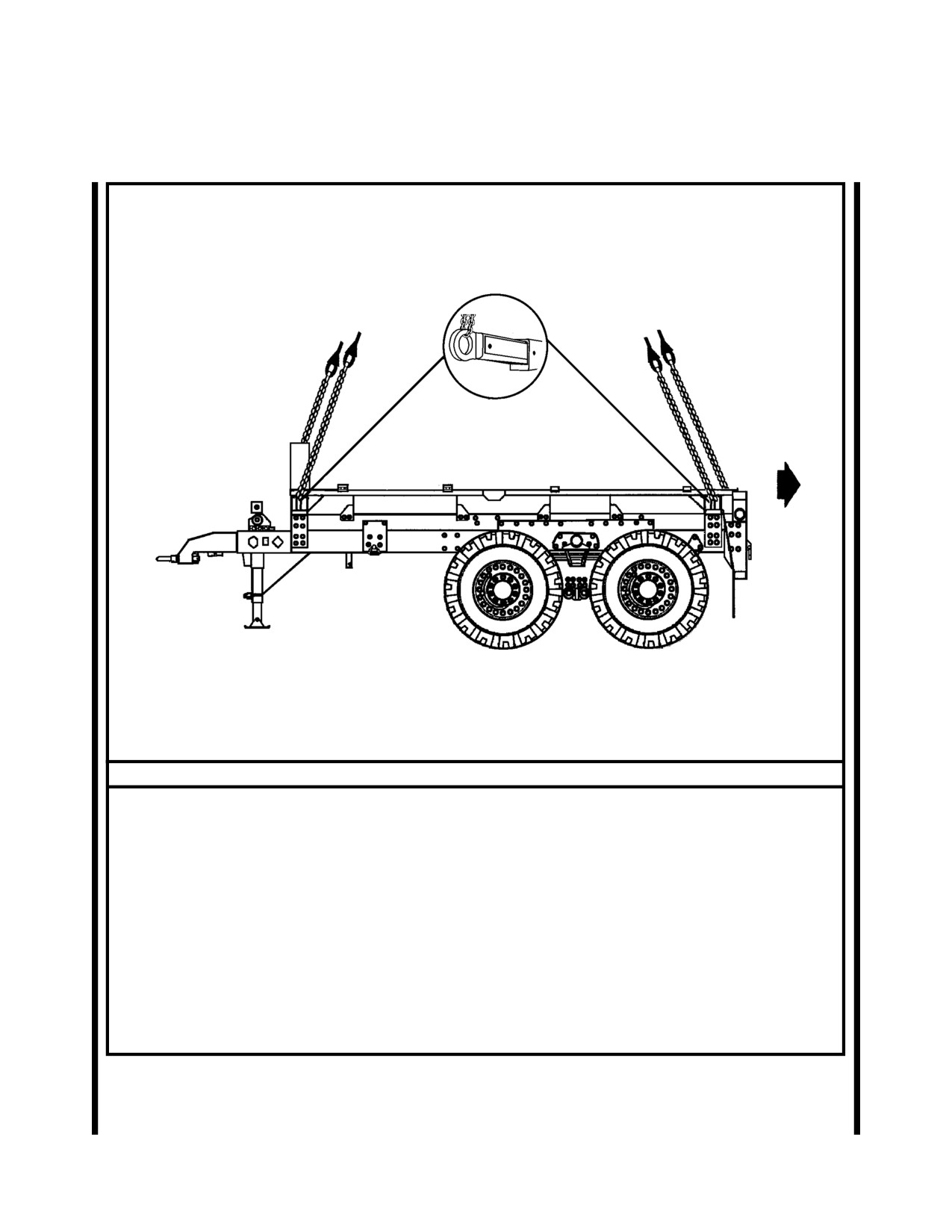
C2, FM 10-450-4/MCRP 4-23E, VOL II/NWP 3-04.12/AFJMAN 11-223, VOL II/
COMDTINST M13482.3A
RIGGING STEPS
1. Position the apex fitting on top of the trailer. Route
3. Loop the chain end of sling leg 3 through the left rear
outer sling legs 1 and 2 to the front of the trailer and inner
lift provision bar located on the left rear corner of the
sling legs 3 and 4 to the rear. Sling legs 1 and 3 must be on
trailer. Place the correct link from Table 3-27 in the grab
the left side of the load.
hook. Repeat with sling leg 4 through the right rear lift
provision.
2. Loop the chain end of sling leg 1 through the left
front lift provision bar located on the left front corner of
4. Secure all excess chain with tape or Type III nylon
the trailer (lunette end) . Place the correct link from Table
cord.
3-27 in the grab hook. Repeat with sling leg 2 through the
right front lift provision.
5. Cluster and tie or tape (breakaway technique) the
sling legs in each sling set together to prevent entangle-
ment during hookup and lift-off.
Figure 3-27. M1082 Light Medium Tactical Vehicle (LMTV) and M1095 Medium Tactical Vehicle (MTV)
Trailers
3-54
C2, FM 10-450-4/MCRP 4-23E, VOL II/NWP 3-04.12/AFJMAN 11-223, VOL II/
COMDTINST M13482.3A
3-29. Small Portable Expeditionary Aeromedical Rapid Response (SPEARR) Trailer
a. Applicability. The following item in Table 3-28 is certified for all helicopters with suitable lift capacity by the US Army
Soldier Systems Center:
Table 3-28. Small Portable Expeditionary Aeromedical Rapid Response (SPEARR) Trailer
M AX
RECOMMENDED
LINK COUNT
NOMENCLATURE
WEIGH T
SLING SET
AIRSPEE D
FRONT / REA R
(POUNDS )
(KNOTS )
Small Portable Expeditionary
Listed
i
Aeromedical Rapid Response
6,100
10K
80
Rigging
t
(SPEARR) Tra
l
b. Materials. The following materials are required to
(c) Secure all lids, doors, and caps with tape or Type
rig this load:
III nylon cord.
(1) Sling set (10,000-pound capacity).
(d) Ensure the stabilizer legs are retracted and stowed.
(2) Tape, adhesive, pressure-sensitive, 2-inch wide
(e) Release the curb side lift provisions from the
roll.
stowage straps. Secure the stowage straps to the trailer
with tape.
(3) Cord, nylon, Type III, 550-pound breaking strength.
(2) Rigging. Rig the load according to the steps in
(4) Webbing, cotton, 1/4-inch, 80-pound breaking
Figure 3-28.
strength.
(3) Hookup. The hookup teams stand on the roof of
c. Personnel. Two persons can prepare and rig this
the trailer. The static wand person discharges the static
load in 10 minutes.
electricity with the static wand. The hookup person places
the apex fitting on the cargo hook. The hookup team then
d. Procedures. The following procedures apply to
carefully dismounts the trailer and remains close to the
this load:
load as the helicopter removes slack from the sling legs.
When successful hookup is assured, the hookup team
(1) Preparation. Prepare the load using the following
quickly exits the area underneath the helicopter to the
steps:
designated rendezvous point.
(a) Position the trailer's jack stand in the down posi-
NOTE: This load is flown with the rear of the trailer
tion so the lunette is near the ground.
facing forward.
(b) Secure all loose chains, hoses, and cables to the
(4) Derigging. Derigging is the reverse of the prepa-
trailer drawbar with tape or Type III nylon cord.
ration and rigging procedures in steps d (1) and d (2).
3-55
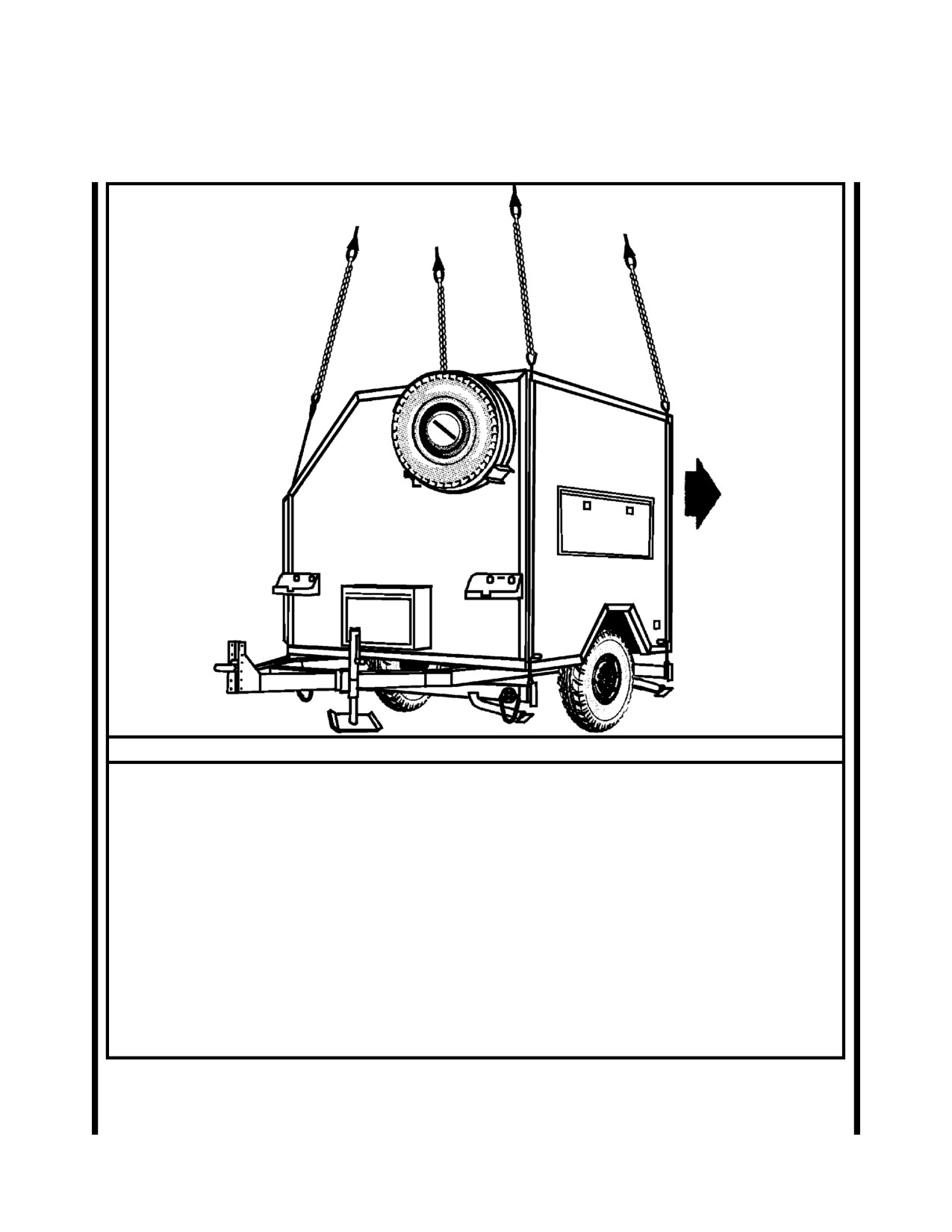
C2, FM 10-450-4/MCRP 4-23E, VOL II/NWP 3-04.12/AFJMAN 11-223, VOL II/
COMDTINST M13482.3A
SLING LEG 1
SLING LEG 4
SLING LEG 2
SLING LEG 3
RIGGING STEPS
1. Position the apex fitting on top of the trailer roof.
4. Loop the chain end of sling leg 3 through the left rear
Route outer sling legs 1 and 2 to the front of the trailer
lift provision located on the left rear corner of the trailer
(lunette end) and inner sling legs 3 and 4 to the rear. Sling
roof. Place link 3 in the grab hook.
legs 1 and 3 must be on the left side of the load.
5. Loop the chain end of sling leg 4 through the right
2. Loop the chain end of sling leg 1 through the left
rear lift provision located on the right rear corner of the
front lift provision located on the left front corner of the
trailer roof. Place link 10 in the grab hook.
trailer roof (lunette end) . Place link 20 in the grab hook.
6. Secure all excess chain with tape or Type III nylon
3. Loop the chain end of sling leg 2 through the right
cord.
front lift provision located on the right front corner of the
trailer roof (lunette end) . Place link 30 in the grab hook.
7. Cluster and tie or tape (breakaway technique) the
sling legs in each sling set together to prevent entangle-
ment during hookup and lift-off.
Figure 3-28. Small Portable Expeditionary Aeromedical Rapid Response (SPEARR) Trailer
3-56
C2, FM 10-450-4/MCRP 4-23E, VOL II/NWP 3-04.12/AFJMAN 11-223, VOL II/
COMDTINST M13482.3A
3-30. Minimum Operating Strip Lighting System (MOSLS)
a. Applicability. The following item in Table 3-29 is certified for all helicopters with suitable lift capacity by the US Army
Soldier Systems Center:
Table 3-29. Minimum Operating Strip Lighting System (MOSLS)
M AX
RECOMMENDED
LINK COUNT
NOMENCLATURE
WEIGH T
SLING SET
AIRSPEE D
FRONT / REA R
(POUNDS )
(KNOTS )
MinimumOperatingStrip
i
System (MOSLS) with Spreader
3,350
15K
1
/
70
Bars
b. Materials. The following materials are required to
(b) Secure all loose chains, hoses, and cables to the
rig this load:
trailer drawbar with tape or Type III nylon cord.
(1) Sling set (15,000-pound capacity).
(c) Secure all lids, doors, and caps with tape or Type
III nylon cord.
(2) Tape, adhesive, pressure-sensitive, 2-inch wide
roll.
(d) Ensure the stabilizer legs are retracted and stowed.
(3) Cord, nylon, Type III, 550-pound breaking strength.
(e) Engage the parking brake.
(4) Webbing, cotton, 1/4-inch, 80-pound breaking
(2) Rigging. Rig the load according to the steps in
strength.
Figure 3-29.
(5) Padding, cellulose.
(3) Hookup. The hookup teams stand on the roof of
the trailer. The static wand person discharges the static
(6) Spreader bar, HMMWV (2 each).
electricity with the static wand. The hookup person places
the apex fitting on the cargo hook. The hookup team then
c. Personnel. Two persons can prepare and rig this
carefully dismounts the trailer and remains close to the
load in 10 minutes.
load as the helicopter removes slack from the sling legs.
When successful hookup is assured, the hookup team
d. Procedures. The following procedures apply to
quickly exits the area underneath the helicopter to the
this load:
designated rendezvous point.
(1) Preparation. Prepare the load using the following
NOTE: This load is flown with the rear of the trailer
steps:
facing forward.
(a) Position the trailer's jack stand in the down posi-
(4) Derigging. Derigging is the reverse of the prepa-
tion so the lunette is near the ground.
ration and rigging procedures in steps d (1) and d (2).
3-57
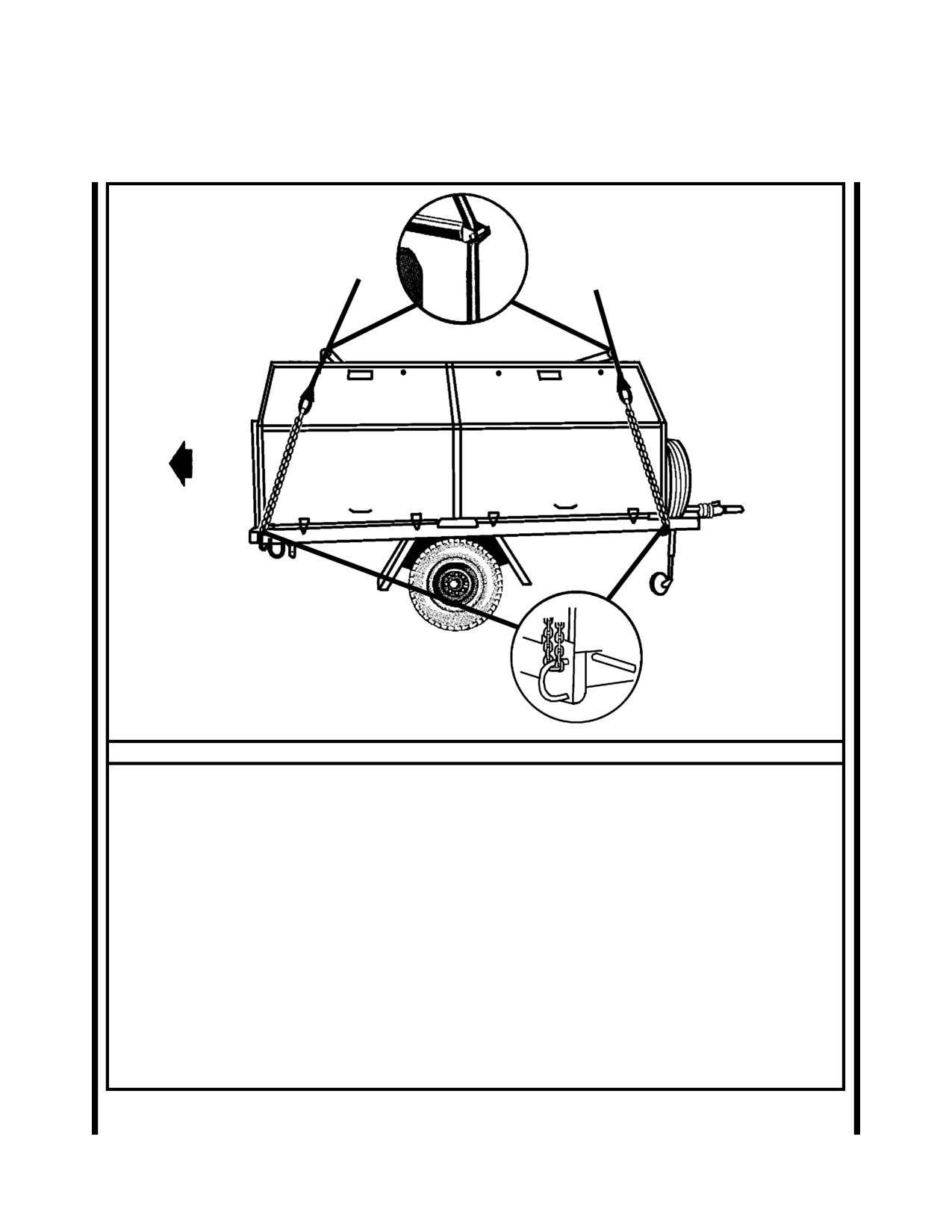
C2, FM 10-450-4/MCRP 4-23E, VOL II/NWP 3-04.12/AFJMAN 11-223, VOL II/
COMDTINST M13482.3A
RIGGING STEPS
1. Position the apex fitting on top of the trailer. Route
hook. Repeat with sling leg 4 through the vertical right
outer sling legs 1 and 2 to the front of the trailer (lunette
rear lift provision.
end) and inner sling legs 3 and 4 to the rear. Sling legs 1
and 3 must be on the left side of the load.
4. Secure all excess chain with tape or Type III nylon
cord.
2. Loop the chain end of sling leg 1 through the vertical
left front lift provision located on the left front corner of
5. Extend the sling set above the trailer. Position the
the trailer (lunette end) . Place the correct link from Table
spreader bar between the front slings 6-inches above the
3-29 in the grab hook. Repeat with sling leg 2 through the
trailer roof. Secure the spreader bar to the slings with
vertical right front lift provision.
Type III nylon cord and tape. Repeat the procedure with
the second spreader bar and the rear slings.
3. Loop the chain end of sling leg 3 through the vertical
left rear lift provision located on the left rear corner of the
6. Cluster and tie or tape (breakaway technique) the
trailer. Place the correct link from Table 3-29 in the grab
sling legs in each sling set together to prevent entangle-
ment during hookup and lift-off.
Figure 3-29. Minimum Operating Strip Lighting System (MOSLS)
3-58
C2, FM 10-450-4/MCRP 4-23E, VOL II/NWP 3-04.12/AFJMAN 11-223, VOL II/
COMDTINST M13482.3A
3-31. Assault Command Post With High Mobility Wheel Set
a. Applicability. The following item in Table 3-30 is certified for all helicopters with suitable lift capacity by the US Army
Soldier Systems Center:
Table 3-30. Assault Command Post With High Mobility Wheel Set
M AX
RECOMMENDED
LINK COUNT
NOMENCLATURE
WEIGH T
SLING SET
AIRSPEE D
FRONT / REA R
(POUNDS )
(KNOTS )
Assault Command Post (ACP),
Housed
i
ECU
i
13,240
25K
80
Airmobile Shelter (ELAMS), wih
/
High Speed Mobile Wheel Set
b. Materials. The following materials are required to
(b) Remove all antennas and secure inside the shel-
rig this load:
ter.
(1) Sling set (25,000-pound capacity).
(c) Secure all lids, doors, and caps with tape or Type
III nylon cord.
(2) Tape, adhesive, pressure-sensitive, 2-inch wide
roll.
(d) Secure all loose equipment inside the shelter with
tape, lashings, or Type III nylon cord.
(3) Cord, nylon, Type III, 550-pound breaking strength.
(e) Secure the tow bar in the up position.
(4) Webbing, cotton, 1/4-inch, 80-pound breaking
strength.
(2) Rigging. Rig the load according to the steps in
Figure 3-30.
c. Personnel. Two persons can prepare and rig this
(3) Hookup. The hookup teams stand on the roof of
load in 15 minutes.
the shelter. The static wand person discharges the static
electricity with the static wand. The hookup person places
d. Procedures. The following procedures apply to
the apex fitting on the cargo hook. The hookup team then
this load:
carefully dismounts the trailer and remains close to the
load as the helicopter removes slack from the sling legs.
(1) Preparation. Prepare the load using the following
When successful hookup is assured, the hookup team
steps:
quickly exits the area underneath the helicopter to the
designated rendezvous point.
(a) Ensure manufacturer approved tiedown assem-
blies (2 each) are in place between the shelter and each
(4) Derigging. Derigging is the reverse of the prepa-
wheel set.
ration and rigging procedures in steps d (1) and d (2).
3-59
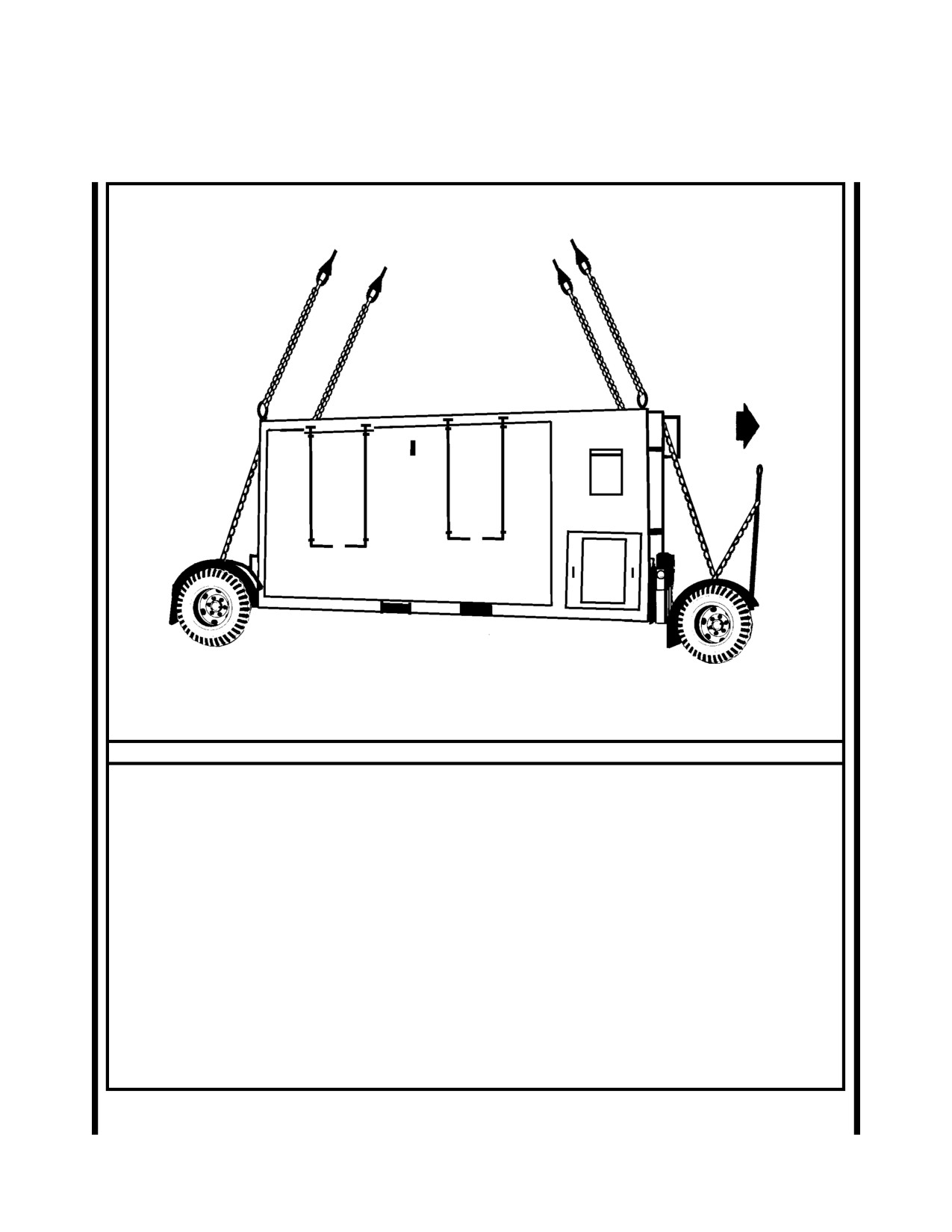
C2, FM 10-450-4/MCRP 4-23E, VOL II/NWP 3-04.12/AFJMAN 11-223, VOL II/
COMDTINST M13482.3A
RIGGING STEPS
1. Position the apex fitting on top of the shelter. Route
lift provision located on the top left rear corner of the
outer sling legs 1 and 2 to the front of the shelter (lunette
shelter. Place the correct link from Table 3-30 in the grab
end) and inner sling legs 3 and 4 to the rear. Sling legs 1
hook. Repeat with sling leg 4 through the top right rear
and 3 must be on the left side of the load.
lift provision.
2. Loop the chain end of sling leg 1 through the left
4. Secure all excess chain with tape or Type III nylon
front lift provision located on the top left front corner of
cord.
the shelter (lunette end) . Place the correct link from Table
3-30 in the grab hook. Repeat with sling leg 2 through the
5. Cluster and tie or tape (breakaway technique) the
top right front lift provision.
sling legs in each sling set together to prevent entangle-
ment during hookup and lift-off.
3. Loop the chain end of sling leg 3 through the left rear
Figure 3-30. Assault Command Post With High Mobility Wheel Set
3-60

C2, FM 10-450-4/MCRP 4-23E, VOL II/NWP 3-04.12/AFJMAN 11-223, VOL II
COMDTINST M13482.2
4-7. M116A3 Trailer-Mounted Power Units, Generators, and Power Plants
a. Applicability. The following items in Table 4-6 are certified for all helicopters with suitable lift capacity by the US
Army Soldier Systems Center:
Table 4-6. M116A3 Trailer-Mounted Power Units, Generators, and Power Plants
MAX
RECOMMENDED
LINK COUNT
NOMENCLATURE
WEIGH T
SLING SET
AIRSPEE D
FRONT / REA R
(POUNDS )
(KNOTS )
AN/MJQ-43 Power Unit withtwo (2) MEP-
2,060
10K
/
80
831A, 3 kW, 60 Hz, Generator Sets
AN/MJQ-35 Power Unit withtwo (2) MEP-
3,160
10K
/
80
802A, 5 kW, 60 Hz, Generator Sets
PU-797, 5 kW, 60 Hz, Power Unit wih
2,720
10K
/
70
MEP-802A, 5 kW, 60 Hz, Generator Set
PU-798, 10 kW, 60 Hz, Power Unit wih
2,860
10K
/
70
MEP-803A, 10 kW, 60 Hz, Generator Set
PU-799, 10 kW, 400 Hz, Power Unit wih
2,870
10K
/
70
MEP-813A, 10 kW, 400 Hz, Generator Set
PU-801, 15 kW, 50/60 Hz, Power Unit wih
MEP-804A, 15 kW, 50/60 Hz, Generator
3,160
10K
1
/
100
Set
AN/MJQ-33
Tactical Quiet Generator (TQ
G)
2,100
10K
/
100
b. Materials. The following materials are required to
d. Procedures. The following procedures apply to this
rig this load:
load:
(1) Sling set (10,000-pound capacity).
(1) Preparation. Prepare the load using the following
steps:
(2) Tape, adhesive, pressure-sensitive, 2-inch wide
roll.
(a) Engage both hand brakes.
(3) Cord, nylon, Type III, 550-pound breaking strength.
(b) Secure safety chains and brake hoses to the top
of the drawbar with Type III nylon cord.
(4) Webbing, cotton, 1/4-inch, 80-pound breaking
strength.
(c) Secure all lids, doors, and caps with tape or Type
III nylon cord.
(5) Felt sheet, cattle hair, Type IV, 1/2-inch or suitable
substitute.
(d) Place additional cargo as close to the center of
the trailer as possible. Secure the cargo with CGU-1/B
(6) Tie-down strap, CGU/1B (as required).
tiedown straps. The cargo must not contact the sling legs
during lift-off or flight.
c. Personnel. Two persons can prepare and rig this
load in 15 minutes.
4-13
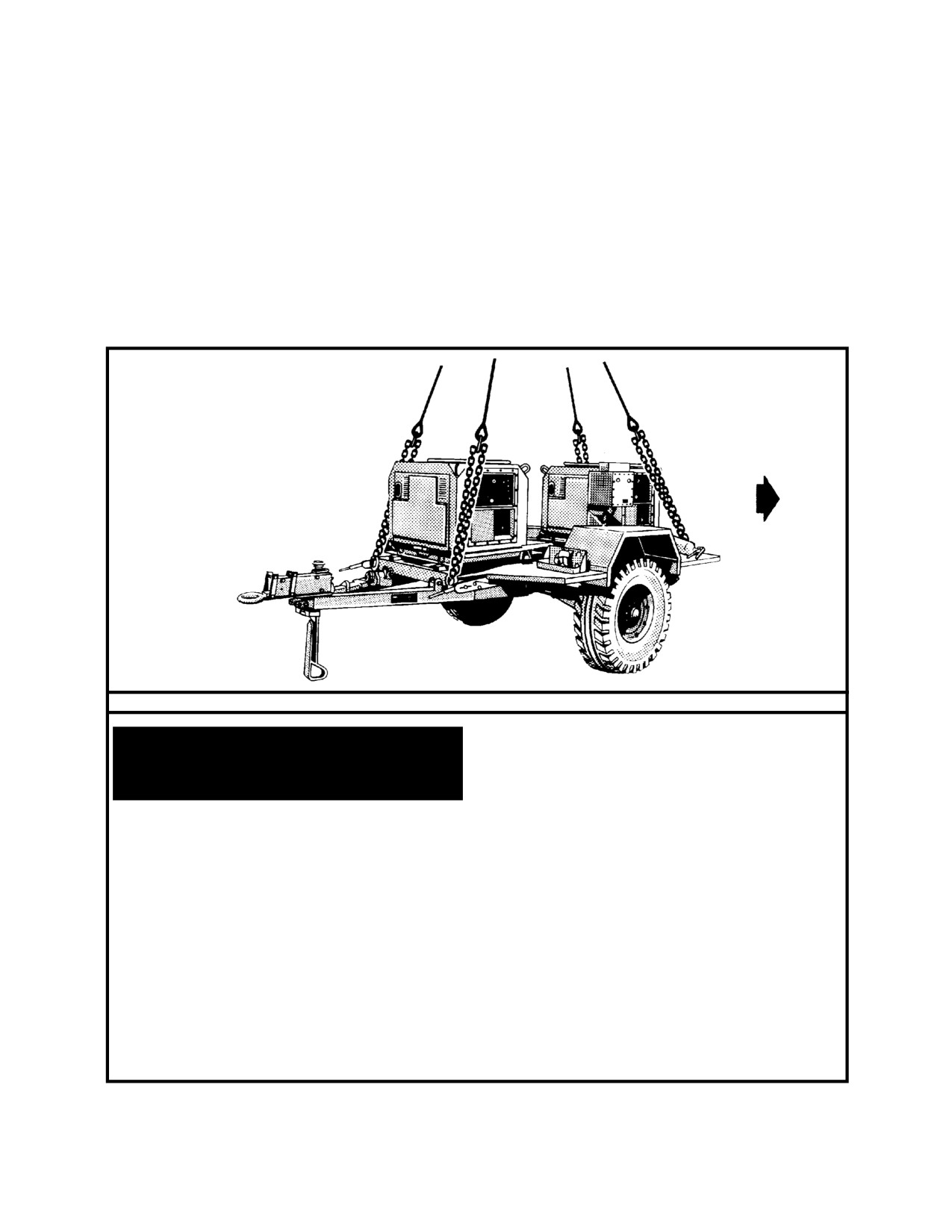
C2, FM 10-450-4/MCRP 4-23E, VOL II/NWP 3-04.12/AFJMAN 11-223, VOL II/
COMDTINST M13482.2
(2) Rigging. Rig the load according to the steps in
team then carefully dismounts the trailer and remains close
Figure 4-6.
to the load as the helicopter removes slack from the sling
legs. When successful hookup is assured, the hookup
(3) Hookup. The hookup person stands on top of the
team quickly exits the area underneath the helicopter to
generator. The static wand person stands on the wheel
the designated rendezvous point.
well. The static wand person discharges the static elec-
tricity with the static wand. The hookup person places
(4) Derigging. Derigging is the reverse of the prepa-
the apex fitting onto the aircraft cargo hook. The hookup
ration and rigging procedures in steps d (1) and d (2).
RIGGING STEPS
rear lift provision located on the rear of the trailer bed.
CAUTION
Place the correct link from Table 4-6 in the grab hook. Re-
DO NOT ADD CARGO TO THE
peat with sling leg 4 through the right rear lift provision.
PU-801 GENERATOR SET
4. Secure the lift provisions in the up position to the
1. Position apex fitting on top of the generator. Route
generator tiedown provisions with 1/4-inch cotton web-
outer sling legs 1and 2 to the front of the trailer (lunette
bing.
end) and inner sling legs 3 and 4 to the rear. Sling legs 1
and 3 must be on the left side of the load.
5. Raise the apex fitting above the generators and route
the rear slings to the side of the rear generator.
2. Loop the chain end of sling leg 1 through the left
front lift provision located on the left front side of the
6. Pad the slings in the areas where they contact the
trailer bed. Place the correct link from Table 4-6 in the grab
tool boxes or the generators.
hook. Repeat with sling leg 2 through the right side, front
lift provision. Secure the excess chain with Type III nylon
7. Cluster and tie or tape (breakaway technique) the
cord.
front sling legs together to prevent entanglement during
hookup and lift-off. Repeat the procedure for the rear
3. Route the chain end of sling leg 3 through the left
sling legs.
Figure 4-6. M116A3 Trailer Mounted Power Units, Generators, and Power Plants
4-14
C2, FM 10-450-4/MCRP 4-23E, VOL II/NWP 3-04.12/AFJMAN 11-223, VOL II
COMDTINST M13482.2
or Type III nylon cord.
ing load and using sling leg 4 on the accompanying load,
extend the chain on sling leg 3 by adding an additional
(d) Secure the firing platform (if carried), hand spike,
length of chain with a coupling link from a 25,000-pound
and jack to the trail assembly with Type III nylon cord.
capacity sling set.
(e) Ensure the lunette is in the extended position.
(2) Rigging. Rig the load according to the steps in
Install the towing eye stop (C-clamp) on the lunette and
Figure 6-8.
secure in place with its retaining pins, when applicable.
NOTE: When an accompanying load requires a sling
(f) The sling set chain safety clamp is an additional
leg, you may remove and use one of the inner sling legs
authorized item. Refer to TM 9-1015-252-10 for NSN and
from the sling set, leaving one sling leg attached to the
installation information.
lunette of the howitzer.
(g) When the detachable field spade is attached to
(3) Hookup. The hookup team stands beside the how-
the permanent spades, ensure the two locking pins are
itzer on the trails. The static wand person discharges the
installed and locked. Route and tie a length of Type III
static electricity with the static wand. The hookup person
nylon cord through the key ring of the cable and around
places the top loop of the reach pendant onto the aircraft
the end of the locking pin.
cargo hook. The hookup team then moves clear of the
helicopter but remains close to the load as the helicopter
(h) When moving the howitzer without an accompa-
removes slack from the sling legs. When successful
nying load, extend the chain on sling leg 3 by removing
hookup is assured, the hookup team quickly exits the area
the chain length and coupling link from sling leg 4 and
underneath the helicopter to the designated rendezvous
attaching them to the end of the chain on sling leg 3.
point.
(i) When moving the howitzer with an accompany-
(4) Derigging. Derigging is the reverse of the prepa-
ration and rigging procedures in steps d (1) and d (2).
6-17
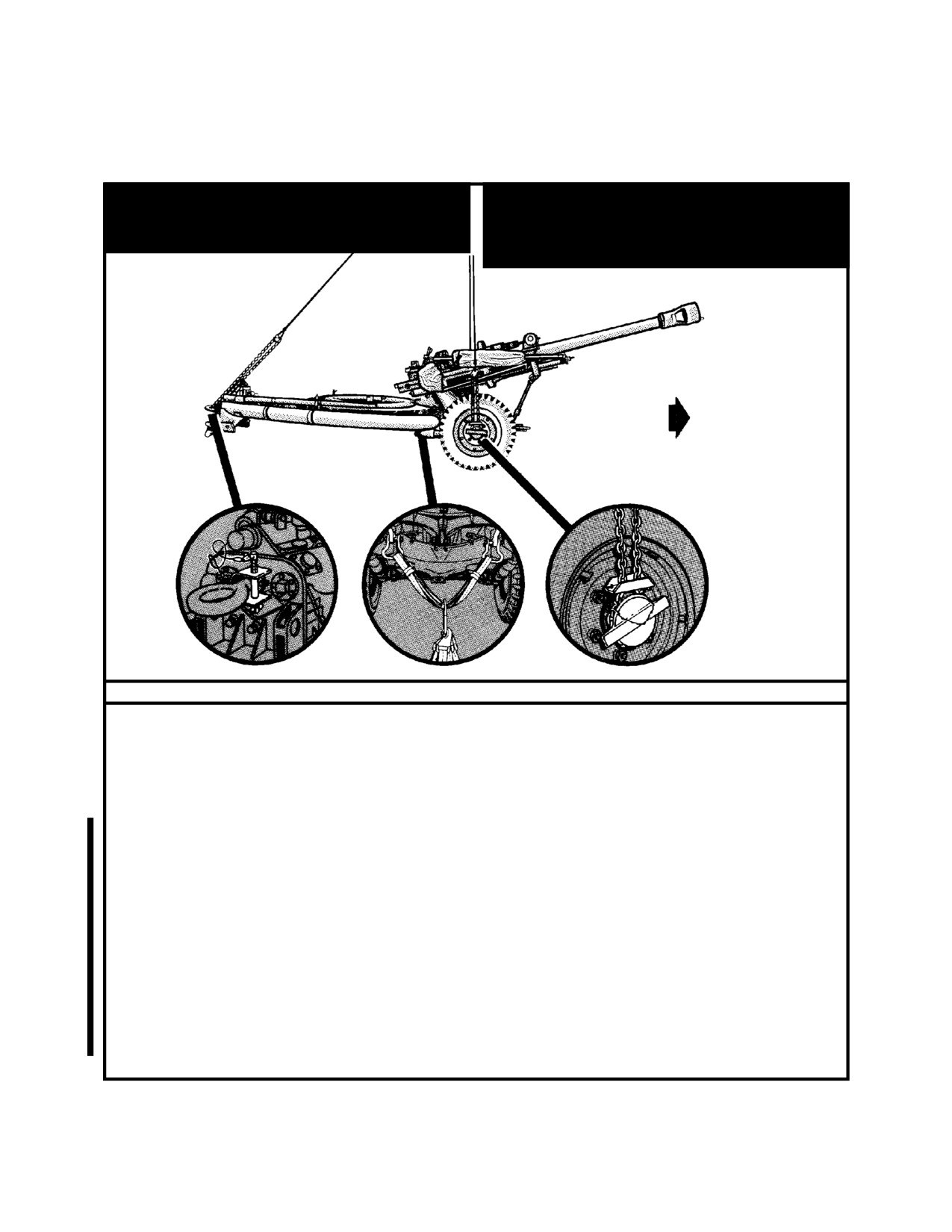
C2, FM 10-450-4/MCRP 4-23E, VOL II/NWP 3-04.12/AFJMAN 11-223, VOL II/
COMDTINST M13482.2
WARNING
WARNING
When moving the howitzer with an accompanying load,
Accompanying loads must not exceed the weight limits
the 25,000-pound capacity sling set must be used.
of the cargo net, cargo bag, sling leg, or exceed the lift
capability of the helicopter.
RIGGING STEPS
1. Attach a reach pendant on the sling set apex fitting.
4. Route the chain end of the extended sling leg 3
through the lunette. Place link 35 (when using the 10,000-
2. Position the apex fitting and the reach pendant on
pound capacity sling set) or link 28 (when using the 25,000-
the breech assembly. Route outer sling legs 1and 2 to the
pound capaclity sling set) in the grab hook. Secure the
wheel hubs. Route inner sling leg 3 to the lunette.
excess chain with Type III nylon cord
3. Route the chain end of sling leg 1 around the left
5. Cluster and tie or tape (breakaway technique) the
wheel hub. Place link 50 (when using the 10,000-pound
sling legs together on top of the howitzers to prevent
capacity sling set) or link 40 (when using the 25,000-pound
entanglement during hookup and lift-off.
capacity sling set) in the grab hook. Pull the chain taut
and ensure the chain is centered on the hub. Install the
6. Attach the accompanying load (if required) by rout-
sling set chain safety clamp on the two chain links closest
ing the 3-foot, 4-loop, Type XXVI multiloop line through
to the top of the wheel hub. If the sling set chain safety
the eye of the sling leg attached to an A-22 or the apex
clamp is unavailable or if the 25,000-pound capacity sling
fitting of a cargo net. Place a medium suspension clevis
set is being used, tie the two chain links together with 1/2-
inch tubular nylon webbing. Repeat with sling leg 2 on
through the loop on each end of the multiloop line and
the right wheel hub. Place link 55 (when using the 10,000-
attach to the provisions located under the howitzer car-
pound capacity sling set) or link 45 (when using the 25,000-
riage and inboard of the wheels.
pound capaclity sling set) in the grabhook. Secure the
excess chain with Type III nylon cord.
Figure 6-8. M119 105-MM Howitzer, Forward/Firing Position
6-18
C2, FM 10-450-4/MCRP 4-23E, VOL II/NWP 3-04.12/AFJMAN 11-223, VOL II
COMDTINST M13482.2
6-9.1. M119, 105-MM Howitzer, Forward/Firing Position, Platform Down, with Additional
Boxes of Ammunition
a. Applicability. The following items in Table 6-8.1 are certified for all helicopters with suitable lift capacity by the US
Army Soldier Systems Center:
Table 6-8.1. M119 105-MM Howitzer, Forward/Firing Position, Platform Down
M AX
RECOMMENDED
LINK COUNT
NOMENCLATURE
WEIGH T
SLING SET
AIRSPEE D
FRONT/REA R
(POUNDS )
(KNOTS )
M119 Howitzer with Two Boxes of
Listed inrig
i
4,850
10K
80
Ammunition on Firing Platform
t
M119 Howitzer with Two Boxes of
Listed inrig
i
Ammunition on Firing Platform and
7,500
25K
11
0
t
Ammunition
i
Refer to TM 9-1015-252-10 for NSN and installation infor-
WARNINGS
mation. Also authorized is the Suncor Stainless 316 preci-
1. The ammunition boxes must be securely lashed to
sion cast, heavy duty Jaw and Swivel device, Item # S0156-
the firing platform.
HD008 ( for use with 10K and 25K sling sets) or a safety
2. When using the A/22 cargo bag for an accompa-
clamp (Picatinny Arsenal Part # 12591189; Cage Code
nying load do not exceed 2,200 pounds.
19200) designed for the 25K sling set .
3. When using the cargo net for an accompanying
load do not exceed 2,650 pounds.
(9) Line, multiloop, Type XXVI, 4-loop, 3-foot (for
accompanying load).
b. Materials. The following materials are required to
rig this load:
(10) Clevis, suspension, medium (2 each) (for A/22 or
cargo net).
(1) Sling set (10,000-pound capacity) (when moving
the howitzer without A/22 or cargo net).
(11) Bag, cargo A/22 or net, cargo (5,000- or 10,000-
pound capacity).
OR
(12) Chain length, part number 38850-00053-102, from
(2) Sling set (25,000-pound capacity) (when moving
a 25,000-pound capacity sling set (1 each) (for A/22 or
the howitzer with an A/22 or cargo net).
cargo net).
(3) Reach Pendant (11,000 or 25,000-pound capacity).
(13) Coupling link, part number 664241, from a 25,000-
pound capacity sling set (1 each)(for A/22 or cargo net).
(4) Tape, adhesive, pressure-sensitive, 2-inch wide
roll.
(14) Strap, cargo, tiedown, CGU-1/B (as required).
(5) Cord, nylon, Type III, 550-pound breaking strength.
c. Personnel. Two persons can prepare and rig this
load in 30 minutes.
(6) Webbing, cotton, 1/4-inch, 80-pound breaking
strength.
d. Procedures. The following procedures apply to this
load:
(7) Sling set chain safety clamp is an authorized item.
6-18.1
C2, FM 10-450-4/MCRP 4-23E, VOL II/NWP 3-04.12/AFJMAN 11-223, VOL II/
COMDTINST M13482.2
(1) Preparation. Prepare the load using the following
(d) When the detachable field spade is attached to
steps:
the permanent spades, ensure the two locking pins are
installed and locked. Route and tie a length of Type III
(a) Place the howitzer in the forward/firing position.
nylon cord through the key ring of the cable and around
If the firing platform is to be carried in the down position,
the end of the locking pin.
follow these steps:
(e) When moving the howitzer without an A/22 cargo
1 Mark the wheel hubs with tape at the center of
bag or a cargo net load, extend the chain on sling leg 3 by
gravity (CG). The CG is located 6 inches behind (towards
removing the chain length and coupling link from sling leg
the lunette) the center of the hub.
4 and attaching them to the end of the chain on sling leg 3.
2 Mark the center of the firing platform along the
(f) When moving the howitzer with an accompany-
length (lunette to muzzle) and width (side to side) with
ing load and using sling leg 4 on the accompanying load,
strips of tape. Ensure the hand holes (used to secure the
extend the chain on sling leg 3 by adding an additional
ammunition boxes) are equally spaced on either side of
length of chain with a coupling link from a 25,000-pound
the long axis of the gun.
capacity sling set.
3 Roll the howitzer onto the firing platform. Align
(2) Rigging. Rig the load according to the steps in
the CG masking tape with the side to side tape strips. The
Figure 6-8.1.
wheel knock-off hub must be horizontal. Engage both
parking brakes.
NOTE: When an accompanying load requires a sling
leg, you may remove and use one of the inner sling legs
4 Connect the firing platform to the weapon. Tie
from the sling set, leaving one sling leg attached to the
the ammunition boxes together with Type III nylon cord.
lunette of the howitzer.
Secure the two ammunition boxes (if carried) by routing a
CGU-1/B tiedown strap through the platform hand holes
(3) Hookup. The hookup team stands on the howitzer
and the carrying handles of each box. Pad the CGU-1/B
or on the trails. The static wand person discharges the
where it rubs on the boxes and platform.
static electricity with the static wand. The hookup person
places the top loop of the reach pendant onto the aircraft
5 Pad and tape the trailing edge of the platform
cargo hook. The hookup team then moves clear of the
when carrying an accompanying load in an A/22 cargo
helicopter but remains close to the load as the helicopter
bag or a cargo net.
removes slack from the sling legs. When successful
hookup is assured, the hookup team quickly exits the area
(b) Secure the sight cover to the dial sight with tape
underneath the helicopter to the designated rendezvous
or Type III nylon cord.
point.
(c) Secure the firing platform (if carried), hand spike,
(4) Derigging. Derigging is the reverse of the prepa-
and jack to the trail assembly with Type III nylon cord.
ration and rigging procedures in steps d (1) and d (2).
6-18.2
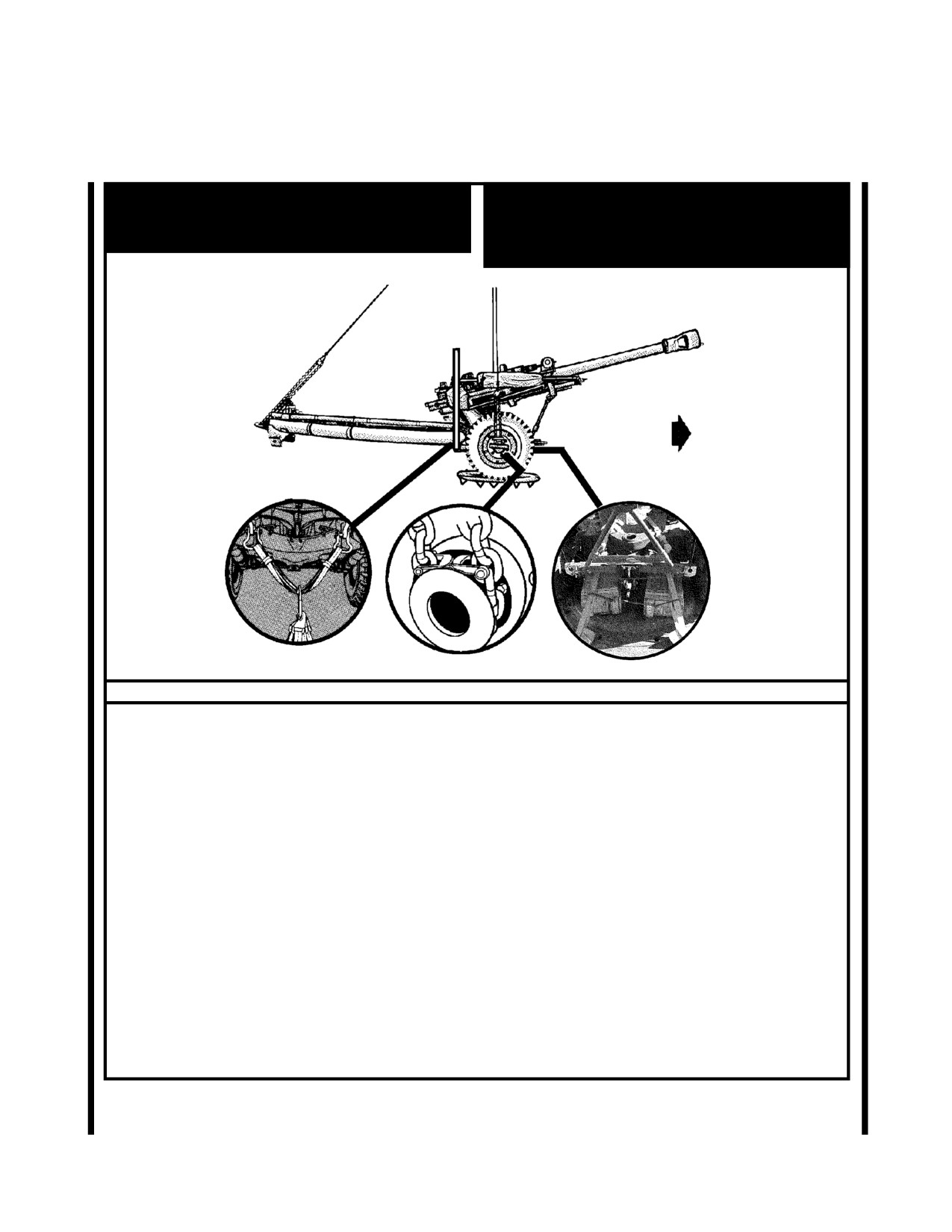
C2, FM 10-450-4/MCRP 4-23E, VOL II/NWP 3-04.12/AFJMAN 11-223, VOL II
COMDTINST M13482.2
WARNING
WARNING
When moving the howitzer with an accompanying load,
Accompanying loads must not exceed the weight limits
the 25,000-pound capacity sling set must be used.
of the cargo net, cargo bag, sling leg, or exceed the lift
capability of the helicopter.
RIGGING STEPS
1. Attach a reach pendant on the sling set apex fitting.
4. Route the chain end of the extended sling leg 3
through the lunette. Place link 35 (when using the 10,000-
2. Position the apex fitting and the reach pendant on
pound capacity sling set) or link 28 (when using the 25,000-
the breech assembly. Route outer sling legs 1and 2 to the
pound capaclity sling set) in the grab hook. Secure the
wheel hubs. Route inner sling leg 3 to the lunette.
excess chain with Type III nylon cord
3. Route the chain end of sling leg 1 around the left
5. Cluster and tie or tape (breakaway technique) the
wheel hub (looking at the howitzer from the lunette). Place
sling legs together on top of the howitzers to prevent
link 50 (when using the 10,000-pound capacity sling set)
entanglement during hookup and lift-off.
or link 40 (when using the 25,000-pound capacity sling
set) in the grab hook. Pull the chain taut and ensure the
6. Attach the accompanying load (if required) by rout-
chain is centered on the hub. Install the sling set chain
ing the 3-foot, 4-loop, Type XXVI multiloop line through
safety clamp on the two chain links closest to the top of
the eye of the sling leg attached to an A-22 or the apex
the wheel hub. If the sling set chain safety clamp is un-
available, tie the two chain links together with 1/2-inch
fitting of a cargo net. Place a medium suspension clevis
tubular nylon webbing. Repeat with sling leg 2 on the
through the loop on each end of the multiloop line and
right (knock-off) wheel hub. Place link 55 (when using the
attach to the provisions located under the howitzer car-
10,000-pound capacity sling set) or link 45 (when using
riage and inboard of the wheels.
the 25,000-pound capaclity sling set) in the grabhook.
Secure the excess chain with Type III nylon cord.
Figure 6-8.1. M119 105-MM Howitzer, Forward/Firing Position, Platform Down
6-18.3
C2, FM 10-450-4/MCRP 4-23E, VOL II/NWP 3-04.12/AFJMAN 11-223, VOL II
COMDTINST M13482.2
11-10. Distributed Explosive Technology (DET) System, Landing Craft, Air Cushioned
(LCAC), Landing Interface Kit (LIK) Container, Single
a. Applicability. The following item in Table 11-9 is certified for all helicopters with suitable lift capacity by the US Army
Soldier Systems Center:
Table 11-9. Distributed Explosive Technology (DET) System, Landing Craft, Air Cushioned (LCAC), Landing
Interface Kit (LIK) Container, Single
MAX
RECOMMENDED
LINK COUNT
NOMENCLATURE
WEIGH T
SLING SET
AIRSPEE D
FRONT/REA R
(POUNDS )
(KNOTS )
Distributed Explosive Techn
l
System, Landing Craft, Air Cushioned
Navy MK105
O
1,550
/
80
(LCAC), Landing Interface Kit (LIK
)
SlingAssem
l
Container
b. Materials. The following materials are required to
(2) Rigging. Rig the load according to the steps in
rig this load:
Figure 11-9.
(1) Sling set, Navy MK105 O Sling Assembly with 91-
(3) Hookup. The hookup team stands on top of the
inch or longer leg assembly.
container. The static wand person discharges the static
electricity with the static wand. The hookup person places
(2) Cord, nylon, Type III, 550-pound breaking strength.
the apex fitting onto the aircraft cargo hook. The hookup
team then moves clear of the load but remains close to the
c. Personnel. Two persons can prepare and rig this
load as the helicopter removes slack from the sling legs.
load in 10 minutes.
When successful hookup is assured, the hookup team
quickly exits the area underneath the helicopter to the
d. Procedures. The following procedures apply to this
designated rendezvous point.
load:
(4) Derigging. Derigging is the reverse of the prepa-
(1) Preparation. Prepare the load by placing a strap
ration and rigging procedures in steps d (1) and d (2).
over each end of the LIK container and attaching it to the
platform in accordance with manufacturer's instructions.
11-17
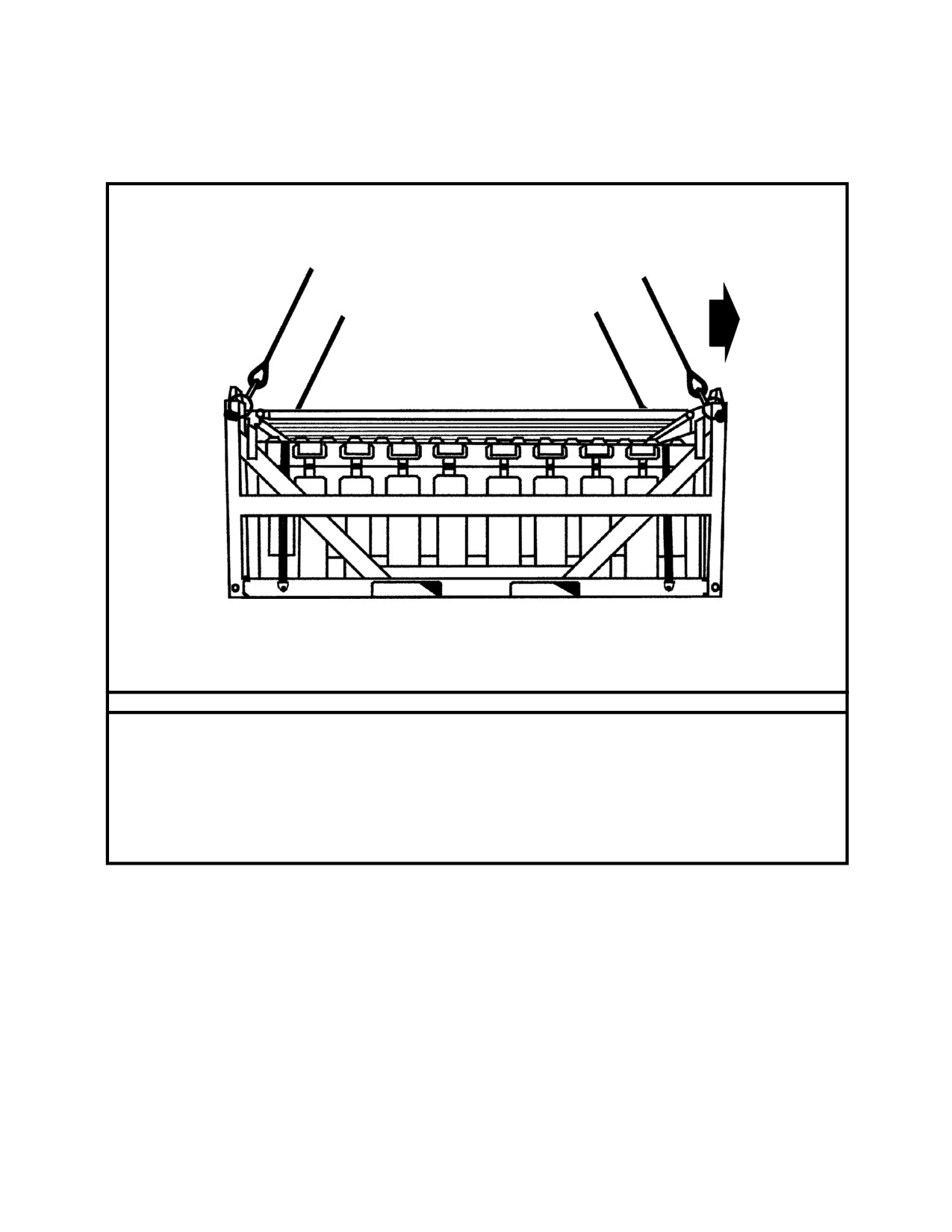
C2, FM 10-450-4/MCRP 4-23E, VOL II/NWP 3-04.12/AFJMAN 11-223, VOL II/
COMDTINST M13482.2
RIGGING STEPS
1. Position apex fitting on top of the container. Route
the respective lift provision located at the top corners of
outer sling legs 1 and 2 to the front of the container. Route
the container.
inner sling legs 3 and 4 to the rear of the container. Sling
legs 1and 3 must be on the left side of the load.
3. Secure the sling leg hooks in the closed position
with Type III nylon cord.
2. Attach the hook on the end of each sling leg to
Figure 11-9. Distributed Explosive Technology (DET) System, Landing Craft, Air Cushioned (LCAC), Landing
Interface Kit (LIK) Container, Single
11-18
C2, FM 10-450-4/MCRP 4-23E, VOL II/NWP 3-04.12/AFJMAN 11-223, VOL II/
COMDTINST M13482.2
GLOSSARY
ACRONYMS AND ABBREVIATIONS
ACP
assault command post
FARE
forward area refueling equipment
ADCGS
aviation direct current generator set
FMOGDS
field medical oxygen generation/distribu-
AETC
auxiliary equipment transportation
tion system
container
FOPS
falling objects protection system
AFATADS
advanced field artillery tactical data
FUPP
full-up power pack
systems
GMLA
guided missile launch assembly
AGPU
aviation ground power unit
GPH
gallons per hour
ARL-C
airborne reconnaissance low-comint
GPM
gallons per minute
ARL-I
airborne reconnaissance low-imagery
HATS
hardened army tactical shelter
ASK
acoustic suppression kit
HEMAT
heavy expanded mobility ammunition
AS
aviation section
trailer
ATG
antenna transceiver group
HMD
high mobility downsized
BIDS
biological integrated detection system
HMDA
high mobility digital group multiplexer
bn
battalion
assemblage
BSTF
base shop test facility
HMMH
high mobility materiel handler
BTU
British Thermal Unit
H-HMMWV heavy high-mobility multipurpose
CAFSM
compressed air foam system, mobile
wheeled vehicle
CBC
cargo bed cover
HMMWV
high-mobility multipurpose wheeled
CFM
cubic feet per minute/cylinder filling
vehicle
module
HMT
high mobility trailers
CG
center of gravity
HSTRU
hydraulic system test and repair unit
CLFFK
company level field feeding kit
HZ
hertz
CMTH
contact maintenance truck, heavy
IAS
intelligence analysis system
CONEX
container express
IEW
intelligence and electronic warfare
CWAR
continuous wave acquisition radar
IFAV
interim fast attack vehicle
DASC
direct air support central
IMETS
integrated meteorological systems
DAMP
digital antenna mast program
ISO
International Organization of
DDSS
downsized direct support section
Standardization
DDGM
downsized digital group multiplexer
JSTAR
joint surveillance target attack radar
DET
distributed explosive technology
JTIDS
joint tactical information distribution
DGM
digital group multiplexer
system
DOD
Department of Defense
KW
kilowatt(s)
DOM
desert operation motorcycle
LAV
light armored vehicle
DOT
desert operation trailer
LCAC
landing craft air cushioned
DTSS-L
digital topographic support system-light
LHGXA
lightweight high gain x-band antenna
EALP
enclosure assembly launch pods
LIK
landing interface kit
EBFL
extendable boom forklift
LIN
line number
ECU
environmental control unit
LMS
lightweight multipurpose shelter
EFOGM
enhanced fiber optic guided missile
LMTV
light medium tactical vehicle
ELAMS
expandable light airmobile shelter
LTACFIRE
lightweight tactical fire control system
EMI
electromechanical induction
LTR
light tactical floating raft bridge
EPLRS
enhanced position location reporting
LVAD
low velocity airdrop
system
MASINT
measurements and signature intelligence
FAAR
forward area alerting radar
MGB
medium girder bridge
Glossary-1
C2, FM 10-450-4/MCRP 4-23E, VOL II/NWP 3-04.12/AFJMAN 11-223, VOL II/
COMDTINST M13482.2
MHG
meterological hydrogen generator
ROPS
roll-over protection system
MICLIC
mine clearing line charge
ROWPU
reverse osmosis water purification unit
MIL STD
military standard
RP/C
rocket pod/container
MLRS
multiple launch rocket system
RT
rough terrain
mm
millimeter
SCAMP
self-propelled crane for Army aircraft
MOSLS
minimum operating strip lighting system
maintenance and positioning
MOST
mobile oversnow transport
SCOTT
single channel objective tactical terminal
MR
mobile radio
SDASS
special diver's air support system
MRBS
mobile radio broadcasting subsystem
SEE
small emplacement excavator
MSFDCS
multiservice flight data collection sheet
SICPS
standardized integrated command post
MT
mobile television
systems
MTBS
mobile television broadcasting subsystem
SIXCON
six-compartment container
MTMCTEA Military Traffic Management Command
SMART-T
secure mobile anti-jam tactical terminal
Transportation Engineering Agency
SMMS
sensor mobile monitoring system
MTS
mobile-track system
SOMS-B
special operations media system
MTV
medium tactical vehicle
SPAM
shop, portable aircraft maintenance
NABS
NATO airbase satcom
SPEARR
small portable expeditionary aeromedical
NATO
North Atlantic Treaty Organization
rapid response
NAVAIR
Naval Air Systems Command
SSC
Soldier Systems Center
NCS-E(D)
downsized net control system
SSS
single shelter switch
NRDEC
Natick Research, Development,
SUSV
small unit support vehicle
and Engineering Center
TAFDS
tactical airfield fuel dispensing system
NSN
national stock number
TAMCN
Table of Authorized Material Control
OC
operations central
Number
OCG
operational control group
TM
technical manual
OGDM
oxygen generation/distribution module
TMS
tactical messaging system
OVE
operator vehicle equipment
TOW
tube launched, optically tracked,
PN
part number
wireguided
POC
platoon operations center
TQG
tactical quiet generator
PTO
pioneer tool outfit
TRSS
tactical remote sensor system
QRSA
quick reaction satellite antenna
TSS
tracked suspension system
RIE
required individual equipment
TTCS
tactical terminal control system
RLST
remote landing site tower
US
United States
USA
United States Army
USMC
United States Marine Corps
Glossary-2