FM 101-10-1/2 STAFF OFFICERS’ FIELD MANUAL ORGANIZATIONAL, TECHNICAL, AND LOGISTICAL DATA PLANNING FACTORS (VOLUME 2)
FM 101-10-1/2
STAFF OFFICERS’ FIELD MANUAL
ORGANIZATIONAL, TECHNICAL, AND LOGISTICAL
DATA PLANNING FACTORS
(VOLUME 2)
This copy IS a reprint which includes current
pages from Change
1
DISTRIBUTION RESTRICTION: Approved for public release; distribution is unlimited.
OCTOBER 1987
HEADQUARTERS, DEPARTMENT OF THE ARMY
3CGS-03644
EXTRACTS OF FM 101-10-1/2, VOL 2
This document extracts pages necessary for completion of subcourse
work
in
M/S 311,
312,
322,
314, and
324.
PAGE
SUPPLY PLANNING DATA
2-0
Table
2-1
Estimating Supply Requirements
2-1
Table 2-2
Classes and Subclasses of Supply
2-2
Table
2-3
Theater-Level Average Consumption Rates
in Temperate Zone
2-5
Table
2-5
Recommended Water Consumption Factors
2-8
Table
2-8
Water Consumption Factors by Level of Cmd
2-9
Table
2-15
Class III Bulk Planning Factors
2-54
Section IV
Class V
2-127
Table
2-16
Ammo Requirements/Type Unit/Wpn/Day
2-129
Para
2-13
Basic Loads
2-145
Table
2-20
Ammunition Basic Load Guide
2-146
TRANS AND MVMT PLANNING DATA
3-0
Table
3-2
Unit Capability Estimate
-- Local Hauls
3-3
Table
3-3
Unit Passenger Capability Est
-- Local Hauls
3-3
Table 3-4
Unit Tonnage Capability Est
-- Line Hauls
3-4
Table 3-5
Unit Passenger Capability Est
-- Line Hauls
3-4
Table 3-6
Vehicle Payload Capacities
3-4
PERSONNEL LOSSES AND REPLACEMENTS
4-6
Table
4-17
Distribution of Battle Losses by Branch
4-9
Table
4-18
Daily Personnel Losses as
% of Strength
4-9
Table
4-21
Types of Battle Losses as
% of Total
4-11
NOTE: Pen and ink corrections have been made to this extract that
have
not
yet been
published
as changes to the FM.
Extract from FM 101-10-1/2 dated 7 Oct 87;
FM 101-10-1/2
authority AR
25-30, paragraph
12-23. February
1989,
C 1
reprinted by The United States Army Command And
General Staff College.
Change
HEADQUARTERS
No
1
DEPARTMENT OF THE ARMY
Washington, DC,
17 July
1990
STAFF OFFICERS' FIELD MANUAL
ORGANIZATIONAL, TECHNICAL, AND LOGISTICAL DATA PLANNING FACTORS (VOLUME 2)
1 .
C h a n g e F M
101 - 1 0 - 1 / 2 ,
7 O c t o b e r
1987 , a s f o l l o w s :
P a g e
2 - 5 .
A d d a " 9 " i n N o t e c o l u m n f o r C l a s s e s o f S u p p l y I I , I I I , V I I I , a n d I X .
A d d t h e
f o l l o w i n g
n o t e a t t h e b o t t o m o f t h e p a g e : " 9 .
P e r I n s t i t u t e o f D e f e n s e A n a l y s e s
( I D A )
f i n a l
s t u d y , N o v
1988 , s u b j e c t :
C o n s u m p t i o n R a t e s f o r C h e m i c a l D e f e n s e E q u i p m e n t
( C D E ) ,
a d d i t i
o n a l c o n s u m p t i o n p l a n n i n g f a c t o r s f o r C D E f o r N o r t h w e s t A s i a , S o u t h e a s t A s i a ,
a n d
E u r o p e a r e
r
e f l e c t e d i n T a b l e
2 - 3 a . "
A d d t h e f o l l o w i n g t a b l e t o t h e r i g h t o f
T a b l e
2
-
3
:
Table
2-3a. Theater-Level Average Consumption Rates for Chemical Defense Equipment
(CDE)
in Northeast Asia, Southwest Asia, and Europe
(Pounds per person per day)
Class of Supply
Consumption ion Rate
Location
Note
II
3.998
S.W. Asia
1,
2
III/VIII/IX
0.085
S.W. Asia
1,
2
Total CDE consumption planning factor for S.W. Asia is
4.083 lbs/person/day.
II
3.128
N.E. Asia
1,
2
III/VIII/IX
0.142
N.E. Asia
1,
2
Total CDE consumption planning factor for N.E. Asia is
3.270 lbs/person/day
II
2.850
Europe
1,
2
III/VIII/IX
9.155
Europe
1,
2
Total CDE consumption planning factor for Europe is
2.295 lbs/person/day
Notes:
1.
Consumption planning factors are for up to
30 days.
2.
Consumption planning factors assume troops change chemical protective suit and
chemical protective boots every
30 days unless mandated earlier by METT-T.
2
F i
l
e
t
h i
s c h a n g e i n t h e f r o n t o f t h e p u b l i c a t i o n .
DISTRIBUTION RESTRICTION: A p p r o v e d f o r p u b l i c r e l e a s e ; d i s t r i b u t i o n i s
u n l i
m i t e d ,
2-0
FM 101-10-1
CHAPTER 2
SUPPLY PLANNING DATA
SECTION I. GENERAL CONSIDERATIONS
2-1. INTRODUCTION. This chapter examines sup-
b. Combat-essential items must be stocked during
2.3. ESTIMATING SUPPLY REQUIREMENTS.
ply classes and subclasses, supply requirements esti.
peacetime for wartime requirements. This is neces-
mates, and theater-level supply consumption rates It
sary to ensure an adequate supply capability to sus-
a. The formulas shown in Table
2-1 are useful in
presents weights, volume conversion factors, and for-
tain operations pending establishment of wartime
estimating supply requirements when both the
mats for computing supply requirements. It also pro-
supply procedures or reestablishment of normal peace-
strengths to be supported and the desired level of sup-
vides combat consumption rates, daily equipment
time supply channels.
plies are known. Requirements are stated in short tons
usage statistics, basic load guides, and chemical muni-
(STONS) or in gallons
tions data characteristics. The functions of supply
c. Personnel and facilities are required to receive,
include requisition, procurement, storage, stock con.
store, maintain, and issue supplies. Each level of sup-
b Table 2-2 is an extract from FM 704.28. It pro
trol, and distribution of items necessary for the equip-
ply distribution must respond to needs by directing
vides definitions of the
10 classes of supply and the
ment, maintenance, and operation of a military
issue, by calling supplies forward for delivery to users,
sub-classes of supply.
combat force. Supplies include food, water, clothing,
or by placing demands on the higher echelon for
equipment, arms, ammunition, fuel, materials, and
action.
machinery of all kinds.
c. Table 2-3 provides theater-level average consump-
tion rates when operating in a temperate zone for each
2-2. FUNDAMENTALS OF SUPPLY.
d. Automatic data processing equipment
(ADPE) is
class of supply. These data are for very broad plan
a. The supply system must be responsive, efficient.
used in supply operations whenever possible. An effec-
ning and may change depending on the needs of the
and simple to operate. It must be able to adjust to
tive communications system is necessary to compile
Army. The factors may vary considerably with the
requirements of supported units and be able to fore-
and transmit supply data and to process management
force structure, mission, area of operation, and inten-
cast and satisfy fluctuating demands.
information.
sity of combat.
Table 2-1. Estimating Supply Requirements
1. Supply requirements less than Class III bulk.
2. Supply requirements for Class III bulk.
a. Supply requirements
a. Supply requirements.
Strength supported x Consumption rate1 x Supply level (days of supply) = STON
Strength supported x Consumption rate2
x Supply level (days of supply) = Gallons
2,000
b Daily resupply.
b. Daily resupply
Average strength x Consumption rate2 = Gallons
Average strength x Consumption rate1 = STDN
2,000
c. Distribution of dally resupply.
c. Distribution of daily resupply.
Strength x Consumption rate2 = Gallons
Strength x Consumption rate1 = STON
d. Buildup of supply levels
2,000
End strength x Consumption rate2 x End supply level (days)
Minus
d. Buildup of supply levels
Beginning strength x Consumption rate2
x Beginning supply level (days) = Gallons
End strength x Consumption rate1 x End supply level (days)
Minus
2,000
e Storage requirements
Beginning strength x Consumption rater x Beginning supply level (days) = STON
End strength x Consumption rate2 x No. of days stored = Gallons
2.000
e. Storage requirements.
End strength x Consumption rate1 x No. of days stored = STON
2.000
FOOTNOTES:
1Consumption rates are to be expressed in pounds per person per day.
2Consumption rates are to be expressed in gallons per person per day.
2-1
FM 101-10-1
2-2
FM
101-10-l
Table
2-2. Classes and Subclasses of Supply
CLASS I - Subsistence, including gratuitous health and welfare Items.
CLASS II - Clothing, individual equipment. tentage, tool sets and tool kits, handtools, administrative and housekeeping supplies
and equipment. Includes items of equipment (other than principal items) prescribed in authorization/allowance tables, and items
of supply (not including repair parts)
CLASS III - POL: Petroleum fuels: lubricants, hydraulic and insulating oils. preservatives. liquid and compressed gases, chemical
products, coolants, deicing and antifreeze compounds, together with components and additives of such products and coal
CLASS IV - Constructron: Construction materials including installed equipment and all fortification/barrier materials
CLASS V - Ammunition: Ammunition of all types including chemical, radiological, and special weapons), bombs, explosives. land
mines, fuzes, detonators, pyrotechnics. missiles. rockets, propellants, and other associated items
CLASS VI - Personal Demand Items (nonmilitary sales items)
CLASS VII - Major End Items: A final combination of end products which is ready for its intended use: principal items; e.g, launchers,
tanks, mobile machine shops, vehicles.
CLASS VIII - Medical material including medical-peculiar repair parts.
CLASS IX - Repair parts and components including kits, assemblies and subassemblies, and reparable and nonreparable items
required for maintenance support of all equipment.
CLASS X - Materiel to support nonmilitary programs; e.g.. agricultural and economic development materials not Included in Classes
I through IX.
Air (aviation), aircraft, airdrop equipment):
(Class I - Fwd packet, inflight, individual.)
(Class II - Items of supply and equipment in support of aviation/aircraft )
(Class III - Petroleum and chemical products used in support of aircraft.)
(Class V - Munitions delivered by aircraft or aircraft weapons systems.)
(Class VII - Major end items of aviation equipment.)
(Class IX - Aircraft repair parts.)
Troop Support Materiel:
(Consists of items such as water purification sets, shower, bath, laundry, drycleaning. and bakery equipment; sets, kits, and
outfits; tool and equipment sets and shop/equipment sets for performing unit, direct support, general support, and depot-level
maintenance operations; sensors and interior intrusion devices; and topographic equipment and related topographic products
as outlined in AR 115-11.)
C - Operational Rations:
(Includes an accessory packet of health and comfort items in meal, combat, individual (MCI) issue, or a ration supplement
sundries pack issued in conjunction with B rations until PX facilities are established.)
D - Commercial Vehicles:
(Includes wheeled vehicles authorized for use in an administrative or tactical operation.)
E - General Supply Items:
(Includes administrative expendable supplies such as typewriter ribbons, paper, cleaning materials, and other supplies nor-
mally referred to as office supplies. Also includes publications distributed through AG channels.)
F - Clothing and Textiles:
(Includes individual and organizational items of clothing and equipment authorized in allowance tables and tentage/tarpaulins
authorized in TOE or other media.)
G-
Communications/Electronics
(C-E)
(Includes Signal items such as radio, telephone. teletype. satellite, avionics, marine communications, and navigational equip-
ment; tactical and nontactical ADP; radar; photographic audio, visual. and television equipment: infrared; Laser/Maser,elec-
tronic sensors, etc.)
H -
Test, Measurement, and Diagnostic Equipment (TMDE):
(Includes items of equipment used to determine the operating efficiency of equipment or to diagnose Incipient problems in
systems, components, assemblies and subassemblies of Army-used materiel.)
K -
Tactical Vehicles:
(Includes trucks, truck tractors, trailers, semitrailer. personnel carriers, etc )
L -
Missiles:
(Classes II, VII, and IX include guided missile and rocket systems such as NIKE-HERCULES, HAWK, LANCE, TOW. and DRAGON.)
(Class V includes guided missile ammunition Items.)
M-
Weapons:
(Includes small arms, artillery. fire control systems, rocket launchers, machine guns, air defense weapons, aircraft weapon sub-
systems, etc.)
N -
Special Weapons:
(Class V - Includes nuclear and thermonuclear munitions.)
(Class VII - Includes weapons systems which deliver nuclear munitions.)
(Class IX - Includes repair parts for Class VII-N ).
O -
Combat Vehicles:
(Includes main battle tanks, recovery vehicles, self-propelled artillery. armored cars, tracked and halftracked vehicles, etc.)
P -
SIGINT/EW and Intelligence Materiel:
(Includes materiel peculiar to those mission areas assigned to FSC 5811 for which CDR AMC has responsibility. This subclass
is identified separately from Subclass G because of specialized supply and maintenance functions performed by a dedicated
EW/SIGINT logistical system.)
Q - Marine Equipment:
(Includes marine items of supply and equipment such as amphibious vehicles, landing craft. barges, tugs, floating cranes, dredges,
etc.)
R - Refrigerated Subsistence:
(Consists of two categories of refrigeration - that which is required to maintain temperatures at 0°F (-17.8C) to keep frozen
meals and foods for extended periods, and that which is required to maintain temperatures at approximately 40°F (4.4C) to
keep perishables such as fruits, vegetables. and eggs contained in A rations for shorter periods.)
S - Nonrefrigerated Subsistence:
(Includes items in standard B rations and nonperishable items in A rations.)
T - Industrial Supplies:
(Includes common supplies and repair parts such as shop stocks, hardware, and fabrication-type items generally having mul-
tiple usage/application. Such items an generally managed by DISC.)
U - COMSEC Materiel:
(Identified separately from Subclass G because of specialized supply and maintenance functions performed through a dedi-
cated COMSEC logistic system.)
W - Ground:
(Class I - Includes water when it is delivered as a supply item.)
(Class III - Includes petroleum/chemical products and solid fuels used in support of ground and marine equipment.)
2-3
FM
101-10-1
2-4
FM
101-10-1
Table
2-2. Classes and Subclasses of Supply of Supply
-
(Cont’d)
(Class V - Includes conventional munitions consisting of chemical, smoke, illummating. incendiary. riot control, and improved
conventional munitions.)
(Classes II, VII. and IX - Consist of construction/road building materials and materials for handling equipment )
X - In Class:
(Indicates no subclass IS assigned )
Y - Railway Equipment:
(Includes rail items of supply and equipment such as locomotives, railcars. rails, rail joining and shifting equipment, etc )
z
-
Chemical:
(Classes II. VII and IX - Include chemical items such as gas masks, decontaminators, and smoke generators )
(Class V - Consists of chemical toxic munitions.)
For Class III. the following subclasses apply:
1 - Air, Bulk Fuels (includes jet fuels and aviation gasolines which are normally transported by pipeline, rail tank car, tank,
truck, barge, and coastal or ocean-going tankers and which are stored in a tank or container having a fill capacity greater than
500 gallons).
2 - Air, Packaged Bulk Fuels (includes fuels in Subclass 1 which, because of operational necessity, are generally packaged
and supplied in containers of 5- to 55-gallon capacities, except for fuels in military collapsible containers of 500 gallons
or less which also will be considered as package fuels)
3 - Air, Packaged Petroleum Products (Includes aircraft-unique petroleum and chemical products generally consisting of
lubricating oils, greases, and specialty items normally packaged by the manufacturer and procured, stored, transported, and
issued in containers or packages of 55-gallon capacity or less).
4 - Ground Bulk Fuels (includes MOGAS. diesel, kerosene, and heating oils normally transported by pipeline, rail tank car,
tank truck, barge and coastal or ocean-going tankers and stored in a tank or container having a fill capacity greater than 500 gallons)
5 - Ground, Packaged Bulk Fuels (includes ground bulk fuels which. because of operational necessity, are generally
packaged and supplied in containers of 5- to 55-gallon capacities, except for fuels in military collapsible containers of
500 gallons or less which also will be considered as packaged fuels),
6 - Ground, Packaged Petroleum (includes petroleum and chemical products, generally lubricating oils, greases, and spe-
cialty items normally packaged by the manufacturer and procured, stored, transported, and issued in containers of 55-gallon
capacity or less).
7 - Ground, Solid Fuels (Includes coal, coke, heating tablets, bars, etc)
For Class VIII. the following subclasses apply:
1 - Controlled substances.
5 - Expendable medrcal items; not restricted
2 - Taxfree alcohol.
6 - All drugs and related items FSC 6505; not otherwise restricted
3 - Precious metal
7 through 9 - Commander-designated controlled items.
4 - Nonexpendable medical items; not restricted.
0 - USAMMA-controlled sensitive items
So far as possible, Alpha subclass designations are synonymous with Commodity Manager Codes contained in such publications
as SB 700-20 and SB 700-40. Moreover, since the Army Master Data File is prime item data source for Army-used items of supply
and equipment, each item is currently being coded by Supply Categories of Material Code as prescribed in AR 708-1 and broadcast
to the field through the Army Master Data File Retrieval Microform System.
Table
2-3. Theator-Level Average Consumption Rates In Temporary Zone
(Pounds per person per day)
Class of Supply
Consumption Rate
Note
4.03
II
3.67
III
53.7
III Packaged
0.59
IV
8.50
V
31.29
VI
3.20
VII
15.00
VIII
1.22
IX
2.50
X
NA
FOOTNOTES:
1Consumption rate is based on ration mix of two Bs and one meal, ready-to-eat (MRE) per person
5Consumption rate is comprised of the following:
per day. If the ration supplement sundries pack (RSSP) is used, an additional .41 should be used
Item
Lbs/Person/Day
by the planner. If the female Health and Comfort Sundries pack is used, an additional .03 lb/per-
Tobacco
.139
son/day should be used by the planner. Consumption rate for the Light Infantry Division is 6.62
Food/Drink
2.375
lb/person/day based on two Ts and one MRE.
Pers Hygiene
.168
2This consumption rate does not include fog oil. To calculate a consumption rate for fog oil.
Military Clothing
.097
use 200 gallons per smoke generator per day.
Jewelry (Watch & Wallets)
.004
3Per Engineer Study Center guidance (19821, consumption rate is comprised of two components:
Stationery
.081
The 4.0 lb/person/day accounts for unit defensive barrier and fortification materiel The other
Civilian Clothing
.096
component is 4.5 lb/person/day which accounts for construction materiel requirements
Gen Supplies (polish, batteries, etc)
.219
for base development in the rear combat zone. The 8.5 lb/person/day represents the complete
Cameras, Radio, Film, etc
.028
Class IV planning factor for a theater of operations. It should be noted that for planning pur-
3.207
poses the 4.0 figure for barrier materiel will reduce to 3.2 as the theater matures over time
In all cases. commanders have the prerogative to Influence the Army and Air Force Exchange
and less barrier materiel is required. The rate of reduction is dependent upon several variables
Service (AAFES) operations as they deem appropriate based on the tactical situation.
which include the intensity of the conflict, type of battle, and the commander’s initiative the
6Consumption rate was derived from Total Army Analysis 90 (TAA 90) and represents mean
employment of Class IV (i.e.. defense, offense, and highly fluid battlefield would require different
usage rate for a heavy force
quantities of Class IV for employment)
7Consumption rate was derived from Class IX Item Analysis Study (LOGC 1984) and represents
4The Class V consumption rate is based upon the TAA 92 P90E Study and is for a moderate
a mean usage rate for a heavy force.
level of combat.
8Consumption rate of Class X has no meaning when based on military strength. Class X require
ments should be developed based on the population. geographic location. and technological
capabilities of the country involved.
9 See change 1 in front of manual.
2-5
FM 101-10-1
3CGS-03644
2-8
FM 101-10-1
Table
2-5. Recommended Water Consumption Planning Factors
(Gallons Per Person Per Day)
Uses
Climate
Hot
Temperate
cold
Drinking requirements
3.01
1.52
2.0
Heat treatment
0.2
0.0
0.0
Personal hygiene3
1.7
1.7
1.7
Centralized hygiene4
1.0
1.0
1.0
Food preparation5
0.0-4.5
0.0-4.5
0.0-4.5
Laundry6
2.1
2.1
2.1
Divisional medical treatment7
0.4
0.4
0.4
Waste (10 percent)
0.8-1.3
0.7-1.1
0.7-1.2
FOOTNOTES:
1This figure goes up to 3.5 when personnel assume mission-
5The actual factor to use depends on the ratron policy in the
oriented protection posture
(MOPP) 3 to 4 levels
theater. No water is needed for meals (ready-to-eat) and
continuously.
meals (combat. individual). B rations require 0.5 gallon per
2This figure goes up to 3.0 when personnel assume MOPP
meal per soldier for rehydration and kitchen sanitation. If
3 or 4 levels continuously.
individual mess equipment is used, 1 .0 gallon per soldier IS
3This figure includes water for shaving daily, brushing teeth
required to sterilize utensils and clean up
three times a day, washing hands, and taking sponge baths
6This figure allows for one clothing exchange per week.
daily. For periods of less than 7 days. the figure is 0.7 gallon;
7This figure IS based on Total Army Analysis 88 peak
this water is used for shaving so that masks will fit.
hospital admission rates. All patients not expected to return
4Thus figure provides water for one shower a week.
to duty within 96 hours are evacuated to corps hospitals.
Table
2.6. Water Planning Factors
Table
2.7. Theater Per Capita
for Hospital Units
Water Planning Factors For Hospitals1
(Medical Functions Only)
Number Gallons
Gallons Per Person
Region
Per Day
Type
of Beds Per Day
Mobile Army Surgical Hospital
60
8,100
Temperate
.6
Combat Support Hospital
200
17,700
Arctic
.6
Tropic
1.2
Evacuation Hospital
400
28,000
Arid
3.5
Field Hospital1
400
31,300
FOOTNOTE:
FOOTNOTE:
1Includes 20,000 gallons per day for laundry of
1Number of hospitals and casualty rates based
hospital linen.
upon FASTALS/TAA-68
e. Water consumption factors depend on the
levels provide enough water to support essential oper-
bles. Class II items include clothing, individual equip
environment and the level of command. Table
2-8
ations for less than
7 days.
ment, tentage, organizational tool sets and tool kits,
gives both sustaining and minimum water require-
hand tools, and administrative and housekeeping sup
ments for individuals of various levels of command.
2.5. CLASS II. Class II supplies are secondary items
plies and equipment. A planning factor of 3.67 pounds
Sustaining levels provide enough water to support
of equipment authorized in allowance tables and
per person per day (Table 2-3) can be used for estimat-
continuous operation for extended periods. Minimum
items of supply including expendables and consuma-
ing Class II requirements.
Table
2-8. Water Consumption Factors by Level of Command
(Gallons Per Person Per Day) Extracted from FM
10-52
Environmental Region
Temperate
Arctic
Hot Tropic
Hot-Arid
(32° - 80°F)
(Lets Than 32°F)
(More than 80°F)
(More than 80°F)
Level of Command
Sustaining1
Minimum
Sustaining1
Minimum
Sustaining1
Minimum
Sustaining1
Minimum
Company
3.8-68
2.4
4.4-7.4
3.0
5.7-8.7
4.3
6.0-9.0
46
Battalion
3.8-6.8
2.4
4.4-7.4
3.0
5.7-8.7
4.3
6.0-9.0
4.6
Brigade
4.3-7.3
2.9
4.8-7.8
3.4
6.1-9.1
4.7
9.2-12.2
6.7
Division
4.3-7.3
2.9
4.8-7.8
3.4
6.1-9.1
4.7
9.4-12.4
6.9
Above Division
4.9-7.9
3.5
5.5-8.5
4.1
7.5-10.5
6.1
15.6-18.6
10.8
FOOTNOTE:
1The ranges in the “Sustaining” columns are the result of differences in ration policy.
SECTION III. CLASSES III AND IV
2-6. CLASS III.
c. Table 2-10 provides combat consumption rates for
vides daily equipment usage rates for tracked com-
packaged petroleum products. Table 2-11 contains a
bat vehicles. Table
2-15 provides Class III bulk
a. Class III supplies consist of fuels and petroleum
format for computing bulk fuel requirements with
planning factors.
products. Class III items include petroleum and chem-
known end item density. Table 2-12 provides combat
ical products used in support of aircraft; petroleum
consumption rates developed for end items which con-
products transported in tankers, cargo barges, etc;
sume either motor gasoline
(MOGAS) or diesel fuel
2-7. CLASS IV. Class IV supplies consist of con-
packaged bulk fuels; packaged products such as lubri-
(DF) plus aircraft line item numbers
(LINs) using jet
struction materials, to include installed equipment
cants, greases. and hydraulic fluids; and solid fuels
propulsion fuel, type
4
(JP-4) of aviation gasoline
and all fortification and barrier materials. Requests
such as coal and coke.
(AVGAS). Table 2-13 provides daily equipment usage
for Class IV supplies normally require command
rates for other than tracked combat vehicles. Tables
approval. FM 5-35 provides weights and cubes for con-
2-11 through 2-13, when specific end items are known,
struction and fortification materials. A planning fac-
b. Table 2-9 contains weights, volumes, and conver-
should be used to compute bulk fuel requirements on
tor of
8.5 pounds per person per day (Table 2-3) can
sion factors for petroleum products.
the basis of equipment density data. Table
2-14 pro-
be used for estimating Class IV requirements.
2-9
FM 101-10-1
2-54
FM
101-10-1
Table
2-15. Class III Bulk Planning Factors
INSTRUCTIONS FOR USE
Computations are based on consumption rates provided in SB 710-23 and represent 1 hour of operation for all
equipment categories except for the wheeled vehicle category, which is based on consumption rates for one kilo-
meter. Planners should be aware of the constant updating of consumption rates in the supply bulletin. The POL
(petroleum. oils, and lubricants) consuming equipment categories and codes are shown below
POL-Consuming Equipment Categories
CODE
CATEGORY
CODE
CATEGORY
CODE
CATEGORY
AB
Amphibious Equipment
SG
Stationary Equipment - Miscellaneous
SR
Tracked Vehicles - Secondary Roads
CE
Construction
SV
Stationary Equipment - Vehicle Mounted
WV
Wheeled Vehrcles
GN
Generators
TI
Tracked Vehicles - Idle
OV
Other Vehicles
HG
Heating Equipment
CC
Tracked Vehicles - Cross Country
AV
Aviation
MH
Materiels Handing Equipment
Once the rate for 1 hour of operation has been established, the usage profile can be used to compute the daily rate
of consumption. Remember, all equipment categories are based on hours of operation except wheeled vehicles which
are based on kilometers. Examples are given below to illustrate how to use the usage profiles to get a daily rate
Example No 1. Compute the total POL requirements for one tank battalion (SRC 17235J4 10) equipped with M60
in a heavy armored division (SRC 87000J410) for 1 day of operation for all categories of equipment. using European
usage profile No. 072.
Total MOGAS = 3.9(12) + 23.6(12) + 16.0(12) = 522 gal/day
Total Diesel = 0.6(12) + 7.0(12)+165.4(4.2) + 2121.9(5.7) + 1560.5(5.5) + 11.4(101) = 22,614.86 gal/day
There is no requirement for aviation fuel in this unit.
Example No. 2. Compute total POL requirements for a Cavalry Brigade Air Attack (SRC 17201J210) in a Heavy
Division Mechanized (SRC 78000J220) for 1 day of operation for all categories of equipment, using the Canal Zone
usage profile No. 075.
Total MOGAS = 103.8(20) + 109.2(10) + 1.5(20) + 75.6(10) = 3,954 gal/day
Total Diesel = 46.0(20) + 49.8(20) + 18.9(20) + 59.0(10) + 89.0(4.6) + 1067.6(4 5) +
668.7(5.3)+50.1(40.2) + 0.6(10) = 13,685.85 gal/day
JP-4 = 10.557.0(4) = 42,228 gal/day
Standard Usage Profiles
Standard - 001
AB CE GN HG MH SG SV TI CC SR
WV OV AV
12
12
12
12
12
12
12
3.8
5.6
5.1
100
12
04
POL Intense - 002
AB CE GN HG MH SG SV TI CC SR
WV OV AV
12
12
12
12
12
12
12
3.9
5.8
5.3
100
12
104
2-108
FM 101-10-1
Table
2-15. Class III Bulk Planning Factors
-
(Cont’d)
SUMMARY OF BULK FUEL USAGE BY EQUIPMENT CATEGORY
HVY DIV FULL 6TK MI 4MB FVS (SRC 87000J250)- (Cont’d)
SRC
UNIT NAME
FUEL TYPE
AR
CE
GN
HG
MH
SG
SV
TI
CC
SR
WV
OV
AV
630051220
FWD SPT BN 2x2 HVY DIV
MOGAS
00
00
46.6
232
0.0
47.0
00
0.0
0.0
0.0
01
00
DIESEL
0.0
28.0
14.8
0.0
31.1
11.0
0.0
70
79.8
70.0
17.9
0.0
63006J200
HHD. FWD SPT BN. HEAVY DIV
MOGAS
0.0
00
2.8
00
DO
10
00
0.0
00
00
01
00
DIESEL
0.0
0.0
3.0
0.0
0.0
0.0
0.0
0.0
0.0
0.0
0.8
0.0
87000J250
HVY DIV FULL 6TK MI 4MBFV
MOGAS
0.0
2.0
830.5
1023.6
1.5
1017.8
14.0
0.0
0.0
0.0
2.8
0.0
DIESEL
86.4
275.0
407.5
0.0
213.2
527.0
0.0
5073.6
34332.9
26752.5
464.9
31.7
JP4
15827.0
87004J210
HHC ARMORED DIVISION
MOGAS
0.0
0.0
16.0
14 8
0.0
12.0
0.0
0.0
0.0
0.0
0.0
0.0
DIESEL
0.0
0.0
0.0
0.0
0.0
0.0
0.0
4.0
34.4
35.6
2.1
0.0
87004J211
AUG-STAFF JUDGE ADVOCATE
MOGAS
0.0
00
0.0
00
0.0
0.0
0.0
00
0.0
0.0
0.0
0.0
DIESEL
0.0
0.0
0.0
0.0
0.0
0.0
0.0
0.0
0.0
0.0
0.0
0.0
87004J212
AUG-AUTOMATION MGT OFFICE
MOGAS
0.0
0.0
0.0
0.0
0.0
0.0
0.0
0.0
0.0
0.0
0.0
0.0
DIESEL
0.0
0.0
0.0
0.0
00
0.0
00
00
0.0
0.0
0.1
0.0
87042J210
HHC ARMD DIV BDE
MOGAS
00
0.0
5.9
9.4
00
4.0
0.0
0.0
0.0
0.0
0.0
0.0
DIESEL
0.0
0.0
0.0
0.0
0.0
5.0
0.0
9.2
72.7
76.6
16
0.0
87042J211
AUG-RIFLE PLATOON
MOGAS
0.0
0.0
0.0
0.0
0.0
0.0
0.0
0.0
0.0
0.0
0.0
0.0
DIESEL
0.0
0.0
0.0
0.0
0.0
0.0
0.0
5.6
72.0
34.4
0.0
0.0
87042J220
HHC INF DIV (MECH) BDE
MOGAS
0.0
0.0
8.9
94
0.0
4.0
0.0
0.0
0.0
0.0
0.0
0.0
DIESEL
0.0
0.0
0.0
0.0
0.0
5.0
0.0
9.2
72.7
76.6
1.6
0.0
87042J221
AUG-RIFLE PLATOON
MOGAS
0.0
0.0
0.0
0.0
0.0
0.0
0.0
0.0
0.0
0.0
0.0
0.0
DIESEL
0.0
0.0
0.0
0.0
0.0
0.0
0.0
5.6
72.0
34.4
0.0
0.0
SUMMARY OF BULK FUEL USAGE BY EQUIPMENT CATEGORY
AR DIV 6-M60 4-M113 2-AHB (SRC 87000J410)
SRC
UNIT NAME
FUEL TYPE
AB CE GN
HG MH SE SV
TI
CC
SR
WV OV
AV
01257J410
CBT SPT AVN CO (CBAA) (UH-1)
MOGAS
0.0
0.0
9.4
21.0
0.0
7.3
0.0
0.0
0.0
0.0
0.0
0.0
DIESEL
0.0
6.0
0.0
0.0
1.3
0.0
0.0
0.0
0.0
0.0
6.0
0.0
JP4
2438.0
01287J400
GEN SPT AVN CO
MOGAS
0.0
0.0
21.9
12.0
0.0
6.4
0.0
0.0
0.0
0.0
0.0
0.0
DIESEL
0.0
6.0
0.6
0.0
0.0
9.0
0.0
0.0
0.0
0.0
5.0
0.0
JP4
1540.8
01385J410
ATTACK HEL BN (AH-1)
MOGAS
0.0
0.0
13.3
14.8
0.0
9.0
0.0
0.0
0.0
0.0
0.0
0.0
DIESEL
0.0
8.0
0.0
0.0
2.6
0.0
0.0
0.0
0.0
0.0
10.0
0.0
JP4
3551.7
01386J410
HQ AND SVC CO (AH-1)
MOGAS
0.0
0.0
13.3
14.8
0.0
9.0
0.0
0.0
0.0
0.0
0.0
0.0
DIESEL
0.0
8.0
0.0
0.0
2.6
0.0
0.0
0.0
0.0
0.0
9.0
0.0
JP4
489.9
SECTION IV. CLASS V
2-8. GENERAL. Class V supplies consist of ammu-
(b) Thirty-five days in the communications zone
not as urgent as during combat. Therefore, in peace-
nition of all types. Class V includes bombs, explosives,
(COMMZ) for units in the combat zone.
time, Class V supplies are often given a lower priority
mines, fuzes, detonators, pyrotechnics, missiles,
than other classes of supply.
rockets, propellants, and other associated items. It
(c) Forty-five days in the COMMZ for units in the
also includes components of Class V items, such as
COMMZ.
boosters, heavy rocket mortars, jet-assisted takeoff
e. Ammunition supply is a logistics action, but
devices, nuclear and nonnuclear warheads, and
(2) To compute the requirements for the theater
expenditure is a matter of tactical command decision.
associated repair parts of assemblies which, because
or major command, it is necessary to consider opera.
Both conventional and special ammunition are allo-
they contain explosives or are peculiar to ammuni-
tional safety and order and ship time levels. During
cated from higher command to lower command. The
tion, are issued through Class V supply channels. The
peacetime, additional stocks may be placed in a the-
primary concern of the support structure is to provide
scope of ammunition supply varies with the type of
ater or major command for contingency plans or as
the ammunition needed to make the plan of the tac-
conflict and the operational environment where the
other theater reserves. These stocks are bulk-allocated
tical commander work.
conflict takes place. Ammunition service support is
items and are not normally definable in terms of days
discussed in detail in FM
9-6.
of supply or rounds per weapon per day. Com-
f. Ammunition planning is a responsibility of oper-
mand/management and supply controls are used to
ations and logistics officers at all levels of command.
a. Interrelationship of ammunition and tactics.
properly supervise ammunition supply.
It requires close coordination between tacticians and
Ammunition directly influences tactical operations.
logisticians.
Therefore, tactical commanders must plan their oper-
2-9. CHARACTERISTICS AND PLANNING
ations and commit their forces with full awareness
CONSIDERATIONS.
g. Ammunition planning is usually in support of
of the support capabilities of the ammunition service
broader strategic planning, and its objectives are
support structure. Likewise, CSS commanders must
a. Ammunition has many characteristics that make
developed from such plans. There is a vital need to
establish, stock, and employ ammunition set-vice units
it different from all other classes of supply. Tactical
include ammunition planning at the strategic level
with full awareness of the operational plans of the
commanders and logistics planners must understand
because of the long lead times involved and the cost
supported tactical commanders. An imbalance of
these characteristics and how they affect ammunition
of obtaining large amounts of Class V supplies.
either tactics or ammunition service may decisively
supply and expenditure control.
influence operations. Both tactical and CSS com-
h. Logistics planning for ammunition must cover
manders must consider tactics and ammunition serv-
b. Ammunition is an important part of a com-
both initial supply and resupply support. Special con-
ices
- not as individual entities, but as an inseparable
mander’s combat power. Once a force is in combat,
sideration must be given to weight and volume and
unit that requires maximum attention, cooperation,
ammunition provides one of the principal means by
the need for rapid movement to meet changing or
and coordination.
which the tactical commander can influence the out-
unexpected demands.
come of the battle.
b. Ammunition supply levels.
2-10. PLANNING PHASES.
c. Ammunition is a part of firepower and maneu-
(1) Depending on its geographical location and
ver. It is used to destroy, neutralize, or deceive the
a. Estimation. The commander’s concept of the
possible contingencies, a theater is authorized a stated
enemy. It is also used to block, screen, and protect
broad course of action requires an initial estimate of
number of days (AR 11-11) of ammunition supply (SB
maneuvering forces.
the ammunition situation to test the feasibility of the
38-26). Using a hypothetical supply level of
45 days,
operation plan and to serve as a basic for further deci-
the distribution would be as follows:
d. Ammunition demands vary in direct ratio to the
sions. Ammunition service staff officers are advised
intensity of combat. In peacetime, ammunition
of the projected tactical plans in time to evaluate and
(a) Ten days in the combat zone to include three
demands are limited to training needs, maintenance
provide information on the ability of the ammunition
days at the direct support level and seven days at the
of basic load, and stockage against war reserve levels.
service support structure to support them. Some of the
general support level.
Because peacetime expenditures are low, demands are
questions to be answered are discussed below.
2-127
FM 101-10-1
2-128
FM 101-10-1
(1) What conventional ammunition is required?
phased increments until the authorized level of sup-
2-11. COMMAND/MANAGEMENT CONTROLS.
This decision is significantly affected by the enemy
ply is reached.
Tactical commanders determine the required supply
threat and effectiveness obtained through weapon
rate
(RSR) for their operations. This may originally
(2) A necessary part of planning is a list reflect-
systems
be based on planning factors such as those contained
ing weapons and weapon systems to be in the hands
in Tables 2-16 through 2-19 or may be computed from
(2) What special ammunition is required? Will
of troops, troop strength, and the rate of deployment
experience factors available through the Standard
nuclear/chemical weapons be employed? Theater com-
of weapons and troops to the theater. From this point
Army Ammunition System. The RSR is given to the
manders are responsible for stating operational
on, the ammunition planner works in terms of rounds
logistician who suggests a controlled supply rate (CSR)
requirements for nuclear/chemical weapons to the
of conventional ammunition fired from weapons, num-
that is then confirmed by the tactical commander. The
Joint Chiefs of Staff
bers of specific special ammunition items allocated
CSR is based on the availability of ammunition and
for use, and in other units of measure for bulk allot-
(3) Is the required ammunition cloth conventional
the ability to move or locate it as desired within
ment and other ammunition items The planner inter-
and special) available? Materiel management centers
required timeframes. The command/management con
prets the ammunition supply situation to tactical
are asked whether the quantities and types of ammu-
trol used by the tactical commander may be varied
planners in terms of projected ability to meet opera-
nition required can be made available on a satisfac-
as required
tional requirements.
tory time schedule.
(3) Conventional ammunition to accompany
(4) Can the ammunition be transported? Based on
troops and phased increments is normally expressed
2-12. SUPPLY CONTROLS. Supply controls are
the time schedule of ammunition availability, the
in terms of numbers of specific items. Special pack-
normally announced by the Department of the Army
transportation allocated for movement, and the avail-
aging needs, such as dunnage or pallets, are included
or theater commander and are termed “allocations.”
ability of off-loading facilities, the planner determines
in the plan at this point. Requests for personnel to
These allocations are normally expressed as a quan-
whether supply levels can be established by the date
handle and maintain special ammunition are consid-
tity for a particular time, such as
500,000 rounds for
specified.
ered. Loading is planned to ensure against the total
180 days. When the
180-day time period ends, any
loss of a single type of ammunition if a carrier should
unused quantities of ammunition
(those not drawn)
(5) What missile maintenance units will be
be lost and to ensure that shipments include balanced
terminate and cannot be added to subsequent alloca-
required? Expansion of air defense coverage and all
stocks. Special consideration is given to dispersion of
tions. This category of ammunition requires close
missile weapon densities affect maintenance and sup-
stocks when the enemy is known to have nuclear capa-
coordination between the tactical commander and the
ply requirements.
bilities.
ammunition service commander. Ammunition supply
point
(ASP) activities and tactical commanders are
b. Determination. The determination phase covers
c. Modification. Modification, the final phase, is
informed of the allocations which include a detailed
detailed planning based on decisions reached during
vital to effect changes in ammunition service due to
list, usually by unit, indicating the quantity of ammu-
preliminary planning. Ammunition planners confer
the changing tactical situation. This phase is super-
nition they may draw during this allocation period.
with higher authority to verify basic loads and to
vised by ammunition staff officers who are competent
If a unit requests ammunition above the allocated
determine the type of combat anticipated, including
to alter the plan as required. Any departure from the
quantity, even though the transportation order is
required supply rate. Deployment of divisions, sepa-
approved plan must be coordinated with command
authenticated, the ASP must request authority,
rate units, or armored cavalry, infantry, combat
headquarters staff. During this phase-
usually from the corps, to issue this ammunition, and
engineers, artillery, and nuclear delivery units is
(1) Off-loading. transportation, security, storage,
the corps will adjust quantities within its total allo-
determined. An agreement is reached on operational
distribution, and inventory procedures are planned
cation Allocation by definition includes both supply
projects involving conventional or special ammu-
in detail. Provisions are made for the proper types and
control and availability. The difference is the degree
nition.
numbers of personnel, transportation, space, labor,
of management and control. SB 38-26 contains details
(1) The ammunition planner arranges for basic
and materials-handling equipment.
on estimated average quantity of ammunition re-
loads to be issued if this has not been done. Based on
quired per day to sustain operations of a large force,
command policies and coordination with tactical plan-
(2) Plans are reviewed or refined to provide for
150,000 or more men, in an active combat theater.
ners, the ammunition planner determines the
prompt delivery of selected items by air or other
AR 11.11 contains details on days of supply autho-
amounts and types to be brought into the theater by
means to meet emergency resupply requirements.
rized oversea commands.
NOTES:
1Succeeding days are the second, third, and fourth days of the battle. For the fifth-day ammunition
requirements, take the average of the succeeding-days’ rate and the protracted rata.
*Protracted period refers to days
6 through 15. For estimating ammunition requirements for periods
greater than
15 days. use rates provided in S8
38-26. as amended by DA message 2622582 Aug
76, subject: FY
77 USAREUR Ammunition-Theater Combat Rates.
3STON are computed on total weight per complete round:
105-mm-68.5 lb/rd
155-mm-135.7/lb/rd
175-mm-275.4 lb/rd
5mm-262.5 lb/rd
2-138
FM 101-10-1
2-13. BASIC LOAD. The basic load is that quan-
b. In peacetime, the size and makeup of the basic
MECH (HVY)
tity of conventional ammunition that is authorized
load tend to become static and are primarily for
and required by each nation to be on hand within a
administrative control of ammunition issued to units.
(3) BDE HHC
54
unit at all times. It is expressed in rounds for ammu-
In wartime, the basic load is a dynamic rather than
(5) INF BN
780
nition items fired by weapons and in other units of
static quantity. For example, a fluid situation with
(5) AR BN
780
measure for bulk allotment and other ammunition
a high-intensity air threat, such as that anticipated
DISCOM
144
items
(Table
2-20).
early in the war, would probably dictate a large basic
load to meet unforeseen contingencies and provide
HHB DIVARTY
18
a. The size and makeup of the basic load is designed
uninterrupted operations. On the other hand, a com-
(3) 155 BN
306
to meet the anticipated initial combat needs of a unit
bat situation of low intensity would tend to
reduce
(1) MLRS
126
until normal resupply is accomplished. During war-
basic loads.
time, the following factors influence composition of
SEP UNITS
the basic load:
SIG BN
48
c. Basis of issue for light antitank weapons
(LAW)
ADA BN
48
(1) Nature of the enemy.
is as follows:
MP CO
30
HHC DIV
18
(2) Type of mission.
ENG BN
186
INFANTRY DIVISION (LIGHT)
CEWI BN
48
(3) Intensity of engagement.
CHEM CO
12
DIV HHC
18
CAV SQDN
60
(4) Availability of resupply transportation.
MP CO
18
SIG BN
54
(5) Availability of ammunition.
CBAA
ADA BN
96
ENG BN
126
HHT
12
The first three factors, largely enemy influenced,
60
MI BN
GEN SPT AVN CO
12
drive the RSR. AS a goal, a combination of the produc-
BDE HHC (3)
54
CBT SPT AVN CO
12
tion base, pipeline assets, and in-theater stockage
INF RN (9)
2,268
CAV SQDN
170
should, as a minimum, provide the RSR. Unit basic
36
DIVARTY HHB
ATK HEL BN
88
loads, which are a relatively small stockpile of ammu-
ARTY BN HHC (4)
144
nition at the forward end of this pipeline, should rep-
ARTY BTRY (12)
540
resent a tradeoff considering available organic
CAB
324
transportation, intensity of combat, and availability
DISCOM
180
of adequate resupply.
3,918
2-145
FM 101-10-1
3-2
FM 101-10-1
SECTION II. MOTOR TRANSPORT PLANNING
3-8. GENERAL PLANNING FACTORS.
(a) Line haul
- one per operating shift.
(b) Semitrailers
-
2.5 hours loading and unload-
ing time per round trip
(straight haul).
a. Motor transport planning, particularly in its
(b) Local haul - four per day (two per operating
earliest stages, must often be based on broad planning
shift).
(c) Container transporters
-
1.5 hours loading
factors and assumptions. However, because of the var-
and unloading time per round trip (straight haul).
ied services performed, the type of load carried, and the
(4) One-way distance that cargo is to be hauled
varied terrain features over which motor transport
from which round-trip mileage may be computed as
(d) Truck tractors in semitrailer relay opera-
operations are conducted, general planning factors
follows:
tions
-
1 hour per relay (round trip per line-haul leg).
should be used with caution and only in the absence
of specific data on the local situation. FMs 55-15 and
(a) Line haul
-
90 miles (144 kilometers
(km))
(8) Number of hours per day in which vehicles
55-30 and STANAGs 2155 and 2156 pertain to this
one way per operating shift.
with drivers are normally employed include
-
section.
(b) Local haul - 20 (32 km) one way per trip.
(a) One shift
-
10 hours.
b. When specific data are not available, the follow-
(5) Average numbers of miles (km) covered in an
(b) Round-theclock
(two shifts)
-
20 hours.
ing factors are used in motor transport planning to
hour, including short halts during the period of move-
compute vehicle and truck company requirements:
ment, are listed below. (NOTE: Under road conditions,
(9) Unit lift and daily lift
- unit lift is the amount
not only the surface must be considered, but also ter-
of cargo which a truck company can move at one time;
(1) Average number of assigned task vehicles not
rain, weather, and hostile activity which may affect
daily lift is that which it can move in a day, making
in maintenance and therefore available for daily oper-
rate of march.)
a number of trips.
ations include
-
(a) Poor roads - 10 miles (16 km) in the hour.
(10) Ton miles and passenger miles
-the product
(a) Operational short range
-
83 percent
(max-
of the number of tons or passengers times the number
imum sustained effort; use only for all-out effort, and
(b) Good roads - 20 miles (32 km) in the hour.
of miles moved.
then only for a period of leas than 30 days).
(6) Turnaround time - time consumed in round-
(b) Long-range planning
-
75 percent.
trip movement, including delays.
3-9. UNIT AND VEHICLE CAPABILITY
ESTIMATES.
(2) Anticipated payload per vehicle. Previously,
(7) Delay
- time consumed in loading/unloading
vehicle payload was classified as being either off-road
and relay time in line-haul relay operations. (Time for
a. For planning purposes, and in the absence of
or highway. The planning factor or allowable load for
halts and delays en route, such as mess halts and fer-
other specific operational data, motor transport
highway operations exceeded those loads for off-road
rying operations which can be anticipated but are not
unit capability estimates based on tables of organiza-
operations. Now only the off-road payload factor is
included in the rate of march/miles in the hour, must
tion and equipment
(TOE) capabilities are shown in
used.
be included in delay time.)
Tables
3-2 through
3-6.
(3) Daily round trips that a vehicle averages (these
(a) Straight trucks
-
2.5 hours loading and
b. Vehicle capabilities given in Table
3-6 may be
vary with running and delay times) include
-
unloading time per round trip
(straight haul).
used in conjunction with other planning factors.
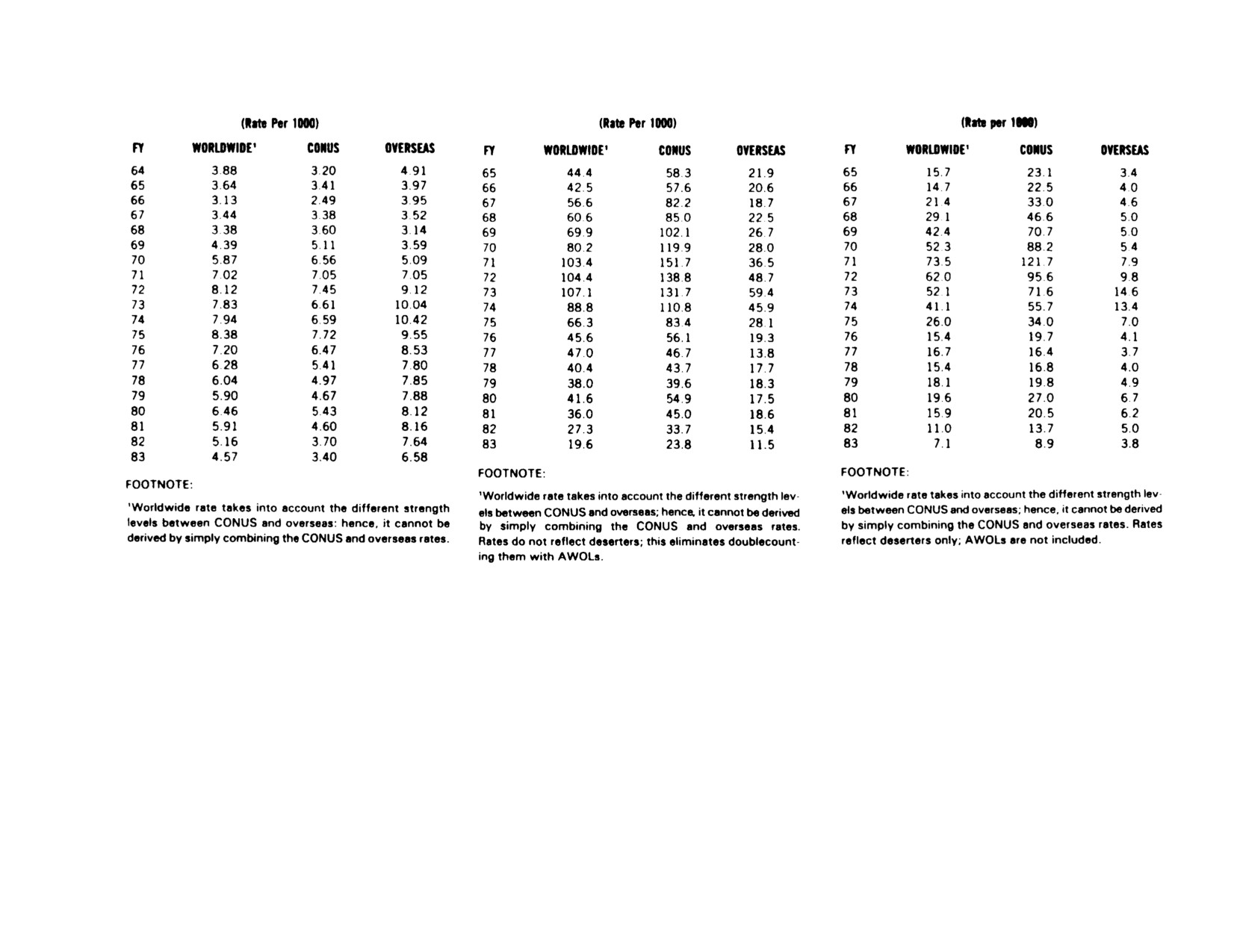
4-6
FM 101-10-1
Table
4-14. Crimes of Violence
Table
4-15. Absence Without Leave
Table
4-16. Deserters
SECTION IV. PERSONNEL LOSSES, LOSS ESTIMATES, AND REPLACEMENTS
4-9. PERSONNEL LOSSES.
posure of the particular category of personnel to the
(b) Killed in action.
various causes of losses. Personnel losses are recorded
a. A personnel loss is any reduction in the assigned
in three general categories: battle, nonbattle, and
(c) Missing in action or captured by the enemy.
strength of a unit. Such loss is caused primarily by ene-
administrative.
my action, disease, accidents, and administrative ac-
(2) Nonbattle losses, which are those not directly
tion. The rate of loss varies with the TO, climate,
terrain, the condition and state of training of troops,
(1) Battle losses, which are those incurred in
attributable to action regardless of when sustained, in-
type of activity, the enemy, and numerous other fac-
action, including
-
cluding
-
tors. Each division and corps has its own loss ex-
perience depending on its own situation. Loss rates by
(a) Wounded or injured in action, to include
(a) Nonbattle dead.
arm or service and by military occupational specialty
those who died of wounds and died of injuries received
(MOS) within corps and divisions vary with the ex-
in action.
(b) Nonbattle accident/injury.
(c) Nonbattle missing
to change over time, they are not readily adaptable to
ter of routine. Further information concerning
presentation in tabular form. Therefore, tables on ad-
family-related matters can be found in FM 26-2, Mis-
(d) Illness/disease.
ministrative losses, other than confinement, are not
cellaneous Publication
4-2, and Miscellaneous Publi-
included in this manual.
cation
4-3.
(3) Administrative losses, which are those result-
4-10. NUCLEAR, BIOLOGICAL, AND CHEMICAL
ing from -
(1) Since the disease rate is a large part of the non-
battle loss rate, the overall loss rate has seasonal var-
LOSS ESTIMATES.
(a) Transfer from the unit.
iations and depends on the region where the force is
a. The enemy’s use of nuclear, biological, and chem-
operating. Generally, disease losses can be expected to
ical
(NBC) weapons against US forces results in in-
(b) Absence without leave.
exceed battle losses over an extended period by as
creased battle losses. Battle losses from nuclear
much as 3 to 1. On occasion, the ratio may reach 6 to
weapons may be divided into the following two general
(c) Desertion.
1 or greater. The majority of disease cases are not
categories:
hospital admissions and, therefore, do not contribute
(d) Personnel rotation.
to statistics. For example, approximately
10 persons
(1) Battle losses sustained when a military unit is
per 1,000 will attend dental clinics daily; they will be
destroyed. Such losses are so great that individual
(e) Discharges.
noneffective for a portion of that day, but they will not
replacement is not feasible. These battle losses are
be reflected in daily admission rates. However, these
replaced by unit replacement.
b. In addition to soldiers killed. captured, or miss-
disease losses do represent a form of noneffectiveness,
(2) Battle losses sustained when units are on the
ing, gross losses include personnel evacuated to hospi-
since they can markedly decrease the ability of an in-
periphery of the area of damage. Replacements for bat-
tals and dropped from the rolls of their units. In all
dividual or a unit to perform a mission.
tle losses in this category come from survivors of de-
units in the theater army, any soldier hospitalized or
stroyed units and from personnel in the individual
evacuated to a hospital in the COMMZ is dropped from
(2) One factor that can influence administrative
replacement system.
unit rolls and carried on the rolls of theater training,
losses is the family. Today, over 50 percent of the Ac-
transient, and patient strength, which is not charge-
tive Army force are married
(over
80 percent of the
b. No valid experience data exist from which loss ex-
able against the authorized theater strength.
officers,
78 percent of the career enlisted, and 28 per-
perience tables can be compiled. The problem of es-
cent of first-term enlistees). Any armed conflict or
timating the number of replacements
(both unit and
c. Net losses are gross losses minus personnel
potential conflict situation will obviously serve to in-
individual) required to replace losses to NBC weapons
returned to duty within theater. Net losses are com-
crease the level of stress felt by individual soldiers.
involves many variable factors. Among the more im-
puted only at theater level and are used as a basis for
Similarly, concern over family welfare and safety will
portant of these factors are
-
estimates of personnel replacements required from the
serve to heighten the existing stress level and could ad-
CONUS to maintain theater strength.
versely impact on unit strength
(through AWOLs,
(1) Frequency of enemy employment of NBC
desertions, concern for the family). However, height-
weapons.
d. The data that appear in the tables of this section
ened stress levels can also be caused by any prolonged
are based on both experience World War II and
separation or absence (for example, extended FTXs,
(2) Types of yields of weapons employed.
Korean War) and on projections (see paragraph 4-11h
REFORGER, long periods of TDY, or annual training
for appropriate projection parameters). The tables
at locales which are displaced from the normal duty
(3) Types of targets selected for NBC weapon
should not be viewed as directly applicable to any fu-
station, such as at Grafenwoehr and the National
attack.
ture conflict, but as a basis from which planning can
Training Center at Fort b-win, California) between the
begin. Each conflict will have its unique characteris-
soldier and the family. Concern for family welfare and
(4) Effectiveness of enemy target location system.
tics and, as such, will require that each echelon of com-
safety, therefore, applies to units within CONUS as
mand compile loss statistics. The longer the conflict
well as to those deployed overseas. If the soldier feels
(5) Accuracy of enemy delivery means.
progresses, the more comprehensive the statistical
that the family will be provided for during periods of
base will become. Accurate estimates of losses should,
separation, the level of stress on that soldier can be sig-
(6) Protective measures adopted by own forces.
therefore, improve over time as the unique aspects of
nificantly reduced. In addition to providing for the
the conflict become readily apparent. Since adminis-
physical needs of the family, accurate and timely infor-
(7) Warning and reporting measures adopted by
trative losses are based on policies which are subject
mation should also be provided to the family as a mat-
own forces.
4-7
FM 101-10-1
4-8
FM 101-10-1
c. Effective battle loss estimation requires an ag-
od. In compilation and use of lose data, units whose loss
(3) For example, calculate the total nonnuclear
gressive effort on the part of all agencies, particular-
rates are about the same because of similar operating
losses of an infantry division in contact in the first
ly intelligence agencies, to provide specific data, the
conditions are grouped together.
three days of the defense of a position, and determine
variable factors outlined in the preceding paragraph,
the number of infantry riflemen and weapon crewmen
or to permit reasonable assumptions concerning these
(2) Loss rates are applied to the strength of the par-
who become battle losses. Compute as follows:
variable factors. The validity of battle loss estimation
ticular command under consideration. The following
is directly proportional to the degree of refinement
two different strengths are used:
(a) Total losses.
that can be made in these factors.
(a) Authorized strength is TOE strength plus ad-
Authorized strength of division
17,423
ditional personnel authorized by higher headquarters.
Assigned strength of division (assumed),
4-11. COMBAT ZONE LOSS ESTIMATES.
Authorized strength is used in long-range planning
beginning of first day
15,341
and in cases of unknown or rapidly fluctuating as-
Losses, first day, defense of position
a. The following procedures and data apply to the es-
signed strength.
(2.2 percent x
15,341 (Table 4-18,
timation of nonnuclear losses. Because of the possibil-
ity of nuclear battle losses and the effect that such
line 9, column 4))
338
(b) Assigned strength includes all personnel car-
Assigned strength, end of first day
15,003
losses may have on tactical operations, nuclear battle
ried as assigned to the unit. Assigned strength is used,
Losses, second day, defense of position
losses are estimated separately.
when known, in long period estimates if it differs
(1.3 percent x
15,003 (Table
4-18,
b. Tables
4-17 through 4-26 address the problem of
materially from authorized strength and if it will re-
line 10, column 4))
195
loss estimation based on historical data generated
main reasonably stable during the estimated period.
Assigned strength, end of second day
14,808
through experience
(primarily from World War II and
Losses, third day, defense of position
the Korean Conflict).
(1.3 percent x
14,808 (Table
4-17,
e. Short period estimates include the following:
line 10, column 4))
193
c. Personnel loss estimates at corps and division are
Assigned strength, end of third day
14,615
(1) Tables
4-17 and
4-18 provide percentages by
used to project the effect of losses on the tactical plan
Total losses, 3 days (338 + 195 + 193)
726
type of action, type of unit, battle loss or nonbattle loss,
and on the handling and distribution of replacements
and branch. Table 4-17 shows an example of the distri-
in the commands. The estimates indicate the strength
bution of infantry battle losses by selected MOS with-
(b) Battle losses.
at any given time, the losses anticipated for a specific
in an infantry division. Personnel losses of maneuver
situation or period, and the distribution of these loss-
battalions most seriously affect the combat effective-
First day, defense of position
(1.9 percent x
es by arm or service and MOS. Combat estimates are
ness of an infantry division. Historically, a total of 87.4
15,341 (Table 4-18, line 9, column 2))
291
of two types - short period (five days or less) and long
percent of the infantry battle losses occurs among rifle-
Second day, defense of position (1.0 percent
x
period (five or more days). Estimates are used as a ba-
men and weapon crewmen
(and closely allied
150
sis for allocation of available replacementa to inform
15,003 (Table 4-18, line 10, column 2))
specialists), who constitute the larger portion of the in-
Third day, defense of position
(1.0 percent x
higher headquarters of anticipated replacement re-
fantry division’s assault battalions’ strength. In stabil-
14,808 (Table 4-18, line 10, column 2))
148
quirements. Corps headquarters use both short peri-
ity operations, maneuver battalions may experience a
od and long period estimates. Divisions normally use
Total battle losses
589
substantial increase in the loss rate among noncom-
only short period estimates.
missioned officers. Table 4-18 is not used for loss esti-
(c) Infantry battle losses.
mates for a period greater than five days.
d. In calculating losses, the following two major fac-
tors are considered:
Infantry battle losses
(93.0 percent x
(2) Distribution of nonbattle losses in each branch
589 (Table 4-17, line 2, column 2))
548
(1) Loss rates applicable to the specific situation
is in the same proportion to the total nonbattle losses
Infantry riflemen and weapon crewmen
are expressed as percentage of strength or as number
as the strength of that branch is to the total strength
battle losses
(87.4 percent, paragraph
per thousand of average strength for any given peri-
of the unit.
e(1) x 548))
479
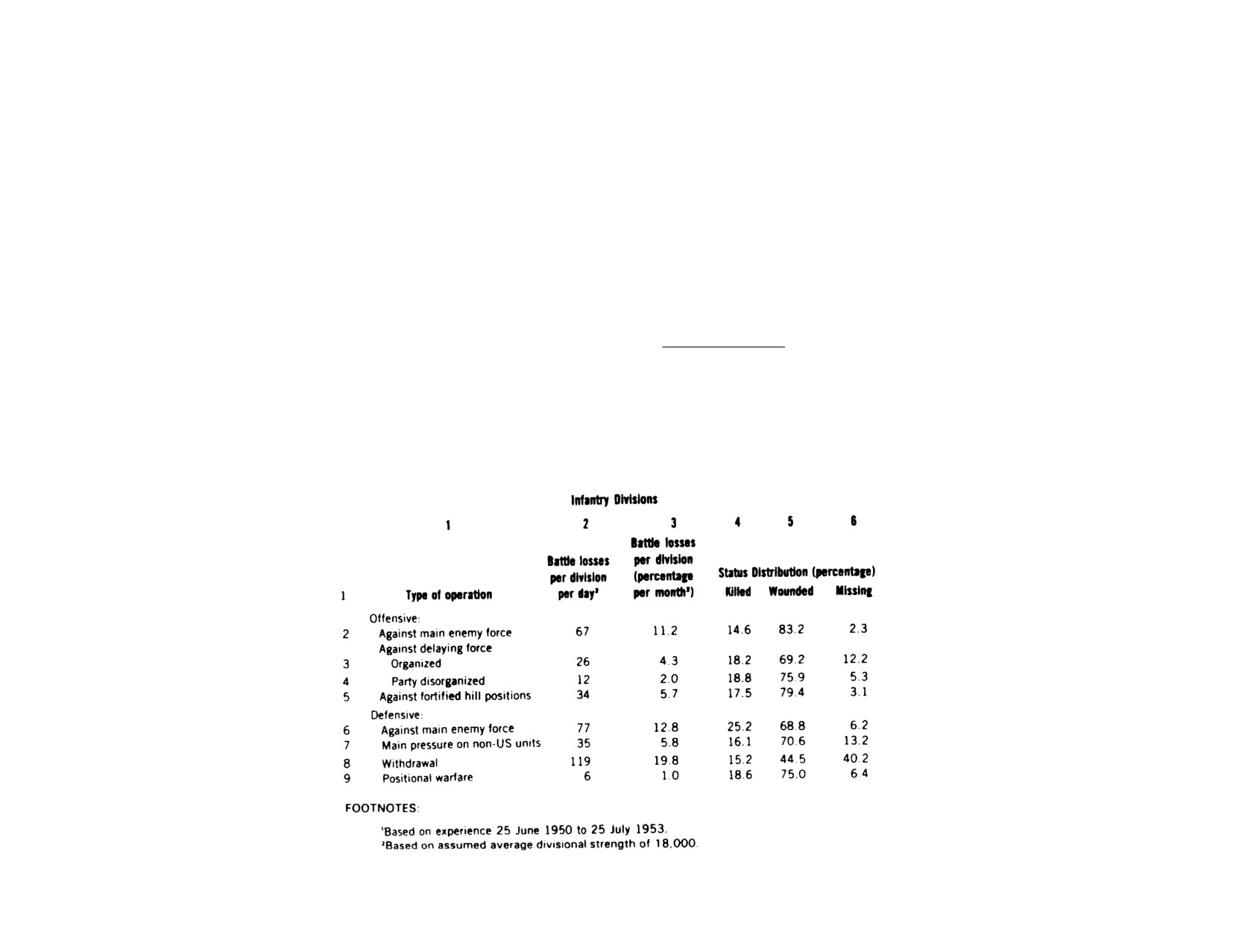
4-10
FM 101-10-1
f. Long period estimates
-combat zone include the
percent). In actual operations. the distribution of battle losses
(b) Estimated losses,
15 days.
by branch varies with the composition of the force and type
following:
of operation.
Infantry divisions
(Table
4-20, line
2):
(1) Tables
4-19 and
4-20 provide percentages of
Battle losses
(1/2
x 10.0 percent x 52,419
2,621
(3) For example, calculate the number of
monthly personnel losses for periods in excess of 5 days
Nonbattle losses
(1/2 x
8.0 percent
replacements required to bring 1st Corps to authorized
for the Korean War and World War II. respectively.
x
52,419
2,097
strength and to maintain it at that strength in combat
Armored division (Table 4-20. line
3):
(2) Table 4-21 contains percentages for types of
for
15 days, assuming no nuclear losses. Compute as
Battle losses
(1/2 x
8.0 percent x
18,057)
722
battle losses. Table 4-22 contains percentages for losses
follows:
Nonbattle losses
(1/2 x
7.0 percent x
18.057)
632
by branch within corps and larger units. For distribu-
Corps nondivisional troops
(Table
4-20, line
4):
tion of losses by branch within divisions, Table 4-17 ap-
Authorized Assigned
Battle losses
(1/2 x
1.25 percent x
46.101)
288
plies. For distribution of nonbattle losses, refer to
Unit
Strength
Strength
Nonbattle losses
(1/2 x
3.0 percent x
46,101)
692
paragraph e(3).
Three infantry divisions
52,419
44,700
Total losses for 15 days
7,052
One armored division
18,057
15,604
REMARK:
Corps nondivisional troops
46,101
38,322
The World War II percentage figures are the field battle loss
(c) Total replacements required.
distribution as reported through data processing unit
Total corps
116,577
98,706
channels, European Theater of Operations, for the period 6
Replacements needed now
17,871
June 1944 through 31 March 1945. The figure for armor
(a) Replacements needed now.
Losses for
15-day period
7,052
combines the percentage originally reported as armored forces
(2.9 percent), tank destroyer (1.4 percent), andcavalry (2.3
Total
24,923
Authorized (116,577) - assigned
(98,706)
= 17,871
1
Table
4-19. Personnel Losses
(Korean War)