FM 6-02 SIGNAL SUPPORT TO OPERATIONS (January 2014)
FM 6-02
Field Manual
Headquarters
Department of the Army
No. 6-02
Washington, DC, 22 January 2014
SIGNAL SUPPORT TO OPERATIONS
Contents
Page
PREFACE
iii
INTRODUCTION
iv
Chapter 1
SIGNAL SUPPORT TO THE ARMY
1-1
Section I - Signal in Unified Land Operations
1-1
Section II - Signal Core Competencies
1-9
Chapter 2
ROLES AND RESPONSIBILITIES OF SIGNAL ORGANIZATIONS
2-1
Section I - Units With Organic Signal Assets
2-1
Section II - Units Without Organic Signal Assets
2-5
Types of Units Without Organic Signal Assets
2-5
Types of Signal Units Leveraged for Support
2-6
Requesting Signal Support
2-9
Section III - Signal Enabling Commands and Staffs
2-10
U.S. Army Signal Center of Excellence
2-10
U.S. Army Chief Information Officer/G-6
2-11
Army Cyber Command/Second U.S. Army
2-11
U.S. Army Network Enterprise Technology Command
2-12
NETCOM G-33
2-12
U. S. Army Space and Missile Defense Command
2-13
Signal Command (Theater)
2-13
Theater Strategic Signal Brigade
2-14
Strategic Signal Battalion
2-14
Signal Center/Theater Network Operations and Security Centers
2-16
Chapter 3
LANDWARNET
3-1
Section I - The Department of Defense Information Networks and
LandWarNet
3-1
The Department of Defense Information Networks
3-1
LandWarNet
3-3
Section II - Network Transport and Information Services
3-6
Distribution Restriction: Approved for public release, distribution is unlimited.
22 January 2014
FM 6-02
i
Figures
Network Transport
3-6
Information Services
3-7
Section III - Network Operations
3-7
Department of Defense Information Network Operations
3-8
LandWarNet Network Operations
3-8
Section IV - Cyber Threats
3-10
Appendix A VISUAL INFORMATION
A-1
Appendix B COMMUNICATIONS SECURITY PROCEDURES
B-1
GLOSSARY
Glossary-1
REFERENCES
References-1
INDEX
Index-1
Figures
Figure 1-1. Signal in unified land operations
1-2
Figure 1-2. Signal Corps responsibilities
1-3
Figure 2-1. Signal Command (Theater) and Army Service component command G-6
relationship
2-6
Figure 3-1. The Department of Defense information networks
3-2
Figure 3-2. LandWarNet operational view
3-4
Figure 3-3. NetOps components, effects, and objectives
3-10
ii
FM 6-02
22 January 2014
Preface
FM 6-02 describes the Signal Regiment support to the Army’s mission, commanders, staff officers and signal
personnel. This manual establishes the Signal Regiment’s roles and responsibilities of organic and non-organic
signal forces providing LandWarNet that enable and support the Army’s mission at all echelons. It supports the
Army's view of how it conducts prompt and sustained operations and sets the foundation for developing the
Army techniques publications, which provide techniques information.
The principal audience for FM 6-02 is Army commanders, leaders and staffs. Commanders and staffs of Army
headquarters serving as joint task force or multinational headquarters should also refer to applicable joint or
multinational doctrine concerning command and control of joint or multinational forces. Trainers and educators
throughout the Army also use this publication.
Commanders, staffs, and subordinates ensure their decisions and actions comply with applicable United States,
international, and, in some cases, host-nation laws and regulations. Commanders at all levels ensure their
Soldiers operate in accordance with the law of war and the rules of engagement. (FM 27-10)
FM 6-02 uses joint terms where applicable. Selected joint and Army terms and definitions appear in both the
glossary and the text. Terms for which FM 6-02 is the proponent publication (the authority) are marked with an
asterisk (*) in the glossary. Definitions for which FM 6-02 is the proponent publication are boldfaced in the
text. For other definitions shown in the text, the term is italicized and the number of the proponent publication
follows the definition.
FM 6-02 applies to the Active Army, Army National Guard/Army National Guard of the United States, and
United States Army Reserve unless otherwise stated.
The proponent of FM 6-02 is the United States Army Signal Center of Excellence. The preparing agency is the
Signal Center Doctrine Branch, United States Army Signal Center of Excellence. Send comments and
recommendations on a Department of the Army (DA) Form 2028 (Recommended Changes to Publications and
Blank Forms) to Commander, U.S. Army Signal Center of Excellence and Fort Gordon, ATTN: ATZH-DT
(FM
6-02),
506 Chamberlain Avenue, Fort Gordon, GA
30905-5735; by E-mail to
usarmy.gordon.sigcoe.mbx.gord-fg-doctrine@mail.mil.
22 January 2014
FM 6-02
iii
Introduction
“The network is essential to a
21st Century Army. Networked organizations improve the
situational awareness and understanding leaders need to act decisively at all points along the
spectrum of conflict, while providing connectivity down to the individual Soldier. The network
allows dispersed Army organizations to plan and operate together, and provides connectivity to
joint, [coalition], and interagency assets.”
Secretary of the Army - 25 February 2010
Field Manual (FM) 6-02, Signal Support to Operations, is the premier Signal doctrine publication, and only
field manual. FM 6-02 compiles Signal Corps doctrine into three chapters with supporting appendices that
address network operations in support of mission command and unified land operations and the specific
tactics and procedures associated with organic and nonorganic Signal forces. The fundamental idea of
Signal Corps tactics is the employment and ordered arrangement of Signal forces in a supporting role to
provide LandWarNet across the range of military operations. The detailed techniques regarding the ways
and methods to accomplish the missions, functions or tasks of the Signal Corps indicated in this FM will be
addressed in supporting Army techniques publications (ATPs).
Army forces operate worldwide and require a secure and reliable communications capability that rapidly
adapts to changing demands. Technological advances improve the capability to fulfill this requirement and
an increased dependence to modify, exchange, and store information in cyberspace. Technical networks
enable every mission from training the force to the execution of all tasks in order to influence the
environment. Technical networks are the voice, data, and video connectivity infrastructure supporting
current and future operations. Today’s tactical radio systems have the capability to pass digital information
and are part of the information environment, expanding the network and increasing the amount of
information transported securely.
The Army typically integrates with the joint community, other government agencies, multinational
partners, host nations, civil authorities, and other organizations. Extending the network is a capability
provided by the Signal Regiment for commanders and staffs to communicate with all necessary entities for
mission success, whatever the mission and whomever the partner.
Signal Soldiers are a flexible, integrated, and adaptive force that supports and enables all warfighting
functions providing depth in communication and synchronization between organizations both horizontally
and vertically. Signal professionals are technically proficient Soldiers able to install operate, defend, and
maintain a redundant, robust and secure network using complex systems and equipment.
Improvements in technology permit better use of the electromagnetic spectrum using various waveforms
and detailed frequency management. The secure network operates within the constraints of the
electromagnetic spectrum. When properly managed, operational and technical communications security
advancements provide a secure environment for passing critical information during mission execution at all
levels.
FM 6-02 is a new publication and captures tactics and procedures from previous field manuals. This
manual supersedes or rescinds appropriate publications after the corresponding Army technique publication
approvals.
FM 6-02 chapters include—
Chapter 1 addresses the Signal Corps’ support to unified land operations to include warfighting functions,
decisive actions, joint missions, space operations, Special Operations, cyberspace and cyber
electromagnetic activities, knowledge management, and port and base camp operations. Signal support to
space operations focuses on space-based capabilities and systems such as global positioning satellites and
satellite communications. Signal Support to Special Operations identifies the unique capabilities provided
to support Special Forces and Rangers. Signal support to cyberspace operations discusses planning,
engineering, installing, integrating, operating, maintaining, and defending the Army’s portion in this global
iv
FM 6-02
22 January 2014
Introduction
domain and support to cyber electromagnetic activities. Signal support to knowledge management includes
information management as an enabler to knowledge management. Signal support to operations also
focuses on the functions, services, and support necessary for port and base camp operations communication
requirements. Included in this chapter are the Signal core competencies and essential capability.
Chapter
2 outlines the organizational structure and the roles and responsibilities of the Signal
organizations that support the Army and joint forces at all echelons. It addresses the roles of the J-6/G-6/S-
6 staff sections that serve at the various echelons within Army commands, direct reporting units, joint task
forces, government agencies, or non-governmental organizations. It addresses the key capabilities and
functions that Signal units provide to Army expeditionary units and joint task forces that execute combat
missions across the conflict continuum. This includes the Network Enterprise Centers, theater strategic
signal brigades, signal command (theater), brigade combat teams signal company, expeditionary signal
battalion, theater tactical signal brigade, and theater strategic signal battalion units that provide signal
support throughout the operational theater.
Chapter 3 describes LandWarNet as an enterprise network mission command enabler. LandWarNet is the
network in which the operational Army and generating forces operate throughout all phases, in all
geographical environments. This chapter addresses the Department of Defense information network and
LandWarNet; LandWarNet network transport and information services; Department of Defense
information network and LandWarNet network operations; and cyber threats. The chapter also discusses
how the Signal Corps’ core competencies and essential capability support the secure network and its cloud
computing environment.
Based on certain doctrinal changes, certain terms for which FM 6-02 is the proponent have been added,
rescinded, or modified for purpose of this publication. The glossary contains acronyms and defined terms.
See the introductory table for specific term changes.
Introductory table. New Army terms
Term
Remarks
spectrum management
Replaces electromagnetic spectrum management operations
operations
Pro Patria Vigilans! (Watchful for the Country)
Signal Regiment Motto
22 January 2014
FM 6-02
v
Chapter 1
Signal Support to the Army
As the Army continues to operate in the information age, communication systems
become more capable and complex. Signal provides the Army with highly skilled
personnel at all echelons to install, operate, maintain, and protect information on the
network every commander depends upon. The planning, preparation for, execution
and assessment of Signal support to operations is the role of the Signal Soldier. The
technical network for unified land operations is essential to the success of the Army’s
mission. This chapter describes the support to unified land operations and introduces
the Signal core competencies.
SECTION I - SIGNAL IN UNIFIED LAND OPERATIONS
1-1. The Signal Corps’ mission is to provide seamless, secure, continuous, and dynamic communications
and information systems and visual information support worldwide in support of United States and
multinational forces at all levels of command. Signal supports unified land operations by employing unique
net-centric capabilities at every echelon, providing secure connectivity to the network and information
services. This support is essential to the success of unified land operations and accomplishment of decisive
action tasks and directly supports the mission command warfighting function.
1-2. Commanders have a flexible and robust network at their disposal during all types of operations and
missions. The network is the primary conduit of information and is used to control forces. The current
network architecture allows collaboration among commanders, staffs, and unified actions partners to clarify
the meaning of events or situations embedded in their unique and continually evolving operational
environment.
SUPPORTING WARFIGHTING FUNCTIONS
1-3. Signal supports all of the warfighting functions directly by engineering, installing, operating,
maintaining, and defending the network. Each of the warfighting functions depend on a secure
communications infrastructure called LandWarNet. LandWarNet is the Army’s portion of the
Department of Defense information networks. It is a technical network that encompasses all Army
information management systems and information systems that collect, process, store, display,
disseminate, and protect information worldwide. LandWarNet is a network for application of the
warfighting functions of mission command, intelligence, fires, sustainment, protection, and movement and
maneuver to use for operations and to provide the commander and staff information necessary to make
decisions. LandWarNet is part of, and operates in, the cyberspace domain, with network operations
(NetOps) supporting both the joint and Army portions of the domain (Figure 1-1, page 1-2). Cyberspace is
a global domain consisting of the interdependent network of information technology infrastructure and
resident data, including the Internet, telecommunications networks, computer systems, and embedded
processors and controllers. (JP 1-02). The Army supports the cyberspace operations tasks of defensive
cyberspace operations and Department of Defense information network operations by executing
LandWarNet NetOps tasks.
1-4. The commander integrates the warfighting functions by executing mission command. The network,
with its associated information management and information systems, is the necessary technical
infrastructure on which to collect, process, store, display, disseminate and protect information.
LandWarNet is the technical network of the mission command system connecting people and enables the
sharing of resources and information.
22 January 2014
FM 6-02
1-1
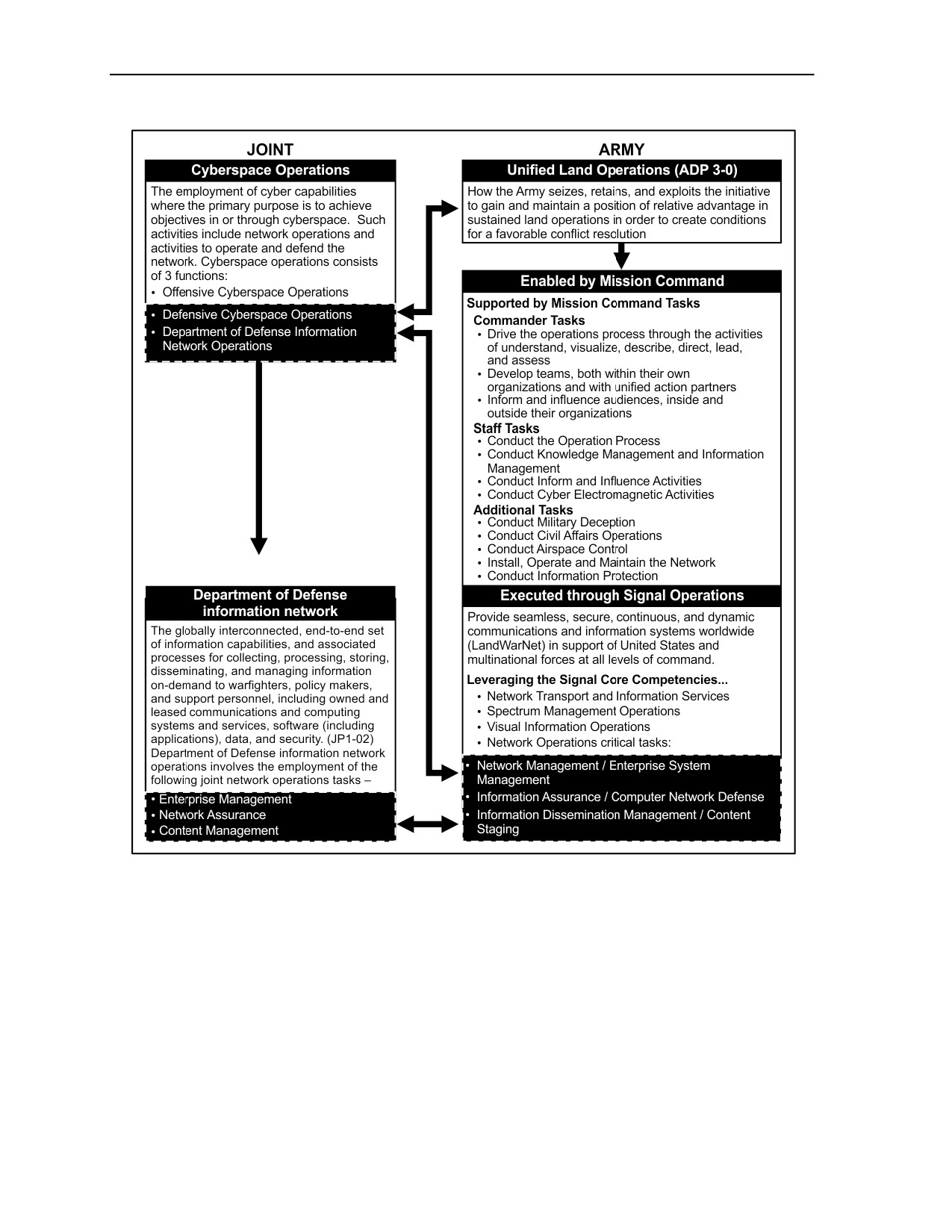
Chapter 1
Figure 1-1. Signal in unified land operations
1-5. Signal support to operations enables or supports the execution of all commander, staff and additional
tasks under mission command. The Signal Corps has direct responsibility to install, operate, and maintain
the network, support cyber electromagnetic activities, and perform tasks associated with information
management and information protection
(Figure
1-2). The network enables the integration of the
warfighting functions, allowing the commander to access critical information to make decisions and
provides communications to control forces. Signal support to operations is an integral part of the mission
command system.
1-2
FM 6-02
22 January 2014
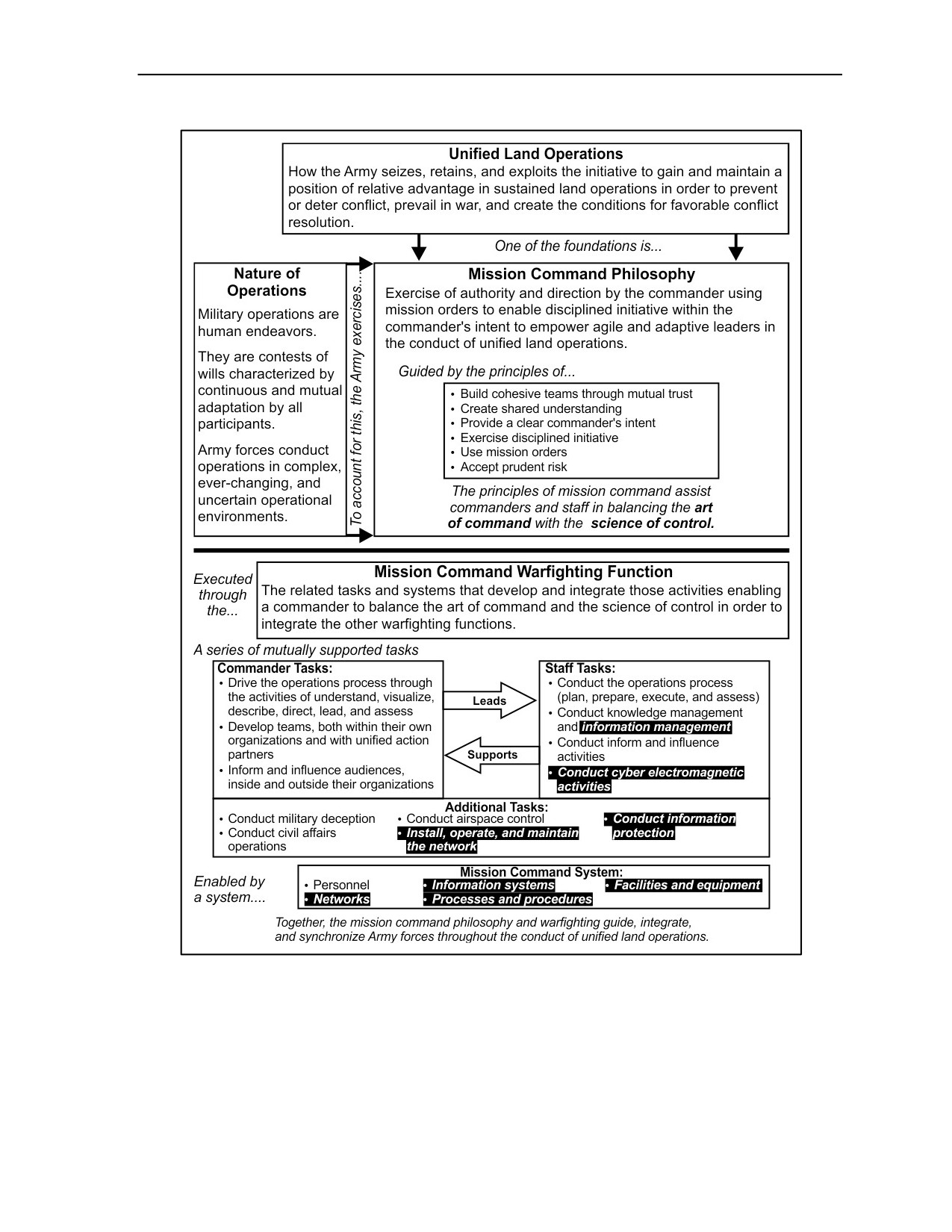
Signal Support to the Army
Figure 1-2. Signal Corps responsibilities
1-6. Integration of the warfighting functions relies on the network for the capability to inform the
commander and staff. This includes the sharing of information among the six functions for each to
complete their own missions or tasks. The warfighting functions are mutually supportive and as
information passes from one element to another, the network supports the completion of missions in
support of the commander’s intent.
22 January 2014
FM 6-02
1-3
Chapter 1
1-7. As information and communication requirements change due to the operational and mission
variables, the signal element providing support adapts the network to continue supporting and enabling the
integration of all warfighting functions. This capability for the network to support changes requires
planning and possibly additional resources. Including signal support early in the planning process allows
for the relied upon network to properly support all communications. It is vital that the commander include
signal support early in the planning process to take full advantage of organic network capabilities and
request additional resources as required.
1-8. The flexibility of the network allows scalability to support the commander’s requirements as
additional units enter or leave an operational area. The Signal Corps expands, extends or contracts the
network based on mission requirements. The signal element plans for the appropriate support based on
commander’s intent and the environmental and mission variables.
SUPPORT TO JOINT OPERATIONS
1-9. Signal operations support communications to joint force commanders, the joint staff, and unified
action partners, as required, by providing the network to enable command and control (JP 6-0). Signal
Soldiers support the joint communications system, which is the joint force commander’s tool to assimilate
information and to exercise authority and direct forces over large geographic areas and a wide range of
conditions. Just as the network integrates the warfighting functions, effective command and control uses
the reliable and secure network to integrate the joint force components.
1-10. During joint operations support, executing the three network operations tasks of enterprise
management, network assurance, and content management provides the joint force commander the ability
to effectively plan, conduct and sustain operations. Through these tasks, the joint commander has access to
cyberspace, service component networks, unified action partners, and higher and lower echelons.
1-11. To support the joint force commander, it is imperative to have communications with all unified
partners in all aspects of joint operations. Including the signal support element as early as possible in the
planning process is imperative as the interoperability with unified partners adds a level of complexity. The
network support is scalable and flexible, and as an operation progresses, the network changes as well to
support the commander’s intent.
SUPPORTING DEFENSE SUPPORT OF CIVIL AUTHORITIES AND HOMELAND DEFENSE
1-12. The support to the decisive action tasks of offense, defense and stability employ similar network
capabilities and the commander’s intent is the basis for support requirements. The commander executes
mission command and the network integrates all the warfighting functions. Defense support of civil
authorities includes unique network requirements from the other decisive action tasks, which need planning
to ensure the commander has the appropriate communication assets.
1-13. The Signal Corps provides communication support assets for the protection of United States
sovereignty, territory, domestic population, and critical defense infrastructure against external threats and
aggression or other threats as directed by the president or during times of support to civil authorities. The
Signal Corps conducts operations in air, land, maritime, space and cyberspace domains. The Department of
Defense (DOD) is the primary federal agency for Homeland Defense. The Army dedicates signal assets to
Defense Chemical, Biological, Radiological, and Nuclear Response Force and Command and Control
Chemical, Biological, Radiological, and Nuclear Response Element-Army on a rotational basis, usually
annually. The communication requirements for defense support of civil authorities and homeland defense
are similar and require additional planning compared to other missions.
1-14. The disparity of communications systems, use of allocated bandwidth (both civilian and military),
and limited interoperable systems hinder the capability of collaborative incident management and response
when conducting defense support of civil authorities and Homeland Defense. The allocated signal support
to these operations conduct planning and coordination with unified action partners, which may include
other military departments, federal and state government agencies, local authorities and officials, and non-
governmental organizations. The signal support to homeland defense and defense support of civil
authorities is responsible for interoperating with various communication mediums, such as network
interfaces including military web portals accessible by non.mil domains, unclassified defense collaborative
1-4
FM 6-02
22 January 2014
Signal Support to the Army
tool suite, joint task force
(JTF)-owned deployable commercial voice switching, secure video
teleconferences (VTCs), radio cross-banding of land mobile radios, tactical satellite radios, high frequency
radios, and cell phones.
1-15. Designated Army Service command components (ASCCs) provide a signal communications task
force capable of assisting federal emergency support to state and local governments during and after a
disaster. The task force consists of a communications vehicle; three communications support emergency
response vehicles and Signal Soldiers specializing in satellites, networks, and communications systems.
These vehicles provide secure and non-secure voice, data communications and a conference room for
VTCs when other networks are unavailable. The task force may request more communication assets to
complete the mission.
Note. Refer to JP 3-27, Homeland Defense, and ADP 3-28, Defense Support of Civil Authorities,
for additional information.
SIGNAL SATELLITE COMMUNICATIONS CAPABILITIES
1-16. Satellite communications (SATCOM) is a key means of information transport for unified land
operations. SATCOM systems provide a long-haul capability, redundant paths for tactical communications,
communications on the move, beyond line of sight communications, and flexibility when preparing the
signal plan. Satellite communication systems are located at every echelon in the Army and support the
mission command warfighting functions. Supporting intra-theater communications and connectivity to
DODIN with SATCOM provides critical services that route through the Defense Satellite Communications
System, and the Wideband Global SATCOM constellation. The services include the Defense Switched
Network (DSN), Defense Red Switch Network (DRSN), Defense Messaging System, VTC, Telemedicine,
SECRET Internet Protocol Router Network (SIPRNET), Nonsecure Internet Protocol Router Network
(NIPRNET), and the global mission networks
1-17. A unique signal battalion performs planning, management, monitoring and control of select DOD
satellite communications resources. Specially trained Signal Soldiers, which require completion of
additional satellite control training, perform these missions. The signal battalion (satellite control) provides
SATCOM transmission control and satellite payload control of the Defense Satellite Communications
System and Wideband Global SATCOM constellations and space situational awareness. The battalion
operates and maintains Wideband Satellite Operation Centers and a Defense Satellite Communications
System Operations Control Certification Facility. Operating these centers enables communications for the
Commander in Chief, Secretary of Defense, Chairman of the Joint Chiefs of Staff, Armed Services, State
Department, intelligence activities, combatant commanders, and allied forces during unified actions.
1-18. The signal battalion (space control) supports unified land operations by performing the following
functions—
z
Monitor and control functions for tactical and strategic use of Defense Satellite
Communications System and Wideband Global SATCOM satellites.
z
Transmission and payload control of assigned Defense Satellite Communications System and
Wideband Global SATCOM satellites.
z
Payload command and telemetry functions.
z
Electromagnetic interference detection and geo-location.
z
Space situational awareness.
z
24-hour communications service to DOD agencies and Soldiers.
z
Satellite configuration control.
z
Satellite link establishment.
z
Maintenance of link quality.
z
Transmissions power management.
z
Monitor electromagnetic spectrum.
z
Monitor satellite terminals.
z
Terminal positive control and subnet work control.
22 January 2014
FM 6-02
1-5
Chapter 1
1-19. The Signal officer with responsibilities of signal operations at each echelon tracks the status of all
satellite constellations affecting the organization’s mission, develop the signal plan, and provide Soldiers
with required mission capabilities. The Signal officer obtains space weather reports from the Air Force
Weather Agency and Army Space Support Elements to advise the commander on how space weather
affects the organization's ability to utilize network systems.
Note. Refer to FM 3-14, Space Operations, for additional information.
SPECIAL OPERATIONS SIGNAL SUPPORT
1-20. The United States Army Special Operations Command provides trained and ready special forces,
ranger, special operations aviation, military information support operations, and civil affairs personnel to
geographic combatant commanders (GCCs) and U.S. diplomatic consulates. These special operations
forces require seamless industry standard and protocol-compliant voice, data, and imagery support. There is
special operations communications support at all echelons, from the national level to the unit level. The
special operations communications networks need to include redundant routes to prevent site isolation.
They must also take advantage of automated systems that provide transparent connectivity to the user. The
communications system must exploit all available means, including host nation assets, to provide robust
and ready access to the Department of Defense information network in support of Army Special Operations
Forces.
1-21. The Signal Battalion (Special Operations) (Airborne) deploys scalable teams capable of providing
worldwide, innovative, responsive, reliable and assured capable communications support to special
operation forces and theater special operations forces. On order, provides theater mobile strategic special
operations forces entry points and global NetOps.
1-22. The Signal Battalion (Special Operations) (Airborne) provides the following capabilities—
z
Theater enterprise level network planning, engineering, architecture determination/integration.
z
Critical dual-homing capability.
z
The planning, engineering, installation, operation, maintenance, and defense for theater of
operations level special operations forces communications systems.
z
Special operations forces theater network communications infrastructure is uniform, pervasive,
and centrally managed.
z
Signal nodes to provide initial, early entry, and sustained secure communications systems
providing voice, video, and data at required classification levels for U.S. Army Special
Operations Command headquarters performing functions as a forward-deployed JTF.
z
Coordinate operations within the theater level NetOps configuration management program.
z
Administer and direct execution of NetOps within the theater of operations.
z
Install, operate, maintain, and control the communications systems providing voice, video, and
data in support of the regional theater special operations command commanders.
z
Communications security (COMSEC) account management and maintenance.
z
Sustainment and field level maintenance to organic signal equipment, automation systems, and
limited maintenance to special operations forces peculiar signal equipment.
z
Communications support for airborne and airdrop operations.
RANGER REGIMENT SIGNAL SUPPORT
1-23. The Signal Company, Ranger Regiment deploys worldwide to install, operate, maintain and protect
the regiment's mission command systems. The Signal Company, Ranger Regiment establishes networks
that support the regiment’s operations and integrate with coalition forces land component command/Army
force, signal support for the ranger battalions, the Ranger Special Troops Battalion, and the Headquarters,
Headquarters Company, Ranger Regiment. The Signal Company, Ranger Regiment establishes networks
that support the regiment’s operations and integrates with coalition forces land component command/Army
force.
1-6
FM 6-02
22 January 2014
Signal Support to the Army
1-24. The Signal Company, Ranger Regiment provides the following capabilities to support the unit’s
mission—
z
Network transport and information services to support maneuver, support and mission command
elements.
z
Tactical radio relay, retransmission and beyond line of sight high frequency and satellite
communications capabilities to extend networks.
z
Global Broadcast Service with the ability to receive high bandwidth products such as imagery,
logistics data, and digital map information to supporting mission command systems.
Note. Refer to FM 3-05.160, Army Special Operations Forces Communications System, for
additional information.
SIGNAL ROLE IN CYBERSPACE AND CYBER ELECTROMAGNETIC ACTIVITIES
1-25. Signal support to operations executes the tasks to engineer, install, operate, maintain and defend the
network. LandWarNet is part of the Department of Defense information networks (DODIN) and both are
part of the domain called cyberspace, in which DOD networks operate. The Signal Corps supports and
coordinates Army cyberspace operations with national and joint cyberspace operations. Cyberspace
operations consist of offensive cyberspace operations, defensive cyberspace operations, and Department of
Defense information network operations.
1-26. The Signal Regiment, through its core competencies of network operations, network transport and
information services, and spectrum management operations (SMO), executes Department of Defense
information network operations on LandWarNet. Department of Defense information network operations
are the operations to design, build, configure secure, operation, maintain, and sustain Department of
Defense networks to create and preserve information assurance on the Department of Defense information
networks (JP 1-02). These include proactive technical functions such as configuration control, system
patching, information assurance (IA) measures and user training, physical security, secure architecture
design, operation of host-based security systems and firewalls, and encryption of data at rest. Many
Department of Defense information network operations activities are regularly scheduled events and the
aggregate effect establishes the security framework on which all missions ultimately depend.
1-27. Defensive cyberspace operations are passive and active operations intended to preserve the ability to
utilize friendly cyberspace capabilities and protect data, networks, net-centric capabilities, and other
designated systems (JP 1-02). To facilitate defensive cyberspace operations, Signal personnel apply NetOps
and SMO capabilities and processes in real-time to detect, analyze, and mitigate threats and vulnerabilities,
as well as outmaneuver adversaries in order to defend LandWarNet, protect critical missions, and enable
freedom of action. To defend cyberspace, Signal personnel work to detect, analyze, and respond to
unauthorized activities not detected by routine measures. This requires Signal personnel are aware of timely
intelligence and threat indicators from traditional and advanced sensors, vulnerability information from
DOD and non-DOD sources, and accurate effects assessment information from offensive cyberspace
operations and Department of Defense information network operations.
1-28. Working in concert with the Department of Defense information network operations and defensive
cyberspace operations aspects of Signal core competencies, offensive cyberspace operations allows
operational offensive planners the ability to coordinate and synergize efforts in and through cyberspace, as
well as other domains necessary to support the accomplishment of the commander’s objectives. Offensive
cyberspace operations are operations intended to project power by the application of force in or through
cyberspace (JP 1-02). Offensive cyberspace operations use cyberspace attack and cyberspace information
collection capabilities to deny access by disrupting, degrading, or destroying the ability of the adversary to
use cyberspace. Although signal organizations do not conduct offensive cyberspace operations, through the
performance of their defensive cyberspace operations mission the signal units may be able to detect and
attribute external threat activity on friendly networks. Signal organizations must be able to support entities
that can execute offensive cyberspace operations.
1-29. Cyber electromagnetic activities include cyberspace operations, SMO and electronic warfare. Cyber
electromagnetic activities are leveraged by commanders to seize, retain, and exploit an advantage over
22 January 2014
FM 6-02
1-7
Chapter 1
adversaries and enemies in both cyberspace and the electromagnetic spectrum. These activities ensure
information availability, protection, and delivery as well as a means to deny, degrade, or disrupt the
enemy’s use of its’ command and control systems and other cyber capabilities. Commanders use
information and a mission command system to understand, visualize, describe, and direct operations
(ADRP 3-0). To support cyber electromagnetic activities at the ASCC level and below, G-6/S-6 and
spectrum managers integrate, synchronize, and coordinate NetOps and spectrum management actions with
mutually supporting capabilities that reside within the G-2/S-2 and G-3/S-3.
Note. Refer to Army doctrine on Cyber Electromagnetic Activities (CEMA), for additional
information.
ENABLING KNOWLEDGE MANAGEMENT
1-30. Information management, the science of using procedures and information systems to collect,
process, store, display, disseminate, and protect data, information, and knowledge products, enables
knowledge management functions. Knowledge management is the process of enabling knowledge flow to
enhance shared understanding learning and decisionmaking (ADRP 6-0). Knowledge management (KM)
facilitates the transfer of knowledge between staffs, commanders, and forces. Knowledge management
aligns people, processes, and tools within an organization to distribute knowledge and promote
understanding. Signal enables KM by providing network architecture and the technological tools necessary
to support content management and knowledge sharing.
1-31. Mission Command Center of Excellence has primary responsibility for knowledge management.
Signal support enables KM by providing network operations and information management support, both
through the G-6/S-6 and by serving in various positions in the KM section. Knowledge management
identifies the specific roles and responsibilities for positions in the KM Section. The table of organization
and equipment identifies what positions Soldiers may serve in KM sections in various unit types and
echelons.
1-32. Signal Soldiers assigned to the KM section ensure that the unit’s information systems network
support knowledge creation, and incorporate automated KM tools. They perform information management
tasks that include application and database administration, data backup and migration, website interface
maintenance, troubleshooting, security, and configuration.
Note. Refer to FM 6-01.1, Knowledge Management Operations, for additional information.
SUPPORT TO PORT OPERATIONS
1-33. The U.S. Transportation Command’s Transportation Command, Control, Communications, and
Computer Systems is responsible for the Integrated Data Environment Global Transportation Network
Convergence system. The Integrated Data Environment Global Transportation Network Convergence
system provides the integrated transportation data and systems necessary for U.S. Transportation Command
to effect the synchronization of mission command warfighting function tasks, planning and analysis, and
business operations in tailoring customer requirements.
1-34. The respective ASCC G-6 coordinates with their GCC and supports the communications operations
for the harbormaster detachment, which is responsible for coordinating and synchronizing vessel
operations. When the detachment arrives, it establishes the harbormaster command and control center and
the necessary radio communications and weather data sensors. One of the duties of the command and
control center is to establish communications with vessels.
Note. Refer to ATTP 4-15, Army Water Transportation Operations, for additional information.
1-8
FM 6-02
22 January 2014
Signal Support to the Army
SUPPORT TO BASE CAMP COMMUNICATIONS
1-35. Base camp size, level of capabilities and purpose determine requisite signal support. Operational
needs of tenant and transient units determine the level of signal support.
1-36. When an G-6/S-6 and/or signal organization has the responsibility to provide signal support to a base
camp, the respective G-6/S-6 coordinates with the base camp commander to identify communications
requirements, and coordinate communications operations with sister services as necessary.
Note. Refer to ATP 3-37.10, Base Camps, Appendix D, Signal Support to Base Camps, for
additional information.
SECTION II - SIGNAL CORE COMPETENCIES
1-37. The Signal Corps supports the Army, joint services, and multinational partner missions by executing
the Signal core competencies and executing the essential capability. The core competencies are network
operations, network transport and information services, spectrum management operations, and visual
information operations. COMSEC is an essential capability of signal support but not considered a core
competency. The core competencies and essential capability enable the warfighting functions and their
integration through the transport, security, storage, display, information management, integration, and
maintenance of the network.
NETWORK OPERATIONS
1-38. Network operations are the activities conducted to operate and defend the Department of Defense
information networks (JP 6-0). The Army conducts NetOps for LandWarNet, and other networks as
required, and for the purpose of this field manual, use of the term NetOps specifically refers to related
activities on all applicable networks.
Note. Refer to Chapter 3 for additional information on network operations.
NETWORK TRANSPORT AND INFORMATION SERVICES
1-39. Network transport and information services are the combined physical assets and activities to ensure
that data reliably transverses the network and is available as information to the user. Network transport is a
system of systems including the people, equipment, and facilities that provide end-to-end
communications connectivity for network components. Information services enable the planning,
controlling, and manipulating of information throughout its lifecycle. They include, but are not limited to,
web services, E-mail, common directories, search services, and data services. Information services allow
forces to access, store, and share information among unified action partners and civilian organizations, as
well as dynamically tailor and prioritize information requirements to support the mission and affect the
operational environment. The resources to connect the clients may belong to U.S. Services or forces, non-
U.S. Services or forces, host nation or commercial assets.
Note. Refer to Chapter 3 for additional information on network transport and information
services.
SPECTRUM MANAGEMENT OPERATIONS
1-40. Spectrum management operations are the interrelated functions of spectrum management,
frequency assignment, host nation coordination, and policy that together enable the planning,
management, and execution of operations within the electromagnetic operational environment
during all phases of military operations. The objective of Army spectrum management operations
(SMO) is to ensure access to the frequency spectrum in order to support commanders during unified land
operations.
22 January 2014
FM 6-02
1-9
Chapter 1
1-41. Spectrum management is the planning, coordinating, and managing use of the electromagnetic
spectrum through operational, engineering, and administrative procedures. The objective is coordinated,
prioritized, and deconflicted operations for electromagnetic spectrum-dependent systems without causing
or suffering unacceptable interference. The coordination for spectrum use may be with government or civil
authorities. Spectrum management also includes enforcing, identifying, and eliminating unauthorized use
of the frequency spectrum.
1-42. Frequency assignment entails the requesting and issuance of authorization to use frequencies for
specific equipment. Frequency assignment may include providing the frequencies for assignment to a
combat net radio network, providing frequencies for unmanned aerial systems, or providing the frequencies
for assignment to a line of sight (LOS) network. SMO includes managing frequencies down to the brigade
level for all equipment that operate using the electromagnetic spectrum.
1-43. Host nation coordination is obtaining authorization to operate electromagnetic spectrum-dependent
systems within a sovereign nation. This constitutes conforming to international and national laws on a
regular basis in addition to safety of life issues. This coordination is imperative to the conduct of unified
land operations as the joint force commanders, subordinate commanders or the operators may be criminally
or financially liable for violations and may have equipment confiscated.
1-44. SMO includes defining policies and ensuring adherence to policies while supporting commanders.
Failure to adhere to these policies and regulations may lead to mission failure, equipment damage, fines
and loss of life.
Note. Refer to JP 6-01, Joint Electromagnetic Spectrum Management Operations, for additional
information.
VISUAL INFORMATION/COMBAT CAMERA
1-45. Visual information is the use of one or more of the various visual media with or without sound
(CJCSI 3205.01C). Generally, visual information includes still photography, motion picture photography,
video or audio recording, graphic arts, visual aids, models, displays, visual presentation services, and the
support processes. Combat camera (COMCAM) is a specific mission within visual information. COMCAM
supports the commander by acquiring, processing, and distributing classified and unclassified still and
motion imagery collected during ongoing military operations.
1-46. The mission of visual information activities and Soldiers is to acquire and provide the president,
Office of the Secretary of Defense, joint staff, military departments, and Army commanders with record
documentation, multimedia/visual information products, and services to satisfy official requirements.
Security classification, operations security or subject sensitivity does not prevent visual information
documentation. Visual information documentation is the process of using motion media, still photography,
and audio equipment to acquire audio and visual records of events activities since classification regulations
also apply to visual information products.
1-47. The official requirements, which visual information Soldiers can provide support to may include, but
are not limited to, mission command warfighting tasks, training, education, logistics, human resources,
special operations, information operations, military information support operations, public affairs, and
intelligence to effectively convey accurate integrated intelligence to the Soldier, decisionmakers, and
supporting organizations. However, because these Soldiers have specific missions that require special
training, augmentation is limited to providing COMCAM support, which a commander requests and for
which the visual information Soldier is equipped and trained. Visual information Soldiers may be required
to perform dedicated visual information capabilities to support medical, safety, and criminal investigation.
1-48. Visual information support is limited to official events or activities. Establish the priority for visual
information support with consideration to mission, cost effectiveness, the quality and quantity of products
and services available. The use of visual information products, equipment, or facilities for other than
official purposes, such as loaning equipment to local and state governments or nonprofit organizations
meeting on government property, is at the discretion of the local commander in accordance with Army
Regulation (AR) 700-131, AR 735-5 and AR 25-1.
1-10
FM 6-02
22 January 2014
Signal Support to the Army
1-49. COMCAM requirements are different from public affairs and press pool media requirements. While
combat imagery may be used for public affairs purposes, its primary use is as an operational
decisionmaking tool. COMCAM personnel have access to information and areas to which media personnel
may not have access. COMCAM personnel photograph all aspects of an operation or event. Intelligence,
operations, and public affairs staff coordination decide classification, sensitivity, and public release to the
media.
1-50. Tactical COMCAM documentation is an essential resource that supports all elements of operations at
all levels of war. They share documentation, as required, to support the operational and planning
requirements of commanders and decisionmakers from the combatant commanders through the president
and Secretary of Defense. It is a fundamental tool of commanders and decisionmakers that, when utilized
properly, is an effective combat force multiplier. COMCAM capabilities include the following—
z
Static line and free fall jump qualified COMCAM equipped personnel.
z
COMCAM personnel qualified and equipped to centrally manage process and distribute
classified and unclassified imagery to support joint operations.
Note. Refer to FM 6-02.40, Visual Information Operations.
COMMUNICATIONS SECURITY
1-51. Communications security is the component of information assurance that deals with measures and
controls taken to deny unauthorized persons information derived from telecommunications and to ensure
the authenticity of such telecommunications. COMSEC includes cryptographic security, transmission
security, emissions security and physical security of COMSEC material (CNSSI No. 4009). The Signal
Corps deems COMSEC an essential capability, as Signal assets routinely perform all other respective tasks
to secure joint and Army electronic communications and those with COMSEC accounts have the capability
to generate National Security Agency (NSA) approved key.
1-52. The need for security cannot override the basic requirement to communicate and there must be a
balance. LandWarNet systems and devices use a robust encryption capability that provides IA to all Army
forces while ensuring the support of communication services. COMSEC and its respective activities
provides for this information protection. Modernized net-centric cryptography is an integral component to
achieving DOD warfighting systems objectives. Effective tactical communications also requires the
management of keys, devices and other COMSEC material at the lowest echelon possible while
maintaining the appropriate physical security level of the equipment and material. This allows for
COMSEC managers and operators the ability to react to contingencies such as emergency key supersession,
equipment failures, or human error, with minimal downtime. The integration of COMSEC key
management products, services, and training into network planning operations is essential to enabling
secure net-centric information operations.
1-53. U.S. Army Training and Doctrine Command, through the Signal Corps, is responsible for developing
and integrating COMSEC doctrine, consistent with established Army COMSEC policies and procedures. It
is the commander’s responsibility to enforce all regulations pertaining to COMSEC. The individual
COMSEC user is personally responsible for the physical protection and accountability of all COMSEC
material in their possession or control. AR
380-40 provides further guidance on responsibilities for
COMSEC.
Note. For more information on COMSEC operations refer to TB 380-41.
22 January 2014
FM 6-02
1-11
This page intentionally left blank.
Chapter 2
Roles and Responsibilities of Signal Organizations
Signal elements support all types of operations. This support requires the signal unit
to engineer, install, operate, maintain, and defend communication networks and
information services. Most signal units exist to support the Army’s needs, whether
organic to the unit or pooled assets. However, some signal units provide support to
unique missions. The unpredictability, complexity, and inherent dangers of the
operational environment require that signal leaders be adaptive, flexible, and
technically proficient. Operations can expand or contract in scale, and signal support
must be fully responsive to changing conditions. This chapter discusses the roles and
responsibilities of organic support at each echelon, those units without organic
support, pooled assets, and the units that enable all communications.
SECTION I - UNITS WITH ORGANIC SIGNAL ASSETS
2-1. The roles and responsibilities of Signal commanders, G-6/S-6 and units are to ensure unity and
priority of effort in providing baseline services (See Chapter 3, paragraph 3-13) to supported units, and
when approved, at the appropriate command authority. This section addresses those roles and
responsibilities in units with organic signal assets from the lowest echelon to highest. Each echelon
performs the functions of the next lower echelon. Included in the echelons above battalion sections are the
additional roles and responsibilities performed, at their respective level.
S-6/G-6 RESPONSIBILITIES
2-2. Commanders and staffs disseminate and share information among people, elements, and places.
Communication is more than the simple transmission of information. It is a means to exercise control over
forces. Communication links information to decisions and decisions to actions. Action occurs when there is
clarity between commanders and subordinates. The S-6/G-6 element facilitates this communication.
2-3. The S-6/G-6 has the following responsibilities at all echelons—
z
Ensure the commander can always securely communicate.
z
Determine the supportability and feasibility of the signal plans.
z
Manage communications assets—
Satellite systems.
Tactical radios.
Networking equipment.
z
Determine specific or unique communications and network requirements.
z
Consult and inform higher, lower, and adjacent headquarters to ensure efficient
communications.
z
Identify and validate the assigned unit’s information support requirements.
z
Recommend site selection of command posts (CPs) and placement of key signal assets to
ensure optimal network availability to higher, lower, and adjacent units.
z
Write the signal annex to the unit’s operation order and fragmentary orders and articulate
network tasks to subordinate units required by Army regulatory guidance.
z
Coordinate and provide responsive redirection of network priorities, policies, and
allocations.
z
Manage LandWarNet assets in the area of operations.
22 January 2014
FM 6-02
2-1
Chapter 2
z
Protect and defend the network by conducting information assurance/computer network
defense (IA/CND), to include the submission of DOD Information Assurance Certification
and Accreditation Process requirements and IA in compliance with AR 25-1, AR 25-2, and
DODI 8500.02.
z
Provide oversight of periodic preventive maintenance and services of signal assets within
the assigned unit.
z
Integrate automated information systems.
z
Process requests to connect/operate respective hardware and software that require ports,
protocols and services modifications at the top-level architecture.
z
Oversee the management and distribution of the respective COMSEC account in accordance
with AR 380-5, AR 380-40, and TB 380-41.
z
Coordinate to reposition signal equipment within area of operation.
z
Coordinate maintenance support for all NetOps, network transport, information services,
and spectrum management equipment and applications.
z
Recommend essential elements of friendly information.
2-4. Many of the functions of S-6/G-6 are similar at all echelons. The higher echelon S-6/G-6 have the
same role of the lower echelon S-6/G-6, with an increase in scope. Each level contains its own unique
challenges and opportunities.
BATTALION S-6
2-5. The S-6 integrates automated information systems, manages the network, conducts IA/CND, and
coordinates SMO. The primary signal operations planner is also an active member of the operations
process. The S-6 ensures the commander can communicate to facilitate effective mission command of their
respective units. They determine the supportability and feasibility of the signal plan supporting each course
of action being considered during the military decisionmaking process.
2-6. The battalion S-6 section is responsible for the communications assets within the battalion area of
operations. They interact closely with the executive officer, operations staff officer (S-3), and other staff
officers to determine specific or unique communications and network requirements. They consult higher,
lower, and adjacent headquarters to ensure efficient communications employment throughout the battalion
area of operations. There is a close relationship between the battalion S-3 and the S-6. The S-6 understands
the commander’s plans, thought processes, and an architecture that allows for dynamic tasking to support
the mission.
2-7. Each maneuver battalion has organic tactical radios, local area network, and wide area network
capabilities. The battalion provides primary internal communications and a command post node from the
brigade signal company, which enables wideband beyond line of sight (BLOS) access to the brigade
information network and limited Defense Information Systems Network (DISN) services, SIPRNET,
NIPRNET, voice, and data services.
2-8. The S-6 maintains an accurate running estimate on the communications capabilities and provides the
commander signal support plans for the design and implementation of the battalion’s communications
requirements. The S-6 works closely with the S-4 to determine communications combat power and
provides the commander with the associated risks.
BRIGADE S-6
2-9. The S-6 section personnel within the brigade CPs support the commander’s communications
requirements across the area of operations. The S-6 consults and informs the higher headquarters J-6/G-6,
the brigade signal company commander, assigned or attached battalion S6 staffs, and adjacent units to
ensure efficient communications employment throughout the brigade area of operations.
2-10. The S-6 is responsible for planning the communications and information systems support for the
brigade, brigade CPs, and subordinate units organic to, assigned to, or operating within the brigade area of
2-2
FM 6-02
22 January 2014
Roles and Responsibilities of Signal Organizations
operations. Unless specifically noted, these roles and responsibilities are applicable to both the brigade
combat team (BCT) S-6 and the multifunctional support brigade S-6.
2-11. Although the support provided is the same, the focused number of users among the various systems
and the mission requirements are different based upon type of brigade. The coordination for planning
network requirements and personnel support remain the same. The S-6 works closely with the S-4 to
determine communications combat power and provides the commander with the associated risks.
Additional responsibilities of the S6 also include—
z
Conduct NetOps for the brigade and subordinate units.
z
Conduct SMO for the brigade and subordinate elements.
z
Coordinates with and assists the Sustainment Automation Support Management Officer.
z
Contribute to the collection and dissemination of relevant information in support of CEMA
situational awareness and related common operational picture.
z
Manage the operations of the network to ensure information system availability.
z
Support cyber electromagnetic activities elements as required.
BRIGADE SIGNAL COMPANY
2-12. The brigade signal company provides
24-hour communications support of the signal system
networks for Stryker brigade combat teams, infantry/armored brigade combat teams, and supported multi-
functional support brigades (fires brigades, battlefield surveillance brigades, sustainment brigades). Unit
subordinate elements (platoons and teams) deploy throughout the BCT area of operations.
2-13. The brigade signal company provides operational elements designed to engineer, install, operate,
maintain, and defend the joint enterprise theater network supporting operations as an integral part of the
Coalition Forces Land Component Command/Army forces. It extends DISN services to the division and
subordinate elements operating in an area of operation and provides basic network management (NM)
capabilities. The brigade S-6 coordinates with the brigade S-3 to request allocation or positioning of signal
assets in the brigade area of operations. The unit commander maintains command authority over the
company’s assigned operational platoons and attached elements. These units provide the following
capabilities—
z
Connects the brigade to LandWarNet.
z
Provides a high-capacity LOS section to communicate between CPs.
z
Provides a data support team for networks services, local area network access and use of
mission command systems.
z
Provides a wireless network extension team for range extension of tactical voice and data radios.
z
Usually, one network extension support platoon deploys with the BCT main CP, and one with
the brigade support battalion tactical CP.
DIVISION
2-14. The division G-6 is the principal staff officer for all matters concerning communications, NetOps,
network transport, information services, and SMO for the division and subordinate or assigned units
operating within the division area of operations. The G-6 recommends changes to the network in support of
the division commander’s intent.
2-15. The G-6 recommends the repositioning of signal equipment within the division area of operations.
The division G-6 is responsible for advising the division commander, staff, and subordinate commanders
on all aspects related to the network and information service integration to include staff responsibilities,
technical guidance, and training readiness.
2-16. The division G-6 controls LandWarNet assets in the division area of operations through the division
network operations and security center (NOSC). The NOSC enables the G-6 to monitor the health of the
network and direct the management of network faults, configurations, resource allocation, performance,
and security in support of the command. When part of a joint task force headquarters, the division NOSC
will act as the core of a joint network operations control center.
22 January 2014
FM 6-02
2-3
Chapter 2
Division G-6 Responsibilities
2-17. The G-6 controls communications assets in the division AO, and the division NOSC manages those
assets. The telecommunications service order process informs subordinate formations of changes to
LandWarNet. Accessing LandWarNet requires strict adherence to the directed changes. The timely
implementation of directed changes ensures vulnerabilities with known fixes are mitigated or remediated.
The NOSC enables the G-6 to monitor the health of the network in support of the command.
2-18. The G-6 is responsible for advising the division commander, staff, and subordinate commanders on
communications and information operational matters (staff responsibilities, technical guidance, and training
readiness responsibilities).
2-19. The G-6 is accountable for all network transport, network services, COMSEC and the viability of
information systems across the division. The G-6 is responsible for the inherited controls of subordinate
formations, and provides the following—
z
Manages installation and operation of the main and tactical (TAC) CP local area networks.
z
Operates and coordinates signal operational networks at the main and TAC CPs.
z
Assists division/corps with network installations and troubleshooting as needed.
z
Forms the information systems security office.
Division Signal Company
2-20. The division signal company provides 24-hour communications support to the division headquarters.
It provides elements designed to engineer, install, operate, maintain, and defend the joint theater network
supporting division operations as an integral part of the division, theater army, Army forces, or JTF in
accordance with technical guidance provided by the division G-6.
2-21. The division signal company is subordinate to the headquarters and headquarters battalion. The
division signal company operates under the direction of the division G-6 for NetOps within the area of
operations. The division signal company provides the following—
z
NetOps and management facilities to include a network command element, information
assurance cell and computer network defense cell.
z
COMSEC support via cryptographic equipment, key, and services for the division.
CORPS
2-22. The corps G-6 oversees and directs the planning, operations, and coordination of all matters
concerning NetOps, network transport, information services, and SMO for the corps headquarters and
assigned units. The G-6 is the senior Signal officer in the corps and coordinates with lower, adjacent, and
higher echelons of command to ensure adequate network support. When the corps headquarters serves as
the headquarters for a joint task force, the corps G-6 becomes the joint task force J-6 unless superseded by
a more senior Signal officer.
Corps G-6 Responsibilities
2-23. The corps G-6 has the same roles and responsibilities as mentioned for the division G-6, with a
different scope. The corps G-6 is responsible for integrating corps network and information systems,
including the training readiness responsibility of the corps signal company. The G-6 is responsible for
planning, designing, and directing the corps signal company to execute the communications plan in support
of the corps commanders’ intent.
2-24. The G-6 employs a fully integrated NOSC to conduct NetOps for the corps commander. The corps
NOSC is responsible for establishing the corps information network and provides the operational and
technical support to all of the corps signal elements in its area of operations. Like the division NOSC, the
corps NOSC enables the G-6 to monitor the health of the network and direct the management of network
faults, configurations, resource allocation, performance, and security in support of the command.
2-4
FM 6-02
22 January 2014
Roles and Responsibilities of Signal Organizations
Corps Signal Company
2-25. The corps signal company provides flexible and robust communications necessary to support the
corps, to include the corps main CP, TAC CP. The signal company specifically provides functions for the
corps headquarters only. The signal company provides NetOps and management facilities to include a
network command element, information assurance communications network defense, and COMSEC
account.
2-26. The corps signal company operates under the direction of the corps G-6, and provides elements
designed to engineer, install, operate, maintain, and defend the corps network enterprise systems in support
of operations. They direct operational elements designed to engineer, install, operate, maintain, and defend
the theater network supporting division and corps operations. The corps signal company also provides the
following capabilities—
z
NetOps and management facilities to include a network command element, information
assurance cell and computer network defense cell.
z
COMSEC support via cryptographic equipment, key, and services for the corps headquarters.
SECTION II - UNITS WITHOUT ORGANIC SIGNAL ASSETS
2-27. Army commands, functional brigades, and functional battalions draw signal support from a pool of
assets. A pooled asset is a collection of signal units subject to standard requirements code 11 rules of
allocation. Units requiring direct support request signal support through command channels. Approval
relies upon the recommendation of their supporting J-6/G-6/S-6 staff and the validation of the J-3/G-3/S-3
staff and the orders process.
TYPES OF UNITS WITHOUT ORGANIC SIGNAL ASSETS
FUNCTIONAL SUPPORT BRIGADES
2-28. The Army normally assigns functional brigades to divisions or corps. Examples of functional
brigades are military police; engineer; air and missile defense; medical; chemical, biological, radiological,
nuclear, and high yield explosives defense; and civil affairs. Functional brigades may be attached or under
operational control (OPCON) to a corps or division. Functional brigades do not contain organic signal
companies or assets. Pooled assets such as an expeditionary signal battalion (ESB), or the organic assets of
the supported unit, provide signal support to functional brigades. The supported unit assumes the
responsibility for NetOps requirements and may require augmentation to manage the network.
2-29. The functional support brigade G-6/S-6 establishes and maintains a close relationship with the
supported unit’s G-6/S-6. The functional brigade G-6/S-6 assesses and defines the level of signal services,
capabilities, and support based upon mission requirements. Requests for required services are in accordance
with the normal G-3/S-3 orders process. The supporting signal unit provides the required signal support
package(s) from pooled assets to satisfy the communications and information exchange requirements. The
supporting signal unit often provides a predetermined surplus of signal assets (spares) based upon the unit’s
operational mission requirements.
TASK FORCES
2-30. At the tactical level, a standing joint force headquarters, combatant command headquarters,
combined JTF, or single service task force may perform NetOps functions. Task forces organized by
combatant commanders may be a combined JTF (or single service task force) and assign tailored forces,
including army signal capabilities. The combined joint task force exercises control of the joint force
systems and networks through a joint network operations control center as detailed in CJCSM 6231.01D.
2-31. The Army forces (ARFOR) commands the Army Service portion of the JTF. The ARFOR is directly
subordinate to the JTF, but are also under the administrative control of the ASCC. The ARFOR has a dual
NetOps reporting relationship to the JTF and the geographical combatant command ASCC. The JTF
exercises overall authority and responsibility for NetOps within the ARFOR. The geographical combatant
22 January 2014
FM 6-02
2-5
Chapter 2
command ASCC also has a responsibility to provide guidance through NetOps channels to the ARFOR to
ensure compliance with Army NetOps standards.
ASCC/THEATER ARMY G-6 STAFF STRUCTURE/FUNCTIONS
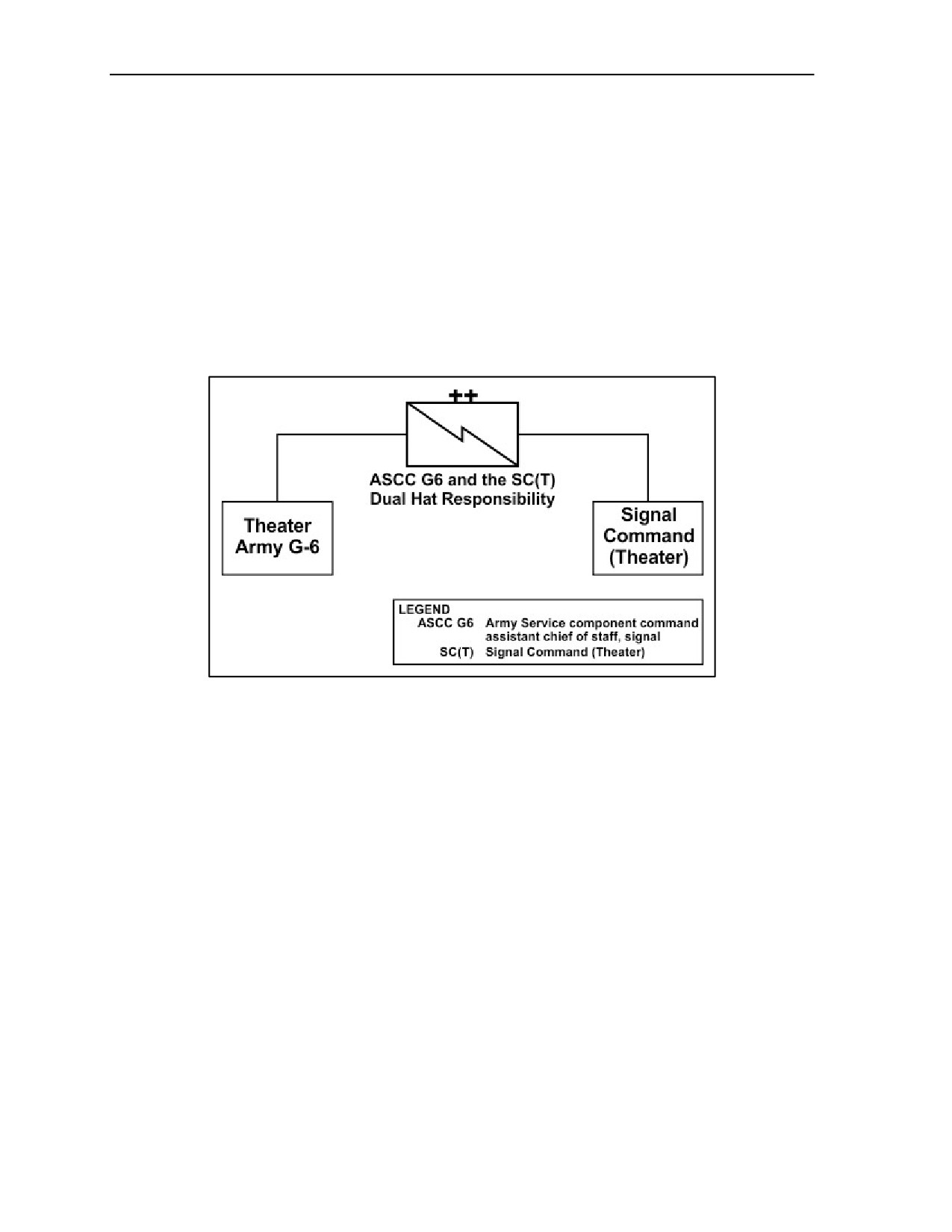
2-32. The Commander of the signal command (theater) (SC[T]), except in CONUS, is dual-hatted as their
respective G6 with a separate G-6 staff that focuses on signal requirements within the theater (Figure 2-1).
The G-6/Theater Army G-6 plans, prioritizes, and coordinates requirements and information systems
networks to support the theater army. The G-6/Theater Army G-6 coordinates with the GCC for authority
to operate within the host nation. The G-6 integrates information systems support to GCC designated joint,
multinational, official government organization, and non-official government organization sites. The G-6
assesses the information systems network’s ability to meet mission command and information exchange
requirements, and develops relevant portions of theater Army operation orders and operation plans. The
operations branch consists of the COMSEC, spectrum, and plans and exercise elements.
Figure 2-1. Signal Command (Theater) and Army Service component command G-6
relationship
TYPES OF SIGNAL UNITS LEVERAGED FOR SUPPORT
TACTICAL INSTALLATION AND NETWORKING-ENHANCED COMPANY
2-33. The tactical installation and networking company-enhanced (TIN-E) deploys worldwide to provide
network installation utilizing a user-provided bill of material, troubleshooting, quality assurance testing and
handoff coordination to enable transition from tactical to semi-permanent automation support for ASCC,
GCC, SC(T) commanders and JTF or coalition headquarters.
2-34. The TIN-E provides the following capabilities to support the unit’s mission—
z
Execution of mission command warfighting function tasks, personnel administration,
maintenance and supply functions.
z
Technical expertise to interpret and implement engineer implementation plans for
communications systems.
z
Direction and technical expertise to sections and teams for the restoration of supported facilities.
z
Installation, maintenance, and repair of aerial, buried, or underground cable, wire, and fiber
optic transmission systems.
z
Repair and maintenance of existing cable, wire, and fiber optic systems.
z
Antenna and tower construction and repair.
2-6
FM 6-02
22 January 2014
Roles and Responsibilities of Signal Organizations
z
Connecting various theater HQ local area networks into required wide area network via cabling,
hardware installation and connection to tactical and indigenous switches and transport systems.
z
Digital system installation to include local area network, network security, hardware, SIPRNET,
NIPRNET and VTC.
z
Quality assurance testing and handoff of installed and restored systems.
COMBAT CAMERA COMPANY
2-35. The COMCAM company provides day/night still/video acquisition in support of unified land
operations.
2-36. The COMCAM company provides combat camera support to joint and U.S. Army operations and
exercises as directed by the combatant commanders. The company provides COMCAM documentation to
support the decisionmaking process for field commanders, the Joint Chiefs of Staff, DOD, President and
the Secretary of Defense. The COMCAM company provides the following capabilities to support the unit’s
mission—
z
Execution of mission command warfighting function tasks that integrate and synchronize the
operations and activities of assigned COMCAM platoons.
z
COMCAM equipment maintenance by on-site repair, replacement, or evacuation to civilian
contractors.
z
Liaison to supported units, joint COMCAM team, and other Service COMCAM elements.
z
Establishment, operation and maintenance of COMCAM facilities required to support theater
and subordinate tactical command posts.
z
Operations and support facilities to provide tailored still and motion media products.
z
Organizational maintenance of vehicles, power generators, environmental control units and
signal support systems.
z
Support of special operations forces (civil affairs, military information support operations,
rangers and special operations aviation).
z
Editing for the electronic processing of digital still and motion imagery acquired by organic
documentation teams.
z
Presentation and exploitation of visual imagery in support of operational requirements.
z
Parachute landing capabilities (unique to airborne COMCAM company).
JOINT/AREA SIGNAL COMPANY
2-37. The joint/area signal company (JASC) is a key theater signal asset that provides engineers, installs,
operates, maintains, and defends two large or medium command nodes plus four to ten extension command
post nodes, the supporting LOS, BLOS assets, NM, cable and wire assets to provide garrison quality data
services. The signal command (theater) ((SC(T)) employs the JASC throughout a theater of operation to
extend U.S. communications systems and services to support deployed forces. It provides communications
facilities in the theater for Army units from brigade to theater Army headquarters, ASCC commanders,
combatant commanders, JTFs and joint forces land component commands throughout the execution unified
land operations. This unit also provides the following capabilities to support the unit’s mission—
z
Automatic switching services for both analog and digital voice and data traffic, tactical
multichannel high capacity transmission systems, and multichannel satellite ground terminals.
z
Telephone switching services and Joint Network Node NetOps tools support NM within the
company.
z
Cable Teams for maintaining cable and wire systems.
z
BLOS communication support in the form of SATCOM and tropospheric communications.
z
Data services support and connectivity for the theater of operations and support of JTF missions.
z
Petroleum, oil, and lubrication, vehicle recovery, field maintenance, and field feeding support
for the company and headquarters and headquarters company when co-located.
22 January 2014
FM 6-02
2-7
Chapter 2
EXPEDITIONARY SIGNAL COMPANY
2-38. The expeditionary signal company (ESC) provides synchronization of mission command warfighting
function tasks, staff planning and supervision of an expeditionary signal company, consisting of
headquarters element and two expeditionary signal platoons plus any augmenting elements, personnel or
material assets.
2-39. The ESC provides communication facilities in the theater for Army units from brigade to theater
Army headquarters, ASCC commanders, combatant commanders, JTFs and joint forces land component
commands throughout the execution unified land operations. This unit also provides the following
capabilities to support the unit’s mission—
z
Automatic switching services for both analog and digital voice and data traffic, tactical
multichannel high capacity transmission systems, and multichannel satellite ground terminals.
z
Telephone switching services and NetOps tools support NM within the company.
z
Two cable teams for maintaining cable and wire systems.
z
BLOS communication support in the form of SATCOM and tropospheric communications.
z
Data services support and connectivity for the theater of operations and support of JTF missions.
z
Petroleum, oil, and lubrication, vehicle recovery, field maintenance, and field feeding support
for the company and headquarters and headquarters company when co-located.
z
Company headquarters provides limited personnel services and logistical support of the
company, which includes unit administration for assigned or attached elements, supply support,
chemical, biological, radiological, nuclear, and high yield explosives support, and weapons
support.
z
Network management, field feeding support, field maintenance support on all organic
communications-electronics and COMSEC equipment, and field maintenance on all organic
automotive, power generation, and environmental control equipment. This support
accommodates entire company deployments and when separate teams provide autonomous
contingency communications packages.
z
Multichannel teams provide range extension capability to support LOS and BLOS signal assets
for an ESB.
EXPEDITIONARY SIGNAL BATTALION
2-40. The expeditionary signal battalion HQ provides mission command, administrative, and logistical
support for an ESB. The HQs oversees the engineering, installing, operating, maintaining, and defending of
nodal and extension communications in support of Army units, combatant commanders, ASCC, or joint
force land component commanders. It also provides NM for all tactical communications assets within the
battalion through the suite of NetOps tools.
2-41. The ESB engineers, installs, operates, maintains, and defends the network for various CPs. It
provides voice, data, VTC, and special circuits over robust LOS and BLOS transmission systems
(tropospheric, tactical satellite, and microwave) via an internet protocol based system, which allows for
support of a greater number of subscribers. This unit also provides the following capabilities to support the
unit’s mission—
z
Staff planning and supervision of the battalion and any attached units.
z
NM of all tactical communication assets within the battalion.
z
Maintenance of the unit property book for the battalion.
z
Personnel and administrative services, logistical and religious support for assigned and attached
units.
z
Field feeding augmentation to the senior signal unit in the theater.
z
Field maintenance support for the headquarters and headquarters company.
z
Management of the COMSEC account for the battalion.
z
Performs field maintenance on all organic equipment, and organic communications-electronics
and COMSEC equipment.
2-8
FM 6-02
22 January 2014
Roles and Responsibilities of Signal Organizations
THEATER TACTICAL SIGNAL BRIGADE
2-42. The theater tactical signal brigade conducts mission command for assigned and attached units. The
HQs supervises the installation, operation, and maintenance of communications signal nodes, and engineers
and defends these nodes, in the theater communications system, excluding the division and corps systems.
It provides theater-level planning and engineering for mission command networks and systems, and
baseline services. It also supervises the installation, operation, and maintenance of nodal communications
in support of the Theater Army, coalition, and augmentation to the corps, division, other government
agencies and non-government organizations. This unit provides the following capabilities—
z
Planning, engineering, and control of the theater communications system.
z
Coordination of the training, administration, and logistical support of assigned units.
z
Allocates, controls, and positions available tactical network resources.
z
Oversees connection of the network to Army, joint, interagency, and coalition forces.
z
Ensures physical security and active defense of network resources.
z
Performs long-range planning for tactical network expansion and upgrade.
z
Enforces enterprise technical standards for all tactical network resources.
z
Conducts system and network management.
z
Provides oversight of contractor support operations/personnel.
z
Provides training and readiness oversight and administrative and logistical support of multiple
assigned signal organizations.
z
Based theater operational requirements, may have responsibility for the total network
environment in the assigned theater/area of operations. This includes assigned SSBs and related
network enterprise center (NEC) operational functions and support.
REQUESTING SIGNAL SUPPORT
2-43. A requesting unit’s G-6/S-6 is responsible to determine what signal support is required for the
current mission based on information contained in the operations order. Signal support is not static and
changes as the mission and circumstances change. The ASCC G-6, who is also the senior signal
commander of a SC(T) except in CONUS, tasks Signal assets to support the requesting unit.
2-44. When tasked to a division, the requesting unit’s G-6/S-6, in conjunction with their G-3/S-3,
coordinates through the division G-6 to the ASCC G-6 to determine the extent of the support required. Any
unit not tasked to a division should coordinate directly with the ASCC G-6 to determine provided signal
support.
2-45. The Signal proponent develops organizational structures to support units requiring pooled signal
assets, like the ESB. Upon receipt of orders, the supporting signal asset receives a change to their current
command relationship to the supported command. The requesting command may be responsible to support
these elements with sustainment capabilities (logistics, personnel services, and health service support).
2-46. When the operation order identifies the supporting signal unit, the requesting S-6/G-6 contacts that
unit for coordination. The supporting signal unit provides connection to LandWarNet, and is not
responsible for computers, telephones or any local area support.
2-47. The requesting unit should describe—
z
The unit needing service and the number of connections for each service required.
z
The services needed (NIPRNET, SIPRNET, voice, special circuits, and COMSEC key support).
z
The DTG for required services.
z
The location for required services.
z
The supported unit battle rhythm for communications services.
22 January 2014
FM 6-02
2-9
Chapter 2
SECTION III - SIGNAL ENABLING COMMANDS AND STAFFS
2-48. The signal enabling commands and staffs provide the NetOps and network transport for mission
command information systems. These commands establish policy and guidance, execute NetOps, provide
network transport, and defend LandWarNet. Through policy and transport, these commands maintain
LandWarNet and the Army’s ability to operate within the cyberspace domain. The following section
describes their roles and responsibilities within the overall support architecture.
U.S. ARMY SIGNAL CENTER OF EXCELLENCE
2-49. The Signal Center of Excellence (SIGCoE) is the Signal Corps and Signal Regiment headquarters
and serves as the force modernization proponent for signal in accordance with AR 5-22. It develops
doctrine, organization, training, materiel, leadership and education, personnel, facilities
(DOTMLPF)
requirements, determines the scope of future capabilities development efforts, and determines integration
tasks for both Army and joint operations under the oversight and guidance of the Chief Information
Officer/G-6 (CIO/G-6), within TRADOC in accordance with AR 5-22. The SIGCoE integrates approved
IA tools, doctrine, procedures, legalities, and techniques into applicable programs of instruction for
TRADOC schools. They develop, test, and recommend operational and organizational concepts and
doctrine to achieve IA goals and ensure compliance in accordance with AR 381-11.
THE SIGNAL CORPS AND REGIMENT
2-50. The Signal Corps is the compilation of all Signal Soldiers, which includes all Signal branch officers
and warrant officers, and Signal career management field enlisted Soldiers. Soldiers become part of the
Signal Corps and affiliate with the Signal Regiment (in accordance with AR 600-82). The Signal Regiment
is the compilation of Signal Soldiers that affiliate with the Signal Regiment upon the completion of branch
or military occupational specialty qualifying schools and the functional area officers that choose to
regimentally affiliate. The SIGCoE is the Signal Corps and Signal Regimental headquarters.
THE SIGNAL PROPONENT
2-51. The SIGCoE is responsible for the execution of training, leader development, education, personnel
lifecycle management functions and signal force modernization. The signal proponent is responsible for
training all Soldiers, including officer, warrant officer and enlisted Soldiers, initially accessed into the
signal career management field and branch designations. This responsibility includes training Soldiers that
transition to signal military occupational specialty, functional areas (regardless of branch) and career field
designations. The transition of Soldiers from other disciplines into the signal profession is necessary to
meet the Army’s requirement for Soldiers at the experience levels necessary for technically advanced
training in unique skill sets required to operate and defend the network. Signal Soldiers receive training
to—
z
Plan and direct signal support to operations.
z
Provide
(engineer/install) network transport and information services
(to include mission
command system integration).
z
Operate (restore, configure, allocate, optimize, and secure) telecommunications networks.
z
Protect and defend the confidentiality, integrity, and availability of telecommunications
networks, computer systems, and residing information.
z
Conduct spectrum management operations.
z
Conduct COMSEC.
z
Conduct visual information operations.
2-52. The signal force modernization proponent is responsible for DOTMLPF requirements for all NetOps,
network transport and information services, spectrum management operations, and visual information
functions. The SIGCoE executes force management responsibilities, consisting of requirements definition,
force development, capabilities development, doctrine development, training development, material
development, leadership development and education, personnel development, facilities development, and
2-10
FM 6-02
22 January 2014
Roles and Responsibilities of Signal Organizations
policy relative to the Signal Corps. SIGCoE ensures its DOTMLPF actions are coordinated with Army
commands, Army Service component commands, direct reporting units, field operating agencies, the
Headquarters, Department of the Army staff, and others as required.
2-53. The SIGCoE integrates joint communication requirements during capabilities development to ensure
the continued ability to network during joint operations. The joint capability areas provide a common
lexicon for all services to use for multi-service capability development and operational planning. The joint
capability areas are the collections of like DOD capabilities functionally grouped to support capability
analysis, strategy development, investment decisionmaking, capability portfolio management, and
capabilities-based force development and operational planning.
2-54. The Signal Corps integrates the joint capability areas to meet the requirements our Army and joint
communications networks must provide to commanders at all levels. Signal Regiment personnel directly
support the net-centric operations, joint capability area, providing communications that enable the other
joint capability areas by extending the voice and data capabilities to the joint partners. The two joint
capability areas that benefit most from this enhancement are command and control and battle space
awareness, although all, force support, force application, logistics, protection, building partnerships and
corporate management and support, also rely on the network during the execution of those capabilities.
more information.
U.S. ARMY CHIEF INFORMATION OFFICER/G-6
2-55. The CIO/G-6 is the principle staff assistant and advisor to the Secretary of the Army on Army
information management to include the strategy, policy, and execution of information management and
information technology for the Army and the effects of information management and information
technology on the warfighting capabilities. The CIO/G-6 provides guidance and policy on information
technology systems and networks, to include reviewing and evaluating existing Army information
management and information technology policies to determine their adequacy and oversee the
implementation of policy and guidance. The CIO/G-6 sets the strategic direction for and supervises the
execution of Army policy and programs for information management, including creating network
architecture and information sharing policy, modernizing Army resource management processes and
ensuring the synchronization of the Army’s network activities. The CIO/G-6 is also responsible for
ensuring the execution of the Army Signal G-6 function, including providing the Secretary of the Army and
Chief of Staff of the Army with advice on the effects of information management, information technology,
and communications. The CIO/G6 is the principal official within Headquarters, Department of the Army
with oversight responsibilities for all information technology resources under the provisions of the Clinger-
Cohen Act. The CIO/G-6 performs the duties and responsibilities as assigned in AR 25-1 while executing
the directorate’s mission.
ARMY CYBER COMMAND/SECOND U.S. ARMY
2-56. U.S. Army Cyber Command plans, coordinates, integrates, synchronizes and defends all Army
networks. When directed, U.S. Army Cyber Command conducts cyberspace operations in support of
unified land operations to ensure U.S. and unified action partner freedom of action in cyberspace, and
denies the same to our enemies and adversaries. U.S. Army Cyber Command also serves as the ASCC
under U.S. Cyber Command and provides reporting and situational understanding of LandWarNet. U.S.
Army Cyber Command is the command and control authority for all collateral top secret and below Army
NetOps. It is the single authority for the operation, management, and defense of LandWarNet global
enterprise network. U.S. Army Cyber Command oversees and reports threats to the Army global enterprise
network and, as required, other DOD agencies and their enabling technologies. In coordination with the
CIO/G-6, supports information security and information assurance compliance for collateral top secret and
below networks and systems. U.S. Army Cyber Command performs the duties and responsibilities as
assigned in AR 25-1 while executing the commands mission.
22 January 2014
FM 6-02
2-11
Chapter 2
U.S. ARMY NETWORK ENTERPRISE TECHNOLOGY COMMAND
2-57. The U.S. Army Network Enterprise Technology Command (NETCOM) plans, engineers, installs,
integrates, protects, defends and operates LandWarNet, enabling mission command through all phases of
unified actions. NETCOM’s task is to be the Army’s global network enterprise service provider, executing
cyberspace operations on behalf of U.S. Army Cyber Command and attaining information superiority,
achieving a joint, interagency and multinational network enterprise.
2-58. NETCOM serves as the designated approval authority for the Army enterprise, as directed by the
CIO/G-6. NETCOM serves as the Army information technology integrator to achieve a single, virtual
enterprise network by advising the end-to-end management of the Army’s enterprise service area, which
includes service delivery, service operations, and infrastructure management. NETCOM prescribes all
service delivery activities, policies, processes, procedures, and protocols for configuration management,
availability management, capacity management, change management, and release management for the
Army’s networks and functional processing centers.
2-59. NETCOM is responsible for managing the Army’s LandWarNet to include establishing the
networthiness, IA, technical and configuration management programs and policies in accordance with AR
25-1 and AR 25-2. NETCOM manages the administration of amateur radio operations and the Army
Military Auxiliary Radio System program per AR 25-6 and provides COMCAM documentation support for
Theater Army and joint military operations unified land operations. They are the single entry point to
submit validated, approved telecommunications requirements to Defense Information Systems Agency
(DISA) for coordination and implementation. NETCOM performs the duties and responsibilities as
assigned in AR 25-1 while executing the commands mission.
NETCOM G-33
2-60. The NETCOM G-33 serves a dual role, both the NETCOM G-33 and under operational control of
U.S. Army Cyber Command. Operations are exercised through the Army Cyber Operations and Integration
Center. The NETCOM G-33 mission is to assist U.S. Army Cyber Command in providing Army and DOD
NetOps reporting and situational understanding for LandWarNet across the strategic, operational, and
tactical levels. The Army Cyber Operations and Integration Center maintains operational control of all
Army Theater Network Operations and Security Centers (TNOSCs) and Regional Network Operations and
Security Centers (RNOSCs). The G-33 exercises the following functions—
z
Directs the mission command of the full spectrum of cyberspace operations (DOD information
network operations, defensive cyberspace operations, and offensive cyberspace operations).
z
Direct, manage and enforce NetOps policies, orders and directives as well as report compliance.
z
Collaborate with the NetOps community to ensure effective operation and defense of
LandWarNet.
z
Provide NetOps situational awareness and reporting for LandWarNet.
z
Serve as the single inject point for Army NetOps to U.S. Cyber Command.
z
Coordinate and direct network troubleshooting and restoral actions.
z
Support the coordination, synchronization and direction of actions in response to CND
incidents.
z
Monitor and report compliance with issued orders and directives.
z
Execute activities, methods, procedures, and employ NetOps capabilities enabling operation,
administration, maintenance and provisioning of managed network resources.
z
Review, monitor, assess, and recommend approvals for major enterprise infrastructure
initiatives, such as, integration, requirements analysis, lifecycle development, configuration
management and performance management of information systems across LandWarNet.
z
Ensure process compliance and infrastructure requirements are compatible with all required
DOD and Army standards and regulations.
2-12
FM 6-02
22 January 2014
Roles and Responsibilities of Signal Organizations
2-61. Maintain oversight of all LandWarNet information technology assets, including gathering system
requirements, establishing baselines and incorporating processes to ensure continued readiness and
availability.
U. S. ARMY SPACE AND MISSILE DEFENSE COMMAND
2-62. The U.S. Army Space and Missile Defense Command/Army Forces Strategic Command G-6 is
designated as the Wideband SATCOM System Expert, the Consolidated Narrowband SATCOM System
Expert, the Wideband Global SATCOM System Expert, the Defense Satellite Communication System
SATCOM System Expert, the Global Broadcast Service SATCOM System Expert and the Mobile User
Objective System SATCOM System Expert responsible for engineering, operating, and the technical
expertise of its assigned satellite systems. U.S. Strategic Command assigned operational control of the four
Regional SATCOM Service Centers to the U.S. Army Space and Missile Defense Command/Army Forces
Strategic Command.
2-63. The regional SATCOM support centers operate around the clock to provide SATCOM resources,
systems engineering, and modeling support for decision makers, national activities and agencies, and other
SATCOM users. The regional SATCOM support centers analyze requirements and develop solutions to
support assigned users in day-to-day management of SATCOM resources allocated for the combatant
command. This includes execution and implementation of the combatant commands directed assignments
to subordinate and geographically associated organizations. They also process the satellite access request
portion of valid two-part satellite/gateway access requests to authorize access to, and the use of, space and
ground terminal resources via the satellite access authorization.
SIGNAL COMMAND (THEATER)
2-64. The SC(T) provides oversight, leadership and direction over theater signal organizations that are
either service assigned to or in direct support of the signal command. These theater signal organizations can
include deployable formations such as theater tactical signal brigades(s) with their associated expeditionary
signal battalions (ESBs), combat camera assets, and inside/outside plant capability in the form of tactical
installation and networking (TIN) companies. Non-deploying structures include theater strategic signal
brigades (TSSBs) with their associated NEC (CONUS) or strategic signal battalions (OCONUS), fixed
satellite communications facilities, and a host of other strategic capabilities. Though non-deploying by
design, these organizations can, based on mission requirements, deploy personnel with specific technical
skill to support ongoing operations.
2-65. The SC(T) executes mission command for assigned and attached units to provide NetOps, in support
of Army, joint, multinational and interagency missions. It functions at the corps/Army and theater
headquarters level to provide NetOps and SMO support to the theater, joint, multinational forces. The
SC(T) provides the following capabilities to support the command’s mission—
z
Mission command/administrative functions for all assigned or attached units as directed.
z
Delivery of common user services in support of combatant commanders.
z
Planning and coordinating corps signal reserve component training.
z
The SC(T) Commander may also serve as the Army Service component command G-6 (ASCC
G-6).
z
Property book services for its organizational elements.
z
Plan, engineer, and manage signal support systems installed by the SC(T) and network
interfaces to existing systems installed by joint, multinational units.
z
Plan, engineer, integrate and rehearse LandWarNet information systems and networks, to
include capital planning; ensure LandWarNet capabilities are prioritized and available as a
capability to senior mission commanders.
z
Provide operational management of signal assets responsible for install, operate, maintain and
defend theater LandWarNet.
z
Plan, engineer, and manage requirements for special purpose information systems.
22 January 2014
FM 6-02
2-13
Chapter 2
z
Execute theater NetOps; improve Army’s ability to adjust network priorities, global availability,
and to enforce policies and standards within the joint NetOps framework.
z
Organic engineering capability used to support systems design and policy development and
implement capabilities needed to support theater NetOps.
THEATER STRATEGIC SIGNAL BRIGADE
2-66. The mission of a theater strategic signal brigade is to provide operational base and sustaining signal
support (long-haul and tactical communications, automation, and network management) to maintain the
warfighter in an area of responsibility and to enable power projection platforms required for force
projection.
2-67. These units provide the following—
z
Executes mission command over strategic signal battalions and assigned units.
z
Installation, operation and maintenance of tactical interface, and sustaining base and strategic
signal support functions (communications, automation, and network management) to sustain the
warfighter in an area of responsibility.
z
NetOps at the installation level.
z
Within CONUS, provides operational direction to the NEC in the provisioning of C4IM
services.
z
Access to LandWarNet for all Army assets assigned to a geographic area and to tactical Army
assets deployed in other theaters.
z
Advice to the commanders, staff, and information system users on the capabilities, limitations,
and employment of all tactical and non-tactical signal and network assets available to a
particular supported command.
z
Advice to the supported commanders and staff on IM, automation policy, technical matters,
performance, and supervision of system analysis and programming functions on related abilities.
z
Input pertaining to enemy capabilities, intention and vulnerabilities regarding the DODIN and
LandWarNet to all-source intelligence assessments and estimates at the operational and strategic
levels. This also entails predicting the enemy courses of action, producing threat estimates,
ensuring proper dissemination of intelligence information and products, and evaluating
intelligence products as they relate to LandWarNet and the DODIN.
STRATEGIC SIGNAL BATTALION
2-68. The strategic signal battalion (SSB) provides synchronization of mission command warfighting
function tasks of the operations and activities of assigned communications and signal support teams/units.
The headquarters detachment provides unit administrative and logistical support to assigned personnel.
2-69. SSBs are regionally based signal elements with varying quantities of support teams assigned,
equipment and information mission requirements. They manage communications facilities and
infrastructure in their respective regions, and are responsible for installing, operating, maintaining, and
defending network facilities in support of theater strategic signal brigade, SC(T) and NETCOM missions.
Some of its assigned subordinate elements may operate and maintain equipment at static locations or fixed
sites. The SSB provides the following common capabilities to support the unit’s mission—
z
Staff planning and operational supervision of assigned teams.
z
Supervision of the functions of signal support, communications, automation, and visual
information.
z
Planning, engineering and control of strategic communications systems.
z
Coordination of the administration, vehicle maintenance, religious, and logistical support to
assigned units.
2-70. SSBs and their companies provide the following capabilities to satisfy specific regional signal
support requirements based upon the supported command’s mission—
2-14
FM 6-02
22 January 2014
Roles and Responsibilities of Signal Organizations
z
Planning, operations, coordination, and management of the supported unit’s telecommunications
systems and information systems support functions for mission command.
z
Spectrum planning and management.
z
Coordination and direction of information processing systems, to include data system studies
and preparation of documentation and specifications for proposals.
z
Oversight of the installation, operation, and maintenance of electronic switches and NetOps
equipment, radio receivers and transmitters, and other associated equipment.
z
COMSEC material issue and management.
z
Installation, operation, and maintenance on multi-functional/multi-user information processing
systems, including peripheral equipment and auxiliary devices.
z
Planning, requirements analysis, design, development, testing, installation, maintenance and
training for all automation data processing systems.
z
Installation and maintenance of copper and fiber optic cable systems, repeaters, restorers,
voltage protection devices, telephones, distribution frames and related equipment.
z
Installation and removal of wire systems, including telephones.
z
Voice and data switching, routing and multiplexing coupled with COMSEC devices, to provide
a shelter-based mobile voice and data switching upgrade to existing tactical communications.
z
Network connectivity to include NIPRNET, SIPRNET, DRSN, DSN, and related private branch
exchange services and video teleconferencing.
z
Satellite access using military constellations or commercial satellites operating in the super high
frequency and extremely high frequency ranges (C, X, L, Ku and Ka bands).
z
Ensuring all systems have a certificate of networthiness.
Note. The SSBs execute the NEC missions for Army posts, camps, and stations in OCONUS.
NETWORK ENTERPRISE CENTER
2-71. The NEC provides overall NetOps for the data and voice networks and is the designated information
manager and information technology manager on their post, camp, or station (or within an assigned
geographical area). NECs plan and budget for appropriate network and information systems hardware and
software technology upgrades or replacements, to meet customers’ validated requirements. NECs work
with external organizations to ensure the proper operation of installation-level components of DOD or
Army-level networks and information systems. The NEC NetOps responsibilities include—
z
Managing all support functions associated with providing customer access to the installation
common-user networks and information systems infrastructure.
z
Ensuring support and problem resolution for physical networks and information systems
equipment on the installation or within the NEC’s direct area of operations.
z
Representing their supported units in recommending changes to LandWarNet based upon
lessons learned and innovative ideas.
z
Implementing NetOps practices in accordance with DOD, Army, and SC(T) policy and
guidance.
z
Establishing policies and procedures for the performance of the operation and maintenance of
networks and information systems within its AO.
z
Establishing individualized service level support agreements between installation/post/
camp/station tenants and the SC(T), and coordinating with the SSB for management of inter-
installation networks and information systems that affect their supported organizations.
z
Establishing and managing the command IA program for post/camp/station.
z
Managing the activities, functions, and capabilities of the network and information systems
resources within its region in accordance with direction from the SC(T) and TNOSC.
z
Providing mission impact of outages, CND incidents, and other network issues to the TNOSC
and SSB operations center.
22 January 2014
FM 6-02
2-15
Chapter 2
REGIONAL NETWORK OPERATIONS AND SECURITY CENTER
2-72. The Regional Network Operations and Security Center (RNOSC) provide NM and information
dissemination management (IDM) services to augment its assigned strategic signal battalion.
2-73. The RNOSC is regionally located at fixed station sites in assigned theaters and provides direct
support NM and IDM assistance to the supported strategic signal battalion. The TNOSC maintains
oversight of the RNOSC and provides NetOps directives. The RNOSC inherits the DOD Information
Assurance Certification and Accreditation Process, vulnerabilities, and threats of the TNOSC. This unit
also provides the following capabilities to support the unit’s mission—
z
Operation and maintenance management of the RNOSC with command, control,
communications, computers and information management support for network systems.
z
Operations and maintenance data systems administration with reports on security intrusions.
z
Personnel network status reports on circuit outages to the Army Cyber Operations and
Integration Center and TNOSC.
z
IA (monitoring networks, relaying information, and security procedures).
z
Status reports on security procedures for all major systems within the command.
SIGNAL CENTER/THEATER NETWORK OPERATIONS AND
SECURITY CENTERS
2-74. Assigned to the SC(T), under OPCON to U.S. Army Cyber Command’s Army Cyber Operations and
Integration Center, the TNOSC mission is to act as the single point of contact for Army network services,
operational status, and anomalies in the theater. The TNOSC provides visibility and status information to
the U.S. Army Cyber Command’s Army Cyber Operations and Integration Center. In some theaters, the
TNOSC may provide visibility to other Service component NOSCs. There are six TNOSCs established for
all theaters of operations: CONUS (CONUS and South), Europe, Pacific, Korea, and Southwest Asia. The
TNOSC functions are interchangeable across all theaters. NetOps personnel can perform theater common
functions at multiple geographical locations and should perform them the same way at each location.
2-75. The TNOSC performs or coordinates any task that spans the theater or multiple regions. This
provides consistent service among regions. It also places the operational function at the only location in the
enterprise that would have visibility or awareness of what was happening in both regions. Security,
operation, and maintenance of the specific theater LandWarNet infrastructure are the exclusive
responsibility of the TNOSC. The TNOSC is responsible for providing LandWarNet theater enterprise
services to the NECs. Each TNOSC is also responsible for ensuring Army information systems providing
these services are configured and maintained according to—
z
Applicable Defense Information Security Agency’s Security Technical Implementation Guides.
z
Army best business practices.
z
Best security practices.
z
Vendor and industry guidance as directed by NSA security readiness guides.
z
Chairman Joint Chiefs of Staff Manual (CJCSM) 6510.01B.
z
Department of Defense Instruction (DODI) 8500.2 and AR 25-2.
2-76. Each theater has a Regional Computer Emergency Response Team which provides the following—
z
Conduct threat based vulnerability assessments and defensive cyberspace operations-response
actions and mitigation countermeasures development and strategies.
z
Conduct signature attack sensing and warning analysis. Develop mitigation strategies to support
network defense requirements and data loss prevention, including spillage.
z
Incident handling and incident response actions in accordance with AR 25-2, DOD O-8530.1-M
and CJCSM 6510.01B.
z
Conduct computer defense assistance program (penetration testing, network assistance visits,
and network damage assessments) in support of the mission commander and subordinate theater
units.
2-16
FM 6-02
22 January 2014
Chapter 3
LandWarNet
The Army is transitioning from the philosophy of connecting secure network
autonomous enclaves in the different theaters to an interdependent security posture
operating as a system of systems. LandWarNet is a mission command enabler, and
the Army’s portion of the DODIN upon which both the generating force and the
operational Army depend on throughout all phases of operations and operational
environments. This chapter discusses the DODIN and LandWarNet, the network
transport and information services capabilities that enable mission command,
NetOps, and cyber threats. Some communications organizations within DOD refer to
LandWarNet as the “Army enterprise network.” This publication uses LandWarNet as
the doctrinal term for the Army’s portion of the DODIN.
SECTION I - THE DEPARTMENT OF DEFENSE INFORMATION NETWORKS
AND LANDWARNET
THE DEPARTMENT OF DEFENSE INFORMATION NETWORKS
3-1. The Department of Defense information networks consist of the globally interconnected, end-to-end
set of information capabilities and associated processes for collecting, processing, storing, disseminating,
and managing information on-demand to warfighters, policy makers, and support personnel, including
owned and leased communications and computing systems and services, software (including applications),
data, security services, other associated services, and national security systems.(JP 1-02). The DODIN is
the worldwide network made up of LandWarNet integrated with the other Services’ networks.
3-2. The DODIN is part of cyberspace. The emergence and use of cyberspace as an operational domain
influences signal support to military commanders. The DODIN, as a part of cyberspace, interacts with and
provides connections to national and global cyberspace, the national information infrastructure, and global
information infrastructure, respectively. The DODIN encompasses capabilities provided by the Army
LandWarNet, the Navy FORCEnet, and the Air Force C2 Constellation Network, as shown in Figure 3-1
on page 3-2.
3-3. The DODIN is capable of storing users’ data or making data stores available in other cloud
computing environments. Authorities manage the applications and services, which reside within the
DODIN. Data centers exist in every GCC’s area of responsibility. These processing nodes are essentially
stacks of servers, with the fundamental purpose of always-on secure data storage. This data storage
capability enables deploying Soldiers and units to take their home-station information with them whenever
and wherever they deploy by transferring their data from their current (home station) data center to the data
centers in the theater of operations. Data centers support a worldwide DOD intranet by which a single
connection allows a user to access Army, joint and coalition data, applications and information services
from anywhere, at any time, in any network environment.
z
Cloud Computing is a mode of architecture for enabling convenient, on-demand network
access to a shared pool of configurable computing resources
(networks, servers, storage,
applications, and services) that can be rapidly provisioned and released with minimal
management effort or service provider interaction. DISA is the DOD enterprise cloud service
broker. As the enterprise cloud service broker, DISA is responsible for making it easier, safer,
and more productive to navigate, integrate, consume, extend, and maintain cloud services within
the DOD, and with other Federal and commercial cloud service providers. DOD components
22 January 2014
FM 6-02
3-1
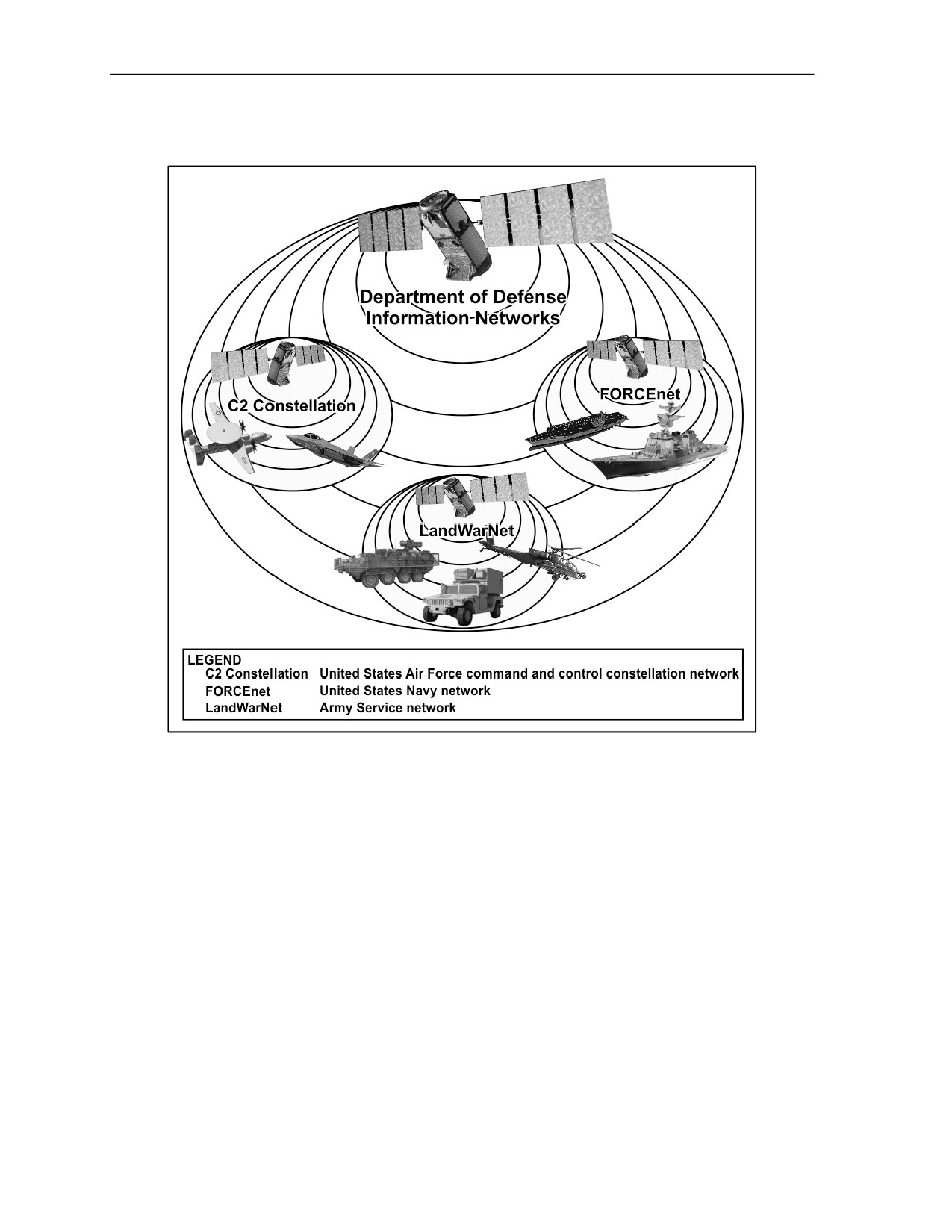
Chapter 3
acquire cloud services by using the broker, or obtain a waiver from the DOD CIO designated
review authority.
Figure 3-1. The Department of Defense information networks
z
Satellite Transport includes all DOD satellite communications (data and voice). Satellite
communications, such as Wideband Global SATCOM and DOD Gateway, extend the DODIN
to users without fiber connections, providing improved connectivity and data transfer capability.
z
DISN includes any DOD system, equipment, software, or service that transmits, stores, or
processes DOD information, and any other associated services necessary to achieve information
advantage. DISN services include SIPRNET, NIPRNET, Joint Worldwide Intelligence
Communications System, VTC, DSN, DRSN, Defense Research Engineering Network, and
global mission network. The three segments of DISN include the sustaining base, long-haul and
deployed. The long-haul segment connects the sustaining base to the deployed portion of the
network.
3-4. The Joint Information Environment (JIE) is a secure environment that shares information technology
infrastructure, enterprise services and a single security architecture within DODIN. The JIE achieves full
spectrum superiority, improves mission effectiveness, increases security and realizes information
technology efficiencies. The JIE operates per the unified command plan using enforceable standards,
specifications, and common tactics, techniques and procedures. JIE improves operational effectiveness,
standardizing training and equip requirements across combatant commands and geographic regions,
enhancing security and allowing Services and agencies to better reallocate and align existing resources.
3-2
FM 6-02
22 January 2014
LandWarNet
LANDWARNET
3-5. LandWarNet is the Army’s contribution to the DODIN and JIE. LandWarNet is a single, secure,
standards-based, versatile infrastructure nested within the DODIN. It is linked by networked, redundant
transport systems, sensors, warfighting and business applications, and services. LandWarNet provides
Soldiers and civilians timely and accurate information in any environment to enable decisive action with
our unified action partners.
3-6. Just as DODIN is the DOD’s application of cyberspace, LandWarNet provides the Army access to
the cyberspace domain. LandWarNet contains network service centers (NSCs) in a cloud computing
environment connected with long-haul network transport, and supports the following—
z
Installation campus transport networks for known, verified users. Campus networks connect
installation-based users to an area processing center and DISN services.
z
Regional hub nodes that provide transport capabilities for deployed users and training
environments to virtually link deployed forces to area processing centers. The hub node is a
LandWarNet satellite transport component that extends DISN services to Army deployed forces.
z
Tactical internet networks to connect deployed users to an area processing center and other
DISN services, regardless of their location. Tactical networks connect to LandWarNet and the
DODIN through the regional hub nodes.
z
Lower tactical internet network infrastructure to support maneuver units to execute decisive
action missions.
3-7. LandWarNet greatly enhances the potential for network integration, and provides a powerful tool for
leaders to use in synchronizing their efforts. LandWarNet also allows subordinate and adjacent units to use
their common understanding of an operational environment and commander’s intent to synchronize their
actions with those of other units without direct control from the higher headquarters.
LANDWARNET ARCHITECTURE
3-8. LandWarNet architecture is a cloud-computing environment that provides access to protected
services at the point of need. LandWarNet operational view (Figure 3-2 on page 3-4) shows LandWarNet
as an enterprise information environment that optimizes the use of Army IT assets to converge
communications, computing, and enterprise services into a single joint platform that commanders can
leverage for all missions.
3-9. LandWarNet provides protected services for cloud computing through a defense in depth posture,
and data stores from within the same network cloud. Security is critical, at the forefront of cloud
computing, and focuses on the security of critical information.
3-10. The logical boundary between LandWarNet and the rest of the DODIN is the Army security
boundary, known as the top-level architecture. The top-level architecture consists of firewalls, intrusion
detection, and intrusion protection sensors. Each SC(T) has multiple top-level architectures within their
respective area of operations providing redundant, seamless connections to the DODIN. The hardened outer
perimeter of the top-level architecture controls access to vital applications and data within LandWarNet.
The DODIN inherits the threats through connections from the most vulnerable communications assets
within the computing environments.
3-11. The Signal Corps’ core competencies enable LandWarNet’s seamless cloud environment through—
z
The core competency of network transport and information services provides the network cloud
with its applications and services.
z
The core competency of NetOps and its essential capability of COMSEC secure the network
and ensure access to the cloud.
3-12. The core competency of SMO enables LandWarNet systems that rely on wireless connectivity to
perform their functions in the intended environment without causing or suffering unacceptable frequency
fratricide.
22 January 2014
FM 6-02
3-3
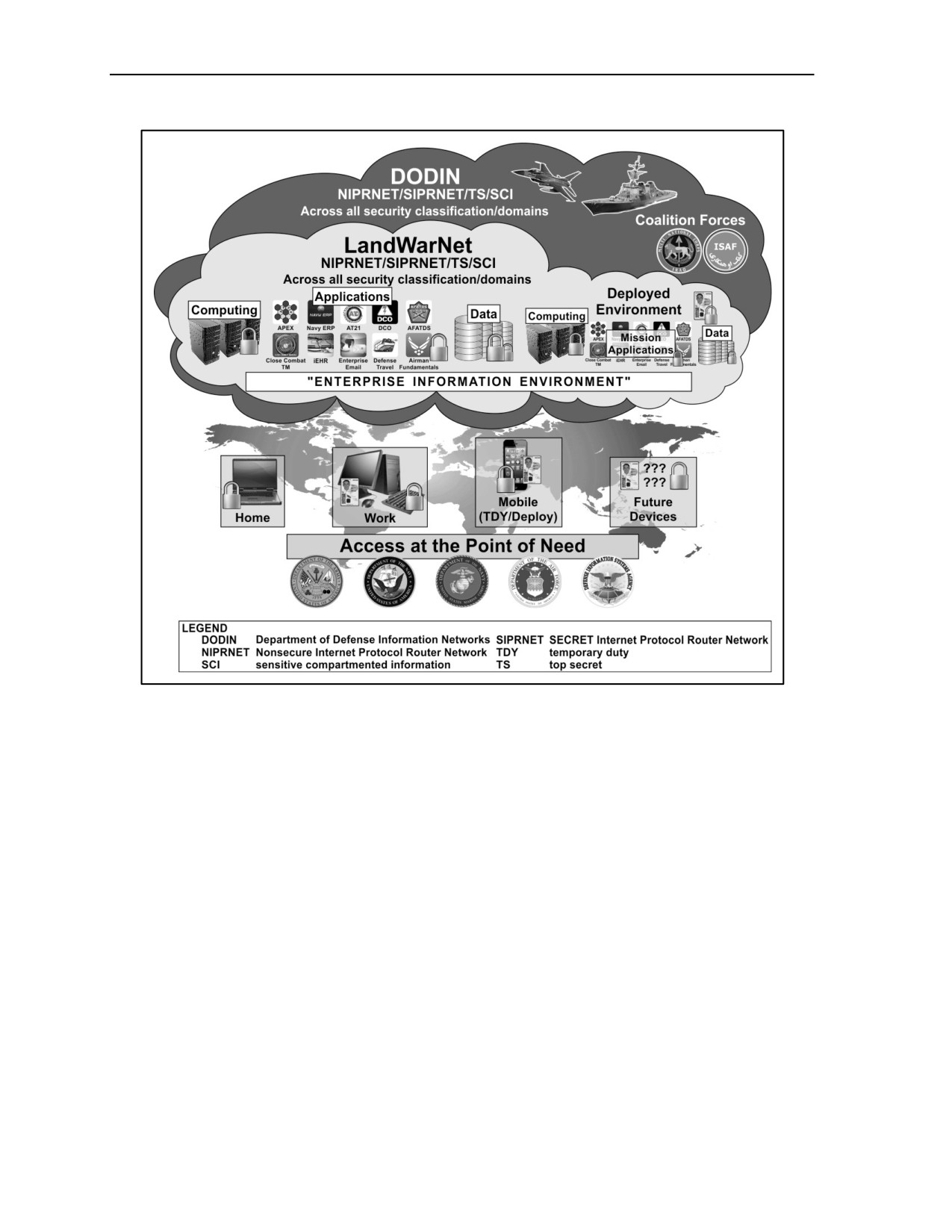
Chapter 3
Figure 3-2. LandWarNet operational view
LANDWARNET OPERATING ENVIRONMENTS
3-13. Work, deployed, home, and mobile represent LandWarNet’s different operating environments. The
standards-based approach to LandWarNet NetOps allows all of these environments to operate as a single,
integrated network cloud. LandWarNet operational view (Figure 3-2) depicts a visualization of how
members of the U.S. Army in each of these environments access protected data and services through the
cloud.
Work Environment
3-14. Generating forces occupy posts, camps, and stations throughout CONUS and OCONUS in support of
GCCs. The work environment is the Army-in-garrison, using LandWarNet as a strategic capability.
3-15. NECs are network service providers to installations. The paradigm has shifted away from locally
provided services to an enterprise approach that makes global operation and defense of the Army's network
possible. The NEC manages the installation campus area network, and ensures agreed-upon service levels
for the supported units at work in garrison. The installation campus area network connects installation-
based users to the DISN, secure data stores, and baseline common services found in the Command,
Control, Communications, Computers and Information Management (C4IM) Services List. Net-centric
enterprise services are the joint standard. The information services the NEC provides in CONUS are the
same information services the strategic signal battalions provide OCONUS. LandWarNet provides the
following baseline services as outlined in the C4IM Services List—
3-4
FM 6-02
22 January 2014
LandWarNet
z
Communications systems and system support services (Service 15).
Telephone and data infrastructure services.
Emergency communications telephone services.
Wireless infrastructure services.
VTC services.
Range/field telephone services.
Telecommunications continuity of operations plan and operations plan support services.
Fire, safety, security, and other circuit services.
Non-tactical radios and tactical radio spectrum management services.
z
Information assurance services (Service 18).
Defense in depth.
COMSEC services.
Risk management/accreditation/certification policy services.
Network security services.
z
Automation Services (Service 19).
Mail messaging/collaboration (E-mail/defense messaging system) and storage services.
Desktop/software/peripheral support services.
Web support services.
Automation and network continuity of operations plan and operations plan support services.
Automation and network service support services.
3-16. Generating forces are transitioning to receiving their network connectivity and patches for their
tactical systems directly from the local NEC. This process of using the installation as a docking station
provides a standard, simplified connection for operating forces to connect their mission command systems
to an installation's secure network. This allows active and reserve-component units who operate tactical
information systems during exercises and deployments to train and work in garrison as they would during
deployments.
3-17. Installation as a docking station provides consistent, streamlined and cost-effective connectivity at
the garrison; enables administrators to keep user accounts current and systems patched to mitigate security
threats; allows users access to the same information technology systems and software used on the
battlefield, enabling the Army to train as we fight providing Soldiers the capability to train on the same
warfighting application terminals used during deployment. A Soldier could be training at an Army
installation in CONUS, receive an alert and an order to deploy elsewhere, and that Soldier is only required
to pack that terminal and begin movement. Once the Soldier arrives at the destination, the Soldier connects
right back to the DODIN. Installation as a docking station reduces the time required to establish a
compliant deployed tactical network through an always-on concept. The installation as a docking station
system physically resides at the garrison installation but is logically its own network environment. When
deployed, the baseline compliancy variables are already inherent. The supporting signal team can then
focus on threats and variables associated with the mission.
3-18. Soldiers access global mission networks through installation as a docking station. The mission
network information stores are now available to Soldiers throughout the operations process. Installation as
a docking station facilitates planning, preparing and continual assessing of operations on the same mission
network used during the execution phase.
Deployed Environment
3-19. Deployed tactical forces connect to the cloud-computing environment via DISA long-haul, DOD
Gateway, or a regional hub node. Under the Army’s modular force design, theater army units have limited
signal/network support capability. These units include Army Service component commands, corps,
divisions, brigade combat teams, and multifunctional support brigades.
3-20. The NOSC/network operations center, under the senior signal commander, centrally manages the
forward-deployed installation campus area networks. The installation campus area network relies upon
22 January 2014
FM 6-02
3-5
Chapter 3
DISA long-haul transport for LandWarNet availability and the tactical internet satellite transport to access
cyberspace. The tactical internet provides connectivity through a series of converged (voice-data-imagery-
video) capabilities to the tactical edge. Protection and defense of this capability occurs within cyberspace.
The tactical internet enables aggregation of intelligence and information from Soldiers, platforms, and
command posts. The satellite transport connects through regional hub nodes or the DISA managed DOD
Gateway.
Home/Mobile Environments
3-21. A significant number of network users operate in the cloud from outside the essential governing
parameters of the Army network. These are users accessing the network from home or from a temporary
duty location. Unavoidably, this particular set of users access the network through the Internet. Users
within the home/mobile environments access LandWarNet cloud through commercial telecommunications
access to an Army or other Service network entry point.
3-22. The enterprise network is only as strong as its weakest connection. Assured compliance standards
associated with a defense in depth security posture are the shared responsibility of the supported user and
the supporting service provider. Access to data and application services depends upon compliance with the
current network security posture.
SECTION II - NETWORK TRANSPORT AND INFORMATION SERVICES
3-23. Network transport and information services capabilities are essential in supporting all Army
organizations in the conduct of unified land operations. Network transport and information services
capabilities connect users, information systems, and applications at all echelons across the enterprise.
Network transport and information services includes human interaction, application interoperability with
the network, and interoperability with joint, coalition, and commercial capabilities. Network transport and
information services capabilities enable mission command applications and commanders’ critical
information exchanges to get the right information to the right place at the right time in a format that meets
the requirements of leaders and Soldiers while training at home station and through all phases of an
operation.
3-24. Transport provides the highway to pass information between data systems, platforms, and sensors.
Services provide basic and common computing and networking capabilities that support the functional
application. Services allow the free flow of data and information among and between applications and
systems. The goal is a common toolset of information technology infrastructure services.
NETWORK TRANSPORT
3-25. Network transport is a system of systems including the people, equipment, and facilities that provide
end-to-end communications connectivity for network components. The system of systems and end-to-end
communications connectivity relative to network transport enables network transport systems to transmit
and receive voice, data and video enabling support of warfighting functions to unified land operations.
Network transport and services capabilities are part of a multi-tiered construct that combines advanced
communications and network management technologies with the expertise, skills, and capabilities of
network professionals at theater army, corps, brigade, and battalion levels. The systems and people
combine with globally positioned network transport and services capabilities that provide access to network
services, to space communications assets, and to robust and responsive aerial and terrestrial
communications layers, form the always-on global network that enables mission command in support of
unified land operations.
3-26. The key transport for the work environment is the sustaining base and long-haul backbone
communications provided by DISA as part of the DISN services within the DODIN (JP 6-0). Network
transport encompasses the integrated space, aerial, and terrestrial capabilities that provide access for Soldier
and sensors through joint and strategic levels. Network transport capabilities support information
requirements. Key network transport capabilities for the operating force are—
z
Servers, routers and switches, and other network infrastructure.
3-6
FM 6-02
22 January 2014
LandWarNet
z
Tactical radios.
z
Satellite communications.
3-27. Satellites and tactical radios are the core transport and information networking capability that enables
mission command in support of unified land operations. These communications transport capabilities are
across all Army echelons, enabling unified land operations in an integrated LandWarNet environment.
Transparent to the user, the network provides access via the most expeditious/available transport layer in
accordance with requirements and established policies. Ensuring adequate transport capability is a critical
prerequisite to reliance on cloud computing and a paradigm shift away from locally provided services to an
enterprise approach.
INFORMATION SERVICES
3-28. Information services consist of—
z
Messaging - enables warfighters to exchange information among users and systems utilizing the
network. Messaging examples include email, unique message formats, message-oriented
middleware, instant messaging, and alerts.
z
Discovery - enables warfighters to discover information content or services that exploit unique
descriptions stored in directories, registries, and catalogs. An example of a discovery service is a
search engine.
z
Mediation - enables system interoperability by processing data to translate, aggregate, fuse, or
integrate it with other data.
z
Collaboration - provides the ability for warfighters to work together and jointly use selected
capabilities. Examples of collaboration services are chat, on-line meetings, and work group
applications.
z
Storage - provides the physical and virtual hosting of data on the network with varying degrees
of persistence, such as archiving, continuity of operations, and content staging. Standing
operating procedures or operations orders may list the storage locations of information in the
unit.
z
User Assistance - provides centralized, automated access to lessons learned information that
reduces the effort required to perform work force intensive tasks.
3-29. Through a full suite of information services, commanders and Soldiers collect, process, store,
transmit, display, and disseminate information, as well as share and collaborate with unified action partners
through all phases of an operation anywhere in the world. Information sharing allows for the mutual use of
information services or capabilities. This ability may cross functional or organizational boundaries. Global
authentication, access control, and directory services facilitates information sharing, which allow any
authorized user with common and portable identity credentials to have access to, and visibility of, all
appropriate operational, business support, or intelligence related information, services, and applications
related to their mission and communities of interest.
3-30. A networked force has the ability to expand its operational reach by allowing dispersed elements to
use nonorganic information services of other organizations. By integrating information from across the
breadth of the area of operations, Army forces are able to maintain more relevant and complete situational
understanding. This integrated picture allows commanders to employ the right capabilities, in the right
place, and at the right time. Achieving this capability is essential to enable unity of command.
SECTION III - NETWORK OPERATIONS
3-31. NetOps is the discipline within signal operations focused on planning, engineering, installing,
operating, maintaining, controlling, and defending the network in support of both the generating force and
the operational Army. The purpose of NetOps is to assure system and network availability, assure
information protection, and assure information delivery, which protects and maintains freedom of action for
DOD missions within cyberspace. Effective NetOps is the availability of service, which facilitates network-
enabled operations. NetOps is a commander-focused activity. All NetOps activities and functions support
22 January 2014
FM 6-02
3-7
Chapter 3
operational commanders. An effective NetOps mission command structure provides unity of command and
unity of effort.
DEPARTMENT OF DEFENSE INFORMATION NETWORK
OPERATIONS
3-32. NetOps functions are conducted to operate and defend the Department of Defense information
networks. Visibility of NetOps across the DODIN is critical to situational understanding and
decisionmaking. Shared situational understanding for all aspects of NetOps, along with coordination
between stakeholders on potential events, ensures joint force commanders are aware of network actions
taking place in their area of operations. Joint force commanders have final authority over network activities
in their area of operations during contingency operations.
3-33. Each Service maintains a NOSC, and is required to provide NetOps support to the GCCs. The means
of accomplishing the NOSC mission is at the discretion of the individual Services. The Army is the only
Service that elected to establish separate NOSCs in each theater.
3-34. Department of Defense information network operations involves the employment of the following
joint network operations tasks—
z
Enterprise management. Enterprise management is the technology, processes, and policies
necessary to effectively and efficiently engineer, install, operate, manage, administer, optimize,
and restore communications networks, information systems, and/or applicable applications that
comprise the DODIN. This essential component merges IT services with the NetOps critical
capabilities.
z
Network assurance. Network assurance is composed of IA, CND, and critical infrastructure
protection. Network assurance provides true end-to-end, defense in depth protection that ensures
data confidentiality, integrity, and availability, as well as protection against unauthorized access.
Network assurance incorporates those actions taken to protect, monitor, analyze, detect, and
respond to unauthorized activity within DOD information systems and computer networks.
z
Content management. Content management allows NetOps centers to optimize the flow and
location of information over the DODIN by positioning and repositioning data and services to
optimum locations on the DODIN in relation to the information producers, information
consumers, and the mission requirements.
LANDWARNET NETWORK OPERATIONS
3-35. LandWarNet NetOps is an integrated construct of the Department of Defense information network
operations critical tasks enterprise management, network assurance, and content management; situational
understanding, and the mission command activities that guide signal entities in the installation,
management, and protection of communications networks and information services necessary to support
operational forces.
3-36. LandWarNet NetOps provides integrated network visibility and end-to-end management of
networks, global applications, and services across LandWarNet. Network visibility enables commanders to
manage their networks as they would other warfighting platforms. The NetOps mission is to operate and
defend LandWarNet. Unlike many missions deemed successful at a defined completion date, the NetOps
mission is perpetual, requiring continual support to be successful. The measurement of effectiveness of
NetOps is in terms of availability and reliability of network enabled services, across all areas of interest, in
adherence to agreed-upon service levels and policies. NetOps essential tasks integrate at the strategic,
operational, and tactical levels and across all warfighting and business functions to be successful. The
effects created by NetOps are system and network availability, information protection, and information
delivery, which gain and maintain information advantage for Army and joint missions within cyberspace.
3-37. The Army’s two core competencies, combined arms maneuver and wide area security, provide the
means for balancing the application of the elements of combat power within tactical actions and tasks
associated with offensive, defensive, and stability operations; whereas the Signal Corps’ core competencies
define its distinct, unique, and valuable contribution in support of mission command to unified land
3-8
FM 6-02
22 January 2014
LandWarNet
operations. NetOps as a core competency of the Signal Corps has three essential tasks. The three essential
tasks are—
z
Provide NM/Enterprise Systems Management (ESM) - Engineer, install, operate, manage,
maintain, and restore LandWarNet communication and computer networks, systems, and
applications to achieve information advantage in support of unified land operations. NM
provides networked system services with the desired level of quality and guaranteed availability.
ESM comprises all measures necessary to ensure effective and efficient operation of
information systems, elements of systems, and services. ESM provides day-to-day management
of information systems, elements of systems, and services to include operating systems,
databases, and hosts of the end-users. The NM/ESM function of LandWarNet NetOps
corresponds to, and nests within, the function of enterprise management.
z
Perform IA/CND - Protect and defend communications and computer networks, systems, and
information services to deny unauthorized access and disruption of service. IA measures protect
and defend information and information systems by ensuring their availability, integrity,
authentication, confidentiality, and non-repudiation. IA includes providing for restoration of
information systems by incorporating protection, detection, and reaction capabilities. Computer
network defense measures protect, monitor, analyze, detect, and respond to unauthorized activity
with Department of Defense information systems and computer networks (JP 6-0). CND
measures also defend networks, information, and computers from disruption, denial,
degradation, or destruction. CND response actions execute authorized defensive measures or
activities that protect and defend systems and networks under attack or targeted for attack by
adversary computer systems/networks. COMSEC capabilities protect information transiting
terminal devices and transmission media from adversary exploitation. The task of IA/CND
corresponds to, and nests within, the function of network assurance and the passive measures in
defensive cyberspace operations.
z
Perform IDM/content staging (CS) - Emplace, manage, provide, and restore information
services to enable information management/knowledge management
(KM) and decision
superiority. IDM/CS consists of the technologies, techniques, processes, policies, and
procedures necessary to provide warfighters technical awareness of relevant, accurate
information; automated access to newly revealed or recurring information; and timely, efficient
and assured technical delivery of information in a usable format. IDM enables warfighters to
perform network-enabled information management tasks and seeks to achieve the dissemination
of the right information, to the right place, at the right time, and in a usable format. CS is a
technique by which information is compiled, cataloged, and cached. The task of IDM/CS
corresponds to, and nests within, the function of content management.
3-38. NetOps pertaining to corps, divisions, brigade combat teams, and maneuver battalions are not applied
to the entire LandWarNet. Thus, the critical tasks listed above are at the operational and tactical levels.
3-39. LandWarNet NetOps provides assured network and information system availability, information
protection, and information delivery across strategic, operational, and tactical boundaries.
z
Network and information system availability. Provide visibility and control over the system and
network resources. Effectively managing resources includes anticipating and mitigating
problems. Proactive NetOps ensure uninterrupted availability and protection of the system and
network resources. This includes providing for degradation, self-healing, diversity, and
elimination of critical failure points.
z
Information protection. Provide protection for the information passing over networks from the
time it is stored and catalogued until distribution to the users, operators, and decisionmakers.
z
Information delivery. Provide information to users, operators, and decisionmakers in a timely
manner. NetOps personnel continuously monitor the networks to ensure the transfer of
information is within the correct response time, and that throughput, availability, and
performance meet the user’s needs.
3-40. Figure 3-3 on page 3-10 establishes a common understanding of the relationships between NetOps
activities and their individual and combined effects. The center of the figure illustrates LandWarNet
NetOps tasks, their relationships with one another, their integration with the corresponding Department of
22 January 2014
FM 6-02
3-9
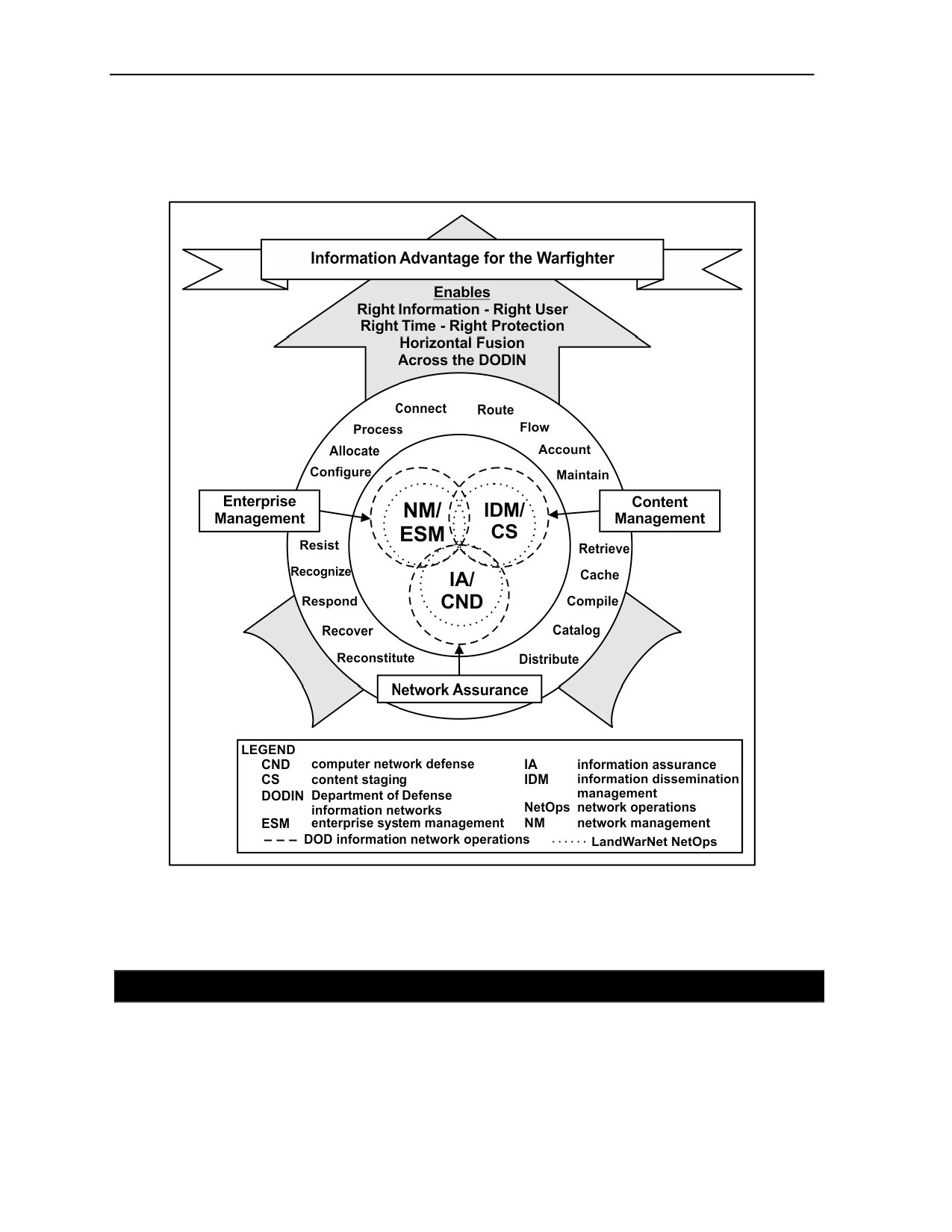
Chapter 3
Defense information network operations tasks, and the desired effects once transformed into an integrated
NetOps capability. The arrow in the figure illustrates how LandWarNet NetOps enables fusion across the
DODIN, and enables knowledge managers to get the right information to the right user at the right time
with the right protection.
Figure 3-3. NetOps components, effects, and objectives
3-41. LandWarNet NetOps is the integration of the individual capabilities associated with NM/ESM,
IA/CND, and IDM/CS that provides commanders the ability to harness the power of the DODIN and bring
this power to their area of operations in order to shape and influence operations.
SECTION IV - CYBER THREATS
3-42. Defending LandWarNet and protecting the information on LandWarNet from threats is a
responsibility of the Signal Corps and essential to freedom of action within the cyberspace domain.
According to the Interagency Working Group on Cyber Security and IA, a cyber threat is any circumstance
or event with the potential to, intentionally or unintentionally, exploit one or more vulnerabilities in a
system resulting in a loss of confidentiality, integrity, or availability. As defined here, cyber threats not
3-10
FM 6-02
22 January 2014
LandWarNet
only involve an action but also require actors (threat agents) to execute that action in order to exploit cyber
weaknesses.
3-43. Enemies and adversaries include, but are not limited to, nation-states, terrorists, hackers, internal
users, and organized crime. They use different methods to deny, degrade, destroy, exploit, alter or
otherwise adversely affect the Army’s use of cyberspace. Because LandWarNet consists of many different
segments existing across traditional domains, with many different means of communicating and differing
levels of interconnectivity and isolation, a wide continuum of capabilities are available to the enemy to
conduct cyber attacks. These capabilities target any portion of LandWarNet, ranging from particular
physical nodes and links to the actual data residing in those nodes and links.
3-44. The adversary or enemy may continuously attempt to gather intelligence within LandWarNet in
order to execute effective offensive operations. Successful intelligence gathering requires access to friendly
activities and networks. Computer network exploitation and electronic warfare support are two types of
intelligence operations performed within cyberspace and the electromagnetic spectrum. Computer network
exploitation reveals information resident on or in transit through a system. Adversarial intelligence
operations can reveal vital information about Army cyberspace operations.
3-45. Methods adversaries and enemies use to deny friendly use of the cyberspace domain and the
electromagnetic spectrum include computer network attack
(digital attack against logical networks),
electronic attack (jamming of the electromagnetic spectrum), physical attack against infrastructure and
electronics, as well as exploitation activities against computer networks or the electromagnetic spectrum.
z
Computer network attack is the employment of network-based capabilities to destroy, disrupt, or
corrupt information resident in or transiting through networks. Computer network attacks are
entirely dependent on access to the target network. This sometimes requires capabilities
specifically designed for the purpose of providing or enabling that access.
z
Electronic attack is the subdivision of electronic warfare actions to prevent or reduce the
effective use of the electromagnetic spectrum, such as jamming and electromagnetic deception.
Electronic attack uses electromagnetic energy, directed energy, and anti-radiation weapons to
attack personnel, facilities or equipment with the intent of degrading, neutralizing, or destroying
the enemy’s combat capability.
z
Physical attack uses measures to physically destroy or otherwise adversely affect a target.
Because networks in cyberspace can be isolated, the ability to attack a network node physically
may still be required. Physical attack can create effects within and outside cyberspace to help
control the domain. Regardless of the degree of isolation, the adversary or enemy may
determine a direct physical attack is the best option depending on the situation, the desired
effect, and availability and suitability of other capabilities or options.
3-46. In considering the threat, the following must be factored—
z
Cyberspace provides an adversary a greater level of obscurity in which to create a false sense of
trust.
z
Interconnectivity exposes critical infrastructures to the risk of perpetual cyber attacks mounted
in cyberspace by adversaries.
z
Expect rises in attacks by adversaries and enemies as convergence of network and device
technologies accelerates and systems increasingly connect to the Internet.
z
Resources for potentially harmful attacks are readily available, relatively inexpensive, and
provide the adversary the ability to circumvent the need to regroup, refit, and reconstitute.
z
Adversaries are capable of launching harmful attacks on Army systems, networks, and
information assets by commandeering the use of unsuspecting systems and integrating them into
the overall cyber arsenal.
z
Individuals and organizations worldwide can access systems and networks connected to the
Internet across geographic and national boundaries.
z
Sensitive information tends to be isolated from the unsecure network. However, the various
gateways that exist to facilitate transfer of information from the outside into a closed network
provide many attack vectors susceptible to exploitation.
22 January 2014
FM 6-02
3-11
Appendix A
Visual Information
Global Force Management is the predictive, streamlined and integrated process to
manage the allocation and appointment of deployed forces, including Combat
Camera (COMCAM) personnel. Global Force Management enables the Secretary of
Defense to make proactive, informed management decisions by evaluating risk to the
services and allocating appropriate forces to known requirements.
PROCEDURES FOR REQUESTING VISUAL INFORMATION SUPPORT
A-1. Combatant Command planners develop requirements and submit them to Joint Chiefs of Staff
through their J-1/J-3 by entering the requirement into the joint capabilities and requirements manager. All
rotational and emergent COMCAM requirements for joint operations vetting transpires through the Global
Force Management process to the service providers. Once the appropriate Service sources the requirement,
the details (personnel and logistics) are loaded in the Joint Operation Planning and Execution System for
assignment of unit line numbers.
A-2. COMCAM support may come from any Services’ COMCAM unit or activity. COMCAM forces,
until placed under the operational or tactical control of deployed forces, belong to their particular Service.
Prior to sending a tasking message—
z
Make verbal contact with the COMCAM unit to discuss the type of support and timeframe of
the required support. Coordinate as soon as possible with the COMCAM unit to ensure they can
meet your needs.
z
The COMCAM unit determines feasibility to support the requirement. In the event that
COMCAM cannot meet the requesting unit’s requirements, COMCAM assists in finding other
resources that can support the requirements.
Note. Verbal contact is not a commitment or an agreement to provide support.
A-3. The requesting unit submits an official tasking using the following message tasking format—
Unit Name: 55th Signal Company
UIC: WDBCAA
Location: Ft. Meade, Maryland 20755
Phone: (301) 677-5343 DSN 923
To:
USACOM NORFOLK VA//J36//
DA WASHINGTON DC//DAMO-ODO//
Info:
HQDA WASHINGTON DC//SAIS-PAC-V//
AMFINFOS WASHINGTON DV//DVI//
CDRFORSCOM FT BRAGG NC//G3//
9th SIG CMD/NETCOM FT HUACHUCA AZ//G3//
7th SIG CMD (THEATER) FT GORDON//NETC-SFC-OPY (G3)//
21st SIG CMD FT DETRICK MD//S3//
CDR 114th SIG BN FT DETRICK MD//CC/NETC-SYR// (use for unclassified messages)
CDR 114th SIG BN FT DETRIC MD//CC/NETC-SYR// (use for classified messages)
CDR 55th SIGNAL CO FT MEADE MD//CC/NETC-SYR-F//
22 January 2014
FM 6-02
A-1
Appendix A
4.B. (U/FOUO) UNIT CAPABILITY REQUESTED:
UNIT TYPE CODE:
4.B.1. (U/FOUO) DESTINATION:
4.B.2. (U/FOUO) DEPLOYMENT DATES:
4.B.3. (U/FOUO) DEPLOYMENT DURATION:
4.B.4. (U/FOUO) MISSION JUSTIFICATION:
4.B.4.A. (U/FOUO) TASK:
4.B.4.B. (U/FOUO) PURPOSE:
4.B.4.C. (U/FOUO) COMMAND AND CONTROL:
4.B.4.D. (U/FOUO) REPORTING INSTRUCTIONS:
PROCEDURES FOR REQUESTING VISUAL INFORMATION PRODUCTS
A-4. Complete government requests on official letterhead signed by a branch or unit head and submit by
fax, mail or E-mail to the Defense Imagery Management Operations Center.
A-5. The following information is required when requesting imagery—
z
Subject and/or image ID number.
z
Unit, location, event, operation name.
z
Date or date range.
z
Equipment or equipment type to be depicted (if any).
z
What action you want to see.
z
Media format, size, and quantity.
z
Date needed.
z
Your name, rank, and position title.
z
Your telephone numbers (DSN and commercial).
z
Complete official mailing address that includes a building/room number or suite.
z
How media is used (briefing, training).
z
For motion media requests, include the approximate total number of minutes needed for each
subject.
z
Defense Imagery Management Operations Center provides still imagery through the defense
imagery web site via zip file of high-resolution photographs for download onto your computer.
(Duplication from that point is at the requestor’s own expense.)
z
Official government customers can also obtain copies of visual information products from the
defense imagery website at http://www.defenseimagery.mil/index.html.
A-2
FM 6-02
22 January 2014
Appendix B
Communications Security Procedures
Secure communications require key, device and other COMSEC material
management at the lowest echelon possible while maintaining the highest physical
and information security level the equipment and material require. This appendix
provides the procedures to execute a COMSEC Incident Report, COMSEC Effective
Status Message, accountability, and destruction by operational elements and users at
all echelons.
PROCEDURES FOR COMMUNICATIONS SECURITY INCIDENT REPORT
B-1. It is the policy of the U.S. Government to safeguard and control COMSEC materials in a manner to
assure continued integrity, prevent access by unauthorized persons, and control the spread of COMSEC
materials, techniques, and technology when not in the best interest of the U.S. and its allies. The ultimate
responsibility of safeguarding COMSEC material rests with the individual in possession of the material.
Within Army organizations, this responsibility rests with the commander.
B-2. The G-6/s-6 uses a warning order to initiate the signal planning process for COMSEC equipment and
material. Employ new COMSEC material in accordance with information on the warning order. The list
includes the type of COMSEC material required. The G-6/S-6 verifies COMSEC and coordinates signal
support as required.
B-3. During unified land operations, the Service authority is the command headquarters G-2, or activity
within each military Service, overseas COMSEC operations, policy, procedures, and training. The
Headquarters, Department of the Army Deputy Chief of Staff, Intelligence (G-2) serves in this capacity.
The Service authority oversees the COMSEC Incident Monitoring Activity or processes and has final
adjudication authority in determining if reported COMSEC incidents have resulted and are then responsible
to report them to the National Security Agency for final adjudication.
B-4. Attempts to minimize or conceal violations or compromises of COMSEC jeopardize the operational
security of communication and information systems.
B-5. In order to conduct a proper evaluation of a COMSEC incident, it is vital that all immediately
available and essential information be included in the initial report. Do not delay incident reports in order to
obtain additional information.
Note. The Headquarters, Department of the Army DCS G-2 has delegated functional Service
authority responsibilities to Communications Security Logistics Activity, which serves as the
Army COMSEC material central office of record and the Communications Security Incident
Monitoring Activity (CIMA).
B-6. Prepare and submit all COMSEC reports in accordance with AR 380-40 and TB 380-41. Submit
incident reports via the web-based COMSEC Incident Management Monitoring System (combat conditions
exempted). This is the only official means of submitting COMSEC incident reports for all Army
organizations to the COMSEC Incident Monitoring Activity and other recipients designated by the user.
COMSEC Incident Management Monitoring System prompts the user for the information required to
complete a COMSEC incident report and has a help feature to assist users to navigate the application. Other
than combat situation, submit all reports using the COMSEC Incident Management Monitoring System.
B-7. The following is the COMSEC Compromise reporting checklist—
z
Unit.
z
Date-time group (DTG) reported.
22 January 2014
FM 6-02
B-1
Appendix B
z
DTG of compromise.
z
Controlled Cryptographic item (CCI) compromised.
z
COMSEC/net IDs compromised.
z
Probability of zeroed/destroyed.
z
Eyewitnesses.
z
First line S-6 assessment.
B-8.
There are four types of COMSEC incidents that must be reported—
z
Physical incidents include the loss, theft, loss of control, improper preparation of, or lack of
preparation of, destruction reports (including supporting documentation for destruction reports)
for COMSEC material. The capture, recovery by salvage, tampering, or unauthorized viewing,
access or photography of classified COMSEC material or unclassified key marked “CRYPTO”
are also physical incidents requiring a report. CCI, keyed or unkeyed, are included and reported
accordingly.
z
Personnel incidents. Any attempted recruitment, known or suspected contact by a foreign
intelligence entity, capture by the enemy, or unauthorized absence or defection of an individual
having knowledge of and access to COMSEC information or material are considered personnel
incidents. The unauthorized disclosure or suspected disclosure of COMSEC information by
individuals, or attempts by unauthorized persons to affect such disclosure, also fall into this
category.
z
Cryptographic incidents. Any equipment or software malfunction, human error by an operator
or COMSEC account manager that adversely affects the cryptographic security of a machine,
auto-manual, or manual cryptosystem is a cryptographic incident. Unique incidents, which
pertain to specific cryptosystems, are contained in technical manuals, operational security
doctrine or in specific DA pamphlets.
z
COMSEC administrative discrepancy is administrative and COMSEC sensitive in nature as
both are insecure practices dangerous to security, jeopardizing the integrity of COMSEC
material. Because of this danger, it is essential that commanders take positive action to prevent
their recurrence. Report these incidents within the Army chain of command as directed by
command authorities, to cryptographic key controlling authorities or command authorities, and
to the Communications Security Logistics Activity via the COMSEC Incident Management
Monitoring System.
Note. Refer to TB 380-41, Procedures for Safeguarding, Accounting, and Supply Control of
COMSEC Material, for more information on types of incident reports.
B-9.
COMSEC incident reports constitute official command correspondence and are submitted by, or for,
the commander. Use direct channels to ensure receipt of the report within the required period. COMSEC
incident reports contain all information required by TB 380-41. Reporting commanders are responsible for
notifying their chain of command that a COMSEC incident has occurred. Classification of COMSEC
incident reports are according to content. Mark unclassified reports “For Official Use Only (FOUO)” and
exempted from automatic disclosure under the provisions of AR 25-55.
Report Precedence and Timeliness
B-10. The following paragraphs indicate the message precedence for addressees and report submission
times. Reports not submitted within the prescribed periods will contain an explanation for the delay.
B-11. Submit the following initial reports to the CIMA within 24 hours of discovery of the incident; at
immediate precedence for action addressees and routine precedence for information addressees—
z
Currently effective key or key scheduled to become effective within 15 days.
z
Possible defection, espionage, clandestine exploitation, tampering, sabotage, or unauthorized
copying, reproduction, or photographing.
z
Recently superseded key (within 30 days).
B-2
FM 6-02
22 January 2014
Communications Security Procedures
B-12. Submit initial reports to the CIMA within 48 hours of discovery of the incident and at priority
precedence for the following—
z
Future key scheduled to become effective in more than 15 days.
z
Superseded (more than 30 days ago), reserve, or contingency key.
B-13. Report initial COMSEC incident not covered in previous paragraphs within 72 hours of discovery of
the incident, normally at routine precedence. However, if the incident has significant potential impact,
originators should assign higher precedence.
B-14. Assign routine precedence to amplifying and final reports. However, assign a higher precedence if
they contain significant new information affecting the evaluation of the incident reports.
B-15. The following is an example and instructions to complete a CCI Incident Report message—
UNCLASSIFIED EXAMPLE TO REPORT CCI INCIDENT REPORT
***CONFIDENTIAL***
FM: (COMPLETE MESSAGE ADDRESS)
TO: DIRUSACSLA FT HUACHUCA AZ//SELCL-IN//
INFO: (SEE TABLE 7-1, TB 380-41)
DTG: 221800Z SEP 05
C O N F I D E N T I A L (CLASSIFICATION IS BASED ON CONTENT)
SUBJECT: INITIAL/FINAL COMSEC INCIDENT REPORT (U)
A. (U) AR 380-40, CHAPTER 7, DTD XXXX
B. (U) TB 380-41, PARAGRAPH 5.24 THROUGH 5.33, DTD XXXX
C. (U) DA PAM 25-380-2
D. (U) AR 710-2
1. (U) DODAAC OF THE UNIT INVOLVED.
2.
(C) MATERIAL IDENTIFICATION. COMPLETE IDENTIFICATION OF THE MATERIAL
INVOLVED IN THE INCIDENT, INCLUDING— NOMENCLATURE, SERIAL NUMBER, AND
QUANTITY. INDICATE WHETHER EQUIPMENT WAS KEYED OR UNKEYED.
3. (C) INCIDENT DESCRIPTION. PROVIDE A DESCRIPTION OF THE INCIDENT, INCLUDING
THE DATE AND TIME OF DISCOVERY, AND ANSWERS THE QUESTIONS WHO, WHAT,
WHEN, WHERE, WHY.
4.
(U) COMPROMISE. ESTIMATE THE PROBABILITY OF POSSIBLE COMPROMISE, I.E.,
COMPROMISED, COMPROMISE CANNOT BE RULED OUT, OR NO COMPROMISE.
5.
(U) KEY. IF KEY IS INVOLVED, IDENTIFY THE
(CONTROLLING AUTHORITY)
CONAUTH(S).
6.
(U) MISSING CCI. IF THE MATERIAL INVOLVED IS MISSING, ALSO INCLUDE THE
FOLLOWING:
(THE LOSS OF CCI REQUIRES AN AR 15-6 INVESTIGATION IAW AR 735-5, PARAGRAPH
13-2A (6)).
A. DATE, LOCATION AND CIRCUMSTANCE. LIST THE DATE, LOCATION AND
CIRCUMSTANCES OF THE LAST KNOWN SIGHTING.
B. CAUSE OF LOSS. LIST ALL AVAILABLE INFORMATION PERTAINING TO THE CAUSE
OF THE LOSS.
C. ACTIONS TAKEN. LIST ALL ACTIONS BEING TAKEN TO LOCATE THE MATERIAL.
D. POSSIBLE TAMPERING. INDICATE THE POSSIBILITY OF ACCESS BY UNAUTHORIZED
PERSONS.
7. (U) TEMPORARY LOSS. IF THE MATERIAL WAS TEMPORARILY LOST OR OTHERWISE
OUT OF PROPER CHANNELS ALSO INCLUDE THE FOLLOWING: A. TIME AND
CIRCUMSTANCES. INDICATE THE EXACT PERIOD OF TIME AND UNDER WHAT
CIRCUMSTANCES THE MATERIAL WAS DISCOVERED TO BE OUT OF PROPER
CHANNELS.
B. ACTION. INDICATE THE ACTION WHICH CAUSED THE MATERIAL TO BE RETURNED
TO PROPER CHANNELS.
22 January 2014
FM 6-02
B-3
Appendix B
C. CLEARANCE STATUS. INDICATE THE CLEARANCE STATUS OF PERSONS HAVING
UNAUTHORIZED ACCESS.
D. SURREPTITIOUS ACCESS. INDICATE THE POSSIBILITY OF SURREPTITIOUS ACCESS
BY UNAUTHORIZED PERSONS.
8. (U) INCLUDE CORRECTIVE ACTIONS IMPLEMENTED TO PREVENT A RECURRENCE OF
THIS INCIDENT.
9.
(U) POC. GIVE NAME, DSN, COMPLETE COMMERCIAL TELEPHONE NUMBER, FAX
NUMBER, AND EMAIL ADDRESS.
UNCLASSIFIED EXAMPLE TO REPORT A CCI INCIDENT REPORT
B-16. Investigations: Normally, informal inquiries about reportable COMSEC incidents uncover sufficient
information to determine if a compromise occurred and to recommend measures for preventing recurrence.
Formal investigations may be required to determine certain violations of law or regulations. Conduct such
investigations as mandated by regulation per direction of a cognizant higher authority, or at the discretion
of the commander. Conduct investigations according to AR 15-6. Ensure investigating personnel have the
appropriate security clearance.
B-17. Evaluations: Base the evaluation on information contained in an incident report, taking into
consideration the security characteristics of the cryptosystem. Evaluations of incident reports must
determine possible impact of the incident on all affected elements. The evaluation consists of CIMA
personnel contacting the involved parties to determine if there were extenuating factors that led to the
compromise or loss of control of the material in question. Consider the following evaluation factors—
z
As the principal activities responsible for evaluation of COMSEC incidents, NSA and the Army
CIMA may direct further investigation or reporting in order to ensure a proper evaluation.
z
When evaluation of the incident indicates that supersession of any material is necessary, the
controlling authority must immediately notify all holders of that item.
z
A cryptosystem declared compromised will not be used for further encryption unless it is
operationally essential that encrypted messages are sent before the supersession date and an
alternate system is not available. See also AR 380-40, paragraphs 6-12 and 6-13.
B-18. COMSEC incident evaluation is often a subjective process, even when all pertinent facts are known.
The guidelines below provide consistency in allowing the CIMA to assess commonly encountered types of
incidents.
z
Evaluate the following incidents as “COMPROMISE” and forward to NSA—
Lost keying material - This includes keying material believed destroyed without
documentation, and material temporarily out of control.
Material believed lost, but later recovered under circumstances when unsure of
continuous secure handling or found in an unauthorized location.
Unauthorized access - Access exists when a person has the capability and
opportunity to gain detailed knowledge of, or to alter information or
material/equipment. A person does not have access if the individual is under escort
or if physical controls prevent detailed knowledge or altering of information or
material.
Reports indicating the theft or loss of keying material or the defection of personnel -
Under such circumstances, the CIMA must consider the material compromised and
direct the controlling authority to initiate emergency supersession at the earliest
practical time.
z
Evaluate the following incidents as “COMPROMISE CANNOT BE RULED OUT” and forward
to NSA—
When information provided in the incident report indicates that COMSEC material
was possibly available to an unauthorized person, but there is no clear proof that it
was available.
Unauthorized absence of personnel who have access to keying material.
Furthermore, when a person who had access to keying material is officially reported
B-4
FM 6-02
22 January 2014
Communications Security Procedures
absent without authorization, all material the individual could access must be
inventoried and the results of the inventory included in the report.
z
Evaluate incidents involving local communication security management software, hardware or
systemic failure as follows—
If a current back-up tape is available for the restoration of electronic key and the key
management database, the CIMA shall rule the incident as “NO COMPROMISE”
and not forward the report to NSA. As such, the CIMA requires no further
investigation and notifies the account and the COMSEC office of record of these
findings.
If the system must be restored using a non-current back-up tape, the CIMA shall
consider any loss of COMSEC material and accounting records as a physical
COMSEC incident. The CIMA forwards the final report to NSA with an evaluation
that “COMPROMISE CANNOT BE RULED OUT” and notifies the COMSEC
office of record of their findings.
Note. Complete guidelines for evaluating incidents involving joint staff positive control material
and devices are contained in joint guidance governing positive control of material and devices.
B-19. Each COMSEC account must maintain case files for reportable COMSEC incidents. As a minimum,
every case file includes—
z
The initial/final report(s) as well as any amplifying reports. The initial report, or an amplifying
report, could serve as the final report.
z
The CIMA case assignment message. If not received within 30 days, the COMSEC account
manager must follow-up with the CIMA to ensure the incident report was received and to
request the case status.
z
The COMSEC incident evaluation issued by the appropriate agency.
z
The case closure message issued by CIMA.
z
Retain COMSEC incident reports on file by COMSEC accounts for two years after closure to
facilitate review by command inspectors and auditors. The Army CIMA maintains incident
report files in the Communications Security Logistics Activity records holding area for no
longer than six years and then destroys the report.
Note. For more information on reporting procedures, see TB 380-41, Security: Procedures for
Safeguarding, Accounting and Supply Control of COMSEC Material.
PROCEDURES FOR COMMUNICATIONS SECURITY EFFECTIVE STATUS MESSAGE
B-20. Procedures to produce a COMSEC Effective Status Message are in TB 380-40, Appendix D.
Effective and supersession dates classification are CONFIDENTIAL at a minimum and the controlling
authority or command authority may upgrade the classification level.
B-21. The following is an example of a COMSEC Effective Status message—
UNCLASSIFIED
(NOTE: CONFIDENTIAL WHEN FILLED IN)
FM: CONAUTH 123 AMS (6C1234) YOUR AB PI
TO: ALL AUTHORIZED USERS
DIR TIER1 FT HUACHUCA AZ//KMT//(CONAUTHs reports to Tier 1)
INFO: IMMEDIATE SUPERIOR IN COMMAND
DIRNSA FT GEORGE G MEADE MD //I5107//
NCMS WASHINGTON DC (Navy/USMC/USCG/MSC accounts)
CMIO NORFOLK VA (Navy/USMC/USCG/MSC accounts)
MAJOR COMMAND
OTHER CONAUTHS (AS REQUIRED)
CLASSIFICATION: (MINIMUM OF CONFIDENTIAL)
22 January 2014
FM 6-02
B-5
Appendix B
SUBJ/COMSEC EFFECTIVE STATUS MESSAGE (U)//
REF/A/DOC/CONAUTH GUIDANCE/KMSP/DATE//
REF/B/DOC/CNSSI 4006/DATE//
NARR/REF A IS XXXXXXX. REF B IS XXXXXX.//
POC/NAME/POSITION/PHONE NUMBER/EMAIL ADDRESS//
RMKS/1. (C/REL) THE FOLLOWING INFORMATION IS REQUIRED:
(A) PARAGRAPH MARKING/RELEASE CODES
(B) SHORT TITLE
(C) CLASSIFICATION OF KEYMAT
(D) ASSOCIATED EQUIPMENT
(E) ALGORITHMS
(F) EDITION
(G) KEY CHANGEOVER TIME
(H) RELEASE COUNTRIES
(I) CONAUTH POINT OF CONTACT INFORMATION
REQUIRED FIELDS:
2. (C/REL) (SHORT TITLE) / (CLASSIFICATION) / (ASSOCIATED EQUIP) / (EDITION) / (KEY
CHANGEOVER TIME)
SEGMENT NUMBERS / (DAILY, WEEKLY, MONTHLY, ETC) /
SEGMENT 01 / (CRYPTOPERIOD) / (SUPERSESSION DATE) /
EXAMPLE:
1. (C/US ONLY) AKAT/USKAD-1234/SECRET/KY-57/AB/0001Z/
1-12 ACTIVE SEGMENTS, 13-16 SPARES/WEEKLY/
SEGMENT 01/01-07 NOV 07/08 NOV 07/
SEGMENT 02/08-14 NOV 07/15 NOV 07/
SEGMENT 03/15-21 NOV 07/22 NOV 07/
2. (C/REL) ASAT-1234/SECRET/KY-57/AB/0001Z/
1-12 ACTIVE SEGMENTS, 13-16 SPARES/WEEKLY/ REL TO:
SEGMENT 01/01-07 NOV 07/08 NOV 07/
SEGMENT 02/08-14 NOV 07/15 NOV 07/
SEGMENT 03/15-21 NOV 07/22 NOV 07/
3. (U) CONAUTH GENERAL REMARKS CONCERNING EMERGENCY POCS, ETC.//
DECL/X1//
BT
COMSEC ACCOUNTABILITY AND DESTRUCTION
Accountability
B-22. All keying material is under accounting controls throughout its life cycle, from the moment
generated, and upon receipt until final disposition through issue, transfer, or destruction. Accounting
procedures are contained in TB 380-41. The Tier 1 COMSEC Army central office of record maintains a
record of all accountable COMSEC material issued to COMSEC accounts. Continuously control centrally
accountable key from time of receipt or generation through final disposition. A physical inventory of this
key must be reconciled with the Army central office of record every six months.
Destruction of Communications Security Material
B-23. The destruction official and the witness must have a clearance equal to the highest classification of
material for destruction. Both individuals must be physically present to view the actual destruction. Both
are responsible for a properly prepared destruction report that lists all material destroyed and for ensuring
that all destruction meets the appropriate standards in TB 380-41. Intentional falsification of COMSEC
material destruction reports is subject to administrative and civil sanction, including adverse personnel
actions, or criminal sanctions under the Uniform Code of Military Justice or Federal law, as appropriate.
B-24. Destroy superseded key material within 12 hours of supersession. Do not destroy defective or faulty
key and immediately report it to the NSA IA Director and hold for disposition instructions.
B-6
FM 6-02
22 January 2014
Communications Security Procedures
B-25. The COMSEC account manager and alternate COMSEC account manager perform monthly or
routine destruction of superseded editions of key. However, this routine scheduled destruction is not to be
used as the basis for delaying immediate destruction of key no longer needed. Granting the authority to
destroy superseded material to additional appropriately cleared people, who then certify this destruction to
the COMSEC account manager, is preferable to delaying destruction even for a short period.
Destruction Schedule and Methods
B-26. Destroy issued keying material designated cryptographic material following expiration of the crypto
period, or in accordance with the equipment operating instruction. Generally, key material may not be held
longer than 12 hours following expiration of the crypto period. However, where special circumstances
prevent compliance with the 12-hour standard, local commanders or responsible officials may grant an
extension in writing up to 72 hours. In the case of an extended holiday period (more than 72 hours) or when
special circumstances prevent compliance with the 12-hour standard (for example, destruction facility or
operational space not occupied) destruction may be extended until the next duty day. In such cases, destroy
the material as soon as possible after reporting for duty. Used or superseded keying material or extracts
carried aboard special purpose aircraft may be retained in secure storage until secure destruction facilities
are available, but must be destroyed as soon as possible thereafter.
B-27. Burning, disintegrating, crosscut shredding, or pulping are the approved methods for the routine
destruction of paper COMSEC and classified material. Burning, disintegrating, and chemical alteration are
the approved methods for the routine destruction of non-paper and classified material. COMSEC key tape
is composed of paper-mylar-paper. Destroy COMSEC key tapes by burning, disintegrating, and chemical
alteration.
COMSEC ASSISTANCE TO FOREIGN GOVERNMENTS
B-28. COMSEC keying materials, documents, and hardware cannot be released to foreign governments
without approval of the Chairman Joint Chiefs of Staff, and of the Director, National Security
Agency/Chief, Central Security Service. The approval process for the release of COMSEC materials,
documentation, and hardware requires strict adherence to approval authority guidance. However, use of
communication liaison teams attached to foreign military forces can alleviate the need to release COMSEC
materials to foreign military forces.
22 January 2014
FM 6-02
B-7
Glossary (Chapter Title)
The glossary lists acronyms and terms with Army or joint definitions. Where Army
and joint definitions differ, (Army) precedes the definition. Terms for which FM 6-02
is the proponent publication are marked with an asterisk
(*). The proponent
publication for other terms is listed in parentheses after the definition.
SECTION I - ACRONYMS AND ABBREVIATIONS
ASCC
Army Service component command
BCT
brigade combat team
BLOS
beyond line of sight
CCI
controlled cryptographic item
CIMA
Communications Security Incident Monitoring Activity
CIO
chief information officer
CND
computer network defense
COMCAM
combat camera
COMSEC
communications security
CONAUTH
controlling authority
CP
command post
CS
content staging
DISA
Defense Information Systems Agency
DISN
defense information systems network
DOD
Department of Defense
DOTMLPF
Doctrine, Organizations, Training, Material, Leadership, Personnel, Facilities
DRSN
Defense Red Switched Network
DSN
Defense Switched Network
ESB
expeditionary signal battalion
ESC
expeditionary signal company
G-2
(Army) Deputy Chief of Staff for Intelligence; (joint) Army or Marine Corps
component intelligence staff officer (Army division or higher staff, Marine
Corps brigade or higher staff)
G-3
(Army) assistant chief of staff, operations; (joint) Army or Marine Corps
component operations staff officer (Army division or higher staff, Marine
Corps brigade or higher staff)
G-6
(Army) assistant chief of staff for communications; (joint) Army or Marine
Corps component command, control, communications, and computer systems
staff officer.
GCC
geographic combatant commanders
IA
information assurance
IDM
information dissemination management
IDM/CS
information dissemination management/content staging
IT
information technology
J-6
communications system directorate of a joint staff; command, control,
communications, and computer systems staff section
22 January 2014
FM 6-02
Glossary-1
Glossary
JASC
joint/area signal company
JIE
Joint Information Environment
JTF
joint task force
KM
knowledge management
LOS
line of sight
NEC
network enterprise center
NETCOM
Network Enterprise Technology Command
NetOps
network operations
NIPRNET
Nonsecure Internet Protocol Router Network
NM
network management
NOSC
network operations and security center
NSA
National Security Agency
OPCON
operation control
RNOSC
Regional Network Operations and Security Center
S-2
(Army) battalion or brigade intelligence staff officer (USMC) battalion or
regiment intelligence staff officer
S-3
(Army) battalion or brigade operations staff officer (USMC) battalion or
regiment operations staff officer
S-6
(Army) battalion or brigade communications staff officer
SATCOM
satellite communications
SC(T)
signal command (theater)
SIGCoE
Signal Center of Excellence
SIPRNET
SECRET Internet Protocol Router Network
*SMO
spectrum management operations
TIN-E
tactical installation and networking company-enhanced
TNOSC
Theater Network Operations and Security Center
TSSB
theater strategic signal brigade
VTC
video teleconference
SECTION II - TERMS
communications security
(Joint) A component of information assurance that deals with measures and controls taken to deny
unauthorized persons information derived from telecomunications and to ensure the authenticity of
such telecommunications. COMSEC includes cryptosecurity, transmission security, emission security,
and physical security of COMSEC material. (CNSSI No. 4009)
computer network defense
(Joint) Actions taken to protect, monitor, analyze, detect and respond to unauthorized activity within
Department of Defense information systems and computer networks. (JP 6-0)
cyberspace
(Joint) A global domain consisting of the interdependent network of information technology
infrastructure and resident data, including the Internet, telecommunications networks, computer
systems, and embedded processors and controllers. (JP 1-02).
Glossary-2
FM 6-02
22 January 2014
Glossary
Defensive Cyberspace Operations
(DOD) Passive and active cyberspace operations intended to preserve the ability to utilize friendly
cyberspace capabilities and protect data, networks, net-centric capabilities, and other designated
systems. (JP 1-02)
Department of Defense information networks
(Joint) The globally interconnected, end-to-end set of information capabilities and associated processes
for collecting, processing, storing, disseminating, and managing information on-demand to
warfighters, policy makers, and support personnel, including owned and leased communications and
computing systems and services, software (including applications), data, security services, other
associated services, and national security systems. (JP 1-02)
Department of Defense information network operations
(Joint) Operations to design, build, configure, secure, operate, maintain, and sustain Department of
Defense networks to create and preserve information assurance on the Department of Defense
information networks. (JP 1-02)
information management
(Army) The science of using procedures and information systems to collect, process, store, display,
disseminate, and protect data, information, and knowledge products. (ADRP 6-0)
knowledge management
(Army) The process of enabling knowledge flow to enhance shared understanding, learning, and
decisionmaking. (ADRP 6-0)
*LandWarNet
The Army’s portion of the Department of Defense information networks. A technical network that
encompasses all Army information management systems and information systems that collect, process,
store, display, disseminate, and protect information worldwide.
network operations
(Joint) Activities conducted to operate and defend the Department of Defense information networks.
(JP 6-0)
*network transport
A system of systems including the people, equipment, and facilities that provide end-to-end
communications connectivity for network components.
Offensive Cyberspace Operations
(Joint) Offensive cyberspace operations intended to project power by the application of force in or
through cyberspace. (JP 1-02)
*Spectrum Management Operations
The interrelated functions of spectrum management, frequency assignment, host nation coordination,
and policy that together enable the planning, management, and execution of operations within the
electromagnetic operational environment during all phases of military operations.
visual information
(Joint)The use of one or more of the various visual media with or without sound. (CJCSI 3205.01C)
22 January 2014
FM 6-02
Glossary-3
References
REQUIRED PUBLICATIONS
These documents must be available to intended users of this publication.
ADRP 1-02. Terms and Military Symbols. 24 September 2013.
JP 1-02. Department of Defense Dictionary of Military and Associated Terms. 8 November 2010.
RELATED PUBLICATIONS
These documents contain relevant supplemental information.
JOINT PUBLICATIONS
Most joint publications are available online: http://www.dtic.mil/doctrine/new_pubs/jointpub.htm
CJCSI 3205.01C. Joint Combat Camera (COMCAM). 27 January 2010.
CJCSM 6231.01D. Manual for Employing Joint Tactical Communications. 15 January 2010.
CJCSM 6510.01B. Cyber Incident Handling Program. 10 July 2012.
CNSSI No. 4009. National Information Assurance (IA) Glossary. 26 April 2010.
DODI 8500.2. Information Assurance Implementation. 6 February 2003.
DOD O-8530.1-M. Department of Defense Computer Network Defense (CND) Service Provider
Certification and Accreditation Process. 17 December 2003.
JP 3-27. Homeland Defense. 12 July 2007.
JP 6-0. Joint Communications System. 10 June 2010.
JP 6-01. Joint Electromagnetic Spectrum Management Operations. 20 March 2012.
ARMY PUBLICATIONS
Most Army doctrinal publications are available online: http://www.apd.army.mil
ADP 3-28. Defense Support of Civil Authorities. 26 July 2012.
ADRP 3-0. Unified Land Operations. 16 May 2012.
ADRP 6-0. Mission Command, Chg 1. 10 September 2012.
AR 5-22. The Army Force Modernization Proponent System. 6 February 2009. (RAR 25 March 2011)
AR 25-1. Army Knowledge Management and Information Technology. 25 June 2013.
AR 25-2. Information Assurance. 24 October 2007. (RAR 001 23 March 2009)
AR 25-6. Military Affiliate Radio System (MARS) and Amateur Radio Program. 01 May 2007.
AR 25-55, The Department of the Army Freedom of Information Act Program, 01 November 1997
AR 380-5. Department of the Army Information Security Program. 29 September 2000.
AR 380-40. Safeguarding and Controlling Communications Security Material. 9 July 2012 (RAR 24
April 2013)
AR 381-11. Intelligence Support to Capability Development. 26 January 2007.
AR 600-82. The U.S. Army Regimental System. 5 June 1990.
AR 700-131. Loan, Lease, and Donation of Army Material. 23 August 2004.
AR 735-5. Policies and Procedures for Property Accountability. 10 May 2013.
ATP 3-37.10. Base Camps. 26 April 2013.
ATTP 4-15. Water Transportation Operation. 11 February 2011.
FM 3-05.160. Army Special Operations Forces Communications System. 15 October 2009.
FM 3-14. Space in Support of Army Operations. Chg 1, 6 January 2010.
FM 6-01.1. Knowledge Management Operations. 16 July 2012.
22 January 2014
FM 6-02
References-1
References
FM 6-02.40. Visual Information Operations. 10 March 2009.
FM 27-10. The Law of Land Warfare. 18 July 1956.
TB 380-40. Security: Army Controlling Authority and Command Authority Procedures. 10 September
2012.
TB 380-41. Security: Procedures for Safeguarding Accounting and Supply Control of COMSEC
Material. 16 November 2012.
PRESCRIBED FORMS
None
REFERENCED FORMS
Forms are available online: http://www.apd.army.mil
DA Form 2028. Recommended Changes to Publications and Blank Forms.
WEB SITES
Joint Capability Areas Web site http://www.dtic.mil/futurejointwarfare/jca.htm
Defense Imagery Web site https://www.defenseimagery.mil/index.html
C4IM Services List Web site https://www.itmetrics.hua.army.mil
References-2
FM 6-02
22 January 2014