FM 4-30 ORDNANCE OPERATIONS (APRIL 2014)
FM 4-30
Field Manual
Headquarters
Department of the Army
No 4-30
Washington, DC, 1 April 2014
Ordnance Operations
Contents
Page
PREFACE
iii
INTRODUCTION
iv
Chapter 1
THE ORDNANCE CORPS
1-1
The Ordnance Corps Mission
1-1
Ordnance Functions
1-1
Ordnance Corps and the Sustainment Warfighting Function
1-3
Summary
1-4
Chapter 2
MUNITIONS OPERATIONS
2-1
Munitions Mission
2-1
Munitions Support Structure and Stakeholders
2-2
Strategic and Joint Partners
2-2
Operational Munitions Stakeholders
2-5
Brigade Level Munitions Operations
2-8
Ammunition Support Activities
2-11
Forward Arming and Refueling Point
2-11
Ammunition Requirements Determination
2-12
Disposition and Retrograde
2-12
Explosives Safety
2-13
Summary
2-14
Chapter 3
EXPLOSIVE ORDNANCE DISPOSAL (EOD) OPERATIONS
3-1
Explosive Ordnance Disposal Mission
3-1
EOD Organization
3-2
Brigade Level EOD Organizations
3-4
Joint Operational Phasing Construct
3-5
Summary
3-6
Chapter 4
MAINTENANCE OPERATIONS
4-1
Section I - Maintenance Fundamentals
4-1
Two-Level Maintenance
4-1
Section II - Strategic Maintenance Partners
4-2
United States Army Materiel Command
4-2
Distribution Restriction: Approved for public release; distribution is unlimited.
i
Contents
Section III - Echelons above Brigade Operational Organizations
4-4
Modular Organization Maintenance Responsibilities
4-5
Section IV - Echelons above Brigade Sustainment Organizations
4-6
Theater Sustainment Command
4-6
Expeditionary Sustainment Command
4-6
Sustainment Brigade
4-6
Combat Sustainment Support Battalion
4-7
Support Maintenance Company
4-7
Section V - Brigade Combat Team Maintenance Support
4-7
Field Maintenance Company
4-7
Forward Support Company
4-8
Section VI - Combat Aviation Brigade Support
4-8
Aviation Support Battalion
4-8
Headquarters and Support Company
4-9
Forward Support Company
4-9
Section VII - Test, Measurement, and Diagnostic Equipment Support
4-9
Section VIII - Contracted Maintenance Support
4-10
Systems Support Contracted Capability
4-10
Summary
4-10
GLOSSARY
Glossary-1
REFERENCES
References-1
INDEX
Index-1
Tables
Table 3-1. Explosive Ordnance Disposal rules of allocation
3-2
ii
FM 4-30
1 April 2014
Preface
This field manual (FM) 4-30 provides fundamental guidance for the employment of United States Army
ordnance maintenance operations, munitions operations and explosive ordnance disposal operations in support
of unified land operations and warfighting functions. Unified land operations are how the Army seizes, retains,
and exploits the initiative to gain and maintain a position or relative advantage in sustained land operations
through simultaneous offensive, defensive, and stability operations in order to prevent or deter conflict, prevail
in war, and create the conditions for favorable conflict resolution (ADRP 3-0).
The principal audience for FM 4-30 is all members of the profession of arms. Commanders and staffs of Army
headquarters serving as a joint task force (JTF) or a multinational headquarters should also refer to applicable
joint or multinational doctrine concerning the range of military operations as well as joint or multinational
forces. Trainers and educators throughout the Army will also use this publication.
Commanders, staffs, and subordinates ensure their decisions and actions comply with applicable United States,
international, and in some cases, host-nation laws and regulations. Commanders at all levels ensure their
Soldiers operate in accordance with the law of war and the rules of engagement. (See FM 27-10.)
FM 4-30 uses joint terms where applicable. Selected joint and Army terms and definitions appear in both the
glossary and the text. Terms for which FM 4-30 is the proponent publication (the authority) are italicized in the
text and are marked with an asterisk (*) in the glossary. Terms and definitions for which FM 4-30 is the
proponent publication are boldfaced in the text. For other definitions shown in the text, the term is italicized and
the number of the proponent publication follows the definition.
FM 4-30 applies to the Active Army, Army National Guard of the United States, and United States Army
Reserve unless otherwise stated.
The proponent of FM 4-30 is the United States Army Ordnance School. The preparing agency is the United
States Army Combined Arms Support Command, Training Support and Doctrine Directorate. Send comments
and recommendations on a Department of the Army (DA) Form 2028 (Recommended Changes to Publications
and Blank Forms) to Commander, United States Army CASCOM, ATTN: ATCL-TS (FM 4-30), 2221 A Ave,
Ft. Lee, VA 23801; or submit an electronic DA Form 2028 by e-mail to: usarmy.lee.tradoc.mbx.leee-cascom-
doctrine@mail.mil.
1 April 2014
FM 4-30
iii
Introduction
The purpose of the ordnance corps is to support the development, production, acquisition and sustainment
of equipment- including weapons systems and munitions- and to provide explosive ordnance disposal
(EOD), during peace and war, to provide superior combat power to the United States (U.S.) Army. The
ordnance corps has a rich and robust history of supporting the force dating back from the American
Revolution to present day. The future of our nation and Army will continue to be engaged in an era of
“persistent conflict” a period of protracted confrontation among states, non-state, and individual actors
increasingly willing to use violence to achieve their political and ideological ends. The ordnance corps
must evolve and remain the indispensable sustainment warfighting function in order for the Army to
successfully execute simultaneous and protracted operations.
The Army sustainment concept is based on the integration of people, systems, material, health services, and
other support that links sustainment to the operations process. Sustainment is the provision of logistics,
personnel services, and health services support necessary to maintain operations until mission completion
(ADP 4-0). The ordnance corps plays a vital role in supporting the sustainment warfighting function
through the sub function of logistics as referenced in Army doctrine reference publication (ADRP) 3-0
Unified Land Operations. Logistics include the planning and executing the movement and support of
forces. It includes those aspects of military operations that deal with: design and development, acquisition,
storage, movement, distribution, maintenance, evacuation, and disposition of materiel; movement,
evacuation, and hospitalization of personnel; acquisition or construction, maintenance, operation, and
disposition of facilities; and acquisition or furnishing of services (JP 4-0). Today modularity requires the
ordnance corps to anticipate, analyze, and tailor available resources for effective and timely maintenance,
munitions, and EOD support. Adaptive planning and increased options for decision makers now necessitate
maintenance, munitions, and EOD managers to embrace change, innovation, and flexibility at all levels.
The ordnance corps success is measured by how well it supports unified land operations with the elements
of maintenance, munitions and EOD support.
FM 4-30 contains four chapters:
Chapter 1 covers a summative history of the ordnance corps and outlines the core competencies of the
ordnance corps and their strategic relevance in sustaining the Army’s unified land operations function.
Chapter 2 discusses the tactical and operational mission of ordnance munitions operation as a major factor
in determining the outcome of offensive, defensive, stability, support, protection and other combat
operations.
Chapter 3 discusses EOD operations, organizational structure, their command and support relationships
and how they support unified land operations.
Chapter 4 discusses the two levels of maintenance concept and how maintenance support is provided
above and below the brigade level. Chapter 4 also identifies the command and support relationships
between the U.S. Army Materiel Command (USAMC) maintenance sustainment organizations and the
operational Army in the conduct of unified land operations.
iv
FM 4-30
1 April 2014
Chapter 1
The Ordnance Corps
The ordnance corps has a proud tradition dating back to colonial America. In 1629,
Samuel Sharpe was appointed as the first Master Gunner of Ordnance for the
Massachusetts Bay Colony. The American Revolution established the general
outlines of the future Ordnance Department. During the war Colonel Benjamin
Flower and Ezekiel Cheever, a civilian, provided ordnance support in the
manufacturing of arms and equipment and supplied support to the army in the field.
During the War of 1812, the Secretary of War recognized the need for a distinct
branch to manage the procurement, research, and maintenance of ordnance materiel.
On May 14, 1812, Congress officially established the Ordnance Department and
appointed Colonel Decius Wadsworth as the first Chief of Ordnance. This chapter
provides an introduction to the ordnance corps, its four functions, and how the
ordnance corps supports the Army’s operational concept of unified land operations by
operating within the context of the sustainment warfighting function.
THE ORDNANCE CORPS MISSION
1-1. The ordnance corps mission is complex and multi-faceted, providing munitions, maintenance, and
EOD support to generate and maintain combat power and to provide protection to Army, joint,
intergovernmental, interagency and multinational forces. This support begins at the very inception of
operations and continues, unabated, until operations are complete.
1-2. Ordnance corps support begins within the continental U.S. at the industrial base. This support is
projected globally to any military area of responsibility and is consistent throughout the generating,
operating, and tactical force structures. Support at the industrial base is achieved through the development,
production, acquisition of materiel to include repair parts and munitions. This support includes participation
by strategic Department of Defense (DOD) partners and organizations that will be discussed in later
sections of this field manual.
1-3. Ordnance corps’ support to the operational force includes various table of organization and
equipment units designed, manned, and equipped to perform a specific ordnance function. These units are
assigned personnel in the proper quantities with military occupational specialties carefully developed and
trained in the skills required to perform the related tasks in each ordnance function. These organizations are
equipped with the latest materiel enablers that give ordnance Soldiers the means to perform their tasks.
Ordnance organizations are allocated based on the mission, operational requirements, and are located at
every level of operation from strategic to tactical.
ORDNANCE FUNCTIONS
1-4. The four functions of the ordnance corps are munitions, maintenance, EOD, and explosive safety.
Each of these functions has a critical role ensuring operational commanders and forces have the required
combat power for mission accomplishment. These functions provide for equipment serviceability,
munitions availability, readiness, and protection that directly support the foundations and tenets of unified
land operations.
MUNITIONS
1-5. The ordnance munitions function provides the correct type and quantity of munitions from the
industrial base to the tactical point of need with minimal handling and reconfiguration.
1 April 2014
FM 4-30
1-1
Chapter 1
1-6. Munitions support is a supply function that provides supply class V to units and is similar in many
ways to other supply support functions, supply being the process of providing all items necessary to equip,
maintain, and operate a military command (ADRP 1-02). The supply commodity, unlike others, directly
provides the lethality to combat operations. Its limited quantities, immediacy of need, and special
transportation and storage requirements present unique challenges to logistics planners and operators.
1-7. Effective munitions management and distribution requires deliberate planning to achieve a clear
understanding of the munitions requirements, understanding of the limitations on meeting those
requirements, communication, and proper allocation of ordnance ammunition units. Units must effectively
and efficiently handle, store, secure, distribute, and account for munitions at every level while ensuring
adequate explosives safety guidelines are met. Army munitions planners and organizations must also
consider support to joint and multi-national partners as dictated by operational requirements.
MAINTENANCE
1-8. The Army maintenance function generates/regenerates combat power and preserves the capital
investment in weapons systems and equipment. Maintenance is the logistics function that directly provides
equipment serviceability and operational readiness to commanders for mission accomplishment.
Maintenance occurs at every level of operations and is performed by either assigned maintenance capability
or by units specifically designed to provide maintenance support to units that have no assigned capability.
1-9. Army maintenance is a two-level system consisting of field and sustainment maintenance and also
includes the management and distribution of supply class IX. Field maintenance is performed by
operational units, usually found in a brigade support battalion (BSB) or sustainment brigade, and is focused
on rapidly returning unserviceable equipment to a serviceable state as quickly and as close to the point of
failure as possible. Sustainment maintenance is performed by strategic organizations, usually emanating
from the USAMC, and is normally focused on rebuilding and resetting severely damaged equipment to a
national military standard and returning it to the supply system.
1-10. Effective maintenance management includes anticipating maintenance requirements, tracking, and
analyzing maintenance reports, proper identification and diagnosis of maintenance faults, application of the
appropriate maintenance capability, and class IX management. As in the munitions function, proper
allocation of maintenance units is essential in ensuring adequate maintenance support is provided to the
force. Army maintenance organizations support joint and multi-national partners during operations as
required.
EXPLOSIVE ORDNANCE DISPOSAL
1-11. The EOD function provides integrated and layered protection support to forces, civil authorities and
critical infrastructure in support of unified land operations. Ordnance EOD detects, identifies, conducts on-
site evaluations, renders safe and conducts exploitation, disposal or other disposition of explosive ordnance,
including weapons of mass destruction (WMD). Additionally EOD provides support to joint, interagency,
intergovernmental and multinational operations as required and is tasked to render safe all types of
explosive hazards to include improvised explosives. EOD is a combat multiplier that facilitates decisive
operations and provides Army operational commanders at every echelon freedom of action in the
operational environment. The operational environment is the composite of the conditions, circumstances,
and influences that affect the employment of capabilities and bear on the decisions of the commander (JP 3-
0).
EXPLOSIVE SAFETY
1-12. The Army’s ordnance corps is the proponent for explosive safety and has established it as a fourth
core competency. Munitions and explosive safety is a priority consideration for all Soldiers and leaders.
Reducing the probability and limiting damage caused by unintended initiation of munitions requires
disciplined application of explosive safety procedures and adherence to explosive safety rules. Explosive
safety rules can be found at the end of the munitions chapter in this publication.
1-2
FM 4-30
1 April 2014
The Ordnance Corps
ORDNANCE CORPS AND THE SUSTAINMENT WARFIGHTING
FUNCTION
1-13. As part of the operational construct the Army developed warfighting functions as a way to
conceptualize capabilities of combat power. A warfighting function is a group of tasks and systems (people,
organizations, information, and processes) united by a common purpose that commanders use to
accomplish missions. Commanders use the warfighting functions to help them exercise mission command
and to assist their staffs to exercise control to accomplish missions and meet operational objectives.
Mission command is the exercise of authority and direction by the commander using mission orders to
enable disciplined initiative within the commander’s intent to empower agile and adaptive leaders in the
conduct of unified land operations (ADP 6-0).
1-14. The sustainment warfighting function is the related tasks and systems that provide support and
services to ensure freedom of action, extend operational reach, and to prolong endurance (ADRP 3-0).
Therefore, all ordnance operations must be accomplished by planning and executing missions within the
context of the sustainment warfighting function and by applying the principles of sustainment when
executing the ordnance functions in support of unified land operations. This implies a need to understand
and embrace the sustainment warfighting function and its tasks. Throughout operations, ordnance
commanders must evaluate the performance of support provided to the force and determine if it meets the
intent of the sustainment warfighting function. When approached from this perspective, and properly
executed, the ordnance functions ensure commanders at all levels have the appropriate freedom of action,
extended operational reach, and prolonged endurance needed to assure mission accomplishment.
1-15. Ordnance operations are planned and executed by applying principles of sustainment. When applied
properly, the principles of sustainment provoke thought and allow commanders and staffs to use their
knowledge, experience, and judgment to employ their capabilities more effectively. Application of the
principles of sustainment should be considered throughout planning, reevaluated during, and reviewed
following operations. The principles of sustainment are:
z
Integration is combining all of the sustainment elements within operations assuring unity of
command and effort.
z
Anticipation is the ability to foresee operational requirements and initiate necessary actions that
most appropriately satisfy a response without waiting for operations orders or fragmentary
orders.
z
Responsiveness is the ability to react to changing requirements and respond to meet the needs to
maintain support.
z
Simplicity relates to processes and procedures to minimize the complexity of sustainment.
z
Economy is providing sustainment resource in an efficient manner that enables the commander
to employ all assets to the greatest effect possible.
z
Survivability is all aspects of protecting personnel, weapons, and supplies while simultaneously
deceiving the enemy.
z
Continuity is the uninterrupted provision of sustainment across all levels of war.
z
Improvisation is the ability to adapt sustainment operations to unexpected situations or
circumstances affecting a mission.
1-16. Refer to Army doctrine publication (ADP) 4-0 and ADRP 4-0 for further explanation of the
principles of sustainment.
ORDNANCE SUPPORT TO LOGISTICS
1-17. There are three major elements to the sustainment warfighting function: logistics, personnel
services, and health service support. The ordnance corps functions support the logistics element of the
sustainment warfighting function.
1-18. Ordnance organizations specifically support maintenance and supply.
z
Ordnance organizations perform field maintenance and sustainment maintenance to support
operations.
1 April 2014
FM 4-30
1-3
Chapter 1
z
Ordnance organizations perform supply management, distribution, and replenishment of class V
and class IX.
z
Ordnance sustainment maintenance organizations repair components and major end items for
return to the supply system.
z
EOD organizations support all commanders by providing explosive safety advice and disposal
capabilities.
1-19. Although the ordnance corps is the EOD proponent, most EOD tasks fall under the protection
warfighting function. The primary role of EOD is to protect life and property or priority assets. EOD
personnel provide commanders the ability to quickly respond to explosive ordnance threat situations as
they occur.
ORDNANCE SUPPORT TO UNIFIED LAND OPERATIONS
1-20. Unified land operations is the Army’s operational concept and the Army’s contribution to unified
action. An important consideration is that commanders of all types of organizations, at all echelons, and in
all environments, lead and conduct operations within the context of unified land operations. Ordnance
leaders must assess the execution of ordnance functions to ensure they fully support the foundations and
apply the tenets of unified land operations. The foundations of unified land operations are initiative,
decisive action, the Army core competencies, and mission command.
z
Initiative: Ordnance operations must ensure commanders have the ability to seize, retain, and
exploit the initiative to achieve decisive results.
z
Decisive action: Ordnance operations must allow the continuous, simultaneous combinations of
offensive, defensive, and stability or defense support of civil authorities’ tasks.
z
Army core competencies: Successful application of the ordnance corps core functions are critical
to maximizing combat power available to leaders to implement the full array of combined arms
maneuver and wide area security.
z
Mission command: Ordnance operations must provide commanders the means to exercise the art
of command and science of control.
1-21. The tenants of unified land operations describe the Army’s approach to generating and applying
combat power. The tenets are very closely aligned with and complement the eight principles of
sustainment. The tenants are mutually supporting, occur simultaneously, and overlap in execution. The six
tenants are:
z
Flexibility
- Commanders employ a continually adapting and versatile mix of capabilities,
formations, and equipment as knowledge increases throughout operations.
z
Integration - Army forces must be able to operate within the larger efforts of unified action,
often with joint and multiservice partners.
z
Lethality
- Physical destruction is the foundation of all military capabilities and the basic
building block for military operations.
z
Adaptability - The ability to adjust formations and techniques to the specific situation being
faced.
z
Depth - The extension of operations in time, space, or purpose to prevent threats from operating
outside the reach of friendly forces.
z
Synchronization - The ability to execute multiple related and mutually supporting tasks in
different locations at the same time, producing greater effects than executing each in isolation.
SUMMARY
1-22. Ordnance organizations provide support to generate and maintain combat power to support
combatant commander’s mission accomplishment. This is accomplished through the functions of
munitions, maintenance and EOD, each of which provides critical aspects of logistics and protection.
Ordnance commanders, staffs, and Soldiers must understand the sustainment warfighting function and how
it enables operations by assuring freedom of action, extended operational reach, and prolonged endurance
leaders. Skillful consideration of these tasks and application of the sustainment principles aid ordnance
1-4
FM 4-30
1 April 2014
The Ordnance Corps
leaders to achieve the desired outcomes. Concurrently, ordnance commanders must understand the Army
operational concept of unified land operations, support to its four foundations and application of its tenets.
This allows the generation of adequate combat power to defeat the enemy and to establish conditions to
achieve the combatant commander’s end state.
1 April 2014
FM 4-30
1-5
Chapter 2
Munitions Operations
Munitions consist of various components and are categorized as supply commodity
class V. Munitions support is a complex and interrelated process composed of
planning, requirements determination, resourcing, acquisition, storage, maintenance,
quality evaluation, transportation, retrograde, explosives safety, and disposal.
Effective munitions support is integral to all Army operations and includes a wide
range of organizations and personnel. This chapter discusses the mission of munitions
organizations; munitions support to the Army, joint, and multi-national forces; staff
roles and responsibilities; retrograde operations; and explosive safety. EOD is a
separate function of ordnance, not a part of the munitions function, and will be
discussed in chapter 3.
MUNITIONS MISSION
2-1. The ordnance corps munitions mission is to provide the correct type and quantity of munitions from
the industrial base to the tactical point of need with minimal handling and reconfiguration. Class V
munitions includes fixed cartridges for small arms, cannon and main battle tanks; separate projectiles,
propellant charges, rockets and missiles, and fuses for artillery; projectiles and charges for mortars;
grenades, missiles, rockets, bombs, and explosives. Ordnance corps munitions organizations must
effectively and efficiently handle, store, secure, distribute and account for munitions in support of
operations to joint or multi-national partners when directed. Throughout operations, strict explosives safety
guidelines must be applied to ensure adequate safety to all personnel. Munitions support must be executed
within the context of the sustainment warfighting function. Leaders must apply the principles of
sustainment throughout munitions operations planning and execution to balance competing mission
requirements against available assets and resources. Effective munitions operations at all echelons support
the combatant commander’s desired end state and his ability to effectively seize, retain, and exploit the
initiative.
MUNITIONS SUPPORT
2-2. Munitions are one of the most complex commodities used by the operational Army during combat
operations. A munition is a complete device charged with explosives, propellants, pyrotechnics,
initiating composition or chemical, biological, radiological or nuclear material, for use in operations,
including demolitions. Lethality is one of the tenets of unified land operations and is the very building
block of all combat operations. Munitions are the commodity that provides combatant commanders the
ability to direct lethal action against an enemy force during decisive action. Regardless of a force’s ability
to arrive and maneuver on a battlefield, without munitions it is an incapable force. Although fundamentally
a supply commodity, munitions have a number of management attributes that do not apply to general
supplies. Specialized storage, handling, transportation, inventory control, and explosives safety are some of
the special considerations.
2-3. Like petroleum and subsistence supplies, munitions are consumable items that must be replenished
periodically. Unlike other consumables, the immediacy of need of munitions requires very prompt and
effective action at all supporting echelons. Because of its specialized nature most munitions cannot be
procured on the open market and resupply must come from existing or prepositioned stocks until resupply
from the U.S. industrial base can be accomplished. Support from the industrial base often involves long
lead times.
1 April 2014
FM 4-30
2-1
Chapter 2
2-4. These aspects of munitions support makes it imperative that all stakeholders in the munitions support
process act promptly, effectively, and in a fully integrated manner. All stakeholders, from strategic to
tactical, must fully understand the requirements and the actions required by them for effective support.
Strategic and joint interfaces include DOD agencies, DOD services, and commands that link the national
base to the theater.
2-5. U.S. Army munitions organizations and staff planners may be called upon to support joint operations
or multinational partners to carry out missions, including all aspects of military operations, joint training,
and logistics (Title 10, United States Code, Section 164).
MUNITIONS SUPPORT STRUCTURE AND STAKEHOLDERS
2-6. Most Soldiers and units in the Army have a munitions requirement at one point or another. The type
of munitions required and the urgency of need will vary widely based upon the current mission and
operational environment. This section will describe agencies and organizations with their associated
munitions role from planning, procurement, production, and distribution at the strategic level to the tactical
point of need. There are no finite limits or boundaries between these levels. The depth of each will vary
depending on the current mission. This section will help commanders visualize a logical arrangement of
operations, allocate resources, and assign tasks to the appropriate command (joint publication [JP] 3-0).
2-7. Every entity in this support structure, from the individual Soldier to a strategic partner, is a
stakeholder in the process. Each is deeply involved in the process and each is affected by the actions of
others. No one is more affected than the individual Soldier since his combat effectiveness ultimately
contributes to the combatant commander’s mission accomplishment.
STRATEGIC AND JOINT PARTNERS
2-8. Strategic partners are those generating force organizations and agencies that support and enable
munitions operations from the national/strategic level. Munitions operations for U.S. forces begin at the
strategic level where the DOD interacts with the industrial base to coordinate the development, production,
and distribution of munitions required to meet strategic-level objectives. The industrial base is both
government-owned and civilian-owned entities capable of producing and maintaining materiel necessary to
support national military objectives. These organizations provide support from the continental U.S.
(CONUS) but the effectiveness, or ineffectiveness, of their operations has a direct if not immediate impact
on tactical combat operations. There are a number of organizations that interface with strategic/national
level partners through operational level organizations to the tactical point of need. It is important for leaders
and managers to understand the roles, relationships, and capabilities these agencies possess to more
efficiently incorporate those capabilities into plans to successfully sustain operations.
2-9. These partners provide products and services that are essential to mobilize, deploy, and sustain
military operations. For the purposes of this chapter, the focus will be with U.S. DOD organizations and
their role related to munitions only. Several DOD agencies play a role in munitions support to operations.
ASSISTANT SECRETARY OF THE ARMY (ACQUISITION, LOGISTICS, AND TECHNOLOGY) -
PROGRAM EXECUTIVE OFFICE - AMMUNITION
2-10. The Assistant Secretary of the Army for acquisition, logistics and technology (ASA(ALT)) has the
responsibility for a broad set of acquisition, logistics, technology and other overarching tasks. Assistant
Secretary of the Army for Acquisition, Logistics and Technology is responsible to the Secretary of the
Army for acquiring, developing, delivering, supporting, fielding, and sustaining capable and affordable
systems and services, including munitions, ensuring Soldiers:
z
Dominate the battle space, safely and securely.
z
Achieve first look, first strike advantage with speed and accuracy.
2-11. The ASA(ALT) serves as the Army acquisition executive, the senior procurement executive, the
science advisor to the Secretary of the Army, and the senior research and development official for the DA.
ASA(ALT) accomplishes these missions through oversight of a number of entities including national and
Army level directorates, a direct reporting unit, program executive offices supported by project and
2-2
FM 4-30
1 April 2014
Munitions Operations
program managers (PM), and through other relationships with the Army Science Board, the Medical
Research and Materiel Command and the Chemical Materials Agency to name a few.
2-12. Program executive office - Ammunition (PEO - Ammo) is a subordinate program of the ASA(ALT).
PEO - Ammo is responsible for life-cycle acquisition management of all conventional ammunition
including, acquisition strategies, research and development, and life-cycle management across all
ammunition families. PEO - Ammo is not an ordnance corps organization but plays a vital role in
munitions support. It ensures that the correct types and quantities of munitions are acquired and placed in
the Army munitions support system.
2-13. PEO - Ammo is comprised of four project management offices: PM Close Combat Systems, PM
Maneuver Ammunition Systems, PM Combat Ammunition Systems, PM Towed Artillery Systems, and
two project director offices; Project Director Joint Services and Project Director Joint Products.
z
PM Close Combat Systems provides networked munitions, shoulder launched, handheld
grenades, signals, simulators, flares, legacy mines, demolitions, and non-lethal munitions
support to the Army.
z
PM Combat Ammunition Systems equips Soldiers with all precision, tube launched, indirect fire
munitions, mortar weapons and fire control systems for Army and other services.
z
PM Maneuver Ammunition Systems provides direct fire combat and training ammunition to the
Army, other Services, and government agencies to support dismounted Soldiers, combat
vehicles, and helicopters.
z
PM Towed Artillery Systems provides the warfighter with direct, reinforcing, and general
support towed artillery fires to maneuver forces.
z
Project Director for Joint Services integrates the single manager for conventional ammunition
(SMCA) mission, providing all services with conventional ammunition and demilitarization.
z
Project Director for Joint Products
THE U.S. ARMY MATERIEL COMMAND
2-14. The USAMC is the Army’s lead materiel integrator and provides technology, acquisition support,
materiel development, logistics power projection, and sustainment support. Like the ASA(ALT), USAMC
and its subordinate organizations are not ordnance corps organizations but play critical roles in munitions
support. USAMC is the DOD Executive Agent for chemical weapons and conventional ammunition,
operating research and development engineering centers, the Army Research Laboratory, depots, arsenals,
ammunition plants, and other facilities while maintaining the Army’s prepositioned stocks (APS) on land
and afloat.
2-15. The USAMC is also the proponent of the Quality Assurance Specialist (Ammunition Surveillance)
(QASAS) program, responsible for fielding QASAS support personnel to DOD installations, activities, and
commands that receive, store, maintain, issue, use, and dispose of munitions in accordance with Army
Regulation (AR) 702-12 Quality Assurance Specialist (Ammunition Surveillance) Program.
THE JOINT MUNITIONS & LETHALITY LIFE CYCLE MANAGEMENT COMMAND
2-16. The Joint Munitions & Lethality life cycle management command (LCMC) manages research,
development, production, storage, distribution, and demilitarization of all conventional ammunition within
DOD. Its overarching objective is to deliver the best munitions to meet combatant commanders’ needs. The
Joint Munitions & Lethality LCMC consists of three component organizations: the PEO - Ammo, Joint
Munitions Command, and the Armament Research, Development and Engineering Center (ARDEC). Joint
Munitions & Lethality LCMC also oversees a nationwide network of installations and facilities that
produce and store conventional ammunition under the direction of Joint Munitions Command.
2-17. PEO - Ammo is an ASA(ALT) organization brought together with the resources and expertise of
Joint Munitions Command and ARDEC under an initiative known as centralized ammunition management.
PEO - Ammo develops and procures conventional munitions to increase available combat firepower.
Through four project management and two Project Director Offices, PEO - Ammo executes the total
ammunition, networked, force protection, and close battle systems acquisition requirements for the Army
1 April 2014
FM 4-30
2-3
Chapter 2
and other military services. In this capacity, PEO - Ammo serves as the Army’s SMCA executor, helping to
integrate those functions.
2-18. The SMCA Executor mission reflects the Army’s role as executive agent for class V ammunition
across all of the military services.
JOINT MUNITIONS COMMAND
2-19. The Joint Munitions Command is a subordinate command of USAMC that manages the production,
storage, issue, and demilitarization of conventional ammunition for all U.S. military services. Joint
Munitions Command serves as the DODs field operating agency in the SMCA role providing support to all
branches of the U.S. military, to selected non-DOD customers, and to other U.S. agencies and allied nations
as directed.
2-20. Joint Munitions Command provides combatant commanders and their staffs with accurate
information on the status of munitions to make the most effective use of existing ammunition stockpiles.
2-21. Joint Munitions Command operates a nationwide network of installations and facilities where
conventional ammunition is produced and stored. Specialists from Joint Munitions Command often work
alongside units in the field and accompany them on deployments to assure the reliability, quality, and
safety of ammunition stockpiles.
2-22. Joint Munitions Command manages the Army’s 14 ammunition arsenals.. Joint Munitions Command
also serves as the logistics and readiness arm of the LCMC, ensuring munitions are delivered to support
unit training and deployments.
U.S. ARMY ARMAMENT RESEARCH, DEVELOPMENT, AND ENGINEER CENTER
2-23. U.S. Army ARDEC is the Army’s principal researcher, technology developer, and sustainer of
munitions systems for the LCMC. ARDEC technology enhancements improve already fielded items,
transitions technology to the program executive officers to continue development, maintains a strong
armament technology base in government, industry, and academia and provides technical support to
Soldiers in the field.
THE DEFENSE AMMUNITION CENTER
2-24. A subordinate of the Ordnance School within the Sustainment Center of Excellence, the Defense
Ammunition Center (DAC) serves a unique role in the areas of training, explosives safety, logistics
engineering, and operational reviews of ammunition support activities. Ammunition support activities will
be described in further detail later in this chapter. A multi-faceted interdependent organization, the DAC’s
major missions are:
z
Explosives safety support to the DOD.
z
QASAS support.
2-25. The DAC accomplishes its major missions through a number of related sub functions. These sub
functions contribute to greater safety and increased efficiency in handling, transporting, and storage of
munitions. Some of the sub functions or tasks the DAC undertake are:
z
Provides support for collection of worldwide environmental data; evaluates new technologies for
modernization of ammunition operations; and performs evaluations of ammunition operations.
z
Provides ammunition-related training for DOD military and civilian personnel. Offer a variety of
training through on-site mobile training teams, regional training site facilities, and distance
learning products.
z
Designs standardized unit, pallet and storage procedures for DA and SMCA and designs
methods and procedures for the outloading, blocking, and bracing of ammunition for rail, road,
and ship transportation.
2-26. The DAC is the lead DOD agency for explosives safety. DACs purpose is to promote and assure safe
and efficient operations involving ammunition and explosives from the time it enters the stockpile
inventory from manufacture through use in training, wartime, or demilitarization.
2-4
FM 4-30
1 April 2014
Munitions Operations
THE U.S. ARMY SUSTAINMENT COMMAND
2-27. The U.S. Army Sustainment Command (ASC) sustains Army and joint forces in support of
combatant commanders. As the USAMCs executing agent for lead materiel integration, ASC is the single
integrator to ensure Soldiers have the right materiel support to accomplish their missions. ASC maintains
and accounts for APS munitions stocks. These stocks include munitions and supplies at land and sea based
positions strategically located around the globe.
OPERATIONAL MUNITIONS STAKEHOLDERS
2-28. Operating forces are those forces whose primary missions are to participate in combat and their
integral supporting elements. Operational munitions support involves multiple headquarters, both
operational and sustainment, and various support organizations. All have vital roles in managing munitions
requirements, readiness, and support. Sustainment headquarters at this level have commodity organized
staff sections to synchronize and array sufficient munitions resources across the area of operations.
Logisticians must be prepared to conduct support operations in a variety of complex operational
environments while encountering adaptive adversaries. Support to joint and multi-national partners
continues at this level and requires communication amongst headquarters to reduce redundancy and
inefficiencies.
OPERATIONAL HEADQUARTERS AT ECHELONS ABOVE BRIGADE
2-29. The operational headquarters above brigade, Army Service component command (ASCC), corps,
and division, all play a major role in munitions support. As the headquarters organizations providing
mission command to various subordinate commands within the force, they must all be fully aware of
munitions requirements and status of subordinate organizations. They must also understand the munitions
organizations available to provide support and the capabilities of each. These headquarters must integrate
munitions support into all planning and effectively communicate, coordinate, and cooperate with the
various sustainment headquarters and support organizations.
2-30. The ASCC is the senior Army command in an area of responsibility (AOR) responsible for all
sustainment support requirements established under Title 10 United States Code. The ASCC can be tailored
and augmented to the specific requirements of the AOR it supports while providing a long term presence
supporting Army forces in unified land operations and to joint forces in the joint operations area (JOA).
Responsibilities of the ASCC include communicating capabilities to the geographic combatant commander
(GCC), coordinating with the industrial base, overseeing common user logistics, conducting Army
executive agent responsibilities, coordination with joint or multi-national partner theater-level components,
supporting multiple JOAs, and to conduct theater level planning.
2-31. Embedded within the ASCC are staff elements which play a vital role providing staff oversight of
ammunition supply, storage, reporting, and safety within the AOR. The assistant chief of staff, operations
(G-3) and assistant chief of staff, logistics (G-4) are the primary staff at the ASCC level concerned with
munitions. Additionally, the staffs develop and consolidate all munitions requirements for the stockage
objective and develop munitions policies for the theater Army. Theater level ammunition situational
awareness occurs between the ASCC and the theater level logistics headquarters.
2-32. Army operational level commands corps headquarters and their associated logistics headquarters.
Theater sustainment command
(TSC) and expeditionary sustainment command
(ESC) and division
headquarters staff provide the mission command structure and capabilities necessary to direct operational
level missions. The staff structure of corps and division headquarters are similar and responsibilities are
relatively the same. Where they differ is in their respective scope of responsibilities determined by their
force structure. The G-3 of each determines requirements and consolidates reports while the G-4 monitors
status and communicates requirements through support channels.
2-33. The corps is the Army’s largest tactical unit and the instrument by which joint forces conduct
operational-level maneuver. The Army corps headquarters is the organization best suited for commanding
and controlling land forces or transitioning to a JTF or joint force land component commander headquarters
for major operations.
1 April 2014
FM 4-30
2-5
Chapter 2
2-34. The division headquarters, the echelon of command below corps, is capable of performing mission
command of multiple brigade combat teams (BCTs) and other functional and multifunctional brigades
engaged in unified land operations. The BCTs may be of a habitual/historical mission command
relationship or they may be task organized and assigned, as needed, for particular missions. Division
headquarters no longer have a habitual sustainment headquarters assigned. The division headquarters staff
has responsibilities to plan for munitions requirements supporting operations, as well as receive,
consolidate, monitor, and communicate munitions data during operations. However, the actual function of
providing logistical support to facilitate munitions on the battlefield rests with sustainment organizations.
Ammunition materiel management functions are now performed at the TSC, ESC, and sustainment brigade
headquarters. Sustainment headquarters will provide input as required for ammunition support plans.
SUSTAINMENT HEADQUARTERS AT ECHELONS ABOVE BRIGADE
2-35. Sustainment headquarters allocate resources in order to meet operational requirements and priorities
for ammunition support. It is imperative that the operational and sustainment headquarters maintain close
coordination and cooperation with each other to ensure complete understanding of the situation,
ammunition support priorities, and capabilities.
Theater Sustainment Command
2-36. The TSC is the senior Army sustainment headquarters within an AOR. The TSC is attached to and
receives mission command from the ASCC in support of the GCC. It provides centralized mission
command and enables decentralized sustainment operations throughout the AOR/theater. The TSC
provides the sustainment needed by Army forces to extend operational reach, enable freedom of action, and
prolong endurance. The TSC is focused on strategic and operational sustainment management, acting as a
bridge between the strategic and operational levels of logistics by coordinating with national level
providers, and directing subordinate logistics commands in the AOR.
2-37. The TSC has three operational responsibilities to forces in theater: theater opening, theater
distribution, and sustainment. The TSC provides munitions sustainment support by directly managing the
requirements, stockage objectives and distribution of munitions in the assigned area of responsibility. The
munitions branch within the TSC support operations (SPO) staff section coordinates with subordinate ESCs
or other subordinate headquarters as necessary.
2-38. The TSC assistant chief of staff, SPO focuses on detailed planning to sustain the force in accordance
with the GCCs commanders’ intent. Within the SPO staff section there is distribution management center
(DMC) responsible for supervising supply, maintenance, hazardous waste management, field services,
transportation, and movement control activities associated with support to the force (FM 4-94). Within the
DMC is the munitions branch where the details of munitions operations are synchronized.
2-39. The TSC DMC Munitions Branch:
z
Maintains stock control visibility on all class V supplies in theater.
z
Establishes and manages class V reporting parameters.
z
Monitors requisitions for stockage objectives, establishes mandatory stockage levels, and
verifies accuracy of unit basic loads.
z
Advises the sustainment command commander and staff on class V status and coordinates
munitions actions on both available and in-transit stocks.
z
Recommends controlled supply rates (CSR) for different combat operations to ASCC G-3.
z
Coordinates special transportation and airdrop requirements for munitions.
z
Responds to requests for statistical analysis and management by exception actions and requests.
2-40. Each logistics echelon with a munitions branch is resourced with standard army ammunition system-
modernization suite and munitions personnel. TSC is the authority to establish the munitions automation
support architecture in theater.
2-41. The TSC can deploy an ESC when the TSC commander or the GCC determines a forward command
is necessary. When required, the TSC employs ESC(s) to provide forward mission command within an area
2-6
FM 4-30
1 April 2014
Munitions Operations
of operation (AO) to improve span of control or conduct mission command of/for a specified function. The
TSC may employ multiple ESCs within the theater.
Expeditionary Sustainment Command
2-42. Positioned to provide a regional focus, the forward deployment of the ESC facilitates agile and
responsive support by placing the ESC in relative proximity to the supported force and its operational
environment. The ESC is similar in structure and purpose to a TSC with primary differences in scale and
scope of responsibility. The ESC is capable of operating as the senior logistical command within a theater
or AOR independent of a TSC or as a subordinate command of the TSC, depending on a number of factors.
2-43. The ESC is regionally focused on synchronizing operational-level sustainment to meet the day-to-
day and projected operational requirements. There are also differences in capabilities in their respective
planning horizons and materiel management. The TSC maintains oversight of sustainment operations
within the AO or JOA through direct coordination with the ESC and its sustainment information systems.
This capability provides the TSC commander with the regional focus necessary to provide effective
operational-level support to Army or JTF missions. Identification of responsibilities and authority for each
echeloning element provides clarity and direction with respect to the exercise of authority and continuity in
the conduct of on-going operations.
The Army Field Support Brigade
2-44. The Army field support brigade (AFSB) is assigned to the ASC. During operations it will normally
be under the operational control (OPCON) of a TSC or ESC. Operational control (OPCON) is the authority
to perform those functions of command over subordinate forces involving organizing and employing
commands and forces, assigning tasks, designating objectives, and giving authoritative direction necessary
to accomplish the mission (JP 1-02). The Army field support brigade is an organization which provides
integrated and synchronized acquisition logistics and technology support, less medical, to Army operational
forces
(ADRP 1-02). AFSBs leverage USAMC national-level provider capabilities and assist in the
coordination of acquisition, logistics, and technology
(ALT) support plans, coordinate special ALT
munitions support, and manage ALT related retrograde operations in theater.
2-45. The AFSB is capable of deploying ammunition support teams who coordinate the off-loading of APS
stocks to storage areas from the port of debarkation from the ammunition supply point. For more
information on the AFSB refer to ATP 4-91, Army Field Support Brigade (INCL C1), 15 December 2011.
Sustainment Brigade
2-46. Sustainment brigades provide mission command of operational missions of the TSC and ESC. The
sustainment brigade is a flexible, tailorable organization that performs theater opening, theater distribution,
and sustainment missions, often simultaneously and is capable of supporting joint and multinational
operations. Each sustainment brigade is a multifunctional organization, tailored and task organized to
provide support for multiple brigade-sized or smaller units using its subordinate battalions, companies,
platoons, and teams to perform specific sustainment functions.
2-47. With an assigned munitions role the sustainment brigade continuously manages and distributes
stocks in the AO providing operational reach to maneuver commanders. The sustainment brigade
accomplishes its munitions mission by coordinating and integrating personnel, equipment, commodities,
facilities, communications, and procedures to support the maneuver commander’s intent. The sustainment
brigade munitions branch manages all levels of munitions operations to include:
z
Operating ammunition support activities (ASAs) in the AO/ JOA. ASAs will be explained in
further detail later in the chapter.
z
Establishing ammunition supply and maintenance procedures consistent with appropriate
directives.
z
Enemy ammunition, inspection, processing, and shipment.
z
Retrograde activities.
1 April 2014
FM 4-30
2-7
Chapter 2
Combat Sustainment Support Battalion
2-48. Combat sustainment support battalions (CSSB) are modular, tailorable, task organized building-
block organizations that perform functional missions in support of sustainment brigade missions. A CSSB
can typically perform mission command of eight companies. The CSSB is capable of performing oversight
of all munitions operations such as distribution, ammunition storage point establishment, explosive safety
reporting, and coordination with division and/or BCT staff for munitions support.
2-49. The CSSB is attached to the sustainment brigade and provides ammunition support to units on an
area basis. The munitions branch within the CSSB directly manages assigned ASAs, coordinates directly
with the supported units, and also monitors reports from various brigade ASAs. A modular ammunition
company or a platoon from a modular ammunition company will be attached to or placed under OPCON of
the CSSB to operate the designated ASA.
Ordnance Battalion (Ammunition)
2-50. In a deployed environment an ordnance battalion
(ammunition) is assigned to the TSC and
subsequently attached to a sustainment brigade. The ordnance battalion provides mission command of
modular ammunition units at the operational level including staff planning and technical supervision of
subordinate ammunition operations.
Modular Ordnance Company (Ammunition)
2-51. The modular ammunition ordnance company provides adaptive and flexible munitions support to
units on an area basis. The modular ammunition company receives munitions; maintains theater, corps, and
division stocks; conducts operational-level reconfiguration; and distributes munitions throughout the
theater. The concept of the modular ordnance company permits assignment of modular platoons tailored for
specific functions deployed to support forces or other munitions units as required. The modular ordnance
company support structure provides a flexible munitions distribution system that meets the needs of the
GCC or senior sustainment commander.
2-52. Modular ammunition companies operate ASAs at theater, corps, and other levels as required by the
tactical situation. Designed with similar tables of organization and equipment, one company is capable of
operating any level of ASA.
2-53. Modular ammunition platoons and rough terrain container handler augmentation teams are normally
attached to a CSSB to provide echelons above brigade munitions support. Alternately, the company or
platoons may be attached to a TSC, ESC, sustainment brigade, or an ammunition battalion. Under the
munitions modularity concept, only the number of companies and platoons needed to support the force are
deployed. Modular ammunition units have a general support relationship with units operating within their
supported area.
BRIGADE LEVEL MUNITIONS OPERATIONS
2-54. At the tactical brigade level there are a number of different brigade formations that require unique
munitions support and capabilities. The BCT, fires brigade, and the combat aviation brigade (CAB) are
supported by assigned support battalions with organic munitions support capability. Organic are those
forces assigned to and forming an essential part of a military organization as listed in its table of
organization for the Army, Air Force, and Marine Corps, and are assigned to the operating forces for the
Navy (JP 1-02).
2-55. The BCT is the modular forces warfighting mission command headquarters at the tactical level.
There are a number of variations of BCTs and units within the various BCTs, and units within the various
BCTs each with slightly different ammunition requirements. Each BCT is assigned a BSB, tailored to
support a specific type of brigade. While most BSBs are designed with essentially the same structures and
capabilities, the exact capabilities in each vary based on the type of supported brigade. For example, the
CAB contains an aviation support battalion (ASB) that is different from other types of BSBs.
2-8
FM 4-30
1 April 2014
Munitions Operations
2-56. The brigade and battalion staffs have ammunition reporting and planning responsibilities while the
BSBs have the assets to provide logistics support to the maneuver forces. Within the BCT is the
ammunition transfer and holding point (ATHP), a designated site operated by a brigade support battalion
distribution company where munitions are received and transferred to supported units within a brigade
combat team and may also temporarily hold or store munitions as required (ADRP 1-02).
2-57. The brigade ammunition officer (BAO) is the multifunctional officer assigned to the BSB
ammunition officer position within the SPO section and serves as the principal munitions staff officer
for the brigade. The BAO functions as the primary munitions advisor to the brigade commander, provides
mission guidance to lower echelon ammunition organizations/entities and sets priorities for the ATHP,
normally located within the brigade support area (BSA). The BAO provides centralized, integrated, and
automated command, control, planning, preparation, and execution of all support operations within the
brigade. The BAO manages ATHP operations and maintains direct liaison with the brigade operations
officer
(S-3) and brigade logistics officer
(S-4). The BAO consolidates munitions requirements and
coordinates issue and resupply operations for units operating in the brigade AO. The BAO forecasts
operational needs, maintains accountability of assets within the ATHP and reports shortages to the
sustainment brigade. The BAO tracks and maintains visibility of ammunition assets within the BCT AO
and monitors and directs explosive safety, storage and transportation actions for all units. The BAO
validates and processes unit requests to the ammunition supply point and the ATHP and the BAO support
staff provides technical assistance for unit issue and turn-in. The BAO represents the brigade and its
subordinate battalion commanders on all munitions-related matters. The BAO operates the Standard Army
Ammunition System in order to consolidate brigade munitions requirements and maintain liaison with the
DMC, the ASAs and the munitions staff officers at the sustainment brigade, and TSC/ESC.
2-58. Basic brigade and battalion staff responsibilities for munitions operations include:
z
Brigade and battalion S-3 ammunition responsibilities:
Determining brigade ammunition requirements based on input from subordinate units and
knowledge of upcoming tactical operations.
Determining the consolidated brigade required supply rate (RSR) and submitting it to the
brigade S-4.
Planning the security for the ATHP.
z
Brigade and battalion S-4 ammunition responsibilities:
Consolidating and forwarding daily ammunition requirements to the BAO.
Coordinating an issue schedule between with the SPO, BSB, and modular ammunition
company ATHP (The CSSB/ sustainment brigade modular ammunition company).
Providing a unit issue priority list to the BAO.
Forwarding the consolidated unit ammunition requirements to the BAO.
Providing subordinate battalion S-4s with their allocation of the brigade CSR.
(This
information is also provided to the BAO so battalion units do not exceed their authorizations
when trans-loading at the ATHP).
z
SPO responsibilities:
Coordinate munitions materiel management with supporting CSSB or sustainment brigade.
Maintain asset visibility of all assigned munitions within the BCT.
Coordinate transportation assets to support class V movement requirements.
Maintain munitions common operational picture through total asset visibility/in transit
visibility.
Manage munitions flow within the BCT, coordinates with ammunition storage activities.
Oversee munitions retrograde operations.
Direct the BAO regarding the brigade CSR breakout and unit priority for munitions
resupply.
Provide forecasted critical shortages and changes in requirements to the BAO.
2-59. The BSB is the organic support element to the BCT (Armor, Stryker, and Infantry) plus other
functional brigades, and receives mission command from the brigade commander. The BSB commander is
1 April 2014
FM 4-30
2-9
Chapter 2
the primary logistics advisor to the brigade commander. The BSB SPO BAO is the principle staff officer
within the BCT for matters relating to munitions. The distribution company located in the BSB contains an
ammunition platoon that operates the brigade’s ATHP.
2-60. The BSB distribution company is under the mission command of the BSB/ASB commander. The
distribution company is employed in the BSA with subordinate elements operating throughout the area of
operations. The distribution company supply platoon operates the ATHP and provides munitions support to
the brigade units and other units operating in the brigade AO.
2-61. Munitions at the tactical level are supplied to the BCT through its organic ATHP. The ATHP is
established and operated by the distribution company that is organic to the BSB/ASB. The ATHP is an
operation established to facilitate the receipt and transfer of all types of ammunition from echelons above
brigade ammunition storage activities to units within a brigade. Under most circumstances the ATHP is a
temporary operation located in the BSA to facilitate rapid receipt and issue of ammunition to the users.
Functions of the ATHP include:
z
Ammunition receipt.
z
Ammunition issue.
z
Ammunition storage.
z
Ammunition inspection.
z
Ammunition maintenance.
z
Transloading.
z
Operation of the Standard Army Ammunition System ATHP.
2-62. At the ATHP, ammunition should be immediately transloaded to the supported units with minimal
reconfiguration or holding. There are circumstances, however, in which the ATHP might be required to
reconfigure loads to meet mission requirements or to temporarily hold ammunition pending issue to the
brigade. The quantity of ammunition received and issued by an ATHP is dependent upon the type of
brigade supported, CSR (if any), and the ongoing operation.
2-63. When operating for long periods in a static environment such as stability operations, the ATHP
section may be required to store quantities of ammunition for extended or indefinite periods of time.
Stability operations is an overarching term encompassing various military missions, tasks, and activities
conducted outside the United States in coordination with other instruments of national power to maintain or
reestablish a safe and secure environment, provide essential governmental services, emergency
infrastructure reconstruction, and humanitarian relief (JP 3-0). In this situation the ATHP operation must
assume expanded holding or storage responsibilities. Actual quantities stored can vary widely and, as such,
the ATHP section must be prepared to receive and issue larger quantities. The time at which the ATHP
must begin storage operations is dependent on the stage of the operation and the number and types of units
supported. The need to store ammunition at an ATHP must be determined through analysis by the brigade
and BSB commanders and supporting staff to include the brigade S-3, S-4, and BAO. Additional
responsibilities and associated resources that must be considered include but are not limited to:
z
The requirement for additional ammunition reconfiguration.
z
Ammunition surveillance and maintenance.
z
Inventories/accountability.
z
Increased security.
z
Storage safety and risk assessment.
z
Additional equipment requirements.
z
Additional transportation requirements for displacement.
z
Status reporting.
z
Echelons above brigade support requirements.
z
Additional personnel requirements due to increased workload or man hour demands.
2-64. The location of the ATHP is determined through coordination between the BSB SPO, brigade S-4,
brigade S-3, BAO, and the distribution company commander. The location should optimize the ability to
2-10
FM 4-30
1 April 2014
Munitions Operations
receive, hold, issue, and retrograde ammunition. Planning considerations include proximity to a main
supply route, proximity to supported units, security and terrain.
2-65. Ammunition replenishment can occur two ways; preferably pushed to the supported units using the
BSB distribution company or supported units forward support company (FSC) can draw ammunition from
the ATHP.
2-66. The BSB has organic FSC that provide direct support to each of the BCT maneuver battalions. Each
FSC is organized to provide munitions support to a specific type of maneuver battalion or squadron. For a
detailed discussion of an FSCs command relationship with the BSB or maneuver battalion, refer to
paragraph 4-47 of this manual.
2-67. In a BCT, the FSCs distribution platoon contains an ammunition/class V section. The intent of the
class V section is to conduct replenishment operations (distribute ammunition) to the supported battalion.
The class V relationship between the BSB distribution company and the FSC class V operation is a
transloading operation; the distribution company pushes the class V to the FSC and the FSC distribution
platoon pushes the ammunition to the maneuver battalion.
2-68. The CAB has an assigned ASB which provides organic munitions support to the CAB while
receiving mission command from the CAB commander. The ASB commander is the primary logistics
advisor to the aviation brigade commander. The size and structure of each ASB munitions /class V section
will vary slightly depending upon the composition and mission of the supported CAB.
2-69. The ASB SPO is the principle staff officer within the CAB for matters relating to munitions. The
distribution company located in the ASB contains an ammunition platoon which operates the aviation
brigade’s ATHP and forward arming and refueling point (FARP). FSCs are assigned to and employed in
the respective supported battalion’s AO. The CAB FSC contains an ammunition section which carries one
combat load for the CAB’s maneuver battalions and squadrons.
AMMUNITION SUPPORT ACTIVITIES
2-70. The term ammunition support activity (ASA) is a term describing locations that are designated to
receive, store, maintain, and provide munitions support to Army forces. The primary mission of an
ASA is to receive, store, issue, and maintain conventional munitions stocks. Additionally, ASAs configure
munitions into mission combat loads for distribution to other munitions storage areas. Regardless of the
location or designated headquarters organization all ASAs perform the same basic functions and are
operated by modular ordnance companies, platoons, or sections depending on the size and scope of support.
Contracted and host nation support are options that may be explored when allowed by regulations or law to
augment organic capability or to provide support where there’s a need.
2-71. ASAs are part of the munitions distribution system and are used to consolidate receipts, reconfigure
them, and prepare them for movement to the next support location or to a supported unit. ASAs located
near a port of debarkation will receive munitions from strategic sources and may be tasked to maintain
theater reserve munitions and receive retrograde munitions for return to the CONUS or transfer to another
theater or JOA/AO.
2-72. ASAs maintain a stockage objective of munitions to meet routine surge and emergency requirements
for supported units. ASA (sustainment brigade) stockage levels are based on tactical plans, availability of
munitions, and threat to the resupply operations and are considered throughout mission analysis.
2-73. ASAs should be located near main supply routes to include water and rail (if feasible) to allow easy
access for theater and corps transportation assets. It is essential that ASAs have good road networks that
can support heavy vehicle traffic.
FORWARD ARMING AND REFUELING POINT
2-74. A FARP is a temporary location, event, or mission that is organized, equipped, and deployed as far
forward, or widely dispersed, as tactically feasible. The FARP provides fuel and ammunition necessary for
the sustainment of aviation maneuver units during decisive operations. The general support aviation
battalion FSC is responsible for accomplishing the FARP mission.
1 April 2014
FM 4-30
2-11
Chapter 2
2-75. FARPs are normally employed in support of aviation operations when the distance covered or
endurance requirements exceed normal capabilities of the aircraft. FARPs may be employed during rapid
advances when field trains are unable to keep pace.
AMMUNITION REQUIREMENTS DETERMINATION
2-76. The authorization and allocation of ammunition within an AO is determined by using two
ammunition supply rates: the RSR and the CSR.
2-77. To sustain tactical operations for specific periods, all units, starting at the lowest level, determine
their ammunition requirements and submit a RSR report to the next higher headquarters. The required
supply rate is an estimated amount of ammunition needed to sustain tactical operations, without
ammunition expenditure restrictions, over a specified time period. The RSR is expressed as rounds per
weapon per day, or as a bulk allotment per day or based on mission. The controlled supply rate is the rate
of ammunition consumption that can be supported, considering availability, facilities, and
transportation. It is expressed in rounds per unit, individual, or vehicle per day
2-78. RSRs can be computed using manual or automated procedures. Weapons density and mission are
vital to determining RSR. Determine RSR using the following formula:
Total Rounds = Weapon Density x Expenditure Rate x Days
2-79. RSR computation and routing is not a logistics function. RSRs are developed by maneuver leaders
and submitted to the next higher headquarters through operational staffs to the ASCC. Logistics staffs
should be consulted in the process. Each level of command will review, adjust, and consolidate RSR
information and forward it through command channels.
2-80. . The ASCC commander announces the CSR for each item of ammunition, and in turn the
commander of each subordinate tactical unit announces a CSR to his commanders at the next lower levels.
A unit may not draw ammunition in excess of its controlled supply rate without authority from its next
higher headquarters (FM 4-30.1).
2-81. At the ASCC level, the total, unrestricted ammunition requirements are compared against total
ammunition assets available, either on hand or expected, to develop the CSR. Several factors limit the
amount of ammunition available for an operation (for example stockage or distribution capabilities).
Accordingly, ammunition issues will be limited by the CSRs. When a particular type of ammunition is in
short supply the CSR may be very low. Commanders will determine the allocation of critical ammunition
based upon unit mission and situation.
2-82. The CSR is disseminated to units through an operations/fragmentary order and may vary from unit to
unit based on the mission objectives and priorities of each, the projected threat, and ammunition
availability. Ammunition items in the Army inventory that are unique to other services or coalition
members must be considered in supply rate computations.
DISPOSITION AND RETROGRADE
2-83. Disposition of munitions may be required at various times throughout operations. A QASAS or other
qualified person may be engaged/employed to make condition code decisions which will determine
disposition protocol.
2-84. Before operations end, leaders must develop plans outlining munitions retrograde. Upon completion
of operations, munitions must be identified, prepared, repackaged, collected, loaded, and shipped. Using
units normally return munitions identified for retrograde to the ASA that provide their ammunition support.
ASAs collect, consolidate and ship this ammunition as directed. At a minimum, planners should consider
the following:
z
Develop a retrograde system that consolidates materiel at various stages (for example at the unit
level to return to an ATHP).
z
Assign condition codes as far forward as possible.
2-12
FM 4-30
1 April 2014
Munitions Operations
z
Make decisions about which ASAs should receive designated items for further consolidation or
reconditioning.
2-85. For planning purposes, assume the following about the condition of munitions in the unit’s or
Soldier’s possession:
z
Munitions have been removed from original packing.
z
Packing materials have not been retained by the users.
z
Munitions will require a serviceability or classification inspection.
2-86. At all levels, plans must incorporate retrograde operations. These plans should include:
z
Retrograde responsibilities of headquarters.
z
Obtaining and providing empty storage containers.
z
Structuring retrograde planning cells.
z
Identifying special requirements for munitions physical security measures. All U.S. munitions
are assigned to one of four risk categories and are assigned a Controlled Item Code in
accordance with applicable regulations. These categories and codes establish associated levels of
risk and are adhered to when determining physical security measures in distribution and
retrograde. (AR 190-11, AR 708-1, DA Pamphlet [PAM] 385-64).
z
Request specialized teams or personnel to assist in retrograde.
z
Assigning responsibilities for the recovery of packing materials.
2-87. Refer to FM 4-30.1, Munitions Distribution in the Theater of Operations, for additional retrograde
information.
2-88. Found or captured enemy ammunition is considered excess and treated as such. AR 381-26, Army
Foreign Materiel Exploitation Program, requires that one of three options be taken when there is excess
ammunition on the battlefield: use, destroy, or secure. Assessing the serviceability of captured enemy
ammunition will require the support of a QASAS representative.
2-89. Captured enemy ammunition are all ammunition products and components produced for or used by a
foreign force that is hostile to, or that is or was engaged in combat against the U.S. in the custody or control
of a U.S. military force or DOD component. Captured enemy ammunition includes confined gaseous,
liquid, and solid propellants; explosives; pyrotechnics; chemical and riot control agents; smokes and
incendiaries; chemical warfare agents; chemical munitions; rockets; guided and ballistic missiles; bombs;
warheads; mortar rounds; artillery ammunition; small arms ammunition; grenades; mines; torpedoes; depth
charges; cluster munitions and dispensers; demolition charges; and devices and components of this list.
Captured enemy ammunition can also include North Atlantic Treaty Organization or U.S. manufactured
munitions that may not have been under U.S. custody or control.
EXPLOSIVES SAFETY
2-90. The Army’s Ordnance Corps is the DOD proponent for explosive ordnance safety. Munitions and
explosives safety is a priority consideration shared across the DOD. The primary focus of munitions and
explosives safety is to reduce the probability and limit damage caused by unintended initiation of
munitions. Application of explosives safety techniques is based on effective risk management. This
includes the functions and skill-sets of the munitions logistics planners/managers, modular munitions units,
Army civilians, contractors, technical munitions safety experts and the EOD units.
2-91. The most basic and important fundamental of the munitions function is to take all measures possible
to minimize risk to personnel, material, facilities and stocks. Personnel must ensure they adhere to the
munitions and explosive cardinal rule of exposing the minimum number of people, to the minimum amount
of explosives, for the minimum amount of time consistent with safe and efficient operations.
2-92. The following explosives safety rules apply to all munitions storage and handling operations:
z
Understand explosives safety responsibilities.
z
Know explosives safety points of contact and how to contact them.
1 April 2014
FM 4-30
2-13
Chapter 2
z
Train personnel to properly perform their munitions missions; have policies/procedures/standard
operating procedures in place that cover your munitions missions.
z
Ensure munitions locations are properly sited and have current licenses; prepare certificate of
risk acceptance to authorize any explosives storage safety deviations.
z
Know where you can find maps depicting munitions locations with associated quantity distance
arcs, exclusion and/or clear zones.
z
Know the outcome of the most recent internal and/or higher headquarters explosives safety
assessment; institute corrective measures.
z
Be aware of any new construction or modification plans that impact explosive safety clear zones.
z
Know local policies/procedures for munitions amnesty program (location of collection points,
responsibilities for collection, and frequency of collection).
z
Know proper response procedures in the event of a munitions mishap (notification, evacuation
procedures, personnel accountability, unexploded explosive ordnance (UXO), EOD support,
accident reporting, and malfunction reporting).
z
Learn what munitions risks exist that could adversely affect mission capability and mitigate
those risks.
SUMMARY
2-93. Sustainment commanders must ensure a seamless and responsive munitions support structure. At
each operational headquarters proper coordination and communication are critical. There must be a
continual flow of requirements data from the consuming units through operational channels to the GCC.
2-94. Munitions are one of the most critical commodities distributed to Army units during operations.
Munitions are the one commodity of combat power that cannot be substituted, locally purchased or
fabricated. Munitions operations integrate strategic munitions support, operational and tactical munitions
organizations and assets while supporting joint and multinational operations in unified land operations.
Army sustainment organizations are structured to provide munitions management to every echelon. The
most basic and important fundamental of the munitions function is the shared mission for the safety of
explosive ordnance items.
2-14
FM 4-30
1 April 2014
Chapter 3
Explosive Ordnance Disposal Operations
Explosive ordnance disposal
(EOD) is the detection, identification, on-site
evaluation, rendering safe, exploitation, recovery, and final disposal of explosive
ordnance. EOD is a key asset in the protection of military and civilian personnel,
critical assets, infrastructure, and public safety. Explosive ordnance threats may be
present during all phases of unified land operations. Commanders can manage the
risk posed by explosive ordnance at the lowest level by integrating EOD during the
planning and execution of unified land operations.
EXPLOSIVE ORDNANCE DISPOSAL MISSION
3-1. The mission of EOD is to support unified land operations by detecting, identifying, evaluating,
rendering safe, and performing final disposition of all explosive ordnance. This includes improvised
explosive devices (IED), UXO, and WMD. Ordnance EOD has four functional areas:
z
Render Safe - The application of special explosive ordnance disposal methods and tools to
provide for the interruption of functions, or separation of essential components of UXO, to
prevent an unacceptable detonation.
z
Technical Intelligence
- Collection, processing, analysis, and exploitation of data and
information pertaining to foreign ordnance and IEDs.
z
Protection - Preservation of the effectiveness and survivability of mission-related military and
nonmilitary personnel, equipment, facilities, information, and infrastructure.
z
Disposal
- Final disposition of explosive ordnance and components, which may include
detonation or a controlled burn.
3-2. The six warfighting functions provide commanders a common framework which link EOD functions
and their respective capabilities to unified land operations. EOD support crosses all of the warfighting
functions, particularly through protection, intelligence and sustainment.
3-3. EOD capabilities primarily support the protection warfighting function. EOD companies providing
direct support to maneuver units provide commanders a rapid response force which has the capability to
render safe, exploit, and dispose of all explosive ordnance. Due to the likelihood of encountering explosive
hazards, EOD teams may be integrated into all operations regardless of type.
3-4. Results of on scene exploitation conducted by the EOD team after the rendering safe of UXO or an
IED are immediately reported to and utilized by the on scene commander as appropriate. EOD teams
operating in a specific AO are the best providers of information related to explosive hazards due to the
frequency that the team is employed and the wide area to which the teams provide support. Explosive
hazards present a condition where danger exists because explosives are present, and that may react in
a mishap, with potential unacceptable effects to people, property, operational capability, or the
environment.
3-5. Theater level labs exploit first seen foreign ordnance, ordnance items of interest, and IEDs to develop
weapons technical intelligence. Ordnance items requiring a higher level of exploitation are forwarded to
CONUS based labs which develop tools, equipment, and render safe procedures for EOD technicians.
Weapons technical intelligence developed by these labs are recorded in the Automated EOD Publication
System which is disseminated to all service EOD units. EOD units integrate technical intelligence with the
appropriate intelligence activity for further analysis and production. EOD elements in a combined JTF
normally process intelligence through the Defense Intelligence Agency liaison officer to support
dissemination throughout joint intelligence channels.
1 April 2014
FM 4-30
3-1

Chapter 3
3-6. In the homeland, EOD provides protection support to local, state, tribal and federal authorities by
providing on-call EOD teams to respond to explosive threats. Civil and federal authorities may become
overwhelmed from attacks involving explosives and could require military EOD support. EOD does not
perform law enforcement actions when supporting civil and federal authorities. The EOD company may
also provide technical assistance to civil and federal authorities regarding all types of explosive ordnance.
EOD companies are dispersed throughout the U.S. and are assigned to allow for a timely response. In cases
where military munitions are encountered by civil authorities, an EOD team will respond to recover the
munition.
3-7. The EOD group and battalion provide command and control of EOD and counter-IED assets within a
theater of operations. The group or battalion may also be designated to perform mission command of a
specialized combined JTF, such as a counter-IED combined joint task force. The combined JTF provides
support through the intelligence warfighting function by synchronizing the information collection efforts
conducted during site exploitation operations, developing intelligence based on collected information and
the distribution of intelligence to support targeting and tactics, techniques, and procedure adjustments.
3-8. Sustainment support provided by EOD enables commanders to maintain operational momentum.
From timely response to the removal of stuck rounds and downloading of misfired munitions from weapons
systems, both enemy and friendly. The EOD company will also advise commanders on safe locations and
appropriate establishment of ammunition supply points.
3-9. Explosive ordnance may be encountered throughout all phases of a campaign. If a unit locates
explosive ordnance that has not been primed for use it is considered recovered. Recovered explosive
ordnance are devices retrieved in the operational environment, from field storage sites and licensed
storage areas that contain explosives, propellants, pyrotechnics, initiating composition, or nuclear,
biological or chemical material for use in operations, including demolitions which when salvaged
have not been primed for use and may or may not be in their primary or logistic packaging. The EOD
commander will provide assistance in the proper handling, storage and disposition when maneuver units
recover explosive ordnance. For more information on EOD operations refer to ATP 4-32, Explosive
Ordnance Disposal (EOD) Operations, 30 September 2013.
EOD ORGANIZATION
3-10. Commanders and EOD leaders synchronize EOD functions and capabilities within the warfighting
functions to support decisive action operations. Commanders at all echelons should be aware of EOD
organizational structures to better understand and employ EOD support. Due to limited EOD forces
available planning, coordination and integration of EOD operations at all echelons is critical. Table 3-1
illustrates the EOD organizations and their rules of allocation.
Table 3-1. Explosive Ordnance Disposal rules of allocation
Explosive Ordnance Disposal
Supported Organization
Modeling Rule of Allocation
(EOD) Organization
theater army
1 per theater army
corps
1 per corps
joint task force
1 per joint task force
combined joint task force
1 per combined joint task force
1 per homeland defense/
Group
defense support of civil
authorities
1 per 2 - 6 EOD battalion
3-2
FM 4-30
1 April 2014
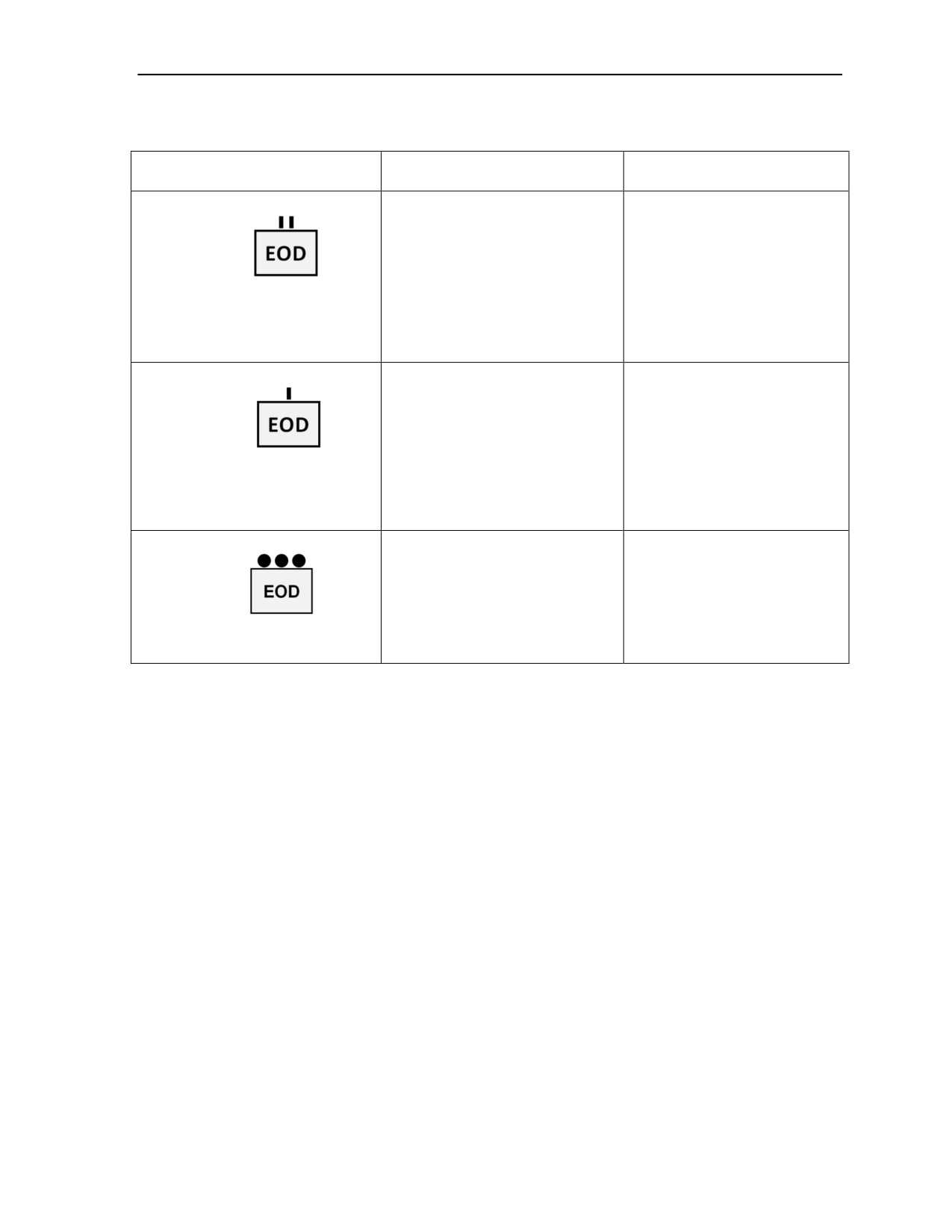
Explosive Ordnance Disposal Operations
Table 3-1. Explosive Ordnance Disposal rules of allocation
Explosive Ordnance Disposal
Supported Organization
Modeling Rule of Allocation
(EOD) Organization
theater army
1 per theater army
corps
1 per corps
division
1 per division
joint task force
1 per joint task force
combined joint task force
1 per combined joint task force
Battalion
EOD group
2 per homeland defense/
defense support of civil
authorities
1 per 2 - 7 EOD company
brigade combat team (BCT)
1 per BCT
maneuver enhancement brigade*
1 per maneuver enhancement
Special Forces (SF) group
brigade
ranger regiment
1 per SF group
EOD battalion
1 per ranger regiment
Company
8 per homeland defense/
defense support of civil
authorities
1 per 1-5 EOD platoon
maneuver battalion
3 per committed BCT
SF battalion
1 per SF battalion
ranger battalion
1 per ranger battalion
EOD company
24 for homeland defense/
defense support of civil
Platoon
authorities
1 per every 3-4 EOD team
Note: The EOD group and battalion commands and staffs may exercise synchronized command of Army, joint, and
multinational EOD forces. Senior EOD personnel provide the expertise to plan, prepare, execute, assess and integrate external
EOD formations into the supported unit.
*Support provided to the maneuver enhancement brigade when assigned an area of operation
ECHELONS ABOVE BRIGADE
3-11. The EOD group and battalion are normally employed at echelons above the brigade and perform
theater-level EOD planning, integrating, coordinating and tasking functions. The EOD group and battalion
exercise synchronized mission command of Army, joint, and multinational EOD forces as well as provides
mission command for counter-IED assets within a theater.
EOD Group
3-12. The EOD group is a functional mission command headquarters for EOD operations. The group
conducts staff planning and technical control of all EOD assets in a theater and provides EOD staff liaison
to the ASCC. The EOD group is capable of conducting EOD mission command for two to six EOD
battalions. The EOD group is attached or placed OPCON, to coordinate counter-IED and weapons
technical intelligence operations, to a theater army, corps, or JTF in support of a specific operation,
operation order, operation plan, or concept plan. The group may also form the core of a specialized
combined JTF with mission of various protection and exploitation enablers such as counter-IED,
exploitation, or counter-WMD task forces. The group can also provide enabling support, analysis, and
advisement to execute targeting efforts, theater exploitation, and counter-WMD in order to provide
maneuver support and force protection in all operational environments
1 April 2014
FM 4-30
3-3
Chapter 3
EOD Battalion
3-13. The EOD battalion reports directly to the EOD group. It may deploy with its assigned EOD group or
be placed OPCON to a separate EOD group. The EOD battalion is also a functional mission command
headquarters for EOD operations and may conduct staff planning for counter-IED assets within a division’s
AO. The EOD battalion is capable of conducting EOD mission command of EOD operations for two to
seven EOD companies.
Army National Guard
3-14. Army National Guard EOD assets are located within several states and the Commonwealth of Puerto
Rico. Administered by the National Guard Bureau (a joint bureau of the departments of the Army and Air
Force), the Army National Guard has both a federal and state mission. The dual mission, a provision of the
U.S. Constitution and U.S. Code, results in each Soldier holding membership in both the National Guard
and in the US Army.
EOD Staff Officer/Non-Commisioned Officer
3-15. The EOD staff officer and noncommissioned officer (NCO) are a key link between the corps or
division commanders and EOD forces integrated into tactical level operations. The officer and NCO must
understand joint and Army EOD doctrine and articulate capabilities, constraints and limitations of EOD
units.
z
The EOD officer provides information about resourcing, integration and reallocation of EOD
capability into the corps or division AO.
z
The EOD NCO has a technical focus; offering guidance on the render safe procedure and
exploitation expertise EOD Soldiers possess.
BRIGADE LEVEL EOD ORGANIZATIONS
3-16. The EOD company headquarters oversees platoons and teams. Decentralized execution of mission
orders is executed at the EOD team level. EOD company leadership should maintain a physical presence in
the supported brigade’s command post in order to maintain continuous integration into brigade planning
and operations. Leaders should understand EOD capabilities and limitations to ensure effective utilization
of the EOD company, platoons, and teams.
EOD COMPANY
3-17. The EOD company oversees one to five EOD platoons. It also provides administrative company
level planning and support determined by level of employment including augmenting BCTs with a special
staff element. The EOD company provides EOD service throughout the theater AO and direct support to
designated BCT, brigade and special forces groups.
EOD Platoon
3-18. The EOD platoon is normally employed at the battalion level and provides leadership, supervision
and technical guidance for three to four EOD teams, typically consisting of three personnel. The EOD
platoon provides the capability to eliminate and reduce explosive, chemical, biological, and nuclear
hazards, including IEDs and conventional U.S. and foreign UXO. The platoon provides support to the U.S.
Secret Service and Department of State in protection of the President, Vice President and other dignitaries
as directed.
EOD Company (CONUS Support)
3-19. The EOD company (CONUS Support) is under the mission command of an EOD battalion and
employed based on the concept of support requirements. The company provides EOD service in the
reduction and elimination of hazardous munitions and explosive devices to federal, state, and local
3-4
FM 4-30
1 April 2014
Explosive Ordnance Disposal Operations
governments and agencies on an area basis. The EOD company is dependent on an ordnance battalion for
administrative and supply services/support.
EOD Company (WMD)
3-20. The EOD company (WMD) provides highly technical EOD operations and containment procedures
for WMD in support of joint or interagency operations. It has the ability to respond anywhere in the world
with two fully capable eight Soldier platoons as part of the joint technical operations team. The unit has the
capability to provide four WMD platoons to support the Army or other U.S. agencies in support of missions
to defeat or mitigate WMD directed against the U.S. or areas of national interest.
JOINT OPERATIONAL PHASING CONSTRUCT
3-21. The phased construct is utilized in campaign planning to provide intermediate goals in order to
accomplish the overall objective of a successful campaign (JP 5-0). Phases are distinct in time, space,
and/or purpose from each other and represent a natural progression. Though the phases are designed to be
conducted sequentially, EOD mission sets, like other activities, may begin in a previous phase and continue
into subsequent phases. EOD Support descriptions are found in Army Techniques Publication (ATP) 4-32,
EOD Operations.
PHASE 0: SHAPE
3-22. Joint and multinational operations, including normal and routine military and interagency activities,
which are performed to dissuade or deter potential adversaries and to assure or solidify relationships with
allies. EOD missions and capacities that support Phase 0 operations include the following:
z
Humanitarian de-mining support.
z
Military to military engagements.
z
Support to foreign internal defense and security force assistance activities.
z
Joint prisoner of war/missing in action accounting command support.
PHASE I: DETER
3-23. Demonstration of capabilities and the resolve of the joint force to deter undesirable adversary action.
This includes activities to prepare forces and set conditions for deployment and employment if deterrence is
not successful. EOD mission and capabilities that support Phase I operations include the following:
z
Habitual training relationships with conventional and special operations forces.
z
Technical intelligence activities.
z
Counter WMD support operations.
PHASE II/III: SEIZE INITIATIVE / DOMINATE
3-24. Phase II/III involves application of appropriate force capabilities to seize the initiative and break the
enemy’s will for organized resistance. EOD missions and capabilities that support Phase II/III operations
include the following:
z
EOD render safe/disposal of explosive ordnance, IEDs, and homemade explosives.
z
Render safe, disposal and exploitation of recovered explosive ordnance.
z
Removal of stuck rounds and downloading of misfired munitions.
z
Management of special programs.
z
Support to special operations (special operations force core operations and activities).
PHASE IV: STABILIZE
3-25. Stabilization includes performance of limited local governance, integrating all joint, interagency,
intergovernmental and multinational participants until legitimate local governmental entities are
functioning. EOD missions and capabilities that support phase IV operations include the following:
1 April 2014
FM 4-30
3-5
Chapter 3
z
Perform battlefield clearance.
z
Captured material exploitation.
z
Mission command of functional task forces
(counter-IED, WMD elimination, asymmetric
threats).
z
Department of State Diplomatic Security Service support.
PHASE V: ENABLE CIVIL AUTHORITY
3-26. Joint force support to legitimate civil governance in theater enables the viability of the civil authority
and its provision of essential services. EOD units help build indigenous military and police EOD and
exploitation capability. EOD support to Phase V is a continuation of missions performed in previous
phases.
SUMMARY
3-27. Ordnance EOD supports the commander’s mission through its four functional areas; render safe,
technical intelligence, protection support, and disposal. These four basic EOD functions also directly
support various Army warfighting functions. EOD staff officers and NCOs participate in their supported
command’s mission analysis to determine the EOD capabilities, task organization, and support
relationships necessary to accomplish the mission. Coordination and integration of EOD operations at all
echelons is critical due to limited EOD forces and assets. EOD assets may be task organized with a variety
of units and organizations, including multinational forces. While EOD operations are inherently dangerous,
catastrophic risk can be mitigated through strict adherence to applicable safety precautions, techniques,
principles, and by careful analysis and implementation of lessons learned.
3-6
FM 4-30
1 April 2014
Chapter 4
Maintenance Operations
This chapter provides an overview of the Army’s maintenance system, the ordnance
organizations that perform maintenance functions, and describes the maintenance
roles and responsibilities at various command levels. Maintenance support begins at
the U.S. industrial base with strategic partners and is projected forward in to the area
of responsibility by operational maintenance units. This chapter discusses the
relationships between the various strategic partners and operational organizations
from strategic level to the tactical point of need.
SECTION I - MAINTENANCE FUNDAMENTALS
4-1. The primary purpose of maintenance is to generate and sustain combat power and when properly
planned, resourced, and executed is the logistics function that delivers readiness and equipment
serviceability to the commander. All logistics functions contribute to the overall success of an operation.
Equipment serviceability is a major indicator of a unit’s combat readiness and a fully mission capable fleet
of equipment is essential to unified land operations. Maintenance operations also protect the vastly
expensive equipment investment capital by ensuring that all weapons systems, platforms, and equipment
meet their intended purpose for the duration of their programmed service life.
4-2. Maintenance does not occur just on the battlefield. It is a very wide reaching function that begins at
the U.S. industrial base, including various strategic partners, and continues deep into the AOR to the
tactical point of need. Across this span, commanders, staffs, Soldiers, and maintainers work together to
monitor maintenance status, communicate maintenance needs, and perform maintenance functions to
ultimately keep the force ready to perform its mission.
4-3. Maintenance operations perform two broad functions to support Army operations: it keeps equipment
mission capable and ready to support commander’s operational needs and it keeps a ready pool of
serviceable equipment in the supply system to replace severely damaged equipment. These are
accomplished through the Army’s two-level maintenance system. Maintenance operations also support the
force through management and distribution of supply class IX repair parts. Class IX management originates
at the industrial base with strategic partners and is distributed into the AOR with management conducted by
staffs and maintenance units at all echelons down to the tactical point of need.
TWO-LEVEL MAINTENANCE
4-4. The Army utilizes a tiered maintenance system. Two-level maintenance is a maintenance system
comprised of field and sustainment maintenance. Two-level maintenance utilizes equipment design,
diagnostic and prognostic equipment and tools, mechanic and technician training, information systems and
management aids in component repair or replacement taking full advantage of increased reliability,
resulting in increased flexibility and depth of capability. At the core of the maintenance process is
performance observation and reporting, equipment services, fault repair, and single-standard repair.
FIELD MAINTENANCE
4-5. Field maintenance is on-system maintenance, repair and return to the user including
maintenance actions performed by operators. It is often performed on or near the unserviceable piece of
equipment or weapon system utilizing line replaceable units and component replacement or repair. It is
most often performed by the owning unit using tools and test equipment found in the unit. Field
maintenance is not limited to simply remove and replace actions. Field maintenance allows for repair of
1 April 2014
FM 4-30
4-1
Chapter 4
components or end items on or near the system if the maintainers possess the requisite skills, proper tools,
proper repair parts, references, and adequate time. Field maintenance also includes adjustment, alignment,
service, applying approved field level modification work orders, fault/failure diagnoses, battle damage
assessment, repair, and recovery. Field maintenance is always repair and return to the user and includes
maintenance actions performed by operators.
4-6. Most organizations in the Army have field maintenance personnel and equipment assigned to
perform field maintenance on the organization’s equipment. The extent of a unit’s field maintenance
capability in terms of trained personnel and tools is determined by equipment type and density. Some units
may have a piece of equipment with no trained mechanics or tool kits because the density of that equipment
is too small to justify the allocation of personnel and tools kits. In this instance, the unit relies on a
designated supporting maintenance organization providing area support for repair of the low-density
equipment.
4-7. There are organizations that are assigned limited or no field maintenance capability or capacity.
These organizations normally receive field maintenance, field maintenance support, or augmentation from
a designated supporting organization that is designed to provide maintenance for that unit. Maneuver
battalions in BCTs are examples of organizations without organically assigned field maintenance
capability. These organizations receive field maintenance from FSCs assigned to a BSB. Functional
brigades lacking maintenance within any equipment or commodity area will normally coordinate for
support with a sustainment brigade/ CSSB. The sustainment brigade/ CSSB, through its assigned support
maintenance company (SMC), normally provides field maintenance to echelons above brigade units
without internal maintenance capabilities.
SUSTAINMENT MAINTENANCE
4-8. Sustainment maintenance is off -system component repair and/or end item repair and return to
the supply system or by exception to the owning unit, performed by national level maintenance
providers. National level maintenance providers include the USAMC and installation directorate of
logistics maintenance activities. The sustainment maintenance function can be employed at any point in the
integrated logistics chain. The intent of this level is to perform commodity-oriented repairs to return items
to a national standard, providing a consistent and measureable level of reliability and to execute
maintenance actions not able to be performed at the field level of maintenance. Sustainment maintenance
supports both operational forces and the Army supply system.
SECTION II - STRATEGIC MAINTENANCE PARTNERS
4-9. Strategic maintenance partners for the Ordnance Corps include elements of the ASA(ALT) and the
USAMC.
UNITED STATES ARMY MATERIEL COMMAND
4-10. The USAMC is the Army’s materiel provider and plays a major role in maintenance operations and
repair parts management. USAMC organizations provide all Army sustainment maintenance support
through depots, AFSBs, and through directorates of logistics. USAMC also procures class IX repair parts
for distribution to maintenance activities at all levels and echelons.
4-11. The USAMC is the lead for the Army’s national-level maintenance and supply programs which are
managed and executed by its subordinate LCMC.
LIFE CYCLE MANAGEMENT COMMANDS
4-12. The USAMC life cycle management commands, together with the ASA(ALT), program executive
officers, product managers, and PMs ensure support for fielded weapon systems and equipment throughout
their entire life cycle. LCMCs also provide support through various logistics assistance representatives
attached to AFSBs. The exact organizational make up of each LCMC varies.
z
Army Aviation and Missile Command (AMCOM) - AMCOM, together with the related
ASA(ALT) program executive officers, PMs, and product managers integrate functions across
4-2
FM 4-30
1 April 2014
Maintenance Operations
their commodities and sustain aviation, missile and unmanned vehicle systems, ensuring weapon
systems readiness with seamless transition to combat operations. The AMCOM performs
applied research, integrated logistics support, materiel readiness management, and maintenance
support for Army aviation and missile systems, subsystems, and associated equipment.
z
Communications-electronics command
(CECOM)- CECOM, together with the related
ASA(ALT) program executive officers and PMs, integrate functions across their commodities
and sustains command, control, communications, computers, intelligence, surveillance, and
reconnaissance information systems. The CECOM LCMC performs integrated logistics support,
materiel readiness management, maintenance support, and provides technical support
capabilities to deployed Army forces.
z
Tank-automotive and armaments command (TACOM)- TACOM, together with the related
ASA(ALT) program executive officers and PMs, integrates functions across their commodities
and sustains Soldier and ground support systems for the operating force through the integration
of effective and timely ALT. It provides acquisition support of repair parts. It also overhauls,
modernizes, and repairs TACOM -LCMC commodity equipment.
ARMY SUSTAINMENT COMMAND
4-13. ASC is a subordinate command of USAMC and is the Army’s lead materiel integrator. The ASC is
normally focused on CONUS logistics support operations but it also supports the operational maintenance
mission through a network of organizations including a distribution management center. ASC is ultimately
responsible for ensuring adequate sustainment maintenance force structure is available and for distribution
of class IX repair parts to the area of responsibility. ASC executes these functions through subordinate
AFSB, and Army field support battalions. The AFSBs and Army field support battalions operate as the link
from the ASC CONUS-based operations to the AOR.
Army Field Support Brigade
4-14. AFSBs are assigned to the ASC and are normally regionally aligned to an ASCC. When deployed,
the AFSB is normally placed under the OPCON of a TSC or ESC, if employed. The AFSBs mission is to
provide the USAMC national-level sustainment support to deployed forces to include sustainment
maintenance and class IX repair parts distribution. The AFSB may also provide field maintenance support
for deployed forces as required. The AFSB SPO section is responsible for all external sustainment
functions and coordination with the appropriate USAMC subordinate command and/or LCMC to meet
mission needs.
4-15. The AFSB normally has one or more Army field support battalions attached that increase the span of
control of the AFSB. The following are specific AFSB mission responsibilities:
z
Oversees assigned or attached Army field support battalions and brigade logistics support teams
and their supporting USAMC LCMC staffs.
z
Plan for and provide command over USAMC call-forward sustainment maintenance and forward
repair activity organizations.
z
Manage, maintain, and retrograde designated theater provided equipment.
Army Field Support Battalion
4-16. Army field support battalions are deployable USAMC, table of distribution and allowance
organizations that remains under the mission command of the AFSB commander in all operations. Army
field support battalions have tailored capabilities that support Army equipment operational readiness
through prioritization, integration, and synchronization of USAMCs national-level provider efforts. They
also assist in the coordination and synchronization of ALT actions in their designated mission support area.
The logistics assistance representatives assigned to the USAMC LCMCs--AMCOM; CECOM, Joint
Munitions and Lethality; and TACOM-- are the core of the logistics assistance program and are the central
part of the Army field support battalions. The Army field support battalion’s primary contingency mission
focus is supporting deployed Army weapon systems, support systems, and other Army systems as required.
1 April 2014
FM 4-30
4-3
Chapter 4
4-17. The Army field support battalion is also capable, with the requisite augmentation, of providing
sustainment maintenance support to deployed units. The Army field support battalion SPO section is
responsible for all Army field support battalion external support operations. It is responsible for overseeing
materiel management and sustainment-level maintenance for supported units. The SPO also recommends
reach back and or call-forward actions from appropriate USAMC subordinate command and or LCMC to
meet mission requirements.
4-18. The Army field support battalions are also responsible for managing APS, and selected pre-
deployment training equipment. APS include repair parts for Army maintenance activities. Army field
support battalions can also be augmented with a variety of USAMC organizations to include equipment
support activities, forward repair activities, combat vehicle evaluation teams, and component repair teams.
BRIGADE LOGISTICS SUPPORT TEAM
4-19. The brigade logistics support teams are organized under a specific table of distribution and
allowances, based on the type of unit they support. The brigade logistics support teams team chief has
direct interface with the BSB SPO and the supported unit S-4 and is responsible for the brigade logistics
support teams operations and personnel. There are two types of brigade logistics support teams: (1)
BCT/CAB and (2) multi-functional brigades and echelon above brigade units.
z
Brigade logistics support teams - BCT/CAB - is a small modular team consisting of the ASC
brigade logistics support teams chief and logistics assistance program representatives. They are
aligned with each of the active component BCTs (infantry, Stryker, armor) and CAB. Each team
is comprised of 8-11 logistics assistance program representative from AMCOM, CECOM, and
TACOM and a logistics management specialist from ASC that report to the brigade logistics
support teams chief. The brigade logistics support teams provide support to the BCT/CAB and
limited area support to other units in their geographical area.
z
Brigade logistics support teams echelons above brigade - is a small modular team headed by the
ASC brigade logistics support teams chief, aligned with the maneuver enhancement, air defense
artillery, signal, theater aviation brigades and special operations forces units. Each team is
comprised of 8-11 logistics assistance representatives from AMCOM, CECOM, and TACOM,
and a logistics management specialist from ASC that report to the brigade logistics support
teams chief. They provide support to these units and limited area support to other units in their
geographic area.
4-20. The skill sets within the brigade logistics support teams are dependent on equipment and technology
densities being supported. When deployed, brigade logistics support teams are normally attached to an
AFSB in accordance with mission, enemy, terrain and weather, troops and support available, time
available, civil considerations mission variables. Brigade logistics support teams, with augmentation, can
perform limited and short-term split-based operations while the brigade logistics support teams displaces in
support of their supported unit. The brigade logistics support teams mission areas and capabilities include
but are not limited to:
z
Providing logistics assistance representative technical expertise from the appropriate USAMC
organization.
z
Assisting in coordinating ALT assistance called forward to support their supported unit.
z
Providing technical support and reach back capability from their supported unit to the
appropriate USAMC command.
z
Assisting the AFSB reception, staging, onward movement, and integration cell, and supervising
AFSB in the accounting of and deployment assistance of personnel.
SECTION III - ECHELONS ABOVE BRIGADE OPERATIONAL
ORGANIZATIONS
4-21. Within an AOR there are normally three operational headquarters organizations at echelons above
brigade; the ASCC, the corps, and the division. The commander and staff of each of these headquarters
organizations have very similar maintenance and repair parts support responsibilities. All are ultimately
4-4
FM 4-30
1 April 2014
Maintenance Operations
responsible for ensuring that subordinate organizations have adequate maintenance support and equipment
readiness.
4-22. The ASCC is the senior Army command in an AOR. It is the headquarters with Title 10, United
States Code logistics support responsibilities and is responsible for ensuring adequate logistics support
structure, to include maintenance and class IX repair parts support, is available within the AOR for
allocation to the corps and division commands. As such, the ASCC commander is responsible for
recommending to the GCC the request for and allocation of U.S Army maintenance organizations. The
ASCC also recommends how these organizations forces should be allocated and employed. The ASCC
provides oversight of the TSC and establishes the TSC priorities for maintenance support throughout the
AOR.
4-23. The ASCC, corps, and division commanders and their staffs play an important part in ensuring that
subordinate commander’s maintenance needs are met. The G-4 on each of the staffs is the primary logistics
coordinating staff. At all echelons it receives, consolidates, and analyzes equipment readiness status reports
submitted by subordinate commands. Based upon the analysis, the G-4 reports the maintenance status to the
commander who ultimately passes the information to the next higher level of command to include
recommendations to increase or reallocate maintenance structure to meet readiness needs. Also based upon
the assessment of maintenance status, the G-4 staffs formulate policy, procedures, and directives related to
the maintenance readiness of the force.
4-24. The ASCC, corps, and division G-4 staffs do not directly manage maintenance or class IX support
operations but rather establish priorities that are executed by and are synchronized with the appropriate
supporting organizations. The G-4 staffs must continually coordinate with the appropriate sustainment
headquarters to ensure that systemic maintenance problems are understood and addressed during materiel
readiness reviews.
MODULAR ORGANIZATION MAINTENANCE RESPONSIBILITIES
4-25. At echelons above brigade there are multiple modular organizations that range from detachment to
battalion size. Types of modular units include military police, engineer, chemical, air defense,
quartermaster, ordnance, transportation, signal, and others. The assigned maintenance and class IX support
capability within these organizations varies widely based upon the size and type of organization and the
density of its equipment. In many instances the maintenance capability is limited to wheeled vehicles and
other common commodities such as small arms or signal equipment. Units that have limited or no
maintenance capability or limited to no maintenance capacity rely on designated support maintenance
companies operating on an area basis to augment the assigned maintenance capability and capacity of the
organization.
4-26. The field maintenance capability within these organizations, especially for units with limited
maintenance capability, is normally located within the headquarters and headquarters company, company,
or detachment headquarters. Larger units with greater maintenance requirements may have a separate
maintenance section or team assigned to the unit. Units with high densities of equipment or units with very
specialized equipment may have separate maintenance companies. Examples of these types of units are
engineer battalions and air defense artillery units.
4-27. Commanders and staffs of modular organizations operating above brigade level must understand the
sustainment organizations in place to provide support to the area within which they operate. Commanders
and staffs must take the initiative to establish contact and to coordinate with the supporting organization to
ensure adequate maintenance and class IX support is available.
4-28. Sustainment organizations providing area support must be aware of the types and quantity of
modular units operating in the supported area. The sustainment organizations must ensure that an adequate
number of support maintenance companies are allocated to provide maintenance and class IX support to
these units.
1 April 2014
FM 4-30
4-5
Chapter 4
SECTION IV - ECHELONS ABOVE BRIGADE SUSTAINMENT
ORGANIZATIONS
4-29. Sustainment organizations with maintenance and maintenance management responsibilities above
the brigade level include the TSC, ESC, sustainment brigade, CSSB, and the SMC.
THEATER SUSTAINMENT COMMAND
4-30. The TSC is the senior Army sustainment headquarters in an AOR and is ultimately responsible for
ensuring that adequate maintenance support capability is available within an AOR to meet the GCC and
Army forces desired end state. The TSC receives maintenance priorities from the ASCC and directs
subordinate sustainment organizations to execute the maintenance support as required. The TSC must
continually coordinate with ASCC, corps, and, if necessary, division headquarters to ensure it stays abreast
of maintenance support requirements and systemic maintenance problems. The TSC must direct and
allocate maintenance support accordingly. The TSC executes this support through ESCs, if employed, and
through sustainment brigades.
4-31. The TSC support operations section is responsible for maintenance management within the AOR.
This includes monitoring and allocating adequate maintenance support. The materiel readiness branch
within the SPO section is specifically responsible for maintenance management. It includes ground and
electronic maintenance sections that monitor mechanical, communications, electronics, armament, materiel
handling equipment, special purpose equipment, and construction equipment maintenance.
4-32. The TSC has assigned field maintenance capability within its special troops battalion that provides
maintenance support for the TSC headquarters equipment. For more information refer to ATP 4-94,
Theater Sustainment Command, 28 June 2013.
EXPEDITIONARY SUSTAINMENT COMMAND
4-33. Considering mission, enemy, terrain and weather, troops and support available, time available, civil
considerations mission variables the TSC commander may employ one or more ESCs to provide mission
command of sustainment operations, to include maintenance, within an AO or JOA. While normally
attached to a TSC, the ESC may also be OPCON to a corps headquarters or JTF if required. If employed an
ESC is responsible for ensuring adequate maintenance support capability is available within an AO/JOA to
meet the corps commander or JTF commander end state. The ESC must continually coordinate with corps,
JTF and, if necessary, division headquarters to ensure it stays abreast of maintenance support requirements
and systemic maintenance problems. The ESC must direct and allocate maintenance support accordingly.
The ESC executes this support through sustainment brigades.
4-34. The ESC SPO section is responsible for maintenance management within the AO/JOA. This
includes monitoring and allocating adequate maintenance support. The materiel readiness branch within the
SPO section is specifically responsible for maintenance management. It includes sections that monitor
mechanical, communications, electronics, armament, materiel handling equipment, special purpose
equipment, and construction equipment maintenance.
4-35. The ESC has assigned field maintenance capability within its headquarters company that provides
maintenance support for the ESC headquarters equipment.
SUSTAINMENT BRIGADE
4-36. The sustainment brigade is attached to a TSC or an ESC, if employed, and provides maintenance and
class IX management and support to Army forces on an area basis. The sustainment brigade coordination
requirements differ from the ESC and TSC. The sustainment brigade is the link from echelons above
brigade sustainment to the brigade. Therefore the sustainment brigade must continually coordinate with the
supported operational headquarters, normally division headquarters, and the supported brigades. This
coordination is necessary to ensure the sustainment brigade commander and staff understand maintenance
support priorities, maintenance requirements, and allocates maintenance assets properly. The sustainment
4-6
FM 4-30
1 April 2014
Maintenance Operations
brigade executes maintenance support through CSSBs. The sustainment brigade SPO office coordinates
maintenance management and support within the supported area. The SPO advises the commander on
balancing maintenance support requirements with maintenance capabilities. The SPO section contains a
maintenance branch that manages electronic, armament, mechanical, special purpose, and engineer
equipment maintenance.
4-37. The sustainment brigade maintenance section has assigned field maintenance capability that supports
headquarters equipment. For more information refer to ATP 4-93 Sustainment Brigade, 9 August 2013.
COMBAT SUSTAINMENT SUPPORT BATTALION
4-38. The division and corps aligned CSSB is a modular organization that consists of a headquarters
company, a multi-capable supply company, a composite truck company, and a SMC capable of providing
flexible and responsive sustainment throughout the corps or division AO.
4-39. The CSSB is the headquarters organization to which SMCs are normally attached, mission
dependent. The CSSB oversees the SMC and directs their maintenance support efforts. The CSSB ensures
that the SMC are properly allocated based upon supported unit density and is capable of commanding up to
seven companies. The CSSB does not manage maintenance support to BCT but does manage supply
distribution to the BSBs within the BCT.
4-40. The CSSB SPO office conducts maintenance and class IX management and support within its
supported area. The SPO office has a maintenance manager and a maintenance control sergeant to oversee
maintenance workload, requirements, and to identify systemic maintenance problems. These personnel
manage electronic, armament, mechanical, special purpose, and engineer equipment maintenance.
4-41. The CSSB headquarters company has assigned field maintenance capability that supports CSSB
headquarters equipment.
SUPPORT MAINTENANCE COMPANY
4-42. The SMC is a modular maintenance company that provides field maintenance support on an area
basis to units at echelons above brigade. The SMC is normally attached to a CSSB but may be attached
directly to a sustainment brigade headquarters or other headquarters element if dictated by the situation.
The SMC is structured to provide maintenance support to a wide variety of organizations and for most
types of equipment. The SMC provides allied trades support; wheeled vehicle recovery; armament;
wheeled vehicle; communications; electronics; special electronic devices; ground support equipment;
power generation equipment; utility equipment; and test, measurement, and diagnostic equipment (TMDE)
maintenance and quality control.
4-43. The SMC has maintenance teams that can be tasked to provide support in multiple locations. It is
designed to augment the field maintenance capability of modular units operating above the brigade echelon.
The SMC is not intended or designed as a source of back up maintenance support for the BSB. The SMC
does not have M1 or M2/M3 system maintenance capability. The SMC receives maintenance support
priorities from the CSSB.
SECTION V - BRIGADE COMBAT TEAM MAINTENANCE SUPPORT
4-44. BCTs include the infantry BCT , armor BCT, and Stryker BCT. They each have an organic BSB that
functions as the primary source of sustainment for the BCT. The BSBs are similar in structure and provide
field maintenance support via the field maintenance company (FMC), and have FSCs that provide field
maintenance support to the maneuver battalions assigned to the BCT. The BSB SPO and the brigade S-4
coordinate field maintenance support of assigned equipment through their subordinate FSCs and the FMC.
FIELD MAINTENANCE COMPANY
4-45. FMCs are assigned one per BSB and are normally based in the BSA. The FMC is designed to
provide maintenance support to the BSB and the brigade headquarters elements. It may also provide
1 April 2014
FM 4-30
4-7
Chapter 4
support for low density equipment such as communication and special electronic devices, chemicals and
armament that are beyond the FSC capabilities. It also provides additional recovery and machine shop
support to the FSCs. FMCs provides support status and information on company operations to the BSB
commander and supported organizations.
4-46. The FMC receives commander’s intent and guidance from the BSB commander and maintenance
tasks from the BSB SPO. The FMC provides direct support to the BSB. The FMC provides maintenance
support, within its capabilities, on an area basis to any non-BCT unit attached, OPCON, or otherwise
operating within the BCT AO. The FMC maintains some repair parts for shop operations but is dependent
on the BSB distribution company for class IX support. Refer to FM 4-90, Brigade Support Battalion for
additional information. FMCs provide maintenance support for wheeled and tracked vehicles (minus M1
and M2/M3), missile and electronic equipment (radar, special electronic, communication and missile
equipment), ground support equipment
(power generation, quartermaster and utilities equipment),
armament systems (small arms, fire control armament systems), service and recovery to include support
maintenance evacuation.
4-47. Although the FMC augments FSC maintenance capability for low-density equipment, the FMC is not
designed to operate as back-up maintenance for the armored BCT FSCs or the infantry BCT FSCs. The
FMC does however provide support for low density equipment such as communications and special
electronics devices, chemical equipment, and armament repair that is beyond an FSC’s capabilities.
FORWARD SUPPORT COMPANY
4-48. The BSB has organic FSCs that provide direct support to each of the BCT maneuver and maneuver
support battalions. Each FSC is organized to provide maintenance to a specific type of maneuver battalion,
maneuver support battalion, or squadron. The FSCs are assigned to the BSB and are normally controlled by
the BSB commander. This allows the BSB commander and the BSB SPO to task organize the FSCs and
cross level assets among the FSC when it’s necessary to weigh the logistic support to the BCT. The FSCs
depend on the BSB for administrative support, some logistic support, and technical oversight.
4-49. Depending on the current operation and situation an FSC may be attached or placed under OPCON
of the battalion it supports. The decision to establish this type of command relationship and to decide the
duration and scope of the command relationship, is made by the brigade commander upon the advice of the
BSB commander following a careful and thorough mission analysis. All commanders must understand that
this type of command relationship limits the BSB commander’s and ultimately the brigade commander’s
flexibility to support the brigade until the attached/OPCON FSC is fully restored to the operational control
of the BSB commander. FSC attachment or OPCON to its supported battalion is generally limited in
duration and may be for a specific mission, phase of an operation, or an entire deployment, based on the
brigade commander’s discretion.
4-50. The FSC may be divided with some elements collocated with the supported battalion and some
elements in the BSA. For example, it may be desirable to locate the FSC field maintenance teams with the
supported battalion and the remainder of the FSC in the BSA. This type of task organization must be
determined by the FSC commander in collaboration with the BSB and maneuver battalion commanders.
The FSC is capable of providing allied trades, recovery, class IX, missile, wheeled and tracked vehicle
maintenance, armament, and communication and electronic repair.
SECTION VI - COMBAT AVIATION BRIGADE SUPPORT
4-51. The CAB provides attack, general support and assault helicopter support to the operational force. The
CAB has an ASB assigned to provide ground field maintenance.
AVIATION SUPPORT BATTALION
4-52. The CAB has an assigned ASB that provides field maintenance support for ground equipment. The
size and structure of the ASB maintenance section varies slightly from light, medium to heavy combat
aviation brigades.
4-8
FM 4-30
1 April 2014
Maintenance Operations
4-53. The CAB aviation battalion has FSCs assigned to provide field maintenance support. The FSCs each
have a maintenance section to support the battalion’s ground equipment. The size and structure of the
maintenance section varies by the type of aviation battalion, assault, attack, general support, or medical.
HEADQUARTERS AND SUPPORT COMPANY
4-54. The ASB provides command intent and guidance for the headquarters and support company. The
headquarters and support company maintenance platoon provides field maintenance on automotive
equipment, communication devices, and ground support equipment. This support includes limited lift
capability, recovery, allied trades and maintenance evacuation for supported units. The maintenance control
section directs, controls and supervises field maintenance activities throughout the company. It also
performs maintenance management and production control functions and maintains class IX (ground)
repair parts for company ground onsite field maintenance operations.
4-55. The headquarters and support company is not designed to operate as back-up maintenance for the
FSC or to provide support for low density equipment that are beyond the FSCs’ capabilities.
FORWARD SUPPORT COMPANY
4-56. The FSC is assigned and tailored to a respective aviation battalion. The FSC provides the ground
field maintenance support for allied trades, recovery missions, repair parts, armament, communications and
electronics, and field level maintenance operations for organic ground equipment. The FSC’s maintenance
platoon headquarters is responsible for providing the planning and coordination for ground equipment field
maintenance support to the supported battalion. This element also performs field level maintenance
management, production control and maintains class IX (ground) repair parts for shop operations. The
FSCs are dependent on the headquarters and support company ASB for sustainment automation
management support. The FSCs also depend on the ASB for supplemental recovery, automation
management and ground field maintenance support on the units’ assigned vehicles, weapons, and ground
support equipment.
SECTION VII - TEST, MEASUREMENT, AND DIAGNOSTIC EQUIPMENT
SUPPORT
4-57. TMDE is defined as any system or device used to evaluate the operational condition of an end item
or subsystem thereof to identify and/or isolate any actual or potential malfunction. TMDE oversight begins
at the TSC level. Commanders at all levels are responsible for their unit’s TMDE readiness and will
appoint a TMDE coordinator to interact on their behalf with their assigned TMDE support activity.
4-58. Types of TMDE range from torque wrenches in a toolbox to complex equipment supporting
sophisticated weapon systems. The Army’s TMDE program supports a number of technical parameters
such as infrared, electro-optics, direct current, low frequency, microwave, radiation, detection, indication
and computation, mechanical, hydraulics, and pneumatics.
4-59. The objective of the Army’s TMDE program is to ensure accurate and serviceable TMDE is
available for Army use with measurement accuracies traceable to national, international, or intrinsic
standards. Highly technical organizations consisting of military, civilian, and contractor personnel are
responsible for calibration and repair of Army TMDE. The military area TMDE support team provides the
primary table of organization and equipment TMDE mission support.
4-60. TMDE support within an area of responsibility is normally performed by an area TMDE support
team which is assigned to SMCs. Each area TMDE support team is capable of providing field level
calibration and repair support to any Army unit that owns and/or uses general purpose or selected special
purpose TMDE.
1 April 2014
FM 4-30
4-9
Chapter 4
SECTION VIII - CONTRACTED MAINTENANCE SUPPORT
4-61. Contracted maintenance support is a method that can be employed to augment organic maintenance
capability or to provide maintenance support where none exists. It may be provided as a way of reducing
the operational burden on military maintenance forces during combat operations. Contracted maintenance
support can be obtained under a theater support contract. Theater support contracts can provide limited
maintenance related services based on the regionally available commercial support capabilities. Requiring
activities should consult with their supporting AFSB to ensure that other contract venues are not already in
place before submitting their maintenance support contract requirement to their supporting contracting
organization. All requiring activities must monitor their supporting contracts utilizing contracting officer
representatives and receiving officials for contracted logistics commodities. Requiring activities are also
responsible to coordinate with the supporting contracting organization to adjust the contract as necessary
based on changes to operational requirements. The use of contracted support to meet maintenance
requirements must be carefully analyzed.
4-62. The largest and most commonly used external support contract is the logistics civilian augmentation
program (LOGCAP). This Army program is commonly used to provide life support, transportation support,
and other support functions to deployed Army forces and other elements of the joint force. A sustainment
brigade may or may not serve as the requiring activity (the unit responsible for developing the requirements
package and assisting in managing specific contract support requirements) for LOGCAP support. If
designated by the Army forces commander and/or TSC commander as the requiring activity for a LOGCAP
task order support actions, the sustainment brigade would normally be augmented by a USAMC logistic
support officer from Team LOGCAP-Forward. The requiring activity/ supported unit will be required to
provide contracting officer representatives for contracted logistics services provided in the affected AO.
SYSTEMS SUPPORT CONTRACTED CAPABILITY
4-63. Systems support contracts are pre-arranged contracts by the USAMC LCMCs and separate
ASA(ALT) program executive officers and PM offices. Supported systems include, but are not limited to,
newly fielded weapon systems, mission command infrastructure, such as logistics information systems and
communications equipment. Systems support contractors provide support in garrison and may deploy with
the force to both training and real-world operations. They may provide either temporary support during the
initial fielding of a system, called interim contracted support or long-term support for selected materiel
systems, often referred to as contracted logistic support. The sustainment brigade does not normally have a
significant role to play in planning for or coordinating systems support contracts other than coordinating
and executing support of systems support contract related personnel.
SUMMARY
4-64. Ordnance maintenance operations are vital to unified land operations at every echelon and in support
of every operation that generates combat power. Maintenance is a key logistic function that sustains the
Army’s equipment. There are ordnance maintenance operations performed by Soldiers, civilians and
contractors, occurring in every organization at every echelon in the Army. Ordnance maintenance supports
the Army’s execution of decisive action in support of unified land operations through an integrated and
synchronized multi-level sustainment structure.
4-10
FM 4-30
1 April 2014
Glossary
The glossary lists acronyms and terms with Army or joint definitions. Where Army
and joint definitions differ, (Army) precedes the definition. Terms for which FM 4-30
is the proponent are marked with an asterisk (*).The proponent publication for other
terms is listed in parentheses after the definition.
SECTION I - ACRONYMS AND ABBREVIATIONS
ADP
Army doctrine publication
ADRP
Army doctrine reference publication
AFSB
Army field support brigade
AMCOM
Army Aviation and Missile Command
ASA(ALT)
Assistant Secretary of the Army for acquisition, logistics and technology
APS
Army prepositioned stocks
AO
area of operation
AOR
area of responsibility
AR
Army regulation
ARDEC
Armament Research, Development, and Engineering Center
ASA
ammunition support activity
ASB
aviation support battalion
ASC
Army Sustainment Command
ASCC
Army Service component command
ATP
Army techniques publication
ATHP
ammunition transfer and holding point
BAO
brigade ammunition officer
BCT
brigade combat team
BSA
brigade support area
BSB
brigade support battalion
CAB
combat aviation brigade
CECOM
communications-electronics command
CONUS
continental United States
CSR
controlled supply rate
CSSB
combat sustainment support battalion
DA
Department of the Army
DAC
Defense Ammunition Center
DOD
Department of Defense
DMC
distribution management center
EOD
explosive ordnance disposal
ESC
expeditionary sustainment command
FARP
forward arming and refueling point
FM
field manual
FMC
field maintenance company
1 April 2014
FM 4-30
Glossary-1
Glossary
FSC
forward support company
G-4
assistant chief of staff, logistics
GCC
geographic combatant commander
IED
improvised explosive device
JOA
joint operations area
JP
joint publication
JTF
joint task force
LCMC
life cycle management command
LOGCAP
logistics civilian augmentation program
NCO
noncommissioned officer
OPCON
operational control
PEO
program executive office
PM
program manager
QASAS
Quality Assurance Specialist (Ammunition Surveillance)
RSR
required supply rate
S-3
battalion or brigade operations staff officer (Army)
S-4
battalion or brigade logistics staff officer (Army)
SMC
support maintenance company
SMCA
single manager for conventional ammunition
SPO
support operations
TACOM
Tank-automotive and armaments command
TMDE
test, measurement, and diagnostic equipment
TSC
theater sustainment command
U.S.
United States
USAMC
United States Army Materiel Command
UXO
unexploded explosive ordnance
WMD
weapons of mass destruction
SECTION II - TERMS
*ammunition support activity
Locations that are designated to receive, store, maintain, and provide munitions support to Army
forces.
ammunition transfer and holding point
A designated site operated by a brigade support battalion distribution company where munitions are
received and transferred to supported units within a brigade combat team and may also temporarily
hold or store munitions as required (ADRP 1-02).
Army field support brigade
An organization which provides integrated and synchronized acquisition logistics and technology
support, less medical, to Army operational forces (ADRP 1-02).
*brigade ammunition officer
The multifunctional officer assigned to the BSB ammunition officer position within the SPO section
and serves as the principal munitions staff officer for the brigade.
Glossary-2
FM 4-30
1 April 2014
Glossary
*controlled supply rate
The rate of ammunition consumption that can be supported, considering availability, facilities, and
transportation.
* explosive ordnance disposal
The detection, identification, on-site evaluation, rendering safe, exploitation, recovery, and final
disposal of explosive ordnance.
* explosive hazards
A condition where danger exists because explosives are present that may react in a mishap with
potential unacceptable effects to people, property, operational capability, or the environment.
*field maintenance
On system maintenance, repair and return to the user including maintenance actions performed by
operators.
logistics
(DOD) The planning and executing the movement and support of forces. It includes those aspects of
military operations that deal with: design and development, acquisition, storage, movement,
distribution, maintenance, evacuation, and disposition of materiel; movement, evacuation, and
hospitalization of personnel; acquisition or construction, maintenance, operation, and disposition of
facilities; and acquisition or furnishing of services (JP 4-0).
mission command
(Army) The exercise of authority and direction by the commander using mission orders to enable
disciplined initiative within the commander’s intent to empower agile and adaptive leaders in the
conduct of unified land operations (ADP 6-0).
* munition
A complete device charged with explosives, propellants, pyrotechnics, initiating composition or
chemical, biological, radiological or nuclear material, for use in operations, including demolitions.
operational control
The authority to perform those functions of command over subordinate forces involving organizing
and employing commands and forces, assigning tasks, designating objectives, and giving authoritative
direction necessary to accomplish the mission (JP 1-02).
operational environment
The composite of the conditions, circumstances, and influences that affect the employment of
capabilities and bear on the decisions of the commander (JP 3-0).
organic
Assigned to and forming an essential part of a military organization as listed in its table of organization
for the Army, Air Force, and Marine Corps, and are assigned to the operating forces for the Navy (JP
1-02).
* recovered explosive ordnance
Devices that are retrieved in the operational environment, from field storage sites and licensed storage
areas that contain explosives, propellants, pyrotechnics, initiating composition, or nuclear, biological
or chemical material for use in operations, including demolitions which when salvaged have not been
primed for use and may or may not be in their primary or logistic packaging.
* required supply rate
An estimated amount of ammunition needed to sustain tactical operations, without ammunition
expenditure restrictions, over a specified time period.
stability operations
(DOD) An overarching term encompassing various military missions, tasks, and activities conducted
outside the United States in coordination with other instruments of national power to maintain or
1 April 2014
FM 4-30
Glossary-3
Glossary
reestablish a safe and secure environment, provide essential governmental services, emergency
infrastructure reconstruction, and humanitarian relief (JP 3-0).
supply
The process of providing all items necessary to equip, maintain, and operate a military command
(ADRP 1-02).
sustainment
(Army) The provision of logistics, personnel services, and health services support necessary to
maintain operations until mission completion (ADP 4-0).
*sustainment maintenance
Off -system component repair and/or end item repair and return to the supply system or by exception
to the owning unit, performed by national level maintenance providers.
sustainment warfighting function
The related tasks and systems that provide support and services to ensure freedom of action, extend
operational reach, and prolong endurance (ADRP 3-0).
* two-level maintenance
Tiered maintenance system comprised of field and sustainment maintenance.
unified land operations
How the Army seizes, retains, and exploits the initiative to gain and maintain a position or relative
advantage in sustained land operations through simultaneous offensive, defensive, and stability
operations in order to prevent or deter conflict, prevail in war, and create the conditions for favorable
conflict resolution (ADP 3-0).
Glossary-4
FM 4-30
1 April 2014
References
REQUIRED PUBLICATIONS
These documents must be available to intended users of this publication.
ADRP 1-02, Terms and Military Symbols, 24 September 2013
JP 1-02, Department of Defense Dictionary of Military and Associated Terms, 8 November 2010
RELATED PUBLICATIONS
These documents contain relevant supplemental information.
JOINT PUBLICATION
Most joint publications are available online: http://www.dtic.mil/doctrine/new_pubs/jointpub.htm.
JP 3-0, Joint Operations, 11 August 2011
JP 4-0, Joint Logistics, 16 October 2013
JP 5-0, Joint Operations Planning, 11 August 2011
ARMY PUBLICATIONS
Most Army doctrinal publications are available online: http://www.apd.army.mil/.
ADP 3-0, Unified Land Operations, 10 October 2011
ADP 4-0, Sustainment, 31 July 2012
ADP 6-0, Mission Command (INCL C1), 17 May 2012
ADRP 3-0, Unified Land Operations, 16 May 2012
ADRP 4-0, Sustainment, 31 July 2012
AR 75-15, Policy for Explosive Ordnance Disposal, 22 February 2005
AR 381-26, Army Foreign Materiel Exploitation Program, 27 May 1991
AR 190-11, Physical Security of Arms, Ammunition, and Explosives, 5 September 2013
AR 702-12, Quality Assurance Specialist (Ammunition Surveillance) Program, 30 August 2012
AR 708-1, Logistics Management Data and Cataloging Procedures for Army Supplies and Equipment,
5 June 2006
ATP 4-32, Explosive Ordnance Disposal (EOD) Operations, 30 September 2013
ATP 4-91, Army Field Support Brigade (INCL C1), 15 December 2011
ATP 4-93, Sustainment Brigade, 9 August 2013
ATP 4-94, Theater Sustainment Command, 28 June 2013
DA PAM 385-64, Ammunition and Explosives Safety Standards, 24 May 2011
FM 4-30.1, Munitions Distribution in the Theater of Operations, 16 December 2003
FM 4-90, Brigade Support Battalion, 31 August 2010
FM 27-10, The Law of Land Warfare (Incl C1), 18 July 1956
OTHER PUBLICATIONS
Title 10, United States Code. Armed Forces.
PRESCRIBED FORMS
None
1 April 2014
FM 4-30
References-1
References
REFERENCED FORMS
Unless otherwise indicated, DA forms are available on the Army Publishing Directorate Web site at:
DA Form 2028. Recommended Changes to Publications and Blank Forms.
References-2
FM 4-30
1 April 2014