FM 4-20.64 Mortuary Affairs Operations (January 2007)
*FM 4-20.64 (FM 10-64)
Field Manual
Headquarters
Department of the Army
No. 4-20.64 (10-64)
Washington, DC,9 January 2007
Mortuary Affairs Operations
Contents
Page
PREFACE
iv
Chapter 1
MORTUARY AFFAIRS OVERVIEW
1-1
Mission
1-1
Theater Relationships
1-2
Theater MA Operations
1-3
Staff MA Responsibilities
1-5
Employment of MA Assets
1-6
Search and Recovery
1-7
Chapter 2
QUARTERMASTER COLLECTION COMPANY (MORTUARY AFFAIRS)
2-1
Mission
2-1
Responsibilities
2-1
Organization
2-2
Assignment and Allocation
2-3
Capabilities
2-4
Mobility
2-4
Required Support
2-5
Site Selection/Establishment
2-5
Operations
2-5
Chapter 3
QUARTERMASTER MORTUARY AFFAIRS COMPANY
3-1
Mission
3-1
Responsibilities
3-1
Organization
3-2
Assignment and Allocation
3-4
Capabilities
3-5
Mobility
3-5
Required Support
3-5
Distribution Restriction: Approved for public release; distribution is unlimited.
*This publication supersedes FM 10-64, 2 February 1999.
9 January 2007
i
Contents
Site Selection/Establishment
3-6
Operations
3-6
Chapter 4
MORTUARY AFFAIRS IN FULL SPECTRUM OPERATIONS
4-1
Offensive Operations
4-1
Defensive Operations
4-2
Stability Operations
4-2
Support Operations
4-3
Multinational and Joint Operations
4-3
Chapter 5
UNIT MORTUARY AFFAIRS RESPONSIBILITIES
5-1
Search and Recovery
5-1
Integration of Assigned MA Assets
5-3
Personal Effects
5-4
Appendix A SAMPLE UNIT MORTUARY AFFAIRS SOP
A-1
Appendix B SAMPLE OPERATION ORDER MORTUARY AFFAIRS APPENDIX
B-1
Appendix C FORMS AND REPORTS
C-1
GLOSSARY
Glossary-
1
REFERENCES
References-
1
Figures
Figure 1-1. Theater organization
1-2
Figure 1-2. MA concept of operation
1-4
Figure 2-1. QM Collection Company (MA) organization chart
2-2
Figure 3-1. QM MA Company (EAC) organization chart
3-3
Figure A-1. Sample unit mortuary affairs SOP
A-1
Figure A-1. Sample unit mortuary affairs SOP
A-2
Figure A-1. Sample unit mortuary affairs SOP
A-3
Figure A-1. Sample unit mortuary affairs SOP
A-4
Figure B-1. Sample operation order mortuary affairs appendix
B-1
Figure B-1. Sample operation order mortuary affairs appendix
B-2
Figure B-1. Sample operation order mortuary affairs appendix
B-3
Figure C-1. DD Form 565
C-4
Figure C-2. DD Form 567
C-7
Figure C-3. DD Form 1074
C-10
Figure C-4. DD Form 1075
C-13
Figure C-5. DD Form 1076
C-17
Figure C-6. DD Form 1077
C-20
Figure C-7. DD Form 1079
C-23
Figure C-8. Report of suspected atrocity
C-24
Figure C-9. Report of unrecovered remains
C-25
Figure C-10. Report of Incident
C-26
ii
FM 4-20.64
9 January 2007
Contents
Figure C-11. Report of area clearance
C-27
Figure C-12. Report of Unrecovered/Missing Major Portions
C-28
9 January 2007
FM 4-20.64
iii
Preface
This manual serves as a planning and operations guide for all personnel involved in mortuary affairs (MA)
within a theater of operations (TO). These personnel must ensure the MA mission is completed with available
personnel and equipment. They must also know the types of problems they may face in performing the MA
mission. This manual will assist in determining operational capabilities and limitations and help guide the
allocation of resources to successfully complete the mission.
This manual outlines existing doctrine and relates policy, procedures, and standards. This publication applies to
the Active Army (AA), Army National Guard (ARNG)/Army National Guard of the United States, and United
States Army Reserve (USAR) unless otherwise stated. It is designed for use as a guide to operations and
procedures by commanders, supervisors, and planners. The use of Automated Information Systems (AIS) that
are used to execute business functions is common throughout the sustainment mission area. The specific
automation requirements and functional software applications that will support MA operations for the total
Army are under development. Automated systems include the Global Combat Support System (GCSS), Force
XXI Battle Command Brigade and Below (FBCB2), Movement Tracking System (MTS), Battle Command
Sustainment Support System (BCS3), the Defense Casualty Information Processing System (DCIPS), and other
related AISs at all force levels. These automated systems will provide the automated means to fulfill the MA
requirements given in this manual.
This manual is a doctrinal guide to MA operations within an area of operations (AO) within a Joint TO. As
such, it gives the mission and organization of the MA force structure. The manual also explains the role of the
various levels of command in the TO. Command relationships between the different brigade combat teams
(BCTs), the division, the corps, and the theater are current as of the publication date of this manual. This
manual should be used in conjunction with JP 4-06 and AR 638-2.
The Armed Forces are charged with defending the nation and its people. This extends to safeguarding the
natural environment. Former Chief of Staff General Dennis Reimer has stated "Environment responsibility
involves all of us." The environmental ethic must be part of how Soldiers live and train. By working together,
the Armed Forces can forge a premiere environmental stewardship program. Protection of the environment,
while providing tough, realistic training, is the key to ensuring the Army is trained and ready to fight present
and future enemies. All leaders are expected to serve as the Army's environmental stewards and have a personal
and professional responsibility to understand and support the Army's environmental program. Violations of
environmental laws and regulations can lead to civil and criminal liability, as well as liability under the
Uniform Code of Military Justice (UCMJ). Leaders should ensure that unit personnel are properly trained and
equipped to achieve environmental legal compliance. Special consideration should be given to storing,
handling, and transporting hazardous materials and wastes that are inherent to the MA mission. Pollution-
prevention techniques should be followed wherever possible. Such methods are preferred because they cost less
than environmental cleanup and prevent adverse public opinion. Related publications are listed in the references
section of this publication.
The proponent for this publication is the United States Army Training and Doctrine Command (TRADOC).
Users of this manual are encouraged to recommend changes and submit comments for its improvement. For
each change, key the comments to the specific page and paragraph in which the change is recommended.
Provide justification for each comment to ensure understanding and complete evaluation. Send comments and
recommendations on DA Form
2028
(Recommended Changes to Publications and Blank Forms) to
Commander, U.S. Army Quartermaster Center and School (USAQMC&S), ATTN: ATSM-MA, 1201 22d
Street, Fort Lee, VA 23801-1601.
Direct e-mail questions to the U.S. Army Mortuary Affairs Center (MAC) at MACweb@lee.army.mil.
Users should not view this manual as a sole source of information. Other supporting publications are referenced
throughout this manual. A list of publications supporting this manual is provided in the references section.
iv
FM 4-20.64
9 January 2007
Chapter 1
Mortuary Affairs Overview
Show me the manner in which a nation or a community cares for its dead and I will
measure with mathematical exactness the tender sympathies of its people, their respect
for the laws of the land and their loyalty to high ideals.
William Gladstone
MISSION
1-1. As today’s Army continues its transformation to the future force, it must remain ready to fight the
enemies of both today and tomorrow. As the rise of noncontiguous conflicts demands faster and more
deployable fighting units, the Department of Defense (DOD) and the American public will continue to
demand the expeditious return of deceased personnel. The Army’s role within the Joint Mortuary Affairs
Program (JMAP) will continue to be one of the nation’s most important and sensitive missions throughout
the foreseeable future.
1-2. As the DOD executive agent for the JMAP, the Army is responsible for providing MA support to all
Service components during peacetime. Eligible recipients include, but are not limited to, U.S. Service
members and their eligible dependents, DOD civilians, contractors, and other authorized civilians assigned
outside the continental United States (OCONUS). During wartime, the MA mission is expanded to the
joint operations area (JOA), providing MA support to coalition and allied forces, upon request; enemy
personnel killed in combat or who die while in U.S. custody; and local nationals as required. See AR 638-2
for a full listing of eligibility criteria and authorized benefits.
1-3. Generally, the Joint Mortuary Affairs Office (JMAO) will appoint a lead agent within a JOA that
oversees all MA functions. Based upon theater or operational requirements, policies may be developed for
handling remains and personal effects (PE) of personnel not listed in AR 638-2. The JMAO has oversight
of all MA operations within the JOA; any questions concerning policies within that theater must be
directed to that office for clarification. See JP
4-06 and CJCSM
3500.05A for the duties and
responsibilities of the JMAO.
1-4. Current joint MA policy states that the remains of all members of the Armed Forces of the United
States must be returned for permanent disposition according to the desires of the person authorized to
direct disposition
(PADD). Personal effects will be returned to the person eligible to receive effects
(PERE). The JMAP is divided into three subprograms which represent the spectrum of joint operations
across the globe. The three programs are Current Death, Concurrent Return, and Graves Registration. For
specifics on each of these programs, reference chapter 1, section II of AR 638-2.
1-5. The role of the MA specialist (Military Occupational Specialty 92M) is to search for, recover,
tentatively identify, and coordinate evacuating remains to the continental United States (CONUS) through
a structured evacuation system. The function of the 92M Noncommissioned Officer (NCO) is to ensure
subordinate personnel and unit leaders are trained to standard on current MA policies and procedures. The
MA specialist is also responsible for the inventory, safeguard, and evacuation of PE of U.S. Service
members, coalition and allied forces, enemy combatants, civilians on the battlefield, and others as required.
1-6. In every case, MA personnel, in conjunction with unit personnel, will attempt to tentatively identify
the deceased prior to evacuating the remains. Preserving all identification media is paramount to a speedy
return of remains to the PADD. However, evacuation will not be delayed for tentative identification. If
required and authorized, MA personnel will conduct temporary interment, disinterment or reinterment
9 January 2007
FM 4-20.64
1-1
FM 4-20.64
operations. The MA Specialist provides backup support and guidance for initial search and recovery during
combat operations; the primary responsibility within an area of responsibility (AOR) lies with the unit
commander.
THEATER RELATIONSHIPS
OPERATIONAL LEVEL
1-7. The operational framework for Army forces rests within the combatant commander’s theater
organization
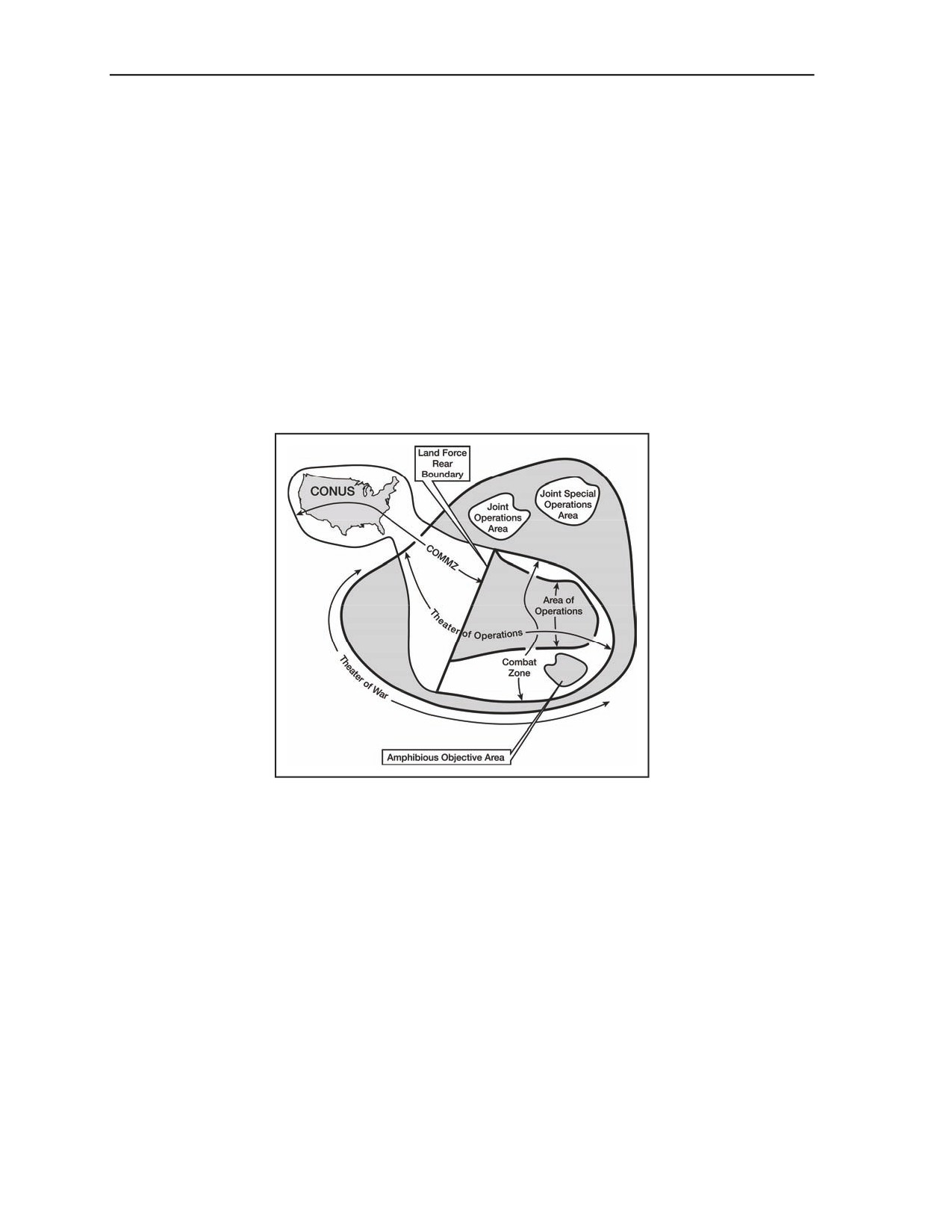
(figure
1-1). Geographic combatant commanders
(GCC), commanders with geographic
responsibilities, designate theaters of war, TOs, combat zones, and communication zones (COMMZ) as
they see fit. A TO is a subarea within a theater of war as defined by a combatant commander within which
forces conduct or support specific combat operations. Different TOs within the same theater of war will
normally be geographically separate and focused upon different enemy forces. TOs are usually of
significant size allowing for operations over a significant period of time. FM 3-0 provides a detailed
discussion of theater territorial organization.
Figure 1-1. Theater organization
1-8. Joint force commanders (JFCs) at all levels may establish subordinate operational areas (figure 1-1).
JP 3-0 discusses the assignment and responsibilities associated with establishing JOA within a TO. Due to
the unique structure of the MA evacuation channel, MA generally operates within a JOA. The JMAO has
responsibility for the JMAP within a JOA. For more information on JMAO responsibilities, reference JP 4-
06.
1-9. The key areas concerning the deployment and execution of the MA mission include the COMMZ
and the combat zone. The COMMZ is the area within the TO that contains the lines of communication
(LOC), establishments for supply and evacuation, and other agencies required for immediate support of the
field forces. In a contiguous area of operations (AO), the COMMZ is generally located behind but
contiguous to the combat zone. Within a noncontiguous AO, the COMMZ may be commingled with the
combat zone. The combat zone is the area required by combat forces for the conduct of combat operations,
generally the area forward of the corps rear boundary.
1-10. The Theater Sustainment Command (TSC) is normally the Army Service component commander’s
major organization responsible to provide common-user logistics (CUL) within the TO. The TSC is
responsible for providing the Army Service Component Command (ASCC) with a common logistical
1-2
FM 4-20.64
9 January 2007
Mortuary Affairs Overview
picture, maximizing throughput to provide follow-on sustainment. Each TSC is responsible for developing
an operational level MA appendix tailored to its unique TO. For more information on the TSC, see FM 4-
93.4.
1-11. The theater level headquarters is assigned command and control (C2) over the JOA. The regional
combatant commander will tailor the theater command structure to meet the needs of the joint forces in the
TO. The theater command is organized and equipped primarily as the ASCC for the Regional Component
Command (RCC). The theater commander normally acts as the ASCC and is responsible for all
administrative control
(ADCON) of all Army forces in the RCC. There will be additional modular
sustainment brigades specifically tailored to support the assigned division and BCTs.
1-12. Operational level MA planners must establish and continually update operation plans (OPLANs) and
estimates, as these are the documents that are used to build the time-phased force and deployment list
(TPFDL). For more information on building operational level estimates and OPLANs, reference Chairman
of the Joint Chiefs of Staff Manual (CJCSM) 3500.05A, CJCSM 3500.05C, and CJCSM 3122.03A.
TACTICAL LEVEL
1-13. Tactical level MA planners are responsible for developing MA plans and support to Army units
capable of defeating a level III threat. Though the tactical MA planner is often located at the Division G-4
level, the BCT has become the Army’s primary organization for tactical engagement of the enemy.
1-14. The three standard BCT designs are the Infantry BCT (IBCT), Heavy BCT (HBCT), and the Stryker
BCT (SBCT). The higher command element of the BCT is the division. In major combat operations, the
division will typically operate with a variable number of BCTs. If a division or corps headquarters is
assigned responsibility of a JOA, it is known as a division or corps AOR.
1-15. Tactical level MA planners must establish and update OPLANs and estimates. For information and
guidance on developing these documents, see FM 5-0.
THEATER MA OPERATIONS
1-16. MA operations occur at all levels of a TO. The MA program starts at the unit level with search and
recovery operations and continues until remains are returned to the PADD and all PE are returned to the
PERE. The MA Program covers the initial search and recovery, tentative identification, coordinated
evacuation, and decontamination (if necessary) of remains and PE.
1-17. The MA mission starts at the unit level. Each unit is responsible for designating a search and
recovery team to conduct search and recovery operations during the combat phase of operations. Unit
commanders are responsible for the initial search and recovery operations within their AOR. Upon
recovering remains the unit search and recovery team will evacuate those remains to the closest MA
collection point (MACP). For more information on establishing search and recovery teams, see chapter 5.
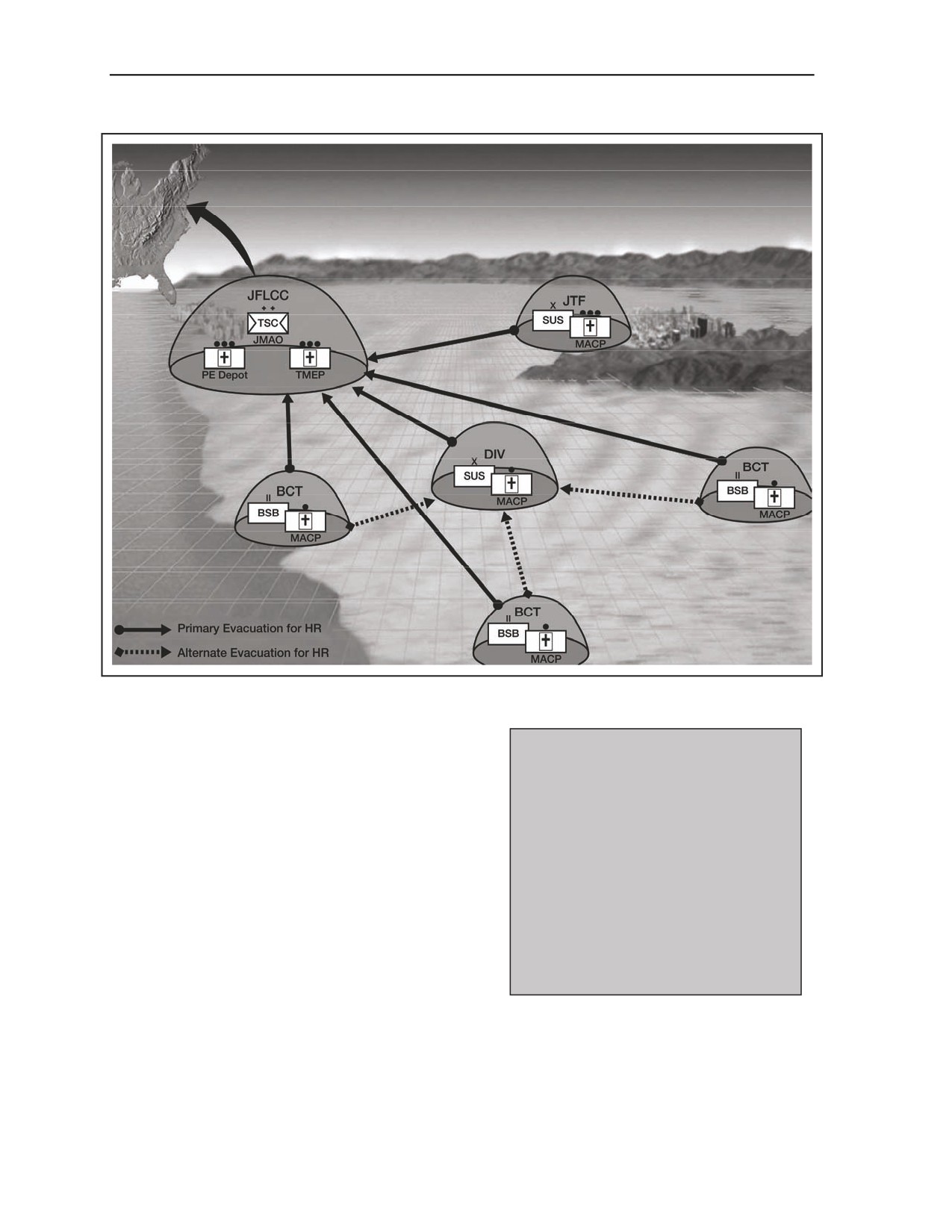
1-18. MA personnel set up MACPs, theater mortuary evacuation points
(TMEPs) and PE depots
throughout the JOA (figure 1-2). Remains recovered by unit initial search and recovery operations are
evacuated to the nearest MACP. From the receiving MACP, MA personnel evacuate the remains to the
TMEP. The preferred method of evacuation is directly from the initial MACP to the TMEP; however, the
tactical situation may dictate that remains be evacuated through several MACPs before reaching the
TMEP.
9 January 2007
FM 4-20.64
1-3
FM 4-20.64
Figure 1-2. MA concept of operation
1-19. The TSC commander or a designated
MA Staff Planning Considerations
representative determines the responsibility and
• Type of operation
placement of theater MA assets within the JOA.
Normally, this is accomplished through coordination
• MA units on TPFDD
with the JMAO. The TSC commander together with the
• Unit structures/capabilities
JMAO must produce a plan that places MA assets where
• Unit locations/relocations
they can best support both current and future operations
• Number of troops supported
within the JOA. This places an inherent responsibility
• Noncombatants affected
upon the JMAO and TSC to ensure that MA assets are
• Coalition/allied support
properly assigned to the TPFDL during the planning
• Coalition/allied requirements
process.
• Host nation support
• Local MA policies
1-20. MA operations must be planned in detail from the
• Local burial customs
unit through the joint level. They must be included in
OPLANs, contingency plans
(CONPLANs), and
• Embedded media relations
standing operating procedures
(SOPs) at both the
operational and tactical level of operations. These plans and procedures should cover unit responsibilities
as well as the employment, relocation criteria, and allocation of MA personnel and equipment throughout
the JOA.
1-4
FM 4-20.64
9 January 2007
Mortuary Affairs Overview
STAFF MA RESPONSIBILITIES
1-21. MA staff planners must be sure to include MA estimates within the unit’s overall logistics estimate.
These estimates are then used to prepare the command to handle anticipated fatalities. MA staff planners
must be able to quickly address any staff or command concern. Each TO has its own unique criteria that
must be coupled with the contemporary operational environment (COE) and included within the planning
process. MA planners must create a plan that is not only tailored to both their TO and the COE, but one
that is adaptable to meet all anticipated future contingencies or operations.
1-22. Each brigade support battalion and sustainment brigade is assigned MA personnel within their
respective modified table(s) of organization and equipment (MTOE) to assist them in their MA planning
and training. MA planners must be adept at anticipating and understanding the support requirements of the
tactical plan or independent course(s) of action (COA). Additionally, the MA planner must be able to
assess sustainment feasibility, while identifying support requirements for synchronization with the
commander’s intent. The MA staff officer/NCO assigned must ensure that all subordinate units—
Develop MA plans and procedures at all levels of command.
Coordinate MA support at all levels within the TO. Units in theater or arriving in theater must
be kept informed of reporting procedures, local MA policies, current operation order (OPORD)
annexes, SOPs, and command guidance.
Assist in logistical estimate planning required to support not only the full spectrum of military
operations but also possible military and civilian mass fatality incidents.
Develop, coordinate, and complete required mission analysis, formulate staff recommendations,
and prepare the MA support annex for the OPLAN.
Obtain the MA support concept of the GCC and the JMAO of the planned TO. Continue to
request the MA support concept down to the level of staff the planner is assigned.
Ensure that units are knowledgeable on MA plans and annexes prior to deployment.
Identify and train company level recovery teams.
1-23. The staff planner is the key individual in the operational concept. These individuals initiate the entire
planning process. Key MA staff officer/NCO planning responsibilities include—
Prepare a MA running estimate for each proposed COA.
Resolve any MA logistical problems as soon as the situation permits.
Advise commanders on MA operations.
The planning considerations for creating MA annexes to OPLANs are similar to creating any
other annex for an OPLAN. Planners must ensure all known factors are taken into account
during the development process.
Validate all MA planning assumptions throughout the military decisionmaking process (MDMP)
as defined in FM 5-0.
Ensure all supported units have established a team for initial search and recovery, tentative
identification and evacuation to a MACP. See
chapter 5 for non-MA unit responsibilities.
MA Staff Input
Ensure all supported units have a validated MA
• MA map overlay
SOP prior to deployment. See appendix A for a
• OPLAN/OPORD annex
sample SOP.
development
Identify procedures for handling deceased local
• Mission requirements vs. on-hand
assets
nationals, enemy combatants and coalition, and
allied Soldiers. Lacking policy or guidance
• Allocation of MA assets
from the JMAO, all remains are handled in the
• Prioritization of MA assets
same manner. Ideally, once positive
• Identify temporary interment sites
identification has been made, MA personnel are
• Evacuation flowchart
informed on proper disposition of non-U.S.
remains.
9 January 2007
FM 4-20.64
1-5
FM 4-20.64
1-24. Staff planners who are developing MA operations must be aware of several factors that affect MA
activities and operations. These include the following:
The type of conflict—regional or global.
The size of the COMMZ and combat zone for a contiguous AO. The lack of a COMMZ for a
noncontiguous AO.
Logistical resources available, including assets within the AOR, existing contingency contracts,
pre-positioned assets, and assets within the time-phased force deployment data (TPFDD).
The level of infrastructure development, including fixed facilities for mortuaries and airfields for
evacuation.
Facts and figures on casualty estimates for different levels of conflict intensity within the
different phases of the OPLAN.
How to best use modular MA assets to fully support the commander’s intent and concept of
execution. MA assets from the MA Quartermaster (QM) Collection Company are able to be
deployed at the MA team level.
Procedures for reporting war crimes and violations of the Uniform Code of Military Justice and
the Geneva and Hague Conventions.
1-25. Non-MA company level units in theater must be involved in the MA mission and operations. Units
must identify search and recovery teams to recover remains within their AOR. The teams must be briefed
on local customs and courtesies on dealing with remains. The teams must be instilled with the MA motto
that all remains are to be treated with the utmost “dignity, reverence, and respect”. For more information on
non-MA unit responsibilities, see chapter 5.
EMPLOYMENT OF MA ASSETS
1-26. MA-qualified officers or 92M NCO’s Additional Skill Identifier 4V (ASI 4V) are responsible for
planning the employment of MA assets assigned to the command in support of operations. MA staff
planners—
Provide guidance on prestocking essential MA equipment, supplies, forms, and publications.
Ensure that subordinate units are training according to OPLAN annexes.
Ensure that deploying MA assets and unit MA plans are certified prior to deployment.
Develop and assess MA TPFDD.
Determine the readiness posture, capabilities, and limitations of each unit.
Publish local MA policy directives, mutual cooperation agreements, or international agreements
as units flow into the TO.
Establish a means to maintain records of transferring remains and PE to host nation and
coalition/allied forces.
Evaluate each unit that is to be assigned an MA asset.
Ensure MA equipment and personnel shortages are filled.
Provide guidance on estimated times for unit deployments.
Establish liaisons with other MA staff from the JMAO through the MACP.
Integrate the current chemical, biological, radiological and nuclear (CBRN) threat into the MA
plan.
Initiate a reporting system within the TO or the assigned level of command.
Establish communications with all supported and supporting MA units, JMAO, transportation
assets, and units providing logistical support.
Coordinate a PE evacuation system.
Coordinate with movement control personnel for transporting remains and PE by surface and by
air.
Provide input to the appropriate staff concerning MA operations.
1-6
FM 4-20.64
9 January 2007
Mortuary Affairs Overview
Ensure that media requests are routed through the local public affairs office (PAO).
Ensure that matters concerning family members are routed through higher HQ or the JMAO.
1-27. During multinational operations, MA staff planners must ensure that joint doctrine takes precedence.
Specifically, it is imperative that MA planners and MA personnel process all remains in the same manner
in accordance with JP 4-06 and all applicable international and cooperative agreements in the specific TO.
SEARCH AND RECOVERY
1-28. Search and recovery is the first step in the MA process. Search and recovery operations have two
distinct phases: conflict recovery and area clearance.
CONFLICT RECOVERY PHASE
1-29. The conflict recovery phase of search and recovery begins immediately. Unit commanders are
responsible for the search and recovery of all remains in their AO. If additional augmentation is required, it
may be requested through the units’ higher headquarters. See chapter 5 for more information and planning
criteria for unit search and recovery operations during the conflict recovery phase.
1-30. As the conflict develops, the situation changes, or the unit relocates, the unit’s higher headquarters
may assign additional assets to assist with security or actual search and recovery. Unit commanders may
request to use MA specialists from the closest MACP to assist with the search and recovery operations. See
chapter 2 of this FM for MACP allocation, responsibilities, and capabilities. However, to take MA
personnel from the MACP will degrade that MACP’s capability to process and evacuate other remains.
Units must make every effort to recover remains during this phase. Failing to do so will significantly delay
or prevent the return of remains to their loved ones.
AREA CLEARANCE PHASE
1-31. Area clearance is a final and thorough search and recovery for all remains and PE not previously
recovered during the conflict recovery phase. It begins as soon as the tactical and logistical situations
permit. Area clearance planning and execution is covered in JP 4-06.
9 January 2007
FM 4-20.64
1-7
Chapter 2
Quartermaster Collection Company (Mortuary Affairs)
They go where others fear to go; they do the things that others will not do; they surround
themselves with sorrow, tragedy and grief and call it their job; they do it willingly, not
for themselves, but for their country.
Commonwealth of Virginia Commendation to the 54th QM Company (MA), 2002
MISSION
2-1. The Quartermaster Collection Company (MA), Standard Requirement Code (SRC) 10490F, mission
is to establish, operate, and maintain MACPs. Company personnel conduct search, recovery, and
evacuation operations for deceased U.S. Military and certain U.S. civilian and allied personnel; dispose of
PE; and maintain essential records and reports. The company is designed to be modular; maintaining the
ability to deploy at the section level. This modularity is essential to support the full spectrum of Army
operations in the COE.
2-2. To enhance modularity and deployability, the Quartermaster Collection Company, has four sub-
SRCs each with its own unique mission and SRC:
The Headquarters Platoon (SRC: 10548FA) mission is to provide command and control,
administrative, logistical, and field feeding support and unit level maintenance management to
the QM Collection Company (MA).
The Support Operations Section (SRC: 10548FB) mission is to coordinate and control MA
operations.
The Forward Collection Platoon (SRC: 10548FC) mission is to establish, operate, and
maintain up to four MACPs. Conduct limited search and evacuation operations of deceased U.S.
Military, certain U.S. civilian and Coalition personnel, receive, inventory, and coordinate
evacuation of PE with remains; maintain essential records and reports.
The Main Collection Platoon (SRC: 10548FD) mission is to establish, operate, and maintain a
Corps Main Collection Point that receives remains and PE from the Forward Collection Points.
RESPONSIBILITIES
2-3. The QM Collection Company (MA) is designed to deploy, set up, and operate MACPs. The MACPs
receive, process, and coordinate the evacuation of deceased U.S. Military, certain U.S. civilian personnel,
coalition forces and their accompanying PE. The company’s specified duties are to—
Conduct limited search and recovery missions, as required.
Set up and operate MACPs, with refrigeration capability, within the Brigade Support Battalion
support area.
Set up and operate a main MACP, with refrigeration capability, within the Sustainment Brigade
area.
Maintain essential records and reports.
2-4. While the specified tasks of the QM Collection Company are extensive, additional on-order
responsibilities include the following:
9 January 2007
FM 4-20.64
2-1
FM 4-20.64
Set up and operate a TMEP until the arrival of the QM Company (EAC).
Set up and operate a PE depot until the arrival of the QM Company (EAC).
When supplied the necessary equipment and augmenting personnel (Per JP 4-06), establish,
operate, and maintain a mortuary affairs decontamination collection point (MADCP).
Conduct temporary interment and disinterment operations as directed by the GCC.
Respond to CONUS or U.S. Territory peacetime mass fatality incidents as requested and
authorized by the Department of Homeland Security, in accordance with DOD Directive 3025.1
and the National Response Plan (NRP)
Respond to OCONUS peacetime mass fatality incidents as requested and authorized by the State
Department and in accordance with DOD Directive 5100.46.
2-5. Commanders and staff planners must understand that the QM Collection Company (MA) ability to
accomplish their tables of organization and equipment (TOE) mission is degraded as it is tasked to perform
additional duties and responsibilities outside the scope of that mission. The QM Collection Company (MA)
commander, or a designated representative, must continually inform the chain of command about current
responsibilities and the capabilities of the unit. The chain of command must also be informed on how the
additional assigned responsibility will impact the ability of the QM Collection Company (MA) to adapt and
flex to future operations within the COE.
ORGANIZATION
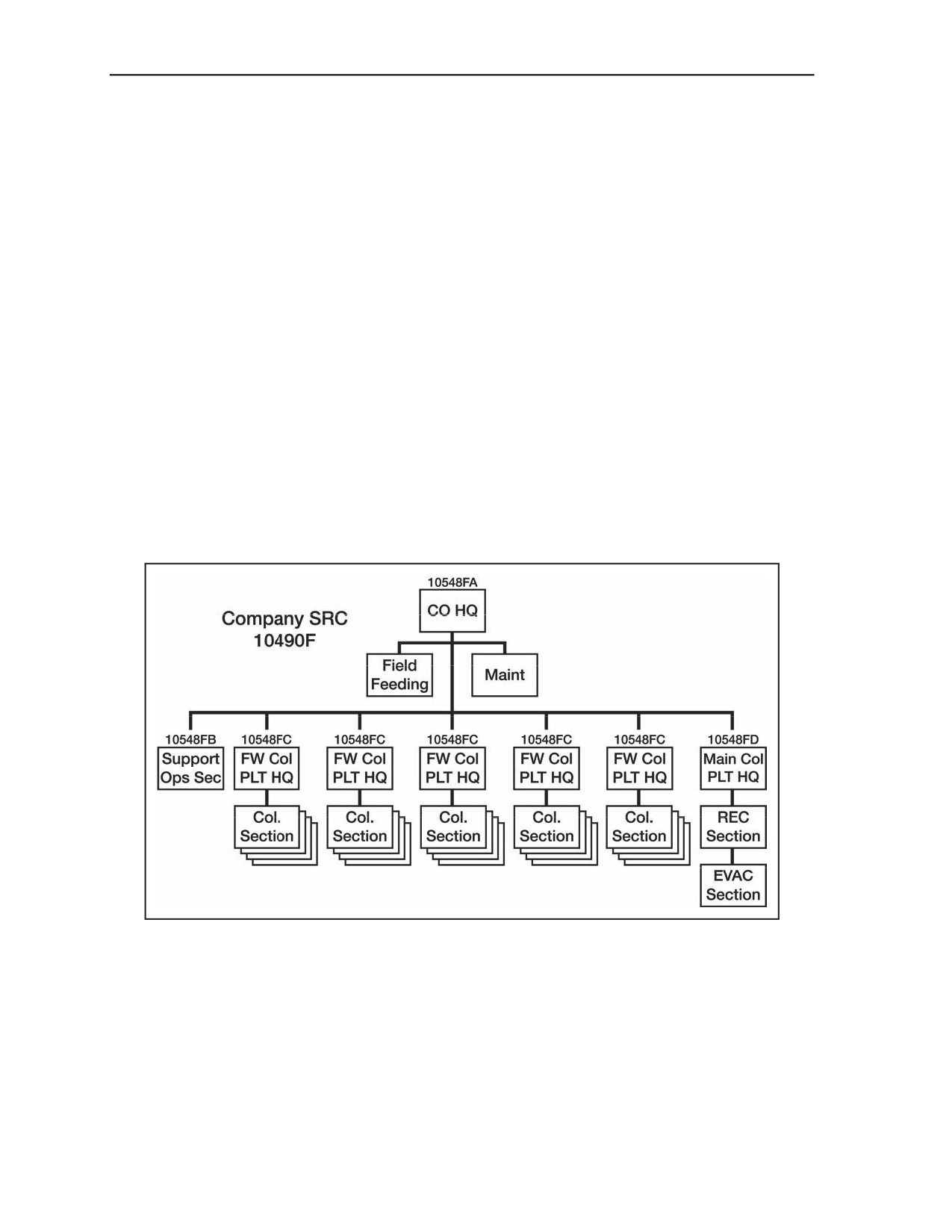
2-6. The QM Collection Company
(MA) (figure
2-1) comprises a headquarters element, support
operations cell, and six platoons.
Figure 2-1. QM Collection Company (MA) organization chart
2-7. The headquarters element contains the headquarters, food service, and maintenance sections. Each
section within the headquarters element has a specific function.
The headquarters section is responsible for providing command and control (C2), administrative
support, and logistical support to the company and any attached elements operating within the
company. This section also operates as the net control station (NCS) for the company.
The maintenance section provides unit level maintenance management, supervision of the
company’s subordinate units, unit level equipment repair, and vehicle recovery for the company.
2-2
FM 4-20.64
9 January 2007
Quartermaster Collection Company (Mortuary Affairs)
The MA commander or the early entry module (EEM) officer in charge (OIC) will place and
assign maintenance personnel to best support the unit.
The field feeding section provides field feeding for the company when the company is co-
located with the platoons. When the platoons are dispersed, the MA company commander or the
EEM OIC will allocate or assign field feeding assets to best support the mission.
2-8. The support operations section is responsible for the properly allocating and placing MA assets on
the battlefield. In the deployment phase this section acts as the MA EEM that deploys with other advance
forces to the JOA. Upon arrival on the battlefield, the section reports to the Theater Sustainment Command
(TSC) MA officer for integration into the G4, Sustainment Operations Division. Commanders must
understand that this section must be integrated as soon as possible and be positioned where it can best
support the further integration of MA assets in order for the MA mission to be successful. Once integrated
this cell acts as a coordination and logistics hub for the assignment and placement of all MA assets going
through the reception, staging, onward movement, and integration (RSOI) into the JOA. Once all Company
MA Assets have been deployed this section is responsible for the oversight and overall execution of the
MA mission at the corps level.
2-9. The five forward collection platoons are organized into a headquarters element and four collection
sections, each of which establishes a MACP. Each MACP will generally be assigned to support a BCT
sized element. Upon establishment, the MACPs receive, process, and coordinate evacuation of remains and
associated PE. Each MACP is able to receive, process, and coordinate evacuation for 20 remains and
associated PE per day.
2-10. The main collection platoon is organized into three sections: headquarters, receiving, and evacuation.
Together these sections provide MA direct support (DS) to the corps. Upon establishment, the main
collection platoon receives remains and PE from the forward MACPs. Additionally, the main collection
point maintains the ability to receive remains and PE directly from surrounding units on an area support
basis. The main collection platoon then coordinates evacuation of received remains and PE to the TMEP.
The main collection platoon may be tasked to act as the MADCP or the TMEP until the QM MA Company
(EAC) arrives in Theater.
2-11. The QM collection company (MA) may be tasked to operate a TMEP, PE depot and to inter/disinter
remains until the QM MA Company (EAC) arrives in theater. These are nonresourced missions and will
reduce the capabilities of the forward collection point operations.
ASSIGNMENT AND ALLOCATION
2-12. The QM Collection Company is assigned to a TSC, TOE 63702A. If the TSC is not fully deployed to
theater, the QM Collection Company assets will be assigned to the highest sustainment unit located within
that theater until the TSC is established. During full deployment the company can support a force of
179,000 Soldiers, or up to 20 individual BCT equivalent units. Individual sections may be deployed from
the company as the mission and logistics requirements dictate. This allows supported units the flexibility
required to operate effectively within the COE. However, the increased modularity places additional
responsibility upon MA staff officers to produce and maintain accurate MA estimates. The estimates
prepared are used for planning both the timeline and the number of assets deploying.
2-13. Forward collection platoons are assigned to the Brigade Support Battalion for allocation to the
different BCTs within a division. The Headquarters element from this platoon will be assigned to the
Sustainment Brigade of that division. Each BCT size element will be assigned a section from the Forward
Collection Platoon. This section is responsible for providing DS to the BCT by establishing a MACP.
Because the AO is a nonfixed structure, the number of forward collection platoons and sections assigned
within an AO will vary by operation.
2-14. The Main Collection Platoon placement within the AO is based upon the JMAO and Theater
Command guidance. Normally the platoon will be assigned to a sustainment brigade within the TSC. The
platoon will be the primary asset called upon to establish a MADCP and may be used to augment different
MACPs based upon forecasted mission requirements and the COE.
9 January 2007
FM 4-20.64
2-3
FM 4-20.64
2-15. The support operations section will be integrated in the TSC, G4 sustainment operations cell. The
company support operations section is responsible for the oversight of all MA assets in the TO and for
tracking the proper evacuation and shipment of all remains and PE.
2-16. Upon full company deployment, or by the needs of the theater, the commander of the QM Collection
Company (MA) will become the subject matter expert advisor to the TSC, G4 Sustainment Operations
Division. The Commander will also act as a liaison between the JMAO, TSC, and supported units with the
responsibility to ensure proper MACP placement and MA troop care. The QM Collection Company
commander’s primary responsibility is to ensure the MA mission is accomplished in accordance with
JMAO and GCC intent. The QM Collection Company commander must be given the flexibility required to
ensure mission success.
2-17. The first sergeant of the QM Collection Company (MA) is attached to the TSC, G4 Sustainment
Operations Division upon deployment. Once assigned the first sergeant will become the subject matter
expert for the organization. He or she is then responsible for preparation and review of the MA
appendix/annex within all OPLAN/OPORDs while still administering the inherent first sergeant
responsibility of caring for the troops. This is done by ensuring that that all MA troops are properly
assigned to their supported units and that they are given the proper support needed to accomplish the MA
mission.
CAPABILITIES
2-18. At TOE level 1 the company is capable of establishing 20 MACPS and a support operations cell. In
addition, the company is able to establish a main collection point.
Each MACP is capable of processing up to 20 remains per day. This capability includes the
receipt, processing, and evacuation of remains along with the receipt, inventory, and evacuation
of all PE associated with the remains.
The support operations cell is able to act as the EEM to assist the TSC, G4 Sustainment
Operations Division with the integration of all RSOI MA Units.
The main collection point is capable of processing 400 remains per day received from the
forward MACPs.
2-19. At TOE Level 2 the operational capabilities of the Company are reduced to approximately 90 percent
of the TOE Level 1 capabilities.
2-20. At TOE Level 3 the operational capabilities of the Company are reduced to approximately 80 percent
of the TOE Level 1 capabilities.
2-21. The operational capabilities drop significantly if the Company is also tasked to conduct search and
recovery operations, operate a TMEP, conduct MADCP operations, or conduct temporary
interment/disinterment operations.
2-22. Soldiers assigned to support a unit can assist in the coordinated defense of that unit’s area.
Supported unit commanders must realize that when the MA Soldiers are given additional defense
responsibilities, the MACP processing capability is reduced. When consolidated the entire company can
provide unit level food service support and maintenance on all organic equipment, except communication
security equipment.
2-23. Personnel strength levels determine other capabilities, which are described within TOE 10490F.
MOBILITY
2-24. The QM Collection Company can move 100 percent of its TOE equipment and supplies in a single
lift by using 100 percent of its authorized organic transportation assets. The MACP should not move until
all remains have been processed and evacuated.
2-4
FM 4-20.64
9 January 2007
Quartermaster Collection Company (Mortuary Affairs)
2-25. If individually deployed, the forward collection sections are 100 percent mobile using organic
section equipment upon evacuation of all remains. Individually deployed the main collection point is also
100 percent mobile when using 100 percent of organic equipment and upon evacuation of all remains.
REQUIRED SUPPORT
2-26. The company is capable of providing its own unit maintenance (except communications security
[COMSEC] maintenance) and food service when colocated.
2-27. When deployed in support of operations the individual sections and platoons require external
support. The supported unit is often tasked to provide this support. This is especially challenging for the
staff planner because of the low density of the equipment and repair parts of much of the essential MA
equipment.
2-28. When determining the placement of the MACPs the commander and first sergeant of the QM
Collection Company must ensure that the appropriate C2 structure is in place. FM 5-0 lists support and
reporting responsibilities for the different C2 applications.
2-29. MA Command controlled supplies and equipment will be managed by the JMAO and “pushed” to
the MA elements. Based upon the operational situation, reusable command controlled items, such as
human remains transfer cases (TCs) may be “pushed” down to the MACP level based upon the COE.
2-30. If exposed to a CBRN environment the QM Collection Company has minimal capability for
decontamination operations. The unit relies upon the
supported element to provide hasty decontamination
Required Support
operations and upon the Corps Decontamination Company
• Life support
for deliberate decontamination operations.
• Religious/spiritual health
• Combat health
SITE SELECTION/ESTABLISHMENT
• Legal
• Financial
2-31. Site selection is dependent upon which unit the MA
• Engineering
assets are attached and the defensive structure of those units.
• Additional transportation
Generally the MACP will be colocated with the Brigade
• Personnel services
Support Area and need to be integrated into the overall
defense plan. MACP specific site selection criteria can be
• Unit level COMSEC maintenance
found in JP 4-06.
2-32. Upon arrival at a new location, the MACP noncommissioned officer in charge (NCOIC) will notify
both the supported unit and the MA higher headquarters. The NCOIC will then implement the priorities of
work. Once the MACP is established the NCOIC will notify both the supported unit and the MA higher
headquarters that the MACP is ready to receive remains.
OPERATIONS
2-33. MA leaders must continually produce estimates, through which operational shortfalls are identified.
Once shortfalls are identified impacts and mitigations must be implemented to ensure mission success.
2-34. Before deploying to a specific JOA, the commander, or a designated representative, must coordinate
with the TSC representatives. The key areas of coordination are synchronizing TPFFD—specifically
matching unit personnel to unit equipment—and identifying equipment shortfalls.
2-35. Upon deployment the commander and first sergeant must work closely with the TSC, G4,
Sustainment Operations Division. This coordination provides the MA leaders visibility over transportation,
personnel, and logistics assets throughout the TO for MA issues. This also allows the MA Leadership to
mitigate any MA issues, specifically those concerning transportation, communications, and C2.
9 January 2007
FM 4-20.64
2-5
FM 4-20.64
2-36. Ideally the Collection Company’s EEM coordinates with the individual incoming MACPs and links
them up with their supported units during the RSOI process. This requires initiative on the part of the EEM
and Forward Collection Platoon leaders or platoon sergeants. After each of the four sections from the
Forward Collection Platoon is assigned, the platoon leader and platoon sergeant become senior MA
advisors to the division or task force logistics planners.
2-37. The MACP NCOIC will report to the BCT Commander for
C2; however MA issues will still be reported through MA
Sample Priorities of Work
channels. Additional reporting requirements are based upon the
• Tie in with adjacent units
supported units logistics situation report (LOGSITREP) SOP.
• Establish site security
2-38. The MACP NCOIC is also responsible for initiating MACP
• Establish communication
priorities of work. This specifically includes establishing and
• Establish life, personnel, medical and
engineer support
maintaining site security over the collection point. As more
reporters and media are embedded into our fighting forces, MA
• Establish habitual transportation link
Leaders need to ensure they are controlling access to the
• Prepare road network
processing area. An MA Leader has an inherent responsibility to
• Prepare refrigeration
ensure that family members do not see their loved one on a
• Construct munitions holding area
newscast before being notified by the Casualty Assistance
• Prepare to receive remains
Command (CAC).
2-39. MA Leaders at all levels should coordinate daily with the appropriate individuals who have
oversight for MA issues. They must also attend recurring briefings to obtain current and vital information
needed to make informed MA decisions. This will ensure the accurate flow of information on MA issues
passed through the chain of command.
2-40. When refrigeration of remains is required, MA Leaders must use the “first-in, first-out” (FIFO)
concept. The first remains placed in the refrigeration unit will be the first remains to be removed for
processing and evacuation.
The refrigeration is not to be used as a “storage” unit and should not be factored into the
planning estimates as such. The refrigeration unit is to be used strictly to hold remains until they
can be processed.
No other items, such as Class I (food and perishables) or medicines should be placed in MA
refrigeration assets.
If additional MACP refrigeration assets are required, the NCOIC should contact the Brigade
Support Battalion
(BSB) Support Operations Office
(SPO) or Division G-4 to initiate
augmentation by external units or local contract.
2-41. Based on the unique stresses placed upon the MA Soldier, the QM Collection Company (MA) is
designed to allow 6-month rotations during long operations. MA Leaders must ensure that after these
deployments Soldiers are allowed to decompress after dealing with death daily. MA leaders should
coordinate with the local chaplain and mental health personnel to plan and implement a decompression
program upon a Soldiers’ return from deployment.
2-6
FM 4-20.64
9 January 2007
Chapter 3
Quartermaster MORTUARY AFFAIRS Company (Echelons
Above Corps)
During wars or in peacetime, no part of the mission of the Army is more sensitive than
the responsibility for the care and burial of the dead of the armed forces.
Florence Cannon, QM Professional Bulletin, 1952
MISSION
3-1. The Quartermaster Mortuary Affairs Company (echelons above corps
[EAC]), SRC: 10690F,
mission is to establish, operate, and maintain up to two TMEPs to move deceased U.S. Military, coalition,
and civilian personnel to CONUS/OCONUS military mortuaries or conduct theater interment operations;
establish and operate up to five MACPs; and establish and operate a personal effects depot. There is
currently one QM MA Company (EAC) in a Reserve status.
3-2. To enhance deployability, there are five sub-SRCs within the Quartermaster Mortuary Affairs
Company (EAC). The Headquarters Platoon, Support Operations Section, Personal Effects Platoon,
Evacuation/Mortuary Platoon, and the Collection Platoon each have their own unique mission and SRC.
The Headquarters Platoon (SRC: 10568FA) mission is to provide C2, administrative, logistical,
field feeding support, and unit level maintenance management to the Quartermaster (QM)
Mortuary Affairs Company (EAC).
The Support Operations Section (SRC: 10568FB) mission is to coordinate and control MA
operations.
The Personal Effects Platoon (SRC: 10568FC) mission is to receive, store, safeguard, and ship
PE of remains processed in theater.
The Evacuation/Mortuary Platoon (SRC: 10568FD) mission is to operate a TMEP and/or a
temporary interment site.
The Collection Platoon (SRC: 10568FE) mission is to recover, receive, process, secure, account,
and evacuate deceased U.S. Military and certain U.S. civilian personnel.
RESPONSIBILITIES
3-3. The QM MA Company (EAC) is designed to deploy, set up, and operate within a TO. The
company’s specified duties are to—
Set up and operate up to two TMEPs to receive, process, and coordinate evacuation of deceased
U.S. Military and certain U.S. civilian personnel to CONUS/OCONUS military mortuaries.
Set up and operate up to five MACPs within the theater area to receive, process, and coordinate
evacuation of deceased U.S. Military and certain U.S. civilian personnel and their accompanying
PE.
Set up and operate up to two temporary interment sites (upon approval of the GCC). The
interment sites will receive, process, and inter deceased U.S. Military, certain U.S. civilian ,
coalition, local national
(if disposition cannot be determined), enemy personnel, and all
associated PE.
9 January 2007
FM 4-20.64
3-1
FM 4-20.64
Set up and operate a theater PE depot to store, safeguard, and coordinate shipment of the PE of
remains and missing Soldiers in theater.
3-4. While the specified tasks of the QM MA Company (EAC) are extensive; additional on-order
responsibilities include the following:
When augmented with table of distribution and allowances (TDA) personnel and host nation
support, the company can operate one in-theater mortuary that will receive, process, embalm,
and coordinate evacuation of deceased U.S. Military and certain U.S. Civilian personnel to
CONUS/OCONUS military mortuaries.
When supplied the necessary equipment and augmenting personnel (Per JP 4-06), establish,
operate, and maintain a MADCP.
Respond to CONUS or U.S. Territory peacetime mass fatality incidents as requested and
authorized by the Department of Homeland Security, in accordance with DOD Directive 3025.1
and the NRP
Respond to OCONUS peacetime mass fatality incidents as requested and authorized by the State
Department and in accordance with DOD Directive 5100.46.
3-5. Commanders and staff planners must understand that as the QM MA Company (EAC) is tasked to
perform additional duties outside the scope of their TOE mission, that mission becomes degraded.
Examples of external missions include area defense, supported units details, and taskings. The QM MA
Company (EAC) commander, or a designated representative, must continually inform the chain of
command about current responsibilities and the capabilities of the unit. The chain of command must also
be informed about how the additional responsibility will impact the ability of the company to conduct
future operations within the COE.
ORGANIZATION
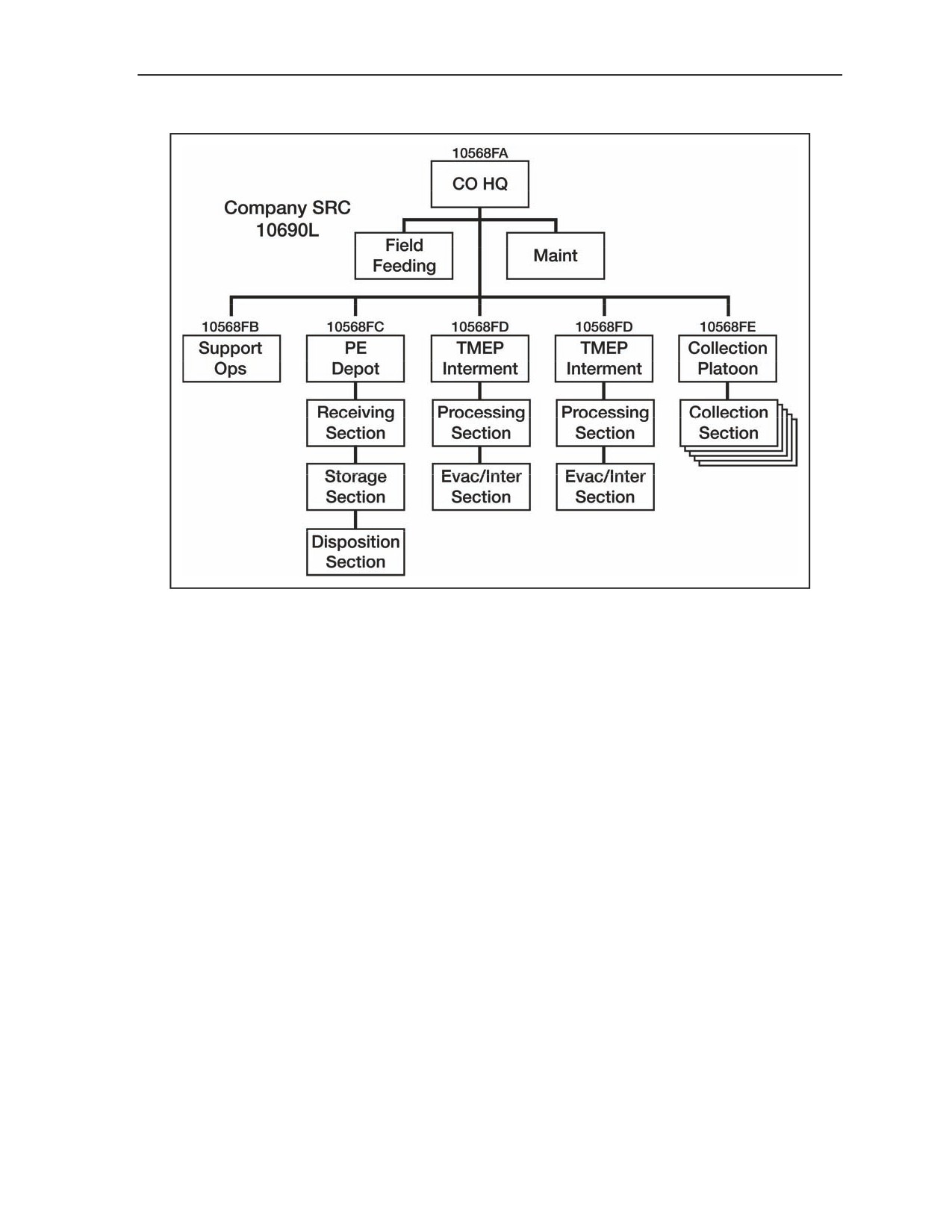
3-6. The QM MA Company (EAC) (figure 3-1) comprises a headquarters element, support operations
section, and four platoons.
3-7. The headquarters element contains the headquarters, food service, and maintenance sections. Each
section within the headquarters element has a specific function.
3-8. The headquarters section is responsible for providing C2, administrative, and logistical support to the
company and any attached elements operating within the company. The section also operates as the
alternate net control station (ANCS) for the company.
3-9. The maintenance section provides unit level maintenance management, supervision of the company’s
subordinate units, unit level equipment repair, and vehicle recovery for the company. When the platoons
are dispersed the EAC Commander or EEM OIC will direct placement of the maintenance section to best
support the unit.
3-10. The field feeding section provides field feeding for the company when the company is colocated
with all the platoons. When the platoons are not colocated the EAC Commander or EEM OIC will direct
placement of the field feeding section to best support the unit.
3-11. The Support Operations Section is responsible for the proper allocation and placement of the
company’s MA assets on the battlefield. Upon arrival, the section reports to the TSC MA officer for
integration into the TSC G4, Sustainment Operations Division. Once integrated, this cell coordinates and
controls assigned MACPs; search and recovery operations; and evacuation operations for deceased U.S.
Military, certain U.S. civilian, and coalition personnel. The QM MA Company (EAC) Support Operations
Section must establish communication with the QM Collection Company (MA) Support Operations
Section as soon as logistically possible. This is necessary to establish a common operating picture (COP) of
all MA operations. Additionally the Support Operations Section is the primary NCS for the QM MA
Company (EAC).
3-2
FM 4-20.64
9 January 2007
Quartermaster MORTUARY AFFAIRS Company (Echelons Above Corps)
Figure 3-1. QM MA Company (EAC) organization chart
3-12. The PE Platoon receives, stores, safeguards, and ships personal effects of remains processed in
theater. The platoon is organized into a headquarters element and three additional sections: receiving,
storage, and disposition.
The headquarters section provides supervision, coordination, and scheduling for operational
elements of the platoon.
The receiving section receives associated PE from the MACPs and also PE left in the unit areas
for all individuals under custody, control or jurisdiction of the Army.
The storage section stores and safeguards all PE received by the receiving section.
The disposition section ships PE processed in the theater. The items will be shipped in
accordance with AR 638-2. Human Resources Command (HRC) and Casualty Memorial Affairs
Operations Center (CMAOC) provide assistance
3-13. The Evacuation/Mortuary Platoon is responsible for the operation of a TMEP and/or a temporary
interment site. The platoon is organized into a headquarters element and two additional sections:
processing and evacuation/temporary interment.
The headquarters section provides supervision and coordination for operating elements of the
platoon. The section is also responsible for managing operations and ensuring quality control of
the TMEP.
The processing section processes remains received from the forward collection platoons. The
section may also receive remains directly from local units that have sustained casualties.
The evacuation/interment section operates a TMEP. The TMEP is responsible for processing
and evacuating remains out of theater. The TMEP must also be prepared to receive
augmentation to support interment or mortuary operations within the TO.
9 January 2007
FM 4-20.64
3-3
FM 4-20.64
3-14. The Collection Platoon is organized into five sections, each of which establishes a MACP. The
MACPs receive, process, and coordinate evacuation of remains and associated PE. Each MACP is able to
receive, process, and coordinate evacuation for 20 remains.
ASSIGNMENT AND ALLOCATION
3-15. The QM MA Company (EAC) is assigned to a TSC to provide MA support on an area basis to the
TO. During full deployment the company can support a force of 165,000 Soldiers. Additionally, individual
sections may be deployed from the company as the mission and logistical requirements dictate. This allows
supported units the flexibility required to operate within the COE. However, the increased modularity
places additional responsibility upon the MA staff officer to produce accurate MA estimates. The estimates
prepared are used as the key planning factors for determining both the deployment timeline and assets
deploying.
3-16. As the QM MA Company (EAC) is designed to support operations across an entire theater,
placement of assets must be thoroughly coordinated. The key commands that determine actual placement
of many of the assets are the JMAO, and the TSC Sustainment Operations Division. The EAC company
commander and first sergeant play an integral role in the coordination between these staff elements. They
must take the initiative and be aggressive during the planning process to ensure proper assets and personnel
arrive to establish the necessary operations to ensure the MA mission success.
3-17. Once coordination is complete and unit placement is determined, the placement location must be
published to the units within the JOA. All remains within the JOA will be evacuated through the TMEP.
Therefore, this notification must be to all Services, not just Army forces.
3-18. The PE Depot Platoon may or may not be located within the JOA. If it is determined that the PE
depot best supports the mission by being assigned within the JOA, then it will generally be colocated with
the TMEP. All units must know the location of the PE depot as they are required to send the PE of killed in
action (KIA) and missing in action (MIA) Soldiers and civilians through this element. Additionally the PE
Depot must be prepared to accept the PE of enemy combatants, local nationals, coalition partners, and any
other individual who is killed within the JOA.
3-19. The Evacuation/Interment Platoons will generally be assigned to the Sustainment Command
(Expeditonary) or a sustainment brigade assigned to the theater within the assigned JOA. The assigned
location must be near an aerial port of embarkation (APOE). The Evacuation/Interment Platoon must be
assigned to an area that is large enough to support the TMEP mission. For more information on the TMEP
mission, reference JP 4-06.
3-20. Upon full company deployment, the commander of the QM MA Company (EAC) will be the subject
matter expert advisor to the lead agent of the JMAO and TSC, G4 Sustainment Operations Division. The
commander will also act as a liaison between the JMAO and TSC, with the responsibility to ensure proper
placement and care of all QM MA Company (EAC) assets. It is imperative that the commander integrate
into the JMAO and establish communications with all participating Services and coalition partners to
ensure dissemination of important MA policies and procedures unique to the JOA.
3-21. At a point designated by the JMAO and the QM MA Company (EAC) commander, the Support
Operations Section will be integrated in the TSC, G4 Sustainment Operations Division. The Company
Support Operations Section is responsible for MA planning within the JOA. This includes overseeing all
theater MA assets and tracking the proper evacuation and shipment of all remains and PE.
3-22. The first sergeant of the QM MA Company (EAC) is attached to the JMAO upon deployment. Once
assigned, he or she will become the subject matter expert for the JOA. The first sergeant is responsible for
preparation and review of the MA appendix/annex within the joint OPLAN/OPORD while still
administering the inherent first sergeant responsibility of caring for the troops. This is done by ensuring
that all MA troops are properly assigned to their supported units and that they are given the proper support
needed to accomplish the MA mission.
3-4
FM 4-20.64
9 January 2007
Quartermaster MORTUARY AFFAIRS Company (Echelons Above Corps)
CAPABILITIES
3-23. At TOE Level 1 the company is capable of establishing two TMEPs for coordinating the receipt,
processing, and evacuation of remains. The company can also establish a PE depot for coordinating the
receipt, processing, and evacuation of PE. In addition to the TMEPs and PE depot, the company can
establish up to 5 MACPs, which are able to receive, process, and coordinate evacuation for a total of 20
remains per day, including the receipt and inventory of associated PE.
Each TMEP platoon is capable of processing and coordinating the evacuation for up to 250
remains per day.
If the two TMEP platoons combine and are augmented with civilian TDA personnel, the
company can operate one in-theater mortuary capable of embalming and coordinating the
evacuation for up to 50 remains
If operating under the Graves Registration Program and augmented by engineer support, each
TMEP Platoon is capable of interring up to 250 remains per day.
Each MACP is capable of processing up to 20 remains per day. This capability includes the
receipt, processing, and evacuation of remains along with the receipt, inventory, and evacuation
of all PE associated with the remains.
3-24. At TOE Level 2 the operational capabilities of the company are reduced to approximately 90 percent
of the TOE Level 1 capabilities.
3-25. At TOE Level 3 the operational capabilities of the company are reduced to approximately 80 percent
of the TOE Level 1 capabilities.
3-26. Soldiers assigned to support a unit can assist in the coordinated defense of that unit’s area. When
consolidated, the company can provide unit level food service support and maintenance on all organic
equipment, except communication security equipment.
3-27. Personnel strength levels determine other capabilities, which are described within TOE 10690F
MOBILITY
3-28. The QM MA Company (EAC) can move 100 percent of its TOE equipment and supplies in a single
lift by using 33 percent of its authorized organic transportation assets. The unit should not relocate until all
received remains are completely processed and evacuated.
3-29. If individually deployed, the MACPs are 100 percent mobile using organic section equipment upon
evacuation of all remains.
REQUIRED SUPPORT
3-30. The company is capable of providing its own unit maintenance (except COMSEC maintenance) and
food service when the company is colocated.
3-31. When deployed in support of operations, the individual sections and platoons require external
support. The support is often provided by the appropriate
sustainment brigade. This support relationship is especially
Required Support
challenging for the staff planner because of the low density of the
• Life support
equipment and repair parts of much of the essential MA
• Religious/spiritual health
equipment.
• Combat health
• Legal
3-32. When allocating the placement of the MACPs the
• Financial
commander and first sergeant of the QM MA Company (EAC)
• Engineering
must ensure that the appropriate C2 structure is in place. FM 5-0
• Additional transportation
lists support and reporting responsibilities for the different C2
• Personnel services
applications.
• Unit level COMSEC
maintenance
9 January 2007
FM 4-20.64
3-5
FM 4-20.64
3-33. MA Command controlled supplies and equipment, such as U.S. flags, will be managed by the JMAO
and “pushed” to MA elements. Based upon the COE, reusable command controlled items, such as human
remains TCs may be “pushed” down to the MACP level based upon the COE.
SITE SELECTION/ESTABLISHMENT
3-34. Site selection for the MACPs is dependent upon the unit of attachment and the defensive structure of
the units. Generally the MACPs will be assigned to the ASGs to provide theater support on an area basis.
Once assigned to a support unit within the ASG the MA personnel and assets will be tied into that assigned
unit’s overall defense plan. MACP specific site selection criteria can be found in JP 4-06.
3-35. Site selection for the TMEP is based upon the locations of major APOEs within the TO. The TMEP
must have quick, easy access to both flight lines and helipads. Remains will most likely arrive to the TMEP
in either rotary or fixed wing aircraft. Additionally, as coordinating and evacuating remains to the mortuary
is done via strategic air lift, the evacuation section of the TMEP must be able to directly contact Air
Mobility Command (AMC). Preference is given to fixed facilities for actual layout and operation of the
TMEP. For additional information on site selection for a TMEP, reference JP 4-06.
3-36. Once established, the TMEP can function as a PE transfer point for pre-inventoried PE. When
functioning as a PE transfer point, the TMEP will receive, store, safeguard, and coordinate evacuation for
pre-inventoried PE from the units in theater.
3-37. Upon arrival at an assigned location the platoon/section NCOIC will notify both the assigned unit
and the MA higher headquarters. The NCOIC will then implement work priorities in order to quickly begin
receiving remains. Once the MACP is established and ready to receive remains the NCOIC will inform
both the supported unit and the MA higher headquarters.
OPERATIONS
3-38. When deployed, MA leaders must strive to identify shortfalls within their operations. Once identified
they must inform the command about the shortfall and the costs associated with mitigating or not
mitigating the shortfall. It is imperative that MA leaders are continually updating the supported commands
about shortfalls and their impacts on MA capabilities.
3-39. Prior to deploying to a specific theater the commander or a designated representative must
coordinate with the TSC representatives for the deployment. The key areas of coordination are TPFDD
synchronization—specifically matching unit personnel to unit equipment—and identification of equipment
shortfalls.
3-40. Upon deployment the commander and first sergeant must work closely with the TSC, Assistant Chief
of Staff
(ACofS), G4, Sustainment Operations Division. This coordination provides the MA leaders
visibility over transportation, personnel, and logistics assets throughout the TO for MA issues. This
relationship also provides the MA leadership the assets necessary to mitigate any MA issues
immediately—specifically any issues concerning transportation, communications, and C2.
3-41. Ideally the individual MACPs will link up with
their supported units following the RSOI process. This
Sample Priorities of Work
requires initiative on the part of the Collection Platoon
• Tie in with adjacent units
leader and platoon sergeant. after each of the five
• Establish site security
sections from the Collection Platoon is assigned, the
• Establish communication
platoon leader and Platoon Sergeant become senior MA
• Establish life, personnel, medical and
Advisors to the Sustainment Operations Division of the
engineer support
senior sustainment element (the TSC or sustainment
• Establish habitual transportation link
brigade)..
• Prepare road network
3-42. NCOICs of all QM MA Company (EAC) units
• Prepare refrigeration
will report to the Commander of the SC(E) to which
• Construct munitions holding area
they are attached. However, MA issues will still be
• Prepare to receive remains
3-6
FM 4-20.64
9 January 2007
Quartermaster MORTUARY AFFAIRS Company (Echelons Above Corps)
reported through MA channels. Additional reporting requirements are based upon the supported units
LOGSITREP SOP.
3-43. NCOICs are also responsible for initiating priorities of work to expedite the establishment of their
MA site. This specifically includes establishing and maintaining site security over the site. As more
reporters and media are embedded into our fighting forces, MA leaders need to ensure they are controlling
access to the receiving, processing, and evacuation areas. MA leaders have an inherent responsibility to
ensure that family members do not see their loved one on a newscast before being notified by the CAC.
3-44. MA leaders at all levels should coordinate daily with the appropriate individuals who have oversight
for MA issues. They must also attend recurring briefings to obtain current and vital information needed to
make informed MA decisions. This will ensure the accurate flow of information on MA issues passes
through the chain of command.
3-45. When refrigeration of remains is required, MA leaders must use the FIFO concept. The first remains
placed in the refrigeration unit will be the first remains removed for processing and evacuation.
The refrigeration unit is not to be used as a “storage” unit and should not be factored into the
planning estimates as such. The refrigeration unit is to be used strictly to hold remains until they
can be processed.
No other items, such as Class I or medicines should be placed inside MA refrigeration facilities.
If additional MACP refrigeration assets are required, the NCOIC should contact the Sustainment
Operations Division of the supported unit to initiate augmentation by external units or local
contract.
3-46. It is essential that leaders give Soldiers the tools and assets necessary to deal with the stresses they
encounter while deployed. MA leaders must ensure that after deployments Soldiers are allowed to
decompress after dealing with death daily. This is done by coordinating with the chaplain and mental
health personnel to plan and implement a decompression program upon a Soldiers’ return from
deployment.
9 January 2007
FM 4-20.64
3-7
Chapter 4
Mortuary Affairs in Full Spectrum Operations
The importance of mortuary affairs on the modern battlefield is evident. The U.S. citizens
expect a fallen soldier to be brought back home. The basis of mortuary affairs is found in
the training of soldiers, search and recovery procedures, identification of fallen
comrades, and appropriate burial that includes the performance of military rites for the
deceased. The bottom line in today's Army is that soldiers train to find, recover, identify,
and bring home all fallen comrades. The goal is no more unknown soldiers.
QM Professional Bulletin, Winter 1998
In all environments, the initiative of Army leaders, agility of Army units, depth of
Army resources, and versatility of Army Soldiers combine to allow Army Forces to
conduct decisive full spectrum operations. Commanders synchronize offensive,
defensive, stability, and support operations to defeat any enemy or dominate any
situation—anywhere, anytime. While FM 3-0 describes the doctrine of full spectrum
operations, this chapter specifically discusses MA support to those operations,
providing a guide to MA planners. MA has a direct influence upon operations
through its effect on the morale of Soldiers, civilians, public opinion, the national
will, the ethical treatment of enemy combatants and local nationals.
OFFENSIVE OPERATIONS
4-1. Offensive operations are characterized by speed, precision, mobility, and high intensity. These
operations generally seek to seize, retain, and exploit the initiative to defeat the enemy decisively. Army
forces attack simultaneously throughout the area of operations
(AO) to throw enemies off balance,
overwhelm their capabilities, disrupt their defenses, and ensure their defeat or destruction. Often during
offensive operations, planning is conducted in a time-constrained environment where the focus is to
quickly develop a flexible, tactically sound, and fully integrated and synchronized plan.
4-2. Casualty rates of friendly forces tend to be higher during offensive operations. The higher casualty
rate is generally coupled with fast-paced forward movement of troops and material. With these
characteristics in mind the MA planner must ensure that adequate assets are allocated and placed for the
operations. Plans should be flexible enough to allow for units to adapt to the rapidly changing situation. In
addition to operational flexibility, MA plans must provide mobility and options to the combatant
commander. The MA planner must ensure that the commander is not limited to one COA because of
mismanagement or inadequate MA planning.
4-3. Planners must consider the higher casualty rates as well as the more frequent moving of the logistics
bases associated with offensive operations. Often during offensive operations ground LOCs are congested
with the forward movement of troops and material. Additionally, on the noncontiguous battlefield the
LOCs may begin to lengthen between the rapidly moving force and the support areas from which the MA
personnel will be working. These factors place greater importance on MA planners coordinating the
expedient evacuation of remains. Remains must be evacuated to the TMEP as quickly as logistically
possible using every evacuation means available to the unit.
9 January 2007
FM 4-20.64
4-1
FM 4-20.64
4-4. MA Planners must continually emphasize the importance of evacuating remains using any assets
available, specifically ground and air backhaul. The fact that evacuating remains is always a national
priority, coupled with the instability and congestion of ground LOCs, places greater emphasis on air
evacuation during offensive operations. Refrigeration assets are not to be used as a “storage” area. They are
only authorized for holding remains until all processing is complete and evacuation assets have arrived.
DEFENSIVE OPERATIONS
4-5. Defensive operations are not a passive activity nor are they stationary units awaiting an attack.
Defensive operations use mobile and static elements. Operationally, the defense is used to buy time,
economize forces, and develop conditions favorable for resuming offensive operations. Commanders will
position sustainment MA assets to best support the forces in the defense and survive.
4-6. Sustainment MA planners must have full understanding of the operations and the commander’s
intent. Specifically, planners must be prepared to reassume any offensive operations projected to follow the
defense. The plan must take into account both the enemy’s most probable course of action (MPCOA) and
the most dangerous course of action (MDCOA). These two courses of action will have direct impact on the
placement of MA assets in the AO. Specifically, these COAs will determine current and projected locations
of the MACPs and MADCP.
4-7. MA planners must strive to support the defense in depth. Because of the fixed nature of MA assets
and evacuation routes, they are more vulnerable to enemy action. MA planners must identify both primary
and secondary LOCs for evacuating the remains of friendly, enemy, and local nationals. Owing to the
unique nature of defensive operations, MA units will handle fewer friendly remains but have the chance of
handling increased numbers of enemy and local remains. Planners must be aware of this, and ensure that
policies and procedures are established for the prompt, dignified return of these remains to local
government officials. Coordination may be made with the JMAO for clarification on these policies. Only
the GCC can authorize temporary interment of remains and only when no evacuation means exist.
4-8. Individual units must identify MA evacuation plans for all units, including reconnaissance assets
located away from the defensive lines. Additionally, units must develop contingency plans and/or alternate
evacuation routes for remains if their supporting MACP is lost to enemy activity. As with all operations,
refrigeration assets are not to be used for the “storage” of remains. Refrigeration units are used only to hold
remains until all processing is complete and evacuation assets have arrived. MA units must arrange to
evacuate the remains to the TMEP as quickly as possible.
STABILITY OPERATIONS
4-9. Stability operations are often conducted in noncontiguous areas of operation
(AOs). Stability
operations are often time and manpower intensive; they are inherently complex and place great demands on
small units. The MA planner must take into account the noncontiguous operational environment. MA
assets must be placed into positions that best support the commander’s intent and increase the effectiveness
of the overall mission. Sustainment and MA in stability operations often involve supporting U.S. and
multinational forces in a wide range of missions. These missions range from long-term logistics-focused
operations in humanitarian and civic assistance (HCA) to major short-notice peace enforcement missions.
Sustainment, specifically MA assets, must be tailored to the specific requirements of the stability mission.
4-10. Often MA assets operate far from their traditional LOCs. MA Units must be tailored to the actual
mission, and may therefore be deployed in nontraditional methods. For example, an MACP positioned on
an APOE in a small-scale stability operation may serve as its own TMEP if the estimated casualty rate is
less than 20 per day. In such a situation the MA planner must ensure that evacuation assets leaving the
APOE have the capability of reaching a port of entry (POE) mortuary.
4-2
FM 4-20.64
9 January 2007
Mortuary Affairs in Full Spectrum Operations
Operation Uphold Democracy
U.S. forces return fire, killing 10 Haitians. Not having clear guidance, the unit placed
the remains in an unrefrigerated warehouse. Remains were held for 20 hours, until
U.S. forces convinced local hospital officials to accept the remains. The hospital
administrator ordered civilians to bury the remains because of the lack of a
refrigerated mortuary facility. The Haitian government then requested to have the
remains disinterred and transported to the capital for a state funeral. The U.S.
ambassador and theater commander agreed to the request and U.S. Soldiers from
the
54th Quartermaster Collection Company
(MA) located and disinterred the
remains, evacuating them to the Haitian capital. If the MA Annex had addressed the
issue and policies had been in place, the remains could have been immediately
returned to the local national control, eliminating the potential for negative media
coverage or political relations.
4-11. For MA personnel, stability operations often result in frequent and direct contact with the local
population. Planners must define the process of how to return civilian remains to the local government.
This includes not only the remains of the local national population, but those of any additional
subcontractors brought into the AO in support of the operation. Due to the increased contact with the local
population, MA personnel may be required to operate locally contracted equipment and/or facilities. The
contracted equipment may be either integrated into the existing MA assets or used to establish separate MA
facilities.
4-12. As offensive and defensive operations may be necessary to defeat enemies that oppose a stability
operation, MA plans for stability operations must remain flexible at all times. MA plans should include
handling the remains of joint and multinational coalition soldiers, civilians, and contractors in the AO.
Often the desired end-state of stability operations is not a short-term goal but requires a long-term
commitment. Owing to the unique nature of the MA mission, a long-term plan must include a rotation
schedule for MA personnel. The schedule must include adequate time for a battle handoff to the incoming
unit and decompression time for the returning personnel.
SUPPORT OPERATIONS
4-13. Generally, the adversaries in support operations are disease, hunger, or the consequences of disaster.
Often the operations are short in duration and meant to assist the local government in regaining control of
the situation. Sustainment operations are often the primary focus, and therefore the decisive factor within
support operations.
4-14. The key to success in support operations is interagency coordination. MA planners must coordinate
not only with other Army units, but also other Services, agencies, and nongovernmental organizations
(NGO). Actual agencies requiring coordination will vary depending on the operation.
4-15. The mission of MA personnel within support operations varies widely and is based upon the specific
requests from the host government. Often MA personnel will be required to quickly deploy to the specific
region or nation in support of a natural disaster. This gives the force limited time for preparation, and it
will often deploy only with mission-essential equipment and personnel tailored to support the request.
Therefore, it is essential that MA planners clearly understand the host government’s request and convey the
full requirements to the deploying force.
4-16. Additional information and guidance concerning MA support operations can be found in JP 4-06.
MULTINATIONAL AND JOINT OPERATIONS
4-17. Although each country is responsible for providing sustainment and MA support for the forces it
deploys, varying degrees of common user logistics (CUL) support in multinational operations can be
expected to achieve economy of effort and to avoid duplication. Allies and coalition partners can delineate
responsibilities among themselves based upon theater requirements. They may also request U.S. MA
9 January 2007
FM 4-20.64
4-3
FM 4-20.64
support through the JMAO. As stated within JP 4-06, the JMAO is the deciding authority on MA support
to other nations.
4-18. Multinational commanders typically form multinational sustainment staff sections to facilitate
sustainment coordination and support multinational operations. The TSC may serve as the building block
for this organization. Ultimately, MA planners must be represented within this multinational sustainment
staff. Multinational MA planning is a major challenge. Possible problem areas include cultural differences,
doctrinal differences, interoperability of C2 systems, competition and jealousies among Services and
nations, and national resource limitations. MA reporting and visibility is required within multinational
operations as is required in purely U.S. operations. No matter what the overall mission, U.S. MA planners
must strive to ensure that all remains are treated with the appropriate dignity, reverence, and respect.
4-19. Army Field Services, of which MA is a part, are equivalent to the Services functions of Joint
Logistics. Joint MA responsibilities are covered in JP 4-0 and JP 4-06.
4-4
FM 4-20.64
9 January 2007
Chapter 5
Unit Mortuary Affairs Responsibilities
Commanders of all units within the DOD have the responsibility to care for deceased
personnel within their AO. This responsibility includes the search for, recovery, and
evacuation of remains and associated PE to the MACP. In addition to the initial search
and recovery of remains within the AO, unit commanders are responsible for the proper
integration of all MA assets.
SEARCH AND RECOVERY
5-1. The search for and recovery of remains is the first step in the care and handling of deceased personnel. A
search and recovery operation is the systematic process of searching for remains and PE, plotting and recording
their locations, and evacuating them to an MA facility. Commanders must make every reasonable effort to
successfully search for, recover, and evacuate all remains within their AO.
5-2. Commanders may be tasked to conduct search and recovery operations for remains of individuals of
other nations or Services. Commanders at all levels must understand that search and recovery operations are a
unit level task during the conflict phase. When remains are located in an area, often the unit responsible for that
AO will be tasked with conducting the search and recovery. The tasked unit may request additional support or
advice from their supporting MACP, but ultimately the tasked unit is responsible. Guidelines for planning,
coordinating, and executing search and recovery operations are listed in JP 4-06.
SEARCH AND RECOVERY TEAM
5-3. All commanders must have a search and recovery team appointed on orders within their unit. This team
should consist of at least five Soldiers, with a minimum of one NCO assigned as the team leader. The team
leader is ultimately responsible for the safety of the team members and the success of the mission.
5-4. MA NCOs assigned to support battalions are responsible for the training of Non-MA unit search and
recovery teams. Unit commanders will ensure that this training is conducted at least semiannually. If additional
training support is required, a mobile training team (MTT) may be requested from the MAC located at Ft. Lee,
VA. MA units or MACP teams may be requested through command channels for integration into scheduled
Combined Training Center (CTC) rotations. Requests will
be approved by FORSCOM depending upon unit
Required S&R Information
availability.
• Enemy activity
5-5. Team members must clearly understand the unique
• Required security
requirements and demands that are encountered when
• Recovery site
dealing with human remains. Unit leaders must ensure that
• Number of remains (if known)
all appointed team members are given the high-risk
• Required search and recovery
occupation immunizations
(reference AR 40-562) in
personnel
addition to access to mental health and spiritual support as
• Transportation to and from recovery
needed.
site
• Required supplies
SEARCH AND RECOVERY PLANNING
• EOD support
• Engineer support
5-6. The tasked unit commander or designated NCOIC is
• Witness statements required
responsible for overall team safety and information
• Communication requirements
gathering concerning the search and recovery. The safety of
• Weather
the search and recovery team is paramount to the success of
9 January 2007
FM 4-20.64
5-1
FM 4-20.64
the mission.
Search and Recovery Steps
5-7. Once all the pertinent information is gathered,
• Secure the area
coordination must be initiated. As the factors of mission,
• Search the area during daylight hours
enemy, terrain and weather, troops and support available,
• Sketch and record data
time available, civil considerations (METT-TC) will greatly
• Check for booby traps
influence different missions, search and recovery teams
• Tag all remains/portions/effects
may require coordination with several different outside
• Load/evacuate to nearest MA facility
agencies or units. It is essential to mission success that
personnel are present who are familiar with the equipment
and munitions located at the search and recovery site. Some specialists include explosive ordinance disposal
(EOD), engineers, CBRN and any others required. Additionally, designated team leaders will select a search
pattern to be used by the team upon arrival at the search and recovery site. Sample search patterns and
additional coordination requirements are listed within JP 4-06.
5-8. Search and recovery operations will only be conducted during daylight hours. Team leaders will ensure
that strict search discipline is maintained and that the whole area is searched completely. The team leader
ensures that the search and recovery is conducted in the proper manner and the proper report(s) (Human
Remains Search and Recovery Status Report - REMAINSARSTAT) is completed (FM 101-5-2, U.S. Army
Reports and Message Formats). If remains are irretrievable or incomplete (missing major portions), the proper
reports will be initiated (see appendix C).
HEALTH AND SANITATION
5-9. One of the intrinsic dangers of search and recovery operations is the sustained contact with human
remains. Proper personal health and sanitation practices are vitally important as handling remains in various
stages of decomposition can result in both medical and biological hazards. Infectious organisms may be
associated with remains and the areas where remains are found or processed. The necessary handling of
remains during search and recovery operations may cause these organisms to spread to those physically
handling the remains. Therefore, each search and recovery team member and any other personnel involved in
the recovery, evacuation, or processing of remains must ensure successful implementation of health and
sanitation procedures.
5-10. To prevent the spread of infection, personnel handling remains should adhere to the following health and
sanitation guidelines:
Always wear disposable surgical or rubber gloves when handling remains. Discard the gloves after
each use.
Wear a protective oral-nasal mask designed to protect inhalation of infectious organisms.
Scrub hands, forearms, and any other body portion that came into contact with the remains or the
bodily fluids of the remains. Use a medicated or disinfectant soap.
Shower, cleansing the entire body, including the hair at the end of the duty day in which remains
were handled.
Dispose of all contaminated protective equipment in the proper manner. Dispose of items by either
incinerating them or turning them over to the proper biological hazard collection facility.
Thoroughly disinfect all equipment that came into contact with the remains or fluids of the remains.
5-11. Additional guidelines for the protection of personnel handling remains can be found in TG 195 and JP 4-
06.
SUPPLIES
5-12. Commanders of all units in the DOD are responsible for the initial search and recovery of remains
located within their AO. The personnel assigned as search and recovery team members are responsible for
ensuring that the required MA supplies are on hand and serviceable.
5-13. Quantities of supplies within a packing list should be based upon 10 percent of the unit’s strength. A
sample packing list of MA supplies and equipment includes the following (NSNs can be found in JP 4-06):
5-2
FM 4-20.64
9 January 2007
Unit Mortuary Affairs Responsibilities
Pouch, human remains.
Bag, personal effects.
Litter.
Zip-lock bags (12 inches x 12 inches).
Metal pegs/engineer flags.
Tags—plastic-coated fiber preferred.
Railcar seals (serial numbered).
Graph paper.
DD Form 565 (Statement of Recognition of Deceased).
DD Form 567 (Record of Search and Recovery).
DD Form 1075 (Convoy List of Remains of Deceased Personnel).
DD Form 1076 (Military Operations Record of Personal Effects of Deceased Personnel).
INTEGRATION OF ASSIGNED MA ASSETS
5-14. MA companies and personnel are deployed throughout the entire JOA and therefore require proper
integration and support to successfully carry out their mission. Staff elements at all levels of command must
understand the importance of providing the proper support to MA personnel. Often the MA mission is not
thought about until it is too late. Commanders must ensure that adequate planning and support is in place to
prevent an MA mission failure. Several vital military and political objectives hinge upon the success of the MA
mission. A failure within the MA mission or disrespectful handling of remains can have a negative impact on
one of the following key areas:
Troop morale within the losing unit.
National public support.
Coalition support.
Local national support.
Enemy treatment of remains and/or prisoners.
OPERATIONAL LEVEL INTEGRATION
5-15. Successful integration begins at the operational level. MA planners must carry out several key steps to
ensure the MA mission does not fail. These processes are not linear and may occur simultaneously.
Additionally, the TPFDD is not static; units arriving are based upon real-world situations and events. Therefore,
MA planners are required to continually update and rework their portion of the OPLAN.
The first step is a thorough TPFDL scrub to ensure adequate MA resources are allocated to the
theater. This determination is based upon OPLAN analysis and casualty estimates for all forces and
civilians in the JOA.
Next, the MA planner will assign allocated MA resources to specific units listed on the TPFDL. This
allocation of resources is based upon OPLAN analysis and is designed to ensure that adequate MA
resources are positioned to support current and future operations. The proper C2 relationship must be
clearly identified and articulated to subordinate units. (See appendix B.)
Once MA resources are allocated to a specific unit, MA planners will ensure that these MA assets
will flow into the same APOE, SPOE, or staging area as the supported unit. To expedite this
integration, MA planners will ensure MA personnel arrive with, or as close as possible to, the MA
equipment.
Once MA personnel and equipment arrive and link up, they must successfully integrate into their
supported unit. Successful integration of MA assets with the supported unit facilitates the completion
of the RSOI process and allows the GCC to generate combat power.
9 January 2007
FM 4-20.64
5-3
FM 4-20.64
TACTICAL LEVEL INTEGRATION
5-16. Tactical units must strive to ensure successful integration of their assigned MA equipment and personnel.
Logistics planners must execute several key steps to achieve this goal.
Units will receive allocated MA assets from higher command; once assigned, every effort must be
made to complete the integration process prior to the unit starting operations. If successful
integration is not possible, it is the staff planners’ responsibility to ensure that commanders are
informed of the tactical and political risks associated with conducting operations with no MA assets.
Planners must develop and inform the supported unit of their C2 relationship with MA assets. To
facilitate the proper reporting and reassignment of MA assets, it is imperative that this relationship is
clearly defined and understood.
All subordinate units must be informed on the proper evacuation procedures for both human remains
and PE. This includes PE associated with the remains and PE left in the unit areas.
5-17. Planners must ensure that all subordinate units are informed about the priorities for forward and rearward
movement of troops and material. Evacuation of human remains must always be of the utmost priority.
PERSONAL EFFECTS
5-18. AR 638-2 and DA Pamphlet 638-2 are the references used when determining the disposition of PE. This
FM is not intended to be used as a sole source of information for handling PE. AR 638-2 provides a listing of
personnel for whom the Army has jurisdiction concerning PE.
5-19. PE are the moveable personal property of the deceased or missing person. PE include but are not limited
to—
Jewelry (watches, rings, bracelets, earrings, and so forth).
Personal clothing.
Personal papers (letters, receipts, will, and so forth).
Books and stationary items (religious publications, reference volumes, magazines, paperbacks, pens
and pencils, and so forth).
Personal hygiene articles (shaving cream, razor, toothbrush, cosmetics, and so forth).
Electronic appliances and accessories (personal computer and related equipment, radio, televisions,
compact discs, digital video disks, audio tapes, and so forth).
Tools.
Household goods.
Personal vehicles, such as automobiles and trucks.
Hobby material, craft supplies, collections.
Religious items, such as Bibles, Torahs, Korans, rosaries, menorahs, and so forth.
Sporting equipment.
Money.
5-20. While the list of PE is long, several items are not considered PE. When inventorying PE, units must
identify and segregate the following:
Classified material, either digital or hard-copy.
Organizational clothing and individual equipment (OCIE).
Hazardous materials, explosives, flammables, corrosives, and/or oils.
Contraband items, such as drugs, war trophies, and so forth
Items not of sentimental or saleable value that may damage other PE in shipment (open mouthwash,
open containers of soda, food, and so forth).
Items damaging to the memory of the decedent (see AR 638-2, chapter 20).
5-21. PE can be found in several areas on and off remains and in or around unit areas. PE found on the remains
are often referred to as associated PE. Associated PE are inventoried and secured at the receiving MACP. It is
5-4
FM 4-20.64
9 January 2007
Unit Mortuary Affairs Responsibilities
the unit’s responsibility to inventory, safeguard, and ship PE located in the unit area for all killed and missing
Soldiers. Per AR 638-2, when inventorying PE outside a TO (current death), use DA Form 54 (Record of
Personal Effects); in a TO (concurrent return/graves registration), use the DD Form 1076 (See appendix C).
Responsibilities for different areas where PE are found include, but are not limited to—
On the remains—the PE are considered associated PE and are inventoried at the first possible MA
facility within the evacuation process.
At the unit—the disposition of PE is a unit responsibility with Casualty Assistance Command
assistance and guidance. During the Current Death Program, the unit will send the PE directly to the
PERE. During Concurrent Return, the unit will send the PE to their supporting PE depot.
In hospitals—often PE and clothing are removed from the decedent while being treated medically.
These items should be logged on a DA Form 4160 (Patient’s Personal Effects and Clothing Record).
It is essential that the appointed summary court martial officer (SCMO) follow up on these items.
Often they will be returned to the losing unit for them to inventory and ship.
In rear areas—IT is the responsibility of the commander with summary court martial authority in that
area to appoint an additional SCMO, generally the rear detachment commander, to inventory and
ship all PE within the Army’s jurisdiction in accordance with AR 638-2.
UNIT ACTIONS
5-22. The unit commander of deceased, missing, and captured Soldiers has operational responsibility to
recover, safeguard, and make further disposition of the effects of members of his or her command. Per AR 638-
2, an SCMO will be appointed by the summary court martial convening authority over the decedent’s unit. The
unit must assist the SCMO in quickly and accurately inventorying all PE for shipment to the proper location.
Units must keep AR 638-2 and DA Pam 638-2 on hand to facilitate the quick and accurate inventory and
evacuation of PE.
5-23. It is a judgment call of the unit SCMO responsible for inventorying the PE to determine if an item may or
may not be damaging to the memory of the decedent. Items determined to be damaging to the decedent will be
inventoried on a form that is not forwarded to the PERE and the effects will be destroyed. Have a Soldier who
was close to the deceased or missing personnel assist with the process of determining and segregating items that
may or may not be damaging to the deceased or missing personnel. If no determination can be made at the unit
level, the items will be inventoried and sent to the appropriate PE Depot.
5-24. Per AR 638-2 and DA Pam 638-2, the SCMO will complete a certificate of destruction for all items
destroyed and a certificate of items withdrawn for all items withdrawn. Items listed on these certificates will not
be included on DA Form 54 or DD Form 1076.
TACTICS, TECHNIQUES, AND PROCEDURES
5-25. PE disposition is an extremely sensitive area for the loved ones of the deceased. Often the successful
return of PE is one of the lasting contacts that loved ones have with the deceased or missing personnel. This
mission must be conducted quickly and accurately; there is no margin for error. Units can use several tactics,
techniques, and procedures (TTP) to assist them with inventorying PE:
Always inventory PE in two-person teams. While one person describes the object, the other will
transcribe what is described onto the appropriate inventory form.
Fill out the inventory form (DD Form 1076 or DA Form 54, depending on location) in triplicate. One
copy goes with the case file of the deceased or missing person, one copy goes with the PE, and one
copy will remain with the unit.
All paper currency must be inventoried by denomination and serial number.
Initiate a separate inventory form for items that will be signed for by different entities. For example,
the Defense Finance and Accounting Service (DFAS) will sign only for cash; therefore, inventory all
cash on a separate form.
Units should maintain a record of all inventories conducted to preserve chain of custody.
Include serial numbers of every piece of PE that has a serial number.
9 January 2007
FM 4-20.64
5-5
FM 4-20.64
Do not describe items by what you believe them to be. Do not automatically assume that gold-
colored wedding bands are gold or that the clear stones are diamonds.
Ensure that the items being inventoried are not on a Government hand receipt.
5-6
FM 4-20.64
9 January 2007
Appendix A
Sample Unit Mortuary Affairs SOP
1. PURPOSE. To establish procedures for the recovery, identification, and
disposition of remains and personal effects of remains found on the battlefield within
the 34th Infantry Division (ID).
2. GENERAL. Mortuary Affairs (MA) operations within the 34th ID are conducted
at the BSB and infantry brigade combat team (IBCT) level. Additional mortuary
support is provided through the 1st Sustainment Command (E) when a Quartermaster
Company Mortuary Affairs (MA) is attached or OPCON.
3. RESPONSIBILITIES.
a. 1st COSCOM. 1st Sustainment Command (E) is the executive agent for MA
activities in the XVIII Airborne Corps:
(1) Provide direct support (DS) to units within the corps area of responsibility
(AOR) in processing, identifying and evacuating human remains and personal
effects.
(2) Arrange for additional assets for individual units when recovery of remains
exceeds their capabilities in the corps AOR.
(3) Provide technical assistance in the recovery and processing of human
remains to units.
(4) Coordinate with the Joint Mortuary Affairs Office (JMAO).
(5) Investigate all congressional inquiries as required by the JMAO.
(6) Coordinate through echelons above corps (EAC) for mortuary specific
items required to conduct mortuary operations.
(7) Track the number of remains processed through the corps/Joint Task
Force (JTF) collection points.
(8) Develop and publish supporting plans and procedures for MA operations.
(9) Coordinate with EAC and other designated agencies (for example, the
International Red Cross) for transferring the remains of deceased allied, enemy, or
civilian personnel.
(10) Coordinate through JMAO to geographic combatant commander for
permission to establish temporary interment/disinterment operation if needed.
(11) Coordinate evacuation of human remains from collection points to the
theater’s mortuary evacuation point/personal effects depot.
Figure A-1. Sample unit mortuary affairs SOP
9 January 2007
FM 4-20.64
A-1
FM 4-20.64
(12) Maintain adequate supplies of mortuary affairs specific items to conduct
daily operations.
(13) Inform the G-4 of problems at the collection points that must be resolved
by corps.
b. Assistant Chief of Staff (ACofS, G4)
(1) Provide staff supervision over MA in the division.
(2) Develop policies and procedures regarding the proper disposition of
human remains and personal effects within the division AO.
c. Divisional units.
(1)
1st,
2nd,
3rd, and
4th IBCT will be responsible for coordinating and
providing life support for MA collection points within their AOR.
(2) Conduct search, recovery, and evacuation operations of all deceased
personnel within their AOR, regardless of branch of Service or nationality.
(3) Transport remains and personal effects by the most expeditious means to
the nearest collection point.
(4) Establish and train company recovery teams in accordance with FM 10-64
and JP 4-06. Units must ensure team members have required vaccinations and
personal protective equipment (PPE) in accordance with the U. S. Army Center for
Health Promotion and Preventive Medicine (USACHPPM) Training Guide (TG) 195.
(5) Develop hasty evacuation plan for removing remains in the event that the
number of KIA overwhelms MA teams.
(6) Each IBCT is required to have on hand 10 percent of human remains
pouches of unit strength. The only remains pouches authorized for use is national
stock number (NSN) 9930-01-331-6244 type 2A.
4. DIVISION MORTUARY AFFAIRS OPERATIONS.
a. Intent. The division policy is to immediately recover, process, and evacuate
remains (with personal effects) from the area of operations to corps. The division
goal is to achieve this as soon as it is tactically possible, using the following flow of
remains:
(1) Clear the area of operations in 2 hours.
(2) Remains will be processed NLT 4 hours after arrival at the collection point.
Augment personnel if necessary.
(3) Command emphasis must be placed on remains evacuation to minimize
decomposition and ensure the remains of our fallen comrades are treated with the
utmost dignity, reverence, and respect.
Figure A-1. Sample unit mortuary affairs SOP
A-2
FM 4-20.64
9 January 2007
Sample Unit Mortuary Affairs SOP
(4) CENTCOM 638-1 states: PARA
4.4.6. Departure ceremonies, fallen
Soldier details, or other ceremonies are not authorized in theater unless specifically
approved in writing by the first general officer in the chain of command. Such
requests may only be approved if they will not delay the scheduled evacuation of the
deceased’s remains. Such requests must be considered on a case-by-case basis,
and a copy of the approved request must be provided to the Theater Mortuary Affairs
Executive Agent TMAEA at least 12 hours before the scheduled departure time of the
aircraft to ensure proper arrangements can be made with the Air Force.
(5) Human remains being transported from place of death to the mortuary
affairs collection point (MACP) or from MACP to MACP via vehicle or rotary aircraft
will be placed in a human remains pouch. Remains traveling on fixed-wing aircraft
must be transported in a transfer case.
(6) Secretary of Defense (SecDef) MEMO, 3 December 2003, Subject: Policy
on Forensic Investigation of Service Members Killed in Service (located within the
Armed Forces Medical Examiner system), requires that human remains be placed in
a human remains pouch with a minimum of handling, consistent with personnel
safety. Do not remove any gear (including helmets, vests, safety equipment, or other
organizational equipment) or clothing. All items on the remains, except weapons,
ammunition, classified documents, and hazardous material, are to be shipped with
the remains. Organizational items will be returned to the supply system when the
Office of the Armed Forces Medical Examiner (OAFME) releases the remains.
b. Recovery of remains:
(1) Unit commanders are responsible for recovering deceased personnel
within their area of responsibility. Searches will be made as the tactical situation
permits. Augmentation may be required to conduct search operations.
(2) Units are required to provide the necessary logistical support and security
to conduct recovery operations.
(3) Conduct all recovery operations in accordance with JP 4-06.
(4) Keep remains shrouded at all times and under constant security. Remains
should be shrouded in a human remains pouch or other suitable material (i.e.
poncho, blanket, or sheet).
(5) Units are responsible for the control of remains until received at a MA
collection point.
(6) Units are responsible for the immediate evacuation of remains to the
nearest MA collection point. The unit representative will take custody of the
decedent’s weapon and mission critical equipment. All individual body armor and
protective gear will be evacuated with the remains.
(7) Medical facilities are responsible for evacuation of deceased personnel to
the nearest MA collection point. No amputated limbs from surgical operations will be
accepted by the collection point personnel. The medical facility is responsible for
disposing of amputations.
(8) Photographs or note-taking devices are prohibited.
Figure A-1. Sample unit mortuary affairs SOP
9 January 2007
FM 4-20.64
A-3
FM 4-20.64
c. Temporary interment. The division commander’s intent is to evacuate
remains as soon as it is tactically possible. When this cannot be accomplished,
refrigeration storage is the next option. Interment is the last available option, only
authorized by the geographic combatant commander.
(1) Inter all remains in accordance with JP 4-06 and FM 10-64.
(2) Complete a DD Form 551 for each temporary interment and forward to
corps ACofS, G4/JMAO.
(3)
10th MTN DIV units will not assist in mass burial of local civilian dead
except when requested by the corps civil affairs and approved by the corps
commander.
(4) Inventory all personal effects using DD Form 1076. The personal effects
and one copy of the DD Form 1076 are place in a watertight container, attached
securely, and interred with the remains.
d. Disposition of personal effects.
(1) Effects found on the remains of any U.S. personnel will accompany the
remains through the channel of evacuation to the collection point. All personal effects
found around the remains will be placed in a separate personal effects bag and
shipped to the same collection point as the remains. At each stage of the evacuation
process, examine the personal effects for identification value. Turn over the effects to
the personal effects depot for disposition after processing at the TMEP is completed.
(2) The person delivering and the person receiving the remains jointly
inventory effects found on the remains and around the remains at the first MA
collection point. Inventory the effects on DD Form 1076. Place the original and all
remaining copies of DD Form 1076 with the personal effects in a personal effects
bag, attach the bag securely to the right wrist of the remains, and evacuate the bag
with the remains to the intermediate collection point or TMEP.
(3) At each point of transfer in the channel of evacuation of remains and
effects, the person accepting and the person relinquishing custody of the remains
and effects must verify the security tag on the transfer case and verify that it isn’t
broken. If security seal is broken, inventory personal effects to ensure that it matches
the original DD Form 1076. If personal effects are missing, conduct an internal
investigation, and if not resolved, contact the criminal investigation division (CID) for
further investigations.
Figure A-1. Sample unit mortuary affairs SOP
A-4
FM 4-20.64
9 January 2007
Appendix B
Sample Operation Order Mortuary Affairs Appendix
The MA mission relies on successful integration and coordination of multiple
agencies. This can only be accomplished through diligent and thorough planning. The
purpose of this appendix is to provide planning guidance for the development of a
mortuary affairs appendix to OPLANS and CONPLANS with or without TPFDDs
and functional plans (FUNCPLANS).
CHARACTERISTICS
B-1. MA plans and orders are the way that MA planners expect to support the commander’s mission and
intent. MA planners must fully integrate the MA concept of support into the plan at both the operational
and tactical level. It is not enough merely to verbalize or write the concept of support; the MA planner
must continually coordinate with affected units and agencies in order for the plan to be successful.
B-2. MA planners use existing facts and necessary assumptions in OPLANs to ensure mission success. It
is essential that MA Planners continually strive to validate assumptions and eliminate any false facts or
assumptions. For more on orders production, see FM 5-0 (Army Planning and Orders Production).
CLASSIFICATION
HQ EUCOM
APO AE 09128
28 February 1999
APPENDIX 3 TO ANNEX D TO USCINCUER OPLAN 4999-99 ( )
MORTUARY AFFAIRS ( )
(
)
References: DODD 1300.22, Joint Publication 4-06, Service regulations,
support agreements, and other documents necessary for a
complete understanding of this appendix.
1.
(
) Situation. Identify any significant factors that may influence mortuary affairs
(MA) activities in support of this OPLAN. Use the following
subparagraphs to the extent necessary.
a.
(
) Enemy. Refer to Annex B, Intelligence (standard OPORD annex).
Access the effect of enemy capabilities and probable courses of action
(COAs) on MA activities.
b.(
) Friendly. Include any coalition military forces and U.S. civilian agencies
that will support the assigned Forces in accomplishing MA activities.
Figure B-1. Sample operation order mortuary affairs appendix
9 January 2007
FM 4-20.64
B-1
FM 4-20.64
2.
(
) Execution.
a.
(
) Concept of Operations. State the general concept of MA support of the
Forces assigned for implementation of the OPLAN and comment on MA facilities,
interment, and evacuation policies existing at the onset of hostilities verses the time
when additional forces and resources became available. Project when the theater
interment and evacuation policy may change. Comment on mass fatality policies and
the processing of CBRN contaminated remains.
b. (
) Task. In separate numbered subparagraphs for each applicable
component, identify specific responsibilities for MA activities. Indicate by component,
responsibility for as many of the following as applicable:
(1)
(
) Mortuary affairs support of forces for each U.S. military Service.
(2)
(
) Surface and aerial evacuation of human remains (HR) and personal
effects (PE).
(3)
(
) Establishment and operation of various MA facilities: mortuary affairs
collection points (MACPs), theater mortuary evacuation point (TMEP), and PE depot.
Indicate the command and support relationships for each facility.
(4)
(
) Establishment and operation of a MADCP.
(5)
(
) Establishment and operation of temporary interment sites.
(6)
(
) Activation and staffing of the Joint Mortuary Affairs Office (JMAO)
and the establishment of sub area JMAOs as needed.
(7)
(
) Designate theater executive agent and Theater Mortuary Affairs
Office (TMAO).
c. ( ) Coordinating Instructions. Include general instructions applicable to two
or more components. Include, if applicable, items such as—
(1)
(
) Arrangements concerning MA support of U.S. forces under OPCON
of other than U.S. command.
(2)
(
) Agreements with coalition nations, U.S. Government and
nongovernmental agencies for MA support of allied forces and civilian personnel in
areas where U.S. forces are operating.
(3)
(
) Advisory services to support allied or host nation MA activities.
(4)
(
) Approving authority for use of temporary interment.
(5)
(
) Providing J-1 information for joint fatality reporting. Establish JMAO
reporting requirements.
(6)
(
) Special instructions for operations involving special operations
forces.
(7)
(
) Armed Forces medical examiner support.
Figure B-1. Sample operation order mortuary affairs appendix
B-2
FM 4-20.64
9 January 2007
Sample Operation Order Mortuary Affairs Appendix
d.(
) Special Guidance. Include guidance and policy, not discussed elsewhere,
concerning the search, recovery, tentative identification, evacuation or temporary
interment of U.S. military, coalition force, civilian, enemy or detainee dead under the
jurisdiction of U.S. forces. Also discuss the recovery and handling of personal effects,
assignments and duties of a summary court martial officer, and the distribution and
retention of related reports and records. If applicable include the following:
(1)
(
) Uniform procedures for maintaining continuous accountability of HR
and PE at all MA Activities.
(2)
(
) Evacuation of HR and PE intra-theater, between theater, and
CONUS.
(3)
(
) Possible transfer of HR and PE of coalition or enemy personnel to
representatives of the coalition or host country concerned.
(4)
(
) Identity of specific collection locations where non-U.S. fatalities will
be evacuated, if applicable.
3.
(
) Administration and Logistics. Refer to Annex D, Logistics. Provide a
concept for furnishing logistics and administrative support for the MA activities and,
as appropriate, include guidance on the following:
a.
(
)
Discuss equipment and resource requirements that may be filled by
LOGCAP or host nation support.
b. (
)
Use of U.S. forces non-MA personnel, coalition forces, contractor or
host nation civilians to augment MA facilities.
4.
(
) Command, Control, Communications, and Computer Systems (C4).
Summarize special C4 systems and command procedures required to conduct MA.
Refer to appropriate section of annex K (standard OPORDER annex).
Figure B-1. Sample operation order mortuary affairs appendix
9 January 2007
FM 4-20.64
B-3
Appendix C
Forms and Reports
When personnel search for, recover, and evacuate remains, forms and reports
detailing the mission must be completed. This appendix provides the user with a
detailed set of instructions for completing necessary forms and reports. All
Department of Defense
(DD) forms can be located via the internet at
http://www.dtic.mil/whs/directives/infomgt/forms/formsprogram.htm. Department of
the Army
(DA) forms may also be located via the internet at
http://www.usapa.army.mil.
NECESSARY FORMS
C-1. Proper documentation with forms completed fully and accurately is required for the MA mission to
be successful. The following is a list of forms that are necessary for the MA mission. Forms may be
required that are not listed in this appendix; if that is the case, MA personnel will reference the proper
document for accurate form completion.
DD Form 565, Statement of Recognition of Deceased.
DD Form 567, Record of Search and Recovery.
DD Form 1074, Questionnaire of Local Inhabitants.
DD Form 1075, Convoy List of Remains of Deceased Personnel.
DD Form 1076, Military Operations Record of Personal Effects of Deceased Personnel.
DD Form 1077, Collection Point Register of Remains.
DD Form 1079, Interment/Disinterment Register.
C-2. Often MA personnel will be required to complete required shipping documentation. The following
list contains some possible documents that may be required. However, additional or even different
documentation may be required based upon local theater policy. As movement and hazardous material
forms and procedures change periodically, contact your local movement control team (MCT) for more
information.
DD Form 836, Dangerous Goods Shipping Paper/Declaration and Emergency Response
Information for Hazardous Materials Transported by Government Vehicles/Containers or
Vessels.
DD Form 1384, Transportation Control and Movement Document.
DD Form 1387, Military Shipping Label.
S-7511, Shippers Declaration of Dangerous Goods (Forms are provided in theater or may be
purchased through IATA).
DD FORM 565
C-3. The DD Form 565 as shown in figure C-1 is used for visual identification of a decedent by an
individual who knew that person well and/or have knowledge of the decedent’s distinguishing physical
characteristics. Entries on this form must fall within guidelines. If any entry cannot be verified, the terms
“UNKNOWN” or “UNK” will be used as applicable.
C-4. Due to the importance of preserving forensic evidence regarding the cause of death of Soldiers killed
in action, MA personnel must not remove clothing and military equipment (such as individual protective
9 January 2007
FM 4-20.64
C-1
FM 4-20.64
equipment) when looking for identifying marks. Additionally, the remains may not be washed to determine
identifying marks because washing the remains may result in the loss of forensic evidence.
C-5. MA personnel at the first receiving MA facility ensure that DD Form 565 is prepared for each
remains. Both the person making the visual recognition and a witness must sign the form. Additionally,
MA personnel may want to interview people who were in the recovery area. Sometimes, no one recognizes
the remains, but the interview still may provide help in providing tentative identification. The original and
one copy of the form are evacuated with the remains. One copy is kept in the processing files of the MA
facility.
BLOCK 1. TENTATIVELY IDENTIFIED DECEDENT.
1a Name of decedent (Last, First, MI or Unidentified).
1b Rank. Enter officer, warrant officer, enlisted grade, or civilian and alphanumeric grade
(for example, O-3, WO-3, E-7, or GS-10), coalition, local national, or enemy/insurgent.
1c Social security number (SSN). The social security number or Service number of the
decedent.
1d Organization. Enter the decedent’s unit of assignment.
1e Service. Enter component: U.S. Air Force, U.S. Army, U.S. Navy, U.S. Coast Guard,
U.S. Marine Corps, coalition, enemy/insurgent, or local national.
BLOCK 2. I HAVE PERSONALLY VIEWED THE REMAINS TENTATIVELY IDENTIFIED
ABOVE. RECOGNITION IS BASED ON THE FOLLOWING:
2a Sex. Enter the sex of the remains (male/female).
2b Approximate age (years). Enter the approximate age of the decedent.
2c Approximate height (inches). Enter the approximate height of the decedent.
2d Race. Enter the race of the decedent if it can be determined: Caucasoid, Negroid, or
Mongoloid.
2e Hair color. Enter the hair color of the decedent if it can be determined. If brown indicate
light or dark as applicable.
2f Build/muscularity. Enter the build of the decedent: slender, medium, heavy, or obese.
2g Identifying marks. Fully describe by type and location all known scars, tattoos,
birthmarks, amputations, and other body markings/criteria to support the tentative
identification.
2h Remarks. Annotate any additional information.
BLOCK 3. DETAILS OF VIEWING.
3a Date. Enter the date of the viewing as YYYYMMDD.
3b Time. Enter the time of the viewing as HHMM
3c Place. Enter the location of the viewing. If possible include military grid coordinates for
the location.
BLOCK 4. PERSON MAKING VISUAL IDENTIFICATION.
4a Name. Enter the name of the person making the visual identification (Last, First, MI).
4b Rank. Enter the grade of the person making the visual identification as officer, warrant
officer, enlisted, or civilian and alphanumeric grade (for example O-3, WO-3, E-7, or
GS-10).
4c SSN. Enter the social security number or Service number of the person conducting the
visual identification.
4d Organization. Enter the unit or organization of the person conducting the visual
identification.
4e Signature. The person conducting the visual identification must sign in this block after
verifying that all information on the form is correct.
4f Date signed. Signer must enter the date signed in the following format: YYYYMMDD.
C-2
FM 4-20.64
9 January 2007
Forms and Reports
4g Relationship to the deceased. Enter the relationship the person conducting the visual
identification had with the decedent (for example, commander, first sergeant, platoon
sergeant/leader, friend, relative, and so forth).
4h Length of time you have known the deceased. Enter the time the visual identifier has
known the decedent in months or years.
BLOCK 5. WITNESS.
5a Name. Enter the name of the person (Last, First, MI) who witnessed the identification.
This person must certify that the individual identified in block 4 viewed the remains and
the annotated items in block 2 are true to the best of his or her knowledge.
5b Rank. Enter the grade of the witness if applicable. Annotate officer, warrant officer,
enlisted or civilian and alphanumeric grade (O-3, WO-3, E-7, or GS-10).
5c Title. Enter the witness’s title or position.
5d Organization. Enter the unit or organization of the witness.
5e Signature. Once the witness signs the form, he or she attests that all the information
entered in Blocks 1 through 4 are true to the best of his or her knowledge.
5f Date signed. Enter date the witness signs the form in YYYYMMDD format.
9 January 2007
FM 4-20.64
C-3
Forms and Reports
DD FORM 567
C-6. Search and recovery team members or personnel at a receiving MA facility (MACP, TMEP, and so
forth) prepare the DD Form 567 for each remains recovered during the search and recovery mission. Team
members also prepare this form if no remains are found. This is done to provide information about the
search. This form is used for field search cases in the area clearance phase of search and recovery. It is
prepared in triplicate with the MA facility keeping one copy and the original and remaining copy
forwarded with the remains.
C-7. The DD Form 567 (figure C-2) is used to establish initial identification of deceased personnel. Do
not leave blocks in this form blank, fill unnecessary blocks with either
“NONE” or “N/A” and if
information is unknown enter either “UNKNOWN” or “UNK”.
BLOCK 1. DATE.
1 Date. The date the report was initiated as YYYYMMDD.
BLOCK 2. DECEDENT.
2a Name. The believed to be name of the decedent (Last, First, MI or Unidentified).
2b Rank. The grade of the decedent as officer, warrant officer, enlisted or civilian and
alphanumeric grade (for example, O-3, WO-3, E-7, or GS-10).
2c Social security number. The social security number or Service number of the decedent.
2d Race. The race of the decedent if it can be determined: Caucasoid, Negroid, or
Mongoloid.
2e Organization. The deceased’s unit of assignment, organization, coalition, enemy, or local
national.
BLOCK 3. TYPE OF SEARCH.
3 Type of search. Enter whether it is an initial or subsequent search.
BLOCK 4. DATE OF MISSION.
4 Date of mission. The date of the mission execution as YYYYMMDD.
BLOCK 5. FIELD SEARCH NUMBER.
5 Field search number. If there is a field search number, the JMAO will provide it before
the team conducts the search and recovery mission.
BLOCK 6. SEARCH AND RECOVERY NUMBER.
6 Search and recovery number. The search and recovery number assigned to the mission
(Per JP 4-06).
BLOCK 7. EVACUATION NUMBER.
7 Evacuation number. The evacuation number assigned to the remains.
BLOCK 8. DATE OF RECOVERY.
8 Date of recovery. The date the remains were recovered as YYYYMMDD.
BLOCK 9. NATIONALITY.
9 Nationality. The country of citizenship and origin of the remains, if known.
BLOCK 10. ESTIMATED TIME OF DEATH.
10 Estimated time of death. The estimated time of death as YYYYMMDD.
9 January 2007
FM 4-20.64
C-5
FM 4-20.64
BLOCK 11. PLACE OF RECOVERY.
11 Place of recovery. Indicate map sheet number, grid coordinates, name of nearest village
or town; name description or number of roads, mountains, or other landmarks; type of
grave (shallow, deep, surface); type of position (artillery, infantry). If recovered from a
vehicle, tank, or aircraft, give the position therein.
BLOCK 12. IDENTIFICATION MEDIA FOUND IN GRAVE AND/OR SURROUNDING AREA.
12 Identification media found in grave and/or surrounding area. Include serial numbers
found on vehicles, tanks, aircraft, and weapons.
BLOCK 13. OTHER REMAINS RECOVERED ON THIS MISSION.
Note. All remains listed here must have an additional DD Form 567 listing them as the principle
decedent. This block is for grouping remains into a single area or incident.
13a Search and recovery number. Enter the search and recovery number assigned to the
specific remains
(for example
002/AR54/1 of 2). A search and recovery number
consists of 3 parts:
Search and recovery mission number.
Unit conducting search and recovery.
The number of this remains of the total number of remains found (for
example, 1 of 2, 2 of 2, and so on.). If additional space is needed continue to
Block 13b.
13b A continuation of block 13a. Additional remains may be listed on the back of the form
if necessary.
BLOCK 14. RECOVERY TEAM MEMBERS.
14a Name. Enter each recovery team member’s name (Last, First, MI).
14b Rank. The grade of the recovery team member listed: officer, warrant officer, enlisted,
or civilian and alphanumeric grade (for example, O-3, WO-3, E-7, or GS-10).
14c Organization. The recovery team member’s unit of assignment, organization, coalition,
or local national.
BLOCK 15. TEAM LEADER.
15a Name. The name of the recovery team leader (Last, First, MI).
15b Rank. The grade of the recovery team leader as officer, warrant officer, enlisted, or
civilian and alphanumeric grade (for example, O-3, WO-3, E-7, or GS-10).
15c Organization. The recovery team leader’s unit of assignment, organization, coalition, or
local national.
15d Signature. Team leader signs the form here after verifying the accuracy of the
information.
15e Date signed. Date team leader signed the form as YYYYMMDD.
BLOCK 16. RECEIVING OFFICIAL.
16a Name. The name of the receiving official (Last, First, MI).
16b Rank. The grade of the receiving official as officer, warrant officer, enlisted, or civilian
and alphanumeric grade (for example, O-3, WO-3, E-7, or GS-10).
16c Organization. The receiving official’s unit of assignment, organization, coalition, or
local national.
16d Signature. The receiving official signs the form here after verifying the accuracy of the
information.
16e Date signed. Date receiving official signed the form as YYYYMMDD
C-6
FM 4-20.64
9 January 2007
FM 4-20.64
DD FORM 1074
C-8. The DD Form 1074 as shown in figure C-3 is used anytime citizens of a search area are questioned
about deceased or missing personnel. All entries on this form must be completed; if any entry cannot be
verified, the term “UNKNOWN” or “UNK” will be used. Additionally, if a question in any block does not
apply, “N/A” will be placed within that block.
C-9. MA personnel at the first receiving MA facility ensure that a DD Form 1074 is prepared for each
interviewed person. The original and one copy of the form are evacuated with the remains. One copy is
kept in the processing MA facility’s file.
BLOCK 1. PERSON INTERVIEWED.
1a Name. The name of the person interviewed (Last, First, MI or Unidentified).
1b Address. The address of the person interviewed.
1c Occupation. The occupation of the person interviewed.
1d Date interviewed. The date the person was interviewed.
BLOCK 2. ARE THERE BELIEVED TO BE U.S. FORCES INTERRED IN THIS AREA?
2a Check the answer given by the person interviewed: Yes or No. If “yes,” finish block 2
otherwise skip to block 3.
2b Who interred the remains? Place the response in this block.
2c Date of death. The date the person interviewed believes the Service member died in the
YYYYMMDD format.
2d Date of interment. The date the person interviewed believes the remains were interred in
the YYYYMMDD format.
2e Where were the remains interred? The location where remains of U.S. Forces were
interred, ensure to include grid coordinates.
BLOCK 3. ARE THE REMAINS BELIEVED TO BE U.S. FORCES ABOVE GROUND IN THIS
AREA?
3a Check the answer given by the person interviewed: Yes or No. If “yes”, finish block 3,
otherwise skip to block 4.
3b Who found the remains? Enter the name of the person the interviewer believes to have
found the remains.
3c Where are the remains now? Enter the location where the person interviewed believes the
remains to be located to include grid coordinates.
3d Date of death. The date of death given by the person being interviewed in the
YYYYMMDD format.
BLOCK 4. WAS THE PERSON WHO FOUND THE REMAINS A WITNESS TO THE DEATH?
4 Enter an “X” in the appropriate box.
BLOCK 5. WERE REMAINS RECOVERED FROM AN AIRCRAFT OR ARMORED VEHICLE?
5 Enter an “X” in the appropriate box. If “yes”, then describe type, marking, and crew
position in the space provided.
BLOCK 6. IS THE AREA WHERE REMAINS ARE LOCATED MINED AND/OR BOOBY
TRAPPED?
6 Enter an “X” in the appropriate box. If “yes”, then describe in block 12.
BLOCK 7. WERE THE REMAINS TENTATIVELY IDENTIFIED PRIOR TO BURIAL?
7a Enter an “X” in the appropriate box. If “yes”, complete block 7b, otherwise continue to
block 8.
7b(1) Person who tentatively identified the remains. The name of the person who tentatively
identified the decedent (Last, Fist, MI).
C-8
FM 4-20.64
9 January 2007
Forms and Reports
7b(2) Title. The professional title of the person who provided the tentative identification.
7b(3) Address. The street address of the person who provided the tentative identification.
BLOCK 8. WERE PERSONAL EFFECTS RECOVERED WITH THE REMAINS?
8a Enter an “X” in the appropriate box. If “yes”, complete block 8b and describe in block
12, otherwise continue to block 9.
8b Where are the Effects Now? The location where the person interviewed believes the
personal effects are now. Describe in block 12.
BLOCK 9. WAS GOVERNMENT PROPERTY FOUND AND/OR RECOVERED WITH REMAINS?
9a Enter an “X” in the appropriate box. If “yes”, complete block 9b and describe in block
12, otherwise continue on to block 10.
9b Where is Property Now? The location where the person interviewed believes the
personal effects are now. Describe in block 12.
BLOCK 10. WERE U.S. FORCES PERSONNEL GIVEN MEDICAL TREATMENT PRIOR TO
DEATH?
10a Enter an “X” in the appropriate box. If “yes”, complete blocks 10b-10d, otherwise
continue to block 11.
10b Who provided medical aid? Enter who the person interviewed witness providing the
medical aid.
10c Name of Medical Facility. Enter the name of the medical facility where the witness saw
the decedent treated.
10d Location of the Medical Facility. Enter the location, to include grid coordinates, of the
medical facility that treated the decedent.
BLOCK 11. WERE U.S. FORCES PERSONNEL MISTREATED PRIOR TO OR AFTER DEATH?
11a Enter an “X” in the appropriate box. If “yes”, complete blocks 11b and 11c describing
events in block 12, otherwise continue on to block 12.
11b Who mistreated the personnel? Enter who the witness saw mistreating the decedent.
11c(1) Witness to mistreatment. The name of who actually witnessed the mistreatment (Last,
First, MI).
11c(2) Address. Address of the person who actually witnessed the mistreatment.
BLOCK 12. ADDITIONAL INFORMATION.
12 Enter any additional information that was not covered in blocks 1-11 here. You may use
a continuation sheet if required.
BLOCK 13. PREPARING OFFICIAL.
13a Name. The name of the preparing official (Last, First, MI).
13b Rank. The grade of the preparing official as officer, warrant officer, enlisted or civilian
and alphanumeric grade (for example, O-3, WO-3, E-7, or GS-10).
13c Organization. The preparing official’s unit of assignment or organization.
13d Signature. The signature of the preparing official.
13e Date signed. Date the preparing official signed the document, entered as
YYYYMMDD.
9 January 2007
FM 4-20.64
C-9
Forms and Reports
DD FORM 1075
C-10. The DD Form 1075 as shown in figure C-4 is completed by MA Personnel at a MA facility (MACP,
TMEP, and so forth). All remains evacuated within an individual convoy or lift is listed on this form. The
convoy commander or crew chief will sign for the remains and begin the evacuation. If any entry on this
form cannot be verified, use the terms “UNKNOWN” or “UNK” as applicable.
C-11. MA personnel at the MA facility initiating the evacuation will ensure that a DD Form 1075 is
prepared listing each remains to be evacuated within a single serial. The original copy of the form is
evacuated with the remains. One copy is kept in the processing MA facility’s file.
BLOCK 1. FROM.
1 From. The designation of the MA Facility or unit initiating the shipment of remains.
BLOCK 2. TO.
2 To. The destination of the remains.
BLOCK 3. DATE PREPARED.
3 Date Prepared. Enter the date the form was prepared as YYYYMMDD.
BLOCK 4. PAGE.
4 Page. Enter the individual page number in relation to the series of page numbers (1 of 2,
3 of 4, and so forth).
BLOCK 5. VEHICLE/AIRCRAFT ID NUMBER.
5 Vehicle/Aircraft ID Number. Enter bumper numbers, tail numbers and any other
information identifying mode of transportation.
BLOCK 6. EVACUATION NUMBER.
6 Evacuation Number. Enter the evacuation number assigned during processing (Per JP 4-
06).
BLOCK 7. TENTATIVELY IDENTIFIED DECEDENT.
7a Name. Enter the name of the decedent believed-to-be ([BTB]: Last, First, MI; or
UNKNOWN).
7b Grade. The grade of the decedent entered as officer, warrant officer, enlisted or civilian
and alphanumeric grade (for example, O-3, WO-3, E-7, or GS-10).
7c SSN. The Social Security or Serial Number of the decedent, if known.
7d Organization. The decedent’s unit of assignment or organization, if known.
BLOCK 8. AIRCRAFT/VEHICLE DEPARTED.
8a Time. The time the convoy/aircraft departed the shipping unit entered as HHMM.
8b Date. The date the convoy/aircraft departed the shipping unit entered as YYYYMMDD.
BLOCK 9. AIRCRAFT/VEHICLE COMMANDER.
9a Name. The name of the aircraft or vehicle commander (Last, First, MI).
9b Grade. The grade of the aircraft or vehicle commander entered as officer, warrant officer,
enlisted or civilian and alphanumeric grade (for example, O-3, WO-3, E-7, or GS-10).
9c Organization. The assigned unit or organization of the aircraft or vehicle commander.
9d Signature. Signature of the aircraft or vehicle commander.
9e Date signed. Date aircraft or vehicle commander signed the form entered as
YYYYDDMM.
BLOCK 10. AIRCRAFT/VEHICLE ARRIVED.
10a Time. The time the vehicle arrived to the receiving MA facility entered as HHMM.
9 January 2007
FM 4-20.64
C-11
FM 4-20.64
10b Date. The date the vehicle arrived to the receiving MA facility entered as
YYYYMMDD.
BLOCK 11. RECEIVING OFFICIAL.
11a Name. The name of the receiving official (Last, First, MI).
11b Grade. The grade of the receiving official entered as officer, warrant officer, enlisted or
civilian and alphanumeric grade (for example, O-3, WO-3, E-7, or GS-10).
11c Organization. The assigned unit or organization of the receiving official.
11d Signature. Signature of the receiving official.
11e Date signed. Date the receiving official signed the form entered as YYYYMMDD.
BLOCK 12. ADDITIONAL INFORMATION.
12 Enter any additional information that was not covered in blocks 1-11 here. You may use
a continuation sheet if required.
C-12
FM 4-20.64
9 January 2007
FM 4-20.64
C-12. The DD Form 1076 (Military Operations Record of Personal Effects of Deceased Personnel) as
shown in figure C-5 may be completed by the losing unit, treating medical facility or MA personnel. This
form is used in all TOs, but not in the CONUS. All PE received with or belonging to the remains are listed
on the form. If no effects are with the remains, this is noted on the form and, if known, the reason there are
no effects is stated. If any entry on this form cannot be verified, use the terms “UNKNOWN” or “UNK” as
applicable.
C-13. PE is divided into two categories; associated and unassociated. Associated PE is inventoried by MA
personnel at the receiving MA facility. Due to the importance of preserving forensic evidence regarding the
cause of death of Service members killed in action, MA personnel must not remove clothing and/or
military equipment (such as individual protective equipment) when inventorying PE. All PE must be
inventoried and evacuated on the remains. The DD Form 1076 is completed in triplicate when inventorying
associated PE. The original is placed in the PE Bag with the PE, which the unit safeguards until the PE is
evacuated with the remains. The PE must be re-inventoried and signed for at each stop in the evacuation
process.
C-14. Unassociated PE is all PE belonging to the decedent that is not associated with the remains. This is
the losing unit’s responsibility to inventory and evacuate to the theater PE depot (see chapter 5). The
original copy of the unit’s inventory is forwarded with the PE. The unit keeps one copy for their unit files.
BLOCK 1. DATE.
1 Date. The date the form was initiated entered as YYYYMMDD.
BLOCK 2. PAGE.
2 Page. Enter the individual page number in relation to the series of page numbers (1 of 2,
3 of 4, and so forth).
BLOCK 3. TENTATIVELY IDENTIFIED DECEDENT.
3a Name. The name of the decedent entered as or BTB: Last, First, MI or UNKNOWN.
3b Grade. Grade of the decedent entered as officer, warrant officer, enlisted grade, or
civilian and alphanumeric grade.
3c SSN. Social security number or Service number of the decedent.
3d Organization. Enter the decedent’s unit of assignment.
3e Status. Enter accountability status (i.e. KIA, MIA, WIA)
3f Date of status. Enter the date of status as YYYYMMDD.
BLOCK 4. PLACE OF RECOVERY.
4 Place of recovery. List the closes town or village; include map name and grid coordinates
of PE recovery.
BLOCK 5. DATE OF RECOVERY.
5 Date of recovery. Date the PE was recovered entered as YYYYMMDD.
BLOCK 6. EVACUATION NUMBERS.
6 Evacuation numbers. Enter the evacuation numbers assigned during PE processing (Per
JP 4-06).
BLOCK 7. INVENTORY OF EFFECTS.
7a Quantity. Give the exact amount of each item inventoried (each [EA], set [ST], pair [PR],
and so forth).
7b Description. Write a brief and complete description of each item (examples: cigarette
lighter, inscribed ZIPPO, silver-tone in color, initials
“WCC” inscribed on front or
watch, yellow in color with black band, inscribed “Timex” and serial # 000154”). Never
specify metal or jewel type; only list the color or tone, as several types of metal and
jewelry look similar.
C-14
FM 4-20.64
9 January 2007
Forms and Reports
7c Received. Enter a check mark “D” or an “X” and the initials of the person receiving the
property. If the item was not received, a line is drawn through the description, and the
person delivering and the person receiving initial the correction.
7d Condition. Enter one of the follow conditions: excellent, good, or poor.
Excellent—visually outstanding.
Good—visually operable or working, no rips, no tears, nothing visually
broken, not burned, and so forth.
Poor—not visually operable or working, rips, tears, broken, burned, and so
on.
7e Disposition. Enter one of the following dispositions: turned-in, destroyed, Service
member, PERE, shipped with remains, hand-carried, or summary court officer
(SCO)/SCMO.
Turn-in—item turned-in to military inventory.
Destroyed—only used on the initial DD Form 1076 for items prescribed in
AR 638-2.
Service-member—item returned/given to the Service member.
PERE—item given to PERE or actual place of disposition (for example,
Federal Bureau of Investigation [FBI], museum, and so forth).
Shipped with remains—item shipped at the request of the PADD/PERE.
Hand-carried—item hand-carried by an escort.
SCO/SCMO—item turned over to the SCO or SCMO for screening.
BLOCK 8. FUNDS/NEGOTIABLE INSTRUMENTS/OTHER HIGH VALUE ITEMS TRANSMITTED
WITH EFFECTS.
Note. Items such as cash, credit cards, or other obvious high-valued items will be entered here.
These items will NOT be included in block 7.
8a Quantity. Enter the exact amount of each item inventoried.
8b Description. Enter a brief, detailed description of each item. (examples: two one-dollar
bills, U.S. currency, serial numbers D73083702H, E78839847I or one ring, yellow in
color with clear stone, initials “DJH” inscribed on inside of band.)
8c Received. Enter a check mark “D” or an “X” and the initials of the person receiving the
property. If the item was not received, a line is drawn through the description, and the
person delivering and the person receiving initial this block.
8d Condition. Enter one of the follow conditions: excellent, good, or poor.
Excellent—visually outstanding.
Good—visually operable or working, no rips, no tears, nothing visually
broken, not burned, etcetera.
Poor—not visually operable or working, rips, tears, broken, burned,
etcetera.
8e Disposition. Enter one of the following dispositions: turned-in, destroyed, Service
member, PERE, shipped with remains, hand-carried, or SCMO.
Turned-in—item turned-in to military inventory.
Destroyed—only used on the initial DD Form 1076 for items prescribed in
AR 638-2.
Service-member—item returned/given to the Service member.
PERE—item given to PERE or actual place of disposition (for example, the
FBI, museum, etcetera).
9 January 2007
FM 4-20.64
C-15
FM 4-20.64
Shipped with remains—item shipped at the request of the PADD/PERE.
Hand-carried—item hand-carried by an escort.
SCMO—item turned over to the SCMO for screening.
BLOCK 9. EFFECTS INVENTORIED ABOVE REPRESENT.
9 Place an “X” in the appropriate block.
BLOCK 10. PREPARING OFFICIAL.
10a Name. The name (Last, First, MI) of the preparing official to include position title, such
as., MACP, TMEP, mortuary, and so forth.
10b Grade. The grade of the preparing official entered as officer, warrant officer, enlisted or
civilian and alphanumeric grade (for example, O-3, WO-3, E-7, or GS-10).
10c Organization. The assigned unit or organization of the preparing official.
10d Signature. Signature of the preparing official.
10e Date signed. Date preparing official signed the form as YYYYMMDD.
BLOCK 11. RECEIVING OFFICIAL.
11a Name. The name (Last, First, MI) of the receiving official to include position title, such
as SCMO, summary court officer
(SCO), CAO, MACP, TMEP, mortuary, Joint
Personal Effects Depot (JPED), and so forth.
11b Grade. The grade of the receiving official entered as officer, warrant officer, enlisted or
civilian and alphanumeric grade (for example, O-3, WO-3, E-7, or GS-10).
11c Organization. The assigned unit or organization of the receiving official.
11d Signature. Signature of the receiving official.
11e Date signed. Date the receiving official signed the form entered as YYYYMMDD.
BLOCK 12. RECEIVING OFFICIAL.
12a Name. The name (Last, First, MI) of the receiving official (include position title, such
as SCMO, SCO, CAO, MACP, TMEP, mortuary, JPED, and so forth).
12b Grade. The grade of the receiving official entered as officer, warrant officer, enlisted or
civilian and alphanumeric grade (for example, O-3, WO-3, E-7, or GS-10).
12c Organization. The assigned unit or organization of the receiving official.
12d Signature. Signature of the receiving official.
12e Date signed. Date the receiving official signed the form entered as YYYYMMDD.
C-16
FM 4-20.64
9 January 2007
FM 4-20.64
DD FORM 1077
C-15. The DD Form 1077 shown in figure C-6 must be completed by personnel at a MA facility. A new
form must be initiated for each 24-hour period running from 0001 through 2400. MA Facilities may use as
many forms per day as required. Originals of the DD Form 1077 are filed at the MA facility until the
facility is closed, at which time disposition instructions per AR 25-400-2 (The Army Records Information
Management System (ARIMS)) are applied.
C-16. After completing all the data for remains on the form, a horizontal line will be drawn under those
data entries. This line provides the senior personnel from the delivering unit a place to sign verifying the
delivery of remains and the accuracy of data entered. This person should sign above the line drawn for
each entry. After the last remains of the 24-hour period is received, a horizontal line will also be drawn
under that entry and underneath that line, enter the words “nothing follows.” If no remains are received
during the 24-hour period, “no remains received” is entered across the face of the form. If remains are
received and any entry on this form cannot be verified, use the terms “UNKNOWN” or “UNK” as
applicable.
C-17. DD Form 1077 will not be filed until all remains listed are evacuated. The MA facility NCOIC/OIC
will place the date in the lower right corner when all remains listed are evacuated. This will close-out the
form allowing it to be filed.
BLOCK 1. DATE OF REPORT.
1 Date of report. The date the form was initiated entered as YYYYMMDD. I
BLOCK 2. PAGE.
2 Page. Enter the individual page number in relation to the series of page numbers (1 of 2,
3 of 4,and so on).
BLOCK 3. COLLECTION POINT NAME.
3 Collection point name. Enter the collection point name or number.
BLOCK 4. COLLECTION POINT LOCATION.
4 Collection point location. Enter the location using grid coordinates with map reference
number.
BLOCK 5. ORGANIZATION OPERATING COLLECTION POINT.
5 Organization operating collection point. Enter the parent unit of the MA facility and the
unit to which that facility is attached, if applicable (for example, 54th QM Company/115th
FSB, 1CD).
BLOCK 6. EVACUATION NUMBER.
6 Evacuation number. Enter the evacuation number assigned to the remains upon receipt
(Per JP 4-06).
BLOCK 7. INFORMATION ON DECEASED.
7a Name. The name of the decedent, if known (BTB: Last, First, MI or Unidentified). If
remains are unidentified do not enter unknown, enter “Unidentified”.
7b Rank. The grade of the decedent entered as officer, warrant officer, enlisted or civilian
and alphanumeric grade (for example, O-3, WO-3, E-7, or GS-10).
7c SSN. The social security number or serial number of the decedent, if known.
7d Organization. The assigned unit or organization of the decedent, if known.
C-18
FM 4-20.64
9 January 2007
Forms and Reports
BLOCK 8. SEARCH AND RECOVERY NUMBER.
8 Search and recovery number. The search and recovery number assigned to the remains
by the search and recovery team. This number is transferred from the DD Form 567.
BLOCK 9. NAME OF PERSON AND/OR UNIT RECOVERING REMAINS.
9 Name of person and/or unit recovering remains. The unit and NCOIC/OIC of the search
and recovery team obtained from the DD Form 567. If a DD Form 567 is unavailable,
enter the name and unit of those who delivered the remains to the MA facility.
BLOCK 10. PLACE OF RECOVERY.
10 Place of recovery. The location from which the remains were recovered including grid
coordinates and map reference from the DD Form 567. If a DD Form 567 is unavailable,
attempt to retrieve this information from those delivering the remains to the MA facility.
BLOCK 11. DATE RECOVERED.
11 Date recovered. The date the remains were recovered as obtained from DD Form 567. If
a DD Form 567 is unavailable, retrieve this information from those delivering the
remains to the MA facility.
BLOCK 12. UNIT RECEIVED FROM.
12 Unit received from. The unit actually delivering the remains to the MA facility. MA
personnel must ensure that the senior person delivering remains signs DD Form 1077 for
each remains delivered. This is to verify delivery of remains and accuracy of data
entered.
BLOCK 13. REMAINS EVACUATION TO.
13 Remains evacuated to. The unit to which the remains were shipped. Only place an entry
in this block when the remains are actually evacuated.
9 January 2007
FM 4-20.64
C-19
Forms and Reports
DD FORM 1079
5-26. The DD Form 1079 as shown in figure C-6 is a record of the processing and burial of each remains
at a temporary interment site. It is completed by MA personnel located at the interment site. The original
and one copy of the DD Form 1079 are kept at the interment site until it is closed and all remains are
disinterred, at which time, the original is forwarded to the JMAO. The JMAO is responsible for disposition
as dictated by AR 25-400-2 (The Army Records Information Management System (ARIMS). An additional
copy is maintained by the MA unit conducting the interment/disinterment mission.
5-27. When using DD Form 1079 a new form must be initiated for each individual row of interment or
disinterment (See JP 4-06). If any entry cannot be verified, an entry of “UNKNOWN” or “UNK” will be
entered.
BLOCK 1. DATE OF REPORT.
1 Date of report. Enter the date the form was initiated as YYYYMMDD.
BLOCK 2. PAGE.
2 Page. Enter the individual page number in relation to the series of page numbers (1 of 2,
3 of 4, and so forth).
BLOCK 3. UNIT OPERATING INTERMENT/DISINTERMENT SITE.
3 Unit operating interment/disinterment site. Enter the designation of the unit performing
the interment/disinterment mission. If more than one unit is performing the mission, enter
the unit with command authority over the mission.
BLOCK 4. LOCATION OF THE SITE.
4 Location of the site. Enter the location of the interment/disinterment site using grid
coordinates with map reference number.
BLOCK 5. PROCESSING NUMBER.
5 Processing number. Enter the assigned processing number. Refer to JP 4-06 (Joint
Tactics, Techniques, and Procedures for Mortuary Affairs in Joint Operations) for
determining this number.
BLOCK 6. INFORMATION ON THE TENTATIVELY IDENTIFIED DECEDENT.
6a Name. The name of the decedent, if known (BTB: Last, First, MI or Unidentified). If
remains are unidentified, do not enter unknown; enter “Unidentified.”
6b Grade. The grade of the decedent entered as officer, warrant officer, enlisted, or civilian
and alphanumeric grade (for example, O-3, WO-3, E-7, or GS-10).
6c SSN. The social security number or serial number of the decedent, if known.
6d Branch of Service. The branch of Service of the decedent if known or applicable; for
example, U.S. Army, U.S. Navy, U.S. Marine Corps, U.S. Coast Guard, U.S. Air Force,
DOD/DA civilian, or coalition/enemy equivalent.
6e Organization. The assigned unit or organization of the decedent, if known.
BLOCK 7. UNIT DELIVERING REMAINS.
7 Unit delivering remains. The unit delivering the remains to the interment site.
BLOCK 8. DATE RECEIVED.
8 Date received. Enter date the remains were received at the interment/disinterment site as
YYYYMMDD.
9 January 2007
FM 4-20.64
C-21
FM 4-20.64
BLOCK 9. DATE OF INTERMENT/DISINTERMENT.
9 Date of interment/disinterment. Enter the date the remains were interred or disinterred as
YYYYMMDD.
BLOCK 10. INTERMENT/DISINTERMENT LOCATION.
10a Row. The row number where the decedent was interred/disinterred.
10b Space. The space within a row where the decedent was interred/disinterred.
C-22
FM 4-20.64
9 January 2007
FM 4-20.64
REPORTS
C-18. MA reports are prepared in memorandum format as prescribed by AR 25-50 (Preparing and
Managing Correspondence). Reports provide the JMAO with an overview of the MA situation within the
theater. Samples of common MA reports are listed below; however, additional reports not listed may be
necessary as the situation dictates.
Report of atrocity.
Report of unrecoverable remains.
Report of incident.
Report of area clearance.
Report of nonrecoverability of major missing portions.
REPORT OF ATROCITY.
C-19. If the recovery teams inform the collection point of an atrocity, the collection point personnel will
prepare an atrocity report in memorandum format (Per AR 25-50). In the report (see figure C-8), suspected
reasons or causes of the atrocity must be provided. Once complete, the memorandum is forwarded to the
JMAO. This information will be used as necessary by the JMAO to initiate an investigation.
Figure C-8. Report of suspected atrocity
C-24
FM 4-20.64
9 January 2007
Forms and Reports
REPORT OF UNRECOVERED REMAINS.
C-20. The report of unrecovered remains (see figure C-9) is prepared in memorandum format by the
responsible commander when he or she knows where unrecovered remains are located but has not assets
needed to recover the remains due to the tactical situation. The report includes, but is not limited to, the
number and location of remains, reasons the remains were not recovered, and other relevant information.
The responsible commander forwards this report through channels to the JMAO.
Figure C-9. Report of unrecovered remains
REPORT OF INCIDENT.
C-21. The report of incident (figure C-10) is prepared in memorandum format to help identify deceased
personnel killed in an accident or by any incident that might make identification difficult. The report
includes, but is not limited to, the following information:
Time and date.
9 January 2007
FM 4-20.64
C-25
FM 4-20.64
Location of the incident including grid coordinates and map reference numbers.
Name, grade, social security number, and unit of each person involved in the incident.
Status of survivors (if any).
A narrative of what the incident entailed (what took place). The narrative should include all
relevant information pertaining to the incident.
A statement within the narrative that indicates a thorough search and recovery was or was not
conducted.
The name, grade, social security number or serial number, and unit or organization of the person
making the report.
Figure C-10. Report of Incident
C-26
FM 4-20.64
9 January 2007
Forms and Reports
Figure C-11. Report of area clearance
REPORT OF AREA CLEARANCE.
C-22. The report of area clearance (figure C-11) is prepared in memorandum format when the final search
of an area is complete. The OIC with the responsibility for the geographical area prepares and signs the
report. The report is forwarded through channels to the JMAO.
9 January 2007
FM 4-20.64
C-27
FM 4-20.64
Figure C-12. Report of Unrecovered/Missing Major Portions
REPORT OF UNRECOVERED/MISSING MAJOR PORTIONS.
C-23. The report of unrecovered or missing major portions (figure C-12) is prepared in memorandum
format when remains are missing major portions, such as an arm, leg, or head. The preparer of the report
may be the unit of the deceased personnel, the leader of the recovery team, or the receiving MA facility.
Tentative identification personnel in the MA facilities need to know that a thorough search was conducted
and no additional portions of the deceased were or will be received by their facility. This report is
forwarded through channels to the JMAO.
C-28
FM 4-20.64
9 January 2007
Glossary
Acronym/Term
Definition
AA
Active Army
ACofS
Assistant Chief of Staff
ADCON
administrative control
AIS
automated information system
AMC
Air Mobility Command
ANCS
alternate net control station
AO
area of operations
AOR
area of responsibility
APOE
aerial port of embarkation
AR
Army regulation
ARNG
Army National Guard
ASCC
Army Service Component Command
ASG
area support group
ASI 4V
Additional Skill Identifier 4V
BCS3
Battle Command Sustainment Support System
BCT
brigade combat team
BSB
Brigade Support Battalion
BTB
believed-to-be
C2
command and control
CAC
Casualty Assistance Command
CBRN
chemical, biological, radiological, and nuclear
CENTCOM
U. S. Central Command
CID
criminal investigation division
CJCSM
Chairman of the Joint Chiefs of Staff Manual
CMAOC
Casualty Memorial Affairs Operations Center
COA
course(s) of action
COE
contemporary operational environment
COMMZ
communication zone
COMSEC
communications security
CONPLANs
contingency plans
CONUS
continental United States
CSS
combat service support
CTC
combined training center
CUL
common user logistics
DCIPS
Defense Casualty Information Processing System
DFAS
Defense Finance and Accounting Service
DIV
division
9 January 2007
FM 4-20.64
Glossary-1
FM 4-20.64
DOD
Department of Defense
EAC
echelons above corps
EEM
early entry module
FBCB2
Force XXI Battle Command Brigade and Below
FBI
Federal Bureau of Investigation
FIFO
first in, first out
FUNCPLAN
functional plan
G-1
personnel staff officer
G-2
intelligence staff officer
G-4
logistics staff officer
GCC
geographic combatant commanders
GCSS
Global Combat Support System
HBCT
heavy BCT
IBCT
infantry BCT
JFC
joint force commanders
JMAO
joint mortuary affairs office
JMAP
joint mortuary affairs program
JOA
joint operations area
JP
Joint Publication
JPED
Joint Personal Effects Depot
JTF
Joint Task Force
KIA
killed in action
LOC
lines of communication
LOGSITREP
logistics situation report
MA
mortuary affairs
MAC
U.S. Army Mortuary Affairs Center
MACP
mortuary affairs collection point
MADCP
mortuary affairs decontamination collection point
MCT
movement control team
MDCOA
most dangerous course of action
MDMP
military decision making process
METT_TC
mission, enemy, terrain and weather, troops and support available, time
available, civil considerations
MIA
missing in action
MPCOA
most probable course of action
MTOE
modified table(s) of organization and equipment
MTS
Movement Tracking System
MTT
mobile training team
NCO
noncommissioned officer
NCOIC
noncommissioned officer in charge
NCS
net control station
Glossary-2
FM 4-20.64
9 January 2007
Glossary
NG
National Guard
NGO
nongovernmental organizations
NSN
national stock number
OCIE
organizational clothing and individual equipment
OCONUS
outside the continental United States
TOE
table of organization and equipment
OAFME
Office of the Armed Forces Medical Examiner
OCIL
organizational clothing and individual equipment
OIC
officer in charge
OPLAN
operation plan
OPORD
operation order
PADD
person authorized to direct disposition
PAO
public affairs office
PE
personal effects
PERE
person eligible to receive effects (PERE)
POE
port of entry
PPE
personal protective equipment
QM
quartermaster
RCC
Regional Component Command
RSOI
reception, staging, onward movement, and integration
SBCT
Stryker BCT
SCMO
summary court martial officer
SCO
summary court officer
SecDef
Secretary of Defense (JP 1-02)
SOP
standing operating procedures
SPO
Support Operations Office
SRC
standard requirement code
SSN
social security number
ST
set
TC
transfer case
TDA
table of distribution and allowance
TG
training guide
TMAEA
theater Mortuary Affairs executive agent
TMEP
theater mortuary evacuation point
TO
theater of operations
TOE
table of organization and equipment
TPFDD
time-phased force deployment data
TPFDL
time-phased force and deployment list
TRADOC
U. S. Army Training and Doctrine Command
TSC
Theater Sustainment Command
TTP
tactics, techniques, and procedures
9 January 2007
FM 4-20.64
Glossary-3
FM 4-20.64
UCMJ
Uniform Code of Military Justice
UEx
unit of employment
USACHPPM
U. S. Army Center for Health Promotion and Preventive Medicine
USAR
United States Army Reserve
Glossary-4
FM 4-20.64
9 January 2007
References
JOINT PUBLICATIONS
Most joint publications are online at http://www.dtic.mil/doctrine/jel/.
CJCSM 3122.03A. Joint Operation Planning and Execution System Volume II (Planning Formats and
Guidance). 31 December 1999 (current as of 3 May 2004).
CJCSM 3500.05A. Joint Task Force Headquarters Master Training Guide. 01 September 2003.
CJCSM 3500.04D. Universal Joint Task List. 01 August 2005.
JP 1-02. Department of Defense Dictionary of Military and Associated Terms. 12 April 2001 (As
Amended Through 14 April 2006).
JP 3-0. Doctrine for Joint Operations. 10 September 2001.
JP 4-0. Doctrine for Logistic Support of Joint Operations. 06 April 2000.
JP 4-06. Mortuary Affairs in Joint Operations. 5 June 2006.
ARMY PUBLICATIONS
Most Army doctrinal publications are available online at http://wwww.adtdl.army.mil. Army
regulations and pamphlets are produced only in electronic media. Most are available online at
http://www.usapa.army.mil.
ARTEP 10-498-30-MTP. Mission Training Plan for Quartermaster Collection Company (Mortuary
Affairs). 26 March 2001.
ARTEP 10-698-30-MTP. Mission Training Plan for Quartermaster Mortuary Affairs Company
(Echelons Above Corps). 14 April 2000.
AR 25-50. Preparing and Managing Correspondence. 3 June 2002.
AR 25-400-2. The Army Records Information Management System (ARIMS). 15 November 2004.
AR 40-562. Immunizations and Chemoprophylaxis. 01 November 1995.
AR 638-2. Care and Disposition of Remains and Disposition of Personal Effects. 22 December 2000.
DA Pam 638-2. Procedures for the Care and Disposition of Remains and Disposition of Personal
Effects. 22 December 2000.
FM 1-02. Operational Terms and Graphics. 21 September 2004.
FM 3-0. Operations. 14 June 2001.
FM 3-07. Stability and Support Operations. 20 February 2003.
FM 3-25.26. Map Reading and Land Navigation. 18 January 2005.
FM 3-61.1. Public Affairs, Tactics, Techniques, and Procedures. 01 October 2000.
FM 3-90. Tactics. 4 July 2001.
FM 4-0. Combat Service Support. 29 August 2003.
FM 4-01.30. Movement Control. 01 September 2003.
FM 4-93.4. Theater Support Command. 15 April 2003.
FM 5-0. Army Planning and Orders Production. 20 January 2005.
FM 5-01.12. Multi-Service Tactics, Techniques, and Procedures for Joint Task Force Liaison Officer
Integration (JTF LNO Integration). 27 January 2003.
FM 6-22.5. Combat Stress {MCRP 6-11C; NTTP 1-15M}. 23 June 2000.
FM 7-15. The Army Universal Task List. 31 August 2003.
9 January 2007
FM 4-20.64
References-1
FM 4-20.64
FM 8-51. Combat Stress Control in a Theater of Operations Tactics, Techniques, and Procedures.
29 September 1994 (will be revised as FM 4-02.51).
FM 22-51. Leader’s Manual for Combat Stress Control. 29 September 1994 (will be revised as
FM 6-22.5).
FM 100-8. The Army in Multinational Operations. 24 November 1997 (will be revised s FM 3-16).
FM 100-14. Risk Management. 23 April 1998 (will be revised as FM 5-19).
FM 100-17-3. Reception, Staging, Onward Movement, and Integration. 17 March 1999 (will be
revised as FM 3-35).
FM 101-5-2. United States Army Report and Message Formats. 29 June 1999 (will be revised as
FM 6-99.2).
FMI 4-90.1. Heavy Brigade Combat Team Logistics (Expires 15 March 2007). 15 March 2005.
DEPARTMENT OF THE ARMY FORMS
DA Form 54. Record of Personal Effects.
DA Form 3161. Request for Issue or Turn-In.
DA Form 4160. Patient’s Personal Effects and Clothing Record.
DEPARTMENT OF DEFENSE FORMS
DD Form 2A. Armed Forces of the United States—Geneva Conventions Identification Card.
DD Form 565. Statement of Recognition of Deceased.
DD Form 567. Record of Search and Recovery.
DD Form 836. Dangerous Goods Shipping Paper/Declaration and Emergency Response Information
for Hazardous Materials Transported by Government Vehicles/Containers or Vessels.
DD Form 1074. Questionnaire of Local Inhabitants.
DD Form 1075. Convoy List of Remains of Deceased.
DD Form 1076. Military Operations Record of Personal Effects of Deceased Personnel.
DD Form 1077. Collection Point Register of Remains.
DD Form 1079. Interment/Disinterment Register.
DD Form 1384. Transportation Control and Movement Document.
DD Form 1387. Military Shipping Label (only available by purchase from IATA).
S-7511. Shippers Declaration of Dangerous Goods (Forms are provided in theater or may be
purchased through IATA).
OTHER MILITARY PUBLICATIONS
USACHPPM references can be downloaded from: http://chppm-www.apgea.army.mil/.
Marine
publications can be accessed through: https://www.doctrine.quantico.usmc.mil/.
MCDP 4. Logistics. 21 February 1997.
MCWP 4-1. Logistical Operations. 15 April 1999.
MCWP 4-11. Tactical-Level Logistics. 13 June 2000.
MCWP 4-12. Operational-Level Logistics. 30 January 2002.
USACHPPM TG 185. Commander’s Guide to the Health Risk Assessment Process. January 1992.
References-2
FM 4-20.64
9 January 2007
References
USACHPPM TG 190. Guide to Managing Occupational Exposure to Bloodborne Pathogens. April
2004.
USACHPPM TG 195. Guidelines for Protecting Mortuary Affairs Personnel from Potentially
Infectious Materials. October 2001.
USACHPPM TG 217. Hazardous Material/Hazardous Waste Management Guidance for Maneuver
Brigades During Field and Contingency Operations. October 2000.
USACHPPM TG 240. Combat Stress Behaviors. June 2004.
USACHPPM TG 241. Battle Fatigue/Combat Stress Reaction. June 2004.
USACHPPM TG 242. Battle Fatigue/Combat Stress Reaction Prevention: Leader Actions. June 2004.
USACHPPM TG 275. Personal Protection Equipment Guide for Military Medical Treatment Facility
Personnel Handling Casualties from Weapons of Mass Destruction and Terrorism Events.
August 2003.
OTHER PUBLICATIONS
DOD Directive 1300.22. Mortuary Affairs Policy. 03 February 2000 (Certified through 21 November
2003).
DOD Directive 3025.1. Military Support to Civil Authorities. 15 January 1993.
DOD Directive 5100.46. Foreign Disaster Relief. 04 December 1975.
Department of Homeland Security. National Response Plan. December 2004.
TG 195. Guidelines for Protecting Mortuary Affairs Personnel from Potentially Infectious Materials.
9 January 2007
FM 4-20.64
References-3