FM 3-61 Public Affairs Operations (April 2014)
*FM 3-61
Field Manual
Headquarters
Department of the Army
No. 3-61 (46-1)
Washington, DC, 1 April 2014
Public Affairs Operations
Contents
Page
PREFACE
iii
INTRODUCTION
v
Chapter 1
PUBLIC AFFAIRS IN ARMY OPERATIONS
1-1
Public Affairs Defined
1-1
Public Affairs in the Information Environment
1-1
Public Affairs Support to Unified Land Operations
1-2
Public Affairs and Mission Command
1-3
Public Affairs and the Commander’s Task to Inform
1-3
Public Affairs Information Synchronization
1-4
Public Affairs in the Operations Structure
1-4
Public Affairs Support to Defense Support of Civil Authorities
1-5
Joint Operations
1-6
Summary
1-6
Chapter 2
PUBLIC AFFAIRS ARCHITECTURE
2-1
Public Affairs Mission
2-1
Public Affairs Mandate
2-1
Public Affairs Structure
2-2
Public Affairs Activities
2-2
Public Affairs Core Tasks
2-3
Public Affairs Tenets
2-15
Public Affairs Characteristics
2-16
Chapter 3
PUBLIC AFFAIRS ELEMENTS
3-1
Personnel
3-1
Organizations
3-3
Public Affairs Units
3-10
Chapter 4
ARMY PUBLIC AFFAIRS RELATIONSHIPS AND THEIR CAPABILITIES
4-1
People
4-1
Distribution Restriction: Approved for public release; distribution is unlimited.
* This publication supersedes FM 46-1, dated 30 May 1997, and FM 3-61.1, dated 1 October 2000.
i
Contents
Organizations
4-4
Information-Related Capabilities
4-5
Appendix A PUBLIC AFFAIRS RUNNING ESTIMATE
A-1
Appendix B PROPOSED PUBLIC AFFAIRS GUIDANCE
B-1
Appendix C PUBLIC AFFAIRS ANNEX FORMAT AND INSTRUCTIONS
C-1
SOURCE NOTES
Source Notes-1
GLOSSARY
Glossary-1
REFERENCES
References-1
INDEX
Index-1
Figures
Figure 2-1. Army public affairs architecture
2-2
Figure 2-2. Themes, messages, and talking points
2-9
Figure 2-3. Security, accuracy, propriety, and policy
2-11
Figure 3-1. Garrison public affairs task organization
3-3
Figure 3-2. Public affairs detachment task organization
3-11
Figure 3-3. Mobile public affairs detachment task organization
3-12
Figure 3-4. Broadcast operations detachment task organization
3-13
Figure 3-5. Press camp headquarters task organization
3-14
Figure A-1. Running estimate format
A-1
Figure B-1. Sample proposed public affairs guidance format
B-3
Figure C-1. Sample Annex J (Public Affairs)
C-1
ii
FM 3-61
1 April 2014
Preface
FM 3-61 focuses on public affairs as a command responsibility and describes public affairs roles, missions,
capabilities, and organizations in operational, home station, and garrison environments. It provides principles
for public affairs employment and public affairs support to unified land operations. Public affairs operations are
a component of the mission command warfighting function and support the commander’s task to inform
internal and external publics.
FM 3-61 supersedes FM 46-1, Public Affairs Operations, and consolidates tactics, techniques, and procedures
from FM 3-61.1, Public Affairs Tactics, Techniques and Procedures, into one doctrinal publication. The
principles contained in this revised publication link to AR 360-1 and JP 3-61.
The principal audience for FM 3-61 is all members of the profession of arms and others whose involvement in
public affairs is essential to the Army’s success. Commanders and staffs of Army headquarters serving as joint
task force or multinational headquarters should also refer to applicable joint or multinational doctrine
concerning the range of military operations and joint or multinational forces. Trainers and educators throughout
the Army will also use this publication.
Commanders, staff, and subordinates ensure their decisions and actions comply with applicable United States,
international, and, in some cases, host-nation laws and regulations. Commanders at all levels ensure their
Soldiers operate in accordance with the law of war and the rules of engagement. (See FM 27-10.)
FM 3-61 uses joint terms where applicable. Selected joint and Army terms and definitions appear in the
glossary and the text. For terms and definitions shown in the text, the term is italicized and the number of the
proponent publication follows the definition. This publication is not the proponent for any Army terms.
FM 3-61 applies to Active Army, Army National Guard/Army National Guard of the United States, and United
States Army Reserve unless otherwise stated.
The proponent of publication FM 3-61 is the Office of the Chief of Public Affairs. The preparing agency is the
Army Public Affairs Center, Office of the Chief of Public Affairs. Send comments and recommendations on a
DA Form 2028 (Recommended Changes to Publications and Blank Forms) to Director, Army Public Affairs
Center, SAPA-PAC, 8607 6th ACR Road, Suite 5650, Fort Meade, MD 20755-5650; or by e-mail to
apac.doctrine@us.army.mil; or submit an electronic DA Form 2028.
1 April 2014
FM 3-61
iii
Preface
Acknowledgements
Extract of “Florida Quran burning, Afghanistan Violence Raise Questions About the Power of Media
Blackouts” courtesy of Steve Myers. Available at http://www.poynter.org.
iv
FM 3-61
1 April 2014
Introduction
Army public affairs doctrine is consistent and compatible with joint public affairs doctrine and policy, and
Department of Defense (DOD) and Department of the Army (DA) public affairs policies. It describes the
fundamental principles and concepts that provide information to internal and external national and
international key actors and publics—Soldiers, family members, retirees, political leaders, allies, and
adversaries.
This publication includes public affairs principles, functions, core public affairs tasks, tenets and
characteristics for commanders, planners, and other users of Army public affairs. Public affairs
professionals use this manual to plan and conduct public affairs training.
This publication is based on current force structure and materiel capabilities. It is authoritative but not
prescriptive. Public affairs professionals must use their professional knowledge, skills, and judgment when
recommending command adaptations to the principles in this publication to meet specific situations.
FM 3-61 contains four chapters:
Chapter 1 addresses the defined role of Army public affairs activities and how public affairs supports
unified land operations and the relationship of public affairs to the mission command warfighting function.
It outlines the relationship of public affairs in information synchronization and how public affairs supports
operations. It addresses public affairs support to defense support of civil authorities and the role of public
affairs in joint operations.
Chapter 2 addresses the public affairs architecture and the mission of Army public affairs as a command
responsibility and the mandate from the United States (U.S.) Code requiring the Secretary of the Army to
designate a career field to communicate to the American public what the Army does. It discusses the
commander’s responsibility to designate only military personnel or Army civilian employees as official
spokespersons and to train all personnel to tell the Army story to help promote public understanding of
Army operations and activities. It outlines the three broad, interrelated public affairs functions: public
(external) information, command (internal) information, and community engagement. It addresses the
Army public affairs core tasks, tenets, and public affairs functions, core tasks, tenets, and public affairs
characteristics.
Chapter 3 addresses the Army public affairs force and how it is organized to support commanders at all
levels of command and in all phases of operations. The chapter outlines the career programs for
commissioned officers, noncommissioned officers, enlisted Soldiers, and Army civilians. It addresses the
functions and capabilities of all Army public affairs units, organizations and command sections at
installations, in garrison and when deployed.
Chapter 4 addresses public affairs relationships with the international, U.S., and local publics with which
public affairs must interact to support the commander’s communication objectives. It addresses the
relationship of the commander to public affairs and the public affairs relationship with the command staff
and other functional areas. It addresses Army public affairs and its interaction with other government
agencies, such as the Department of State, U.S. Information Agency, U.S. ambassadors, and
nongovernmental organizations.
Summary of Changes
First FM 3-61 defines the role of public affairs in the Army’s operational concept, unified land operations,
as well as the role of public affairs in the domestic environment, at home station and in garrison.
Then FM 3-61 explains the role of public affairs in supporting the commander’s exercise of mission
command, one of the foundations of unified land operations, to build cohesive teams through mutual trust,
create shared understanding, and provide a clear commander’s intent.
1 April 2014
FM 3-61
v
Introduction
FM 3-61 consolidates tactics, techniques, and procedures from FM 3-61.1 into this field manual.
FM 3-61 provides a section on the public affairs relationship to the Army’s information synchronization
process to coordinate themes, messages, and actions with commander-designated information-related
capabilities (IRCs).
FM 3-61 adds a chapter on the updated architecture of Army public affairs based on revised functions,
public affairs core tasks, tenets, and characteristics required of public affairs professionals.
FM 3-61 updates changes in the military and civilian public affairs career fields, public affairs units and
organizations, and adds a section on the function, capabilities, and common levels of support related to
garrison public affairs.
Lastly, FM 3-61 reduces redundancies and improves continuity among FM 3-61, FM 3-13, ADRP 3-0, and
ADP 6-0.
This publication is not the proponent for any new terms.
vi
FM 3-61
1 April 2014
Chapter 1
Public Affairs in Army Operations
This chapter discusses public affairs in Army operations. It first defines public affairs
and describes public affairs support to unified land operations. It then discusses
public affairs and mission command. It then discusses public affairs and the
commander’s task to inform. Next, the chapter discusses information
synchronization. It then discusses public affairs in the operations structure. Next, it
discusses public affairs support to defense support of civil authorities and concludes
with discussing public affairs in joint operations.
PUBLIC AFFAIRS DEFINED
1-1. Army public affairs is public information, command information, and community engagement
activities directed toward both the external and internal publics with interest in the Department of Defense.
(See JP 3-61 for a formal definition of public affairs.) The mission of Army public affairs is to inform
internal and external publics, and fulfill the Army’s obligation to keep the American people and the Army
informed as established in Title 10, United States Code (see paragraph 2-5). Public affairs operations help
to establish conditions that lead to confidence in the Army and its readiness to conduct unified land
operations. Public affairs professionals conduct public affairs operations while deployed, at home station,
and in garrison to support the commander’s responsibility of keeping the American people and the Army
informed.
PUBLIC AFFAIRS IN THE INFORMATION ENVIRONMENT
1-2. Public affairs operations are conducted in the information environment. Synchronizing public affairs
operations with military information-related capabilities
(IRCs) helps the commander shape the
information environment. The information environment is the aggregate of individuals, organizations, and
systems that collect, process, disseminate, or act on information (JP 3-13). The information environment
consists of the physical, informational, and cognitive dimensions.
1-3. The complexity of the information environment creates many challenges for public affairs. The
global expanse of the information environment and technology enables news reports and analyses to
rapidly inform public opinion and decisions concerning military operations. Information is constantly being
generated and disseminated as evidenced by the continuous news cycle, as well as on-line and social media
where a seemingly unimportant post or update can go viral and have significant impacts on military
operations. Geographic boundaries no longer limit information dissemination; therefore, information about
an event in the United States can directly affect operations in a theater of operations halfway around the
world and vice-versa.
1-4. Public affairs professionals are responsible for analyzing information in the media and contributing
to the information environment through the release of accurate information and imagery. Public
information about Army activities may have positive or negative effects in the information environment.
Technological advances have made collection and dissemination of information available to broader and
more diverse publics faster and on a larger scale. The American public, allies, adversaries, and enemies
view military operations in real-time, which results in the increased analysis, critique, and editorial
commentary by the media.
1 April 2014
FM 3-61
1-1
Chapter 1
The Impact of the Florida Quran Burning
With current technology, information has global impacts and can change
communication strategies half a world away dramatically in a short time. On
March 20, 2011, a minister from Florida orchestrated a mock trial against the Quran
at his Gainesville church, culminating with burning a copy of Islam’s holy book.
Although not widely covered by U.S. media outlets, an Agence France-Presse (AFP)
reporter filed a story that was picked up by Google News and Yahoo News the
following day. U.S. media’s initial response to the event was minimal. On March 22, a
news agency in Pakistan published an article citing much of the information from the
AFP report. Pakistani and Indian news outlets began reporting on the
denouncements by Pakistani government officials ending in demonstrations and
protests on Friday, March 25. The following week, the information had spread
through the region. On April 1, eleven days after the incident, protestors of the
Florida Quran burning overran the United Nations compound in Mazar-e Sharif,
Afghanistan, resulting in the deaths of seven United Nations employees and five
demonstrators. The protests garnered U.S. and international media coverage and
created long-term operational and strategic communication challenges for military
forces in Afghanistan.
PUBLIC AFFAIRS SUPPORT TO UNIFIED LAND OPERATIONS
1-5. Army public affairs supports unified land operations through the distribution of truthful, timely, and
factual information. Public affairs, when directed or required, coordinates with military IRCs through
information operations working groups to support unified land operations. Public affairs professionals also
conduct public affairs in garrison and home station to support the commander’s communication strategy.
See paragraph 1-18 that begins a discussion for public affairs information synchronization. Commanders
at all echelons must be aware of public affairs activities and the impact that public affairs operations have
on the operational and nondeployed environments.
1-6. Commanders use public affairs to communicate with key publics within an operational environment.
An operational environment is a composite of the conditions, circumstances, and influences that affect the
employment of capabilities and bear on the decisions of the commander (JP 3-0). Army leaders plan,
prepare, execute, and assess operations by analyzing an operational environment. Army commanders and
staff synchronize public affairs with the operations process. Information is the pervasive backdrop to an
operational environment and is continuously changing.
1-7. The perception of the Army and its conduct of operations can be as important to the success of an
operation as decisive action. Decisive action is the simultaneous combination of offense, defense, and
stability operations or defense support of civil authorities. Through proper planning, integration,
synchronization, and coordination, units conduct public affairs operations within decisive action.
1-8. Public affairs is inherent in all military activities and is a key enabler for managing and delivering
public information through public communication. In Army public affairs, public communication is the
communication between the Army and international, national, and local publics through coordinated
programs, plans, themes, and messages. It involves the receipt and exchange of ideas and opinions that
contribute to shaping public understanding of, and discourse with the Army. Public communication
includes the release of official information through news releases, public service announcements, media
engagements, and social networks.
1-9. The commander’s public affairs responsibility exists not only in an operational environment but also
in home station and garrison environments. The public affairs mission requirement is continuous regardless
of the environment or type of military operation in which the Army operates.
1-10. Effective public affairs personnel thoroughly understand the essential characteristics of the Army
Profession, the fundamentals of Army operations, and the strategic context within which the Army
conducts operations. Public affairs personnel need to appreciate the link among public opinion, political
1-2
FM 3-61
1 April 2014
Public Affairs in Army Operations
decision-making and the national security strategy. They must understand the Army's concept of unified
land operations.
PUBLIC AFFAIRS AND MISSION COMMAND
1-11. Mission command is the exercise of authority and direction by the commander using mission orders
to enable disciplined initiative within the commander's intent to empower agile and adaptive leaders in the
conduct of unified land operations (ADP 6-0). It is commander-led and blends the art of command and
science of control to integrate the warfighting functions to accomplish the mission. Through mission
command, commanders initiate all actions and integrate all military functions toward a common goal—
mission accomplishment.
1-12. Commanders formulate and communicate their intent to their Soldiers and subordinates to describe
the boundaries within which they may exercise initiative while maintaining unity of effort. The public
affairs officer (PAO) is the commander’s principal advisor and counselor on public affairs. As a skilled
communicator and member of the commander’s personal or special staff, the PAO must be closely and
continuously involved in the operations, staff coordination, and communication processes to support
mission command.
1-13. Informing and influencing audiences, inside and outside their organization, is a commander’s task
within mission command. The staff task of synchronize information-related capabilities ensures actions,
themes, and messages compliment, reinforce and are de-conflicted with each other to accomplish
objectives in the information operations working group during the operations process. Public affairs
supports both the commander’s and staff’s information responsibilities. Chapter 2 discusses these tasks in
detail.
1-14. Public affairs operations core tasks:
z
Provide advice and counsel to the commander.
z
Conduct public affairs planning.
z
Conduct public affairs training.
z
Conduct media facilitation.
z
Conduct public communication.
PUBLIC AFFAIRS AND THE COMMANDER’S TASK TO INFORM
1-15. Public affairs is the primary capability supporting the commander’s task to inform. This task
provides information to global and domestic audiences that accurately describes operations or provides
information pertinent to selected publics in the area of operations. Public affairs provides publics with facts
so they can increase knowledge or make their own decisions. Providing credible, accurate, and timely
information serves as the best means to counter misinformation, disinformation, and propaganda.
Maintaining trust, transparency, and credibility are critical when providing public information.
1-16. Public affairs Soldiers accomplish their mission through public information, command information,
and community engagement functions. Public information focuses on informing external audiences. It
primarily engages the media and key publics to convey Army and command themes and messages to global
and American audiences. Command information focuses on internal audiences—Soldiers, civilians, and
family members—who recognize that an informed force is a more ready, reliable, and resilient force.
Community engagement places special emphasis on two-way communication with identified publics and
communities surrounding military installations. It recognizes that a positive rapport between the Army and
its host communities is mutually beneficial, supporting the Army as an institution as well as its individual
Soldiers.
1-17. Public communication is an activity that provides an accurate and informed portrayal of operations
to the public. Public communication includes news releases, public service announcements, and press
conferences among others. Key publics receive these messages best through the actions and words of
individual Soldiers. To gather such personal information, units embed media personnel into the lowest
1 April 2014
FM 3-61
1-3
Chapter 1
tactical levels, ensuring their safety and security. Public communication fosters a culture of engagement in
which Soldiers and leaders confidently and comfortably engage the media.
PUBLIC AFFAIRS INFORMATION SYNCHRONIZATION
1-18. Under the mission command warfighting function, one of the commander’s primary designated tasks
is to inform and influence publics, inside and outside the command Staffs coordinate themes, messages,
and actions to meet the commander’s communications objectives. This task informs global and American
publics, influences foreign publics, and affects adversary and enemy decisionmaking. See ADRP 6-0 for
additional information.
1-19. Public information and military information both directly support military objectives, but their
activities differ with respect to intent, scope, and audience and are governed by separate procedures. Public
affairs is the principal capability for keeping the American public and Army informed. Influencing
activities, such as military information support operations (MISO) and military deception, may attempt to
change attitudes, beliefs, and ultimately behavior of foreign friendly, neutral, adversary, and enemy publics
to support operations.
1-20. All information dissemination, regardless of the communicator or medium, is intended to either
inform or influence. The intent of the communication guides the commander’s decision to either inform or
influence in order to achieve the desired end state. Commanders must communicate to the American public
with accurate information, within operations security guidelines, strictly adhering to the commander’s task
to inform.
1-21. Commanders, through non-public affairs information-related activities, communicate to select, non-
American publics to change attitudes, beliefs, and behavior. In tactical and operational environments, and
when appropriate, synchronization and coordination of communication objectives are conducted directly
between staff sections in the information operations working group. The working group conducts
coordination in which public affairs and command-designated IRCs participate during tactical and
operational missions, however, the capabilities retain their own distinct identities and staff organization.
1-22. Public affairs Soldiers participate in the information operations working group by continually
assessing the media information environment to determine the degree and nature of media coverage. They
take steps to correct misinformation and propaganda. They also seek to leverage other military
information-related capabilities—such as combat camera or civil affairs operations—to provide greater
accuracy, context, and characterization while informing. Additionally, public affairs operations provide
reinforcing messaging for other IRCs.
1-23. The commander’s designated IRCs participate in the information operations working group to shape
the information environment. Mission requirements determine if a staff for each IRC operates
independently or with other IRCs staffs. Based on command guidance and assessments, the coordination
through the working group allows for message alignment, reinforcement, and consistency in support of the
commander’s overall concept of operations. The commander resolves any differences in courses of actions
developed in the information operations working group.
PUBLIC AFFAIRS IN THE OPERATIONS STRUCTURE
1-24. The operations structure—the operations process, warfighting functions, and the operational
framework—is the Army’s common construct for operations. Public affairs personnel plan, coordinate, and
synchronize activities in the information operations working group during the operations process. Public
affairs activities help Army leaders communicate their visualization of operations in time, space, purpose,
and resources and are conducted throughout the operational framework (ADRP 3-0 discusses operational
framework).
1-25. The operations process consists of the major mission command activities performed during
operations: planning, preparing, executing, and continuously assessing the operation. Public affairs must be
incorporated into every phase of operations (see JP 3-61).
1-4
FM 3-61
1 April 2014
Public Affairs in Army Operations
1-26. The public affairs staff actively contributes to the operations process and Army design methodology.
Public affairs planning begins with the receipt of the mission. The public affairs staff works with the
information operations working group in the operational environment during the military decisionmaking
process. Public affairs provides the following input to the working group:
z
Media analysis products.
z
Media engagement plan.
z
Higher headquarters communication plan.
z
Changes in themes and messages from higher headquarters.
z
Command information plan.
1-27. The result is the development of Annex J (Public Affairs). The public affairs staff continually
assesses the media information environment to determine the degree and nature of media coverage.
Chapter 2 discusses public affairs planning. Appendix C contains Annex J (Public Affairs).
PUBLIC AFFAIRS SUPPORT TO DEFENSE SUPPORT OF CIVIL
AUTHORITIES
1-28. Critical differences exist between operations conducted in defense support of civil authorities and
operations conducted outside the United States (U.S.)—principally, the roles of civilian organizations; the
relationship of military forces to federal, state, tribal, and local agencies; and the legal authorities under
which military forces operate. Military personnel must understand the domestic environment so they can
employ military capabilities efficiently, effectively, and legally.
1-29. Defense support of civil authorities operations are vital aspects of the military’s service to the
Nation. DODD 3025.18 defines defense support of civil authorities as support provided by US Federal
military forces, Department of Defense civilians, Department of Defense contract personnel, Department of
Defense component assets, and National Guard forces (when the Secretary of Defense, in coordination
with the governors of the affected states, elects and requests to use those forces in Title 32, United States
Code, status) in response to requests for assistance from civil authorities for domestic emergencies, law
enforcement support, and other domestic activities, or from qualifying entities for special events.
1-30. State and local officials provide information and directions to the public (such as evacuation and
shelter in place) during defense support of civil authorities. Each state determines who has the authority to
provide directions to the public (such as the sheriff, mayor, judge). In no case will the Army take the
initiative to provide directions to the public. Army agencies may assist the appropriate authorities with
dissemination of information as long as the instructions properly attribute the source (for example, “The
mayor has directed a mandatory evacuation for the city”).
1-31. Normally the incident PAO, press officer, public information officer, or Joint Information Center
releases general information to the public and media. Supporting agencies may assist in the release of
information but are limited to only providing specific agency actions. For the Army, this means public
affairs activities are limited to supporting the primary agency or focusing on Army actions that support the
incident (in coordination with the primary agency). In no case will Army public affairs activities place the
Army in the forefront; the Army must be portrayed as a partner and participant in the incident response.
1-32. The PAO ensures military personnel are aware of the potential consequences associated with
questionable on-camera behavior or speaking to the media without authorization. PAOs are encouraged to
complete IS-250 Emergency Support Function 15 External Affairs: A New Approach to Emergency
Communication and Information Distribution on-line training at the Federal Emergency Management
Agency Web site to prepare for potential defense support of civil authorities operations.
1 April 2014
FM 3-61
1-5
Chapter 1
Public Affairs Support during Hurricane Sandy
Hurricane Sandy caused major damage along the east coast of the U.S. in late
October 2012. The U.S. military mobilized more than 61,000 personnel to be ready to
assist in relief efforts. As of 4:00 a.m. on October 30, 2012, more than 7,400 National
Guard members were responding to assistance calls in 11 states. On November 2,
2012, as part of the national framework for Hurricane Sandy, the U.S. Corps of
Engineers in support of the Federal Emergency Management Agency, and working
closely with state, city, and local officials, established a public affairs support team to
provide recovery information to the media and the public. National Guard public
affairs professionals told the story of their respective state’s National Guard Soldiers
and their support to the relief efforts.
JOINT OPERATIONS
1-33. Although the Army may operate as an independent element, it normally conducts operations as part
of a joint, multinational, or interagency team. The Army regularly works with other military forces (both
other Services and unified action partners), non-Department of Defense (DOD) government agencies, and
private nongovernmental organization.
1-34. The Army may be tasked to staff a media operations center, preferably using Army force resourcing
as augmentation. The principles of public affairs do not differ in a joint environment from a single Service
operation. The primary goal is still to expedite the flow of complete, accurate, and timely information
about the activities of U.S. joint forces. Joint public affairs includes planning, media facilitation, execution
of internal and external information strategies, and, when appropriate, training and community relations.
Individual service and DOD responsibilities, as well as media operations center operating procedures, are
addressed in JP 3-61.
SUMMARY
1-35. Public affairs activities are incorporated into unified land operations and support the commander’s
task of informing and influencing audiences, inside and outside an organization. Public affairs activities are
conducted to inform internal and external publics, fulfill the Army’s obligation to keep the American
people and the Army informed, and support the commander’s operational goals. Army public affairs has a
unique mission because it is conducted regardless of the environment in which the Army operates, and
whether the Army is involved in unified land operations.
1-6
FM 3-61
1 April 2014
Chapter 2
Public Affairs Architecture
This chapter discusses the public affairs mission, the public affairs mandate, and the
public affairs functions. It details the core tasks. It also discusses the public affairs
tenets. The chapter concludes with a discussion of the public affairs characteristics.
PUBLIC AFFAIRS MISSION
Today the world is changing faster than ever, and information moves around the globe at
the "speed of Twitter". Leaders must be flexible, agile and prepared to engage multiple
audiences on a variety of issues ranging from the tactical to strategic levels.
General Raymond T. Odierno
38th Chief of Staff of the U.S. Army
2-1. The mission of Army public affairs is to inform internal and external publics and fulfill the Army’s
obligation to keep the American people and the Army informed. Public affairs operations help to establish
conditions that lead to confidence in the Army and its readiness to conduct unified land operations.
2-2. Implicit in a democratic republic is the right of citizens to know about the activities of their elected
government; and the government, in return, has an obligation to inform its citizens about its activities.
These rights also apply to the activities of the military, established by the Constitution to provide for the
common defense and general welfare of the United States.
2-3. One of the most significant conduits through which information is passed to the people is the free
press guaranteed by the Constitution. Since the nation’s founding, the Army has communicated
information to the American people through the media.
2-4. Army public affairs is an element of effective mission command and an essential part of mission
accomplishment. When properly employed, Army public affairs assists in meeting the commander’s
communication intent. Army public affairs helps the commander establish and maintain the trust between
the Army and the American people that is essential to the legitimacy and support of the Army as a
profession. All stakeholders in Army public affairs are affected—whether negatively or positively—by the
flow of information. Army public affairs contributes to ethical behaviors, respect for laws of war, and the
rights of noncombatants.
PUBLIC AFFAIRS MANDATE
2-5. Army public affairs activities derive from Title 10, Chapter 303, Section 3014, United States (U.S.)
Code, which requires the Secretary of the Army to designate a single career field to conduct public affairs.
Army public affairs is responsible for informing the American people about the Army’s mission and goals;
it communicates to the public what the Army does. Informing the American people assists the Army in
establishing conditions that lead to the public’s understanding and support. Effective public affairs
generates and enables the sustainment of Army credibility with international, national, and local publics
(see discussion beginning in paragraph 4-2).
2-6. Public affairs doctrine and principles apply during unified land operations, at home-station, and in
garrison. Public affairs is a command responsibility. At each level of command, public affairs reports
directly to the commander. Commanders at all levels ensure that public affairs planning is coordinated and
de-conflicted with other information-related capabilities (IRCs) through command working and planning
groups.
1 April 2014
FM 3-61
2-1
Chapter 2
2-7. Commanders are authorized to designate only military personnel or Army civilian employees as
official spokespersons, per AR 360-1, paragraph 2-3 (c). However, commanders should educate and
encourage all their military personnel, civilian employees, and contractors to tell the Army story by
providing them with timely information appropriate for public release. By projecting confidence and
commitment during interviews or in other interactions with families and friends, Army personnel can help
promote public understanding of military operations and activities.
PUBLIC AFFAIRS STRUCTURE
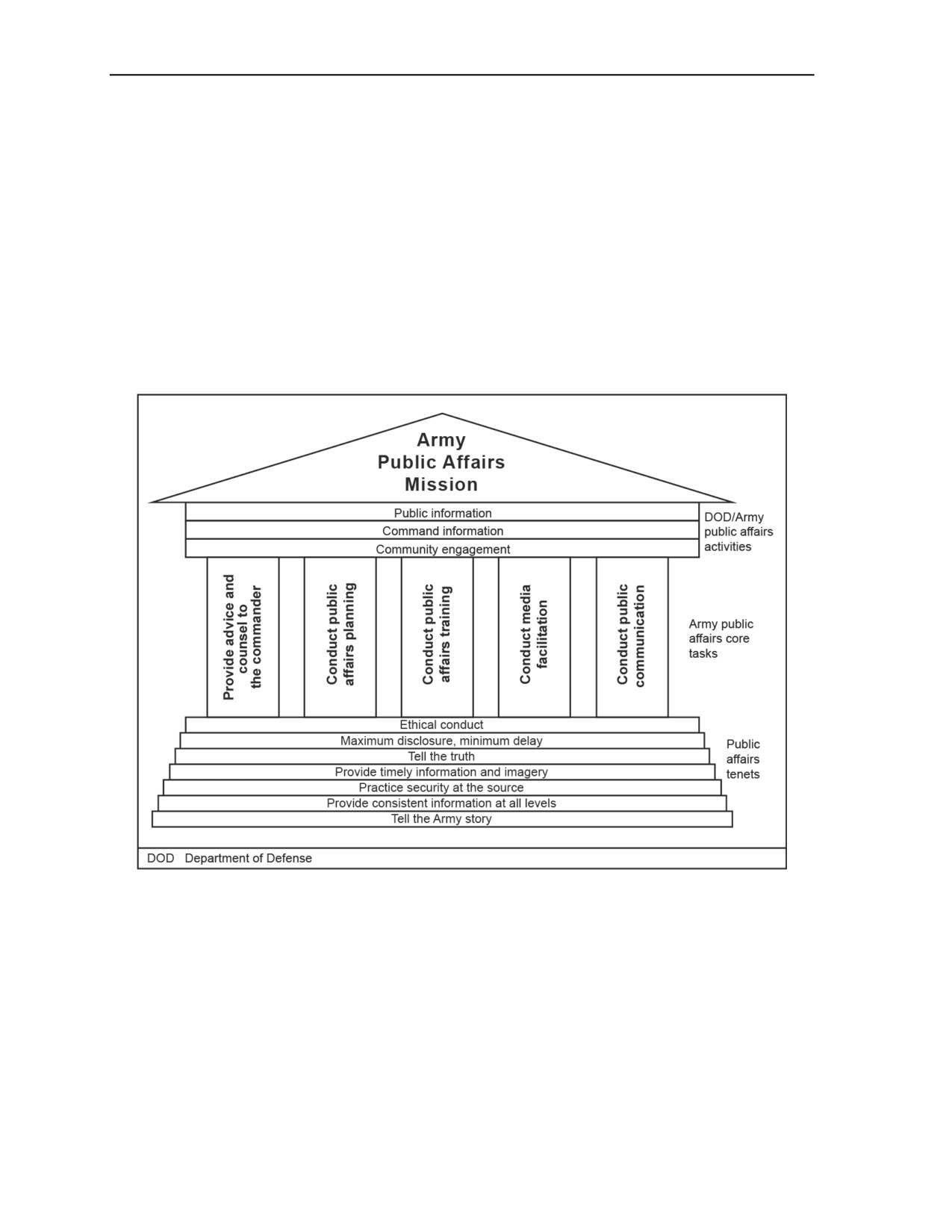
2-8. The structure of public affairs resembles the Parthenon. The overarching mission consists of the
activities, the tasks, and the tenets (see figure 2-1). The tenets form the base of public affairs and are the
best practices or actions by public affairs professionals. The tenets support the core tasks. Public affairs
professionals conduct the core tasks in support of public affairs activities to complete the public affairs
mission.
Figure 2-1. Army public affairs architecture
PUBLIC AFFAIRS ACTIVITIES
2-9. Public affairs activities are broadly categorized into three functions: public information, command
information, and community engagement. Planning and assessment throughout the course of operations
and activities support the functions. With today’s technological communications advancements, the lines
between functions may converge or overlap because information becomes instantly available throughout
the information environment. The three functions are supported by Army public affairs core tasks, tenets,
and public affairs professional characteristics.
2-2
FM 3-61
1 April 2014
Public Affairs Architecture
PUBLIC INFORMATION
2-10. Army public information is information of a military nature, the dissemination of which is consistent
with security and the Department of Defense (DOD) principles of information. (See JP 3-61 for the formal
definition of public information; see DODD 5122.05 for the principles of information.) Information
technology advances provide new public information opportunities. However, public information remains
largely a matter of ensuring media representatives have access to information they need to report on
military operations. Media facilitation activities provide information to international and domestic publics.
Commanders and their public affairs staffs should conduct briefings and interviews, issue statements,
respond to queries, arrange for access to operational units, and provide appropriate equipment,
transportation, and communications support to the media. Media plans should include specific provisions
for each phase of operations and media transportation when available and appropriate.
COMMAND INFORMATION
2-11. Command information is communication from the commander to help members of the command
understand organizational goals, operations, and significant developments. (See JP 3-61 for a formal
definition of command information.) Installation and organizational publications are traditional ways of
communicating with the command, although other forms of communication have evolved such as social
media. Public affairs professionals must understand the effectiveness of social media operations in
communicating quickly and effectively with their local publics, such as using social media in announcing
weather hazards, gate closures, or traffic issues. During a military operation, commanders should consider
all dissemination capabilities available to communicate releasable details and the role of the military in the
operation.
2-12. Command information is an excellent venue to incorporate and reinforce the five essential
characteristics of the Army Profession (trust, military expertise, honorable service, esprit de corps, and
stewardship), the Army Ethic, and the three-certification criteria of Army professionals: competence,
character, and commitment. The guidance in ADRP 1 frames the characteristics and criteria for success as
an Army professional.
2-13. While command information is intended to communicate internally, commanders must recognize
that in today’s information environment, once information is released, it becomes readily available to all
publics.
COMMUNITY ENGAGEMENT
2-14. Army community engagement is public affairs activities that support the relationship between
military and civilian communities (see JP 3-61 for a formal definition of community engagement). It is the
process of working collaboratively with, and through, groups of people affiliated by geographic proximity
or special interest to enhance the understanding and support for the Army, Soldiers, operations, and
activities. During military operations, personnel may be involved in activities that engage the community.
All community engagement activities should support the commander’s communication objectives. Senior
military leaders have responsibilities to engage key leaders in their operational areas, including those from
other government agencies and nongovernmental organizations. Public affairs assists in identifying key
leaders and recommending opportunities for military engagement.
PUBLIC AFFAIRS CORE TASKS
2-15. Core tasks are key activities performed in an exemplary manner to ensure mission success. Public
affairs core tasks make the public affairs section or unit value-added for commanders, staffs, media
representatives, and publics.
PROVIDE ADVICE AND COUNSEL TO THE COMMANDER
2-16. The public affairs officer (PAO) is the commander’s senior advisor on public affairs. This is a key
PAO responsibility. The PAO establishes and sustains commander and staff relationships and maintains
1 April 2014
FM 3-61
2-3
Chapter 2
direct and timely access to the commander. The more the public affairs community understands the
environment in which the commander operates, the more valuable the advice and counsel.
2-17. The PAOs ensure commanders understand implications of their decisions as well as the strength of
public perception. Commanders must know their actions and decisions have public affairs implications.
With the evolution of the global information environment, public affairs activities have become an
increasingly critical element in determining the success of support to strategic end states. Commanders
must recognize the strength and influence of public opinion and perception on the morale, confidence, and
effectiveness of Soldiers.
2-18. Public affairs professionals assist the commander in providing complete, accurate, timely
information to the public. All information must abide within the constraints of operations security
(OPSEC). Providing timely information within such constraints enables the commander to achieve a
balanced, fair, and credible information exchange and relationship with the public.
2-19. Public affairs professionals assist the commander in understanding the information needs and
expectations of Soldiers, family members, the home station community, and all other affected publics.
Commanders should consider these expectations when developing their communication strategy. Public
affairs professionals should also tailor the public affairs plan to meet the information needs and
expectations of the affected publics.
CONDUCT PUBLIC AFFAIRS PLANNING
2-20. Public affairs and communication take continuous, collaborative planning. Developing a
synchronized, cohesive, and comprehensive public affairs plan is vital in meeting the commander’s public
information requirements. The public affairs section or unit must articulate and synchronize public affairs
planning within the military decisionmaking process. Commanders should incorporate communication in
the initial plan. The public affairs section or unit provides detailed analysis of public affairs activities
beyond article counts and “positive/neutral/negative” evaluations. Public affairs professionals also plan for
and incorporate traditional, nontraditional, and social media into the public affairs plan and analysis.
Public Affairs Assessment
2-21. The public affairs assessment addresses all aspects of the information environment, whether or not
they are under the commander’s control. (See JP 3-61 for a formal definition of public affairs assessment.)
Primary emphasis is placed on identifying, measuring and evaluating the implications of the external
information environment that public affairs does not control, but can inform through a coherent,
comprehensive public affairs strategy and its early integration into the commander’s planning and
decisionmaking process. The convergence of external and internal information adds to the value of
assessing the internal environment as well. A public affairs assessment is conducted for each specific
public affairs operation (see paragraph 2-30 for the public affairs running estimate).
2-22. The assessment identifies and evaluates the information environment relevant to the commander’s
intent, mission, area of operations, and echelon of unit. It includes an examination of the physical and
social infrastructure from a public affairs perspective. Each staff section builds and maintains running
estimates. The staff continually updates and uses the assessment as a reference document that describes
regional characteristics pertinent to public affairs activities. PAOs acquire much of the required
information from country studies, operational reports and from other IRC products. The information
exchange ensures coordination in the development of communications strategies, themes, and messages.
2-23. The public affairs assessment serves as the benchmark of the public affairs running estimate and
includes, but may not be limited to, media presence, media capability, information needs, media content
analysis, public opinion, and information infrastructure.
Media Presence
2-24. A commander must understand the level of media interest from initial receipt of mission. The
commander also must have an analysis of traditional, nontraditional, and social media and the visibility of
2-4
FM 3-61
1 April 2014
Public Affairs Architecture
the media interested in the mission. (Paragraph 2-45 begins a discussion on delivery mediums.) The
assessment should address the authority under which media representatives are credentialed and operating
in the area of operations.
Media Capability
2-25. A commander must know the technological capabilities of media representatives present in the area
of operations. An effective public affairs assessment includes the media’s transportation and resupply
capabilities and requirements.
Information Needs
2-26. Successful commanders comprehend what the media wants to know about the unit and its mission.
These commanders also know what information to provide and to which publics. Public affairs planners
analyze the information needs of publics pertinent to the commander’s communication intent. A thorough
public analysis evaluates the delivery of information made available to the media; it analyzes the effect of
delivery on perceptions by non-American publics, such as allied and adversarial.
Media Content Analysis
2-27. A commander must understand what is being reported and by whom. A media content analysis
provides an evaluation of the quantity and the nature of coverage, media trends, and agendas. The analysis
enables commanders to understand how military operations are interpreted and what messages are
communicated to the public. The context in which the Army presents an event or operation can impact on
how a specific public defines the results of that event or operation. Media content analysis is essential to
designing an effective plan that achieves a balanced, fair, and credible exchange of information.
Public Opinion
2-28. A commander must know how regional and local publics, the American people, and U.S. civilian
leaders perceive a situation, military operations, and the use of military power. The public’s perception
may impact the overall public affairs plan based on the information needs of the identified publics.
Commanders also must understand the perceptions held by international publics, both allies and
adversaries, when military operations occur outside the United States.
Information Infrastructure
2-29. Lastly, a commander must consider the information infrastructure that supports public affairs
activities. Public affairs must assess the availability of communications equipment for transmitting and
receiving internal and external information. PAOs must have access to unsecure networks with sufficient
bandwidth to communicate commanders’ messages to the media and publics.
Public Affairs Running Estimate
2-30. The public affairs running estimate is a continuous assessment of the current public affairs situation.
It determines if the current operation is proceeding according to the commander’s intent and if planned
future operations are supportable. Commanders and staffs develop detailed running estimates in the
planning stage and then continuously update the running estimate. In its running estimates, the command
and staff continuously consider the effects of new information and update facts, assumptions, and
conclusions accordingly. A running estimate can describe the existing information environment, emerging
trends, current events, and internal and external communication issues. It also contains analyses and
comparisons of alternative courses of action, recommendations about public affairs force structure, and
employment of available public affairs assets. Based on the mission analysis, the PAO must identify and
request additional public affairs units or individual augmentation if required. The public affairs running
estimate must always include recommendations to the commander.
1 April 2014
FM 3-61
2-5
Chapter 2
2-31. Because a public affairs running estimate may be needed at any time, PAOs develop, revise, update,
and maintain it continuously, including at home station. See appendix A for the public affairs running
estimate format.
Public Affairs Plans
2-32. Based on the information developed in the public affairs running estimate, public affairs planners
develop a support strategy to operations. The public affairs plan reinforces the strategic goals and
operational objectives. It defines the Army perspective of an operation and describes how the operation
supports strategic goals. The public affairs plan provides the commander’s intent for public affairs
activities and the Army’s approach to inform internal and external publics. In final form, it becomes Annex
J (Public Affairs) of the operation plan, which serves as the framework for developing public affairs
guidance. Annex J must address all the public affairs related transportation, communications, billeting,
equipment, and personnel resources required to support the plan. (See appendix C for a sample Army
annex.)
2-33. Public affairs professionals must be aware of their role in providing content for joint Annex Y
(Strategic Communication and Communication Strategy). This annex content is outlined in
CJCSM 3130.03. The content focuses on important communication-related elements, such as the overview
of the information environment, opposition, lines of operations, measures of effectiveness and
performance, tasks, and coordination instructions. Public affairs planners contribute to the development of
joint Annex Y and use the information included to inform the development of joint Annex F (Public
Affairs). (See JP 3-61 for more on the joint annex). Joint content mirrors the Army annex format. (See
appendix C for a sample Army annex.)
Proposed Public Affairs Guidance
2-34. The proposed public affairs guidance (PPAG) recommends mission specific guidance to support
public discussion of the operation. PPAG is created at the local level and submitted through command
channels for approval by Office of the Assistant Secretary of Defense Public Affairs (OASD [PA]). The
OASD (PA) is the sole approval authority for PPAG. PPAG becomes public affairs guidance upon
approval. (See JP 3-61 for a formal definition of public affairs guidance.)
2-35. Public affairs guidance must be approved prior to use. Development of additional or supplemental
PPAG continues as needed. The joint force commander’s public affairs staff recommends additional public
affairs policy, drafts appropriate statements, and identifies any issues and the responses most likely to
address the questions, concerns, and interest of external and internal publics. (See appendix B for PPAG
format.)
Development of the Communication Plan
2-36. Public affairs professionals develop public affairs communication plans to support the execution of
the commander’s communication strategy. Communication planning is the commander’s blueprint and
design for coordinating and synchronizing themes, messages, images, and actions to support public affairs
and other information-related objectives. Synchronization ensures the integrity and consistency of
command themes and messages to the lowest tactical level.
2-37. Communication synchronization requires commanders and staffs to understand the impact
communication plans have on the instruments of national power (diplomatic, informational, military, and
economic) as well as on the operational variables. Communication synchronization facilitates coordinated
communication efforts focused on reaching individual publics through the most credible and effective
means.
2-38. An effective communication plan is commander driven, is proactive, and ensures the results of
tactical actions on the information environment are considered and addressed during plan development. In
tactical and operational environments, the staff develops the commander’s communication plan through
information operations working groups.
2-6
FM 3-61
1 April 2014
Public Affairs Architecture
2-39. The commander’s communication plan addresses the higher headquarters communication strategies,
commander’s planning guidance, and mission requirements. To achieve a specific communication goal,
public affairs professionals should analyze the situation, develop public affairs objectives and desired
outcomes, identify specified publics, develop themes and messages, develop metrics and measures of
effectiveness, and develop steps required to implement the communication plan.
Execution of the Communication Plan
2-40. Army public affairs executes the communication plan through the public information, command
information, and community engagement functions. Public affairs professionals acquire, process, and
deliver information products to the public, which supports the communication plan. Other examples of
support to the communication plan include Soldier and leader engagements and civil-military operations
conducted by other IRCs, which reinforce the commander’s themes and messages.
2-41. To communicate effectively when information flows constantly, public affairs professionals must
acquire accurate and timely information, produce deliverable and desirable products, and deliver products
through the appropriate mode to the intended public in a timely manner. These products must be applicable
to internal and external publics.
Acquire
2-42. To acquire information, public affairs monitors current and ongoing events in the information
environment and seeks credible sources of information. Because of the volume of information and the
numerous potential distribution possibilities, public affairs professionals must acquire and develop
information from many sources:
z
Leaders, Soldiers, and units.
z
Developed sources.
z
Media (traditional, nontraditional, social media).
z
Intelligence.
z
Communities and publics.
z
Subject matter experts.
2-43. Public affairs sections and units must be equipped with current and emerging technologies to
communicate effectively. It is imperative for public affairs professionals to maintain and grow their
technological competency. This technology must be comparable and compatible with national and
international media industry standards.
Process
2-44. Although public affairs product development is technical—planning, interviewing, writing, editing,
and photographing—the public affairs professional stills review the context of the information and
products for their impact on internal and external publics and the military operation.
Deliver
2-45. Public affairs releases all products in a format used by the recipient. Although not always possible,
products are more likely to be used if compatible with the recipient’s equipment. Public affairs
communication products must be expedited to the users by the most technologically advanced reliable
method.
2-46. As technology improves public affairs capabilities, public affairs units incorporate those
improvements into the delivery system. This incorporation increases the potential to reach an ever-growing
need for information and the ability to remain relevant.
2-47. Public affairs professionals consider the following mediums:
1 April 2014
FM 3-61
2-7
Chapter 2
z
Traditional media.
z
Nontraditional media.
z
Social media.
2-48. Traditional media involves traditional means of communication and expression that have existed
since before the advent of the Internet. Industries generally considered part of the traditional media include
broadcast and cable television, radio, newspapers, and magazines.
2-49. Nontraditional media involve targeted reporting from citizen journalists or activist journalists. It is
often associated with the use of Internet-based mediums like blogs, microblogs, Web forums, community
radio, and independent or self-published written materials.
2-50. Social media is the use of Internet-based applications to create and exchange user-generated content.
Social media instantaneously connects users within a global network, making the accelerated transfer of
information more widespread. Social media sites offer a means of dialogue when developing
communication strategies and can counter adversarial propaganda. However, an understanding of an
operational environment is essential, as Internet access is limited in many nonwestern or underdeveloped
countries.
Themes, Messages, and Talking Points
2-51. Commanders communicate public affairs messages that support their themes through the functions
of public information, command information, and community engagement. Public information messages
communicate to global and domestic audiences and accurately describe operations or provide information
pertinent to selected publics in the area of operations, host-nation officials, and local publics. Command
information messages are communicated through command relationships to reinforce command policy and
commander’s intent to subordinates. Community engagement messages keep the community and the local
public informed. Public affairs professionals advise commanders on the use of public affairs themes,
messages, and talking points to support communication objectives. Commanders must ensure their themes
and messages are nested within those of their higher headquarters.
2-52. Public affairs professionals develop public information, command information, and community
engagement themes, messages, and talking points. Consideration must be given to second- and third-order
effects on intended and unintended publics when developing themes, messages, and talking points. To
avoid information fratricide, PAOs synchronize themes, messages, and talking points with other IRCs
when required in the operational or tactical environments.
Themes
2-53. Themes are a commander’s priorities that guide messages and other information products, such as
talking points and public affairs guidance (see discussion beginning in paragraph 2-34). Themes are broad
ideas the commander wants to convey to key publics. They are enduring and as such do not change
frequently.
Messages
2-54. Messages are situation or mission dependent. Messages support themes that reinforce specific
actions or objectives tailored to publics. They can be verbal, written, gestured, or electronic
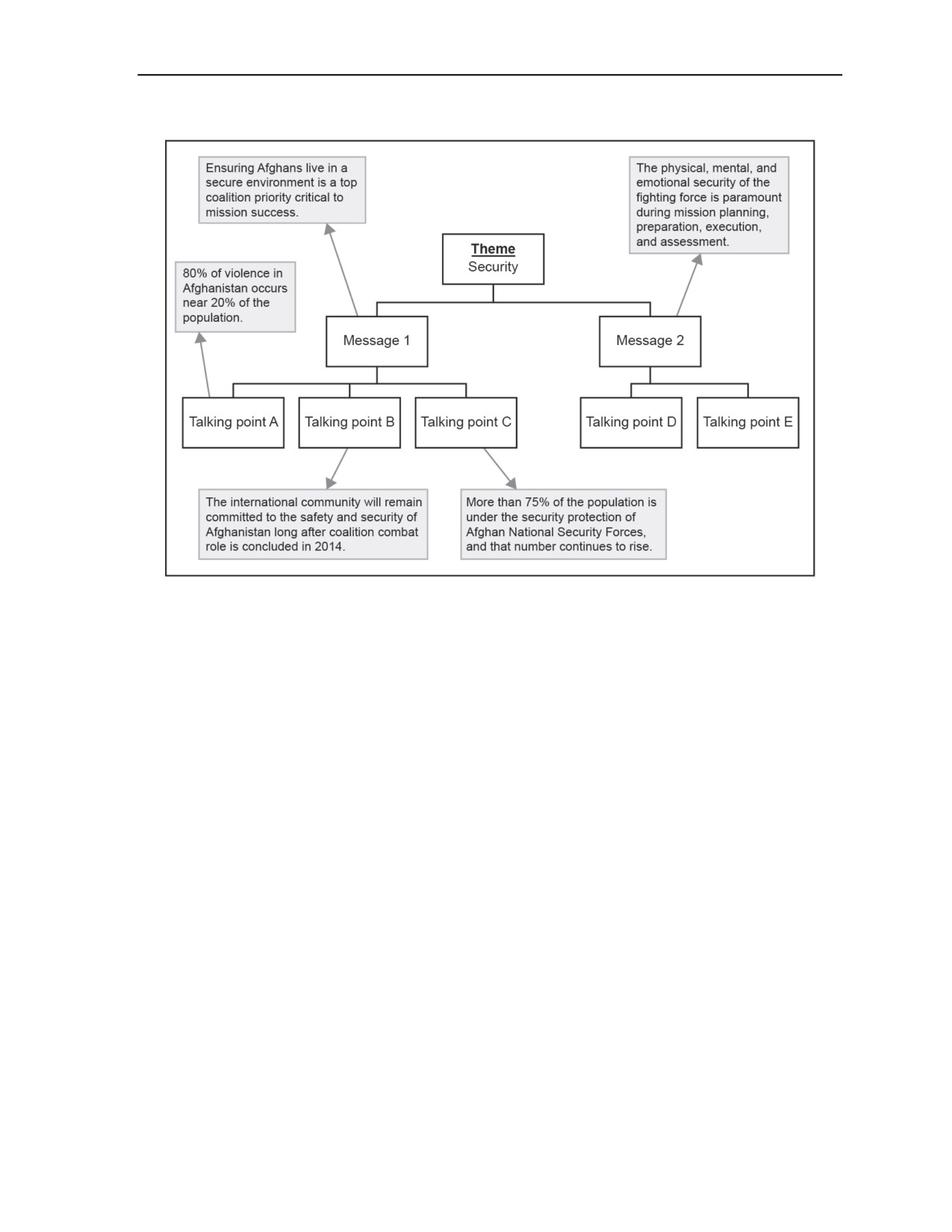
communications. They are meant to communicate clear, accurate information. See figure 2-2.
2-8
FM 3-61
1 April 2014
Public Affairs Architecture
Figure 2-2. Themes, messages, and talking points
2-55. Psychological messages convey specific information to selected foreign publics to influence their
perceptions, attitudes, beliefs, and behavior. The military information support operations (MISO) planner
or unit develops these messages. Public affairs must be aware of these messages and their intended
audience to prevent conflicts within the commander’s communication strategy. MISO messages and
actions support themes established in the approved MISO program for that particular mission. (See JP 3-
13.2 for detailed information on MISO.)
2-56. To gain and maintain support of populations in areas of conflict, commanders must consider public
perceptions and ramifications of their actions. Commanders must understand host-nation laws and cultures
to operate effectively and ethically in the information environment. This understanding determines how to
inform publics at home, gain support abroad, and generate support or empathy for the mission.
Commanders must synchronize all available IRCs and other designated operational assets to support
messaging and communication efforts and ultimately operational objectives and mission success. This
coordination is conducted within an information operations working group. (For more information on the
synchronization of public information, see discussion beginning in paragraph 1-18.)
Talking Points
2-57. Talking points are brief, concise statements of relevant fact that provide proof of a message. They
are used to inject consistency into an organization’s interviews and public comments. They provide
personnel additional specifics and rationale to reinforce messages when speaking with the media. Talking
points are intended to complement and be supportive of messages. For example, each message could have
five or six associated talking points.
Development of Themes, Messages, and Talking Points
2-58. The development of public affairs themes and messages is a deliberate process that supports the
commander’s information objectives. A specific theme guides the development of the supporting messages.
1 April 2014
FM 3-61
2-9
Chapter 2
Messages should be concise, centered on a single idea, and tailored to the appropriate medium. Messages
are supported by talking points that contain relevant facts and information.
IMPLEMENT HIGHER HEADQUARTERS’ PUBLIC AFFAIRS THEMES
2-59. Public affairs professionals must implement, support, and tailor higher headquarters themes,
messages, and talking points into their public affairs planning process. These themes and talking points are
included in the higher headquarters’ public affairs guidance (see paragraph 2-34).
2-60. Coordination and synchronization of the higher headquarters themes, messages, and talking points in
tactical and operational environments are conducted in the information operations working group. Higher
headquarters’ public affairs guidance may be included in the operation plan, warning order, operation
order, or fragmentary order, or it may be published separately for specific topics.
CONDUCT PUBLIC AFFAIRS TRAINING
2-61. Public affairs training should follow the operations process of plan, prepare, execute, and assess in
unit training and leader development by using unit training management as discussed in ADRP 7-0. Public
affairs professionals should participate in and use the military decisionmaking process to plan public affairs
training.
2-62. Public affairs professionals must train fellow public affairs professionals and nonpublic affairs
Soldiers, civilian employees, and family members to communicate the Army message. The training may be
group media familiarization or focused one-on-one interview techniques with subject matter experts. Public
affairs professionals must be prepared to train and assist allies and global partners. Effective training
replicates operational realities and teaches the fundamentals of media and military interactions. Such
training emphasizes that the media is a communication channel to internal and external publics and not an
adversary.
Public Affairs Personnel Training
2-63. Public affairs personnel training emphasizes individual and collective tasks to prepare professionals
to conduct the public affairs core tasks, mission planning, and execution. See the discussion beginning in
paragraph 2-15 for public affairs core tasks. Public affairs staff routinely incorporate training scenarios into
the commander’s training events.
Non-Public Affairs Soldiers, Civilians, and Family Members Training
2-64. Public affairs training provides nonpublic affairs Soldiers, civilians, and family members with
guidelines regarding interaction with media, how to react to media encounters, and interview preparation.
Although not mandatory for family members, it is highly recommended.
2-65. For commanders, staffs, and other Army leaders, public affairs training builds on individual training.
It focuses on synchronizing public affairs considerations into the planning and decisionmaking process. It
prepares them to recognize that media coverage can affect Soldier morale, combat effectiveness, tactical
execution, and mission accomplishment. Public affairs training and its importance enables commanders,
staffs, and other Army leaders to recognize, understand, and plan for the strategic, operational, and tactical
impact of a media-intense information environment.
CONDUCT MEDIA FACILITATION
2-66. Media facilitation is the process of planning, preparing, executing, and assessing a media
engagement. It can be accomplished for an individual media engagement or a large-scale media event. A
media engagement is a specified instance of media interaction between a Soldier and a member of the
media. Media engagements may be planned or unplanned. Media facilitation enables PAOs to identify
requirements for a planned media engagement or media event.
2-10
FM 3-61
1 April 2014
Public Affairs Architecture
2-67. The meaning of the word media continues to evolve. It has evolved from verbal mass
communication to printed mass communication to technological mass communication. Public affairs
personnel must evolve media facilitation to support emerging technology needs and increased
nontraditional media interest in Army activities. Facilitation must include traditional, nontraditional, and
social media. It is essential to have access to information and operations centers, along with adequate
media facilitation facilities, to assist the media in reporting the Army story properly.
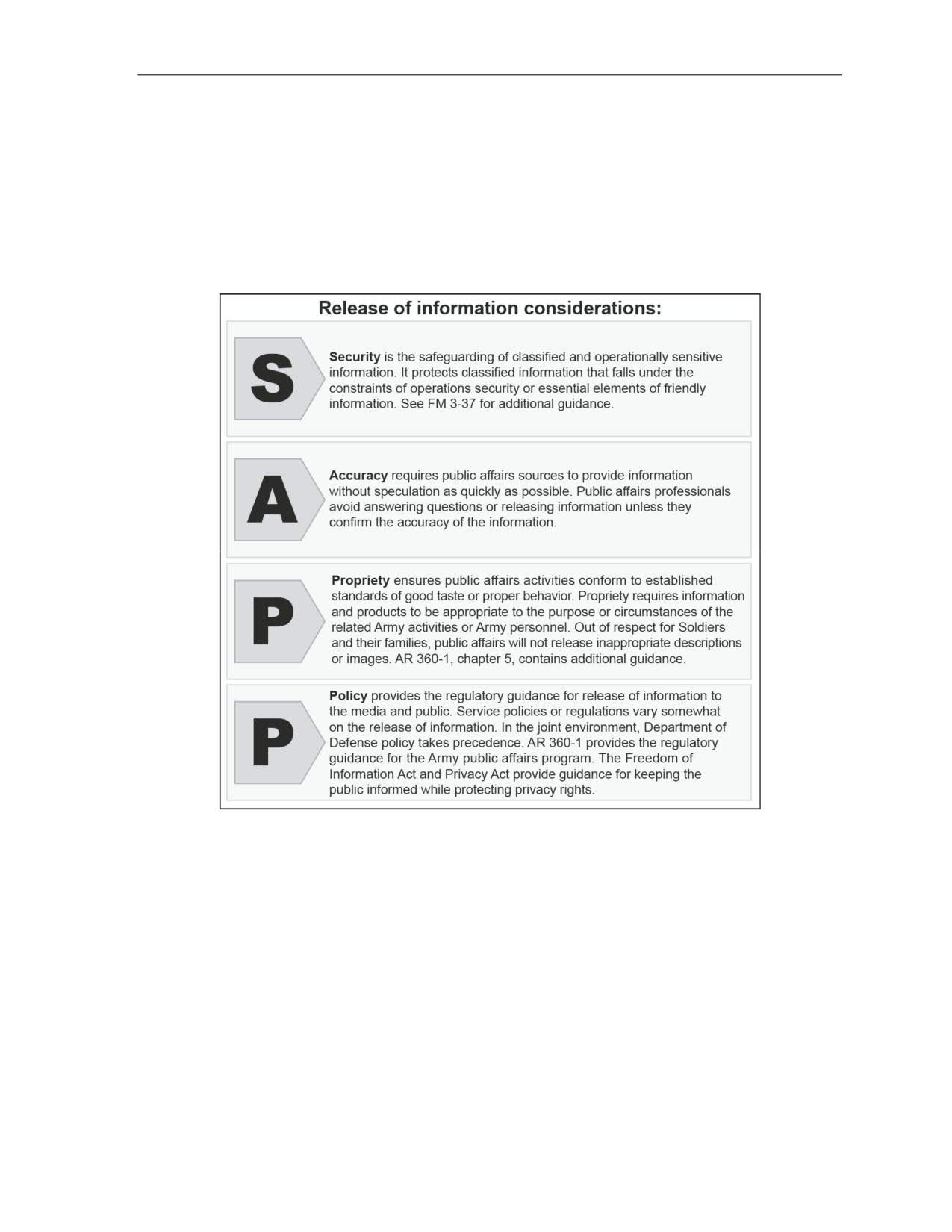
2-68. When releasing information, public affairs professionals use security, accuracy, propriety, and policy
(known as SAPP) to remember release of information considerations. See figure 2-3.
Figure 2-3. Security, accuracy, propriety, and policy
Media Operations Center
2-69. A media operations center is a facility established by the joint force commander to serve as the focal
point for the interface between the military and the media during the conduct of joint operations (JP 3-61).
This central meeting place for the military personnel and media representatives provides the media with a
primary information source, a logistics support base, and a coordination base. The media operations center
(MOC) provides commanders and public affairs staffs with a venue to discuss operations and provides
journalists a place to obtain information quickly and efficiently. Public affairs professionals must identify
and request additional public affairs units or individual augmentation for establishing a MOC in the
planning phase of an operation or high-visibility media event.
2-70. Public affairs Soldiers serve in all sections of the MOC, including planning cells and a media
facilitation section. PAOs staff the MOC to support regional and local non-English speaking media,
especially in an operational environment.
1 April 2014
FM 3-61
2-11
Chapter 2
Major Nidal Hasan Article 32 Hearing
High-profile legal cases often necessitate the establishment of a temporary media
operations center (MOC) to coordinate and support an intense media presence. After
the Soldier Readiness Processing Center shooting at Fort Hood, Texas, on
November 5, 2009, Major Nidal Hasan was charged with premeditated murder and
attempted premeditated murder. The III Corps and Fort Hood Public Affairs Office
developed a media plan to facilitate media during the course of the Article 32
hearing. To support the media presence, the 7th Mobile Public Affairs Detachment
(MPAD) augmented the III Corps and Fort Hood Public Affairs Office by establishing
a MOC at Club Hood. The 7th MPAD was responsible for media transportation,
registration, badging, and facilitation, as well as coordinating briefing area set-up,
responses to query, and assisting in media content analysis.
Media Access
2-71. Public affairs professionals take a proactive approach to media facilitation and ensuring media
representatives have access to leadership and relevant information. Public affairs professionals serve as
liaisons and rarely interfere with the reporting process unless OPSEC or command guidance violations are
committed. The public affairs mission includes increasing media representatives’ understanding of military
events and occurrences so the coverage is accurate and timely.
2-72. There must be continuous dialogue between the Army and media representatives who have a vested
interest in military activities. Open and independent reporting are the principal means of coverage. Most
media representatives strive to publish accurate, truthful, balanced stories. Their goal is not to undermine,
interfere, or misrepresent the military, its operations, or activities. However, some stories may result in
misunderstandings, errors, or criticisms.
2-73. Commanders and their public affairs professionals must seek regular opportunities to engage the
media. The command must understand the impact of command actions on perceptions, attitudes, and
beliefs of the media. The command must formulate and deliver timely and culturally attuned messages to
counter potential misperceptions.
2-74. Effective commanders make every effort to provide access, transportation, and communication
capabilities to media representatives. Consistent with operational conditions, support should enable timely,
secure, compatible transmission of information products. When government support is unavailable, the
media must file products using their own resources.
Media Credentials
2-75. Media credentialing is used by commanders to allow journalists and members of the press access to
cover military activities in the continental United States and in deployed operations. While not intended to
control or restrict media coverage, commanders must take reasonable steps to ensure all media
representatives on their installation or in their operational areas are properly credentialed for accountability
purposes. However, the increasingly open information environment and the number of noncredentialed
media representatives who “show up” at military activities or operations of public interest make it unlikely
all journalists will have proper credentials.
2-76. In an operational environment, the joint force PAO or the MOC director establish media
credentialing guidelines. Credentialing during operations ensures media representatives are recognized as
journalists and treated accordingly under the law of war. Also during operations, some media will embed
with units for an extended time. Embedded reporters will be registered by the joint force and will carry
identifying credentials or, as appropriate, Geneva Convention cards. Commanders should not provide
information to noncredentialed and unregistered media representatives without guidance from the joint
force PAO or the MOC director.
2-77. Journalists seeking credentials to cover military activities must agree to ground rules tailored to the
specific event or operation established by the approving commander, PAO, or MOC director. Media
2-12
FM 3-61
1 April 2014
Public Affairs Architecture
representatives without credentials may not be afforded the same access as credentialed media. All media
representatives should be encouraged to register with the MOC. All journalists, registered or not, are
expected to abide by established media ground rules. Under normal circumstances, participating in DOD-
hosted training for the media will not be used as a prerequisite for accompanying U.S. forces.
2-78. In an operational environment, the decision to suspend credentials or expel a reporter should be
made only with the approval of the joint force or combatant commander. In garrison or home station, the
authority to suspend or expel a reporter rests with the installation senior mission commander.
Ground Rules
2-79. Ground rules protect the media and Soldiers from the release of information that could threaten their
security or safety. Ground rules reconcile the media’s interest to report on military operations in a timely
manner with security and safety concerns. They are not intended to prevent release of derogatory,
embarrassing, negative, or noncomplimentary information. Media ground rules also include requirements
that protect the health and welfare of the media. For example, media ground rules should include the
process for release of information, access to the commander, access to the Internet if not commercially
available, and unintentional exposure to classified information. (See JP 3-61for more information on
release of information.)
2-80. In multinational operations, responsibilities for establishing media ground rules, credentialing media,
and, if necessary, expulsion of media, are developed and implemented through appropriate multinational
command and staff channels. Media outlets owned in whole or in part by governments or citizens of rival
states may not receive the same considerations as those working for outlets owned by governments or
citizens of friendly nations. As in joint operations, noncredentialed journalists may not be given the same
access as those with credentials. Media representatives should be encouraged to register at the appropriate
information center.
2-81. Public affairs personnel do not always accompany the media. U.S. commanders and public affairs
personnel should identify media facilitation issues and train nonpublic affairs personnel to serve as
facilitators. Commanders must develop plans that accommodate reporters and issue guidance as to the
information and support the media will receive.
Media Pools
2-82. Media pools are no longer the standard for reporting U.S. military operations. Current
communications technology and open media access to an operational area make media pools less necessary
than in past operations. However, media pools may provide the only means of early access to a military
operation. Pools should be as large as possible and be disbanded at the earliest opportunity.
2-83. The arrival of early-access pools does not cancel independent coverage for media representatives
already in the area. Under conditions of open coverage, pools may be appropriate where seating is limited,
at remote locations, or during shipboard events. In such circumstances, public affairs plans specify what
mediums form the pool, such as print, broadcast, and trade mediums, to ensure adequate scope and
distribution of coverage. Ideally, media representatives determine who fills the spaces in the pool.
2-84. The military is responsible for the transportation of media pools. Commanders should provide
dedicated transportation if available to ensure the most complete coverage. Under conditions of open
coverage, commanders should permit media representatives to ride on military vehicles and aircraft when
feasible. Commanders follow the guidelines in The Joint Travel Regulations, Volume 2, Department of
Defense Civilian Personnel to ensure standardization of policy and procedures.
2-85. The formation of a media pool places additional media support requirements on the organization.
When commanders decide media pools are necessary, public affairs planning should include
reimbursement from the media depending on location and availability of commercial transportation.
1 April 2014
FM 3-61
2-13
Chapter 2
CONDUCT PUBLIC COMMUNICATION
2-86. Public communication refers to the communication among the Army and international, national, and
local publics through coordinated programs, plans, themes, and messages. It involves the receipt and
exchange of ideas and opinions that contribute to shaping public understanding of, and discourse with, the
Army. Public communication includes the release of official information through news releases, public
service announcements, media engagements, town halls, senior leader and Soldier engagements, and social
networks. Public communication supports the commander’s responsibility to keep the American people
and the Army informed. Public communication objectives are:
z
Increase public awareness of the Army’s mission, policies, and programs.
z
Foster good relations with communities the Army interacts with at home and abroad.
z
Maintain the Army’s reputation as a respected professional organization responsible for national
security.
z
Support the Army’s recruiting and personnel procurement mission.
2-87. An active approach to public communication requires specific objectives, courses of action, and the
identification of potential obstacles. Public communication engagements are impacted by media coverage,
which heighten media facilitation efforts and communication strategies. A mutually supportive relationship
between the Army and the public is fundamental to creating confidence in America’s Army. While
relationships can be affected by events, they also are shaped by general perceptions. An Army community
thought to be indifferent to its civilian neighbors will likely experience a negative relationship.
2-88. The Army relies on communities and regions surrounding its installations for direct and indirect
support. Communities provide the Army access to resources needed to train and maintain readiness and
extend support to families of mobilized or deployed Soldiers. Army family members, who represent Army
values and ideals, serve as community ambassadors.
2-89. Members of the Army National Guard and United States Army Reserve live and work in the
community and are integral parts of their hometowns. A public’s positive relationship with a local reserve
unit or an active-duty installation requires the command to consider potential implications of every
installation activity, operation, or major training activity. This is especially important during crisis
management, mobilization, deployment, and redeployment operations, even if the installation or reserve
unit is not directly involved. It is also important during national debate about a politically sensitive or
controversial Department of the Army or Department of Defense issues. During such times, the
information requirements of internal and external publics increase dramatically. Installation and reserve
unit commanders and their staffs—advised, counseled, and supported by their public affairs elements—
need to conduct effective public affairs programs that include open, honest, accurate, complete, and timely
release of information based on information needs.
2-90. Command-initiated actions that contribute to positive community relations include participating in or
providing open houses, exhibits, static displays, bands, color guards, and speakers. Additional activities
include participation and membership in civic, business, and professional organizations. Restrictions on
military participation and support of specific activities are addressed in detail in AR 360-1.
2-91. Management of domestic public communication programs is a public affairs function. Outside the
United States, public communication is a coordinated effort with other IRCs. Regardless of locations,
public affairs personnel help civic leaders and local populations understand the activities of nearby
installations and units. Critical publics include, but are not limited to, the general public, government
officials, business leaders, and religious, service, civic, and school organizations.
2-92. Outside the United States, host-nation civilians are often employed as media facilitators and public
communication specialists. They advise PAOs and commanders of host-nation cultural and political
sensitivities and conduct media analysis to assess public responses.
2-14
FM 3-61
1 April 2014
Public Affairs Architecture
PUBLIC AFFAIRS TENETS
2-93. Effective application of the public affairs tenets can result in more effective and efficient public
affairs activities and improved relationships with the media. The tenets describe best practices. Successful
public affairs personnel review and appropriately apply these tenets during all stages of public affairs
activities, operations, planning, and execution.
PRACTICE ETHICAL CONDUCT
2-94. The practice of public affairs is centered on truth, trust, and credibility. In a profession that relies
heavily on institutional and individual credibility, communication professionals must have a solid ethical
foundation to be effective. The Army profession is built on trust, and public affairs professionals are
charged with establishing conditions that lead to trust and confidence in America’s Army in peace and war.
2-95. Lapses of ethical judgment often become controversial media topics, garner negative publicity, and
significantly damage reputations and credibility. As a result, these lapses potentially result in the loss of
trust. Any loss of discipline on the part of Soldiers may be exploited by the enemy through propaganda and
then magnified through the media. Public affairs professionals must understand that negative publicity
damages the Army’s reputation and that adhering to the tenets of public affairs can minimize the effects of
negative publicity and maintain public trust and confidence in the Army.
2-96. Public affairs professionals communicate to internal and external publics the importance of careful
and responsible management of the Army Profession. These professionals communicate with their actions
by adhering to the highest standards of military ethics and morality. This stewardship helps solidify the
trust among the American people, host-nation countries, and the Army.
2-97. To maintain credibility, public affairs professionals must understand journalism ethics and be able to
identify when media representatives are not adhering to fair and balanced reporting. Although public
affairs professionals cannot control the media, public affairs professionals must be accurate, accountable,
and treat all media representatives with respect, integrity, and equal consideration to maintain credibility.
PROVIDE MAXIMUM DISCLOSURE, MINIMUM DELAY
2-98. The Army has an obligation to keep its publics informed in a thorough and timely manner. Open and
independent reporting is the norm. Media representatives should be granted access to units, activities, and
operations within the bounds of operational security. The commander delegates to the PAO the authority to
release information to the public as stipulated in AR 360-1.
2-99. The release of information should not be withheld or delayed solely to protect the installation,
command, or the Army from criticism or embarrassment. Being open and forthcoming enhances the
Army’s credibility and trustworthiness.
TELL THE TRUTH
2-100. Public affairs professionals release only accurate information in a timely manner. The long-term
success of public affairs activities depends on maintaining the integrity and credibility of officially released
information. Deceiving the public undermines trust in the Army. Accurate, balanced, and credible
presentation of information leads to public confidence in the Army and the legitimacy of Army operations.
Attempting to deny unfavorable information or failing to acknowledge its existence leads to media
speculation, the perception of a cover-up, and the of loss public trust. Public affairs professionals should
address issues openly and honestly as soon as possible.
PROVIDE TIMELY AND ACCURATE INFORMATION AND IMAGERY
2-101. Commanders should be prepared to release timely, factual, coordinated, and approved information
and imagery. The public release of information and imagery has a powerful effect on friendly, neutral,
adversary, and enemy decisionmaking cycles and perceptions. The source that releases more timely and
1 April 2014
FM 3-61
2-15
Chapter 2
accurate information and imagery often becomes the media’s preferred information source. PAOs should
establish a timely and accurate process for the release of information.
PRACTICE SECURITY AT THE SOURCE
2-102. All Army personnel must be aware of OPSEC and are responsible for safeguarding sensitive
information. Therefore, it is important that official information and imagery be approved prior to public
release. As sources of information, OPSEC applies to media interviews and the sharing information and
imagery with families or friends to include email and social media platforms.
PROVIDE CONSISTENT INFORMATION AT ALL LEVELS
2-103. The public often receives information simultaneously from many sources. The Army’s or
commander’s credibility is jeopardized if the information is conflicting. Information and imagery must be
appropriately coordinated and in compliance with command guidance before release to the public.
TELL THE ARMY STORY
2-104. The aim of Army public affairs is to tell the Army story accurately, honestly, and completely to as
many publics as possible by the timely release of information to internal and external news sources. The
civilian media serve as a link between the Army and the American public. That link is critical because the
Army cannot carry out its mission without public support. Commanders must recognize the legitimate role
of news media and emerging technologies in reporting military operations as well as accept the presence of
these technologies wherever the U.S. military operates.
PUBLIC AFFAIRS CHARACTERISTICS
2-105. Public affairs characteristics are those qualities, behaviors, skills, abilities, and knowledge that
directly and positively impact the success of public affairs and the Army. Characteristics are objectively
measured, enhanced, and improved through mentoring and training. Public affairs characteristics help
public affairs professionals focus attention on key command goals and values, such as improved credibility
and public understanding and support.
2-106. Public affairs professionals must—
z
Exercise a proactive approach to determine second- and third-order effects and develop plans to
shape possible outcomes.
z
Exercise disciplined initiative by adapting to operational conditions through flexible and agile
creative thinking to solve problems.
z
Comprehend the strategic vision by seeing the big picture and strategic implications of tactical
events.
z
Use sound judgment to form opinions and advice in recommending public affairs courses of
action to the commander.
z
Create a collaborative understanding of the impact of public affairs activities on an operational
environment, mission, and operations.
z
Enhance relationships and communication through cultural awareness by understanding the
cultural differences among military, U.S., international, adversary, and enemy publics and
knowing how public affairs activities impact each differently.
z
Apply ethical reasoning to make informed choices and provide counsel to the commander when
faced with tough issues and ethical concerns concerning the ramifications of an organization’s
or leadership’s actions.
2-16
FM 3-61
1 April 2014
Chapter 3
Public Affairs Elements
This chapter addresses the Army public affairs force and its organization to support
commanders at all levels of command. It first discusses the personnel to include the
career programs for commissioned officers, noncommissioned officers, enlisted
Soldiers, and Army civilians. It next addresses the public affairs organizations. The
chapter concludes with a discussion of specific public affairs units.
PERSONNEL
3-1. Public affairs commissioned officers, noncommissioned officers (NCOs), and civilians must be
prepared to support the commander with a wide range of knowledge and understanding of the
communication process, the information environment, and potential impact of public affairs personnel on
operations. Public affairs leaders should be among the most informed in the command. They must be aware
of all aspects of an operation and how related releasable information is conveyed to and perceived by
publics.
THE PUBLIC AFFAIRS OFFICER ROLE
3-2. The public affairs officer (PAO) develops strategies, leads, and supervises the conduct of public
information, community engagements, and command information. Whether commissioned officer, NCO,
or Army civilian, the PAO’s principal role is to provide advice and counsel to the commander and the staff
on how affected external and internal publics will accept and understand the unit’s operations.
3-3. PAOs provide commanders with the expertise and guidance to conduct public affairs activities and
enhance the command’s ability to acquire, process, and deliver information. Because information—through
mass media and information technologies—reaches publics immediately, PAOs must assist the commander
to anticipate and respond to media impact on internal and external publics.
3-4. PAOs serve on the commander’s personal or special staff and supervise public affairs staff sections
or attached public affairs units. Because of their role in explaining the Army and its operations to all
publics, PAOs must maintain a sound grasp of Army doctrine and war fighting knowledge throughout their
careers.
FUNCTIONAL AREA 46
3-5. Regular Army commissioned officers apply for functional area 46 or to be PAOs between their 5th
and 10th years of commissioned service. All officers, regardless of component, must graduate from the
Public Affairs Qualification Course prior to assignment as a PAO. The majority of new PAOs are assigned
to operational units.
3-6. Gaining operational experience in a basic branch is vital to a PAO’s success and credibility. For this
reason, PAOs attend professional military education and training at the same rate and career patterns as
other branch and functional area officers.
3-7. PAOs receive extensive training in public affairs principles, operations, tactics, techniques, and
procedures at the Defense Information School (through the Army Correspondence Course Program) and in
educational opportunities, such as Training with Industry and Advanced Civil Schooling. The combination
of military and civilian experiences enables PAOs to support the Army, their commanders and the
command’s communications goals and strategies.
1 April 2014
FM 3-61
3-1
Chapter 3
CAREER MANAGEMENT FIELD 46
3-8. Career management field 46 comprises three military occupation specialties (MOSs): 46Q Public
Affairs Specialist, 46R Public Affairs Broadcast Specialist, and 46Z Chief Public Affairs NCO. Soldiers
with the 46Q and 46R specialties are awarded MOS 46Z at the sergeant first class rank. Like their Regular
Army counterparts, Reserve Component Soldiers must meet the same basic and advanced educational
requirements.
3-9. Public affairs Soldiers receive their MOS qualification at the Defense Information School. Public
affairs NCOs receive additional public affairs training through the Army’s Noncommissioned Officer
Education System schools, including the Advanced Leaders Course, the Senior Leaders Course, and the
Sergeants Major Course.
3-10. Career management field 46 Soldiers have additional opportunities to attend advanced public affairs
training at the Defense Information School, to train with industry, and to enroll in civilian education
options similar to PAOs.
3-11. Career management field 46 Soldiers remain tactically proficient performing Soldier tasks and
technically proficient in today’s information environment. These Soldiers take every opportunity for
advanced schooling to remain current with emerging communication technologies and methods.
3-12. Public affairs NCOs work closely with the PAO. In some situations, a public affairs NCO may serve
as the commander's senior public affairs advisor. Therefore, public affairs NCOs must be prepared to
perform the duties of a PAO. See discussion beginning in paragraph 3-5.
3-13. Public affairs NCOs are experts on the public affairs functions, core tasks, tenets and characteristics
found in Chapter 2. NCOs provide the essential functional area expertise and continuity required for
successful public affairs programs and activities.
THE DEPARTMENT OF THE ARMY PUBLIC AFFAIRS CIVILIAN CAREER PROGRAM 22
3-14. Career program (CP) 22 civilian employees fill critical roles in the Army’s public affairs mission.
CP 22 includes six occupational series applicable to the public affairs and communications media
professions: 1035 Public Affairs; 1082 Writer-Editor; 0301 Miscellaneous Administration and Program
Series (Strategic Communications and Legislative Affairs); 1001 General Arts and Information Series;
1087 Editorial Assistant Series; and 1099 Information and Arts Student Trainee Series.
3-15. Public affairs civilians serve across the Army in support of the Department of the Army, Army
commands, Army Service component commands (ASCCs), direct reporting units, field operating agencies,
and other positions requiring professional communicators. They work as public affairs specialists,
newspaper and magazine writers and editors, visual arts specialists, speechwriters, congressional affairs
specialists, strategic communicators, and editorial assistants. CP 22 professionals develop and maintain
working relationships with media representatives, as well as serve as liaisons with academic, civic,
business, and government organizations.
3-16. The CP 22 workforce has a centralized training and development program that provides sequential
and progressive training for communication functional specialties and in leadership, supervision, and
managerial development. The CP
22 Army Civilian Training, Education and Development System
(ACTEDS) plan provides general information and guidance on management of the Public Affairs and
Communications Media Career Program, including career progression ladders, core functional
competencies, master training plans, and mobility and continued service requirements. The CP 22 manager
facilitates central training, education, and development opportunities for public affairs careerists as defined
by the ACTEDS plan and CP 22 career maps. Public affairs specialists also attend the Civilian Education
System leadership courses. See the Career Program 22 ACTEDS Plan Web site.
3-17. Civilian public affairs specialists must have the same skills and competencies as their military
counterparts. Continuity of operations is one of the civilian public affairs specialists more critical roles.
They support military operations by providing a direct and vital link between deployed forces and the
home-station community. In many situations, they may deploy with the units they support or as an
3-2
FM 3-61
1 April 2014
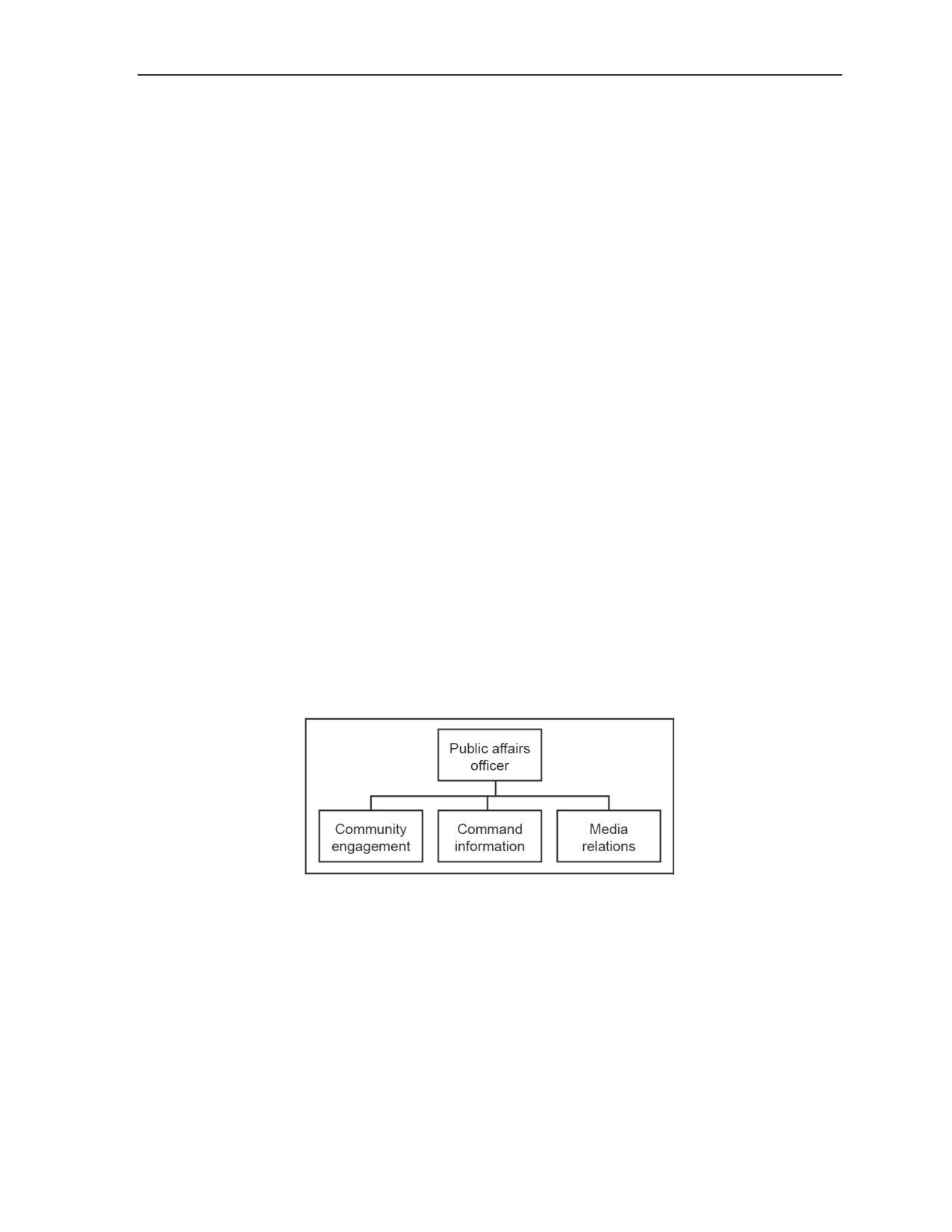
Public Affairs Elements
individual augmentee. During disaster operations supported by the United States (U.S.) Army Corps of
Engineers within the United States, the civilian public affairs specialist often serves as a primary Army
liaison in affected communities.
3-18. Senior civilian public affairs professionals develop and execute communication strategies, conduct
analyses, and provide assessments of communications operations. They lead, manage, and train other
public affairs personnel.
3-19. Civilian public affairs specialists participate in the full range of public affairs missions from
community relations and outreach to communication planning (see paragraph 2-36) and media operations.
Many civilian public affairs employees begin their careers within CP 22 working on a command or
installation publication.
ORGANIZATIONS
3-20. Public affairs is the commander’s responsibility at all levels of command. The PAO serves on the
brigade’s special staff, the commander’s personal staff (from division through Army command), and the
Department of the Army principal staff.
3-21. Operational unit public affairs sections are staffed at their minimum-essential wartime requirements
to perform public affairs tasks and support the commander’s ongoing communication strategies and
planning guidance. When these units deploy, the public affairs sections may be augmented to support the
mission. Commanders must request their public affairs unit augmentation in accordance with approved
rules of allocation. Without the proper planning and additional public affairs support, the commander’s
public affairs capability and capacity may be degraded.
3-22. At home station, operational units and installation tenant organizations, with and without assigned
public affairs staffs, receive limited public affairs support from the garrison public affairs office.
GARRISON PUBLIC AFFAIRS OFFICE
3-23. The garrison public affairs office provides standard public affairs services to an installation. Garrison
public affairs support is dependent on staff size, which varies based on mission and tenant unit
requirements. See figure 3-1 for task organization.
Figure 3-1. Garrison public affairs task organization
Function
3-24. The garrison public affairs office supports the senior commander, the garrison commander, and
partner commanders on the installation. Garrison public affairs is collaborative, allowing the Army to
speak with one voice. Where geographically feasible, the garrison PAO should be co-located with other
public affairs activities and remain rated by the garrison commander. Co-location allows for easier staffing
and communication among public affairs elements.
1 April 2014
FM 3-61
3-3
Chapter 3
Capabilities
3-25. The garrison public affairs office provides communications services under a business model called
common levels of support (see paragraphs 3-27 through 3-31). The garrison public affairs office reports to
the garrison commander but supports the communications priorities of the senior commander per
AR 600-20, Chapter 4. Garrison public affairs offices are modularly organized, staffed, and trained to
provide services to all members of the garrison.
3-26. The garrison public affairs office has personnel and equipment to perform various tasks. This office
works with commanders, installations, communities, media, and other organizations.
3-27. Concerning commanders, the garrison public affairs office—
z
Advises the garrison commander on public affairs issues and opportunities.
z
Coordinates with senior commander’s PAO on local and regional communications efforts.
z
Coordinates with partner organizations to ensure respective commands are represented in the
communications effort.
z
Develop timely strategies on behalf of the commander to address crisis communications
scenarios.
3-28. For installations, the garrison public affairs office—
z
Participates in installation force protection exercises and continuity of operations exercises.
z
Conducts communications priorities within the scope of the Army Campaign Plan.
z
Serves as the liaison between the public and the installation and its units and institutions (to
include tenant units without functioning public affairs offices).
3-29. For media, the garrison public affairs office—
z
Pitches stories to media supporting the garrison mission. Seeks to obtain balanced media
coverage of key events.
z
Conducts media training for subject matter experts as required, to include pre-event preparation
and post-event critiques.
z
Monitors media coverage of relevant issues or events and provides appropriate media analysis to
command staff.
z
Coordinates public affairs capabilities and resources to support communication campaigns.
z
Determines requirements and develop products (brochures, newsletters, fact sheets, broadcasts,
web sites, and other print and electronic products, and the like) to convey command messages.
z
Contracts the installation newspaper; edits and writes newspaper articles for garrison or
command; writes, edits, and publishes installation newspaper.
3-30. Concerning communities, the garrison public affairs office—
z
Identifies key audiences and community groups, and determines their attitudes, needs, and
information requirements. Determine themes and messages that resonate with these individuals
and groups.
z
Serves as the communications liaison and command advisor for formal and informal leaders in
the surrounding community. Coordinates actions with Headquarters, Department of the Army
Office of the Chief Legislative Liaison as necessary and supports the Directorate of Human
Resources Freedom of Information Act and Congressional missions with appropriate
communications products.
z
Develops courses of action for community outreach events or activities.
z
Plans, executes, and manages the communications mission of Army-directed observances.
Facilitates tours, recruiting support, and speaker requests. Manages command displays,
command brochures, fact sheets, flyers, and other assets.
z
Plans, executes, and manages Army participation in community-hosted events.
3-31. For organizations, the garrison public affairs office—
3-4
FM 3-61
1 April 2014
Public Affairs Elements
z
Convenes a quarterly communications coordination working group with partner organizations to
discuss and collaborate on communications efforts.
z
Provides public affairs support and training to partner organizations that lack organic public
affairs capability.
z
Executes media outreach programs directed by Headquarters, Department of the Army (HQDA);
the Department of Defense; and the United States Army Installation Management Command.
z
Partners with tenant public affairs organizations for integration with installation information
strategies objectives.
z
Provides command information support to deployed (partner organization) elements.
Common Levels of Support
3-32. Common levels of support is a set of standard business practices that articulate type and quality of
services at Army garrisons. Each service is made up of service support programs that ensure Soldiers and
families enjoy the same programs at all garrisons and that programs have standard naming convention to
eliminate ambiguity. This is particularly important in areas of family and religious support. Common levels
of support allows for predictable expenses and levels of service across the enterprise.
Support and Coordinate Installation Public Affairs Operations and Public Affairs Advisory Support
3-33. This business process supports the Army Campaign Plan and leads the development and execution of
strategic goals in communication planning. The senior commander sets the communication priorities for
the installation. The garrison public affairs office supports the senior commander, garrison commander,
and partner commanders on the installation. Installation public affairs is collaborative and integrated,
allowing the Army to speak with one voice. When the senior commander’s PAO is unavailable, the
garrison public affairs office takes this mission and accomplishes it with guidance from the senior and
garrison commanders. The garrison public affairs office convenes a communications coordination working
group with partner PAOs on the installation to refine and synchronize communications. This group meets
as necessary. This service support program includes advising and counseling the commander and planning
communication.
Conduct Media Relations
3-34. The garrison public affairs office provides the service support program, conduct media relations, as a
service to all members of the installation to avoid duplication of services. The garrison public affairs office
is the primary point of contact for coordinating access to the installation for civilian news media. Partner
organizations provide their own escorts for media, whenever possible. This business process also provides
a response to specific (general public and civilian media) inquiries about garrison services and facilities,
and establishes and maintains relationships with civilian news media representatives. Responses to media
queries about garrison services are copy-furnished to the senior commander’s PAO to facilitate the
installation speaking with one voice. This service support program includes escort of civilian media
through garrison security checkpoints and other garrison-related procedures. The garrison public affairs
office also provides media training to prepare installation representatives to speak with or escort media,
when required.
Conduct Command Information
3-35. The garrison public affairs office conducts command information as a service to all members of the
installation to avoid duplication of services. Garrison-based communication vehicles—to include the
installation Web site, newspaper, email news lists, social media sites—are maintained by the garrison
public affairs office on behalf of the senior commander and the garrison commander. The PAO is
responsible for content management of the installation Web site and coordinates with the Directorate of
Information Management for Web support. All public affairs activities on the installation will be allowed
input into the garrison-based communication vehicles. The garrison public affairs office consistently
supports the strategic initiatives of the senior commander. This business process also provides, prepares
1 April 2014
FM 3-61
3-5
Chapter 3
for, manages, and coordinates the release of relevant and accurate information and strategic messages to
internal and external audiences.
Conduct Community Engagement
3-36. The garrison public affairs office conducts community engagement as a service to all members of the
installation. This service avoids duplication of services and ensures that the installation speaks with one
voice. The Installation Community Engagement Program represents the Army and the installation in the
surrounding community as directed by the senior and garrison commanders. This business process
develops and maintains relationships with local community leaders and stakeholders, to include
government relations as needed. It requires that PAOs design events and activities to communicate Army
and installation missions to relevant audiences. It also provides for interaction with key individuals and
groups who determine or impact relationships between the Army, the installation, and the public.
ARMY SERVICE COMPONENT COMMAND
3-37. The ASCC public affairs section provides public affairs support to the ASCC commander and units
attached, assigned, or under its operational control. The ASCC is the command responsible for
recommendations to the joint force commander on the allocation and employment of Army forces within a
combatant command.
Function
3-38. The ASCC public affairs section exercises planning and supervisory authority over all public affairs
units assigned, attached, or under the operational control of the command. The ASCC public affairs section
coordinates closely with the public affairs sections of other government agencies, coalition commands, and
other forces, when appropriate, to synchronize and conduct public affairs activities. The combatant
command PAO may direct public affairs planning, priorities, and public affairs activities across the
ASCC’s operational area.
Capabilities
3-39. The ASCC PAO is a colonel who serves on the commander’s personal staff. A sergeant major serves
as the senior public affairs enlisted advisor. The public affairs section is organized, staffed, trained, and
equipped to deploy rapidly in support of Army theater-level operations and to direct public affairs activities
in support of the commander’s communication strategy. The combatant command public affairs will
require ASCC support to rapidly acquire, process, and deliver public affairs products to inform the
command’s publics and support the U.S. national and Department of Defense (DOD) communication goals
and objectives. The ASCC PAO may become the land component command PAO and senior command
PAO when the ASCC is designated the land component command or combined forces land component
command. The ASCC PAO determines the best location from which to support the commander: normally
the ASCC main command post. The deputy and media operations officers execute public affairs activities
from the contingency command post.
3-40. The organic Army public affairs section has personnel and equipment to—
z
Conduct public affairs planning and analysis for the commander.
z
Develop and execute communication strategies that support operations.
z
Produce public affairs products.
z
Conduct public affairs planning in the main command post and media operations in the
contingency command post.
z
Support higher echelon public affairs requirements for information, media facilitation, planning,
and training.
z
Provide 24-hour support to the staff.
z
Identify and assess relevant information with public affairs implications to include strategic and
tactical information.
3-6
FM 3-61
1 April 2014
Public Affairs Elements
z
Serve as a technologically capable public affairs media operations center
(MOC), when
augmented by public affairs units.
z
Conduct and evaluate public affairs training programs for partner nations and assigned or
attached units in the operational area.
z
Communicate to public affairs units at echelons above and below ASCC and supported combat
units in the operational area.
z
Transport personnel, equipment, and media in and around the area of operations, depending on
availability.
z
Provide public affairs support to brigades and separate battalions in the operational area that do
not have organic public affairs staffs.
z
Support the Hometown News Release Program.
z
Plan, direct, execute, and support media embed programs within the operational area.
3-41. When augmented by public affairs units according to HQDA rules of allocation, the Army public
affairs section gains the attached unit’s capabilities
(see discussions beginning in paragraph
3-70,
paragraph 3-76, and paragraph 3-83).
CORPS PUBLIC AFFAIRS SECTION
3-42. The corps public affairs section provides public affairs support to the corps commander and to corps
units. Army corps are an intermediate headquarters between divisions and the theater army. Corps
headquarters are capable of serving as either a joint task force or joint force land component command
headquarters.
Function
3-43. The corps PAO exercises planning and supervisory authority over public affairs units attached,
assigned, or under the operational control of the corps headquarters. The corps PAO coordinates closely
with the organic public affairs sections of lower and adjacent commands, and other forces to carry out the
commander’s public affairs activities.
Capabilities
3-44. The corps PAO is a colonel who serves on the personal and special staffs of the corps commander
and leads a public affairs section within the corps headquarters. A sergeant major serves as the senior
public affairs enlisted advisor. The section is organized, staffed, trained, and equipped to deploy rapidly in
support of military operations.
3-45. The section has personnel and equipment to—
z
Conduct public affairs planning and analysis.
z
Develop information strategies that support operations.
z
Support higher echelon public affairs requirements for information, media facilitation, planning,
and training.
z
Provide 24-hour support to the corps staff.
z
Identify and assess relevant battlefield information with public affairs implications to include
strategic and tactical information.
z
Serve as a technologically capable public affairs MOC when augmented by a public affairs unit.
z
Conduct and evaluate public affairs training programs for the corps.
z
Communicate to public affairs units at echelons above and below corps and supported combat
units in the operational area.
z
Transport personnel, equipment, and media in and around the operational area, depending on
availability.
z
Provide public affairs support to brigades and separate battalions that do not have organic public
affairs staffs.
1 April 2014
FM 3-61
3-7
Chapter 3
z
Support the Hometown News Release program.
z
Plan, direct, conduct, and support corps media embed programs.
3-46. When augmented by a public affairs unit according to HQDA rules of allocation, the corps public
affairs section gains the attached unit’s capabilities (see paragraph 3-70).
DIVISION PUBLIC AFFAIRS SECTION
3-47. The division public affairs section provides public affairs support to the division commander and
assigned units. The division is the Army’s primary tactical-level warfighting headquarters. It employs
brigade combat teams, functional and multifunctional brigades, and other Army forces across the range of
military operations to achieve military objectives. The division public affairs section may function in an
Army forces or joint force land component headquarters for small scale operations. When designated by a
competent authority, the division headquarters receives Army, joint, or other Service augmentation and
transitions to form a joint task force to command and control small scale operations in a joint operations
area.
Function
3-48. The division PAO exercises planning and supervisory authority over all public affairs units attached
to or under operational control of the division headquarters or operating within the division operational
area. The division PAO coordinates closely with the organic public affairs sections of lower echelons and
other forces to carry out public affairs activities.
Capabilities
3-49. The division PAO is a lieutenant colonel who serves on the personal staff of the division
commander. A master sergeant serves as the senior enlisted advisor and noncommissioned officer in
charge. The staff section is organized, staffed, trained, and equipped to deploy rapidly in support of
division-size task force operations.
3-50. The division public affairs section has the personnel and equipment to—
z
Conduct public affairs planning and analysis for the commander.
z
Develop information strategies that support operations.
z
Support higher echelon public affairs requirements for information, media facilitation, public
affairs products, planning, and training.
z
Serve as a standalone, forward deployed MOC.
z
Acquire, process, and deliver digital imagery, audio recordings, and information products.
z
Protect digital images, information products, and information systems from compromise and
intrusion.
z
Provide public affairs support to the development and implementation of civil affairs programs.
z
Conduct and evaluate public affairs training programs.
z
Identify and assess relevant battlefield information with public affairs implications, to include
strategic and tactical information.
z
Communicate to public affairs units at echelons above, attached, assigned, or in proximity to the
division.
z
Transport personnel, equipment, and media in and around the operational area, depending on
availability.
z
Support the Hometown News Release Program.
z
Conduct division media embed programs.
3-51. When augmented by a public affairs unit according to the HQDA rules of allocation, the division
public affairs section gains the attached unit’s capabilities.
3-8
FM 3-61
1 April 2014
Public Affairs Elements
BRIGADE COMBAT TEAM PUBLIC AFFAIRS SECTION
3-52. The brigade combat team public affairs section supports the brigade commander and assigned units.
As combined arms teams, brigade combat teams form the basic building block of the Army’s tactical
formations. They are the principal means of executing engagements. Three standardized brigade combat
teams designs exist: armored, infantry, and Stryker.
Function
3-53. The brigade PAO exercises planning and supervisory authority over public affairs units assigned,
attached, or under operational control to the brigade headquarters. The brigade PAO coordinates closely
with higher echelons and other forces to carry out public affairs activities.
Capabilities
3-54. The brigade combat team PAO is a major and serves on the special staff of the brigade commander.
A staff sergeant serves as the noncommissioned officer in charge. The staff section is organized, staffed,
trained, and equipped to deploy rapidly in support of brigade task force operations.
3-55. The section has the personnel and equipment necessary to—
z
Conduct public affairs planning and analysis for the commander.
z
Develop information strategies that support operations.
z
Support higher echelon public affairs requirements for information, media facilitation, planning,
and training.
z
Identify and assess relevant battlefield information with public affairs implications to include
operational and tactical information.
z
Communicate to public affairs units at echelons above and below joint task force or brigade
level and all supported combat units in the operational area.
z
Transport personnel, equipment, and media in and around the operational area, depending on
availability.
z
Support the Hometown News Release Program.
z
Support division and higher media embed plans.
3-56. When augmented by a public affairs unit according to the HQDA rules of allocation, the brigade
combat team public affairs section gains the attached unit’s capabilities (see paragraph 3-60).
MULTIFUNCTIONAL AND FUNCTIONAL BRIGADES
3-57. Multifunctional and functional brigade public affairs professionals provide public affairs support to
the commander and assigned units. Multifunctional brigades include fires, maneuver enhancement,
battlefield surveillance, combat aviation, and sustainment brigades. Functional brigades include air defense
artillery, chemical, engineer, military intelligence, military police, signal, explosive ordinance disposal,
medical, regional support groups, and theater aviation brigades.
Function
3-58. The brigades’ public affairs sections coordinate closely with the supported command to plan and
conduct public affairs activities.
Capabilities
3-59. These brigades’ public affairs sections are comprised of two trained public affairs professionals who
serve on the commander’s special staff. The public affairs staff sections support and receive support from
higher echelon public affairs staffs. When augmented by a public affairs detachment (PAD) team, the PAD
commander may serve as the brigade PAO when no organic PAO is assigned or authorized.
3-60. The staff section has the personnel and equipment necessary to:
1 April 2014
FM 3-61
3-9
Chapter 3
z
Conduct public affairs planning and media analysis for the commander.
z
Develop communication strategies that support operations.
z
Support higher echelon public affairs requirements for information, media facilitation, planning,
and training.
z
Support division and higher media embed plans.
3-61. When augmented by a public affairs unit according to the HQDA rules of allocation, multifunctional
and functional brigade public affairs sections gain the attached unit’s capabilities (see paragraph 3-70).
PUBLIC AFFAIRS UNITS
3-62. Army public affairs units are designed to augment ASCC, corps, division, brigade, Special Forces
Group (Airborne) and other organic public affairs staffs to provide public affairs support to unified land
operations
3-63. Public affairs units are designated as standard requirements code (SRC) 45 units for force modeling,
which are fully capable of operating in operational environments but require administrative and life support
functions. Separate public affairs units support development and execution of the commander’s
communication intent.
3-64. These units also may support any of the following centers: joint information centers, MOCs, press
information centers, allied press information centers, or coalition press and information centers as the
situation and mission dictate. SRC 45 units may be attached or directed to support partner nations during
multinational operations, exercises, and training.
3-65. Most SRC 45 units are in the United States Army Reserve and Army National Guard. These units
integrate with Regular Army units to meet the commanders’ requirements through the deliberate planning
process and various operation and contingency plans.
3-66. Because of their modular design, SRC 45 units often provide Army support to other Services, such
as a marine expeditionary force, a joint special operations task force, or an air expeditionary wing. These
units are tasked routinely to support interagency requirements of national importance, such as support to
civil authorities.
3-67. There are four types of public affairs SRC 45 units:
z
Public affairs detachments.
z
Mobile public affairs detachments.
z
Broadcast operations detachments.
z
Press camp headquarters.
Public Affairs Units in Operation Enduring Freedom
During Operation Enduring Freedom XII, mobile public affairs detachments
augmented Regional Command-East, commanded by the 1st Cavalry Division, and
Regional Command-South, commanded by the 82nd Airborne Division. Based on
mission analysis, each regional command used attached public affairs units in
different ways. In Regional Command-East, mobile public affairs detachment
(MPAD) Soldiers augmented brigade elements based on mission requirements,
embedding with units for specified durations, returning to Bagram Airfield to refit and
receive future missions. In Regional Command-South, MPAD Soldiers augmented a
specified brigade for the duration of their deployment.
PUBLIC AFFAIRS DETACHMENT SRC 45500
3-68. A PAD is commanded by a captain. A sergeant first class serves as the noncommissioned officer in
charge. A PAD consists of 8 Soldiers. See figure 3-2 for PAD task organization.
3-10
FM 3-61
1 April 2014
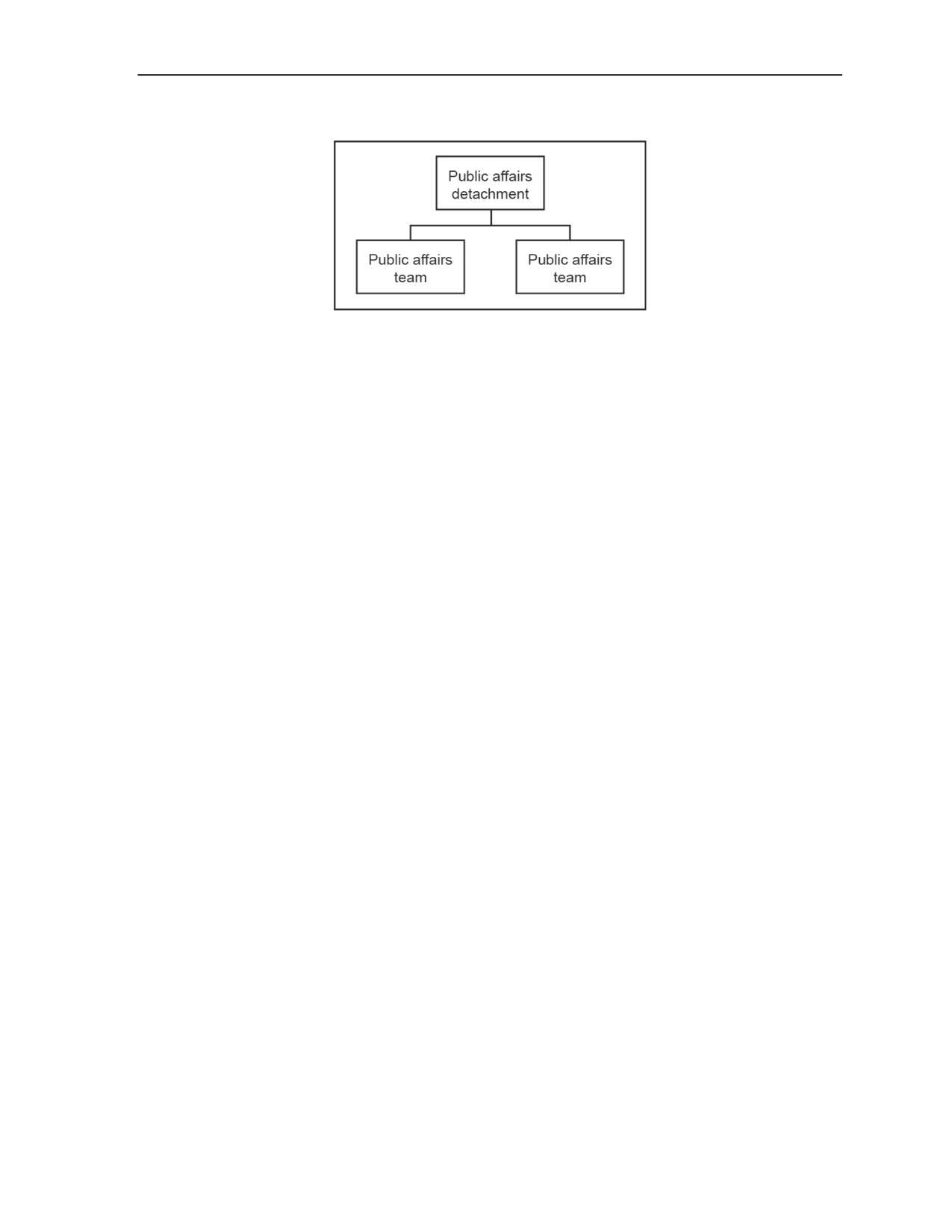
Public Affairs Elements
Figure 3-2. Public affairs detachment task organization
Function
3-69. A PAD provides support to units in support of Army, joint, or multinational operations. Although it
is primarily attached or assigned to a division or a brigade, a PAD may support special forces groups, civil
affairs, and brigade equivalents. A PAD also supports interagency operations, such as natural disaster
crises and chemical, biological, radiological, nuclear, and high-yield explosives disasters.
Capabilities
3-70. During interagency and coalition operations, the PAD may be used as a public information liaison
with the Department of State press attaché office, host nation, or multinational partner public affairs staff
equivalents. A special forces group may rely on a PAD to operate a temporary MOC or support public
affairs plans and operations. A PAD provides public affairs support to brigade combat teams,
multifunctional and functional brigades in support of the commander’s communication intent.
3-71. A PAD has limited capability to conduct independent public affairs activities and requires higher
command guidance, administrative support, and life support. Because of its limited capabilities, a PAD
generally co-locates and is under the planning and supervisory authority of the senior PAO or the
operational and tactical control of the commander to which it is assigned or attached.
3-72. A PAD is modularly organized, staffed, trained, and equipped to deploy rapidly in support of
operations. A PAD comprises two teams to provide brigade level support and augment the organic public
affairs element or provide area support within the assigned command’s area of operations. Deployment by
teams is accomplished administratively via a derivative unit identification code.
3-73. A PAD has personnel and equipment to—
z
Evaluate and conduct public affairs training programs.
z
Plan, develop, and execute communication strategies.
z
Be technologically capable to serve as a limited stand-alone, forward-deployed subordinate
public affairs MOC.
z
Facilitate, assess, and monitor media activity.
z
Acquire and process public affairs digital video, audio, and imagery.
z
Deliver public affairs video and imagery to intended publics.
z
Transmit finished public affairs products between higher and lower echelon headquarters.
z
Provide support to command information and hometown news programs.
z
Provide additional public affairs capabilities to the public affairs staff of the supported
command.
z
Support media embed programs of the supported command.
1 April 2014
FM 3-61
3-11
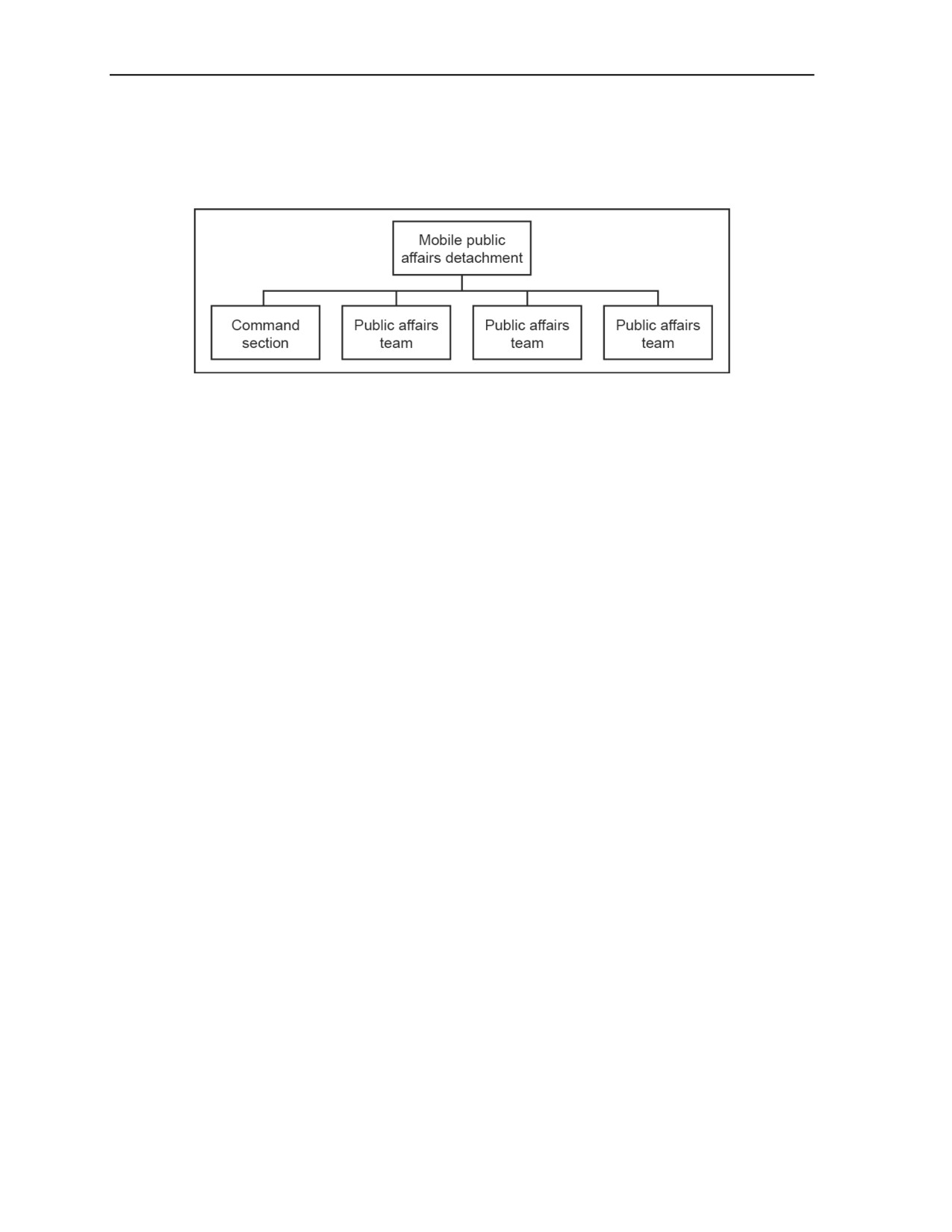
Chapter 3
MOBILE PUBLIC AFFAIRS DETACHMENT SRC 45413
3-74. A mobile public affairs detachment (MPAD) is commanded by a major. A first sergeant serves as the
senior enlisted advisor. An MPAD consists of 20 Soldiers. See figure 3-3 for task organization.
Figure 3-3. Mobile public affairs detachment task organization
Function
3-75. An MPAD provides support to units in support of Army, combined, joint, or multinational
operations. An MPAD is assigned, attached, or under operational control to echelons at division and above.
It may support the ASCC, theater sustainment command, or corps public affairs staff sections. It also may
augment a press camp headquarters in operating a MOC, or deploy independently in support of other
Services and operations. An MPAD can also support interagency operations, such as natural disaster crises
and chemical, biological, radiological, nuclear, and high-yield explosives disasters.
Capabilities
3-76. An MPAD provides additional public affairs support to meet the unit commander’s communication
intent. If attached to a press camp headquarters, the press camp headquarters (PCH) commander may
exercise operational and tactical control over the MPAD. MPADs deployed in support of a division are the
first level of operations and command at which a robust editing and transmitting public affairs capability
exists. MPADs provide the commander the capability to collect, edit, and transmit edited and packaged
news and information products both internally and externally.
3-77. An MPAD can deploy to provide Army support of other Services such as a marine expeditionary
force or in support of operations including peace and sustainment operations.
3-78. An MPAD has limited capability to conduct independent public affairs activities and requires higher
command guidance, administrative support, and life support. Because of its limited capability, the PAO of
the supported unit exercises planning and supervisory authority over the MPAD.
3-79. The MPAD is modularly organized, staffed, trained, and equipped to deploy rapidly in support of
brigade, division or corps operations. The MPAD consists of a command element and can be task
organized into two or three production and media facilitation teams as required.
3-80. An MPAD has personnel and equipment to—
z
Assist and advise commanders on public affairs programs and missions.
z
Plan, develop, and execute information strategies.
z
Facilitate, assess, and monitor media activity
z
Acquire and process public affairs digital video, audio, and imagery.
z
Deliver public affairs video and imagery to intended publics.
z
Transmit finished public affairs products between higher and lower echelon headquarters.
z
Provide support to command information and hometown news programs.
3-12
FM 3-61
1 April 2014
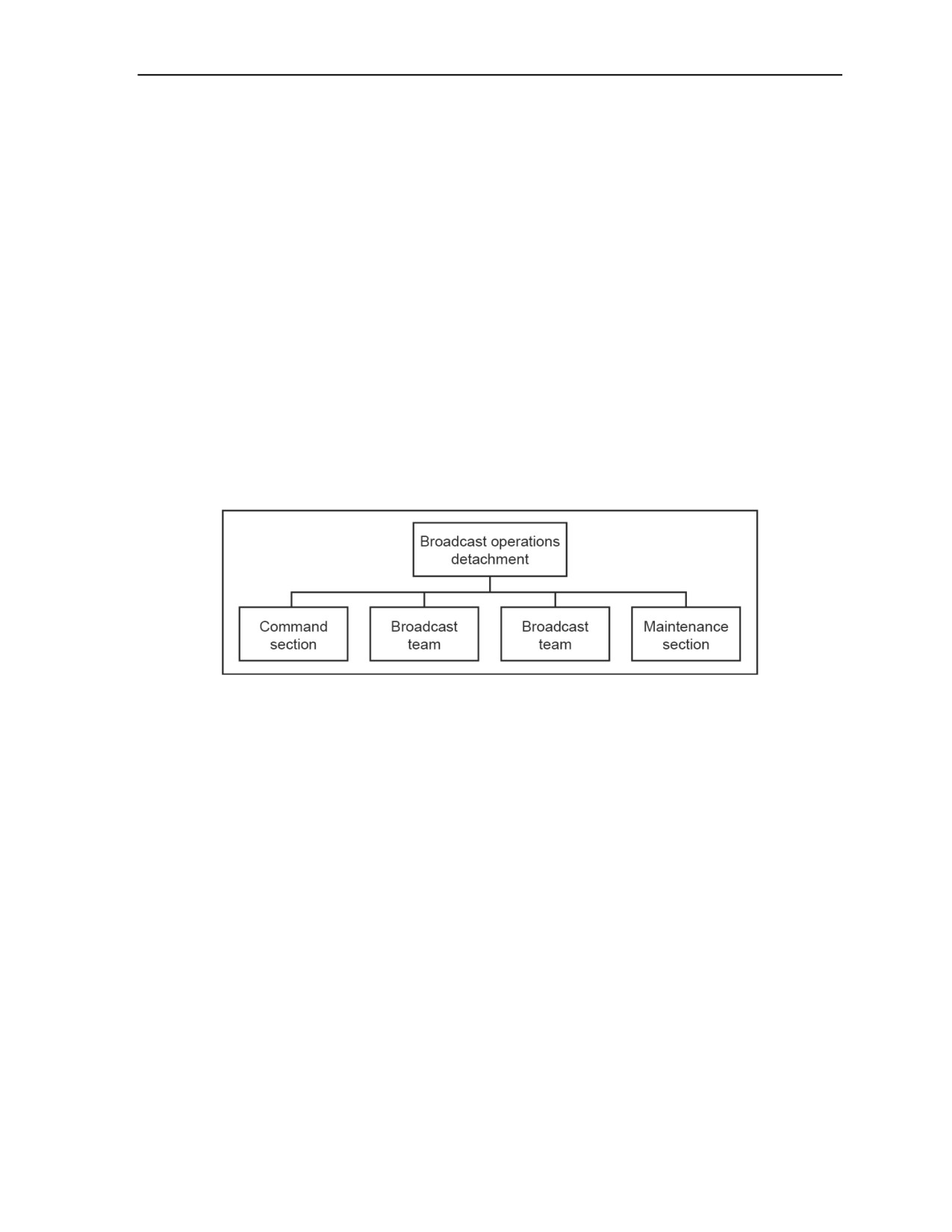
Public Affairs Elements
z
Provide additional public affairs capabilities to the public affairs staff of the supported
command.
z
Support media embed programs of the supported command.
z
Conduct daily news briefings and press conferences.
z
Operate a limited MOC.
z
Provide services and facilities for media representatives in support of unified action.
z
Conduct and evaluate public affairs training programs.
z
Communicate to public affairs units at echelons above brigade and supported units in the
operational area.
z
Transport personnel, equipment, and media in and around the area of operations, depending on
availability.
z
Provide public affairs support to the development and implementation of civil affairs programs.
z
Execute media embed programs of the supported command.
BROADCAST OPERATIONS DETACHMENT SRC 45607
3-81. A broadcast operations detachment (BOD) is commanded by a major. A first sergeant serves as the
senior enlisted advisor. A BOD, also known as a broadcast public affairs detachment, consists of 27
Soldiers. See figure 3-4 for task organization.
Figure 3-4. Broadcast operations detachment task organization
Function
3-82. The BOD operates a mobile radio and television broadcast facility, performs as the broadcast support
arm for a PCH, and produces broadcast products for distribution to internal and external worldwide publics
through the Defense Media Activity (DMA). The BOD is assigned to an ASCC headquarters, joint task
force, or combatant command when a press camp headquarters is assigned. It can operate with the PCH
using its organic broadcast equipment or augment a fixed station or field expedient DMA operation.
Capabilities
3-83. A BOD is modularly organized, staffed, trained and equipped to rapidly deploy and can be tasked
organized into four teams. The unit operates a separate radio broadcast operation to support theater level
operations. The BOD consists of a command element, two broadcast teams and a maintenance team. It
requires higher command direction, administrative, and life support. The detachment commander works for
the PAO of the supported unit or the commander of the DMA asset or PCH to which the unit is assigned or
attached.
3-84. The BOD has personnel and equipment to—
z
Support the higher echelon public affairs and communication planning requirements.
z
Operate a 24-hour-a-day internal information over-the-air radio and television broadcast service.
1 April 2014
FM 3-61
3-13
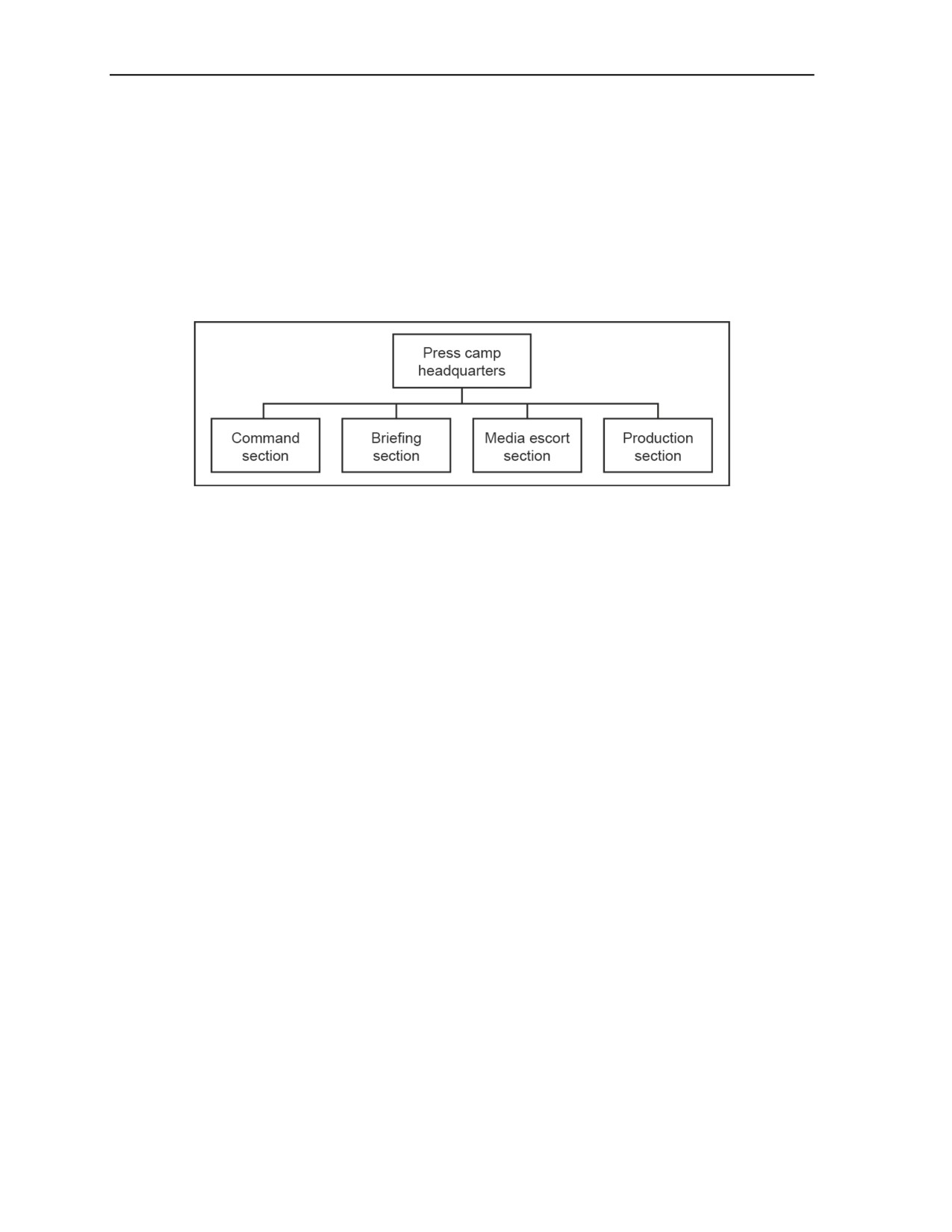
Chapter 3
z
Provide digital video and audio electronic newsgathering, including post-production services for
audio and video news feature material supplied in unedited format by other units.
z
Perform field maintenance and repair above operator level to broadcast and electronic news-
gathering equipment organic to the unit.
PRESS CAMP HEADQUARTERS SRC 45423
3-85. A PCH is commanded by a lieutenant colonel. A command sergeant major serves as the senior
enlisted advisor. A PCH, also referred to as a public affairs operations center, consists of 31 Soldiers. See
figure 3-5 for task organization.
Figure 3-5. Press camp headquarters task organization
Function
3-86. A PCH provides mission command, staff planning, and supervision of press camp operations. In
addition, it can supervise and coordinate operations performed by other public affairs units in support of
Army, joint, interagency, intergovernmental, coalition, and multinational partners. However, its primary
mission is to operate a MOC in support of civilian media personnel working in the theater of operations. In
unified action, the PCH forms the Army element of the MOC.
Capabilities
3-87. The PCH is the most capable public affairs unit in the Army to conduct all facets of public affairs
missions. The PCH is modularly organized, staffed, trained, and equipped to deploy rapidly in support of
Army operations. The PCH consists of a command element and can be task organized into several teams.
3-88. The PCH has personnel and equipment to—
z
Direct and lead subordinate public affairs activities and units across an operational area.
z
Implement a media accreditation program in accordance with current public affairs guidance or
Department of Defense directives.
z
Produce daily news briefings, press conferences, newsgathering operations, and embedded
media opportunities to units within the parent unit’s operational area.
z
Conduct real-time live media interviews and briefings via satellite or other technologies to
international, national, and hometown media.
z
Coordinate all logistics support for accredited civilian news media personnel, including
communications support, billeting, food service, transportation, and individual equipment.
z
Coordinate civilian news media issues with host-nation representatives for access to the theater
of operations.
z
Coordinate participation and operational requirements for embedded and pool media.
z
Provide escort control and support (when required) for 100 media personnel per day. When
augmented by a MPAD, the number of personnel supported will increase by 100 for each
additional MPAD to a maximum of 400 media.
3-14
FM 3-61
1 April 2014
Public Affairs Elements
z
Serve as a clearinghouse and distribution center for electronic print, digital still photographic,
and audiovisual news products.
z
Conduct public affairs planning and analysis for the commander.
z
Evaluate and conduct public affairs training programs.
z
Develop communication strategies that support operations.
z
Support higher echelon public affairs requirements for information, imagery, and media
facilitation.
z
Communicate to public affairs units at echelons above brigade and supported combat units in the
operational area.
z
Transport personnel, equipment, and media in and around the area of operations, depending on
availability.
z
Provide commander with real-time broadcast capability to disseminate internal information
when augmented by a broadcast public affairs detachment.
z
Provide support to command information and hometown news programs.
1 April 2014
FM 3-61
3-15
Chapter 4
Army Public Affairs Relationships and Their Capabilities
This chapter discusses public affairs relationships and their capabilities. Public affairs
must maintain complementary and coordinated relationships with people and
organizations or agencies. The chapter then discusses the information-related
capabilities.
PEOPLE
4-1. Army public affairs has relationships with people. The category of people consists of publics,
commanders, command staff, and the United States (U.S.) ambassador.
PUBLICS
4-2. Key to public affairs is the relationship between commanders and key publics. Commanders must
build and sustain positive relationships with key publics. Through planning and synchronization, public
affairs maintains a complementary and coordinated continuous relationship with other warfighting
functions, operational cells, working groups, information-related capabilities (IRCs), and key publics.
There are numerous definitions and different IRCs in support of engaging with defined publics.
4-3. Public engagement is an interaction between a Soldier and the public. A public engagement can be
planned or unplanned, can occur anywhere Soldiers are, and may have positive, neutral, or negative effects
depending on the circumstances of the engagement. Public affairs professionals must be ready to support
media operations and facilitation if a public engagement garners media attention.
4-4. Planned official public engagement programs consist of command-initiated actions that effectively
inform the public about the Army and maintain a viable relationship with the civilian community.
Examples of official public engagement programs include making speeches; partnering with organizations;
using exhibits, bands, color guards, and other ceremonial units in the public domain; and hosting open
houses and active installation tours. Unofficial public engagement programs may include any program that
involves Soldiers interacting directly with the civilian community such as participating or supporting
educational, religious, organizational, recreational, and youth programs or volunteering at a community
organization. (See AR 360-1, chapter 8, for more information on programs and activities.)
4-5. Senior leaders within the Army may conduct senior leader engagements—planned engagements with
the public to disseminate or exchange information. When senior or garrison commanders interact with
municipal officials near an installation, they are conducting a senior leader engagement. Another example
is an Army senior leader providing congressional testimony. These engagements can include members of
the media, and public affairs professionals should be involved in the planning, preparation, and assessment
of the engagement.
4-6. A Soldier and leader engagement is an interpersonal interaction by Soldiers and leaders with
audiences in an area of operations. It can occur as an opportunity, a face-to-face encounter on the street, or
in a scheduled meeting. Soldier and leader engagement is part of the commander’s communication
strategy. A Soldier on patrol that engages in conversation with a street vendor is an example of Soldier and
leader engagement.
4-7. Key leader engagement is a planned meeting(s) with an influential leader with the intent of building
a relationship that facilitates communication and cooperation across a wider population (FM 3-53). This
long-term, planned defense support to public diplomacy activity is conducted to build interpersonal
1 April 2014
FM 3-61
4-1
Chapter 4
relationships with key local and regional leaders.. This activity requires a fundamental understanding of
cultural context, cognitive orientation patterns, cultural and social backgrounds, perspectives, capabilities,
strengths, weaknesses, authorities, spheres of influence, motivators, and communication methods..
Internal
4-8. Commanders use command information programs as the primary means to communicate with
military members, Army civilians, contractors, and family members. The internal public includes Regular
Army, Army National Guard/Army National Guard of the United States, and United States Army Reserve,
as well as retirees.
United States
4-9. Commanders have an obligation to inform the American public about its military. Public affairs
professionals serve the public interest by working as responsible advocates for the commands they
represent. This communication enhances morale and readiness and increases public trust and support.
Through active engagements, the military demonstrates it is a community partner and a responsible steward
of national resources.
International
4-10. Current information technology allows information and imagery to be available worldwide.
International interest in military operations may be as high as, and sometimes higher than U.S. media
interest, especially in military operations conducted outside the United States. The Department of Defense
(DOD) and U.S. Army, in coordination with Department of State, and host and partner nations, should
keep the international community informed about U.S. Army operations and activities within the
constraints of operations security.
Adversaries and Enemies
4-11. Public affairs distributes timely, truthful, and accurate information regarding U.S. intentions and
actions to counter adversary and enemy misinformation, disinformation, and propaganda and to potentially
deter adversary and enemy actions. Volatility within the information environment dictates public affairs
and all other IRCs synchronize their communication efforts with respect to adversaries and enemies.
COMMANDERS
4-12. Public affairs activities are commanders’ tools to interact with intended internal and external publics;
to inform U.S. and global publics about command goals, missions, and activities; and to communicate
command themes and messages to garner public support and cooperation. Commanders remain actively
attuned to and engaged in the information environment. When developing their public affairs program,
commanders—
z
Incorporate public affairs considerations.
z
Appoint unit public affairs representatives.
z
Develop support agreements.
z
Ensure information synchronization.
z
Publicize Army messages.
Incorporate Public Affairs Considerations
4-13. Commanders ensure public affairs considerations are incorporated into plans and operations. They
also ensure that all public affairs programs, plans, and operations are evaluated and refined for maximum
effectiveness.
4-2
FM 3-61
1 April 2014
Army Public Affairs Relationships and Their Capabilities
Appoint Unit Public Affairs Representatives
4-14. Commanders appoint a unit public affairs representative to each subordinate unit not supported by a
designated public affairs officer (PAO), per AR 360-1. Unit public affairs representatives must be trained
in basic public affairs tasks and principles such as media facilitation and social media.
Develop Support Agreements
4-15. Commanders are responsible for developing inter-Service support agreements or memoranda of
understanding that provide appropriate public affairs support to tenant units and activities, Army recruiters,
and Army National Guard, United States Army Reserve, and Reserve Officers’ Training Corps units.
Ensure Information Synchronization
4-16. Commanders ensure public affairs activities are coordinated with all other IRCs, which, in tactical
and operational environments, is generally accomplished within the information operations working group.
See paragraph 1-18.
Publicize Army Messages
4-17. Commanders synchronize their public affairs communication plans with Army top-line messages to
include global missions and the Army Campaign Plan. Commanders localize these messages based on their
publics.
COMMAND STAFF
4-18. Public affairs is a door to the command’s human interaction between internal and external publics
for leaders, staffs, and Soldiers. Military operations are dynamic; they affect and are affected by human
interactions. Cultural competence underlies a Soldier's ability to understand, communicate, and coordinate
effectively with diverse groups of people. Leaders and Soldiers interact with friendly forces, enemy forces,
adversaries, supporters, and neutral parties. Command information programs must be designed to enhance
this cultural understanding.
4-19. The public affairs professional assists the commander in encouraging active collaboration and
dialogue with all command publics. Collaboration and dialogue aid in developing shared situational
understanding, perceptions, and ideas to improve decisionmaking.
4-20. Collaboration is two or more people, staff sections, or organizations exchanging information, sharing
knowledge, and building consensus toward common goals. Effective collaboration includes continuous
dialogue that leads to increased understanding. Trained public affairs communicators participate in
command staff cells, working groups, and teams to support the collaboration process.
4-21. In addition to communicating their commander’s intent to organizations and personnel within their
command, commanders also communicate and collaborate with civilian and other military organizations in
the garrison and operational area to better understand their perspectives and build unity of effort.
Communication leads collaboration to shared understanding of the command’s mission and improves
coordination and cooperation. The PAO helps ensure the success and credibility of the commander’s
communications by the skilled use of accurate, objective, and timely information unencumbered by
propaganda, manipulation, or deceit.
CHIEF OF MISSION
4-22. The chief of mission—often the ambassador—presides over the country team. The country team
coordinates activities to achieve a unified program for the host nation and U.S. national interests. Working
under the chief of mission’s direction, the country team pools the skills and resources of the participating
agencies. This combined effort helps eliminate problems and achieve U.S. national objectives and goals.
Through the country team, PAOs should consult with host-nation governments to identify local issues and
concerns, including host-nation rules for media and release of information, which could impact public
1 April 2014
FM 3-61
4-3
Chapter 4
affairs activities. This coordination normally is established through the public information officer at the
respective embassy. Release authority is retained by the chief of mission unless delegated.
ORGANIZATIONS
4-23. Army public affairs has relationships with organizations. Organizations consist of the Defense Media
Activity, U.S. government agencies, and nongovernmental organizations.
DEFENSE MEDIA ACTIVITY
4-24. The Defense Media Activity consolidates several DOD and Service media capabilities and is the
DOD’s direct link to U.S. forces worldwide for news and information. The agency presents news,
information, and entertainment via radio, television, internet, print media, and emerging media
technologies. The Defense Media Activity is located at Fort Meade, Maryland, and reports to the Office of
the Assistant Secretary of Defense for Public Affairs (known as OASD [PA]).
U.S. GOVERNMENT AGENCIES
4-25. Effective public affairs activities require close coordination among the U.S. military, the Department
of State, and other U.S. Government agencies. Normally, executive orders define agency responsibilities,
functions, and interagency relationships. Either the senior Department of State representative or the U.S.
commander will be assigned overall responsibility for U.S. activities in the area.
Department of State
4-26. Department of State implements foreign policy. Due to its mission, the Department of State has a
vested interest in public affairs activities. In the area of public affairs, the Department of State has primary
or shared responsibility with DOD for policy concerning—
z
The extent U.S. forces will aid host-nation governments.
z
Matters that may affect U.S. relations with other nations, principally allies or neutrals.
z
The level at which a country’s economy will be maintained by U.S. operations.
z
Matters involving military information support operations, public affairs, civil affairs,
information synchronization, or other measures to inform or influence the attitude of a public.
United States Information Agency
4-27. The U.S. Information Agency is an independent agency that influences public attitudes in foreign
areas to achieve U.S. foreign policy objectives. It advises the President and U.S. departments and agencies
of the possible impact of policy, programs, and official statements on foreign opinion. PAOs ensure the
U.S. Information Agency is informed of theater public affairs activities during the communication
synchronization process.
NONGOVERNMENTAL ORGANIZATIONS
4-28. Nongovernmental organizations and humanitarian groups, such as the International Red Cross,
American Red Cross, and Doctors Without Borders, are often located in geographic areas, before, during,
and after military operations. They are often present before the media arrive and are often initial sources of
information for journalists. Nongovernmental organizations also may serve as major sources of information
during an operation.
4-29. Prior to deployment, public affairs personnel must know what agencies and organizations are in their
assigned area. These organizations may conduct short-term humanitarian or long-term developmental
operations. The sponsoring groups or agencies may be private corporations, foundations, professional
associations, or religious groups. Public affairs must understand their goals and establish an understanding
of their potential public affairs needs. Nongovernmental organization representatives may have valuable
local knowledge that can assist public affairs activities.
4-4
FM 3-61
1 April 2014
Army Public Affairs Relationships and Their Capabilities
INFORMATION-RELATED CAPABILITIES
4-30. Army public affairs applies to and works with select information-related capabilities. An
information-related capability is a tool, technique, or activity employed within a dimension of the
information environment that can be used to create effects and operationally desirable conditions (JP 3-13).
MILITARY INFORMATION SUPPORT OPERATIONS
4-31. Military information support operations (MISO) are used to influence the attitudes, opinions, and
behaviors of specific non-American publics through the dissemination of information. The respective
activities of public affairs and MISO affect each other and require continual coordination.
4-32. By law, MISO will not be conducted against the American public. However, MISO personnel and
equipment may be used to support approved homeland defense or as part of civil authority information
support element activities such as information dissemination, printing, reproduction, distribution, and
broadcasting. MISO units in support of civil authority information support elements act to inform rather
than to influence. All civil authority information support element efforts are coordinated with lead federal
agency public information efforts.
CIVIL AFFAIRS OPERATIONS
4-33. Public affairs and civil affairs operations use many of the same communications mediums, but
inform different publics. Civil affairs engages local non-U.S. populations; public affairs addresses U.S.,
international, and internal publics. Public affairs and civil affairs information becomes available to all
publics simultaneously; therefore, both elements synchronize information efforts to ensure positive
outcomes.
4-34. Public affairs should inform the American public about civil affairs operations. Doing so
demonstrates the Army’s unique capabilities to advance U.S. strategic communication and diplomatic
interests abroad.
OPERATIONS SECURITY OPERATIONS
4-35. Operations security (OPSEC) operations are designed to identify, control, and protect generally
unclassified information associated with sensitive operations and activities. OPSEC is concerned with
denying friendly “critical information” to an adversary or enemy.
4-36. Public affairs releases information to the public and must be aware of OPSEC considerations.
Security at the source is the primary means of protecting classified and sensitive material and should
govern release of information to the public.
4-37. PAOs provide leaders an assessment of the possible effects of media coverage. They work with
OPSEC planners to avoid inadvertent disclosure of sensitive information. Public affairs representatives
participate in OPSEC planning, surveys, and security reviews to avoid release of critical information. A
typical OPSEC survey team contains multidisciplined expertise to include public affairs.
4-38. OPSEC guides decisions as to when to release information and imagery. Ground rules allowing
temporary transmission delays of potentially sensitive information are acceptable to the media and effective
in balancing short-term security concerns with media coverage requirements.
4-39. Public affairs also consider OPSEC issues relating to the use of media and information technology
capabilities, such as blogging, cell phones, social networking sites, portable media players, multimedia
smart phones, and streaming media.
MILITARY DECEPTION OPERATIONS
4-40. Military deception operations include actions executed to deliberately mislead adversary decision
makers. Deception may affect friendly military capabilities, intentions, and operations that cause the
adversaries to take specific actions or inactions. Military deception can be employed during all phases of
1 April 2014
FM 3-61
4-5
Chapter 4
military operations. Safeguarding military deception-related information is critical and must be classified
accordingly.
4-41. Consistent with policy, legal limitations, and security, public affairs activities should be planned,
coordinated, and deconflicted with military deception operations. The coordination between public affairs
and military deception operations must safeguard deception plans and maintain the integrity, reputation,
and credibility of public affairs as a source of truthful information.
COMBAT CAMERA OPERATIONS
4-42. Combat documentation and production specialists conduct combat camera operations. These
operations support the combat camera mission of acquiring and using imagery in support of operational
and planning requirements. These operations apply across the range of military operations and during joint
exercises and are an integral part of the visual information function.
4-43. Combat camera teams provide commanders with still and video imagery capabilities to support
operational and planning requirements. Combat camera documentation and production specialists use
video documentation capabilities ranging from aerial to underwater photography. They access areas and
events inaccessible to other personnel or media. Furthermore, combat camera teams have a technological
capability to transmit real-time images that in turn serve to reinforce other information-related capability
efforts.
4-44. The visual information function represents a broad spectrum of imagery products that includes
unmanned aircraft systems, combat camera, intelligence assets, weapons systems cameras, and military
broadcast organizations. Public affairs often relies on visual information products to accomplish its
mission.
4-45. The acquisition of visual information products to support public affairs, especially sensitive imagery,
must be planned. Imagery requirements need to be synchronized with the operation plans of the imagery-
producing capabilities so that imagery captured in support of other mission areas, along with public affairs
missions, can be exploited by public affairs.
KNOWLEDGE MANAGEMENT OPERATIONS
4-46. Knowledge management is a staff responsibility. The communication skills and expertise in
information exchange make the PAO a valued advisor to the commander for successful knowledge
management. Knowledge management creates and aligns people, processes, and tools within an
organizational structure and culture. The alignment of knowledge management increases collaboration and
interaction between commanders and Soldiers, which enables improved operational adaptability,
integration, and synchronization. Knowledge management includes lessons learned and collaboration.
LESSONS LEARNED
4-47. Army lessons learned are the deliberate and systematic process of collecting and analyzing field data
and disseminating, integrating, and archiving lessons and best practices collected from unified land
operations and training events. Included with lessons learned are developing and maintaining a linked issue
resolution process to ensure issues identified by the operating force are addressed at the appropriate levels
to support current and future force requirements. PAOs need to establish and maintain a relationship with
the Center for Army Lessons Learned that serves as the office of primary responsibility and action agent
for the implementation of the United States Army Lessons Learned Program.
COLLABORATION
4-48. Public affairs professionals encourage active collaboration and dialogue within the command to
share, use, and capture lessons and best practices. Active participation enables rapid adaptation and issue
resolution.
4-6
FM 3-61
1 April 2014
Appendix A
Public Affairs Running Estimate
RUNNING ESTIMATE OUTLINE
A-1. The running estimate is discussed in ATTP 5-0.1. The basic outline consists of situations and
considerations, mission, courses of action, analysis, comparison, and recommendations and conclusions.
BASIC RUNNING ESTIMATE
A-2. Figure A-1 illustrates the public affairs running estimate.
1.
SITUATION AND CONSIDERATIONS.
a.
Area of Interest. Describe the strategic and operational media environment in which
the operation is being conducted and identify the critical factors—the "action and
reaction" within global media channels—that might impact the mission. Identify the
media environment across the operational continuum, describing it from "austere" for
low media interest and capability in a limited area of operations (AO) communication
infrastructure to "dynamic" for high media interest and capability in a high-tech AO
infrastructure.
b.
Characteristics of the Area of Operations.
(1) Terrain. List all critical terrain aspects that would impact public affairs operations
such as hilly terrain obscuring satellite dishes for receiving television broadcasts or
require additional support and requirements for escorting media.
(2) Weather. List all critical weather aspects that would affect public affairs operations.
Refer to Tab B
(Weather) to Appendix
1
(Intelligence Estimate) to Annex B
(Intelligence), as required.
(3) Enemy Forces. Describe enemy public affairs and media disposition, composition,
strength, and systems. Describe the enemy's capabilities and most likely and most
dangerous public affairs courses of action (COAs). Forces hostile to U.S. interests can
be expected to—
(a) Attempt to mold U.S. and foreign public opinion using propaganda,
misinformation, and fictionalized reporting to discredit the United States and its
allies, creating opposition to the operation.
(b) Seek information about U.S. intentions, military capabilities, and current
activities.
(c) Use the publicity generated by (potential) terrorism to promote their ideology.
(4) Friendly Forces. List current public affairs resources in terms of equipment,
personnel, and systems. Identify additional resources available for the functional area
located at higher, adjacent, or other units. List those capabilities from other military and
civilian partners that may be available to provide public affairs support. Compare
requirements to current capabilities and suggest solutions for satisfying discrepancies.
Figure A-1. Running estimate format
1 April 2014
FM 3-61
A-1
Appendix A
(a) Higher headquarters public affairs resources and capabilities.
(b) Organic public affairs resources and capabilities.
(c) Attached public affairs units resources and capabilities.
(d) Information channel availability. An assessment of the information channels
available for the communication of information in and out of the AO. It identifies the
means available to the commander for receipt, transmission, and dissemination of
public information.
(5) Civil Considerations.
(a) Media presence. Assess the news media presence in the area of interest prior
to deployment and the likely presence of additional news media during the conduct
of operations. This assessment should address the authority under which media
representatives are operating and the degree of control that can be imposed on
their efforts.
(b) Media capabilities. An assessment of the media's information collection and
communication technology, specifically identifying their level of visual information
acquisition and satellite communication capabilities. It includes an analysis of the
logistics support, transportation assets, and host-nation communications
infrastructure available to them.
(c) Media content. An assessment of the global media's presentation of
information and their agendas, and an analysis and prioritization of the potential
strategic and operational issues confronting the command in the news media. This
media content analysis will provide an evaluation of the quantity of coverage and
the nature of that coverage.
(d) Public opinion. Assessment of national and international attitude about the
operation and command, leaders, and Soldiers conducting it. This paragraph
should include both the perceptions held by major audience groups and the
relative solidity or strength of those attitudes. A public opinion analysis should
include as a minimum an analysis of the following groups:
1. American public.
2. Civilian political leaders.
3. Coalition forces and unified action partners and their publics.
4. International audiences.
5. Internal command audience.
6. Home station public.
c.
Assumptions. Until specific planning guidance from the commander becomes
available, use assumptions for initiating planning or preparing the public affairs running
estimate. Modify these assumptions as factual data or planning guidance becomes
available.
2.
MISSION. Enter the restated mission from a public affairs perspective. A mission statement
contains no subparagraphs. Keep the American people informed of the operation to the
maximum extent possible within the constraints of operations security and personnel
safety. Provide public affairs support to on-scene commanders. Provide the media with
access to unclassified, timely, and accurate accounts of the operation to counter enemy
propaganda and disinformation efforts that discredit United States (U.S.) political and
military efforts.
Figure A-1. Running estimate format (continued)
A-2
FM 3-61
1 April 2014
Public Affairs Running Estimate
3. COURSES OF ACTION.
a. List friendly COAs that were war-gamed.
b. List enemy actions or COAs that were templated that impact public affairs.
c. List the evaluation criteria identified during COA analysis. All staffs use the same
criteria.
4. ANALYSIS. Analyze each COA using the evaluation criteria from COA analysis. Review
enemy actions that impact public affairs as they relate to COAs. Identify issues, risks, and
deficiencies these enemy actions may create with respect to public affairs. Analysis should
focus on media facilitation and support, news and information provision, and force training
and support. Analyze each COA from a public affairs point of view to determine its
advantages and disadvantages for conducting public affairs.
5. COMPARISON. Compare COAs. Rank order COAs for each key consideration. Use a
decision matrix to aid the comparison process. List advantages and disadvantages of each
COA under consideration. Include methods for overcoming deficiencies or modifications
required for each COA.
6. RECOMMENDATIONS AND CONCLUSIONS.
a. Recommend the most supportable COAs from the public affairs perspective. Indicate
the abilities of the command and other supporting staffs to assist in public affairs.
b. Prioritize and list issues, deficiencies, and risks and make recommendations on how to
mitigate them.
Figure A-1. Running estimate format (continued)
1 April 2014
FM 3-61
A-3
Appendix B
Proposed Public Affairs Guidance
PREPARING AND OBTAINING APPROVED GUIDANCE
B-1. Public affairs guidance is an operational tool that guides commanders and their public affairs officers
(PAOs) in applying doctrine and policy during major military operations, exercises, and contingencies.
Local commanders use the information below to assist in preparing and obtaining approved guidance. (See
JP 3-61 for the formal definition of public affairs guidance.)
B-2. Department of Defense (DOD) policy requires that proposed public affairs guidance (PPAG) be
provided to the Office of the Assistant Secretary of Defense for Public Affairs (OASD [PA]) by combatant
commands and others, as required for all major operations. This requirement includes major training
exercises that could attract international or national attention. PPAG may not be used without OASD (PA)
approval. (See DODI 5405.3 for joint PPAG guidance.)
B-3. Upon receipt of the warning order, the commander, through the PAO, requests public affairs
guidance (PAG) from higher headquarters. PAG may be included in alert order or operation orders.
Commanders of major units and commands direct their PAOs to prepare PPAG to forward the proposal
through major commands and combatant command public affairs channels to OASD (PA).
B-4. Commanders of combatant commands ensure that the staff coordinated the PPAG with appropriate
organizations within the theater of operations whenever possible (such as embassies, country teams, host-
nation governments, and subordinate commands).
B-5. Upon receipt of the PPAG, the OASD (PA) coordinates and staffs the PPAG within the DOD and
Department of State.
B-6. The OASD (PA) then issues a message approving, modifying, or disapproving the PPAG. The
format for PPAG is as follows:
z
Classification
z
Subject.
z
Paragraph 1: References.
z
Paragraph 2: Background and Coordination.
z
Paragraph 3: Public Affairs Posture.
Active Public Affairs Posture.
Response-to-Query Posture.
z
Paragraph 4: Holding Statement.
z
Paragraph 5: Public Statement.
z
Paragraph 6: Themes and Messages.
z
Paragraph 7: Questions and Answers.
z
Paragraph
8: Public Affairs and Communication Planning Instructions and Command
Relationships.
z
Paragraph 9: Media Operations.
z
Paragraph 9.1: Owned Media.
z
Paragraph 9.2: Media Information Centers.
z
Paragraph 9.3: Media Embeds or Embarks and Space Available Travel.
z
Paragraph 9.4: Online and Social Media.
1 April 2014
FM 3-61
B-1
Appendix B
z
Paragraph 10: Public Affairs Points of Contact.
z
Paragraph 11: Declassification Instructions
PPAG FORMAT AND CONTENT
B-7. PAOs send PPAG by e-mail as a document with 1-inch margins and Times New Roman, 12-point
font. Do not submit using “all caps.” All PPAG submissions include the sections described in this appendix
and shown in Figure B-1 on page B-3. Insert “N/A” (for not applicable) for each numbered paragraph that
is not needed or does not apply for the specific PPAG.
CLASSIFICATION
B-8. PPAG should normally be submitted to OASD (PA) via unclassified Nonsecure Internet Protocol
Router Network (NIPRNET) and marked “UNCLAS/FOUO” (for Unclassified/For Official Use Only) as
the first line of the document. However, PAOs determine the classification of the PPAG according to the
classification of the material from which the PPAG was derived and the sensitivity of the event itself.
SUBJECT
B-9. The subject line of the PPAG should state “Proposed Public Affairs Guidance For [Insert Name of
Operation, Exercise, or Event].” For purposes of distribution and coordination, the subject shall be
unclassified. If an operation, exercise, or event name cannot be used, an unclassified short title shall be
used. When OASD (PA) approves the PPAG, the subject line will change to “Approved Public Affairs
Guidance (PAG)” when returned to the submitting DOD component.
PARAGRAPH 1: REFERENCES
B-10. Following the subject line, the first numbered paragraph lists all pertinent messages, orders, DOD
and military Services publications, publications that apply to public affairs policy and the release of
information to the public, strategic communication or other guidance, and other documents as appropriate
that informed the process of drafting the PPAG. All references should be the most current version, listed
using a lettering system—such as (a), (b), (c)—and, if applicable, include the message date-time-group and
the publication date. This paragraph explains what each reference means and how it contributes to the
PPAG. This section is generally not for public release.
PARAGRAPH 2: BACKGROUND AND COORDINATION
B-11. This paragraph explains the purpose of the operation, exercise, or event and describes any significant
existing or anticipated problems and limiting factors. It explains how and why DOD assets are
participating, historical information, a description of the current situation, and why PAG is needed. The
paragraph may also include communication objectives, key audiences, and other planning guidance on how
stakeholders coordinate public affairs activities among agencies and host nations. This section is generally
not for public release.
PARAGRAPH 3: PUBLIC AFFAIRS POSTURE
B-12. This paragraph states the overall public affairs posture for the operation, exercise, or event and states
which DOD component retains the public affairs lead. Only two public affairs postures are authorized for
use: active public affairs posture and response-to-query posture.
B-2
FM 3-61
1 April 2014
Proposed Public Affairs Guidance
UNCLAS/FOUO
Subject: Proposed Public Affairs Guidance (PPAG) for [insert name of operation, exercise, or event]
1. References.
a. DODI 5405.3 Development, Submission, and Approval of PPAG
b. [List all references used in developing this PPAG.]
2. Background and coordination. [See Enclosure.]
3. Public Affairs Posture. The public affairs posture for this event is [active or respond to query].
[State the lowest-level organization allowed to use the PPAG including the holding statement and public
statement. For example, “All commanders and spokespersons at the brigade-level and above are authorized
to implement this PPAG after the public statement has been released by the combatant command (CCMD).
Only the CCMD may use the holding statement.” (If these restrictions are necessary.)]
[If Public Affairs posture is expected to change, state the date or action that will signal the change in
posture.]
4. Holding Statement. [to be used prior to the approval of the PPAG. [See Enclosure.]
5. Public Statement. The public announcement of this event will be made by [Office of the Assistant Secretary
of Defense Public Affairs
(OASD [PA]), Joint Staff, CCMD, operational headquarters, or other
organization] using a [media conference, media release, announcement posted to Web site, or other method]
on or about [state time or event that will signal use of the public statement.]
5.1. (Begin) [Proposed statement should be clear and understandable to civilians who may not understand
military acronyms, operations or events.] (End) [See Enclosure.]
6. Themes and Messages. [See Enclosure.]
6.1.
[State who can use the messages, for example: These themes and messages are for use by all
participants who talk to the media.]
6.1.1. [State overarching theme.]
6.1.1.1. [State supporting message.]
6.1.1.2. [State additional supporting message.]
6.2. [If some messages are reserved for use by a higher level, state this clearly. For example: These themes
and messages are for use above the tactical and operational level and will only be used at the CCMD
headquarters or above.]
6.2.1. [State overarching theme. Continue with paragraphs as needed.]
7. Questions and Answers. [Annotate clearly if any questions and answers are reserved for a certain
spokesperson or certain level of command; see Enclosure.]
Q1.
A1.
Q2.
A2.
8. Public Affairs and Communication Planning Instructions and Command Relationships.
8.1. Approving authority for release of information is [state level.] [If necessary describe circumstances that
require a higher level of approval. Describe procedures and points of contact for crises situations. Include
any planning guidance not included elsewhere in the PPAG. See Enclosure.]
9. Media Operations.
9.1. Owned Media. [Describe how Department of Defense-owned media will be used and whether or not
there are any restrictions on their movement or coverage. See Enclosure.]
9.2. Media Information Centers. [See Enclosure.]
9.3. Media Embeds or Embarks and Space Available Travel. [See Enclosure.]
9.4 Online and Social Media. [See Enclosure.]
10. Public Affairs Points of Contact. [Include off-duty-hour contact information. See Enclosure.]
10.1. [List primary point of contact for this exercise or event as the first entry.]
10.2.
[List OASD (PA) defense press operations desk officer as the last entry. Include after hours
information.] After duty hours contact dutyofficer@osd.mil or 703-678-6162.
11. Declassification Instructions (if required.) [See Enclosure]
Figure B-1. Sample proposed public affairs guidance format
1 April 2014
FM 3-61
B-3
Appendix B
Active Public Affairs Posture
B-13. An active public affairs posture is recommended whenever possible. An active public affairs posture
involves using various communication tactics to stimulate public and media interest, such as distributing
press releases and inviting media to cover the event, exercise, or operation. The term “active” can have
multiple meanings; not all active public affairs postures are the same, with some more limited in scope than
others are. This posture is specific. For example, if the intent is to start in a response-to-query (RTQ)
posture and then move to an active posture, this paragraph provides as much detail as possible (for
example, using a holding statement until an initial announcement by a public statement or press release).
This paragraph provides specific guidance on what tactics are desired after the initial announcement.
Response-to-Query Posture
B-14. An RTQ posture is recommended when there is a desire not to take action to generate media or
public interest beyond responding to media queries. On occasion, the public affairs posture is RTQ until a
certain point in the planning and execution of an operation, exercise, or event. At that time, the RTQ
posture may change to an active posture. On other occasions, the public affairs posture will remain RTQ
for the duration or until completion of a military operation, exercise, or event. All PPAG should specify all
units or personnel authorized to respond to queries. Release authority at the lowest possible level with
security at the source is recommended.
B-15. Some public affairs personnel mistakenly believe there is a “passive” option to not say anything
about a specific military operation. Not responding to a query is not an option. Public affairs
communicators should always be able to respond using a prepared holding statement, even if it is
something as simple as “the information you are asking for is classified and not to be discussed publicly.”
If applicable, clearly identify when an RTQ posture will change to an active public affairs posture.
PARAGRAPH 4: HOLDING STATEMENT
B-16. A PPAG contains a holding statement to be used before release of the approved PAG. Usually, the
holding statement emphasizes the nature of the planning process and that operational details not be
discussed before an event, operation, or exercise has been formally announced. PAOs can modify this
approach as circumstances dictate. When using a strict RTQ posture, sometimes the holding statement may
also serve as the only public statement.
PARAGRAPH 5: PUBLIC STATEMENT
B-17. A PPAG usually contains a statement for public release. It is used in an active public affairs posture
to initially announce the military activity or for responding to queries in an RTQ posture after an operation
has commenced. If making a public announcement, this paragraph states who will make the announcement,
the method of announcement, the preferred time and date for the announcement, and the rationale for the
recommendation. If a combined announcement is desired with a host nation or other U.S. Government
agency, complete details of the methods, time, and procedures shall be included in this paragraph. Public
statements are usually made 1 to 5 days prior to the start of an event. If a public statement will be made
long before the event begins, explain why that action is necessary. If the public statement requires multiple
paragraphs, identify each paragraph as a subparagraph of the message. This paragraph explains when the
initial announcement should be made, by what method (for example, press release, spokesperson, or social
media), and by which command. The statement should include “(Begin)” at the beginning of the statement
and “(End)” at the end of the statement. The last sentence of any statement should identify points of contact
or a Web address where additional information may be obtained.
PARAGRAPH 6: THEMES AND MESSAGES
B-18. This paragraph lists broad themes and specific messages or talking points to use in support of the
operation, exercise, or event. These themes and messages may come from a public affairs communication
strategy or other planning guidance. All communication in support of this issue should be consistent with
these themes and messages. Successful public affairs personnel understand that themes and messages
B-4
FM 3-61
1 April 2014
Proposed Public Affairs Guidance
provide guidance and are not expected to be used verbatim. Themes and messages should be concise. If
applicable, specify whether some talking points are restricted for use by specific personnel or commands.
PARAGRAPH 7: QUESTIONS AND ANSWERS
B-19. Questions and answers (Q&As) are developed to enable public affairs communicators to respond to
the majority of anticipated questions with a recommended range of the most likely and most difficult or
politically sensitive questions expected. They should all be contained in one paragraph and numbered
sequentially (e.g., Q1, A1; Q2, A2; Q3, A3). Q&As are for use in both active public affairs and RTQ
postures. If applicable, specify which Q&As are restricted for use by specific personnel or commands.
PARAGRAPH 8: PUBLIC AFFAIRS AND COMMUNICATION PLANNING INSTRUCTIONS AND
COMMAND RELATIONSHIPS
B-20. This paragraph defines the approving authority by level of command and procedures for the release
or clearance of information. It identifies participating commands or components that may be affected as
information addressee on all messages, including incident and accident reports. This paragraph indicates if
there are other proposed public affairs activities, considerations, or assumptions and whether this PAG is
part of a larger communication strategy involving other elements of communication. This paragraph
provides the timeline of communication delivery and events (such as legislative engagements, local
audiences, think tanks, and regional security centers). Planning information that does not otherwise fit in
the PPAG format that may be unique to the individual operation, exercise, or event should be included
here. Examples include information regarding political sensitivities, media analyses, description of the
communication environment, or command PAO recommendations regarding coordination issues. This
information is generally not for public release.
PARAGRAPH 9: MEDIA OPERATIONS
B-21. This paragraph explains the rationale on whether owned media (such as military communication
specialists, combat camera, American Forces Press Service, American Forces Network, and Pentagon
Channel) and external media coverage is encouraged or not desired. This section is generally not for public
release.
PARAGRAPH 9.1: OWNED MEDIA
B-22. This paragraph provides instructions on the use of owned military media; the degree of freedom of
movement, including whether escorts are necessary; and the submission and screening of visual
information materials. Instructions and information for submissions to the Defense Imagery Management
Operations Center and Defense Video & Imagery Distribution System should be included. Specify if host-
nation owned media are involved.
PARAGRAPH 9.2: MEDIA INFORMATION CENTERS
B-23. This paragraph provides instructions on whether centers are single-Service, joint, or combined. It
delineates who is responsible for the establishment. It gives a generic description of its composition such as
joint public affairs support element, U.S. Army desk (listing for example, O-4 and E-6/E-7), or United
States Navy/Marine Corps desk (listing for example, USN O-4/O-5 and USMC E-5/E-6). This paragraph
also establishes the center's functions such as coordination of all media and public affairs activities,
clearance of U.S. military-generated news material before release, production of news material for release,
and escort of accredited news media representatives. Examples of the various types of media information
centers include the Joint Information Bureau, Press Information Centers, and Combined Information
Bureau.
1 April 2014
FM 3-61
B-5
Appendix B
PARAGRAPH 9.3: MEDIA EMBEDS OR EMBARKS AND SPACE AVAILABLE TRAVEL
B-24. This paragraph states whether embeds or embarks are authorized and which command is responsible
for handling such requests. It lists detailed requirements for news media representatives such as valid
passport, working media visa, local accreditation requirements, protective equipment, funds for food,
lodging, and return travel, if military air is not available. Additionally, this paragraph provides instructions
regarding assistance to continental United States-based units for handling requests from news media for
accompanying travel before and following the event. It identifies whether commanders are authorized to
provide media transportation on a space available basis. This paragraph provides a chronology of potential
events that would be of interest to media. It specifies media ground rules, if established.
PARAGRAPH 9.4: ONLINE AND SOCIAL MEDIA
B-25. Consistent with DODI 8550.01 and any supporting guidance from the OASD (PA), this paragraph
provides guidance for using online media and social media platforms to inform families and other
interested audiences about unit activities in support of military operations. Online and social media sites
can be a platform by which units can create a command or unit presence. This paragraph indicates whether
command and individual Service member usage of online platforms or social media is encouraged or
discouraged to upload photos, stories, and provide best practice instructions if appropriate. All Service
members must remain cognizant of the power of connected media and understand that every word and
photo reflects on the United States and its military; every word and photo should reflect the appropriate
tone given the circumstances of the military operation.
PARAGRAPH 10: PUBLIC AFFAIRS POINTS OF CONTACT
B-26. This paragraph lists all relevant point of contact names, phone numbers (Defense Switched Network,
commercial, and cell phone if applicable), and e-mail addresses. Information should also include after
hours contact numbers and e-mail addresses if different from normal duty hours.
PARAGRAPH 11: DECLASSIFICATION INSTRUCTIONS
B-27. This last paragraph describes the declassification instructions in accordance with DODD 5230.09,
Reference (d), if required.
FRAGMENTARY PPAG FORMAT AND CONTENT
B-28. The format and content for fragmentary PPAG is the same as for a PPAG but may contain less
information than a full PPAG submission. Remove the sections that are not needed or do not apply for the
specific fragmentary PPAG being submitted. Number each paragraph sequentially. At a minimum,
fragmentary PPAG must include the following:
z
Classification.
z
Subject.
z
Background and coordination.
z
Public affairs posture.
z
Holding and public statements.
z
Themes and messages.
z
Points of contact.
SUBMISSION PROCEDURES
B-29. All PPAG and fragmentary PPAG e-mail submissions from the commander, through the PAO, to the
OASD (PA) must include an attached document that can be edited as needed. In the text of the e-mail, the
commander formally requests OASD (PA) approval and specifies the date it is required for use. the e-mail
identifies the document as being fully coordinated and theater-approved and lists all commands and
agencies that coordinated on the PPAG or fragmentary PPAG. If the document is transmitted to the OASD
B-6
FM 3-61
1 April 2014
Proposed Public Affairs Guidance
(PA) before it is fully coordinated, the submitting command is responsible to ensure the OASD (PA) is
promptly informed of the results of the remaining coordination. The PPAG or fragmentary PPAG request
e-mail includes all coordinating agencies as information addressees. If in doubt about whether to submit
PPAG or fragmentary PPAG, the commander or the PAO calls the defense press operations (DPO)
directorate at the OASD (PA).
B-30. Most PPAG submissions are UNCLAS/FOUO and e-mailed via NIPRNET to the OASD (PA),
which allows for fastest interagency coordination. In rare instances, some PPAG requests are classified and
require submission to the OASD (PA) via SECRET Internet Protocol Router Network e-mail. All
Unclassified/For Official Use Only PPAG submissions submitted by SECRET Internet Protocol Router
Network e-mail will be summarily disapproved by the OASD (PA) and sent back without comment.
B-31. Classified PPAG submissions should always contain an unclassified public statement in order to
respond to query.
B-32. If applicable, PPAG submissions include an explanation of why a specific date is desired for the
initial public announcement.
B-33. The commander, through the PAO, submits the PPAG via e-mail to the applicable DPO media
officer at the OASD
(PA) as early as possible but no later than
30 days prior to desired initial
announcement date or, if no active announcement is to be made, 30 days prior to the start of an operation,
exercise, or event.
OASD (PA) STAFFING PROCEDURES
B-34. PPAG or fragmentary PPAG requests are assigned to the appropriate media officer from the DPO
directorate—usually the media officer who directly supports the submitting DOD component. The media
officer then becomes the primary point of contact to the submitting DOD component and is listed under the
point of contact section of the PPAG or fragmentary PPAG.
REVIEW
B-35. The DPO media officer reviews the PPAG or fragmentary PPAG submission to ensure that it is
complete and complies with this appendix. The media officer then determines which DOD or executive-
level organizations need to review the PPAG, determines an appropriate suspense date for return
comments, and requests review and comments. The media officer reviews response comments for
incorporation into the PPAG. If comments significantly alter the PPAG, the media officer presents the
comments to the submitting DOD component and adjudicates any disagreements. If unable to adjudicate
disagreements, the media officer elevates the disagreement to the DPO director for resolution or guidance.
APPROVAL OR DISAPPROVAL
B-36. Upon adjudicating and incorporating all the inputs, the media officer prepares a cover memo and
submits the final PPAG to the DPO director. The DPO director then recommends approval or disapproval
to the Deputy Assistant Secretary of Defense for Media Operations. Upon confirmation of approval, the
PPAG becomes official DOD PAG. The cognizant DPO media officer e-mails the PAG to the submitting
DOD component and all relevant addresses. If disapproved, the media officer sends the PPAG back to the
originator for restaffing. OASD (PA) does not issue PAG via message traffic, but DOD components are
authorized to retransmit in message traffic if desired.
1 April 2014
FM 3-61
B-7
Appendix C
Public Affairs Annex Format and Instructions
ANNEX FORMAT
C-1. An annex has a basic format that consists of the situation, mission, execution, sustainment, and
command and signal.
SAMPLE ANNEX
C-2. This annex provides fundamental considerations, formats, and instructions for developing Annex J
(Public Affairs) to the base plan or order. Commanders and staff use Annex J (Public Affairs) to describe
how public affairs support the concept of operations described in the base plan or order. The public affairs
officer develops Annex J (Public Affairs). See figure C-1.
[CLASSIFICATION]
Place the classification at the top and bottom of every page of the attachments. Place the classification
marking (TS), (S), (C), or (U) at the front of each paragraph and subparagraph in parentheses. Refer to
AR 380-5 for classification and release marking instructions.
Copy ## of ## copies
Issuing headquarters
Place of issue
Date-time group of signature
Message reference number
Include the full heading if attachment is distributed separately from the base order or higher-level
attachment.
ANNEX J (PUBLIC AFFAIRS) TO OPERATION PLAN/ORDER [number] [(code name)]—
[(classification of title)]
(U) References: List documents essential to understanding the attachment.
a. List maps and charts first. Map entries include series number, country, sheet names, or numbers,
edition, and scale.
b. List other references in subparagraphs labeled as shown.
c. Doctrinal references for inform and influence activities include FM 3-61 and JP 3-61.
(U) Time Zone Used Throughout the OPLAN/OPORD: Write the time zone established in the base plan
or order.
(U) Task Organization: Describe the organization of forces available to the issuing headquarters and
their command and support relationships. Refer to Annex A (Task Organization) if long or complicated.
1. (U) Situation. Include information affecting public affairs that paragraph 1 of the OPLAN or OPORD
does not cover or that needs expansion.
[page number]
[CLASSIFICATION]
Figure C-1. Sample Annex J (Public Affairs)
1 April 2014
FM 3-61
C-1
Appendix C
[CLASSIFICATION]
ANNEX J (PUBLIC AFFAIRS) TO OPERATION PLAN/ORDER [number] [(code name)]—
[(classification of title)]
a. (U) Area of Interest. Describe the area of interest as it relates to public affairs. Refer to Annex B
(intelligence) as required.
b. (U) Area of Operations. Refer to Appendix 2 (Operations Overlay) to Annex C (Operations).
(1) (U) Terrain. Describe the aspects of the terrain that impact public affairs. Refer to Annex B
(Intelligence) as required.
(2) (U) Weather. Describe the aspects of weather that impact public affairs. Refer to Annex B
(Intelligence) as required.
c. (U) Enemy Forces. Identify enemy forces general communication and media capabilities. Describe
the enemy’s disposition, location, strength, and probable public affairs courses of actions to include
disinformation, rumors, and propaganda. Refer to Appendix B (Intelligence) as required.
(1)
(U) Enemy Communication and Media Capabilities. Identify enemy forces general
communication and media capabilities to include television, radio, and print mediums as well as online and
social media capabilities.
(2) (U) Enemy Courses of Action. Describe enemy’s employment of communication and media
capabilities that would impact friendly operations and public affairs operations.
d. (U) Friendly Forces. Outline the higher headquarters' plan (and public affairs annex) and adjacent
unit public affairs plans. Provide information on friendly coalition forces, which may impact the public
affairs mission. Note public affairs resources supporting the unit (who, where, when), (higher, allied and
adjacent headquarters).
(1) (U) Higher Headquarters Public Affairs Mission. State the public affairs mission of the higher
headquarters.
(2) (U) Public Affairs Mission of Adjacent Units. Identify and state the public affairs missions of
adjacent units and other units whose actions have a significant impact on the issuing headquarters.
e.
(U) Interagency, Intergovernmental, and Nongovernmental Organizations. Identify and describe
other organizations in the area of operations that may impact the conduct of public affairs operations or
implementation of public affairs activities.
f.
(U) Civil Considerations. Describe critical aspects of the civil situation that impact public affairs
operations. Refer to Annex K (Civil Affairs Operations) as required.
g.
(U) Attachments and Detachments. Identify all augmenting public affairs units supporting this
command and all attached/assigned subordinate units. Include effective dates, if applicable.
h. (U) Media. Identify media in the area (who, where, pools, as well as U.S., international, and host
nation).
i.
(U) Assumptions. List any additional assumptions or information not included in the general
situation, which will impact the public affairs mission.
2. (U) Mission. State the mission of public affairs in support of the base plan or order.
3. (U) Execution.
Chapter 5[page number]
Chapter 6[CLASSIFICATION]
Figure C-1. Sample Annex J (Public Affairs) (continued)
C-2
FM 3-61
1 April 2014
Public Affairs Annex Format and Instructions
[CLASSIFICATION]
ANNEX J (PUBLIC AFFAIRS) TO OPERATION PLAN/ORDER [number] [(code name)]—
[(classification of title)]
a. (U) Scheme of Public Affairs. Describe how public affairs supports the commander’s intent and
concept of operations. Summarize how the commander visualizes executing the public affairs plan. Include
public affairs priorities (Intent: access, information, welfare, morale, will to win), (Concept: who, where,
what, why, when), (Specifics: task to a subordinate; who is to do what, where, when, covers non-PAs too,
actions with media: credential, train, transport).
(1) (U) Outline of Public Affairs Objectives. Describe clearly defined public affairs objectives that
the commander intends to achieve.
(2) (U) Outline of Public Affairs Tasks. Identify and assign supporting public affairs tasks to each
objective. Assign specific tasks to elements of the command charged with public affairs tasks. Establish
priorities of support for each phase of the operation.
b. (U) Tasks to Subordinate Units. Identify and list public affairs tasks assigned to subordinate units
not contained in the base order including maneuver and augmenting public affairs units. Also identify unit
public affairs representatives requirements.
c. (U) Coordinating Instructions. Give details on coordination, task organization, and groupings. List
instructions that apply to two or more subordinate elements or units. Refer to supporting appendixes (public
affairs running estimate) not referenced elsewhere (public affairs guidance, media in country, media en
route with US forces, media contact report, handover checklist, task organization, and public affairs
synchronization requirements).
4. (U) Sustainment. Identify priorities of sustainment for public affairs key tasks and specific additional
instructions as required by the paragraph below. Refer to Annex F (Sustainment) as required.
a. (U) Logistics. Use subparagraphs to identify priorities and specific instructions for maintenance,
transportation, supply, field services, distribution, contracting, and general engineering support. Outline
requirements for establishing a media operations center (if required) and embedded journalists. Refer to
Annex F (Sustainment) and Annex P (Host-Nation Support) as required.
b. (U) Personnel. Use subparagraph to identify priorities and specific instructions for human resources
support, financial management, legal support, and religious support. Refer to Annex F (Sustainment) as
required.
5. (U) Command and Signal.
a. (U) Command. State the location of key public affairs leaders (to include media operations center
locations and public affairs contact information).
b. (U) Control. State the public affairs liaison requirements not covered in the base order.
c. (U) Signal. Address any public affairs specific communication requirements (such as commercial
internet or Defense Visual Information Distribution Systems) and reports. Refer to Annex H (Signal) as
required.
ACKNOWLEDGE: Include only if attachment is distributed separately from the base order.
[Commander’s last name]
[Commander’s rank]
[page number]
[CLASSIFICATION]
Figure C-1. Sample Annex J (Public Affairs) (continued)
1 April 2014
FM 3-61
C-3
Appendix C
[CLASSIFICATION]
ANNEX J (PUBLIC AFFAIRS) TO OPERATION PLAN/ORDER [number] [(code name)]—
[(classification of title)]
OFFICIAL:
The commander or authorized representative signs the original copy of the attachment. If the representative
signs the original, add the phrase “For the Commander.” The signed copy is the historical copy and
remains in the headquarters’ files.
[Authenticator’s name]
[Authenticator’s position]
Use only if the commander does not sign the original attachment. If the commander signs the original, no
further authentication is required. If the commander does not sign, the signature of the preparing staff
officer requires authentication and only the last name and rank of the commander appear in the signature
block.
ATTACHMENTS: List lower-level attachment (appendixes, tabs, and exhibits).
Appendix 1 - Public Affairs Running Estimate
Appendix 2 - Public Affairs Guidance
DISTRIBUTION: Show only if distributed separately from the base order or higher-level attachments.
[page number]
[CLASSIFICATION]
Figure C-1. Sample Annex J (Public Affairs) (continued)
C-4
FM 3-61
1 April 2014
Source Notes
1-2
Florida Quran Burning vignette. Extracted from article by Steve Myers, “Florida Quran
burning, Afghanistan violence raise questions about the power of media blackouts,” available
afghanistan-violence-raise-questions-about-the-power-of-media-blackouts.
1-6
Hurricane Sandy vignette. Extracted from article by Justin Ward, “Corps of Engineers
establishes Hurricane Sandy Public Affairs Support Team,” available at
http://www.nad.usace.army.mil; extracted from article “Hurricane Sandy: Timeline,”
available at http://www.fema.gov.
2-1
“Today the world…”: General Raymond T. Odierno, 38th Chief of Staff of the Army, quote
provided in e-mail from Lieutenant Colonel Kathleen Turner to Colonel Richard Patterson on
02 July 2013.
2-12
Major Nidal Hasan Article 32 Hearing vignette. Summarized from 7th Mobile Public Affairs
Detachment Article 32 Hearing Standard Operating Procedure, 10 May 2010; Master
Sergeant Joey E. Thompson, 7th Mobile Public Affairs Detachment First Sergeant, 2009-
2012, Personal interview, 6 June 2013.
3-10
Operation Enduring Freedom vignette. Sergeant First Class Patrick Malone, 82nd Airborne
Division Public Affairs Planner, Operation Enduring Freedom XII, Personal interview, 6 June
2013. Master Sergeant Joey E. Thompson, 7th Mobile Public Affairs Detachment First
Sergeant, Operation Enduring Freedom XII, Personal interview, 6 June 2013.
1 April 2014
FM 3-61
Source Notes-1
Glossary
The glossary lists acronyms and terms with Army or joint definitions. The proponent
manual for terms is listed in parentheses after the definition.
SECTION I - ACRONYMS AND ABBREVIATIONS
ACTEDS
Army Civilian Training, Education and Development System
ADP
Army doctrine publication
ADRP
Army doctrine reference publication
AR
Army regulation
ASCC
Army Service component command
ATTP
Army tactics, techniques, and procedures
BOD
broadcast operations detachment
CJCSM
Chairman of the Joint Chiefs of Staff manual
CP
career program
DA
Department of the Army
DMA
Defense Media Activity
DOD
Department of Defense
DODD
Department of Defense directive
DODI
Department of Defense instruction
DPO
defense press operations
FM
field manual
HQDA
Headquarters, Department of the Army
JP
joint publication
IRC
information-related capability
MISO
military information support operations
MOC
media operations center
MOS
military occupation specialty
MPAD
mobile public affairs detachment
NCO
noncommissioned officer
NIPRNET
Nonsecure Internet Protocol Router Network
OASD (PA)
Office of the Assistant Secretary of Defense Public Affairs
OPSEC
operations security
PAD
public affairs detachment
PAG
public affairs guidance
PAO
public affairs officer
PCH
press camp headquarters
PPAG
proposed public affairs guidance
Q&A
question and answer
RTQ
response-to-query
1 April 2014
FM 3-61
Glossary-1
Glossary
SRC
standard requirements code
U.S.
United States
SECTION II - TERMS
defense support of civil authorities
Support provided by US Federal military forces, Department of Defense civilians, Department of
Defense contract personnel, Department of Defense component assets, and National Guard forces
(when the Secretary of Defense, in coordination with the governors of the affected states, elects and
requests to use those forces in Title 32, United States Code, status) in response to requests for
assistance from civil authorities for domestic emergencies, law enforcement support, and other
domestic activities, or from qualifying entities for special events. (DODD 3025.18)
information environment
The aggregate of individuals, organizations, and systems that collect, process, disseminate, or act on
information. (JP 3-13)
information-related capability
A tool, technique, or activity employed within a dimension of the information environment that can be
used to create effects and operationally desirable conditions. (JP 3-13)
key leader engagement
Planned meeting(s) with an influential leader with the intent of building a relationship that facilitates
communication and cooperation across a wider population. (FM 3-53)
media operations center
A facility established by the joint force commander to serve as the focal point for the interface
between the military and the media during the conduct of joint operations. (JP 3-61)
mission command
The exercise of authority and direction by the commander using mission orders to enable disciplined
initiative within the commander's intent to empower agile and adaptive leaders in the conduct of
unified land operations. (ADP 6-0)
operational environment
A composite of the conditions, circumstances, and influences that affect the employment of
capabilities and bear on the decisions of the commander. (JP 3-0)
Glossary-2
FM 3-61
1 April 2014
References
REQUIRED PUBLICATIONS
These documents must be available to intended users of this publication
ADRP 1-02. Terms and Military Symbols. 24 September 2013.
AR 360-1. The Army Public Affairs Program. 25 May 2011.
JP 1-02. Department of Defense Dictionary of Military and Associated Terms. 8 November 2010.
JP 3-61. Public Affairs. 25 August 2010.
RELATED PUBLICATIONS
These documents contain relevant supplemental information.
JOINT AND DEPARTMENT OF DEFENSE PUBLICATIONS
Most joint publications are available online: http://www.dtic.mil/doctrine/new_pubs/jointpub.htm
CJCSM 3130.03. Adaptive Planning and Execution (APEX) Planning Formats and Guidance.
18 October 2012.
DODD 3025.18. Defense Support of Civil Authorities (DSCA). 29 December 2010.
DODD 5230.09. Clearance of DoD Information for Public Release. 22 August 2008.
DODD 5122.05. Assistant Secretary of Defense for Public Affairs (ASD (PA)). 05 September 2008.
DODI 5405.3. Development of Proposed Public Affairs Guidance (PPAG). 05 April 1991.
DODI 8550.01. DoD Internet Services and Internet-Based Capabilities. 11 September 2012.
JP 3-0. Joint Operations. 11 August 2011.
JP 3-13. Information Operations. 27 November 2012.
JP 3-13.2. Military Information Support Operations. 7 January 2010.
ARMY PUBLICATIONS
Most Army doctrinal publications are available online: http://www.apd.army.mil/.
ADP 6-0. Mission Command. 17 May 2012.
ADRP 1. The Army Profession. 14 June 2013.
ADRP 3-0. Unified Land Operations. 16 May 2012.
ADRP 6-0. Mission Command. 17 May 2012.
ADRP 7-0. Training Units and Developing Leaders. 23 August 2012.
AR 380-5. Department of the Army Information Security Program. 29 September 2000.
AR 600-20. Army Command Policy. 20 September 2012.
ATTP 5-0.1. Commander and Staff Officer Guide. 14 September 2011.
FM 3-13. Inform and Influence Activities. 25 January 2013.
FM 3-53. Military Information Support Operations. 4 January 2013.
FM 27-10. The Law of Land Warfare. 18 July 1956.
OTHER PUBLICATIONS
The Joint Travel Regulations, Volume 2, Department of Defense Civilian Personnel. Available at
Title 10, United States Code. Available at http://armedservices.house.gov/index.cfm/title-10-usc.
1 April 2014
FM 3-61
References-1
References
WEB SITES
Career Program 22 ACTEDS Plan Web site at http://cpol.army.mil/library/train/acteds/CP_22/.
Federal Emergency Management Agency Web site for the IS-250 Emergency Support Function 15
External Affairs: A New Approach to Emergency Communication and Information
Distribution Training at http://training.fema.gov/EMIWeb/IS/courseOverview.aspx?code=is-
250.a.
PRESCRIBED FORMS
None.
REFERENCED FORMS
Forms are available online: www.apd.army.mil.
DA Form 2028. Recommended Changes to Publications and Blank Forms.
References-2
FM 3-61
1 April 2014